http://dx.doi.org/10.4236/am.2015.62026
Complete Semigroups of Binary Relations
Defined by Semilattices of the Class
(
X
)
1
Σ
,10
Shota Makharadze
1, Neşet Aydın
2, Ali Erdoğan
31Shota Rustavelli University, Batum, Georgia
2Çanakkale Onsekiz Mart University, Çanakkale, Turkey 3Hacettepe University, Ankara, Turkey
Email: [email protected], [email protected], [email protected]
Received 10 January 2015; accepted 28 January 2015; published 4 February 2015 Copyright © 2015 by authors and Scientific Research Publishing Inc.
This work is licensed under the Creative Commons Attribution International License (CC BY).
http://creativecommons.org/licenses/by/4.0/
Abstract
In this paper we give a full description of idempotent elements of the semigroup BX (D), which are defined by semilattices of the class Σ1 (X, 10). For the case where X is a finite set we derive
formu-las by means of which we can calculate the numbers of idempotent elements of the respective se-migroup.
Keywords
Semilattice, Semigroup, Binary Relation
1. Introduction
Let X be an arbitrary nonempty set, D be an X-semilattice of unions, i.e. such a nonempty set of subsets of the
set X that is closed with respect to the set-theoretic operations of unification of elements from D, f be an
arbi-trary mapping of the set X in the set D. To each such a mapping f we put into correspondence a binary relation
f
α on the set X that satisfies the condition
{ }
( )
(
)
f x X
x f x
α
∈
=
×The set of all such αf
(
f X: →D)
is denoted by BX( )
D . It is easy to prove that BX( )
D is asemi-group with respect to the operation of multiplication of binary relations, which is called a complete semisemi-group of
Recall that we denote by ∅ an empty binary relation or empty subset of the set X. The condition
( )
x y, ∈α will be written in the form xαy. Further let , x y∈X , Y ⊆X , α ∈BX( )
D , T∈D, ∅ ≠D′⊆D,D= ∪D and t∈D . Then by symbols we denoted the following sets:
{
}
{
}
{ }
(
)
{
}
{
}
{
}
{
}
(
)
(
)
, , 2 , 2 \ ,
, , , ,
, , \ .
X X
y Y
T T
t T
y x X y x Y y Y Y X X
V D Y Y D D T D T T D T D T T
D Z D t Z l D T D D
α α α α
α α
∗ ∈
= ∈ = = ⊆ = ∅
′ ′ ′ ′ ′ ′ ′ ′
= ∈ = ∈ ⊆ = ∈ ⊆
′= ′∈ ′ ∈ ′ ′ = ∪ ′ ′
By symbol Λ
(
D D, ′)
is denoted an exact lower bound of the set D' in the semilattice D.Definition 1. We say that the complete X-semilattice of unions D is an XI-semilattice of unions if it satisfies the following two conditions:
a) Λ
(
D D, t)
∈D for any t∈D ;
b)
(
, t)
t Z
Z=
∈ Λ D D for any nonempty element Z of the semilattice D.Definition 2. We say that a nonempty element T is a nonlimiting element of the set D' if T l D T\
(
′,)
≠ ∅and a nonempty element T is a limiting element of the set D' if T l D T\
(
′,)
= ∅.Definition 3. Let α ∈BX
( )
D , T∈V X(
∗,α
)
, YTα ={
y∈X yα
=T}
. A representation of a binary relationα
of the form(
)
(
)
, T
T V X Y T
α α
α=
∈ ∗ × is called quasinormal.Note that, if
(
)
(
)
, T
T V X Y T
α α
α=
∈ ∗ × is a quasinormal representation of the binary relationα
, then thefol-lowing conditions are true:
1)
(
)
, T T V X X =
∈ ∗α Yα;2) YTα∩YTα′ = ∅ for T T, ,′∈V X
(
∗α
)
and T≠T′.Let
∑
n(
X m,)
denote the class of all complete X-semilattices of unions where every element is isomorphicto a fixed semilattice D.
The following Theorems are well know (see [1] and [3]).
Theorem 4. Let X be a finite set;δand q be respectively the number of basic sources and the number of all automorphisms of the semilattice D. If X = ≥n δ and Σn
(
X m,)
=s, then( )
( ) (
(
)
)
( ) (
)
1 1
1
1 ! !
1
1 ! 1 !
p i p n
p m
m p
p i
C C p i
s
q i p i
δ δ
δ
δ
δ δ
+ + −
+
−
= =
− ⋅ ⋅ ⋅ ⋅ − ⋅
= ⋅
− ⋅ − +
∑ ∑
where
( ) (
! !)
!k j
j C
k j k
=
⋅ − (see Theorem 11.5.1 [1]).
Theorem 5. Let D be a complete X-semilattice of unions. The semigroup BX
( )
D possesses right unit iff D is an XI-semilattice of unions (see Theorem 6.1.3 [1]).Theorem 6. Let X be a finite set and D
( )
α be the set of all those elements T of the semilattice(
,) { }
\Q=V Dα ∅ which are nonlimiting elements of the set QT. A binary relation
α
having a quasinormalrepresentation ( )
(
)
, T
T V D Y T
α α
α=
∈ × is an idempotent element of this semigroup iff a) V D(
,α)
is complete XI-semilattice of unions;b) ( )
T T
T D Y T
α
α ′
′∈ ⊇
for any T∈D( )
α ;c) YTα∩ ≠ ∅T for any nonlimiting element of the set
( )
TD α (see Theorem 6.3.9 [1]).
Theorem 7. Let D, Σ
( )
D , E( )Xr( )
D′ and I denote respectively the complete X-semilattice of unions, the set of all XI-subsemilatices of the semilattice D, the set of all right units of the semigroup BX( )
D′ and the set of all idempotents of the semigroup BX( )
D . Then for the sets E( )Xr( )
D′ and I the following statements are true:1) if ∅ ∈D and Σ∅
( )
D ={
D′∈ Σ( )
D ∅ ∈D′}
thena) EX( )r
( )
D′ ∩E( )Xr( )
D′′ = ∅ for any elements D′ and D′′ of the set Σ∅( )
D that satisfy the condition D′≠D′′;b) ( ) ( )Xr
( )
D D
I E D
∅
′∈Σ ′
=
c) the equality ( ) ( )r
( )
XD D
I E D
∅
′∈Σ ′
2) if ∅ ∉D, then
a) EX( )r
( )
D′ ∩E( )Xr( )
D′′ = ∅ for any elements D′ and D′′ of the set Σ( )
D that satisfy the conditionD′≠D′′;
b) ( ) ( )Xr
( )
D D
I=
′∈Σ E D′c) the equality ( ) ( )Xr
( )
D D
I =
∑
′∈Σ E D′ is fulfilled for the finite set X (see Theorem 6.2.3 [1]).Corollary 1. Let Y=
{
y y1, 2,,yk}
and Dj ={
T T1, 2,,Tj}
be some sets, where k≥1 and j≥1. Then the number s k j( )
, of all possible mappings of the set Y into any such subset Dj′ of the set D that j Tj∈D′j can be calculated by the formula( )
, k(
1)
ks k j = j − −j (see Corollary 1.18.1 [1]).
2
. Idempotent Elements of the Semigroups
B D
X( )
Defined by Semilattices of the
Class
Σ
1(
X
,10
)
Let X and Σ1
(
X,10)
be respectively an arbitrary nonempty set and a class X-semilattices of unions, whereeach element is isomorphic to some X-semilattice of unions D=
{
Z Z Z Z Z Z Z Z Z D9, 8, 7, 6, 5, 4, 3, 2, 1,}
that satis-fies the conditions:9 4 1 9 5 1
9 6 1 9 6 2
9 6 3 9 7 3
9 8 3 1 2 2 1
1 3 3 1 2 3
3 2 4 5 5 4
4 6 6 4 4 7
7 4 4 8
, , , , , ,
, \ , \ ,
\ , \ , \ ,
\ , \ , \ ,
\ , \ , \ ,
\ , \ ,
Z Z Z D Z Z Z D
Z Z Z D Z Z Z D
Z Z Z D Z Z Z D
Z Z Z D Z Z Z Z
Z Z Z Z Z Z
Z Z Z Z Z Z
Z Z Z Z Z Z
Z Z Z Z
⊂ ⊂ ⊂ ⊂ ⊂ ⊂
⊂ ⊂ ⊂ ⊂ ⊂ ⊂
⊂ ⊂ ⊂ ⊂ ⊂ ⊂
⊂ ⊂ ⊂ ≠ ∅ ≠ ∅
≠ ∅ ≠ ∅ ≠ ∅
≠ ∅ ≠ ∅ ≠ ∅
≠ ∅ ≠ ∅ ≠ ∅
≠ ∅ ≠ ∅
8 4
5 6 6 5 5 7
7 5 5 8 8 5
6 7 7 6 6 8
8 6 7 8 8 7
1 2 1 3 2 3 4 2
4 3 4 7 4 8 5 2
5 3 5 7 5 8 7 1
7 2 8
\ ,
\ , \ , \ ,
\ , \ , \ ,
\ , \ , \ ,
\ , \ , \ ,
Z Z
Z Z Z Z Z Z
Z Z Z Z Z Z
Z Z Z Z Z Z
Z Z Z Z Z Z
Z Z Z Z Z Z Z Z
Z Z Z Z Z Z Z Z
Z Z Z Z Z Z Z Z
Z Z Z
≠ ∅
≠ ∅ ≠ ∅ ≠ ∅
≠ ∅ ≠ ∅ ≠ ∅
≠ ∅ ≠ ∅ ≠ ∅
≠ ∅ ≠ ∅ ≠ ∅
∪ = ∪ = ∪ = ∪
= ∪ = ∪ = ∪ = ∪
= ∪ = ∪ = ∪ = ∪
= ∪ = ∪ 1 8 2
4 5 4 6 5 6 1
6 7 6 8 7 8 3
, ,
.
Z Z Z D
Z Z Z Z Z Z Z
Z Z Z Z Z Z Z
= ∪ =
∪ = ∪ = ∪ =
∪ = ∪ = ∪ =
(1)
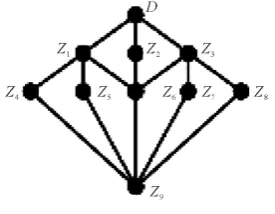
An X-semilattice that satisfies conditions (1) is shown inFigure 1.
[image:3.595.245.383.596.703.2]Let C D
( ) {
= P P P P P P P P P P0, ,1 2, 3, 4, 5, 6, 7, 8, 9}
be a family of sets, where P0, P1, P2, P3, P4, P5, P6, P7, P8, P9are pairwise disjoint subsets of the set X and 1 2 3 4 5 6 7 8 9
0 1 2 3 4 5 6 7 8 9
D Z Z Z Z Z Z Z Z Z P P P P P P P P P P
ϕ
=
be a map-
ping of the semilattice D onto the family sets C D
( )
. Then for the formal equalities of the semilattice D wehave a form:
0 1 2 3 4 5 6 7 8 9
1 0 2 3 4 5 6 7 8 9
2 0 1 3 4 5 6 7 8 9
3 0 1 2 4 5 6 7 8 9
4 0 2 3 5 6 7 8 9
5 0 2 3 4 6 7 8 9
6 0 4 5 7 8 9
7
, , , , , , ,
D P P P P P P P P P P Z P P P P P P P P P Z P P P P P P P P P Z P P P P P P P P P Z P P P P P P P P Z P P P P P P P P Z P P P P P P
Z
= ∪ ∪ ∪ ∪ ∪ ∪ ∪ ∪ ∪
= ∪ ∪ ∪ ∪ ∪ ∪ ∪ ∪
= ∪ ∪ ∪ ∪ ∪ ∪ ∪ ∪
= ∪ ∪ ∪ ∪ ∪ ∪ ∪ ∪
= ∪ ∪ ∪ ∪ ∪ ∪ ∪
= ∪ ∪ ∪ ∪ ∪ ∪ ∪
= ∪ ∪ ∪ ∪ ∪
0 1 2 4 5 6 8 9
8 0 1 2 4 5 6 7 9
9 0
, , .
P P P P P P P P Z P P P P P P P P Z P
= ∪ ∪ ∪ ∪ ∪ ∪ ∪
= ∪ ∪ ∪ ∪ ∪ ∪ ∪
=
(2)
Here the elements P1, P2, P3, P4, P5, P6, P7, P8 are basis sources, the elements P0, P6, P9 are sources of
com-pleteness of the semilattice D. Therefore X ≥7 and
δ
=7 (see [2]).Lemma 1. Let D∈ Σ1
(
X,10)
, Σ1(
X,10)
=s and X ≥ ≥δ 7. If X is a finite set, then( )
(
)
1
1 4 7 5 21 6 35 7 35 8 21 9 11
8
n n n n n n n
s= − × + × − × + × − × + × + .
Proof. In this case we have: m = 10, δ = 7. Notice that an X-semilattice given inFigure 1 has eight automor-phims. By Theorem 1.1 it follows that
( )
( ) (
(
)
)
(
) (
)
1 7 7
1 10
3
7 1
1 7! 7 !
1
8 1 ! 1 !
p i p n
p
p
p i
C C p i
s
i p i
+ + −
+
= =
− ⋅ ⋅ ⋅ ⋅ − ⋅
= ⋅
− ⋅ − +
∑ ∑
,where
(
!)
! !
k j
j C
k j k
=
⋅ − and that
( )
(
)
1
1 4 7 5 21 6 35 7 35 8 21 9 11
8
n n n n n n n
s= − × + × − × + × − × + × + .
Example 8. Let n=7, 8, 9, 10 Then:
( )
7 8 9 1010 , 10 , 10 , 10
X
B D = .
Lemma 2. Let D∈ Σ1
(
X,10)
. Then the following sets are all proper subsemilattices of the semilattice{
9, 8, 7, 6, 5, 4, 3, 2, 1,}
D= Z Z Z Z Z Z Z Z Z D :
1)
{ } { } { } { } { } { } { } { } { }
Z9 , , , , , , , , , Z8 Z7 Z6 Z5 Z4 Z3 Z2 Z1{ }
D (see diagram 1 of the Figure 2);
2)
{
Z Z9, 8} {
, ,Z Z9 7} {
, ,Z Z9 6} {
, ,Z Z9 5} {
, ,Z Z9 4} {
, ,Z Z9 3} {
, ,Z Z9 2} {
, ,Z Z9 1}
, ,{
Z D9 }
, ,{
Z Z8 3}
,{
Z D8,}
, ,{
Z Z7 3}
, ,{
Z D7}
, ,{
Z Z6 3} {
, ,Z Z6 2} {
, ,Z Z6 1}
, ,{
Z D6}
, ,{
Z Z5 1}
, ,{
Z D5}
, ,{
Z Z4 1}
,
{
Z D4,} {
, ,Z D3} {
, ,Z D2} { }
, ,Z D1
(see diagram 2 of the Figure 2);
3)
{
Z Z Z9, 8, 3}
, ,{
Z Z D9 8, }
, ,{
Z Z Z9 7, 3}
, ,{
Z Z D9 7,}
, ,{
Z Z Z9 6, 3} {
, ,Z Z Z9 6, 2} {
, ,Z Z Z9 6, 1}
,{
Z Z D9, 6,}
, ,{
Z Z Z9 5, 1}
, ,{
Z Z D9 5,}
, ,{
Z Z Z9 4, 1}
, ,{
Z Z D9 4,} {
, ,Z Z D9 3,} {
, ,Z Z D9 2,}
,{
Z Z D9, 1,} {
, ,Z Z D8 3,} {
, ,Z Z D7 3,} {
, ,Z Z D6 3,} {
, ,Z Z D6 2,} {
, ,Z Z D6 1,} {
, ,Z Z D5 1,} {
, ,Z Z D4 1,}
(see diagram 3 of the Figure 2);
4)
{
Z Z Z D9, 4, 1,} {
, ,Z Z Z D9 5, 1,} {
, ,Z Z Z D9 6, 1,} {
, ,Z Z Z D9 6, 2,} {
, ,Z Z Z D9 6, 3,}
,
{
Z Z Z D9, 7, 3,} {
, Z Z Z D9, 8, 3,}
(see diagram 4 of the Figure 2);
5)
{
Z Z Z Z9, 5, 4, 1} {
, ,Z Z Z Z9 6, 4, 1} {
, ,Z Z Z Z9 6, 5, 1} {
, ,Z Z Z Z9 7, 6, 3} {
, ,Z Z Z Z9 8, 6, 3} {
, ,Z Z Z Z9 8, 7, 3}
,{
Z Z Z D9, 8, 4,} {
, Z Z Z D9, 8, 5,} {
, Z Z Z D9, 7, 2,} {
, Z Z Z D9, 7, 4,} {
, Z Z Z D9, 7, 5,} {
, Z Z Z D9, 8, 1,}
,
{
Z Z Z D9, 8, 2,} {
, Z Z Z D9, 4, 2,} {
, Z Z Z D9, 4, 3,} {
, Z Z Z D9, 5, 2,} {
, Z Z Z D9, 5, 3,} {
, Z Z Z D9, 7, 1,}
,
{
Z Z Z D9, 2, 1,} {
, ,Z Z Z D9 3, 1,} {
, ,Z Z Z D9 3, 2,} {
, ,Z Z Z D6 2, 1,} {
, ,Z Z Z D6 3, 1,} {
, ,Z Z Z D6 3, 2,}
;
(see diagram 5 of the Figure 2);
6)
{
Z Z Z Z D9, 5, 4, 1, } {
, Z Z Z Z D9, 6, 4, 1,} {
, Z Z Z Z D9, 6, 5, 1, } {
, Z Z Z Z D9, 7, 6, 3,}
,{
Z Z Z Z D9, 8, 6, 3,} {
, Z Z Z Z D9, 8, 7, 3,}
(see diagram 6 of the Figure 2);
7)
{
Z Z Z Z D9, 6, 2, 1,} {
, Z Z Z Z D9, 6, 3, 1,} {
, Z Z Z Z D9, 6, 3, 2,}
(see diagram 7 of the Figure 2);
8)
{
Z Z Z Z Z D9, 8, 6, 3, 2, } {
, Z Z Z Z Z D9, 8, 6, 3, 1,} {
, Z Z Z Z Z D9, 7, 6, 3, 2,} {
, Z Z Z Z Z D9, 7, 6, 3, 1, }
,{
Z Z Z Z Z D9, 6, 5, 3, 1,} {
, Z Z Z Z Z D9, 6, 5, 2, 1,} {
, Z Z Z Z Z D9, 6, 4, 3, 1,} {
, Z Z Z Z Z D9, 6, 4, 2, 1,}
(see diagram 8 of the Figure 2);
9)
{
Z Z Z8, 7, 3} {
, ,Z Z Z8 6, 3}
, ,{
Z Z D8 6,} {
, ,Z Z D8 5,} {
, ,Z Z D8 4,} {
, ,Z Z D8 2,} {
, ,Z Z D8 1,}
, ,{
Z Z Z7 6, 3}
,
{
Z Z D7, 5,} {
, ,Z Z D7 4,} {
, ,Z Z D7 2,} {
, ,Z Z D7 1,}
, ,{
Z Z Z6 5, 1} {
, ,Z Z Z6 4, 1} {
, ,Z Z Z5 4, 1}
, ,{
Z Z D5 3,}
,
{
Z Z D5, 2,} {
, ,Z Z D4 3,} {
, ,Z Z D4 2,} {
, ,Z Z D3 2,} {
, ,Z Z D3 1,} {
, ,Z Z D2 1,}
(see diagram 9 of the Figure 2);
10)
{
Z Z Z D8, 6, 3,} {
, ,Z Z Z D8 7, 3,} {
, ,Z Z Z D7 6, 3,} {
, ,Z Z Z D5 4, 1,} {
, ,Z Z Z D6 4, 1,} {
, ,Z Z Z D6 5, 1,}
(see diagram 10 of the Figure 3);
11)
{
Z Z Z Z D6, 5, 3, 1,} {
, Z Z Z Z D6, 5, 2, 1,} {
, Z Z Z Z D6, 4, 3, 1,} {
, Z Z Z Z D6, 4, 2, 1,}
,{
Z Z Z Z D7, 6, 3, 2,} {
, Z Z Z Z D7, 6, 3, 1,} {
, Z Z Z Z D8, 6, 3, 2,} {
, Z Z Z Z D8, 6, 3, 1,}
(see diagram 11 of the Figure 2);
12)
{
Z Z Z Z6, 5, 4, 1} {
, ,Z Z Z Z8 7, 6, 3}
, ,{
Z Z Z D8 2, 1,} {
, ,Z Z Z D3 2, 1,} {
, ,Z Z Z D4 3, 2,} {
, ,Z Z Z D5 3, 2,}
,
{
Z Z Z D7, 2, 1,} {
, Z Z Z D7, 4, 2,} {
, Z Z Z D7, 5, 2,} {
, Z Z Z D8, 4, 2,} {
, Z Z Z D8, 5, 2,}
(see diagram 12 of the Figure 2);
13)
{
Z Z Z D7, 5, 3,} {
, Z Z Z D4, 2, 1,} {
, Z Z Z D8, 3, 1,} {
, Z Z Z D8, 3, 2,} {
, Z Z Z D8, 4, 1,} {
, Z Z Z D4, 3, 1,}
,
{
Z Z Z D5, 2, 1,} {
, Z Z Z D5, 3, 1,} {
, Z Z Z D7, 3, 1,} {
, Z Z Z D7, 3, 2,} {
, Z Z Z D7, 4, 1,} {
, Z Z Z D7, 4, 3,}
,
{
Z Z Z D7, 5, 1,} {
, ,Z Z Z D8 4, 3,} {
, ,Z Z Z D8 5, 1,} {
, ,Z Z Z D8 5, 3,}
(see diagram 13 of the Figure 2);
{
Z Z Z Z D9, 5, 3, 2,} {
, Z Z Z Z D9, 7, 2, 1,} {
, Z Z Z Z D9, 7, 4, 2,} {
, Z Z Z Z D9, 7, 4, 3,} {
, Z Z Z Z D9, 7, 5, 2,}
,
{
Z Z Z Z D9, 8, 2, 1,} {
, Z Z Z Z D9, 8, 4, 2,} {
, Z Z Z Z D9, 8, 5, 2,}
(see diagram 14 of the Figure 2);
15)
{
Z Z Z Z D9, 4, 2, 1, } {
, Z Z Z Z D9, 4, 3, 1, } {
, Z Z Z Z D9, 5, 2, 1,} {
, Z Z Z Z D9, 5, 3, 1, } {
, Z Z Z Z D9, 7, 3, 1, }
,{
Z Z Z Z D9, 7, 3, 2,} {
, Z Z Z Z D9, 7, 4, 1,} {
, Z Z Z Z D9, 7, 5, 1,} {
, Z Z Z Z D9, 7, 5, 3,} {
, Z Z Z Z D9, 8, 3, 1,}
,
{
Z Z Z Z D9, 8, 3, 2,} {
, Z Z Z Z D9, 8, 4, 1,} {
, Z Z Z Z D9, 8, 4, 3,} {
, Z Z Z Z D9, 8, 5, 1,} {
, Z Z Z Z D9, 8, 5, 3,}
(see diagram 15 of the Figure 2);
16)
{
Z Z Z Z D5, 4, 3, 1, } {
, Z Z Z Z D5, 4, 2, 1,} {
, Z Z Z Z D7, 5, 4, 1, } {
, Z Z Z Z D8, 5, 4, 1,} {
, Z Z Z Z D8, 7, 3, 2, }
,{
Z Z Z Z D8, 7, 3, 1,} {
, Z Z Z Z D8, 7, 5, 3,} {
, Z Z Z Z D8, 7, 4, 3,}
(see diagram 16 of the Figure 2);
17)
{
Z Z Z Z D5, 3, 2, 1,} {
, Z Z Z Z D4, 3, 2, 1,} {
, Z Z Z Z D7, 4, 2, 1,} {
, Z Z Z Z D7, 3, 2, 1,} {
, Z Z Z Z D7, 5, 3, 2,}
,
{
Z Z Z Z D7, 5, 2, 1,} {
, Z Z Z Z D7, 4, 3, 2,} {
, Z Z Z Z D8, 3, 2, 1,} {
, Z Z Z Z D8, 5, 3, 2,} {
, Z Z Z Z D8, 5, 2, 1,}
,
{
Z Z Z Z D8, 4, 3, 2,} {
, Z Z Z Z D8, 4, 2, 1,}
(see diagram 17 of the Figure 2);
18)
{
Z Z Z Z D7, 4, 3, 1, } {
, Z Z Z Z D7, 5, 3, 1,} {
, Z Z Z Z D8, 5, 3, 1, } {
, Z Z Z Z D8, 4, 3, 1,}
(see diagram 18 of the Figure 2); 19)
{
Z Z Z Z D6, 5, 4, 1, } {
, Z Z Z Z D8, 7, 6, 3,}
.(see diagram 19 of the Figure 2);
20)
{
Z Z Z Z Z D8, 7, 5, 3, 2,} {
, Z Z Z Z Z D8, 7, 4, 3, 2, } {
, Z Z Z Z Z D8, 5, 4, 2, 1, } {
, Z Z Z Z Z D7, 5, 4, 2, 1,}
,{
Z Z Z Z Z D8, 7, 3, 2, 1,} {
, Z Z Z Z Z D5, 4, 3, 2, 1,}
(see diagram 20 of the Figure 2);
21)
{
Z Z Z Z Z D6, 5, 4, 2, 1,} {
, Z Z Z Z Z D8, 7, 6, 3, 2,} {
, Z Z Z Z Z D8, 7, 6, 3, 1,} {
, Z Z Z Z Z D6, 5, 4, 3, 1, }
(see diagram 21 of the Figure 2);
22)
{
Z Z Z Z Z D9, 5, 4, 2, 1,} {
, Z Z Z Z Z D9, 8, 7, 4, 3,} {
, Z Z Z Z Z D9, 8, 7, 3, 1,} {
, Z Z Z Z Z D9, 8, 5, 4, 1,}
,
{
Z Z Z Z Z D9, 7, 5, 4, 1,} {
, ,Z Z Z Z Z D9 5, 4, 3, 1,} {
, ,Z Z Z Z Z D9 8, 7, 3, 2,} {
, ,Z Z Z Z Z D9 8, 7, 5, 3,}
(see diagram 22 of the Figure 2);
23)
{
Z Z Z Z Z D9, 8, 7, 6, 3,} {
, Z Z Z Z Z D9, 6, 5, 4, 1,}
(see diagram 23 of the Figure 2);
24)
{
Z Z Z Z Z D9, 8, 5, 3, 2,} {
, Z Z Z Z Z D9, 8, 5, 2, 1,} {
, Z Z Z Z Z D9, 8, 4, 3, 2,} {
, Z Z Z Z Z D9, 8, 4, 2, 1,}
,
{
Z Z Z Z Z D9, 8, 3, 2, 1,} {
, Z Z Z Z Z D9, 7, 5, 3, 2,} {
, Z Z Z Z Z D9, 7, 5, 2, 1,} {
, Z Z Z Z Z D9, 7, 4, 3, 2,}
,
{
Z Z Z Z Z D9, 7, 4, 2, 1,} {
, Z Z Z Z Z D9, 7, 3, 2, 1,} {
, Z Z Z Z Z D9, 5, 3, 2, 1,} {
, Z Z Z Z Z D9, 4, 3, 2, 1,}
(see diagram 24 of the Figure 2);
25)
{
Z Z Z Z Z D9, 8, 5, 3, 1, } {
, Z Z Z Z Z D9, 8, 4, 3, 1,} {
, Z Z Z Z Z D9, 7, 5, 3, 1, } {
, Z Z Z Z Z D9, 7, 4, 3, 1, }
(see diagram 25 of the Figure 2); 26)
{
Z Z Z Z Z D9, 6, 3, 2, 1,}
27)
{
Z Z Z Z Z D8, 7, 5, 3, 1,} {
, Z Z Z Z Z D8, 7, 4, 3, 1, } {
, Z Z Z Z Z D8, 5, 4, 3, 1,} {
, Z Z Z Z Z D7, 5, 4, 3, 1,}
(see diagram 27 of the Figure 2);
28)
{
Z Z Z Z Z D8, 6, 5, 3, 1,} {
, Z Z Z Z Z D8, 6, 4, 3, 1,} {
, Z Z Z Z Z D8, 5, 3, 2, 1,} {
, Z Z Z Z Z D7, 6, 5, 3, 1,}
,
{
Z Z Z Z Z D7, 6, 4, 3, 1,}
(see diagram 28 of the Figure 2);
29)
{
Z Z Z Z Z D8, 6, 3, 2, 1, } {
, Z Z Z Z Z D7, 6, 3, 2, 1, } {
, Z Z Z Z Z D6, 5, 3, 2, 1, } {
, Z Z Z Z Z D6, 4, 3, 2, 1,}
(see diagram 29 of the Figure 2);
30)
{
Z Z Z Z Z D8, 4, 3, 2, 1,} {
, Z Z Z Z Z D7, 5, 3, 2, 1,} {
, Z Z Z Z Z D7, 4, 3, 2, 1,}
(see diagram 30 of the Figure 2); 31)
{
Z Z Z Z Z Z D8, 7, 5, 4, 3, 1,}
(see diagram 31 of the Figure 2);
32)
{
Z Z Z Z Z Z D6, 5, 4, 3, 2, 1,} {
, Z Z Z Z Z Z D8, 7, 6, 3, 2, 1,}
(see diagram 32 of the Figure 2);
33)
{
Z Z Z Z Z Z D7, 5, 4, 3, 2, 1, } {
, Z Z Z Z Z Z D8, 5, 4, 3, 2, 1,} {
, Z Z Z Z Z Z D8, 7, 4, 3, 2, 1,}
,{
Z Z Z Z Z Z D8, 7, 5, 3, 2, 1,}
(see diagram 33 of the Figure 2);
34)
{
Z Z Z Z Z Z D7, 6, 5, 4, 3, 1,} {
, Z Z Z Z Z Z D8, 6, 5, 4, 3, 1,} {
, Z Z Z Z Z Z D8, 7, 6, 4, 3, 1,}
,
{
Z Z Z Z Z Z D8, 7, 6, 5, 3, 1,}
(see diagram 34 of the Figure 2);
35)
{
Z Z Z Z Z Z D9, 6, 4, 3, 2, 1,} {
, Z Z Z Z Z Z D9, 6, 5, 3, 2, 1,} {
, Z Z Z Z Z Z D9, 7, 6, 3, 2, 1,}
,
{
Z Z Z Z Z Z D9, 8, 6, 3, 2, 1,} {
, Z Z Z Z Z Z D9, 8, 6, 3, 2, 1,}
(see diagram 35 of the Figure 2);
36)
{
Z Z Z Z Z Z D9, 6, 5, 4, 3, 1,} {
, Z Z Z Z Z Z D9, 8, 7, 6, 3, 1,} {
, Z Z Z Z Z Z D9, 8, 7, 6, 3, 1,}
(see diagram 36 of the Figure 2);
37)
{
Z Z Z Z Z Z D9, 7, 4, 3, 2, 1,} {
, Z Z Z Z Z Z D9, 7, 5, 3, 2, 1,} {
, Z Z Z Z Z Z D9, 8, 4, 3, 2, 1,}
,
{
Z Z Z Z Z Z D9, 8, 5, 3, 2, 1,}
(see diagram 37 of the Figure 2);
38)
{
Z Z Z Z Z Z D9, 7, 5, 4, 3, 1,} {
, Z Z Z Z Z Z D9, 8, 5, 4, 3, 1,} {
, Z Z Z Z Z Z D9, 8, 7, 4, 3, 1,}
(see diagram 38 of the Figure 2); 39)
{
Z Z Z Z Z Z D9, 7, 6, 5, 3, 1,}
(see diagram 39 of the Figure 2);
40)
{
Z Z Z Z Z Z D9, 7, 5, 4, 2, 1,} {
, Z Z Z Z Z Z D9, 8, 5, 4, 2, 1,} {
, Z Z Z Z Z Z D9, 8, 7, 4, 3, 2,}
,
{
Z Z Z Z Z Z D9, 8, 7, 5, 3, 2,} {
, Z Z Z Z Z Z D9, 5, 4, 3, 2, 1,}
(see diagram 40 of the Figure 2);
41)
{
Z Z Z Z Z Z D9, 6, 5, 4, 2, 1,} {
, Z Z Z Z Z Z D9, 8, 7, 6, 3, 2,}
42)
{
Z Z Z Z Z Z Z D7, 6, 5, 4, 3, 2, 1, }
(see diagram 42 of the Figure 2);
43)
{
Z Z Z Z Z Z Z D8, 6, 5, 4, 3, 2, 1,} {
, Z Z Z Z Z Z Z D8, 7, 6, 4, 3, 2, 1,} {
, Z Z Z Z Z Z Z D8, 7, 6, 5, 3, 2, 1,}
(see diagram 43 of the Figure 2); 44)
{
Z Z Z Z Z Z Z D8, 7, 5, 4, 3, 2, 1,}
(see diagram 44 of the Figure 2); 45)
{
Z Z Z Z Z Z Z D9, 8, 7, 5, 4, 3, 1,}
(see diagram 45 of the Figure 2);
46)
{
Z Z Z Z Z Z Z D9, 6, 5, 4, 3, 2, 1, } {
, Z Z Z Z Z Z Z D9, 8, 7, 6, 3, 2, 1, }
(see diagram 46 of the Figure 2);
47)
{
Z Z Z Z Z Z Z D9, 7, 5, 4, 3, 2, 1, } {
, Z Z Z Z Z Z Z D9, 8, 7, 5, 3, 2, 1, } {
, Z Z Z Z Z Z Z D9, 7, 5, 4, 3, 2, 1,}
,{
Z Z Z Z Z Z Z D9, 8, 7, 4, 3, 2, 1,}
(see diagram 47 of the Figure 2);
48)
{
Z Z Z Z Z Z Z D9, 7, 6, 5, 4, 3, 1,} {
, Z Z Z Z Z Z Z D9, 8, 6, 5, 4, 3, 1, } {
, Z Z Z Z Z Z Z D9, 8, 7, 6, 4, 3, 1,}
,{
Z Z Z Z Z Z Z D9, 8, 7, 6, 5, 3, 1,}
[image:8.595.161.470.369.713.2](see diagram 48 of the Figure 2);
49)
{
Z Z Z Z Z Z Z Z D8, 7, 6, 5, 4, 3, 2, 1, }
(see diagram 49 of the Figure 2);50)
{
Z Z Z Z Z Z Z Z D9, 7, 6, 5, 4, 3, 2, 1,} {
, Z Z Z Z Z Z Z Z D9, 8, 6, 5, 4, 3, 2, 1, } {
, Z Z Z Z Z Z Z Z D9, 8, 7, 6, 4, 3, 2, 1, }
,{
Z Z Z Z Z Z Z Z D9, 8, 7, 6, 5, 3, 2, 1,}
(see diagram 50 of the Figure 2); 51)
{
Z Z Z Z Z Z Z Z D9, 8, 7, 5, 4, 3, 2, 1, }
(see diagram 51 of the Figure 2); 52)
{
Z Z Z Z Z Z Z Z D9, 8, 7, 6, 5, 4, 3, 1, }
(see diagram 52 of the Figure 2);Diagrams of subsemilattices of the semilattice D.
Lemma 3. Let D∈ Σ1
(
X,10)
. Then the following sets are all XI-subsemi-lattices of the given semilattice D: 1){ } { } { } { } { } { } { } { } { }
Z9 , , , , , , , , , Z8 Z7 Z6 Z5 Z4 Z3 Z2 Z1{ }
D(see diagram 1 of the Figure 2);
2)
{
Z D9,}
, ,{
Z Z9 8} {
, ,Z Z9 7} {
, ,Z Z9 6} {
, ,Z Z9 5} {
, ,Z Z9 4} {
, ,Z Z9 3} {
, ,Z Z9 2} {
, ,Z Z9 1} {
, ,Z Z8 3}
,{
Z D8,}
, ,{
Z Z7 3}
, ,{
Z D7}
, ,{
Z Z6 3} {
, ,Z Z6 2} {
, ,Z Z6 1}
, ,{
Z D6}
, ,{
Z Z5 1}
, ,{
Z D5}
, ,{
Z Z4 1}
,
{
Z D4,} {
, ,Z D3} {
, ,Z D2} { }
, ,Z D1
(see diagram 2 of the Figure 2);
3)
{
Z Z D9, 8,} {
, Z Z D9, 7, } {
, Z Z D9, 6,} {
, Z Z D9, 5, } {
, Z Z D9, 4,} {
, Z Z D9, 3,} {
, Z Z D9, 2,} {
, Z Z D9, 1, }
,{
Z Z Z9, 8, 3} {
, ,Z Z Z9 7, 3} {
, ,Z Z Z9 6, 3} {
, ,Z Z Z9 6, 2} {
, ,Z Z Z9 6, 1} {
, ,Z Z Z9 5, 1} {
, ,Z Z Z9 4, 1}
,{
Z Z D8, 3,} {
, ,Z Z D7 3,} {
, ,Z Z D6 3,} {
, ,Z Z D6 2,} {
, ,Z Z D6 1,} {
, ,Z Z D5 1,} {
, ,Z Z D4 1,}
(see diagram 3 of the Figure 2);
4)
{
Z Z Z D9, 4, 1,} {
, Z Z Z D9, 5, 1, } {
, Z Z Z D9, 6, 1,} {
, Z Z Z D9, 6, 2,} {
, Z Z Z D9, 6, 3, }
,{
Z Z Z D9, 7, 3,} {
, Z Z Z D9, 8, 3,}
(see diagram 4 of the Figure 2);
5)
{
Z Z Z Z9, 5, 4, 1} {
, ,Z Z Z Z9 6, 4, 1} {
, ,Z Z Z Z9 6, 5, 1} {
, ,Z Z Z Z9 7, 6, 3} {
, ,Z Z Z Z9 8, 6, 3}
,{
Z Z Z Z9, 8, 7, 3}
, ,{
Z Z Z D9 8, 4,} {
, ,Z Z Z D9 8, 5,} {
, ,Z Z Z D9 7, 2,} {
, ,Z Z Z D9 7, 4,}
,
{
Z Z Z D9, 7, 5,} {
, Z Z Z D9, 8, 1,} {
, Z Z Z D9, 8, 2,} {
, Z Z Z D9, 4, 2,} {
, Z Z Z D9, 4, 3,}
,
{
Z Z Z D9, 5, 2,} {
, Z Z Z D9, 5, 3,} {
, Z Z Z D9, 7, 1,} {
, Z Z Z D9, 2, 1,} {
, Z Z Z D9, 3, 1,}
,
{
Z Z Z D9, 3, 2,} {
, ,Z Z Z D6 2, 1,} {
, ,Z Z Z D6 3, 1,} {
, ,Z Z Z D6 3, 2,}
(see diagram 5 of the Figure 2);
6)
{
Z Z Z Z D9, 5, 4, 1, } {
, Z Z Z Z D9, 6, 4, 1,} {
, Z Z Z Z D9, 6, 5, 1, } {
, Z Z Z Z D9, 7, 6, 3,}
,{
Z Z Z Z D9, 8, 6, 3,} {
, Z Z Z Z D9, 8, 7, 3,}
(see diagram 6 of the Figure 2);
7)
{
Z Z Z Z D9, 6, 2, 1,} {
, Z Z Z Z D9, 6, 3, 1,} {
, Z Z Z Z D9, 6, 3, 2,}
8)
{
Z Z Z Z Z D9, 8, 6, 3, 2, } {
, Z Z Z Z Z D9, 8, 6, 3, 1,} {
, Z Z Z Z Z D9, 7, 6, 3, 2,} {
, Z Z Z Z Z D9, 7, 6, 3, 1, }
,{
Z Z Z Z Z D9, 6, 5, 3, 1,} {
, Z Z Z Z Z D9, 6, 5, 2, 1,} {
, Z Z Z Z Z D9, 6, 4, 3, 1,} {
, Z Z Z Z Z D9, 6, 4, 2, 1,}
(see diagram 8 of the Figure 2);
Proof.It is well know (see [1]), that the semilattices 1 to 8, which are given by lemma 2 are always XI-semi- lattices. The semilattices 9 and 10 which are given by Lemma 2
{
} {
}
{
} {
} {
}
{
} {
}
{
}
{
} {
}
{
} {
}
{
} {
} {
}
{
} {
} {
} {
} {
}
8 7 3 8 6 3 8 6 8 5 8 4
8 2 8 1 7 6 3 7 5 7 4
7 2 7 1 6 5 1 6 4 1 5 4 1
5 3 5 2 4 3 4 2 3 2
3
, , , , , , , , , , , , , , ,
, , , , , , , , , , , , , , ,
, , , , , , , , , , , , , , ,
, , , , , , , , , , , , , , ,
,
Z Z Z Z Z Z Z Z D Z Z D Z Z D
Z Z D Z Z D Z Z Z Z Z D Z Z D
Z Z D Z Z D Z Z Z Z Z Z Z Z Z
Z Z D Z Z D Z Z D Z Z D Z Z D
Z Z
{
1,D} {
, ,Z Z D2 1,}
.
(see diagram 9 of theFigure 2);
{
Z Z Z D8, 6, 3,} {
, ,Z Z Z D8 7, 3,} {
, ,Z Z Z D7 6, 3,} {
, ,Z Z Z D5 4, 1,} {
, ,Z Z Z D6 4, 1,} {
, ,Z Z Z D6 5, 1,}
(see diagram 10 of theFigure 2);
are XI-semilattices iff the intersection of minimal elements of the given semilattices is empty set. From the
for-mal equalities (1) of the given semilattice D we have
(
) (
)
8 7 0 1 2 4 5 6 7 9 0 1 2 4 5 6 8 9
Z ∩Z = P ∪ ∪ ∪ ∪ ∪ ∪ ∪P P P P P P P ∪ P ∪ ∪ ∪ ∪ ∪ ∪ ∪P P P P P P P ≠ ∅
(
) (
)
8 6 0 1 2 4 5 6 7 9 0 4 5 7 8 9
Z ∩Z = P ∪ ∪ ∪ ∪ ∪ ∪ ∪P P P P P P P ∪ P ∪ ∪ ∪ ∪ ∪P P P P P ≠ ∅
(
) (
)
8 5 0 1 2 4 5 6 7 9 0 2 3 4 6 7 8 9
Z ∩Z = P ∪ ∪ ∪ ∪ ∪ ∪ ∪P P P P P P P ∪ P ∪ ∪ ∪ ∪ ∪ ∪ ∪P P P P P P P ≠ ∅
(
) (
)
8 4 0 1 2 4 5 6 7 9 0 2 3 5 6 7 8 9
Z ∩Z = P ∪ ∪ ∪ ∪ ∪ ∪ ∪P P P P P P P ∪ P ∪ ∪ ∪ ∪ ∪ ∪ ∪P P P P P P P ≠ ∅
(
) (
)
8 2 0 1 2 4 5 6 7 9 0 1 3 4 5 6 7 8 9
Z ∩Z = P ∪ ∪ ∪ ∪ ∪ ∪ ∪P P P P P P P ∪ P ∪ ∪ ∪ ∪ ∪ ∪ ∪ ∪P P P P P P P P ≠ ∅
(
) (
)
8 1 0 1 2 4 5 6 7 9 0 2 3 4 5 6 7 8 9
Z ∩Z = P ∪ ∪ ∪ ∪ ∪ ∪ ∪P P P P P P P ∪ P ∪ ∪ ∪ ∪ ∪ ∪ ∪ ∪P P P P P P P P ≠ ∅
(
) (
)
7 6 0 1 2 4 5 6 8 9 0 4 5 7 8 9
Z ∩Z = P ∪ ∪ ∪ ∪ ∪ ∪ ∪P P P P P P P ∪ P ∪ ∪ ∪ ∪ ∪P P P P P ≠ ∅
(
) (
)
7 5 0 1 2 4 5 6 8 9 0 2 3 4 6 7 8 9
Z ∩Z = P ∪ ∪ ∪ ∪ ∪ ∪ ∪P P P P P P P ∪ P ∪ ∪ ∪ ∪ ∪ ∪ ∪P P P P P P P ≠ ∅
(
) (
)
7 4 0 1 2 4 5 6 8 9 0 2 3 5 6 7 8 9
Z ∩Z = P ∪ ∪ ∪ ∪ ∪ ∪ ∪P P P P P P P ∪ P ∪ ∪ ∪ ∪ ∪ ∪ ∪P P P P P P P ≠ ∅
(
) (
)
7 2 0 1 2 4 5 6 8 9 0 1 3 4 5 6 7 8 9
Z ∩Z = P ∪ ∪ ∪ ∪ ∪ ∪ ∪P P P P P P P ∪ P ∪ ∪ ∪ ∪ ∪ ∪ ∪ ∪P P P P P P P P ≠ ∅
(
) (
)
7 1 0 1 2 4 5 6 8 9 0 2 3 4 5 6 7 8 9
Z ∩Z = P ∪ ∪ ∪ ∪ ∪ ∪ ∪P P P P P P P ∪ P ∪ ∪ ∪ ∪ ∪ ∪ ∪ ∪P P P P P P P P ≠ ∅
(
) (
)
6 5 0 4 5 7 8 9 0 2 3 4 6 7 8 9
Z ∩Z = P ∪ ∪ ∪ ∪ ∪P P P P P ∪ P ∪ ∪ ∪ ∪ ∪ ∪ ∪P P P P P P P ≠ ∅
(
) (
)
6 4 0 4 5 7 8 9 0 2 3 5 6 7 8 9
Z ∩Z = P ∪ ∪ ∪ ∪ ∪P P P P P ∪ P ∪ ∪ ∪ ∪ ∪ ∪ ∪P P P P P P P ≠ ∅
(
) (
)
5 4 0 2 3 4 6 7 8 9 0 2 3 5 6 7 8 9
Z ∩Z = P ∪ ∪ ∪ ∪ ∪ ∪ ∪P P P P P P P ∪ P ∪ ∪ ∪ ∪ ∪ ∪ ∪P P P P P P P ≠ ∅
(
) (
)
5 3 0 2 3 4 6 7 8 9 0 1 2 4 5 6 7 8 9
Z ∩Z = P ∪ ∪ ∪ ∪ ∪ ∪ ∪P P P P P P P ∪ P ∪ ∪ ∪ ∪ ∪ ∪ ∪ ∪P P P P P P P P ≠ ∅
(
) (
)
5 2 0 2 3 4 6 7 8 9 0 1 3 4 5 6 7 8 9
Z ∩Z = P ∪ ∪ ∪ ∪ ∪ ∪ ∪P P P P P P P ∪ P ∪ ∪ ∪ ∪ ∪ ∪ ∪ ∪P P P P P P P P ≠ ∅
(
) (
)
4 3 0 2 3 5 6 7 8 9 0 1 2 4 5 6 7 8 9
(
) (
)
4 2 0 2 3 5 6 7 8 9 0 1 3 4 5 6 7 8 9
Z ∩Z = P ∪ ∪ ∪ ∪ ∪ ∪ ∪P P P P P P P ∪ P ∪ ∪ ∪ ∪ ∪ ∪ ∪ ∪P P P P P P P P ≠ ∅
(
) (
)
3 2 0 1 2 4 5 6 7 8 9 0 1 3 4 5 6 7 8 9
Z ∩Z = P ∪ ∪ ∪ ∪ ∪ ∪ ∪ ∪P P P P P P P P ∪ P ∪ ∪ ∪ ∪ ∪ ∪ ∪ ∪P P P P P P P P ≠ ∅
(
) (
)
3 1 0 1 2 4 5 6 7 8 9 0 2 3 4 5 6 7 8 9
Z ∩Z = P ∪ ∪ ∪ ∪ ∪ ∪ ∪ ∪P P P P P P P P ∪ P ∪ ∪ ∪ ∪ ∪ ∪ ∪ ∪P P P P P P P P ≠ ∅
(
) (
)
2 1 0 1 3 4 5 6 7 8 9 0 2 3 4 5 6 7 8 9
Z ∩Z = P ∪ ∪ ∪ ∪ ∪ ∪ ∪ ∪P P P P P P P P ∪ P ∪ ∪ ∪ ∪ ∪ ∪ ∪ ∪P P P P P P P P ≠ ∅
From the equalities given above it follows that the semilattices 9 and 10 are not XI-semilattices.
The semilattices 11
{
} {
} {
} {
}
{
} {
} {
} {
}
6 5 3 1 6 5 2 1 6 4 3 1 6 4 2 1
7 6 3 2 7 6 3 1 8 6 3 2 8 6 3 1
, , , , , , , , , , , , , , , , , , , ,
, , , , , , , , , , , , , , , , , , , .
Z Z Z Z D Z Z Z Z D Z Z Z Z D Z Z Z Z D
Z Z Z Z D Z Z Z Z D Z Z Z Z D Z Z Z Z D
(see diagram 1-8 of theFigure 3);
are not XI-semilattice since we have the following inequalities
5 3 5 2 4 3 4 2
7 2 7 1 8 2 8 1
, , , , , , , .
Z Z Z Z Z Z Z Z
Z Z Z Z Z Z Z Z
∩ ≠ ∅ ∩ ≠ ∅ ∩ ≠ ∅ ∩ ≠ ∅
∩ ≠ ∅ ∩ ≠ ∅ ∩ ≠ ∅ ∩ ≠ ∅
The semilattices 12 to 52 are never XI-semilattices. We prove that the semilattice, diagram 52 of theFigure 2,
is not an XI-semilattice (seeFigure 4). Indeed, let Q=
{
T T T T T T T T T0, ,1 2, 3, 4, 5, 6, 7, 8}
and( ) {
0, 1, 2, 3, 4, 5, 6, 7, 8}
C Q = P P P P P P P P P′ ′ ′ ′ ′ ′ ′ ′ ′
be a family of sets, where P P P P P P P P P0′, , , , , , , , 1′ ′2 3′ ′4 5′ 6′ 7′ 8′ are pairwise disjoint subsets of the set X. Let
0 1 2 3 4 5 6 7 8
0 1 2 3 4 5 6 7 8
T T T T T T T T T
P P P P P P P P P
ϕ= ′ ′ ′ ′ ′ ′ ′ ′ ′
be a mapping of the semilattice Q onto the family of sets C Q
( )
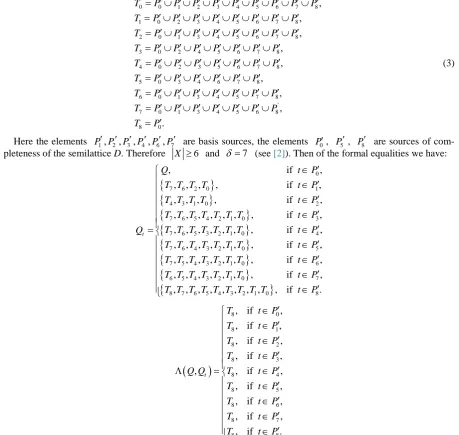
. Then for the formal equalities of the [image:11.595.214.412.455.571.2]semilat-tice Q we have a form:
Figure 3. Diagram of all subsemilattices which are isomorphic to 11 in Figure 2.
[image:11.595.251.377.610.703.2]0 0 1 2 3 4 5 6 7 8
1 0 2 3 4 5 6 7 8
2 0 1 3 4 5 6 7 8
3 0 2 4 5 6 7 8
4 0 2 3 5 6 7 8
5 0 3 4 6 7 8
6 , , , , , ,
T P P P P P P P P P T P P P P P P P P T P P P P P P P P T P P P P P P P T P P P P P P P T P P P P P P T ′ ′ ′ ′ ′ ′ ′ ′ ′ = ∪ ∪ ∪ ∪ ∪ ∪ ∪ ∪ ′ ′ ′ ′ ′ ′ ′ ′ = ∪ ∪ ∪ ∪ ∪ ∪ ∪ ′ ′ ′ ′ ′ ′ ′ ′ = ∪ ∪ ∪ ∪ ∪ ∪ ∪ ′ ′ ′ ′ ′ ′ ′ = ∪ ∪ ∪ ∪ ∪ ∪ ′ ′ ′ ′ ′ ′ ′ = ∪ ∪ ∪ ∪ ∪ ∪ ′ ′ ′ ′ ′ ′ = ∪ ∪ ∪ ∪ ∪
0 1 3 4 5 7 8
'
7 0 1 3 4 5 6 8
8 0
, , .
P P P P P P P T P P P P P P P T P ′ ′ ′ ′ ′ ′ ′ = ∪ ∪ ∪ ∪ ∪ ∪ ′ ′ ′ ′ ′ ′ = ∪ ∪ ∪ ∪ ∪ ∪ ′ = (3)
Here the elements P P P P P P1′, 2′ ′, 3, 4′, 6′, 7′ are basis sources, the elements P0′, P5′, P8′ are sources of
com-pleteness of the semilattice D. Therefore X ≥6 and
δ
=7 (see [2]). Then of the formal equalities we have:{
}
{
}
{
}
{
}
{
}
{
}
07 6 2 0 1
4 3 1 0 2
7 6 5 4 2 1 0 3
7 6 5 3 2 1 0 4
7 6 4 3 2 1 0 5
7 5 4 3 2 1 0 6
6 5 4 3 2 1
, if ,
, , , , if ,
, , , , if ,
, , , , , , , if ,
, , , , , , , if ,
, , , , , , , if ,
, , , , , , , if ,
, , , , ,
t
Q t P
T T T T t P
T T T T t P
T T T T T T T t P
T T T T T T T t P
Q
T T T T T T T t P
T T T T T T T t P
T T T T T T
′ ∈ ′ ∈ ′ ∈ ′ ∈ ′ ∈ = ′ ∈ ′ ∈
{
}
{
8 7 6 5 4 3 02 1 0}
78, , if ,
, , , , , , , , , if .
T t P
T T T T T T T T T t P
∈ ′ ∈ ′
(
)
8 0 8 1 8 2 8 3 8 4 8 5 8 6 8 7 8 8, if ,
, if ,
, if ,
, if ,
, , if ,
, if ,
, if ,
, if ,
, if .
t
T t P
T t P
T t P
T t P
Q Q T t P
T t P
T t P
T t P
T t P
′ ∈ ∈ ′ ∈ ′ ∈ ′ ′
Λ = ∈
∈ ′ ′ ∈ ∈ ′ ∈ ′
We have, that Q∧ =
{ }
T8 and Λ(
Q Q, t)
∈Q for any t∈Q. But elements T7, T6, T5, T4, T3, T2, T1, T0 are notunion of some elements of the set Q∧. Therefore from the Definition 1 it follows that Q is not an XI-semilattice
of unions. Statements 12 to 51 can be proved analogously. We denoted the following semitattices by symbols:
a) Q1=
{ }
T , where T∈D (see diagram 1 of theFigure 5);b) Q2=
{
T T, ′}
, where T T, ′∈D and T⊂T′ (see diagram 2 of theFigure 5);c) Q3=
{
T T T, ′ ′′,}
, where T T, , ′ T′′∈D and T⊂T′⊂T′′ (see diagram 3 of theFigure 5); d) Q4={
Z T T D9, , ′, }
, where T T, ′∈D and Z9⊂ ⊂T T′⊂D (see diagram 4 of theFigure 5);e) Q5=
{
T T T T, ′ ′′ ′, , ∪T′′}
where T T, , ′ T′′∈D, T ⊂T′, T⊂T′′, T′\T′′ ≠ ∅, T′′\T′ ≠ ∅, (see dia-gram 5 of theFigure 5);
f) Q6 =
{
Z T T T9, , ′, ∪T D′, }
, where T T, ′∈D, Z9 ⊂T, Z9⊂T′, T T\ ′ ≠ ∅, T′\T ≠ ∅ (see diagram6 of theFigure 5);
g) Q7=
{
Z Z T T D9, 6, , ′, }
, where , T T′∈D, Z6 ⊂T , Z6⊂T′, T T\ ′ ≠ ∅, T′\T ≠ ∅, T∪T′=D [image:12.595.83.543.89.524.2] [image:12.595.220.423.255.529.2]Figure 5. Diagram of all XI-subsemilattices of D.
h) Q8=
{
Z T T T9, , ′, ∪T Z D′, ,}
, where Z9⊂T′⊂Z, T T\ ′ ≠ ∅, T′\T ≠ ∅,
(
T∪T′)
\Z≠ ∅,(
)
\
Z T∪T′ ≠ ∅ (see diagram 8 of theFigure 5);
Note that the semilattices inFigure 5 are all XI-semilattices (see [1] and Lemma 1.2.3).
Definition 9. Let us assume that by the symbol Σ′XI
(
X D,)
denote a set of all XI-subsemilatices of X-semila-tices of unions D that every element of this set contains an empty set if ∅ ∈D or denotes a set of all XI-sub- semilatices of D.
Further, let D D′, ,′′∈ Σ′XI
(
X D)
and ϑXI ⊆ Σ′XI(
X D,)
× Σ′XI(
X D,)
. It is assumed that D′ϑXID′′ iff thereexists some complete isomorphism
ϕ
between the semilatices D′ and D′′. One can easily verify that thebinary relation ϑXI is an equivalence relation on the set Σ′XI
(
X D,)
.By the symbol QiϑXI denote the ϑXI-equivalence class of the set Σ′XI
(
X D,)
, where every element is iso-morphic to the X-semilattice Qi
(
i=1, 2,,8)
.Let D' be an XI-subsemilattice of the semilattice D. By I D
( )
′ we denoted the set of all right units of these-migroup BX
( )
D′ , and( )
( )
i XI
i D Q
I Q I D
ϑ ∗
′∈
′
=
∑
where i=1, 2,,8.
Lemma 4. If X is a finite set, then the following equalities hold a) I Q
( )
1 =1b) I Q
( )
2 =(
2T T′\ − ⋅1 2)
X T\ ′c) I Q
( )
3 =(
2T T′\ − ⋅1) (
3T′′ ′\T −2T′′ ′\T)
⋅3X T\ ′′d)
( )
(
\9) (
\ \)
(
\ \)
\4 2 1 3 2 4 3 4
D T D T X D
T Z T T T T
I Q = − ⋅ ′ − ′ ⋅ ′ − ′ ⋅
e) I Q
( )
5 =(
2T T′ ′′\ − ⋅1) (
2T′′ ′\T − ⋅1 4)
X\(T′∪T′′)f) I Q
( )
6 =(
2T T′ ′′\ − ⋅1) (
2T T′′ ′\ − ⋅1)
(
5D T\( ∪T′′)−4D T\( ∪T′′))
⋅5X D\
g)
( )
(
6\ 9)
( )\ 6(
\ \) (
\ \)
\7 2 1 2 3 2 3 2 5
T T Z X D
Z Z T T T T T T T T
I Q = − ⋅ ∩ ′ ⋅ ′ − ′ ⋅ ′ − ′ ⋅
h) I Q
( )
8 =(
2T Z\ − ⋅1) (
2T T′\ − ⋅1)
(
3Z T\( ∪T′) −2Z T\( ∪T′))
⋅6X D\
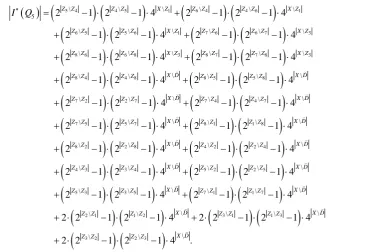
Proof. This lemma immediately follows from Theorem 13.1.2, 13.3.2, and 13.7.2 of the [1].
Theorem 10. Let D∈Σ1
(
X,10)
and α ∈BX( )
D . Binary relationα
is an idempotent relation of the semmigroup BX( )
D iff binary relationα
satisfies only one conditions of the following conditions:a)
α
= ×X T, where T∈D;b)
α
=(
YTα×T) (
∪ YTα′×T′)
, where T T, ′∈D, T ⊂T′, YT , YT{ }
α α
′ ∉ ∅ , and satisfies the conditions: YT
α ⊇
T, YTα′∩T′≠ ∅;
c)
(
YT T) (
YT T) (
YT T)
α α α
α
= × ∪ ′× ′ ∪ ′′× ′′ , where T T, , ′ T′′∈D, T ⊂T′⊂T′′, YT , , YT YT{ }
α α α
′ ′′∉ ∅ , and sa-
tisfies the conditions: YTα ⊇T , YTα∪YTα′ ⊇T′, YT T
α
′ ∩ ′≠ ∅, YT T
α