Stability of a Class of Neutral Time-Delay Systems with a
Robust Control
Saloua Bel Hadj
Ali
Unité de Recherche MACS Ecole Nationale d’Ingénieurs de Gabès Rue Omar Ibn Elkhatab,
6029, Tunisie.
Aicha Elhsoumi
Unité de Recherche MACS Ecole Nationale d’Ingénieurs de Gabès Rue Omar Ibn Elkhatab,
6029, Tunisie.
Rafika Elharabi
Unité de Recherche MACS Ecole Nationale d’Ingénieurs de Gabès Rue Omar Ibn Elkhatab,
6029, Tunisie.
Mohamed Naceur
Abdelkrim
Unité de Recherche MACS Ecole Nationale d’Ingénieurs de Gabès Rue Omar Ibn Elkhatab,
6029, Tunisie.
ABSTRACT
This paper deal with the stability problem of neutral time-delay systems. Based on the Lyapunov-Krasovskii functional theory, new theorems are proposed for a type of neutral delay systems with robust time-delay control. New delay-dependent stability conditions are developed for the system without time-delay control in first time and with time-time-delay control in second time. Linear matrix inequality approaches are used to solve the stability problem in these cases. Numerical examples illustrate that the proposed methods are effective and lead to less conservative results.
General Terms
Stability Analysis, Time-delay systems.
Keywords
Neutral time-delay systems, stability analysis, robust time- delay control, linear matrix inequality (LMI).
1.
INTRODUCTION
Neutral systems represent an interesting class of time-delay systems where dynamical systems not only depend on present and past states but also involve derivatives with delays. The presence of time-delay in state derivatives makes system behavior more similar to real comportment. Many systems can be modeled by these systems, such as population ecology, distributed networks with loss-less transmission lines, heat exchangers, and robots in contact with rigid environments. Recently, much attention has been given to the study of neutral delay systems’ theory. Moreover, time delays are often the main sources of instability. Hence, system stability and stabilization analysis are the essential step to treat system control problem. These subjects have been studied see e.g. References [1], [2], [3] [4].
Lyapunov stability is a general theory available for any differential equation. Over the past researches on time-delay systems, many useful approaches are applied to guarantee the stability or stabilization of systems. The application of Lyapunov-Krasovskii functional theory has first started for system without neither uncertainties nor control [2] [5], some robust stability conditions based on LMI approach are given. Then, the guaranteed cost control problem for neutral time delay system with feed-back control is investigated. Some papers are interested on stability and stabilization of this type of system where a linear–quadratic cost function is considered
as a performance measure for the closed-loop system [6] [7] [8] [9] [10]. In the last years, interesting works have been concerned with uncertain neutral time-delay systems stability and stabilization analysis based on Lyapunov-Krasovskii functional theory [3] [11] [4].
In the theory of time-delay systems, there are two classes of stability conditions. The first is delay-independent conditions which guarantee that a time-delay system remains stable for all non-negative values of delay elements; see for example [5][12][13][14].
The second type is called delay-dependant conditions and involve explicitly delay elements of the system and guarantee the system stability for some restricted values of the delay elements, see for example [6] [4] [15] [16][17] .
Dependant or independent-delay stability conditions, in practical system, are usually obtained by using the analysis of mathematical model. Therefore, in this paper a LMI condition is proposed equivalent to the delay-dependent stability of neutral systems with time-delay. More precisely, one displays a family of LMIs of increasing size, each of them ensuring delay-independent stability. The key result is that, reciprocally, the strong delay-dependent stability ensures that the LMIs are solvable beyond a certain rank.
The aim contributions of this paper is to develop some stability analysis conditions, witch depend on delays, based on linear matrix inequality LMI approach for a neutral delay system without delayed robust control, in first time and with delayed control in second time. The application of Lyapunov-Krasovskii functional theory is the first step to conclude these conditions.
2.
STABILITY ANALYSIS OF
NEUTRAL DELAY SYSTEMS
2.1 Review
The stability analysis is an essential step for a system control and a diagnosis strategy. Some conditions are derived in literature to guarantying neutral time-delay system.
It’s already cited that there are two classes of stability conditions for neutral systems with time-delay. The first is a delay independent condition. Stability criteria for neutral systems with multiple time delays are presented in [5]. Using the Lyapunov second method, Park and al. establish a new delay-independent criterion for the asymptotic stability of systems. In these criteria, the derived sufficient conditions are expressed in terms of linear matrix inequalities so that the criteria are less conservative.
In [12], sufficient conditions for the existence of these observers are derived. Using the linear matrix inequality and the linear matrix equality (LME) formulation, independent of delays stability criteria are derived in [12] for proposed observers.
Wang and al. [13] consider the H∞ dynamic for linear neutral time-delay systems output feedback controller design problem. The approach here is based on Lyapunov functional due to Krasovsii. A sufficient condition is deduced in terms of linear matrix inequalities.
The second conditions are dependent on a delay size. In fact, in [6], Sun and al. introduce a new form of the Lyapunov functional that contains a triple integral term
0 0
( ) ( ) t
T t
x s Rx s dsd d
. Two integral inequalities are used to derive a new delay-dependent stability criterion without introducing any free-weighting matrices. Using this criterion, a method of designing a stabilizing state feedback controller is also presented.The paper of Xin and al. [17] deals with the delay-dependent stability criterion and the state observers design problem as well as observer-based stabilization problem for linear neutral delay systems. A delay-dependent stability criterion is developed, which is presented in terms of a feasibility positive definite solution to a linear matrix inequality.
2.2 Problem Formulation and preliminaries
In this paper, a stability condition for a type of neutral systems with delayed control will be presented.
Consider the following neutral time-delay system with a robust control:
1 1
( ) ( ) ( ) ( ) ( ) ( )
( ) ( ) ( ) ( ), ,0
h d
x t Ax t A x t h A x t d Bu t B u t
y t Cx t
x t t t
(1)
where x t( )n, um and y t( )p. 1
0, 0 and 0
h d
are respectively the state and its derivativedelay.A A, h, Ad, , B B1 and C are constant matrix.
max h d,
and ( )t n is the continuous functionof
Using the Newton-Lebuniz formula, 0
( ) ( ) ( )
h
x t h x t x t d
system (1) become as the following form: 0
1 1
( ) ( ) ( ) ( ) ( ) ( ) ( )
( ) ( ) ( ) ( ), ,0
h h d
h
x t A A x t A x t d A x t d Bu t B u t
y t Cx t
x t t t
(2)
In this paper some problem will be treated:
A technique of stability analysis will be investigated for a system with a robust non delayed control including feedback control and disturbances. In second step, a stability condition is derived for a system with a robust delayed control including feedback control and disturbances.
Two known lemmas will be used in the proof of the following theorem.
Lemma 2.1 For all ( )t C
,0 , n
, the following inequality holds:
2
2 0
22 2 ds
, ,0(3)
Lemma 2.2 For all ( )t C
,0 , n
and for the system (2), there exist10 and 20satisfy:2 2
1 (0) V( ( ), )t 2 ( )W
(4)
3.
DELAY-DEPENDENT STABILITY
CRITERIA
In this section, tTwo delay-dependent stability conditions with and without control delays are developed.
3.1
Stability of neutral delay systems
without delayed control
The following theorem shows a new condition for system (2) with robust non delayed control (B10).
Theorem 3.1:
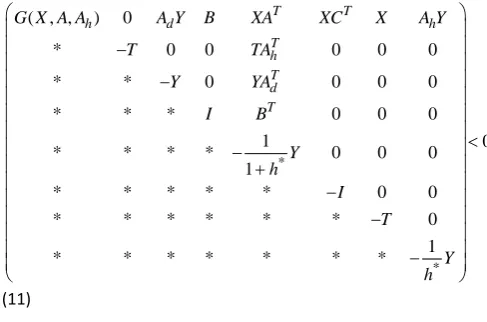
Consider a neutral system (2) with a given constanth*0and 1 0
*
* ( , , ) 0
* 0 0 0 0 0
* * 0 0 0 0
* * * 0 0 0
1 0
* * * * 0 0 0
1
* * * * * 0 0
* * * * * * 0
1
* * * * * * *
T T
h d h
T h T d T
G X A A A Y B XA XC X A Y
T TA Y YA I B Y h I T Y h (5)
where “*” and I denote respectively the transposed elements in the symmetric position and identity matrix.
( , , h) h h T
G X A A AA XX AA Proof:
Let us choose a Lyapunov function for the system (2) as:
0
( , ) ( ) ( ) ( ) ( ) ( ) ( )
( ) ( )
t t
T T T
t h t d
t T h t
V x t x s Px s x s Sx s ds x s H x s ds
x s Hx s ds d
where: P0, S0 and H0 are symmetric positive- definite matrices.
First, we’ll start to prove that:
2
2 0
22
2
ds
,
, 0
(5) Since0 ( ) (0) ( )s ds
,
,0, inequality (5) can be writen as:
2 0 2 2 0 2 2 0 0 2 0 2 2 0 2 2 02 0 2
2 0 2 1
2 0 2
2 0 2 s ds
s ds
s ds ds
s ds s ds
Second, for a system (2) with Lyapunov functional candidate, there exist10 and 20satisfy
2 2
1 (0) V( ( ), )t 2 ( )W
(6)
where
1 2 0
2 2
( ) (0) ( )
W d
The Lyapunov functional candidate is:
0 ( ( ), ) ( ) ( ) ( ) ( ) ( ) ( ) ( ) ( ) t T T t h t t T T
t d h t
V t P S d
H d H d d
2 ( ( ), ) ( ) ( ) ( ) (0)T m
V t P
P
where
m( )P the smallest eigenvalues of matrix P. Then,1m( )P 0
In second hand,
0
2 2
0 2 0 0 2
0
2 2
0 2 0 0 2
0 2 2 ( ( ), ) ( ) ( ) ( ) ( ) ( ) ( ) ( ) ( ) ( ) ( ) ( ) ( ) ( ) ( ) ( ) ( ) ( ) ( ) ( ) ( ) M M h M M d d M M M M M M
V t P S d
H d H d d
P S d
H d H d d
P S d
0 2 0 2 20 2 0 2
0 2 2 0 2 0 2 2 2
(1 ) ( ) ( )
2 ( ) 0 2 ( )
( ) 2 0 2
(1 ) ( ) ( )
2 ( ) ( ) 0
2 ( ) ( ) (1 ) ( ) ( )
0 ( )
M
M M
M
M
M M
M M M
H d
P P s ds
S s ds
H d
P S
P S H d
d
where
22 ( ) ( ) ,
max 0
2 ( ) ( ) (1 ) ( )
M M
M M M
P S
P S H
(7)
For simplicity, write ( )x t x x t, ( h)xh, (x t d)xd. Therefore,
21 2 2
2 2
2 0
2
T T T T
T T T
u v u u u v v v
u u v v u v
Let us consider2M, then u MuT v MT 1v 2u vT . Hence,
0
0 ( , ) 2
( ) ( ) ( ) ( )
2 (1 )
( ) ( ) ( )
T T T T T
h h d d
T T
h
T T T T T
h h d d
T h T
h
V x t x Px x Sx x Sx x Hx x Hx
x t Hx t x t Hx t d
x Px x Sx x Sx h x Hx x Hx
x t Hx t d
x P A A
0 0 ( )2 ( ) 2 2
(1 ) ( ) ( )
T h
T T T
h d d
h
T T T
h h d d
T h
A A P S x
x P A x t d x PA x x PBu
x Sx h x Hx x Hx
x t Hx t d
(8) 0 0 0 1 0 1
2 ( ) 2 ( )
( ) ( )
( ) ( )
T T
h h
h h
T T T
h h
h
T T T
h h
h
x P A x t d x PA x t d
x PA H A Px x t Hx t d
hx PA H A Px x t Hx t d
Substituting this inequality into (8), we obtain:
1 0 0 ( , ) ( ) ( )( ) ( ) 2 +2
(1 ) ( ) ( )
( ) ( )
T T T T
h h h h
T T T T
d d h h
h
T T T
d d
h
T T T
h h h
V x t x P A A A A P S x hx PA H A Px
x t Hx t d x PA x x PBu x Sx
h x Hx x Hx x t Hx t d
x P A A A A P S x hx PA
1 12 2 (1 )
( ) ( )
2 2 (1 )
T h
T T T T T
d d h h d d
T T T
h h h h
T T T T T
d d h h d d
H A Px
x PA x x PBu x Sx h x Hx x Hx
x P A A A A P S hPA H A P x
x PA x x PBu x Sx h x Hx x Hx
We have also,
1 2 1
2 1 2 1 2 1 2 1 1 2 1
T T T T T
h h
T T T T
d d
T T T T
h h d d h h
T T T T
h h h h d d
x H hH x x A h HAx x A h HA x
x A h HA x x A h HBu
x A h HA x x A h HBu
x A h HA x x A h HBu
x ATd dT 1h HA xd d u BT T 1h HBu So, Lyapunov functional is obtained as:
1 ( , ) ( ) ( )2 2 1
2 1 2 1
2 1 2 1
2 1
T T T
h h h h
T T T T T
d d h h
T T T T
h h d d
T T T T
h h d d
T T T
h h h
V x t x P A A A A P S hPA H A P x
x PA x x PBu x Sx x A h HAx
x A h HA x x A h HA x
x A h HBu x A h HA x
x A h HBu x
12 1 1
1
T
h h h
T T T T
d d d d d d
T T T
d d
A h HA x
x A h HBu x A h HA x
u B h HBu x Hx
Since y yT u uT 0, so,
( , ) T T T ( ) 0
V x t y yu u x h x
(9) where x xT, xTh, xdT, uTTand
(1 ) ( ) (1 )
* (1 ) (1 )
( )
* * (1 )
* * * (1 ) (1 ) ¨ (1 ) (1 ) T T d d h T T h d h h T d d T T h T d T
PA h A HA
h h A HA
h A HA
h A HA S
h
h A HA H
PB h A HB
h A HB h A HB h B HB I
1 ( ) ( ) ( ) (1 ) T T
h h h h
T T
h P A A A A P S hPA H A P
h A HA C C
Obviously, inequality (9) impliesV0
, if
( )h 0. Note that the matrix ( )h 0 is monotonic increasing with respect to 0 in the sense of positive definiteness, therefore,( )h 0
holds for 0 h* if (h*)0 holds. By Schur complement, (h*)0holds if and only if:
1 *
* ( , ) 0
* 0 0 0
* * 0 0
* * * 0 0
1
* * * * 0
1 1 * * * * * T d h T h T d T
G P S PA PB A PA
S A H A I B H h H h
(10)
*
* ( , , ) 0
* 0 0 0 0 0
* * 0 0 0 0
* * * 0 0 0
1 0
* * * * 0 0 0
1
* * * * * 0 0
* * * * * * 0
1
* * * * * * *
T T
h d h
T h T d T
G X A A A Y B XA XC X A Y
T TA
Y YA
I B
Y h
I T
Y h
(11)
where G X A A( , , h)
AAh
XX A
Ah
T3.2
Stability of neutral delay systems with
delayed control
Some neutral delay system models contain time delay in control. In this section, a stability condition is derived for system (2) with delay robust control (B10). In theorem 3.2, stability criterion is created in term of linear matrix inequality. Theorem 3.2:
Consider a neutral system (2) with given constants h*0. h ,d and 1 are supposed different. The system (2) is asymptotically stable for any 0 h*, if there exist matrices X0, T0, and Y0 satisfy the following LM
1
1
*
* ( , , ) 0
* 0 0 0 0 0 0
* * 0 0 0 0 0
* * * 0 0 0 0
* * * * 0 0 0
0 1
* * * * * 0 0 0
1
* * * * * * 0 0
* * * * * * * 0
1
* * * * * * * *
T T
h d h
T h T d T T
G X A A A Y B B XA XC X A Y
T TA
Y YA
I B
I B
Y h
I T
Y h
(12) where “*” and I denote respectively the transposed elements in the symmetric position and the identity matrix.
( , , h) h h T
G X A A AA XX AA Proof:
Consider the vector U t( ) and the matrix Bexpressed as: 1
( ) ( )
( )
u t U t
u t
and B
B B1
.
The system (2) becomes
0
( ) ( ) ( ) ( ) ( ) ( )
( ) ( ) ( ) ( ), ,0
h h d
h
x t A A x t A x t d A x t d BU t
y t Cx t
x t t t
(13)
Hence, the result follows immediately by applying Theorem 3.1 to the system (13).
4.
NUMERICAL EXAMPLE
In this section, numerical examples are presented to illustrate the effectiveness of precedent results. A first leads into system with non delay control and a second introduce the delay in the system control.
Example 1:
Consider system (1) with: -1 1
0 -4 A
,
0.15 0.05 0 0.1 h
A
,
-0.05 0.02 0.01 0 d
A
,
0 1 B
, C
1 1
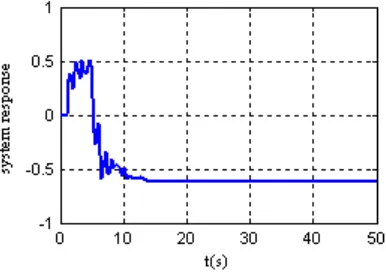
, h1 and d0.9.From Theorem 3.1 the following results can be obtained as:
0.4688 -0.0092 -0.0092 0.2675
X
,
1.7096 -0.0071 -0.0071 1.6667
T
and
1.9208 -0.0318 -0.0318 2.1572
Y
.
, T, and
[image:5.595.46.290.73.234.2]X Yare positives. Thus, the system is asymptotically stable. The following figure (Fig.1) illustrates the unit step response of system and proves the system stability.
Fig.1 step response
Example 2:
Consider a system (1) with:
1
1, h 1, d 1, 1 1 , 1 1 , 1. A A A B B C
1 1 , 0.9 and 0.5.
h d
By Theorem 3.2, the feasibility of the LMI (12) is obtained with:
0.3156, 0.2180, 0.2796.
X Y Z
, T, and
[image:5.595.332.514.464.596.2]a unit step delayed with 10.5. The figure shows that the system is asymptotically stable.
Fig.2 step response of system
5.
CONCLUSION
In this paper, the stability analysis problem for a class of neutral delay system with robust control has been considered. The Lyapunov stability theory and LMI have been used to guarantee the delay-dependent robust stability for the system. Moreover, the problem of delay in the robust control for neutral system has been investigated. Finally, a numerical example is illustrated to show the validity of the proposed methods. Based on these results, the problem of control or diagnosis can be achieved in the future for real example of neutral time-delay.
6.
REFERENCES
[1] V. Kharitonov, J. Collado, and S. Mondié , “Exponential estimates for neutral time delay systems with multiple delays”, International Journal of Robust and Nonlinear Control, vol. 16, pp. 71–84, 2006.
[2] S. A. Rodriguez, V. Kharitonov, J.-M. Dion and L. Dugard, “Robust stability of neutral systems: a Lyapunov–Krasovskii constructive approach”, International Journal of Robust and Nonlinear Control, vol. 14, pp. 1345–1358, 2004.
[3] J. D. Chen, “LMI-Based Robust H∞ Control of Uncertain Neutral Systems with State and Input Delays”, Journal of optimization theory and applications, vol. 126, no. 3, pp. 553–570, 2005.
[4] C. H. Lien, “Stability and Stabilization Criteria for a Class of Uncertain Neutral Systems with Time-Varying Delays”, Journal of optimization theory and applications, vol. 124, no. 3, pp. 637–657, 2005.
[5] J. H. Park and S. Won, “Asymptotic Stability of Neutral Systems with Multiple Delays”. Journal of Optimization Theory and Applications: Vol. 103, No. 1, pp. 183-200, 1999.
[6] J. Sun, G. P. Liu and J. Chen, “Delay-dependent stability and stabilization of neutral time-delay systems”,
International Journal of Robust and Nonlinear Control, 2008.
[7] J. H. Park, “Delay-Dependent Criterion for Guaranteed Cost Control of Neutral Delay Systems”. Journal of Optimization Theory and Applications: Vol. 124, No. 2, pp. 491–502, 2005.
[8] S. Xu, J. Lam and C. Yang, “H∞ and Positive-Real Control for Linear Neutral Delay Systems”. IEEE Transactions on Automatic Control, Vol. 46, No. 8, 2001.
[9] Wang H., Zhang Y., Dong X. and Liang J., 2008. H∞ dynamic output-feedback control for a class of linear neutral delay systems. In Proceeding 2008 Chinese Control and Decision Conference (CCDC 2008), 2008 IEEE, pp. 4117- 4121.
[10]Zhang Y., Liu M., Wang C. and Sun W., 2008. Delay-dependent H∞ control of linear neutral delay systems. In Proceeding 2008 Chinese Control and Decision Conference (CCDC 2008), pp 4680-4685, 2008.
[11]C. L. Yu and L. L.Chun, “Optimal control approach for robust control design of neutral systems”, Optimal Control Applications and Methods, pp : 87–102, 2009. [12]M. Darouach. “Reduced-order observer for linear neutral
delay systems”, IEEE Transactions on Automatic Control, 50(9), pp 1407-1413, 2005.
[13]Wang H., Zhang Y., Dong X, Liang J., 2008. H∞ dynamic output-feedback control for a class of linear neutral delay systems. In Proceeding 2008 Chinese Control and Decision Conference (CCDC 2008), 2008 IEEE, pp. 4117-4121.
[14]J. D. Chen, “LMI Approach to Robust Delay-Dependent Mixed H2/H∞ Controller of Uncertain Neutral Systems with Discrete and Distributed Time-Varying Delays”, Journal of optimization theory and applications, Vol. 131, No. 3, pp. 383–403, 2006.
[15]K. K. Fun, C. H. Lien and J. G. Hsieh, “Asymptotic Stability for a Class of Neutral Systems with Discrete and Distributed Time Delays”, Journal of Optimization Theory and Applications, Vol. 114, No. 3, pp. 705–716, 2002.
[16]Zhang Y., Liu M., Wang C., Sun W., 2008. Delay-dependent H∞ control of linear neutral delay systems. In Proceeding 2008 Chinese Control and Decision Conference (CCDC 2008), 2008 IEEE, pp. 4680-4685. [17]Xin L., Zhaochun W., YOU Z.et Jiacheng L., 2008.