IJPSR (2019), Volume 10, Issue 5 (Research Article)
Received on 30 August 2018; received in revised form, 03 November 2018; accepted, 09 November 2018; published 01 May 2019
DEVELOPMENT AND VALIDATION OF STABILITY INDICATING ASSAY METHOD FOR DETERMINATION OF LOXAPINE SUCCINATE IN CAPSULE DOSAGE FORM
Khushbu A. Thakor * and T. Y. Pasha
Department of Chemistry, Parul Institute of Pharmacy and Research, Parul University, Limda, Waghodia, Vadodara - 391760, Gujarat, India.
ABSTRACT: To develop and validate simple, selective, specific, sensitive and accurate stability indicating assay method by RP-HPLC for determination of Loxapine succinate in the capsule dosage form. Several trials are taken by changing mobile phase composition, and ratio and finally the drug was eluted on a C18 Purospher star (250 mm × 4.6 mm, 5 µm) column using mobile phase consisting of water: Methanol: Acetonitrile: TEA:: 40:10:50:1 ratio and pumped at flow rate of 1.0 ml/min using 10 µl injection volume at 254 nm. The Retention time of Loxapine succinate was found to be 10.783 ± 0.02 min. The calibration
curve was linear over concentration range of 75-225 µg/ml (r2 = 0.999).
The accuracy of the method was estimated by recovery studies and % recovery was in a range of 98% to 102%. Stability of Loxapine succinate was studied under different stressed condition like acid, alkali, peroxide, thermal and photolytic conditions. The drug was degraded in all conditions except thermal and photolytic conditions. The developed method was validated as per ICH guidelines.
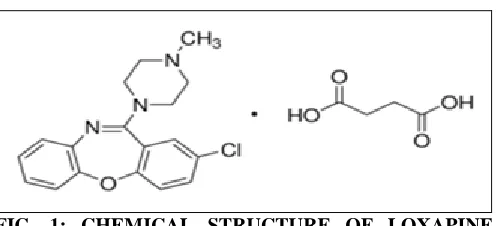
INTRODUCTION: Loxapine succinate is a typical antipsychotic drug, member of dibenzoxazepine class and used to treat certain mental or mood disorders (such as schizophrenia). It is a dopamine antagonist and also serotonin 5-HT2 blocker. The exact mode of action of Loxapine succinate has not known. This drug helps in reducing aggression and hallucinations (such as hearing/ seeing things that are not occurred). Loxapine is present in capsules as the succinate salt
1, 2, 3
. Its IUPAC name is 8-chloro-6-(4-methyl
piperazine-1yl)benzo[b][1,4] benzoxazepine. Its
molecular weight is 445.9 gm/mole 4, 5.
QUICK RESPONSE CODE
DOI:
10.13040/IJPSR.0975-8232.10(5).2362-68
The article can be accessed online on www.ijpsr.com
DOI link: http://dx.doi.org/10.13040/IJPSR.0975-8232.10(5).2362-68
FIG. 1: CHEMICAL STRUCTURE OF LOXAPINE
SUCCINATE 6, 7
A literature search reveals that the following methods are reported viz. UV method, HPLC method, HPLC-MS/MS, GC-MS method 8, 9, 10, 11,
12, 13
. There is a need for developing stability indicating assay method in the capsule dosage form. So, the authors attempted to develop simple, sensitive, selective and specific stability indicating assay method for determination of Loxapine succinate in a capsule dosage form as per ICH guidelines 14, 15, 16, 17.
Keywords:
Loxapine succinate, RP-HPLC, ICH, Validation
Correspondence to Author: Khushbu A. Thakor
Research Scholar, Department of Chemistry, Parul Institute of Pharmacy and Research, Parul University, Limda, Waghodia, Vadodara - 391760, Gujarat, India.
[image:1.612.317.565.465.578.2]MATERIALS AND METHODS:
Chemicals and Reagents: Loxapine succinate was provided as a gift sample by Hetero Drugs Ltd., Hyderabad, Andhra Pradesh, India. Capsule dosage form was procured from the local market. All the chemicals and reagents like methanol, acetonitrile, water were of HPLC grade and were procured from Merck Specialties Pvt. Ltd., Mumbai, India.
Instrumentation: HPLC waters Alliance 2695 series, equipped with an autosampler, temperature control, and auto-injector with the capacity to inject 5 µl to 500 µl with PDA detector. Waters HPLC system is equipped with Empower 2 software. METHODS:
Experimental Conditions: The HPLC system was operated isocratically at a flow rate of 1.0 ml/min at 30°C column temperature for 30 min. The mobile phase was found to be most suitable for analysis was water: Methanol: Acetonitrile: TEA:: 40:10:50:1 ml which was filtered through 0.45 µm PVDF filter. Detection was carried out at 254 nm. The mobile phase is used as a diluent.
Preparation of Standard Solution of Loxapine Succinate: Accurately weighed and Transfer 60 mg of Loxapine succinate into 200 ml volumetric flask. Add diluent about 70% of flask volume. Sonicate to dissolve and volume made up to mark with diluents. Pipette out 10 ml of the stock solution into 20 ml volumetric flask; volume made up to mark with diluents (150 µg/ml). Results were shown in Fig. 3 and Table 1.
Calibration Curve of Loxapine Succinate: Transfer accurately weighed 30 mg of Loxapine into 50 ml volumetric flask. Add 5 ml of diluent. Sonicate to dissolve, volume made up to mark with diluents (600 µg/ml). from 600 µg/ml appropriate aliquots like 2.5 ml, 4 ml, 5 ml, 6 ml, and 7.5 ml taken into 20 ml volumetric flask and made up to mark with diluents, so the resulting solutions become 75, 120, 150, 180 and 225 µg/ml.
Preparation of Sample Solution of Loxapine Succinate: Open 20 capsules and mix and blend powder. Accurately weighed and transferred powder equivalent to 75 mg of loxapine succinate into 50 ml volumetric flask. Add diluent about 50% of flask volume. Sonicate for 30 min with intermitting shaking, volume made up to mark with
diluent. Solution filter using 0.45 µm PVDF filter after 5 ml of filtrate discarded. Pipette out 5 ml of the stock solution into 50 ml volumetric flask; volume made up to mark with diluents (150 µg/ml). Results were shown in Fig. 3 and Table 2.
Method Development and Optimization: During the process of method development, several trials were taken using different aqueous phase, organic phase, different column, good peak shape was observed when using the C18 Purospher star (250 mm × 4.6 mm, 5 µm) column and water: Methanol: Acetonitrile: TEA:: 40:10:50:1 as mobile phase at a flow rate of 1.0 ml/min. for the quantitative analytical purpose, the wavelength was selected as 254 nm.
Initially, standard solution 150 µg/ml was injected into column five times and the retention time of Loxapine succinate was found to be 10.783 min. Then the same concentration of sample solution was injected into the system and the resulting chromatogram was recorded.
Method Validation: The developed method was validated as per the USP and ICH guideline Q2(R1).
Specificity: The specificity of the method was evaluated to ensure there was no interference from the placebo components or from products resulting from forced degradation.
Forced Degradation Studies:
Acid Degradation Sample: Accurately weighed and transferred Loxapine succinate equivalent to 75 mg of loxapine into 50 ml volumetric flask. Add 10 ml 1N HCl solution. Keep solution at room temperature for 5 h. After 5 h neutralize with 10 ml of 1N NaOH. Add diluent about 50% of flask volume. Sonicate for 30 min with intermittent shaking, volume made up to mark with diluent. Solution filter using 0.45 µm PVDF filter after 5 ml of filtrate discarded. Pipette out 5 ml of the stock solution into 50 ml volumetric flask, volume made up to mark with diluent. Results are shown in Fig. 4 and Table 3.
temperature for 5 h. After 5 h neutralize with 10 ml of 0.1N HCl. Add diluent about 50% of flask volume. Sonicate for 30 min with intermittent shaking, volume made up to mark with diluent. Solution filter using 0.45 µm PVDF filter after 5ml of filtrate discarded. Pipette out 5 ml of the stock solution into 50 ml volumetric flask; volume made up to mark with diluent. Results are shown in Fig. 5 and Table 4.
Peroxide Degradation Sample: Accurately weighed and transferred Loxapine succinate equivalent to 75 mg of loxapine into 50 ml volumetric flask. Add 10 ml 30% H2O2 solution.
Keep solution at room temperature for 5 h. Add diluent about 50% of flask volume. Sonicate for 30 min with intermittent shaking, volume made up to mark with diluent. Solution filter using 0.45 µm PVDF filter after 5 ml of filtrate discarded. Pipette out 5 ml of the stock solution into 50 ml volumetric flask; volume made up to mark with diluent. Results are shown in Fig. 6 and Table 5.
Thermal Degradation Sample: Accurately weighed and transferred Loxapine succinate equivalent to 75 mg of loxapine into 50 ml volumetric flask. Keep at 85 ºC for 7 days in vaccum oven. Add diluent about 50% of flask volume. Sonicate for 30 min with intermittent shaking, volume made up to mark with diluent. Solution filter using 0.45 µm PVDF filter after 5ml of filtrate discarded. Pipette out 5 ml of the stock solution into 50 ml volumetric flask; volume made up to mark with diluent. Results are shown in Fig. 7 and Table 6.
Photolytic Degradation Sample: Put Capsule Sample into UV Chamber for 7 days to complete one ICH cycle accurately weighed and transferred Loxapine succinate equivalent to 75 mg of loxapine into 50 ml volumetric flasks. Add diluent about 50% of flask volume. Sonicate for 30 min with intermittent shaking, volume made up to mark with diluent. Solution filter using 0.45 µm PVDF filter after 5 ml of filtrate discarded. Pipette out 5 ml of the stock solution into 50 ml volumetric flask; volume made up to mark with diluent. Results are shown in Fig. 8 and Table 7.
Results for % degradation and % assay after degradation were shown in Table 8.
Linearity: The concentration range 75, 120, 150, 180 and 225 µg/ml was injected into the system. Linearity was evaluated by linear regression analysis which was obtained by plotting the Loxapine succinate against peak area. The regression coefficient was found to be 0.999. linearity data were shown in Table 9.
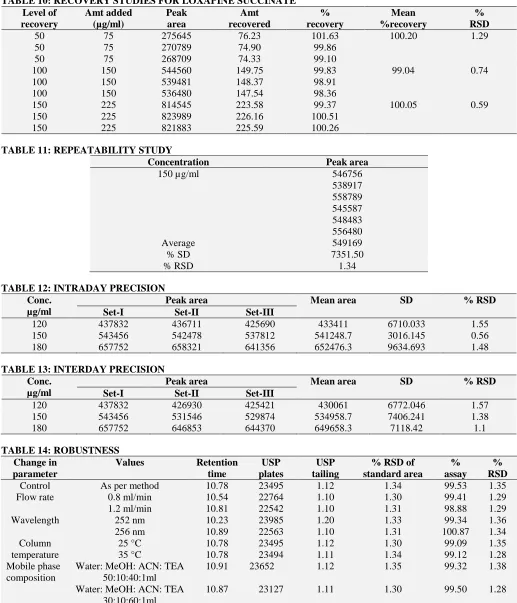
Accuracy: The accuracy of the method was determined at three different concentration levels 50%, 100% and 150% of target concentration (150 µg/ml) by recovery studies. The recovery studies were carried out in triplicate on composite blend collected from 20 capsules of Loxapine succinate and analyzed as per the proposed method.
Individual recovery was found to be in the range of 97.0% to 103% and mean recovery was found to be in a range of 98% to 102%. The results of accuracy revealed that the method was accurate. Results for accuracy were shown in Table 10.
Precision: Repeatability study was carried out by estimating six determination of Loxapine succinate with 150 µg/ml. The intraday precision study of loxapine succinate was carried out by estimating the peak response for three determination on the same day with 120 µg/ml, 150 µg/ml and 180 µg/ml concentration and interday precision study of Loxapine succinate was carried out by estimating the peak response for three determination on different days using 120 µg/ml, 150 µg/ml and 180 µg/ml.
SD and % RSD was calculated and found to be within limits. The results of the precision study revealed that the method was precise as shown in Table 11, 12, 13.
Robustness: The Robustness of the analytical method was determined by analysis of aliquots from the homogenous sample by varying the chromato-graphic parameters like change in flow rate, change in column oven temperature, change in mobile phase ratio, change in wavelength, change in HPLC column and their impact on retention time and peak area were studied.
RESULTS AND DISCUSSION:
[image:4.612.50.561.72.543.2]FIG. 2: STANDARD CHROMATOGRAM FOR LOXAPINE FIG. 3: SAMPLE CHROMATOGRAM FOR LOXAPINE SUCCINATE 150 µg/ml SUCCINATE 150 µg/ml
TABLE 1: STANDARD LOXAPINE SUCCINATE
Peak Name RT Area USP Tailing USP Plate count Purity Angle Purity Threshold
[image:4.612.45.564.232.749.2]Loxapine 10.783 552387 1.12 23495 1.276 1.735
TABLE 2: FOR SAMPLE LOXAPINE SUCCINATE
Peak Name RT Area USP Tailing USP Plate count Purity Angle Purity Threshold
Loxapine 10.985 542976 1.12 23478 1.324 1.712
FIG. 4: CHROMATOGRAM FOR LOXAPINE SUCCINATE - FIG. 5: CHROMATOGRAM FOR LOXAPINE SUCCINATE - ACID DEGRADATION BASE DEGRADATION
TABLE 3: FOR ACID DEGRADATION
Peak Name RT Area USP Tailing USP Plate count Purity Angle Purity Threshold
UnkImp 5.872 20487 1.45 4236 2.875 3.986
UnkImp 9.985 38125 1.01 3478 1.798 1.143
Loxapine 10.823 501254 1.20 21870 0.998 1.572
TABLE 4: FOR BASE DEGRADATION
Peak Name RT Area USP Tailing USP Plate count Purity Angle Purity Threshold
UnkImp 5.932 18765 1.54 4187 1.246 2.467
UnkImp 9.879 35398 1.05 3562 5.986 4.651
Loxapine 10.756 511659 1.21 22870 1.876 2.246
TABLE 5: FOR PEROXIDE DEGRADATION
Peak Name RT Area USP Tailing USP Plate count Purity Angle Purity Threshold
Loxapine 10.752 522541 1.21 22212 1.684 1.709
TABLE 6: FOR THERMAL DEGRADATION
Peak Name RT Area USP Tailing USP Plate count Purity Angle Purity Threshold
FIG. 6: CHROMATOGRAM FOR LOXAPINE SUCCINATE- PEROXIDE DEGRADATION
[image:5.612.54.561.52.774.2]FIG. 7: CHROMATOGRAM FOR LOXAPINE SUCCINATE- FIG. 8: CHROMATOGRAM FOR LOXAPINE SUCCINATE- THERMAL DEGRADATION PHOTOLYTIC DEGRADATION
TABLE 7: FOR PHOTOLYTIC DEGRADATION
Peak Name RT Area USP Tailing USP Plate count Purity Angle Purity Threshold
[image:5.612.55.564.52.412.2]Loxapine 10.821 539921 1.17 26009 2.286 3.245
TABLE 8: FORCED DEGRADATION STUDIES FOR LOXAPINE SUCCINATE
Stressed condition Retention time (min) Peak area % Purity % of degradation
Standard drug 10.547 545432 100 -
Acid degradation 10.823 501254 90.95 9.0
Alkaline degradation 10.756 511659 92.83 7.2
Oxidative Degradation 10.752 522541 94.81 5.2
Thermal degradation 10.687 542121 98.36 1.6
[image:5.612.51.560.401.747.2]Photolytic degradation 10.821 539921 97.96 2.0
TABLE 9: FOR LOXAPINE SUCCINATE- LINEARITY
Level % Concentration(µg/ml) Mean peak area
50 75 272175
80 120 437832
100 150 543456
120 180 657752
TABLE 10: RECOVERY STUDIES FOR LOXAPINE SUCCINATE Level of
recovery
Amt added (µg/ml)
Peak area
Amt recovered
% recovery
Mean %recovery
% RSD
50 75 275645 76.23 101.63 100.20 1.29
50 75 270789 74.90 99.86
50 75 268709 74.33 99.10
100 150 544560 149.75 99.83 99.04 0.74
100 150 539481 148.37 98.91
100 150 536480 147.54 98.36
150 225 814545 223.58 99.37 100.05 0.59
150 225 823989 226.16 100.51
150 225 821883 225.59 100.26
TABLE 11: REPEATABILITY STUDY
Concentration Peak area
150 µg/ml 546756
538917 558789 545587 548483 556480
Average 549169
% SD 7351.50
% RSD 1.34
TABLE 12: INTRADAY PRECISION Conc.
µg/ml
Peak area Mean area SD % RSD
Set-I Set-II Set-III
120 437832 436711 425690 433411 6710.033 1.55
150 543456 542478 537812 541248.7 3016.145 0.56
180 657752 658321 641356 652476.3 9634.693 1.48
TABLE 13: INTERDAY PRECISION Conc.
µg/ml
Peak area Mean area SD % RSD
Set-I Set-II Set-III
120 437832 426930 425421 430061 6772.046 1.57
150 543456 531546 529874 534958.7 7406.241 1.38
180 657752 646853 644370 649658.3 7118.42 1.1
TABLE 14: ROBUSTNESS Change in
parameter
Values Retention
time
USP plates
USP tailing
% RSD of standard area
% assay
% RSD
Control As per method 10.78 23495 1.12 1.34 99.53 1.35
Flow rate 0.8 ml/min 10.54 22764 1.10 1.30 99.41 1.29
1.2 ml/min 10.81 22542 1.10 1.31 98.88 1.29
Wavelength 252 nm 10.23 23985 1.20 1.33 99.34 1.36
256 nm 10.89 22563 1.10 1.31 100.87 1.34
Column temperature
25 °C 10.78 23495 1.12 1.30 99.09 1.35
35 °C 10.78 23494 1.11 1.34 99.12 1.28
Mobile phase composition
Water: MeOH: ACN: TEA 50:10:40:1ml
10.91 23652 1.12 1.35 99.32 1.38
Water: MeOH: ACN: TEA 30:10:60:1ml
10.87 23127 1.11 1.30 99.50 1.28
TABLE 15: ASSAY OF CAPSULE DOSAGE FORM (LOXAPINE SUCCINATE)
Label claim Amount found % Assay Average SD % RSD
34 mg
33.84 99.55 99.55 0.0252 0.0253
33.86 99.58
CONCLUSION: This study presents simple and validated stability-indicating HPLC method for the determination of Loxapine succinate in the presence of its degradation products. The developed method is specific, accurate, precise and robust. All the peaks of the degradation products formed during forced degradation studies were well separated from the analyte peak. Hence, the developed method can be used for routine analysis for the determination of Loxapine succinate in capsule dosage forms.
ACKNOWLEDGEMENT: The authors express sincere thanks to Hetero Drugs Ltd., Hyderabad, Andhra Pradesh for providing a gift sample of Loxapine succinate and Umedica Pvt. Ltd., Vapi for providing necessary facilities to carry out the research work.
CONFLICT OF INTEREST: The authors reveal that there are no conflicts of interest.
REFERENCES:
1. Barar FSK: Essentials of Pharmacotherapeutics. S. chand and company ltd, fifth Edition 201: 143.
2. Tripathi KD: Essential of Medical Pharmacology. Jaypee publisher, fifth Edition, 2004: 394.
3. Hawland RD: Reviews: Pharmacology. B.I publications, third edition, 2005: 149.
4. www.drugbank.ca/drugs/DB00408
5. www.chemspider.com/chemicalstructure.3827.html
6. Pubchem.ncbi.nlm.nih.gov/compound/Loxapine
7. www.rsc.org/merck-index
8. USP<905> US Pharmacopeia 32 NF 27, Vol- I, the United State Pharmacopoeial Convention, Rockville 2817. 9. Rajendra P and Tushar D: Review on Analytical Method
Development and Validation. Journal of Pharmaceutical Analysis 2014; 3: 1-10.
10. Guidance for Industry: Analytical Procedures and Methods Validation of Drugs and Biologics. U.S. Department of
Health and Human Services Food and Drug
Administration. 2015; 1-13.
11. Bhojan C: Development of UV spectrophotometry and HPTLC techniques for Loxapine in the formulation. International Journal of Chemical and Pharmaceutical Analysis 2017; 4(1).
12. Dammalapati S and Rudraraju R: Development and validation of RP-HPLC method for Loxapine in the capsule dosage form. International Journal of Advances in Pharmaceutical Analysis 2015; 5(3): 61-64.
13. Garcia LG and Bares IF: Simultaneous determination of four antipsychotic drugs in plasma by HPLC: Application to the management of acute intoxications. Journal of chromatography 2017; 2: 257-64.
14. International Conference on Harmonization (ICH) Q2 (R1): Validation of Analytical Procedures: Test and Methodology, Geneva, Switzerland 2005.
15. Validation of Analytical Procedures: Methodology (Q2B), ICH Harmonized Tripartite Guidelines, Geneva 1996. 16. ICH Stability Testing of New Drug Substances and
Products Q1A (R2), International Conference on Harmonization 2003.
17. ICH guidelines for impurities in new drug substances Text and methodology Q3A (R2), International Conference on Harmonization 2006.
All © 2013 are reserved by International Journal of Pharmaceutical Sciences and Research. This Journal licensed under a Creative Commons Attribution-NonCommercial-ShareAlike 3.0 Unported License.
This article can be downloaded to Android OS based mobile. Scan QR Code using Code/Bar Scanner from your mobile. (Scanners are available on Google Play store)
How to cite this article: