N A N O E X P R E S S
Open Access
Thermal Behaviour of Sm
0.5
R
0.5
FeO
3
(
R
= Pr, Nd) Probed by High-Resolution
X-ray Synchrotron Powder Diffraction
Olena Pavlovska, Leonid Vasylechko
*and Oleh Buryy
Abstract
Mixed ferrites Sm0.5Pr0.5FeO3and Sm0.5Nd0.5FeO3with orthorhombic perovskite structure isotypic with GdFeO3were synthesized by solid-state reaction technique in air at 1473 K. Structural parameters obtained at room temperature prove a formation of continuous solid solutions in the SmFeO3–PrFeO3and SmFeO3–NdFeO3pseudo-binary systems. Sm0.5Pr0.5FeO3and Sm0.5Nd0.5FeO3show strongly anisotropic nonlinear thermal expansion: thermal expansion in thebdirection is twice lower than in theaandcdirections. The average linear thermal expansion coefficients of Sm0.5Pr0.5FeO3and Sm0.5Nd0.5FeO3in the temperature range of 298–1173 K are in the limits of (9.0–11.1) × 10−6K−1, which is close to the values reported for the parentRFeO3compounds. Subtle anomalies in the lattice expansion of Sm0.5Pr0.5FeO3and Sm0.5Nd0.5FeO3detected at 650–750 K reflect magnetoelastic coupling at the magnetic ordering temperatureTN.
Keywords:Mixed rare earth ferrites, Perovskites, Crystal structure, Thermal expansion, Magnetoelastic coupling PACS:61, 61.05.cp, 65.40.De
Background
Complex oxides with perovskite structureRFeO3, whereR is the rare earth(RE), represent an important class of func-tional materials. The RFeO3-based materials are used as electrodes in solid oxide fuel cells, as catalysts, gas sensory materials and semiconductor ceramics [1–6]. Complemen-tary, the interest in the rare earth ferrites is stimulated by their interesting fundamental physical properties, such as spin-reorientation transitions at 80–480 K and the para- to antiferromagnetic transitions at 620–750 K [7–10]. Just re-cently, the interest to RE ferrite perovskites was renewed due to reported multiferroic properties of NdFeO3, SmFeO3
and other RFeO3 compounds [11–13]. At room
temperature (RT), all RE orthoferrites adopt orthorhombic perovskite structure isotypic with GdFeO3 [14, 15]. No structural phase transitions were reported in the literature for RFeO3 compounds, with an exception of LaFeO3, which undergoes a high-temperature (HT) transition to rhombohedral structure at 1220–1280 K [16, 17]. Ortho-rhombic RFeO3 perovskites show strongly anisotropic
thermal expansion: the expansivity in the b direction in thePbnmsetting is ca. two times lower than in theaand c directions. Subtle anomalies in the lattice expansion of PrFeO3 and SmFeO3are observed in the b direction at 600–800 K, which is indicative for magnetoelastic coup-ling at the magnetic ordering temperatureTN [18, 19]. In ref. [9], it was shown that the spin-reorientation transition in NdFeO3 between 100 and 200 K is associated with changes of theb-lattice parameter, which has a broad local minimum in the spin-reorientation region near 160 K. However, no lattice anomalies in NdFeO3 were found around the Néel temperature of 687 K in [10].
The aim of the present work is the detail study of the thermal behaviour of Sm0.5Pr0.5FeO3and Sm0.5Nd0.5FeO3 in order to reveal the possible magnetoelastic coupling in these mixed perovskite ferrites.
Methods
Polycrystalline samples with nominal compositions Sm0.5Pr0.5FeO3 and Sm0.5Nd0.5FeO3 have been pre-pared from stoichiometric amounts of constituent ox-ides Sm2O3, Pr6O11, Nd2O3 and Fe2O3 by solid-state
* Correspondence:[email protected]
Lviv Polytechnic National University, 12 Bandera Street, 79013 Lviv, Ukraine
reaction technique according to the following reaction schemes:
3=2Sm2O3þ 1=2Pr6O11þ 3Fe2O3→6Sm0:5Pr0:5FeO3þ 1=2O2↑
1=2Sm2O3þ 1=2Nd2O3þ Fe2O3→2Sm0:5Nd0:5FeO3:
Precursor oxides were ball-milled in ethanol for 5 h, dried, pressed into pellets and annealed in air at 1473 K for 20 h. The as-obtained product was repeatedly re-grinded and annealed at 1473 K for 20 h and, after that, slowly cooled to RT for 20 h.
X-ray phase and structural characterization of the samples was performed at room temperature by using
imaging plate Guinier camera G670 (Cu Kα1 radiation,
λ= 1.54056 Å). Thermal behaviour of Sm0.5Pr0.5FeO3 and Sm0.5Nd0.5FeO3structures has been studied in situ in the temperature range of 298–1173 K by means of high-resolution X-ray synchrotron powder diffraction technique. The corresponding experimental powder dif-fraction patterns were collected with the temperature steps of 30 K at beamline B2 of synchrotron laboratory HASYLAB/DESY (Hamburg, Germany). Structural pa-rameters of the samples were derived from the experimen-tal diffractograms by using full-profile Rietveld refinement technique applying WinCSD program package [20].
Results and Discussion
X-ray powder diffraction examination revealed that both samples synthesized possess orthorhombic perovskite structure isotypic with GdFeO3. No extra crystalline
phases were found. The unit-cell dimensions of
Sm0.5Pr0.5FeO3and Sm0.5Nd0.5FeO3at room temperature are in good agreement with the structural data of the par-ent SmFeO3, PrFeO3 and NdFeO3 [14, 15] compounds, (Fig. 1), thus proving possible formation of continuous solid solutions Sm1−xPrxFeO3and Sm1 -xNdxFeO3in the SmFeO3–PrFeO3and SmFeO3–NdFeO3systems.
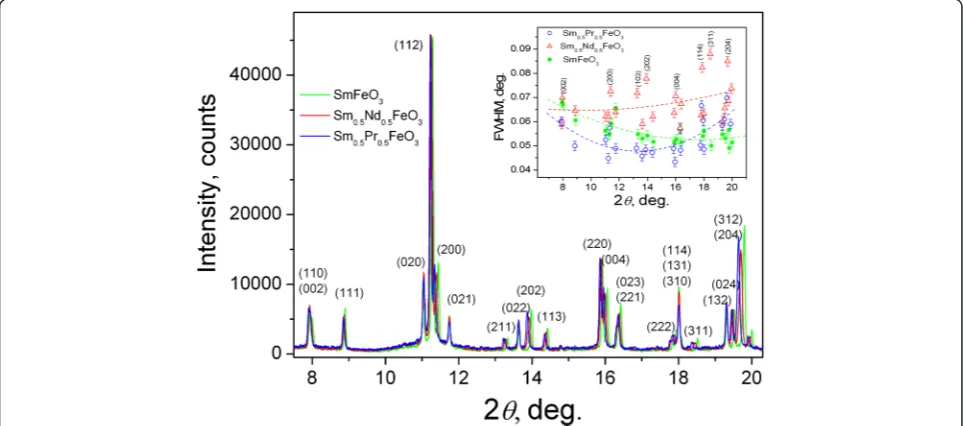
Precise high-resolution X-ray synchrotron powder dif-fraction examination confirms phase purity of the Sm0.5Pr0.5FeO3 and Sm0.5Nd0.5FeO3 samples (Fig. 2). The values of full width at half maximum (FWHM) of the mixed praseodymium and samarium-neodymium ferrites are in the limits of 0.043°–0.089°, which is comparable with those of the “pure” SmFeO3 ferrite (Fig. 2, inset). Angular dependence of FWHM of Fig. 1Concentration dependence of the unit-cell dimensions in the
SmFeO3–PrFeO3and SmFeO3–NdFeO3systems. The orthorhombic
lattice parameters are normalized to the perovskite cell as follows: ap=ao/√2,bp=bo/√2, andcp=co/2
Fig. 2X-ray synchrotron powder diffraction patterns of Sm0.5Pr0.5FeO3and Sm0.5Nd0.5FeO3(λ= 0.53833 Å). For a comparison, the corresponding
[image:2.595.57.291.86.261.2] [image:2.595.57.539.490.703.2]Fig. 3Graphical results of Rietveld refinement of the Sm0.5Pr0.5FeO3structure at 1173 K. Experimental X-ray synchrotron powder diffraction
pattern (λ= 0.53833 Å) collected at 1173 K (dots) is shown in comparison with the calculated pattern (lines). The difference between measured and calculated profiles is shown as acurve below the diagrams. Short vertical barsindicate the positions of diffraction maxima in the space group
[image:3.595.60.539.87.286.2]Pbnm. Insetshows the view of the structure as corner-shared FeO6octahedra with Sm/Pr species located between them
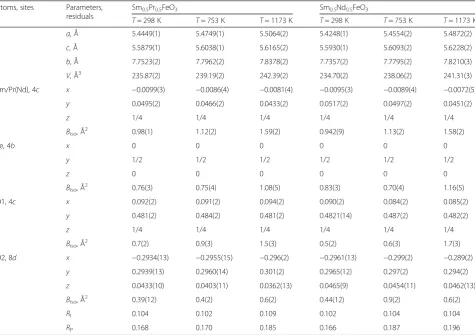
Table 1Lattice parameters, coordinates and displacement parameters of atoms in the Sm0.5Pr0.5FeO3and Sm0.5Nd0.5FeO3structures at RT, 753 and 1173 K
Atoms, sites Parameters, residuals
Sm0.5Pr0.5FeO3 Sm0.5Nd0.5FeO3
T= 298 K T= 753 K T= 1173 K T= 298 K T= 753 K T= 1173 K
a, Å 5.4449(1) 5.4749(1) 5.5064(2) 5.4248(1) 5.4554(2) 5.4872(2)
c, Å 5.5879(1) 5.6038(1) 5.6165(2) 5.5930(1) 5.6093(2) 5.6228(2)
b, Å 7.7523(2) 7.7962(2) 7.8378(2) 7.7357(2) 7.7795(2) 7.8210(3)
V, Å3 235.87(2) 239.19(2) 242.39(2) 234.70(2) 238.06(2) 241.31(3)
Sm/Pr(Nd), 4c x −0.0099(3) −0.0086(4) −0.0081(4) −0.0095(3) −0.0089(4) −0.0072(5)
y 0.0495(2) 0.0466(2) 0.0433(2) 0.0517(2) 0.0497(2) 0.0451(2)
z 1/4 1/4 1/4 1/4 1/4 1/4
Biso, Å 2
0.98(1) 1.12(2) 1.59(2) 0.942(9) 1.13(2) 1.58(2)
Fe, 4b x 0 0 0 0 0 0
y 1/2 1/2 1/2 1/2 1/2 1/2
z 0 0 0 0 0 0
Biso, Å 2
0.76(3) 0.75(4) 1.08(5) 0.83(3) 0.70(4) 1.16(5)
O1, 4c x 0.092(2) 0.091(2) 0.094(2) 0.090(2) 0.084(2) 0.085(2)
y 0.481(2) 0.484(2) 0.481(2) 0.4821(14) 0.487(2) 0.482(2)
z 1/4 1/4 1/4 1/4 1/4 1/4
Biso, Å 2
0.7(2) 0.9(3) 1.5(3) 0.5(2) 0.6(3) 1.7(3)
O2, 8d x −0.2934(13) −0.2955(15) −0.296(2) −0.2961(13) −0.299(2) −0.289(2)
y 0.2939(13) 0.2960(14) 0.301(2) 0.2965(12) 0.297(2) 0.294(2)
z 0.0433(10) 0.0403(11) 0.0362(13) 0.0465(9) 0.0454(11) 0.0462(13)
Biso, Å 2
0.39(12) 0.4(2) 0.6(2) 0.44(12) 0.9(2) 0.6(2)
RI 0.104 0.102 0.109 0.102 0.104 0.104
[image:3.595.61.537.396.731.2]Sm0.5Pr0.5FeO3 substantially resembles the behaviour of
the parent SmFeO3 compound, whereas a rather
scattered behaviour is observed for the Sm0.5Nd0.5FeO3 sample (Fig. 2, inset). To some extent,hkl-dependent an-isotropic broadening of Bragg peaks points on the pos-sible compositional, thermal and elastic microstrains presented in the Sm0.5Nd0.5FeO3sample [21].
In situ high-temperature X-ray synchrotron powder diffraction investigations prove that Sm0.5Pr0.5FeO3 and Sm0.5Nd0.5FeO3 remain orthorhombic at least up to 1173 K. No structural phase transitions were detected in the whole temperature range investigated. Based on the ex-perimental X-ray synchrotron powder diffraction data, the unit-cell dimensions and positional and displacement parameters of atoms in the Sm0.5Pr0.5FeO3 and Sm0.5Nd0.5FeO3 structures between RT and 1173 K were derived by full-profile Rietveld refinement technique. As an example, Fig. 3 represents the graphical results of Rietveld refinement of the Sm0.5Pr0.5FeO3structure at 1173 K. Re-fined structural parameters of Sm0.5Pr0.5FeO3 and Sm0.5Nd0.5FeO3at the selected temperatures are presented in Table 1.
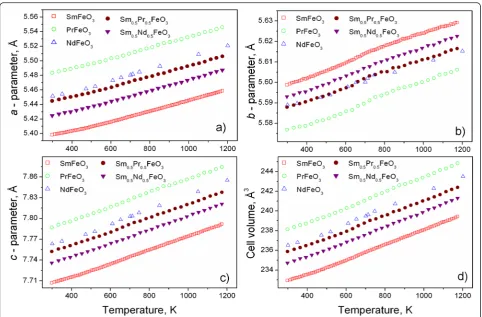
Temperature dependencies of the unit-cell dimensions of Sm0.5Pr0.5FeO3 and Sm0.5Nd0.5FeO3 in comparison
with the literature data for the“pure”ferrite perovskites SmFeO3 [19], PrFeO3 [18] and NdFeO3 [10] are pre-sented in Fig. 4.
Temperature evolution of the lattice parameters of mixed Sm-Pr and Sm-Nd ferrites resemble for the most part the thermal behaviour of the parent compounds. In both cases, clear deviations from the“normal”trend are observed in thebdirection at 650–750 K, whereas much less visible anomalies in the lattice expansion are ob-served in theaandc directions (Fig. 4a–c). It is evident that similar to SmFeO3and PrFeO3, a kink in the b-lat-tice expansion of Sm0.5Pr0.5FeO3and Sm0.5Nd0.5FeO3is associated with the para- to antiferromagnetic transi-tions that occurred in these specimens at the Néel tem-peratures. Earlier, nonlinear lattice expansion across the antiferromagnetic to paramagnetic transitions was also observed in LaFeO3atTN= 735 K [17].
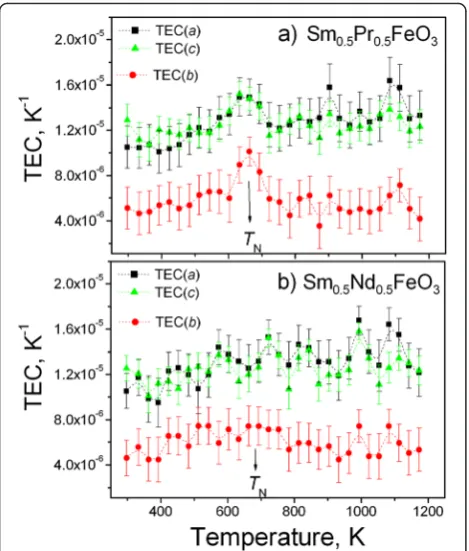
Similar to the“pure”RFeO3perovskites, thermal ex-pansion of Sm0.5Pr0.5FeO3 and Sm0.5Nd0.5FeO3shows a clear anisotropic behaviour. Calculated thermal ex-pansion coefficients (TECs) in the b direction are in the limits of (5.3–6.2) × 10−6K−1which is twice lower than the values of (11.1–13.6) × 10−6K−1in theaandc directions (Fig. 5). Such anisotropic thermal expansion Fig. 4Temperature dependencies of the lattice parameters (a-c) and unit cell volumes (d) of Sm0.5Pr0.5FeO3and Sm0.5Nd0.5FeO3. Thermal
[image:4.595.57.540.86.403.2]is rather typical for the majority of perovskite oxides with a GdFeO3type of structure and is inherent for the families of rare earth aluminates, gallates [22–25] and other perovskites. The average linear thermal expansion coefficients of Sm0.5Pr0.5FeO3and Sm0.5Nd0.5FeO3in the temperature range of 298–1173 K are in the limits of (9.0–11.1) × 10−6 K−1. It is close to the TEC value of (10.8–11.8) × 10−6K−1 reported for LaFeO3 [26, 27] and other rare earth ferrites confirming the suggestion that the nature of rare earth ions does not influence the thermal expansion inRFeO3[15].
Subtle maxima at the TEC curves of Sm0.5Pr0.5FeO3 around 670 K (Fig. 5a) reflect the observed lattice anom-alies at the Néel temperature. In spite of no obvious maxima observed on the TEC curves of Sm0.5Nd0.5FeO3, a change of the slope of the TEC(b) values occurs around 650–700 K (Fig. 5b). A similar step at the ther-mal expansion coefficient at 723 ± 50 K, corresponding with the Néel temperature, has been revealed in LaFeO3 by dilatometric measurements [16].
The lattice expansion of Sm0.5Pr0.5FeO3 and Sm0.5Nd0.5FeO3 could be also affected by a possible change of the oxygen defect structure during the heat-ing of the samples, as it was detected in PrFeO3 and
SmFeO3by thermogravimetric measurements [15]. As it was shown, detectable weight loss due to the fast oxygen desorption begins in these ferrites above 573 K. As a consequence, thermal expansion behaviour of SmFeO3shows a change of the slope at around 593 K close to the temperature of sharp weight loss detected by TGA [15].
Conclusions
Crystal structure parameters of the mixed
samarium-praseodymium and samarium-neodymium ferrites
Sm0.5Pr0.5FeO3 and Sm0.5Nd0.5FeO3 synthesized by solid-state reaction technique in air at 1473 K have been studied in a wide temperature range of 298–1173 K by means of high-resolution X-ray synchrotron powder dif-fraction technique. Close analysis of the temperature dependence of the unit-cell dimensions in comparison with the literature data for the parent RFeO3 com-pounds revealed strongly anisotropic lattice expansion and subtle anomalies associated with the para- to antiferromagnetic transitions at 650–750 K. The
average linear thermal expansion coefficients of
Sm0.5Pr0.5FeO3 and Sm0.5Nd0.5FeO3 derived from the experimental values of the unit-cell dimensions in
the temperature range of 298–1173 K are in the
limits of (9.0–11.1) × 10−6 K−1, which is close to the corresponding values reported for the parent RFeO3 compounds.
Competing Interests
The authors declare that they have no competing interests.
Authors’Contributions
OP synthesized the samples, contributed to the data evaluation and wrote the manuscript. LV performed the laboratory X-ray and HT synchrotron powder diffraction measurements, made the structural characterization of the samples and contributed to the manuscript writing. OB contributed to the discussion of the results and manuscript writing. All authors read and approved the final manuscript.
Authors’Information
OP is a 2nd year PhD student at the Semiconductor Electronics Department of Lviv Polytechnic National University. LV is a Doctor of Science (Dr. Hab.) and Professor at the Semiconductor Electronics Department of Lviv Polytechnic National University. OB is a Doctor of Science (Dr. Hab.) and Associate Professor at the Semiconductor Electronics Department of Lviv Polytechnic National University.
Acknowledgements
The work was supported in part by the Ukrainian Ministry of Education and Sciences (Project“RZE”) and ICDD Grant-in-Aid programme. The authors express especial gratitude to A. Berghäuser for his kind assistance in the maintenance of the equipment during the measurements at HASYLAB beamline B2 under the project I-20110214.
Received: 2 December 2015 Accepted: 22 February 2016
References
1. Sun C, Hui R, Roller J (2010) Cathode materials for solid oxide fuel cells: a review. J Solid State Electrochem 14:1125–1144
Fig. 5Temperature evolution of the linear thermal expansion coefficients of Sm0.5Pr0.5FeO3(a) and Sm0.5Nd0.5FeO3(b) The
[image:5.595.57.292.87.363.2]2. Bukhari S, Giorgi J (2012) Chemically stable and coke resistant Sm1−xCexFeO3−δ perovskites for low temperature solid oxide fuel cell anode applications. J Power Sources 198:51–58
3. Ciambelli P, Cimino S, De Rossi S, Lisi L, Minelli G, Porta P, Russo G (2001) AFeO3(A = La, Nd, Sm) and LaFe1−xMgxO3perovskites as methane
combustion and CO oxidation catalysts: structural, redox and catalytic properties. Appl Catal B: Environmental 29:239–250
4. Ding J, Lü X, Shu H, Xie J, Zhang H (2010) Microwave-assisted synthesis of perovskite ReFeO3(Re: La, Sm, Eu, Gd) photocatalyst. Mater Sci Eng B 171:31–34
5. Itagaki Y, Mori M, Hosoya Y, Aono H, Sadaoka Y (2007) O3and NO2sensing
properties of SmFe1−xCoxO3perovskite oxides. Sens Actuators B 122:315–320
6. Prasad B, Rao G, Chen J, Babu D (2011) Abnormal high dielectric constant in SmFeO3semiconductor ceramics. Mater Res Bull 46:1670–1673
7. Gorodetsky G, Levinson L (1969) Spin reorientation in SmFeO3. Solid State
Commun 7:67–70
8. Pinto H, Shaked H (1972) Long wavelength neutron diffraction study of the magnetic structures of PrFeO3and NdFeO3. Solid State Comm 10:663–665
9. Sławiński W, Przeniosło R, Sosnowska I, Suard E (2005) Spin reorientation and structural changes in NdFeO3. J Phys Condens Matter 17:4605–4614
10. Sławinski W, Przeniosło R, Sosnowska I, Brunelli M, Bieringer M (2007) Anomalous thermal expansion in polycrystalline NdFeO3studied by SR and
X-ray diffraction. Nucl Instrum Methods Phys Res, Sect B 254:149–152 11. Tokunaga Y, Furukawa N, Sakai H, Taguchi Y, Arima T, Tokura Y (2009) Composite
domain walls in a multiferroic perovskite ferrite. Nat Mater 8:558–562 12. Lee J-H, Jeong Y, Park J, Oak M-A, Jang H, Son J, Scott J (2011)
Spin-canting-induced improper ferroelectricity and spontaneous magnetization reversal in SmFeO3. Phys Rev Letters 107:117201
13. Hu G, Umehara I, Shuang X, Yuan S, Cao S (2012) Pressure effect in multiferroic phase transition of perovskite ferrite crystals NdFeO3and
ErFeO3. JPCS 400:032023–032027
14. Marezio M, Remeika J, Dernier P (1970) The crystal chemistry of the rare earth orthoferrites. Acta Cryst B 26:2008–2022
15. Berenov A, Angeles E, Rossiny J, Raj E, Kilner J, Atkinson A (2008) Structure and transport in rare-earth ferrates. Solid State Ionics 179:1090–1093 16. Fossdal A, Menon M, Wærnhus I, Wiik K, Einarsrud M-AN, Grande T (2004)
Crystal structure and thermal expansion of La1-xSrxFeO3-δmaterials. J Am Ceram Soc 87:1952–1958
17. Selbach S, Tolchard J, Fossdal A, Grande T (2012) Non-linear thermal evolution of the crystal structure and phase transitions of LaFeO3investigated by high
temperature X-ray diffraction. J Solid State Chem 196:249–254
18. Kharko O, Vasylechko L (2013) Anomalous thermal expansion of new mixed praseodymium cobaltites-ferrites. Visnyk Lviv Polytechnic Natl University Electronics 764:61–66
19. Kuo C-Y, Drees Y, Fernández-Díaz M, Zhao L, Vasylechko L, Sheptyakov D, et al (2014) k = 0 magnetic structure and absence of ferroelectricity in SmFeO3. Phys Rev Lett 113:217203–217208
20. Akselrud L, Grin YU (2014) WinCSD: software package for crystallographic calculations (Version 4). J Appl Cryst 47:803–805
21. Leineweber A (2011) Understanding anisotropic microstrain broadening in Rietveld refinement. Z Kristallogr 226:905–923
22. Vasylechko L, Senyshyn A, Bismayer U (2009) Perovskite-type aluminates and gallates. In: Gschneidner KA Jr, Bünzli J-CG, Pecharsky VK (eds) Handbook on the physics and chemistry of rare earths, vol 39. North-Holland, Netherlands, pp 113–295
23. Senyshyn A, Vasylechko L, Knapp M, Bismayer U, Berkowski M, Matkovskii A (2004) Thermal expansion of the NdGaO3perovskite. J All Comp 382:84–91
24. Senyshyn A, Oganov AR, Vasylechko L, Ehrenberg H, Bismayer U, Berkowski M, Matkovskii A (2004) The crystal structure and thermal expansion of the perovskite-type Nd0.75Sm0.25GaO3: powder diffraction and lattice dynamical
studies. J Phys Condens Matter 16:253–265
25. Vasylechko L, Pivak Y, Senyshyn A, Savytskii D, Berkowski M, Borrmann H et al (2005) Crystal structure and thermal expansion of PrGaO3in the
temperature range 12–1253 K. J Solid State Chem 178:270–278 26. Hung M-H, Rao M, Tsai D-S (2007) Microstructures and electrical properties of
calcium substituted LaFeO3as SOFC cathode. Mater Chem Phys 101:297–302
27. Köferstein R, Ebbinghaus S (2013) Synthesis and characterization of nano-LaFeO3powders by a soft-chemistry method and corresponding ceramics.
Solid State Ionics 231:43–48
Submit your manuscript to a
journal and benefi t from:
7 Convenient online submission 7Rigorous peer review
7 Immediate publication on acceptance 7Open access: articles freely available online 7 High visibility within the fi eld
7Retaining the copyright to your article