© 2015, IRJET ISO 9001:2008 Certified Journal
Page 108
Comparative analysis of Spectral Phase Encoding/Decoding based
OCDMA Communication System for two Optical Modulation Formats
Yogendra Singh
1, Manisha Bharti
2, Jitender Kumar
31
M.tech Scholar, ECE Dept. AIACT&R, Delhi, India
2Assistant Professor, ECE Dept. AIACT&R, Delhi, India
3
M.tech Scholar, ECE Dept. AIACT&R, Delhi, India
---***---
Abstract
:In this paper a Simulative analysis of OCDMA system is demonstrated for DPSK and Duo-binary optical data formats using spectral phase encoding/decoding (SPE/SPD) in time and a single phase Modulator for different optical codes that can reconfigure using these optical codes with help of phase modulator this Spectral phase encoding technique can be realize using by the process of expanding and compressing the optical pulse with help of optical component having positive and negative dispersion value.SPD has similar configuration as SPE but here phase modulator is driven by the complementary code pattern that was used in SPE. In this simulative demonstration 2.5 Gbps DPSK and Duo binary data and chip rate of 40 GChips/s has transmitted over 50 km fibre and successfully decoded at receiver for four different OCs.Keywords
-- Fibre optics, DPSK, Duobinary, Spectral phase encoding (SPE), Spectral phase decoding (SPD), Optical pattern, phase modulator (PM), OCDMA.1. INTRODUCTION
FibreOptical communication system gets the high attention due to economic advantages, and high information capacity. This systemhas multiplexing, demultiplexing, filtering, amplificati- on, correlation and optical signal processing is much faster than electrical signal processing, it can be directly done in optical domain. In optical fibre communication system OCDMA is one of the type of multiplexing technique in which this can be achieved by assigning different code sequences for different users. According to principle of working OCDMA is classified in two categories that are incoherent and coherent, incoherent is an intensity based and coherent which is phase shift based OCDMA technique, but due to overall performance coherent typegets more attraction for practicalthan
incoherent OCDMA. Other hand is usefulfor development of compact and reliable encoding/decoding devices[1].In OCDMA spectral phase encoding time spreading SPECTOCDMA is performed in spectral domain by encoding different phase shift into different spectral components which will also result in pulse stretching or spreading in time domain. According to recent experiments a novel spectral phase encoding (SPE) scheme realized in time domain by using two opposite dispersive optical components and a high speed phase modulator[1-4].Time-domain spectral phase encoding has many advantages including itsflexibility in reconfiguring the optical codes and compatibility with the fibre optical system. It is also has the potential of combining the optical code (OC) generation and data modulation by using single phase modulator to provide high security optical communication.
This paper has five sections,first is Introduction part this paper which includes a brief introduction of system that is used in that paper, after introduction next sectionis defines the some optical data formats that are used in optical communication system like NRZ, DPSK, Duobinary etc. Modulation Formats section followed by Encoding decoding in this a detailed description of encoding and decoding scheme is discussed. Forth section is simulation setup and discussion section which describe how system works and at last result and conclusion which show the comparison of output result for these two data formats in thetermsof Q factor and min BER.
2. MODULATION FORMATS
© 2015, IRJET ISO 9001:2008 Certified Journal
Page 109
(ii) Duobinary: Duobinary is a binary modulation format that was introduced back in the 1960sfor electrical cable communications Duobinary transmission scheme for transmitting R bits/sec using less than R/2 Hz bandwidth [10]. As a matter of fact, Duobinary is usually thought of as a line coding technique that is used to shape up the spectrum of the signal rather than a modulation format[5-6].
(iii)Differential Phase Shift Keying (DPSK): DPSK is a binary modulation format that encodes information in the optical phase of the optical symbols. The DPSK signal has two phase states (0 or π) which can be generated either using an optical phase modulator or a MZM. The structure of the MZM-based DPSK transmitter is very similar to the OOK transmitter structure. However, in case of DPSK the MZM should be biased at the trough point and driven with a binary electrical driving signal that has an amplitude of 2Vπ[5]. Compared to OOK DPSK has a much better tolerance to nonlinear transmission effects, and it induces lessercross phase modulation (XPM) to its neighbouring channels due to its nearly constant power envelope [6].
3. ENCODING DECODING
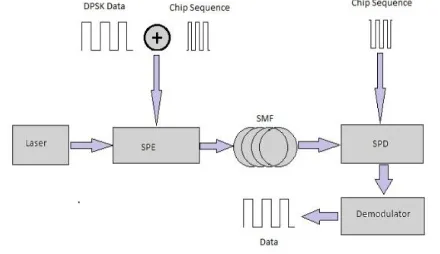
[image:2.612.333.553.101.228.2]In this experiment time domain SPE is designed by using an optical component having positive and negative dispersion value at operation wavelength of 1550nm it can be an optical fibre or a FBG or other optical component. At transmitter side optical component having negative dispersion is used to stretch or expand the optical pulse after optical pulse is feed into a phase modulator (PM) that is driven by DPSK data formats which is combined with the 16 bits chip length optical code driven at the rate of 40Gchips/sec. working of optical phase modulator is totally bases on bit of DPSK data phase modulator is driven by the optical code only is the DPSK data bit is ‘1’ otherwise or for bit ‘0’ it is driven by complement of optical codeby using this configuration it can be doneby using one Phase modulator. An optical fibre having single mode (SMF) with a positive and negative dispersionvalue of300 ps/nm are used tospread, optical pulse and generate the SPEsignal.At decoding side this part has the similar configuration as that of the encodingwith minor difference here phase modulator is driven only by the complementary optical codepattern that is used at encoding.
Figure 1: Basic structure of System
4. SIMULATION SETUP
© 2015, IRJET ISO 9001:2008 Certified Journal
Page 110
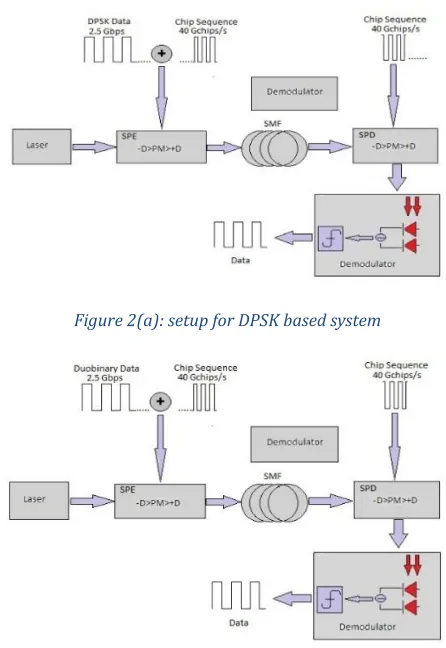
Figure 2(a): setup for DPSK based system
Figure 2(b): setup for Duobinary based system
5. RESULTS & DISCUSSIONS
This section of paper is mainly describe and shows the results that we have got from the system after the simulation study and discussed them accordingly. In this work we have carried out simulative study or analysis of spectral phase encoding and decoding for four users using four different 16 chips sequences for each user separately on the simulation setup of the OCDMA System that is shown in the figure 2 (a) & 2 (b). Performance of these system is analysed using output parameters as given below
(i) Input Signals: Input signal are generated at the transmitter for the both modulation formats input signal are shown in figures 3(a)for DPSK and Duobinary.
(ii)Optical Spectrum and Eye Diagram:in this section figure3(b) & (c) shows the optical spectrum& eye pattern of the DPSK and Duobinary modulation format, from the figure we can understand that Duobinary signal has better power at same input power. Which can easily retrieve at receiver side.
Figure 3(b) Optical spectrum for DPSK and Duobinary
[image:3.612.55.278.92.416.2] [image:3.612.316.567.108.269.2] [image:3.612.316.568.293.475.2]© 2015, IRJET ISO 9001:2008 Certified Journal
Page 111
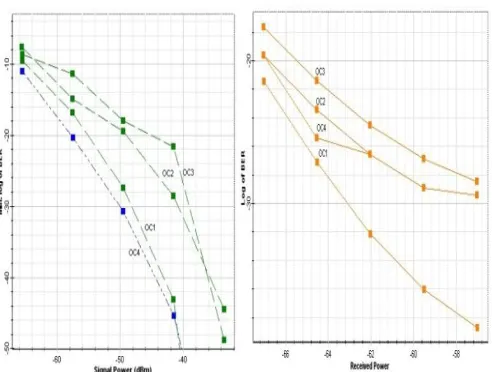
Figure3 (d): Min log BER and Received Power for DPSK& Duobinary
Above figure shows the Relation between Min log of BER and Received power for DPSK and Duobinary at four different optical codes (OC1, OC2, OC3 and OC4) and from this figure we analysed that Duobinary has the better performance than DPSK because it has more received power for the same values of Log of BER in both graph.
(iii)Input power and Received Power: Figure 3(e) is the graph which shows the Relation between Input power and Received power for optical codes (OC1) from this figure we conclude that Duobinary has the better performance than DPSK because Duobinary has more received power for low input power as compare to the DPSK.
[image:4.612.43.289.94.280.2]Figure 3(e): Power and Received Power (DPSK &Duobinary)
Table: Performance comparison of two modulation formats
Parameters
Formats
Chip Rates (Gcps)
Data Rats
(Gbps) Q-Factor Min BER
DPSK 40 2.5 6.77 1.30*e-012
DPSK 40 3 6.32 7.61*e-011
Duobinary 40 2.5 22.45 1.03*e-098
Duobinary 40 3 7.41 7.84*e-014
CONCLUSION
In this paper a simulative demonstration of time domain spectral phase encoded and decoded OCDMAusing a single phase modulator (PM) is carried out for two different optical modulation formats DPSK and Duobinary using four different optical codes of 16 chip length at 40GChips/s chip rate and in this system DPSK and Duobinary modulation formats of data rate 2.5 Gb/s are generatedusing the one phase modulator for theoptical fibre span of 50 kms. After the detailed analysis of OCDMA system for above two modulation formats at different bit rates,we concluded that Duobinary gives better performance as compare to
DPSK.Duobinary format gives a better value of Q factor and lower the BER value.
REFERENCES
[1].Zhensen Gao, Xu Wang, Nobuyuki Kataoka, Naoya Wada, “Rapid Reconfigurable OCDMA System Using Single-Phase Modulator for Time Domain Spectral Phase Encoding/Deco- ding and DPSK Data Modulation”, Journal of lightwave tech- nology, vol. 29, no. 3, february 1, 2011
© 2015, IRJET ISO 9001:2008 Certified Journal
Page 112
[3].X. Wang, Z. Gao, N. Kataoka, and N. Wada, “Time domain spectral phase encoding/DPSK data modulation using single phase modulator for OCDMA application,”Opt. Exp., vol. 18, no. 10, pp. 9879–9890, 2010.
[4].X. Wang and N. Wada, “Spectral phase encoding of ultra-short optical pulse in time domain for OCDMA application,”Opt. Exp., vol. 15, no.12, pp. 7319–7326, Jun. 2007.
[5].G. Bosco,A. Carena, V. Curri, R. Gaudino, and P. Poggiolini, “Modulation Formats Suitable for Ultrahigh Spectral Efficient WDM Systems” IEEE journal of selected topics in quantum electronics, vol. 10, no. 2, march/April 2004
[6].P. J. Winzer and R. J. Essiambre, “Advanced optical modulation formats,” in Proc. ECOC 2003, Rimini, Italy, Sept. 2003.
[7].J. A. Salehi, A. M. Weiner, and J. P. Heritage, “Coherent ultrashort light pulse code-division multiple access communi- cation systems,” J.Lightw. Technol., vol. 8, no. 3, pp. 478–491, Mar. 1990