© 2016, IRJET | Impact Factor value: 4.45 | ISO 9001:2008 Certified Journal | Page 2539
Performance Optimization and Emission Reduction on Diesel Engine
using Diesel Blend
Pradeesh A. R.
1; Deepu T
2; Vishnu Viswanath K
3; Monish M
4; Ratheesh P
5; Anuraj M
61Asst. Professor, Dept. of Mechanical Engineering, Ammini college of Engineering, Palakkad-678613 2Asst. Professor, Dept. of Mechanical Engineering, Ammini college of Engineering, Palakkad-678613
3,4,5,6B.Tech Scholars, Dept. of Mechanical Engineering, Ammini college of Engineering, Palakkad-678613
---***---Abstract -
In this paper, Performance Optimizationand Emission reduction on Diesel engine using diesel blend is discussed. Biodiesel production nowadays become the modern and technological area for researchers due to constant increase in the prices of petroleum, diesel and environmental advantages. Biodiesel from Jatropha oil was produced by alkali catalyzed transesterification process used for the study on engine performance evaluation. Recently it is being considered as one of the most promising alternative fuels in internal combustion engine. Performance test and exhaust gas analysis was conducted with single cylinder water cooled diesel engine with Jatropha oil as fuel.
Key Words: Bio diesel blend, Jatropha,
Transesterification.
1.INTRODUCTION
As civilization is growing, transport becomes essential part of life. The biggest problem is the growing population & depletion of fossil fuel. The rapid depletion of fossil fuel reserves with increasing demand and uncertainty in their supply, as well as the rapid rise in petroleum prices, has stimulated the search for other alternatives to fossil fuels. In view of this, there is an urgent need to explore new alternatives, which are likely to reduce our dependency on oil imports as well as can help in protecting the environment for sustainable development. Many alternative fuels are being recently explored as potential alternatives for the present high-pollutant
diesel fuel derived from diminishing commercial resources.
Biodiesel emerges as one of the most energy-efficient environmentally friendly options in recent times to full fill the future energy needs. It is a renewable diesel substitute that can be obtained by combining chemically any natural oil or fat with alcohol. It is an alternative fuel for diesel engine. The esters of vegetable oils and animal fats are known collectively as biodiesel. It is a domestic, renewable fuel for diesel engine derived from natural oil like Jatropha oil. Biodiesel has an energy content of about 12% less than petroleum-based diesel fuel on a mass basis. It has a higher molecular weight, viscosity, density, and flash point than diesel fuel. Pure biodiesel (B100) can be used in any petroleum diesel engine, though it is more commonly used in lower concentrations. Jatropha oil can also be used directly by blending with diesel.
© 2016, IRJET | Impact Factor value: 4.45 | ISO 9001:2008 Certified Journal | Page 2540 that the photosynthesis recycles carbon dioxide
produced by combustion of biodiesel. Therefore, biodiesel usage may reduce the greenhouse effect.
The growing concern due to environmental pollution caused by the conventional fossil fuels and the realization that they are non-renewable have led to search for more environment friendly and renewable fuels. Among various options investigated for diesel fuel, biodiesel obtained from jatropha has been recognized. The performance and characteristics are tested by using compression ignition engine. Biodiesel was made by transesterification process. The effect of test sample and commercial diesel on the engine power, fuel consumption, efficiency and exhaust gas temperature were ascertained by performance tests. The influence of blends emission CO, HC and NO were investigated by gas analyzer.
Thus the objective is to conduct a test in order to increase the efficiency of a diesel engine and help in controlling the emission of particulates in a considerable Amount. This is to be done by adding a certain diesel blend (here it will be jatropha oil) in consistent amounts and verify the conditions. Accordingly, tests are to be conducted to determine: Flash Point and Fire Point; Load Test; Emission of Particulates.
In section 2, the production of biodiesel and the
application of biodiesel were explained. The preparation of jatropha oil and jatropha biodiesel from jatropha curcas. Fuel analysis and properties of various biodiesel were discussed in Section 3. In Section 4, the experimental setup of the diesel engine to carry out the performance and emission test for diesel and various jatropha blends, its testing procedure to carry out the results were explained. In Section 5, the results and discussions of the experiments carried out.
Section 6 contains the Conclusions of the Paper
followed by references.
2. PRODUCTION OF BIODIESEL
Biodiesel refers to a vegetable oil- or animal fat-based diesel fuel consisting of long-chain alkyl (methyl, ethyl, or propyl) esters. Biodiesel is typically made by chemically reacting lipids (e.g., vegetable oil, animal fat (tallow) with an alcohol producing fatty acid esters. Biodiesel is meant to be used in standard diesel engines and is thus distinct from the vegetable and waste oils used to fuel converted diesel engines.
Biodiesel can be used alone, or blended with petro diesel in any proportions.
2.1 Biodiesel Blends
Blends of biodiesel and conventional hydrocarbon-based diesel are products most commonly distributed for use in the retail diesel fuel marketplace. Much of the world uses a system known as the “B” factor to state the amount of biodiesel in any fuel mix:
100% biodiesel is referred to as B100
20% biodiesel, 80% petro diesel is labeled B20 15% biodiesel, 85% petro diesel is labeled B15 10% biodiesel, 90% petro diesel is labeled B10 5% biodiesel, 95% petro diesel is labeled B5
Blends of 20% biodiesel and lower can be used in diesel equipment with no, or only minor modifications, although certain manufacturers do not extend warranty coverage if equipment is damaged by these blends.
The commercial method used for the biodiesel production is the transesterification (also called Alcoholysis). The transesterification consists on the reaction of oils or fats with an alcohol of low molecular weight (usually ethanol or methanol) with the presence of an alkaline catalyst (usually NaOH or KOH) to produce esters and glycerin. The stoichiometric ratio for the transesterification is as shown.
1 OIL/FAT + 3 METHANOL 3 METHYL ESTERS + 1 GLYCERIN
3. PREPARATION OF JATROPHA
© 2016, IRJET | Impact Factor value: 4.45 | ISO 9001:2008 Certified Journal | Page 2541 Fig -1: Seeds of Jatropha Fig -2: Jatropha Oil
3.1 Jatropha Oil
[image:3.595.304.565.126.547.2]Jatropha oil is vegetable oil produced from the seeds of the jatropha curcas, a plant that can grow in marginal lands. When jatropha seeds are crushed, the resulting jatropha oil can be processed to produce a high-quality biodiesel that can be used in a standard diesel car, while the residue (press cake) can also be processed and used as biomass feedstock to power electricity plants or used as fertilizer (it contains nitrogen, phosphorus and potassium).
Fig -3: Jatropha Production Cycle
4. EXPERIMENTAL SETUP
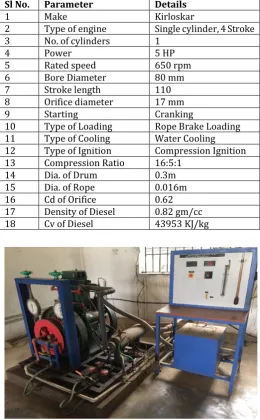
After preparation of various blends of biodiesel it is tested in engine to check the performance of engine. The kirloskar make single cylinder diesel engine was used for experimentation. The technical details of engine are given in table. The filter of the diesel engine was disconnected from its diesel tank and connected directly to fuel measuring unit.
Table- 4:Technical specification of diesel engine
Fig -4:Photographic view of the Test Engine
4.1 Test Procedure
At first the diesel engine with the particular specifications are set to be conduct the experiment. The diesel engine is cleaned thoroughly and made ready.
The engine started taking following precautions. Check the fuel level.
Check the lubricating oil level.
Check the cooling water circulation.
Check whether the engine is on no load
Sl No. Parameter Details
1 Make Kirloskar
2 Type of engine Single cylinder, 4 Stroke
3 No. of cylinders 1
4 Power 5 HP
5 Rated speed 650 rpm
6 Bore Diameter 80 mm
7 Stroke length 110
8 Orifice diameter 17 mm
9 Starting Cranking
10 Type of Loading Rope Brake Loading
11 Type of Cooling Water Cooling
12 Type of Ignition Compression Ignition
13 Compression Ratio 16:5:1
14 Dia. of Drum 0.3m
15 Dia. of Rope 0.016m
16 Cd of Orifice 0.62
17 Density of Diesel 0.82 gm/cc
[image:3.595.35.291.356.540.2]© 2016, IRJET | Impact Factor value: 4.45 | ISO 9001:2008 Certified Journal | Page 2542 The flash point and fire points of diesel in its pure form,
and then when added with jatropha are looked into using the pensky-marten apparatus.
After starting the engine the time taken for the consumption of 10cc of fuel is recorded at no load. Now load the gradually and take the time for the consumption of 10cc of fuel at constant rpm. Care should be taken that the engine is not overloaded. The engine was run initially using diesel for 10 minutes each for 25, 50, 75 and 100% load. The fuel consumption was measured by using stopwatch. During the initial and the final load applications, the AVL analyzer is used to detect the amount of effluent gases. The cooling water temperature at the outlet was maintained at 700C. The engine was stabilized before taking all measurements. Different blends of jatropha oil biodiesel with diesel were prepared namely B0, B10, B20, B30, B40 and B50.Before using blend, each one was mixed thoroughly. The filter of diesel engine was opened and complete mixture of biodiesel and diesel was drained so that it could not mix with the next blend. The experiment was repeated for each blend.
4.2 Performance Test
Fig- 5: Pensky–Martens closed cup apparatus
The flash point of diesel is 60 ºC. The fire point of diesel is 70 ºC.
4.3 Emission Test
The emission tests were conducted on a Kirloskar, four stroke, 4 cylinder petrol engine test-rig with rope braking loading system. AVL 444 Digas exhaust analyzer is used for measuring the emission of exhaust gas. The gas analyzer is capable of measuring CO, CO2, HC, NOx and O2 and is interfaced with RS232 cable. The temperature of the catalyst has been measured with K
type thermocouple and the data are stored using data logger.
Fig- 6:Photographic View of the AVL Exhaust Gas
Analyzer
5. RESULTS AND DISCUSSIONS
5.1 Flash and Fire Point
It is known that the flash point of the diesel is 600C and fire point is 700C. Now when the blend is added to diesel in varied proportions, we have the following fire and flash points obtained. The readings were obtained using the pensky-marten apparatus.
1. Diesel with 10% jatropha Flash point : 61 ºC Fire point : 70 ºC 2. Diesel with 20% jatropha
Flash point : 64 ºC Fire point : 80 ºC 3. Diesel with 30% jatropha
Flash point : 66 ºC Fire point : 81 ºC 4. Diesel with 40% jatropha
Flash point : 68 ºC Fire point : 84 ºC 5. Diesel with 50% jatropha
© 2016, IRJET | Impact Factor value: 4.45 | ISO 9001:2008 Certified Journal | Page 2543 5.2 Performance of Diesel
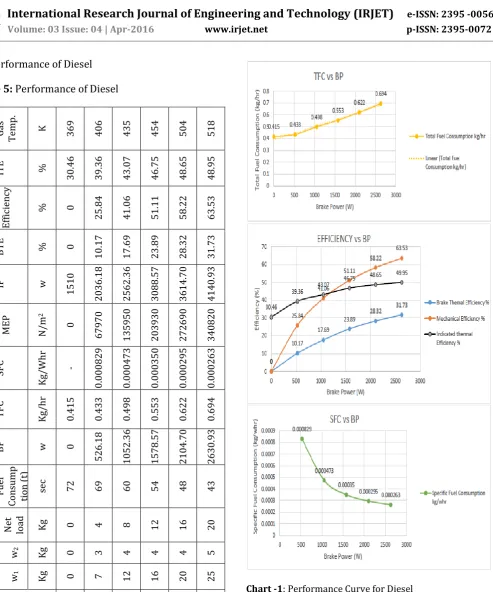
Table 5: Performance of Diesel
Exha
us
t
G
as
Te
mp. K 369 406 435 454 504 518
ITE % 30.46 39.36 43.07 46.75 48.65 48.95
M
ec
h.
Eff
ic
ie
nc
y
% 0
25.84 41.06 51.11 58.22 63.53
B
TE % 0
10.17 17.69 23.89 28.32 31.73
IP w
1510
2036.18 2562.36 3088.57 3614.70 4140.93
B
ra
ke
MEP N/m
2
0
67970 135950 203930 272690 340820
SF
C
Kg/W
hr
-
0.000829 0.000473 0.000350 0.000295 0.000263
TFC Kg/h
r
0.415 0.433 0.498 0.553 0.622 0.694
BP w 0
526.18 1052.36 1578.57 2104.70 2630.93
Ti
me
F
or
10 cc Fue
l
Con
sump
tion
(
t)
se
c
72 69 60 54 48 43
Loa
d N
et
loa
d
Kg 0 4 8 12 16 20
w2 Kg 0 3 4 4 4 5
w1 Kg 0 7 12 16 20 25
Sl No. 1 2 3 4 5 6
© 2016, IRJET | Impact Factor value: 4.45 | ISO 9001:2008 Certified Journal | Page 2544 Table 6: Performance of 80% Diesel & 20% Biodiesel
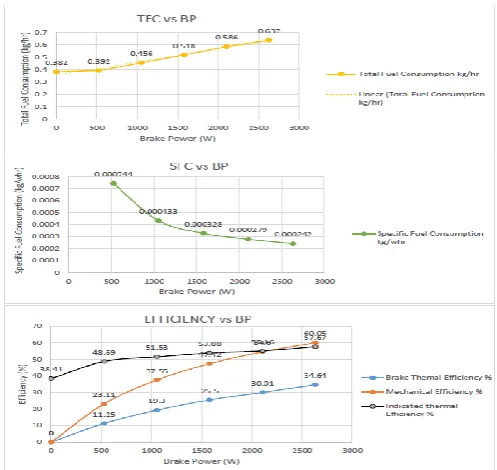
Chart -2: Performance Curve of 80% Diesel & 20% Biodiesel 5.3 Comparison
Chart -3: Brake Thermal Efficiency V/S Brake Power
Chart -4: Total Fuel Consumption V/S Brake Power
Exha
us
t
G
as
Te
mp. K 359 393 420 444 469 492
ITE % 38.41 48.61 51.53 53.88 55.16 57.61
M
ec
h.
Eff
ic
ie
nc
y
% 0
23.11 37.55 47.42 54.60 60.05
B
TE % 0
11.28 19.3.0 25.50 30.01 34.63
IP w
1750
2276.18 2802.36 3328.57 3854.7 4350.93
B
ra
ke
MEP N/m
2
0
67970 135950 203930 272690 340820
SF
C
Kg/W
hr
-
0.000744 0.000433 0.000328 0.00
0279
0.000242
TFC Kg/h
r
0.38 0.39 0.45 0.51 0.58 0.63
BP w 0 526.
2
1052.
4
1578.
6
2104.7 2630.9
Ti
me
F
or
10 cc
F
ue
l
Con
sumpt
i
on
(
t)
se
c
80 78 67 59 52 48
Loa
d Net
loa
d
Kg 0 4 8 12 16 20
w2 Kg 0 3 4 4 4 5
w1 Kg 0 7 12 16 20 25
© 2016, IRJET | Impact Factor value: 4.45 | ISO 9001:2008 Certified Journal | Page 2545 Chart -5: Specific Fuel Consumption V/S Brake Power
Chart -6: Indicated Thermal Efficiency V/S Brake Power
Chart -7: Exhaust Gas Temperature V/S Brake Power
It can be noted that the efficiency of the diesel
engine can be increased when around 60% of diesel blend, i.e. jatropha, is added to fuel. However, due to the density capacity that can be considered by the engine, more than 60% cannot be added since the density will gradually increase
The flash and fire points have their advantages
when the diesel bend is added, which can be clearly noted. This helps in favour of the engine.
Most of all, with the addition of the diesel bend, it
can be seen that the efficiency of the engine is much better than when only diesel was added.
5.4 Emission Results
Using the AVL Gas Analyzer Di-Gas 444, the tests were conducted for 100% diesel and 50% diesel and 50% jatropha conditions, for no load and 6-load stages. The following results were obtained.
Hydrocarbon emission (HC)
Biodiesel blends give lower HC emission as compared to diesel. Due to better combustion of the biodiesel inside the combustion chamber and the availability of the excess oxygen content in the biodiesel blends as compared to diesel. There are two reasons for hydrocarbon emissions:
(1) The leaner fuel mixture than required during combustion in diesel engine.
(2) Under-mixing of fuels.
HC emission of biodiesel is lower than diesel due to better combustion of biodiesel
Carbon Dioxide emission (CO2)
Carbon dioxide is a by-product of efficient and complete combustion. At all loads biodiesel blends give less CO2 as compared to diesel.
Carbon monoxide emission (CO)
Biodiesel blends give less carbon monoxide as compared to diesel due to complete combustion. CO emission is due to improper combustion of fuel and it mainly depends on many engine temperature, and A/F ratio. With increases the percentage of biodiesel blend, carbon monoxide decreases. The more amount of oxygen content of biodiesels result in complete combustion of the fuel and supplies the necessary
oxygen to convert CO to CO2.
NOx Emissions
About 90% nitrogen in the exhaust is in the form of nitric oxide. The three important factor which support the formation of nitric oxide such as oxygen concentration, combustion temperature and time. At higher loads, more fuel is burnt and higher temperature of the exhaust gases which
result in higher production of nitric oxide. The NOx from
© 2016, IRJET | Impact Factor value: 4.45 | ISO 9001:2008 Certified Journal | Page 2546 5.6 Advantages
By adding the appropriate jatropha in required amounts, we have found several significant changes. As such, the advantages can be as given below:
1. The CO2 emissions are lower for biodiesel
blends as compared with diesel.
2. The Hydrocarbon emissions are less than diesel
fuel as compared with biodiesel
3. The CO emissions are lower for biodiesel
blends as compared with diesel.
4. Fuel cost can be reduced.
5. Diesel engine efficiency increases
6. CONCLUSIONS
In this present work, the jatropha biodiesel represents a good alternative fuel with closer performance and better emission characteristics to that of a diesel. The advantage of adding the blend to the fuel was obtained during optimization, which was a definite success. The compression ignition engines can perform well on jatropha biodiesel without any modifications in engine. From the above analysis the biodiesel shows better performance compared to diesel in the sense of better performance characteristics. Here one blended biodiesel in diesel engine was tested and tabulated. Various performance characteristics were also plotted. Comparing the plots it was noticed that the 20:80 biodiesel blend gives more efficiency than the diesel engine and the engine performance is smooth. Hence the biodiesel can be used as a substituent for diesel.
REFERENCES
[1] Schwab A.W., M.O. Bagby, B. Freedman. 1987. Preparation and properties of diesel fuels from vegetable oils.
[2] Demirbas, A. 2006. Biodiesel production via non-catalytic SFC method and biodiesel fuel characteristics. [3] Avinash Kumar Agarwal, “Biofuels (alcohols and
biodiesel) applications as fuels for internal combustion engines” Renewable Energy, 27 November 2006. [4] Jincheng Huang, Yaodong Wang, Shuangding Li,
Anthony P.Roskilly,Hongdong Yu, Huifen Li, “Experimental Investigation on the Performance and Emissions of a Diesel Engine Fuelled with Ethanol-diesel Blend,” ATE 2697, 2008.
[5] Tiwari, A., Akhilesh, K., & Raheman, H. (2007). Biodiesel production from jatropha oil (Jatropha curcas) with high free fatty acids: An optimized process. Biomass & Bioenergy, 569-575.
BIOGRAPHIES
He is an Assistant Professor at Ammini College of Engineering, Palakkad. He received his BE and
M.Tech in Mechanical
Engineering 1996 and 2006 respectively. He has 7 years of industrial experience at HAL Bangalore and 9 years of teaching experience.
He is an Assistant Professor at Ammini College of Engineering, Palakkad. He received his B.Tech and M.Tech in Mechanical Engineering in 2013 and 2015 respectively. He has Presented and Published a paper in National conference on Emerging
Trends in Manufacturing,
organized by department of mechanical engineering, NSS college of engineering, Palakkad.
He is Pursuing B.Tech in
Mechanical Engineering at
Ammini College of Engineering, Palakkad.
He is Pursuing B.Tech in
Mechanical Engineering at