2018 International Conference on Information, Electronic and Communication Engineering (IECE 2018) ISBN: 978-1-60595-585-8
Rumor Classification Model Based on Deep Convolutional
Neural Networks
Rui SUN
1,2,*, Yong ZHONG
2and Wan-bo LUO
31
Department of Computer Science, Chengdu Normal University, China 2
Chengdu Information Technology Co., LTD, Chinese Academy of Sciences, China 3
School of Computer Science, Sichuan University, China
*Corresponding author
Keywords: Deep convolutional neural network, Rumor classification, Deep learning.
Abstract. With the rapid development of mobile Internet and big data technology, the recognition classification and trend prediction of rumors became has important research subject. At present, the traditional methods represented by the hidden markov model and support vector machine (SVM) has many problems, such as low classification accuracy, excessive reliance on long-term historical data and weak system practicability. Based on the new generation of artificial intelligence theory, such as deep learning, this paper proposed a rumor classification model based on deep convolutional neural networks. By training deep convolutional neural network, the classifier was constructed to solve the problem of high accuracy identification and classification of network rumors.
Introduction
Most of early research on rumor propagation is only the simple classification and semantics statistics. The description of the motivation and transmission dynamics of rumor propagation in the real world is relatively rough using the complex network transmission dynamics theory [1]. The traditional pattern recognition research mainly adopts the hidden markov model (HMM) and support vector machine (SVM) methods. It is inevitable to extract the features manually. In the context of big data, such methods inevitably consume a lot of manpower time, resulting in low efficiency of the model and low classification accuracy [2].
Architecture of Rumor Classification Model
There are many problems in current research, such as too simplified models, poor classification accuracy, over-reliance on long-term historical data for prediction results, excessive running time of models and hardware requirements, and weak system practicability. Given the deep learning theory and methods show outstanding performance in natural language processing, pattern recognition, time series prediction and to consider the feasibility of system implementation, this paper proposes a rumor classification model based on deep convolutional neural network, and strive to realize the current optimal solution.
Convolutional Neural Network (CNN) is developed on the basis of the standard neural network, are as for neural network on the overall architecture is very similar, both by the neuron as a node and has edge connection between adjacent layers. But convolutional neural network has only part of connections between adjacent layers, and the reduced connections sharply reduce the number of model parameters. In addition, the local receptive field convolution, weights of shared and downsapling effectively reduce the number of neurons and weights in the network. At the same time, pooling technology is adopted to maintain the extracted features, so that the features have the invariance of displacement, scaling and distortion. Therefore, convolutional neural network has become an efficient pattern recognition method, which is widely used in classification fields such as handwritten character recognition, image recognition, face recognition and natural language processing.
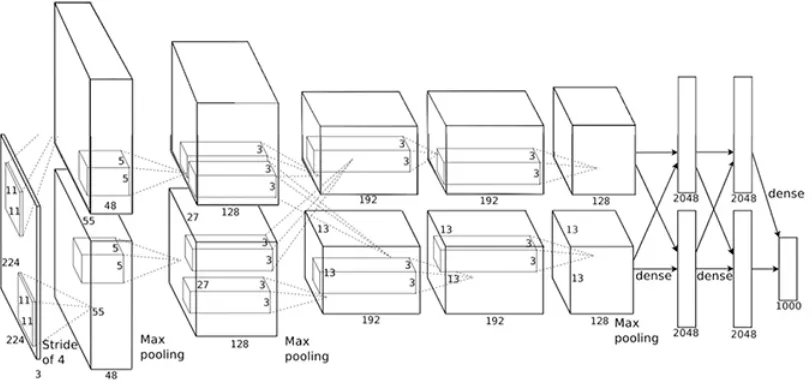
[image:2.595.96.502.418.612.2]In this paper, a rumor classification model based on deep convolutional neural network is proposed. Referring to the AlexNet architecture, this model adopts the parallel structure to build a deep convolutional neural network of 12 layers, including 1 input layer, 5 convolution layers, 3 pooling layers, 2 full connection layers and 1 Softmax output layer. The model structure is shown in figure 1.
Figure 1. Deep convolutional neural network rumor classification model.
Input Data Preprocessing
In this paper, Chinese Dataset use "zhiwei data". This data set mainly collects nearly 20,000 rumors spread on social network in the past five years through sina weibo API. It also notes in detail time, place, theme, influence and other features. English Dataset is Penn Treebank Dataset of Pennsylvania. PTB contain about 7 million words through the combination of automatic labeling and manual proofreading to carry out lexical labeling and syntactic structure labeling of English text.
dimensional space vectors. The transformed word vector matrix is the input of deep convolutional neural network.
Convolutional Layer
Convolutional layer is the most important structure in deep convolutional neural network. This model constructs five convolutional layers. The neurons in each convolutional layer are connected with a local region in the upper layer. The convolution is expressed as:
1 2
1 1 =
m m
ij ij i j
A B a b
(1)where A B, Rm1m2 represent the eigenvectors. DefinewRh k is 2-dimensional matrix as a
convolution kernel. The role of convolution kernel is in-depth analysis and abstract characteristics. Global features can be learned through the operation of multiple convolutional layers. The convolution kernels used in each convolutional layer of this model are 11×11, 5×5, 3×3, 3×3, 3×3, respectively. Multiple congeneric convolution kernels are used in each layer to carry out convolution operation synchronously, and the output of convolution layer is finally obtained. Therefore, the forward propagation process of convolution layer is expressed as:
: 1
( )
i i i h
s f wa b (2)
where si represents ith word vector in sentence S, wis the weight, bis the offset, and f is the activation function. To accelerate the convergence speed, the unsaturated nonlinear ReLU function
( ) max(0, )
f x x is used as the activation function in this model. The convolution kernel convolves
the input matrix, get an characteristic graphS[ ,s s1 2,,sm h 1],
1
m h
SR .
Pooling Layer
The output feature matrix through a convolutional layer increases in depth, but the dimensions on width and height do not change. If directly into the next convolutional layer, there are large calculation amount. Therefore, the pooling layer was usually added after convolutional layer to reduce the matrix size. The process of pooling can be thought of as transforming a high-resolution image into a lower-resolution one, so the pooling is also called down sampling. The pooling layer can not only speed up the calculation but also prevent overfitting problems.
Similar to the convolution kernel, the filter of pooling layer is generally set to a small 2-dimensional matrix, and then the pooling operation similar to convolution operation. There are mainly two ways for pooling operations, one is mean-pooling, and the other is max-pooling. This model uses the max-pooling method, which can effectively retain the most important features and eliminate irrelevant features while reducing the matrix size. In this model, the pooling layer with filter size of 2×2 is set after convolutional layer of layer 1, 2 and 5, respectively.
Full Connection Layer
After some convolutional layers and pooling layers, it generally sets 1 or 2 full connection layers at the end of deep convolutional neural network to give final classification results. After the processing of 5 convolutional layers and 3 pooled layers, this model can be considered that the information of input word vector has been abstracted into a feature with higher information content. Two full connection layers are set here to complete the classification task after feature extraction.
Softmax Output Layer
At the end of deep convolutional neural network, a Softmax output layer is set to classify rumor information. Softmax regression formula is expressed as:
'
1
( ) ( | ) i j
N y y
i i
j
softmax y y p i S e e
(3)where y1,y2,yN represents the output of full connection layer, yi'represents the vector after
regression processing, and N represents the number of categories. The output of full connection layer is used as confidence to generate new output, which can be understood as the probability distribution of an input sample belonging to different categories derived by the neural network, so the final classification result can be obtained. Based on the analysis of the characteristics of online rumor information and the annotation of data set, this model sets the rumor category as economic rumor, political rumor, life rumor, health rumor, entertainment rumor and other rumors.
Training and Optimizing Model
The training process of deep convolutional neural network is based on the above process. Fist, the labeled rumor information is input into the convolutional neural network as the training set, and propagates forward layer by layer until the classification results are obtained by Softmax output layer. And then the parameters of deep convolutional neural network are continuously optimized through back propagation. The effect and optimization objective of the model are defined by loss function. The parameters to be optimized in this model include two parts: the word vector and the network parameters.
The sample set is denoted {(S1,y1), (S2,y2),, (S,y)}, where Si is ith sentence,
i
y denotes its category label, denotes the number of samples, p y( i |Si, ) denotes the
probability of classifying sentences category yiwhen given parameter . The optimized loss function
is expressed as:
2 2 1
log ( i | i, )
i
L p y S
(4)where is the parameter of the regular term. In the actual operation, the stochastic gradient descent algorithm is adopted to minimize the objective function, so the parameter is updated in the following way
L
(5)
where is the learning rate.
This model also makes two adjustments in actual training. One is approximately 10000 news text information from Internet through Web crawlers expansion into the Chinese data set for enhance generalization ability. At the same time, in order to solve the data set of rumors text category imbalance problem, on the basis of original text to generate a new text message adopt some operation such as image rollovers and intercept. In this way, the final classification categories are adjusted to 6 categories of rumors and non-rumors, and there are 7 categories in total.
Summary
In order to solve the problems that the accuracy of rumor recognition and classification is not high and the generalization is not strong, a rumor classification model based on deep convolutional neural networks is proposed. Using neural network to automatically extract the features of local details, implements a parallel structure deep convolutional neural network. This model will transform rumors text information to word vector by Skip-Gram algorithm, and training model by multiple convoluting and sampling, extract multilayer complex characteristics of rumors, constantly optimize model parameters based on back propagation algorithm, finally using Softmax classifier classifies rumors.
Acknowledgements
This research was financially supported by Sichuan Science and Technology Program (Grants Nos. 2018JY0202), Sichuan Department of Education Science Program (Grants Nos. 18ZA0083) Education Informatization Application and Development Research Center Program (Grants Nos. JYXX17-005) and Chengdu Normal University Science Program (Grants Nos. CS14ZD03, YJRC2015-7).
References
[1] O. Oh, M. Agrawal, H.R. Rao, Community intelligence and social media services: A rumor theoretic analysis of tweets during social crises, MIS Quart. 37 (2013) 407-426.
[2] W. Li, S. Tang, S. Pei, The rumor diffusion process with emerging independent spreaders in complex networks, Phys. A, 397 (2014) 121-128.
[3] J. Wang, L. Zhang, Y. Chen, A New Delay Connection for Long Short-Term Memory Networks, Int. J. Neural. Syst. (2017) 1750061.
[4] K. Li, S. Mao, X. Li, Automatic lexical stress and pitch accent detection for L2 English speech using multi-distribution deep neural networks, Speech Commun.96 (2018) 28-36.
[5] Y. LeCun, Y. Bengio, G. Hinton. Deep learning, Nature, 521 (2015) 436-444.
[6] Q. Li, Z. Jin, C. Wang, Mining opinion summarizations using convolutional neural networks in Chinese microblogging systems, Knowledge-Based Syst. 107 (2016) 289-300.
[7] J, Bollen, H, Mao, X, Zeng. Twitter mood predicts the stock market, J. Comput. Sci. 2 (2011) 1-8.
[8] Z. Lei, Z. Yi, Big Data Analysis by Infinite Deep Neural Networks, J. Comput. Res. & Develop. 53 (2016) 68-79.
[9] D. Silver, A. Huang, C. J. Maddison, Mastering the game of Go with deep neural networks and tree search, Nature, 529 (2016) 484-489.