R E S E A R C H
Open Access
A hybrid projection method for solving a
common solution of a system of equilibrium
problems and fixed point problems for
asymptotically strict pseudocontractions in
the intermediate sense in Hilbert spaces
Chatchawan Watchararuangwit
1, Pongrus Phuangphoo
1,2and Poom Kumam
1**Correspondence:
1Department of Mathematics,
Faculty of Science, King Mongkut’s University of Technology Thonburi (KMUTT), Bang Mod, Thung Kru, Bangkok, 10140, Thailand Full list of author information is available at the end of the article
Abstract
In this paper, we introduce a new iterative algorithm which is constructed by using the hybrid projection method for finding a common solution of a system of equilibrium problems of bifunctions satisfying certain conditions and a common solution of fixed point problems of a family of uniformly Lipschitz continuous and asymptotically
λ
i-strict pseudocontractive mappings in the intermediate sense. Weprove the strong convergence theorem for a new iterative algorithm under some mild conditions in Hilbert spaces. Finally, we also give a numerical example which supports our results.
MSC: 47H05; 47H09; 47H10
Keywords: asymptotically strict pseudocontraction in the intermediate sense; hybrid projection method; system of equilibrium problems; fixed point problems
1 Introduction
LetCbe a closed and convex subset of a real Hilbert spaceHwith the inner product·,· and the norm · . Let{Fm}m∈be a family of bifunctions fromC×CintoR, whereRis the set of real numbers andis an arbitrary index set. Thesystem of equilibrium problems
is to findx∈Csuch that
Fm(x,y)≥, m∈,∀y∈C. (.)
The set of solutions of (.) is denoted bySEP(Fm), wherem∈, that is,
SEP(Fm) =
x∈C:Fm(x,y)≥,∀y∈C
. (.)
Ifis a singleton, then the problem (.) is reduced to theequilibrium problemof finding
x∈Csuch that
F(x,y)≥, ∀y∈C. (.)
The set of solutions of (.) is denoted byEP(F). Recall the following definitions.
A mappingA:C→His calledmonotoneif
Ax–Ay,x–y ≥, ∀x,y∈C. (.)
A mappingAis calledα-inverse-strongly monotone[, ], if there exists a positive real numberαsuch that
Ax–Ay,x–y ≥αAx–Ay, ∀x,y∈C. (.)
Clearly, ifAisα-inverse-strongly monotone, thenAis monotone.
A mappingAis calledβ-strongly monotoneif there exists a positive real numberβsuch that
Ax–Ay,x–y ≥βx–y, ∀x,y∈C. (.)
A mappingAis calledL-Lipschitz continuousif there exists a positive real numberL
such that
Ax–Ay ≤Lx–y, ∀x,y∈C. (.)
It is easy to see that ifAis anα-inverse-strongly monotone mapping fromCintoH, thenAis
α-Lipschitz continuous.
In , Qinet al.[] introduced the following algorithm for a finite family of asymp-toticallyλi-strictly pseudocontractions.
Letx∈Cand{αn}∞n=be a sequence in (, ). The sequence{xn}is as follows:
⎧ ⎪ ⎪ ⎪ ⎪ ⎪ ⎪ ⎪ ⎪ ⎪ ⎪ ⎪ ⎪ ⎪ ⎪ ⎪ ⎪ ⎪ ⎪ ⎪ ⎪ ⎪ ⎪ ⎪ ⎪ ⎪ ⎪ ⎪ ⎨ ⎪ ⎪ ⎪ ⎪ ⎪ ⎪ ⎪ ⎪ ⎪ ⎪ ⎪ ⎪ ⎪ ⎪ ⎪ ⎪ ⎪ ⎪ ⎪ ⎪ ⎪ ⎪ ⎪ ⎪ ⎪ ⎪ ⎪ ⎩
x=αx+ ( –α)Sx,
x=αx+ ( –α)Sx,
x=αx+ ( –α)Sx,
.. .
xN=αN–xN–+ ( –αN–)SNxN–,
xN+=αNxN+ ( –αN)SxN,
xN+=αN+xN++ ( –αN+)SxN+,
.. .
xN=αN–xN–+ ( –αN–)SNxN–,
xN+=αNxN+ ( –αN)SxN,
.. . .
(.)
It is calledthe explicit iterative sequenceof a finite family of asymptoticallyλi-strictly
wherei=i(n)∈ {, , , . . . ,N},h=h(n)≥ is a positive integer andh(n)→ ∞, asn→ ∞,
we can rewrite the above table in the following compact form:
xn=αn–xn–+ ( –αn–)Sih((nn))xx–, ∀n≥.
Next, Sahuet al.[] introduced new iterative schemes for asymptotically strictly pseu-docontractive mappings in the intermediate sense. To be more precise, they proved the following theorem.
Theorem (SXY) Let C be a nonempty closed and convex subset of a real Hilbert space H and T:C→C be a uniformly continuous asymptoticallyκ-strictly pseudocontractive mapping in the intermediate sense with a sequence{γn}such that F(T)is nonempty and
bounded.Let{αn}be a sequence in[, ]such that <δ≤αn≤ –κ for all n∈N.Let
{xn} ⊂C be a sequence generated by the following(CQ)algorithm:
⎧ ⎪ ⎪ ⎪ ⎪ ⎪ ⎪ ⎪ ⎪ ⎨ ⎪ ⎪ ⎪ ⎪ ⎪ ⎪ ⎪ ⎪ ⎩
u=x∈C chosen arbitrarily,
yn= ( –αn)xn+αnTnxn,
Cn={z∈C:yn–z≤ xn–z+θn},
Qn={z∈C:xn–z,u–xn ≥},
xn+=PCn∩Qn(u), ∀n∈N,
(.)
whereθn=cn+γnnandn=sup{xn–z:z∈F(T)}<∞.Then{xn}converges strongly
to PF(T)(u),where PF(T)is a metric projection from H into F(T).
In , Hu and Cai [] considered the asymptotically strictly pseudocontractive map-pings in the intermediate sense concerning the equilibrium problem. They obtained the following result in a real Hilbert space. Next, Cenget al.[] introduced the viscosity ap-proximation method for a modified Mann iteration process for asymptotically strict pseu-docontractive mappings in the intermediate sense and they proved the strong convergence of a general CQ-algorithm and extended the concept of asymptotically strictly pseudo-contractive mappings in the intermediate sense to the Banach space setting called nearly asymptotically strictly pseudocontractive mappings in the intermediate sense. Finally, they established a weak convergence theorem for a fixed point of nearly asymptotically strictly pseudocontractive mappings in the intermediate sense which are not necessarily Lipschitz continuous mappings.
Theorem (HC) Let C be a nonempty closed and convex subset of a real Hilbert space H and N≥be an integer,φ:C→C be a bifunction satisfying(A)-(A),and A:C→H be anα-inverse-strongly monotone mapping.Let for each≤i≤N,Ti:C→C be a uniformly
continuous ki-strictly asymptotically pseudocontractive mapping in the intermediate sense
for some≤ki< with sequences{γn,i} ⊂[,∞)such thatlimn→∞γn,i= and{cn,i} ⊂
[,∞)such thatlimn→∞cn,i= .Let k=max{ki: ≤i≤N},γn=max{γn,i: ≤i≤N},and
cn=max{cn,i: ≤i≤N}.Assume that=
N
i=F(Ti)∩EP(φ)is nonempty and bounded.
Let{αn}and{βn}be sequences in[, ]such that <a≤αn≤, <δ≤βn≤ –k for all
Let{xn}and{un}be sequences generated by the following algorithm: ⎧ ⎪ ⎪ ⎪ ⎪ ⎪ ⎪ ⎪ ⎪ ⎪ ⎪ ⎪ ⎪ ⎪ ⎪ ⎪ ⎪ ⎪ ⎨ ⎪ ⎪ ⎪ ⎪ ⎪ ⎪ ⎪ ⎪ ⎪ ⎪ ⎪ ⎪ ⎪ ⎪ ⎪ ⎪ ⎪ ⎩
x∈C chosen arbitrarily,
un∈C such thatφ(un,y) +Axn,y–un+rny–un,un–xn ≥,
∀y∈C,
zn= ( –βn)un+βnTih(n(n))un,
yn= ( –αn)un+αnzn,
Cn={v∈C:yn–v≤ xn–v+θn},
Qn={v∈C:xn–v,x–xn ≥},
xn+=PCn∩Qn(x), ∀n∈N∪ {},
(.)
whereθn=ch(n)+γh(n)ρn→,as n→ ∞,andρn=sup{xn–v:v∈}<∞.Then{xn}
converges strongly to P(x).
In , Duan and Zhao [] introduced new iterative schemes for finding a common solution set of a system of equilibrium problems and a solution of a fixed point set of asymptotically strict pseudocontractions in the intermediate sense and they proved these schemes converge strongly.
In , Shui Ge [] introduced a new hybrid algorithm with variable coefficients for a fixed point problem of a uniformly Lipschitz continuous mapping and asymptotically pseudocontractive mapping in the intermediate sense on unbounded domains and he proved strong convergence in a real Hilbert space.
Theorem (Ge) Let C be a nonempty,closed,and convex subset of a real Hilbert space H,
T:C→C be a uniformly L-Lipschitz continuous mapping and asymptotically pseudocon-tractive mapping in the intermediate sense with sequences{kn} ⊂[,∞)and{vn} ⊂[,∞).
Let qn= kn– for each n∈N.Let{xn}be the sequence generated by the following hybrid
algorithm with variable coefficients: ⎧ ⎪ ⎪ ⎪ ⎪ ⎪ ⎪ ⎪ ⎪ ⎪ ⎪ ⎪ ⎪ ⎪ ⎪ ⎨ ⎪ ⎪ ⎪ ⎪ ⎪ ⎪ ⎪ ⎪ ⎪ ⎪ ⎪ ⎪ ⎪ ⎪ ⎩
x∈C chosen arbitrarily,
C=C,
zn= ( –βˆn)xn+βˆnTnxn,
yn= ( –αˆn)xn+αˆnTnzn,
Cn={u∈Cn:yn–u≤ xn–u
–αˆnβˆn( –βˆn–βˆnL–qnβˆn)xn–Tnxn+αnθn},
xn+=PCn+(x), ∀n∈N,
(.)
where
θn= +r
(qn– )( +qnβˆn) + ( +qnβˆn)vn,
ˆ αn=
αn
+xn–x
and βˆn=
βn
+xn–x
Assume that the positive real number ris chosen so that Br(x)∩Fix(T)=∅and that {αn}and{βn}are sequences in(, )such that a≤αn≤βn≤b for some a> and for some
b∈(,+L).
Then{xn}converges strongly to a fixed point of T.
In this paper, motivated and inspired by the previously mentioned above results, we in-troduce a new iterative algorithm by the hybrid projection method for finding a common solution of a system of equilibrium problems of bifunctions satisfying certain conditions and a common solution of fixed point problems of a family of uniformly Lipschitz contin-uous and asymptoticallyλi-strict pseudocontractive mappings in the intermediate sense
in a real Hilbert space. Then, we prove a strong convergence theorem of the iterative algo-rithm generated by this conditions. Finally, we also give a numerical example which sup-ports our results. The results obtained in this paper extend and improve several recent results in this area.
2 Preliminaries
LetH be a real Hilbert space with the inner product·,·and the norm · . LetCbe a closed and convex subset ofH. For any pointx∈H, there exists a unique nearest point inC, denoted byPC(x), such that
x–PCx ≤ x–y, ∀y∈C.
PCis called the metric projection ofHontoCdefined by the following:
PC(x) =arg min y∈Cx–y.
We know thatPCis a nonexpansive mappingHontoC. It is also known thatPCsatisfies
PCx–PCy≤ PCx–PCy,x–y, ∀x,y∈H,
and
x–PCx,z–PCx ≥, ∀z∈C.
We will adopt the following notations:
() →for strong convergence andfor weak convergence. () ωw(xn) ={x:∃xnjx}denotes the weakw-limit set of{xn}.
() A nonlinear mappingS:C→Cis a self-mapping inC. We denote the set of fixed points ofSbyF(S)(i.e.,F(S) ={x∈C:Sx=x}). Recall the following definitions.
Definition . LetSbe a mapping fromCtoC. Then ()Sis said to benonexpansiveif
Sx–Sy ≤ x–y, ∀x,y∈C. (.)
()Sis said to beasymptotically nonexpansiveif there exists a sequence{kn} ⊂[,∞)
withkn→ asn→ ∞such that
Snx–Sny≤knx–y, for all integersn≥,∀x,y∈C. (.)
The class of asymptotically nonexpansive mappings was introduced by Goebel and Kirk (see []) in . It is known that ifCis a nonempty, bounded, closed, and convex subset of a real Hilbert spaceH, then every asymptotically nonexpansive self-mapping has a fixed point. Further, the setF(S) of fixed points ofSis closed and convex.
()Sis said to beasymptotically nonexpansivein the intermediate sense [, ] if it is continuous and the following inequality holds:
lim sup n→∞
sup x,y∈C
Snx–Sny–x–y≤. (.)
Putting ξn=max{,supx,y∈C(Snx–Sny–x–y)}, we see that ξn→ as n→ ∞.
Then (.) is reduced to
Snx–Sny≤ x–y+ξn, ∀x,y∈C.
The class of asymptotically nonexpansive mappings in the intermediate sense was intro-duced by Kirk and Brucket al.(see [, ]) as a generalization of the class of asymptotically nonexpansive mappings. It is known that ifCis a nonempty, bounded, closed, and convex subset of a real Hilbert spaceH, then every asymptotically nonexpansive self-mapping in the intermediate sense has a fixed point (see []).
()Sis said to becontractiveif there exists a coefficientk∈(, ) such that
Sx–Sy ≤kx–y, ∀x,y∈C. (.)
()Sis said to be aλ-strict pseudocontractionif there exists a coefficientλ∈[, ) such that
Sx–Sy≤ x–y+λ(I–S)x– (I–S)y, ∀x,y∈C. (.)
The class of strict pseudocontractions was introduced by Brower and Petryshyn (see []) in . Clearly, ifSis a nonexpansive mapping, thenSis a strict pseudocontraction with λ= . We also remark that ifλ= , thenSis called a pseudocontractive mapping.
()Sis said to be anasymptoticallyλ-strict pseudocontractionwith the sequence{dn}
(see also []) if there exists a sequence{dn} ⊂[,∞) withdn→ asn→ ∞and a
con-stantλ∈[, ) such that
Snx–Sny≤( +d
n)x–y+λ x–Snx
– y–Sny,
∀x,y∈C,∀n∈N. (.)
strict pseudocontraction withλ= . We also remark that ifλ= , thenSis said to be an asymptotically pseudocontractive mapping which was introduced by Schu [] in .
()Sis said to be anasymptoticallyλ-strict pseudocontractionin the intermediate sense with the sequence{dn}[, ] if there exists a sequence{dn} ⊂[,∞) withdn→ asn→ ∞
and a constantλ∈[, ) such that
lim sup n→∞
sup x,y∈C
Snx–Sny– ( +dn)x–y–λ x–snx
– y–sny≤,
∀x,y∈C,∀n∈N. (.)
Puttingcn=max{,supx,y∈C(Snx–Sny– ( +dn)x–y–λ(x–snx) – (y–sny))},
we see thatcn→ asn→ ∞. Then (.) is reduced to
Snx–Sny≤( +dn)x–y+λ x–snx
– y–sny+cn, ∀x,y∈C,∀n∈N.
The class of asymptotically strict pseudocontractions in the intermediate sense was in-troduced by Sahu, Xu, and Yao [] as a generalization of a class of asymptotically strict pseudocontractions.
For solving the equilibrium problem, let us give the following assumptions for the bi-functionFand the setC:
(A) F(x,x) = for allx∈C;
(A) Fis monotone,i.e.,F(x,y) +F(y,x)≤, for allx,y∈C; (A) for eachx,y,z∈C,lim supt→F(tz+ ( –t)x,y)≤F(x,y); (A) for eachx∈C,y→F(x,y)is convex and lower semicontinuous.
Lemma .([]) Let C be a nonempty closed and convex subset of a real Hilbert space H.
For any x,y,z∈H and given also a real number a∈R,the set
v∈C:y–v≤ x–v+z,v+a
is closed and convex.
Lemma .([]) Let C be a nonempty closed and convex subset of a real Hilbert space H.
Let F:C×C→Rsatisfy(A)-(A),and let r> and x∈H.Then there exists z∈C such that
F(z,y) +
ry–z,z–x ≥, ∀y∈C.
Lemma .([]) Assume that F :C×C→Rsatisfies(A)-(A).For r> and x∈H,
define a mapping Tr:H→C as follows:
Tr(x) =
z∈C:F(z,y) +
ry–z,z–x ≥,∀y∈C
. (.)
Then the following hold:
() Tris firmly nonexpansive,i.e.,for anyx,y∈H,
Trx–Try≤ Trx–Try,x–y; (.)
() F(Tr) =EP(F);and () EP(F)is closed and convex.
Lemma .([, ]) Let H be a real Hilbert space.Then the following identities hold:
(i) x–y=x–y– x–y,y,∀x,y∈H.
(ii) tx+ ( –t)y=tx+ ( –t)y–t( –t)x–y,∀t∈[, ],∀x,y∈H. (iii) x+y=x+ y,x+y.
Lemma .([]) Let C be a nonempty closed and convex subset of a real Hilbert space H,
and S:C→C be a uniformly L-Lipschitz continuous and asymptoticallyλ-strict pseudo-contraction in the intermediate sense.Then F(S)is closed and convex.
Lemma .([]) Let C be a nonempty closed and convex subset of a real Hilbert space H and S:C→C be a uniformly L-Lipschitz continuous and asymptoticallyλ-strict pseudo-contraction in the intermediate sense.Then the mapping I–S is demiclosed at zero,that is,if the sequence{xn}in C is such that xnx and xn–Sxn→,then x∈F(S).
Lemma .([]) Let C be a nonempty closed and convex subset of a real Hilbert space H.
Let{xn}be a sequence in H and u∈H,and let q=PCu.Suppose that{xn} is such that ωn(xn)⊂C and satisfies the condition
xn–u ≤ u–q, ∀n∈N.
Then xn→q.
Lemma .([]) Let C be a nonempty closed and convex subset of a real Hilbert space H.
Let S:C→C be an asymptoticallyλ-strict pseudocontractive mapping in the intermediate sense with the sequenceγn.Then
Snx–Sny≤
–λ λx–y+ + ( –λ)γn
x–y+ ( –λ)c n
,
for all x,y∈C and n∈N. 3 Main results
In this section, we prove a strong convergence theorem which solves the problem of find-ing a common solution of a system of equilibrium problems and a common solution of fixed point problems in Hilbert spaces.
Theorem . Let C be a nonempty closed and convex subset of a real Hilbert space H.Let M≥be a positive integer.Let{Fm}mM=:C×C→Rbe a bifunction satisfying(A)-(A).
Let{Si}Ni=:C→C be a uniformly Lipschitz continuous and asymptoticallyλi-strict
pseu-docontractive mapping in the intermediate sense for some≤λi< with the sequences
λ=max{λi: ≤i≤N},cn=max{cn,i: ≤i≤N}and dn=max{dn,i: ≤i≤N}.Assume
that:= (Mm=SEP(Fm))∩(
N
i=F(Si))is nonempty and bounded.Let{αn},{βn}be
se-quences in[, ]such that <a≤αn≤, <b≤βn≤ –λ,a,b∈R,∀n∈Nand{rm,n}be
a sequence in(,∞)such thatlimn→∞rm,n> .
Let{xn}be a sequence generated by the following algorithm:
⎧ ⎪ ⎪ ⎪ ⎪ ⎪ ⎪ ⎪ ⎪ ⎪ ⎪ ⎪ ⎪ ⎪ ⎪ ⎨ ⎪ ⎪ ⎪ ⎪ ⎪ ⎪ ⎪ ⎪ ⎪ ⎪ ⎪ ⎪ ⎪ ⎪ ⎩
x∈C chosen arbitrarily,
C=H,
un=TrFMM,nT
FM–
rM–,n· · ·T
F
r,nT
F
r,nxn,
zn= ( –βn)un+βnShi((nn))un,
yn= ( –αn)un+αnzn,
Cn+={w∈Cn:yn–w≤ xn–w+θn},
xn+=PCn+(x), ∀n∈N,
(.)
whereθn=ch(n)+dh(n)ρn→,as n→ ∞andρn=sup{xn–w:w∈}<∞and n=
(h(n) – )N+i(n),where i(n)∈ {, , , . . . ,N}.Then{xn}converges strongly to some point
p*,where p*=P(x ).
Proof The proof is split into seven steps. Step . We will show thatPis well defined.
From Lemma ., we getMm=SEP(Fm) is closed and convex. From the assumption of
{Si}Ni=and Lemma ., it follows that
N
i=F(Si) is closed and convex.
Therefore,:= (Mm=SEP(Fm))∩(
N
i=F(Si)) is closed and convex. Hence,Pis well defined.
Step . We will show thatCnis closed and convex for eachn≥.
By the assumption ofCn+, it is easy to see thatCnis closed for eachn≥. We only show
thatCnis convex for eachn≥.
Note thatC=His convex. Suppose thatCkis convex for somek≥. Next, we show
thatCk+is convex for the samek. For eachw∈Ck, we see that
yk–w≤ xk–w+θk
is equivalent to
xk–yk,w ≤ xk–yk+θk. (.)
TakingwandwinCk+and puttingw=tw+ ( –t)w, it follows thatw,w∈Ck, and so
xk–yk,w ≤ xk–yk+θk (.)
and
xk–yk,w ≤ xk–yk+θk. (.)
Combining (.) with (.), we obtain that
That is,
yk–w≤ xk–w+θk.
In view of the convexity ofCk, we see thatw∈Ck. This implies thatw∈Ck+. Therefore,
Ck+is convex. Hence,Cnis closed and convex for eachn≥.
Step . We will show that⊂Cnfor eachn≥.
Putm
n :=TrFmm,nT
Fm–
rm–,n· · ·T
F
r,nT
F
r,nxnfor everym∈ {, , , . . . ,M}and
n=Ifor alln∈N.
Therefore,un=Mnxn. It is obvious that⊂C=H. Suppose that⊂Ckfor somek≥.
Next, we show that ⊂ Ck+ for the same k. Taking p∈ and for each m ∈
{, , , . . . ,M}, we see thatTFm
rm,nis nonexpansive andT
Fm
rm,np=p. We note that
un–p=Mnxn–nMp≤ xn–p, ∀n∈N. (.)
We observe that
zn–p=( –βn)(un–p) +βn Sih((nn))(un–p)
= ( –βn)un–p+βnSih((nn))un–p
–βn( –βn)Shi((nn))un–un
≤( –βn)un–p+βn
( +dh(n))un–p+λSih((nn))un–un
+ch(n)
–βn( –βn)Shi((nn))un–un
≤( +dh(n))un–p–βn( –βn–λ)Sih((nn))un–un
+βnch(n)
≤( +dh(n))un–p+βnch(n). (.)
By virtue of convexity of · , one has
yn–p =( –αn)(un–p) +αn(zn–p)
≤( –αn)un–p+αnzn–p. (.)
Substituting (.) and (.) into (.), we obtain
yn–p≤( –αn)un–p+αnzn–p
≤( –αn)un–p+αn
( +dh(n))un–p+βnch(n)
≤ un–p+dh(n)un–p+βnch(n)
≤ un–p+dh(n)xn–p+ch(n)
=un–p+θn (.)
≤ xn–p+θn. (.)
Therefore,p∈Ck+, and so⊂Cnfor eachn≥. Hence,{xn}is well defined.
Step . We will show that{xn}is bounded.
Sinceis a nonempty closed and convex subset ofH, there exists a uniqueq∈such thatq=Px. By the assumption, we havexn=PCnxfor anyq∈⊂Cn. Then
This implies that{xn}is bounded. Therefore,{un},{zn}, and{yn}are also bounded.
Step . We will show that un–Siun → and xn–Sixn → as n→ ∞, ∀i∈
{, , , . . . ,N}.
Sincexn=PCnxandxn=PCnx∈Cn+⊂Cn, we have
≤ x–xn,xn–xn+
=x–xn,xn–x+x–xn+
≤–x–xn+x–xnx–xn+. (.)
Therefore,x–xn≤ x–xnx–xn+, and so
xn–x=x–xn ≤ x–xn+. (.)
Thus, the sequence{xn–x}is nondecreasing. Since{xn}is bounded,limn→∞xn–x
exists. On the other hand, from (.), we have
xn–xn+=xn–x+x–xn+
=xn–x+ xn–x,x–xn++x–xn+
=xn–x+ xn–x,x–xn+xn–xn++x–xn+
=xn–x– xn–x+ xn–x,xn–xn++x–xn+
≤ x–xn+–xn–x. (.)
The fact thatlimn→∞xn–xexists implies that lim
n→∞xn–xn+= . (.)
It is easy to see that
lim
n→∞xn–xn+i= , ∀i= , , , . . . ,N. Sincexn+=PCn+x∈Cn+, we have
yn–xn+≤ xn–xn++θn.
It follows that
yn–xn=yn–xn++xn+–xn
=yn–xn++xn+–xn+ yn–xn+,xn+–xn
≤ xn–xn++θn+xn+–xn+ yn–xn+,xn+–xn
≤xn+–xn+ yn–xn+xn+–xn+θn. (.)
Sinceθn→ asn→ ∞and from (.), we obtain lim
For eachp∈, it follows from the firmly nonexpansiveTFm
rm,n that for eachm∈ {, , ,
. . . ,M}, we have
mnxn–p
=TFm
rm,n
m–
n xn–TrFmm,np
≤mnxn–p,mn–xn–p
=
m
nxn–p+mn–xn–p–mnxn–mn–xn
,
for all ≤m≤M. Thus, we get
mnxn–p≤mn–xn–p–mnxn–mn–xn, for all ≤m≤M. (.)
This implies that for eachm∈ {, , , . . . ,M},
mnxn–p
≤nxn–p
–mnxn–mn–xn
–mn–xn–mn–xn
–· · ·–nxn–nxn
–nxn–nxn
≤ xn–p–nmxn–mn–xn
.
Therefore, by the convexity of · and (.) and the nonexpansivity ofTFm
rm,n, we get
yn–p≤ un–p+θn
=Mnxn–Mnp
+θn
≤mnxn–p
+θn
≤ xn–p–nmxn–mn–xn
+θn.
It follows that
mnxn–mn–xn
≤ xn–p–yn–p+θn
≤ xn–yn xn–p+yn–p
+θn. (.)
From (.) and (.), we obtain
lim n→∞
m
nxn–mn–xn= , ∀m∈ {, , , . . . ,M}. (.)
Then we have
un–xn ≤un–Mn–xn+Mn–xn–Mn–xn
+· · ·+nxn–nxn→, asn→ ∞.
Therefore,
lim
From (.) and (.), we get
un+–un ≤ un+–xn++xn+–xn+xn–un →, asn→ ∞. (.)
It follows that
lim
n→∞un+i–un= , ∀i∈ {, , , . . . ,N}. (.)
Since for any positive integer n≥N, we can write n= (h(n) – )N+i(n), wherei(n)∈ {, , , . . . ,N}, note that
un–Snun ≤un–Shi((nn))un+Sih((nn))un–Snun
=un–Sih((nn))un+Sih((nn))un–Si(n)un. (.)
From the conditions <a≤αn≤ and <b≤βn≤ –λ, we get
un–Sih((nn))un=
βn
zn–un
= αnβn
yn–un
≤
ab yn–xn+xn–un
.
From (.) and (.), we obtain
lim n→∞un–S
h(n)
i(n)un= . (.)
It is obvious that the relationsh(n) =h(n–N) + andi(n) =i(n–N) hold. Therefore, we compute
Sih((nn))–un–un≤Sih((nn))–un–Shi((nn–)–N)un–N++Shi((nn–)–N)un–N+–Sih((nn––NN))un–N
+Sih((nn––NN))un–N–un–N+un–N–un–N++un–N+–un
=Sih((nn))–un–Shi((nn))–un–N++Sih((nn––NN))un–N+–Shi((nn––NN))un–N
+Sih((nn––NN))un–N–un–N+un–N–un–N++un–N+–un.
Applying Lemma . and (.), we get
lim n→∞un–S
h(n)–
i(n) un= . (.)
From (.) and (.), it follows that
lim
n→∞un–Snun= . (.)
Since
for anyi∈ {, , , . . . ,N}, which gives that
lim
n→∞un–Siun= , ∀i∈ {, , , . . . ,N}. (.)
Moreover, for eachi∈ {, , , . . . ,N}, we obtain
xn–Sixn ≤ xn–un+un–Siun+Siun–Sixn →, asn→ ∞.
This implies that
lim
n→∞xn–Sixn= , ∀i∈ {, , , . . . ,N}. (.) Step . We will show thatp*∈:= (N
i=F(Si))∩(
M
m=SEP(Fm)).
(.) We will show thatp*∈N i=F(Si).
We takep*∈ω
w(xn) and assume thatxnjp*for some subsequence{xnj}of{xn}.
Note thatSiis uniformly Lipschitz continuous and (.), we obtain
lim n→∞xn–S
k
ixn= , ∀k∈N. (.)
It follows from Lemma . that
p*∈
N
i=
F(Si). (.)
(.) We will show thatp*∈Mm=SEP(Fm).
By Lemma ., for eachm∈ {, , , . . . ,M}, we have
Fm mnxn,y
+
rn
y–mnxn,nmxn–mn–xn
≥, ∀y∈C.
From (A), we get
rn
y–mnxn,nmxn–mn–xn
≥Fm y,mnxn
, ∀y∈C.
Takingn=nj, we get
y–mn
jxnj,
mn
jxnj–
m– nj xnj
rnj
≥Fm y,mnjxnj
, ∀y∈C.
From (.), we obtain that mnjxnj p
* asj→ ∞for each m∈ {, , , . . . ,M}
(espe-cially unj =Mnjxnj). Considering this together with (.) and (A), we have for each
m∈ {, , , . . . ,M}that
≥Fm y,p*
For any <t≤ andy∈C, we letyt=ty+ ( –t)p*. Sincey∈Candp*∈C, we obtain that
yt∈C, and soFm(yt,p*)≤. It follows that
=Fm(yt,yt)≤tFm(yt,y) + ( –t)Fm yt,p*
≤tFm(yt,y).
Dividing byt, for eachm∈ {, , , . . . ,M}, we get
Fm(yt,y)≥, ∀y∈C.
Lettingt→, from (A), we get
Fm p*,y
≥, ∀y∈C.
Therefore,p*∈M
m=SEP(Fm), and sop*∈.
Step . We will show that{xn}converges strongly toPx.
Setp*=P(x), then
xn+–x ≤p*–x, ∀n∈N.
Sinceis a nonempty closed and convex subset ofH, there exists a uniquep*∈such that
p*=P(x
). It follows from Lemma . thatxn→p*, wherep*=P(x). This completes
proof.
4 Deduced theorems
If we takeM= in Theorem ., then we obtain the following result.
Theorem . Let C be a nonempty closed and convex subset of a real Hilbert space H.
Let M≥be a positive integer.Let F:C×C→Rbe a bifunction satisfying(A)-(A).
Let{Si}Ni=:C→C be a uniformly Lipschitz continuous and asymptoticallyλi-strict
pseu-docontractive mapping in the intermediate sense for some≤λi< with the sequences
{cn,i} ⊂[,∞)such thatlimn→∞cn,i= and{dn,i} ⊂[,∞)such thatlimn→∞dn,i= .Let λ=max{λi: ≤i≤N},cn=max{cn,i: ≤i≤N}and dn=max{dn,i: ≤i≤N}.Assume
that:=EP(F)∩(Ni=F(Si))is nonempty and bounded.Let{αn},{βn} be sequences in
[, ]such that <a≤αn≤, <b≤βn≤ –λ,a,b∈R,∀n∈N,{rm,n}be a sequence in
(,∞)such thatlimn→∞rm,n> .
Let{xn}be a sequence generated by the following algorithm:
⎧ ⎪ ⎪ ⎪ ⎪ ⎪ ⎪ ⎪ ⎪ ⎪ ⎪ ⎪ ⎪ ⎪ ⎪ ⎨ ⎪ ⎪ ⎪ ⎪ ⎪ ⎪ ⎪ ⎪ ⎪ ⎪ ⎪ ⎪ ⎪ ⎪ ⎩
x∈C chosen arbitrarily,
C=H,
un=TrFnxn,
zn= ( –βn)un+βnShi((nn))un,
yn= ( –αn)un+αnzn,
Cn+={w∈Cn:yn–w≤ xn–w+θn},
xn+=PCn+(x), ∀n∈N,
whereθn=ch(n)+dh(n)ρn→,as n→ ∞andρn=sup{xn–w:w∈}<∞and n=
(h(n) – )N+i(n),where i(n)∈ {, , , . . . ,N}.Then{xn}converges strongly to some point
p*,where p*=P(x).
Remark . Theorem . improves and extends the theorem of Tada and Takahashi [] and the corollary of Duan and Zhao [].
If we setFm≡ andrm,n= for allm∈ {, , , . . . ,N}in Theorem ., then we obtain
the following result.
Theorem . Let C be a nonempty closed and convex subset of a real Hilbert space H.
Let M≥be a positive integer.Let{Si}Ni=:C→C be a uniformly Lipschitz continuous
and asymptoticallyλi-strict pseudocontractive mapping in the intermediate sense for some
≤λi< with the sequences{cn,i} ⊂[,∞)such thatlimn→∞cn,i= and{dn,i} ⊂[,∞)
such thatlimn→∞dn,i= .Letλ=max{λi: ≤i≤N},cn=max{cn,i: ≤i≤N}and dn= max{dn,i: ≤i≤N}.Assume that:=
N
i=F(Si)is nonempty and bounded.Let{αn},{βn}
be sequences in[, ]such that <a≤αn≤, <b≤βn≤ –λ,a,b∈R,∀n∈N,{rm,n}
be a sequence in(,∞)such thatlimn→∞rm,n> .
Let{xn}be a sequence generated by the following algorithm:
⎧ ⎪ ⎪ ⎪ ⎪ ⎪ ⎪ ⎪ ⎪ ⎪ ⎪ ⎪ ⎨ ⎪ ⎪ ⎪ ⎪ ⎪ ⎪ ⎪ ⎪ ⎪ ⎪ ⎪ ⎩
x∈C chosen arbitrarily,
C=H,
zn= ( –βn)xn+βnShi((nn))xn,
yn= ( –αn)xn+αnzn,
Cn+={w∈Cn:yn–w≤ xn–w+θn},
xn+=PCn+(x), ∀n∈N,
(.)
whereθn=ch(n)+dh(n)ρn→,as n→ ∞andρn=sup{xn–w:w∈}<∞and n=
(h(n) – )N+i(n),where i(n)∈ {, , , . . . ,N}.Then{xn}converges strongly to some point
p*,where p*=P(x ).
Remark . Theorem . improves and extends the theorem of Sahu, Xu, and Yao [], the theorem of Qin, Cho, Kang, and Shang [] and the corollary of Duan and Zhao [].
5 Numerical examples
In this section, in order to demonstrate the effectiveness, realization and convergence of algorithm of Theorem ., we consider the following simple example that was presented in reference [].
Example . Letx∈RandC= [, ]. For eachx∈C, we define
Sx= ⎧ ⎨ ⎩
kx, ifx∈[,]; , ifx∈(
, ],
It is easy to see thatS:C→Cis discontinuous atx=andSis not Lipschitz continuous. SetC= [,] andC= (, ].
For eachx,y∈C, we have
Snx–Sny=kn|x–y| ≤ |x–y|, ∀x,y∈Cand∀n∈N.
For eachx,y∈C, we have
Snx–Sny= ≤ |x–y|, ∀x,y∈Cand∀n∈N.
For eachx∈Candy∈C, we have
Snx–Sny=knx–
≤kn(x–y) +kny
≤kn|x–y|+kn|y|
≤ |x–y|+kn, ∀n∈N.
It follows that
Snx–Sny≤ |x–y|+kn
≤ |x–y|+kx–Snx– y–Sny+knK,
for allx,y∈Candn∈Nand for someK> .
Therefore,Sis an asymptoticallyk-strict pseudocontractive mapping in the intermedi-ate sense.
In Theorem ., we setN= ,Fm≡,βn= –k,αn=n+n. We apply it to find the fixed
point ofSof Example ..
Under the above assumption in Theorem . is simplified as follows:
⎧ ⎪ ⎪ ⎪ ⎪ ⎪ ⎪ ⎪ ⎪ ⎪ ⎪ ⎪ ⎨ ⎪ ⎪ ⎪ ⎪ ⎪ ⎪ ⎪ ⎪ ⎪ ⎪ ⎪ ⎩
x∈Hchosen arbitrarily,
C=H,
zn=kxn+ ( –k)Snxn,
yn= (n–n)xn+ (n+n)zn,
Cn+={w∈Cn:yn–w≤ xn–w+θn},
xn+=PCn+x, ∀n∈N.
(.)
In fact, in one-dimensional case,Cn+is a closed interval. If we set [an+,bn+] :=Cn+, then
the projection pointxn+ofx∈ContoCn+can be expressed as
xn+=P(x)
⎧ ⎪ ⎪ ⎨ ⎪ ⎪ ⎩
x, ifx∈[an+,bn+];
bn+, ifx>bn+;
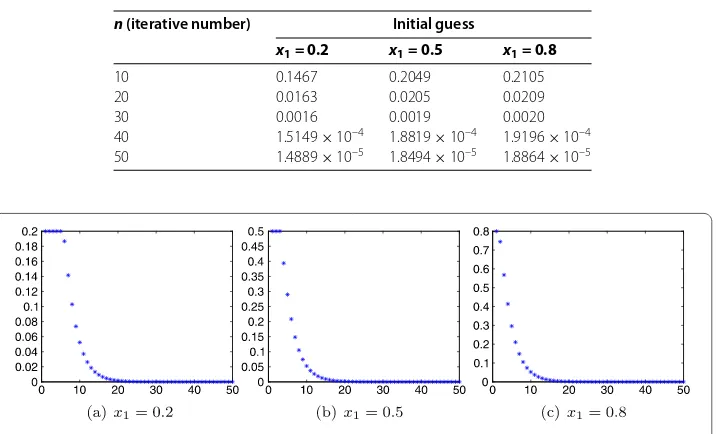
Table 1 The numerical results for an initial guessx1= 0.2, 0.5, 0.8
n(iterative number) Initial guess
x1= 0.2 x1= 0.5 x1= 0.8
10 0.1467 0.2049 0.2105
20 0.0163 0.0205 0.0209
30 0.0016 0.0019 0.0020
40 1.5149×10⁻⁴ 1.8819×10⁻⁴ 1.9196×10⁻⁴ 50 1.4889×10⁻⁵ 1.8494×10⁻⁵ 1.8864×10⁻⁵
Figure 1 The convergence comparison of different initial valuesx1.
The numerical results for an initial guessx= ., ., . are shown in Table . From the
table, we see that the iterations converge to which is the unique fixed point ofS. The convergence of each iteration is also shown in Figure for comparison.
Competing interests
The authors declare that they have no competing interests.
Authors’ contributions
All authors contributed equally and significantly in this research. All authors read and approved the final manuscript.
Author details
1Department of Mathematics, Faculty of Science, King Mongkut’s University of Technology Thonburi (KMUTT), Bang Mod,
Thung Kru, Bangkok, 10140, Thailand.2Department of Mathematics, Faculty of Education, Bansomdejchaopraya Rajabhat
University (BSRU), Thonburi, Bangkok, 10600, Thailand.
Acknowledgements
This research was supported by the Faculty of Science, KMUTT Research Fund 2553-2554.
Received: 15 June 2012 Accepted: 15 October 2012 Published: 30 October 2012
References
1. Browder, FE, Petryshyn, WV: Construction of fixed points of nonlinear mappings in Hilbert space. J. Math. Anal. Appl. 20, 197-228 (1967)
2. Liu, F, Nashed, MZ: Regularization of nonlinear ill-posed variational inequalities and convergence rates. Set-Valued Anal.6, 313-344 (1998)
3. Qin, XL, Cho, YJ, Kang, SM, Shang, M: A hybrid iterative scheme for asymptoticallyk-strictly pseudocontractions in Hilbert spaces. Nonlinear Anal.70, 2009 (1902-1911)
4. Sahu, DR, Xu, HK, Yao, JC: Asymptotically strict pseudocontractive mappings in the intermediate sense. Nonlinear Anal.70, 3502-3511 (2009)
5. Hu, CS, Cai, G: Convergence theorems for equilibrium problems and fixed point problems of a finite family of asymptoticallyk-strictly pseudocontractive mappings in the intermediate sense. Comput. Math. Appl.61, 79-93 (2010)
6. Ceng, LC, Ansari, QH, Yao, JC: Strong and weak convergence theorems for asymptotically strict pseudocontractive mappings in the intermediate sense. J. Nonlinear Convex Anal.11(2), 283-308 (2010)
7. Duan, P, Zhao, J: Strong convergence theorems for system of equilibrium problems and asymptotically strict pseudocontractions in the intermediate sense. Fixed Point Theory Appl. (2011). doi:10.1186/1687-1812-2011-13 8. Ge, C-S: A hybrid algorithm with variable coefficients for asymptotically pseudocontractive mappings in the
9. Geobel, K, Kirk, WA: A fixed point theorem for asymptotically nonexpansive mappings. Proc. Am. Math. Soc.35, 171-174 (1972)
10. Kirk, WA: Fixed point theorems for non-Lipschitzian mappings of asymptotically nonexpansive type. Isr. J. Math.17, 339-346 (1974)
11. Bruck, RE, Kuczumow, T, Reich, S: Convergence of iterates of asymptotically nonexpansive mappings in Banach spaces with the uniformly Opial property. Colloq. Math.65, 169-179 (1993)
12. Xu, HK: Existence and convergence for fixed points of mappings of asymptotically nonexpansive type. Nonlinear Anal.16, 1139-1146 (1991)
13. Kim, TH, Xu, HK: Convergence of the modified Mann’s iteration method for asymptotically strict pseudocontractions. Nonlinear Anal.68, 2828-2836 (2008)
14. Qihou, L: Convergence theorems of the sequence of iterates for asymptotically demicontractive and hemicontractive mappings. Nonlinear Anal.26, 1835-1842 (1996)
15. Schu, J: Iterative construction of fixed points of asymptotically nonexpansive mappings. J. Math. Anal. Appl.158, 407-413 (1991)
16. Marino, G, Xu, HK: Weak and strong convergence theorems for strict pseudo-contractions in Hilbert spaces. J. Math. Anal. Appl.329, 336-346 (2007)
17. Blum, E, Oettli, W: From optimization and variational inequalities to equilibrium problems. Math. Stud.63, 123-145 (1994)
18. Combettes, PL, Hirstoaga, SA: Equilibrium programming using proximal-like algorithms. Math. Program.78, 29-41 (1997)
19. Kumam, P, Jaiboon, C: A system of generalized mixed equilibrium problems and fixed point problems for pseudocontractions mappings in Hilbert space. Fixed Point Theory Appl.2010, Article ID 361512 (2010) 20. Martinez, CY, Xu, HK: Strong convergence theorem of the CQ method for fixed point processes. Nonlinear Anal.64,
2400-2411 (2006)
21. Tada, A, Takahashi, W: Weak and strong convergence theorems for a nonexpansive mapping and an equilibrium problem. J. Optim. Theory Appl.133, 359-370 (2007)
doi:10.1186/1029-242X-2012-252