CONTENT-BASED SEMANTIC WEB SERVICE DISCOVERY,
AN EMPIRICAL ANALYSIS WITH IMPLEMENTATION
1A.GNANASEKAR, 2R.M.SURESH
1Assistant Professor, R.M.D Engineering College, Department of Computer Science and Engineering,
Chennai, INDIA
2Principal, Sri Muthukumaran Institute of Technology, Department of computer Science and Engineering,
Chennai, INDIA
E-mail: [email protected] , [email protected]
ABSTRACT
Web Service discovery and composition is one of the key objectives of Service Oriented Architecture (SOA) which provides a loosely-coupled environment and enables flexible assembly of existing web services. Service discovery plays a vital role in the overall process of the service discovery and composition. The Web Ontology Language for Services (OWL-S) has emerged as the de facto standard for implementing business process from existing semantic web services. The semantic discovery is a challenging problem and attracts much attention both from industry and academia. This work focuses on the semantic web service discovery using empirical analysis.
Keywords: Semantic Web Services, Service Discovery, Ontology, Service Oriented Architecture, OWL-S.
1. INTRODUCTION
Service Oriented Architecture (SOA) has evolved to become a promising technology for the integration of disparate software components using internet protocols. The standards such as Web Services Description Language (WSDL) [13], Universal Description Discovery and Integration (UDDI) [15] and Simple Object Access Protocol (SOAP) [14] are three core standards for web services description, registration and binding respectively. Nowadays, a large number of companies and organizations are implementing their applications over internet. Thus, the ability to efficiently, effectively and dynamically discover and compose inter-organizational and heterogeneous services on the Web is an important step towards the development of the web services applications. When an atomic web service cannot satisfy the user’s requirements, there should be a possibility to combine existing services together in order to meet the user request. A composite service includes a set of atomic services together with the control and data flow among the services. The rest of the paper is organized as follows: In section 2 the related works and the motivation of this work is explained. In section 3, the content based service discovery by using the WordNet ontology is explained with example. Section 4 comprehensively and empirically analyzes the
service discovery with a test collection and section 5 briefs the conclusions and the future work.
2. RELATED WORK
time complexity [10]. A framework IRS-III (Internet Reasoning System) is used for creation and running of Semantic Web Services, which takes a semantic broker-based approach for the mediation between service requesters and service providers [11]. Web service composition system can help us to automate the business process, from specifying functionalities, to develop the executable workflows that capture non-functional requirements to deploy them on a runtime infrastructure [12]. Aviv Segev et al. [3] proposed a context-based semantic approach to the problem of matching and ranking of web services for possible service composition and provided a numeric estimation about the possible composition to the designer. An OWL-S service profile ontology based framework is used, for the retrieval of web services based on subsumption relation and structural case-based reasoning, which performs domain-dependant discovery [4]. Tamer Ahmed Farrag et al. [6] proposed a mapping algorithm that helps to facilitate the integration of the current conventional web services into the new environment of the Semantic Web. This has been achieved by extracting information from WSDL files and using it to create a new semantic description files using OWL-S. Hai Dong et al [20] proposed a conceptual framework for a semantic focused crawler, which combines the speciality of ontology-based metadata classification from the ontology, based focused crawlers and the speciality of metadata abstraction from the metadata abstraction crawlers, in order to achieve the goal of automatic service discovery, annotation, and classification in the Digital Ecosystems environment. Antonio Brogi [8], had emphasized the importance of behavioral information in service contracts, that inhibits the possibility of guaranteeing the service interactions and highlighted the limitations of currently available service registries which do not take into account the behavioral information. In the research to web services, a lot of initiatives have been conducted with the intention to provide platforms and languages for Web Service Composition (WSC) such as Business Process Execution Languages for Web Services (BPEL4WS) [1]. Presently some languages have the ability to support semantic representation of the Web services available on the internet such as the Web Ontology Language for Web Services OWL-S [2] and the Web Service Modeling Ontology WSMO [9].
Using OWL-S, web services are extended with an unambiguous description by relating the input and output parameters of the service to common
concepts defined in Web Ontology [17], which serve as the key mechanism to globally define and reference concepts. In this paper, architecture is proposed for the content based semantic web service discovery.
2.1 Motivation
Most of the works in this area had used a user query in the form of input and/or output for the service discovery, but not the textual content. This limitation in the service discovery process has given the motivation to propose a content based service discovery method. In order to facilitate service discovery based on the user given content, a new method is proposed in this paper which reads the textual content and after a refinement process it discovers more relevant web services from the registry.
3. SEMANTIC WEB SERVICE DISCOVERY
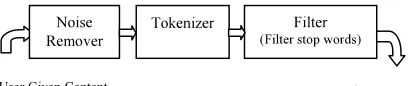
[image:2.595.307.511.420.463.2]As shown in Figure 1, the user given content will passes through the following refinement steps to extract the annotations (nouns) that are used to discover the services.
Figure 1: Refining Process Modules
• Removing noise from the query • Tokenizing the query
• Filtering “stop” words
The user query is content or a sentence which may contains several special characters like comma (,), dot (.), plus (+) etc. These special characters are indeed, not useful for the service discovery. So these types of words are considered as a noise and these are to be removed from the content to enable the service matchmaking. The noise remover module removes the noise, if any, present in the user given content. Once the noise is removed from the content, the remaining words are to be tokenized. The tokenizer will analyze the noise free content and separate each word as a token. The result of the tokenizer is a set of words which may also contain “stop words”. Stop words are nothing but verbs in natural language, such as “want”, “which”, “is”, “what” etc. These stop words are also indeed not useful for the service discovery. So these types of stop words are to be removed from the tokenized content. The noise free tokenized
User Given Content
Tokenizer Filter
(Filter stop words)
User Given Content Extracted Nouns
content is fed to the filter module to filter the “stop words”. The noise free and “stop word” free content is used for the service discovery. For example, suppose a user want to travel abroad and assume that the user has given the content “I want
to travel” as the input. The noise remover module
in the proposed framework will first check the existence of noises and are will be removed from the content. Since the given sentence is noise free and this content will then pass through the tokenizer module. Tokenizer will make the noise free content as a group of tokens. These tokens are then passed through the filterization module to find and remove the “stop words”. The words such as “I”, “want” “to” are all the stop words and are removed from the content. Finally, the word
“travel” will remain in the original content. The
word travel is given as the input and the services which are used for the travel booking will be discovered by the system.
4. EMPIRICAL ANALTSIS
An experiment has been conducted with the dataset for some selected text queries. A dedicated personal computer running Windows XP with 2GB
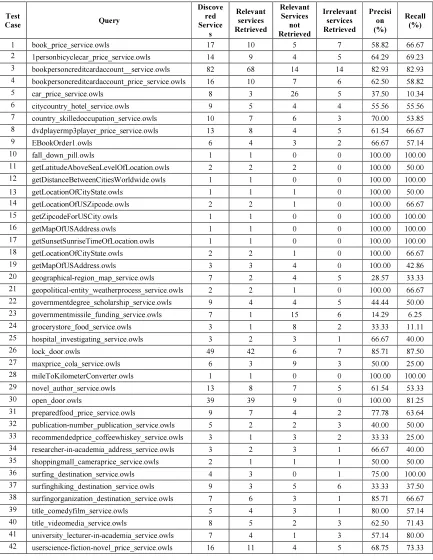
RAM is used for the experiment. The proposed matching algorithm is implemented in Java. Apache web server is used to access all ontologies used by the matchmaker and thus to avoid the incorrect path problems to access ontologies used to describe service IO concepts. OWL-S API [18] is used to parse the service profile ontology. OWL-S API is the most comprehensive library for working with OWL-S documents. For reasoning operations Pellet reasoner [16] has been used. Pellet is the mapping engine that matches the service advertisements with the service requests. To prove the validity of the matching algorithm, the same algorithm is applied to the dataset which was obtained from the OWL-S service retrieval test collection, OWL-S TC (version 4.0). This dataset consists of 1083 semantic web services from nine different domains namely, education, medical care, food, travel, communication, economy, weapons, geography and simulation. OWL-TC provides a set of 42 test queries covering all the nine domains.
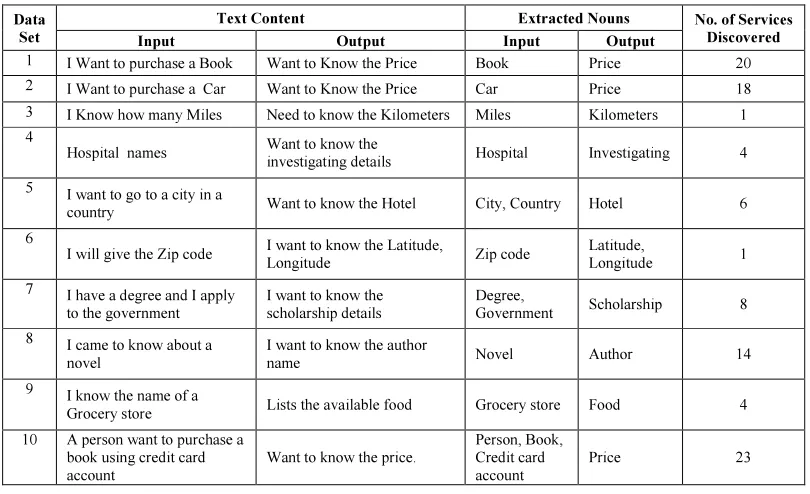
[image:3.595.96.501.430.677.2]The user given text contents, the extracted nouns and the number of services returned by the experiment is given in Table 1 and Table 2.
Table 1: Experimental Result For The User Given Text Contents
Data Set
Text Content Extracted Nouns No. of Services Discovered
Input Output Input Output
1 I Want to purchase a Book Want to Know the Price Book Price 20
2 I Want to purchase a Car Want to Know the Price Car Price 18
3 I Know how many Miles Need to know the Kilometers Miles Kilometers 1
4
Hospital names Want to know the
investigating details Hospital Investigating 4
5 I want to go to a city in a
country Want to know the Hotel City, Country Hotel 6
6
I will give the Zip code I want to know the Latitude,
Longitude Zip code
Latitude,
Longitude 1
7 I have a degree and I apply to the government
I want to know the scholarship details
Degree,
Government Scholarship 8
8 I came to know about a
novel
I want to know the author
name Novel Author 14
9 I know the name of a
Grocery store Lists the available food Grocery store Food 4
10 A person want to purchase a book using credit card account
Want to know the price.
Person, Book, Credit card account
Table 2: Experiment And Analysis Number Of Services Discovery By Service Discovery Algorithm.
Test
Case Query
Discove red Service
s
Relevant services Retrieved
Relevant Services
not Retrieved
Irrelevant services Retrieved
Precisi on (%)
Recall (%)
1 book_price_service.owls 17 10 5 7 58.82 66.67
2 1personbicyclecar_price_service.owls 14 9 4 5 64.29 69.23
3 bookpersoncreditcardaccount__service.owls 82 68 14 14 82.93 82.93
4 bookpersoncreditcardaccount_price_service.owls 16 10 7 6 62.50 58.82
5 car_price_service.owls 8 3 26 5 37.50 10.34
6 citycountry_hotel_service.owls 9 5 4 4 55.56 55.56
7 country_skilledoccupation_service.owls 10 7 6 3 70.00 53.85
8 dvdplayermp3player_price_service.owls 13 8 4 5 61.54 66.67
9 EBookOrder1.owls 6 4 3 2 66.67 57.14
10 fall_down_pill.owls 1 1 0 0 100.00 100.00
11 getLatitudeAboveSeaLevelOfLocation.owls 2 2 2 0 100.00 50.00
12 getDistanceBetweenCitiesWorldwide.owls 1 1 0 0 100.00 100.00
13 getLocationOfCityState.owls 1 1 1 0 100.00 50.00
14 getLocationOfUSZipcode.owls 2 2 1 0 100.00 66.67
15 getZipcodeForUSCity.owls 1 1 0 0 100.00 100.00
16 getMapOfUSAddress.owls 1 1 0 0 100.00 100.00
17 getSunsetSunriseTimeOfLocation.owls 1 1 0 0 100.00 100.00
18 getLocationOfCityState.owls 2 2 1 0 100.00 66.67
19 getMapOfUSAddress.owls 3 3 4 0 100.00 42.86
20 geographical-region_map_service.owls 7 2 4 5 28.57 33.33
21 geopolitical-entity_weatherprocess_service.owls 2 2 1 0 100.00 66.67
22 governmentdegree_scholarship_service.owls 9 4 4 5 44.44 50.00
23 governmentmissile_funding_service.owls 7 1 15 6 14.29 6.25
24 grocerystore_food_service.owls 3 1 8 2 33.33 11.11
25 hospital_investigating_service.owls 3 2 3 1 66.67 40.00
26 lock_door.owls 49 42 6 7 85.71 87.50
27 maxprice_cola_service.owls 6 3 9 3 50.00 25.00
28 mileToKilometerConverter.owls 1 1 0 0 100.00 100.00
29 novel_author_service.owls 13 8 7 5 61.54 53.33
30 open_door.owls 39 39 9 0 100.00 81.25
31 preparedfood_price_service.owls 9 7 4 2 77.78 63.64
32 publication-number_publication_service.owls 5 2 2 3 40.00 50.00
33 recommendedprice_coffeewhiskey_service.owls 3 1 3 2 33.33 25.00
34 researcher-in-academia_address_service.owls 3 2 3 1 66.67 40.00
35 shoppingmall_cameraprice_service.owls 2 1 1 1 50.00 50.00
36 surfing_destination_service.owls 4 3 0 1 75.00 100.00
37 surfinghiking_destination_service.owls 9 3 5 6 33.33 37.50
38 surfingorganization_destination_service.owls 7 6 3 1 85.71 66.67
39 title_comedyfilm_service.owls 5 4 3 1 80.00 57.14
40 title_videomedia_service.owls 8 5 2 3 62.50 71.43
41 university_lecturer-in-academia_service.owls 7 4 1 3 57.14 80.00
42 userscience-fiction-novel_price_service.owls 16 11 4 5 68.75 73.33
4.1 Degree Of Match
In the matching algorithm, the degree of match
The match is based on the relation between these concepts in their OWL ontologies. The matched services basically have associated with one of the three degree of matches: exact, plug-in, subsume. It may be assumed that, Cinput(R) and Coutput(R) respectively are the input and output concepts of a request R as well as Cinput(S) and Coutput(S) are the input and output concepts of a service S. The proposed matchmaking algorithms uses only ‘exact’ degree of match. The exact degree of match between the request R and services S is that, if Cinput(S) ≡ Cinput(R) Λ Coutput(S) ≡ Coutput(R) then service S exactly matches the request R.
4.2 Precision And Recall
The performance of discovery algorithm is measured using the information retrieval metrics called the precision and recall of the services returned by the algorithm. Precision is the ability to retrieve the most precise services. Higher the precision means better the relevance and more precise results, but may imply fewer results returned. The precision of n results of a query q is computed as follow.
100
A
A B
+
×
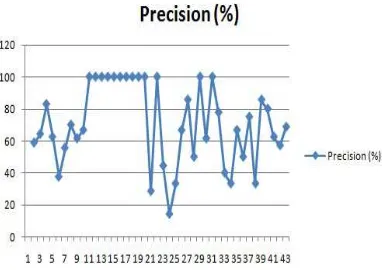
(1) [image:5.595.312.506.240.378.2]Where, A is number of relevant services retrieved and B is number of irrelevant services retrieved. Thus, precision is the ratio of the total number of relevant services retrieved to the total number of irrelevant and relevant services retrieved. The precision of the services returned by the algorithm is shown in Figure 2.
Figure 2: Precision of the discovered services
Recall means the ability to retrieve as many services as possible that match or are related to a query. The recall of n results of a query q is computed as follows.
100
A
A
+
C
×
(2)Where, A is number of relevant services retrieved and C is number of relevant services not retrieved. Hence, recall is the ratio of the number of relevant services retrieved to the total number of relevant services in the repository. The recall of the services returned by the algorithm is shown in Figure 2.
Figure 3: Recall of the discovered services
5. CONCLUSION
[image:5.595.94.285.517.652.2]REFRENCES:
[1] Andrews, F. Curbera, H. Dholakia, Y. Goland, J. Klein, F. Leymann, K. Liu, D. Roller, D.Smith, S.Thatte, I.Trickovic, and S.Weerawarana , “Business Process Execution
Language for Web Services Version
1.1”,-http://msdn.microsoft.com/en-us/library/ee2515
94(v=bts.10).aspx, May 2003.
[2] David Martin et al., “OWL-S Semantic Markup for Web Services,”- http://www.w3.org/
Submission/OWL-S/, November 2004.
[3] Aviv Segev and Eran Toch, “Context – based Matching and Ranking of web services for composition”, IEEE Transaction on Services
Computing, Vol. 2, No. 3, 2009, pp. 210-222.
[4] Georgios Meditskos and Nick Bassiliades, “Structural and Role-Oriented Web Service Discovery with Taxonomies in OWL-S”, IEEE
Transactions on Knowledge and Data
Engineering, Vol. 22, No. 2, 2010, pp. 278-290.
[5] Kaijun Ren, Jinjun Chen, Nong Xiao, Junqiang Song, Jinyang Li and P.R.China, “Building Quick Service Query List using WordNet for automated Service Composition”, IEEE Asia-Pacific Services Computing Conference(IEEE
APSCC’08), 2008, pp. 297-302.
[6] Tamer Ahmed Farrag, Ahmed Ibrahim saleh and Hesham Arafat Ali, “Toward SWSs Discovery: Mapping from WSDL to OWL-S Based on ontology search and standardization Engine”, IEEE Transactions on Knowledge and
Data Engineering, Vol. 25, No. 5, 2013, pp.
1135-1147.
[7] Jacek Kopecky, Tomas Vitvar, Carine Bournez and Joel Farrell, “SAWSDL: Semantic Annotations for WSDL and XML Schema”,
IEEE Internet Computing, Vol. 11, No. 6, 2007,
pp. 60-67.
[8] Antonio Brogi, “On the potential advantages of exploiting behavioural information for contract-based service discovery and composition”, The
Journal of Logic and Algebraic Programming,
Vol. 80, No. 1, 2011, pp. 3-12.
[9] Dumitru Roman, Uwe Keller, Holger Lausen, Jos de Bruijn, Ruben Lara, Michael Stollberg, Axel Polleres, Dieter Fensel, and Christoph Bussler, “Web Service Modeling Ontology”,
Applied Ontology Journal, Vol. 1, No. 1, 2005,
pp. 77-106.
[10] Dong-Hoon Shina, Kyong-Ho Leea and Tatsuya Sudab, “Automated generation of composite web services based on functional semantics”,
Journal of Web Semantics : Science, Services
and Agents on the World Wide Web, Vol.7,
No. 4, 2009, pp.332–343.
[11] John Domingue, Liliana Cabral, Stefania Galizia, Vlad Tanasescu, Alessio Gugliotta, Barry Norton and Carlos Pedrinaci, “IRS-III: A broker-based approach to semantic Web services”, Journal of Web Semantics: Science,
Services and Agents on the World Wide Web,
Vol. 6, No. 2, 2008, pp. 109–132.
[12] H Vikas Agarwal, Girish Chafle, Koustuv Dasgupta, Neeran Karnik, Arun Kumar, Sumit Mittal and Biplav Srivastava, “Synthy: A system for end to end composition of web services”, Journal of Web Semantics: Science,
Services and Agents on the World Wide Web,
Vol. 3, No. 4, 2005, pp. 311-339.
[13] Erik Christensen, Francisco Curbera, Greg Meredith and Sanjiva Weerawarana, “Web Services Description Language (WSDL) 1.1”, -
http://www.w3.org/TR/wsdl, 2001.
[14] Martin Gudgin, Marc Hadley, Noah Mendelsohn, Jean-Jacques Moreah,Henrik Frystyk Nielson,Anish Karmarkar and Yves Lafon ,“SOAP version 1.2 part 1: Messaging Framework (Second Edition)”,
http://www.w3.org/TR/soap12 -part1, 2007.
[15] http://uddi.org/pubs/uddi_ v3.htm
[16] Evren Sirin, Bijan Parsia, Bernardo Cuenca Grau, Aditya Kalyanpur and Yarden Katz, “Pellet: A Practical OWL DL Reasoner”,
Journal of Web Semantics: Science, Services
and Agents on the World Wide Web, Vol. 5,
No. 2, 2007, pp. 51-53.
[17] Sean Bechhofer, Frank Van Harmellen, Jim Hendler, lan Horrocks, Deborch L. McGuinness, Peter F. Patel and Lynn Andrea Stein, “OWL web ontology language”-
http:\\www.w3.org/TR/owl-ref/ , 2004.
[18] L Matthias Kiusch, Patrick Kapahnke, Benedikt Fries, Mahboob Alam Khalid and Martin Vasileski, “OWLS-TC - OWL-S Service Retrieval Test Collection Version 4.0”,-
http://projects.semwebcentral.org/projects/owls -tc/, 2010.
[19] D.K.Lin, “WordNet: An electronic lexical database”, Computational Linguistics, Vol. 25, No. 2, 1999, pp.292-296.
[20] Hai Dong and Farookh Khadeer Hussain “ Focused Crawling for Automatic Service Discovery, Annotation and Classification in Industrial Electronics”, IEEE Transcations on
Industrial electronics, Vol. 58, No. 6, 2011,