290
BAYESIAN ESTIMATION FOR ASSESSMENT BASED
LEARNING ICT
1J. ALVAREZ-CEDILLO, 1J. HERRERA-LOZADA, 1J. SANDOVAL-GUTIERREZ, , 1M.
OLGUIN-CARBAJAL, 1M. HERNANDEZ-BOLAÑOS, 1I.L RIVERA-ZARATE,
2T. ALVAREZ-SANCHEZ, AND 3R. CADENA-MARTINEZ
1Instituto Politécnico Nacional, CIDETEC, UP Adolfo López Mateos Edif. CIDETEC, México D.F., MEXICO
2Instituto Politécnico Nacional, CITEDI, Av. del Parque No. 131O, Mesa de Otay:: Tijuana, Baja California, MEXICO
3Universidad Tecnológica de México. Av. Marina Nacional No. 162, Col. Anáhuac, México, D.F. , MEXICO
E-mails: [email protected], [email protected], [email protected], [email protected], [email protected], [email protected], [email protected], [email protected]
ABSTRACT
Incorporating Information Technology and Communication (ICT) in education improves the level with sophisticated tools to increase a competence system in education. Bayes theorem is valid in all applications of the probability theory. In essence, the followers of traditional statistical probabilities only support repeatable experiments and have empirical confirmation while so-called Bayesian statistics allow subjective probabilities. The theorem can then serve to indicate how our subjective probabilities should be modified when receiving additional information from an experiment. Bayesian statistics prove their utility in certain estimates based on the subjective prior knowledge and reviews these estimates based on the empirical evidence. This feature is opening up new ways of understanding. This situation has had a strong tendency envisioned by offering new interpersonal communication systems worldwide and obtains and provides information of all kinds, instantaneously. This paper shows the tests performed in a study to measure learning under a Bayesian approach.
Keywords: Information Technology and Communication, Bayesian statistics, Bayesian algorithms,
Learning, Education.
I. INTRODUCTION
The new digital age of technology and its great influence in society have influenced plans and educational programs. (Kafyulilo, 2013) These institutions need to include the digital training curriculum, including the creation of technological infrastructure, the organization and management of schools, training materials and methodologies.
This allows sensitization, induction and aims at adapting new uses of cyberspace and the development and updating of knowledge, skills and attitudes that lead to this new learning environment. For these reasons, today the role of Teachers, Facilitators and Trainers have been transforming the traditional teaching approach to implementing schemes focused on teaching the student to be transformed into a self-promoting
cognitive-behavioral development through the use of ICT tool activities. (Malapile, 2013) There are several important elements to develop these concepts:
1. Teacher Profile
2. Professional Development.
[1] 1.1 Teacher Profile
The teacher must assimilate and develop general and specific knowledge related to ICT (Stiggins, 1989) (Orlando, 2014), as follows:
a) Basic Knowledge of Computer Systems. b) Capacity Building and General Skills for
291 c) Implementation of the Technical Standards
and Quality published by various National and International organizations related to information systems.
d) The constant development of values that help strengthen the personality, not only in the teaching role, but also in personal and professional life.
[2] 1.2 Professional Development.
During the process of curriculum development the teacher should identify their training needs, areas of opportunity, detect errors that must be corrected, or develop knowledge and skills to new technologies (Brasic, 2013).
The teacher is oriented to training professional and personal; the development of teachers' process shall incorporate the reflective conceptual plans (acquisition and deepening of a conceptual framework on educational processes in the classroom) (critical reflection and on their own teaching practice) and ICT practical use (leading to the generation of alternative and innovative solutions to their teaching) practices. (James, 2010) It is further considered that there are four areas that teachers must consider at all times to prepare the student in the development of skills, (knowing) that represents the transmission of knowledge and cognitive feedback, procedures, rules, regulations involved in the teaching-learning process.
Expertise and knowing how to innovate undoubtedly involves practical feedback on what contextualized knowledge, project generation, problem solving, application of innovative practices and ideas within the workplace.
The implementation of proposals to improve used in this paper, allow resolving among others the result of a perfect harmony of teaching-learning processes and synchrony of student skills for the sake of learning, the self.
(Doris, 1999) Applied techniques and methodology Fuller, consistent and reliable development of implementing powers should seriously consider updating processes on teaching techniques to detect this activity to support needs based on curriculum practice (Gellel, 2010).
These important aspects are the following:
a) The correct updating of knowledge allows their proper application to reduce the narrow path of the congruence of thought and action.
b) The Teaching of common sense, which refers to the spontaneous ideas the teacher calls on and a simplistic view of teaching and learning occurs. It is considered that teaching is something simple, common sense or appropriating some recipes or techniques and represents a natural failure of students in science subjects, for a fixed view or bias of their intellectual abilities, gender or social background.
In addition, negative attitudes and low motivation of students towards scientific knowledge of external causes and ignorance was attributed to the role of the teacher. (Herran, 2011) This proposal seeks to identify the underlying causes for poor academic achievement. The result may be that teachers are not prepared to use instrumental technological tools not know the major operating systems, modern programming languages, or simply do not know the technology and how it is currently applied in enterprises.
Table 1. Comparison Between Different Approaches
To Teacher Education.
The teacher needs to distinguish between theory and practice in training and refresher courses, plus everyday implementation of their knowledge, skills and attitudes in business practice and academia. This will support teachers to create in students a full vision of the new technology trends that will have to be handled and at the same time be able to attract students' interest towards the subject and promote a pro-active attitude. See Table 1.
Class
Modalities Training program Meaning of formation Instructional focus Common Methods Pre- construction Predefined
and closed Modeling Direct instruction Models and e xposure Re- constructive Undefined and open Conflict
292
2.TEACHINGMETHODOLOGY
The teacher should prepare their class, for example, plan students should to follow and learn, it is necessary to assess and comply within the curriculum frameworks in force and materials used for the understanding of the topics and implementation of strategies for meaningful learning. (Herran, 2011), See Figure 3.
The academic objectives concern expected learning in relation to curriculum content. The teacher should consider the conceptual level and motivation of their students, their knowledge, skills and attitudes and their own previous significance of auxiliary materials of a conceptual analysis or to perform the same tasks.
The University of Minnesota in the article proposed by David and Roger Johnson suggested 18 steps that allow the teacher to structure the learning process based on cooperative learning situations, which are:
a) Specify learning objectives b) Decide the size of the group c) Assign students to groups d) Condition the classroom
e) Plan teaching materials to promote interdependence
f) Assign roles to ensure interdependence g) Explain the academic task
h) Structuring the group goal of positive interdependence
i) Structuring the individual assessment j) Structuring inter-group cooperation k) the criteria for success
l) Specify the desired behaviors m) Monitor student behavior
n) Provide assistance in relation to the task o) Intervening to teach collaborative skills p) Provide closure to the lesson
q) To assess the quality and quantity of student learning
r) Assess the functioning of the group. \section{Implementation and result}
3.IMPLEMENTATIONANDRESULT
The following results were obtained from a thousand students and our study was applied to different schools in Mexico City, in order to evaluate teachers regarding the knowledge acquired by students. The following was assessed:
1. Academic achievement 2. Socio-affective relations
3. Professional relationships, group size and learning products.
Bayes theorem was enunciated by Thomas Bayes as the probability theory, and is the result given the conditional probability distribution of a random event A with respect to Bevent in terms of the conditional probability distribution of Bevent with respect to A event and marginal probability distribution of only A.
Given A, A, . . . , A a set of mutually
exclusive and exhaustive events, and such that the probability of each is non-zero. Let B be any event in which the conditional probabilities are known |.
Then the probability is | given by the
expression
PB|A
|
|
∑సభೕೕ (1)
Where:
are the a priori probabilities.
is the B probability of the hypothesis. | are the posterior probabilities.
This is valid if: ∀ 1,2,3, . . , ,
∑ | 1 (2)
Given a set of analyzed n=1000 students with a proven reference 0.7.The actions taken
0.7
0.7 !!"# (3)
Our parameter space is defined by:
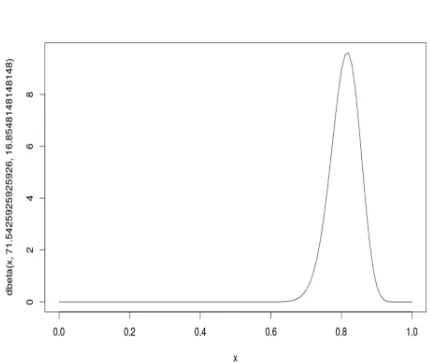
293 The best value of Beta is found, in this case it was specified that the median is (50% percentile) of 0.85, a second value 99.999% percentile of 0.95, and a third value percentile is 0.60 0.001%.
Beta values are obtained for: a= 71.5425925925926 b= 16.8548148148148
Where % 1,2,3, … , and % ∑సభ
.
The distribution of our data, expressed by a function, is shown in Figure 1, Figure 2, shows the likelihood
Input data, a represents the percentage of learning achieved, and b=1-a failure rate in our implementation.
Applying Bayesian inference to the problem, gives:
.
'
. % (5)
a=0.48625$ and b=0.51375$ and %=0.689.
Substituting obtained values in (5)
0.00048 ∗ 0.88 ∗ 0.688
0.0.68877979383
[image:4.595.94.519.50.784.2]Figure 1. A prior distribution.
Figure 2. Calculation Of The Likelihood.
The result shows a knowledge of 68.87% in the use of ICT.
Figure 3 shows the comparison of the Beta distributions at the beginning and end of Bayesian analysis.
4.CONCLUSION
The main goal of the evolutionary human recognition is to (bring about change), which is why this proposal contemplated each of the skills that students must apply to make them their own.
[image:4.595.302.517.158.339.2]294 In the mathematical analysis it was observed that the value obtained a priori 0.7 achievement corresponds to RMS, so when analysis is used creates the perfect joint between information likelihood and posterior.
The information model sample shows that the technological bases allow the use in our model of 68. 68% learning.
The main base of teacher education and development to achieve cognitive consistency, allows creating professional competences. These in turn benefit the student, who is the one who acquires the reflection learning. According to our action model, it appears that the value is below Pr=0.7, ,indicating that the model must be corrected
Our suggested actions are:
1. The teacher should adopt cognitive consistency as this activity directly affects the younger generations, without it the result of the teaching-learning process will remain a traditionalist model of teaching and will stay on the opposite side of the desired objective. The new model focused on meaningful learning.
2. Skills development to train teachers, but mainly the student, must be directed in the following competences:
A. Towards meeting business needs.
B. Adapting new technology tools.
C. Updates and modern technical knowledge. D. Attitudes towards the formation of entrepreneurial leaders.
E. Creators of the new changes that are conducive to achieving the desired success. F. Promote the values that allow to go with head held high toward your goals.
G. Create awareness that they are potentially successful.
H. Problems were observed in the two assessment points presented above:
1. In terms of academic performance: The cooperative learning situations are superior to competitive and individualistic learning in diverse areas such as social studies, science, language arts and math, and tasks, both involving acquisitions, retention and transfer of knowledge, such as Nature's conceptual (rules, concepts and principles). This effect was found in all educational levels studied.
295 students, including those who had at inception a low performance and self-esteem.
3. With respect to the group size and learning products: There are not a series of factors that influence the effectiveness of the work in cooperative teams. However, one factor was the size of the group in which it was observed that increasing the number of students per class, the performance of these was lower. This study recommends the creation of small working groups (no more than six members per team). Among the younger students the effectiveness of cooperative learning experiences is higher than in groups even less numerous. Furthermore, it was observed that the performance and learning outcomes are high when students must prepare a final exam.
REFERENCES:
[1] Brasic, Ch.Kramer, P. (2013): Realising Exemplary Practice-Based Education,Practice, [2] Education, Work and Society.Professional Preparation for PracticeVolume 7, pp. 25-32. [3] Pronin, D. (1999). The Role of Higher
Education in Professional Preparation for Early Childhood Education.Child and Youth Care Forum, Volume 28, Issue 1, pp. 33-42. [4] Gellel, A. (2010). Teachers as Key Players in
Values Education: Implications for Teacher Formation, International Research Handbook on Values Education and Student Wellbeing 2010, pp.163-177.
[5] Herrán, A. (2011). Técnicas didácticas para unaenseñanza más formativa. En N. Álvarez Aguilar y R. Cardoso Pérez (Coords.), Estrategias y metodologías para la formación del estudiante en la actualidad. Camagüey (Cuba): Universidad de Camagüey, ISBN: 978-959-16-1404-9.
[6] McDonald, J. T., \& Dominguez, L. A. (2010). Professional preparation for science teachers in environmental education. In The inclusion of environmental education in science teacher education(pp. 17-30). Springer Netherlands. [7] Kafyulilo, A., and Keengwe, J. (2013).
Teachers perspectives on their use of ICT in teaching and learning: A case study Education and Information Technologies, pp.1-11. [8] Malapile, S., and Keengwe, J. (2013).
Information communication technology planning in developing countries.Education and Information Technologies, pp.1-11.