ISSN: www.jatit.org E-ISSN:
CROWDSOURCING SYSTEMS ON FACEBOOK PLATFORM:
EXPERIMENT IN IMPLEMENTATION OF MATHEMATICAL
METHODS IN SOCIAL RESEARCH
NATALIA ANATOLIEVNA RYABCHENKO
Kuban State University
Stavropolskaya str., 149, Krasnodar, 350040, Russian Federation [email protected]
INNA VALERIEVNA MIROSHNICHENKO
Kuban State University
Stavropolskaya str., 149, Krasnodar, 350040, Russian Federation [email protected]
ANNA ALEKSANDROVNA GNEDASH
Kuban State University
Stavropolskaya str., 149, Krasnodar, 350040, Russian Federation [email protected]
ELENA VASILIEVNA MOROZOVA
Kuban State University
Stavropolskaya str., 149, Krasnodar, 350040, Russian Federation [email protected]
ABSTRACT
The authors research the potential of network civil society for public crowdsourcing development in the contemporary Russian environment. The authors consider public crowdsourcing as policy subjects’ activity aimed at using the resources of citizens, who are engaged in online social networks, to collectively work out (ideas, projects) and/or support (a decision, practice) political innovations in the sphere of public policy. Thus, the authors put forward the issue of studying the quality of network structures and mechanisms of their functioning. The article reflects the main results of empirical research that attempted to define the network structure uniting Russian crowdsourcing resources employing the mathematical analysis of social networks and network communities within the framework of Facebook platform and to describe dominant actors of the network structure under research on the basis of social graph theory.
Keywords: Online Space, The Internet, Online Social Networks, Network Analysis, Public Policy, Network
Civil Society, Crowdsourcing
1.
INTRODUCTIONThe Internet is the largest network in the world and claims the role of the global information space that has primarily cybernetic character. On the one hand, the Internet is a means of communication, on the other hand, the Internet is a special information environment. It is impossible to discuss social environment of the Internet that manifests itself in
society’s influence on creation, use and
reproduction of the content and its consequent influence on social development in isolation from the Internet itself. Thus, it is necessary to describe the space embracing not only the Internet but also its social setting and reproduction of political practices if we touch upon political sphere. Obviously, the main and major part of the online
space is the Internet that defines technological features of online space (absence of hierarchy, openness of access, orientation towards individual users) to the greater extent than other parts and imposes communicative, informative and service functions on online space. Manifestations of online space in economic (electronic payment), territorial (Runet, Bynet), social and political (crowdsourcing political practices) conditions bring it to the level higher than just functioning of global information space; its influence on the life of society is wider and more multifaceted.
ISSN: www.jatit.org E-ISSN: For example, Ushahidi was launched by Kenyan
civil activists in 2008 to cover the consequences of the political crisis [28]. While traditional mass media informed of ethnical clashes when they reached a definite level of escalation, Ushahidi provided the information instantly giving a chance to take measures to prevent the clashes. This platform created new type of information management due to the opportunities of online space. Ushahidi platform gave an impetus to the development of crowdsourcing technologies. In 2011, Iceland used the crowdsourcing technology to draw up and prepare new constitution [22].
Crowdsourcing can be called an innovative interactive mechanism of government and citizen interaction that gained technological and resource development in public policy of contemporary states. Crowdsourcing is rooted in the basic egalitarian principle: every person possesses knowledge and talent that can be useful for other people. In online space, crowdsourcing activities imply establishing network communities permitting to use the “diversity policy” for individual, collective and institutional network actors to develop and implement shared ideas or projects.
Crowdsourcing embraces a variety of forms and technologies of social participation of citizens in public policy; they are based on collective producing of social and political ideas and political practices. Hence, crowdsourcing promotes initiating and implementing political innovations that are considered as a guided change of definite features of political systems – political institutions or political processes aimed at enhancing the efficiency of the political system. Stimulation of different forms of crowdsourcing activities in public policy contributes to secure institutional innovations that can be characterized as public benefit.
2. NETWORK CIVIL SOCIETY AS A
SOURCE OF DESIGNING
CROWDSOURCING ACTIVITIES:
THEORETICAL BASES
M. Castells’s idea of network society is the conceptual ground for the research of the processes of crowdsourcing development and their influence on public policy [5]. M. Castells defines the network society as a resulting vector of development of information ecosystem where knowledge and information flows play a crucial role. By transforming institutions and practices,
social communication obtains absolutely new network features of universal character in the environment of information society.
Governance network theory, proved in the works by E. Klijn and J. Koppenjan [13], conceptually unites and links features of political networks, network components of political process considered as a policy development process and characteristics of network management. The theory of deliberative democracy, developed by J. Habermas, B. Ackerman, S. Benhabib, J. Dryzek, has the
fundamental importance for proving the
significance of crowdsourcing. The essence of deliberative democracy theory asserts that a contemporary state actively involves the institutions of civil society, democratic community, expert community in cooperation to come to an agreement and to take political decisions jointly with relative transparency. Based on this theory, crowdsourcing can be considered as a resource of modern public management.
In the network approach there are studies that are a developing scientific direction and researches of online space and its role in changing the format of public policy in the global [10], [19], [14] as well as in the national context; these changes are connected with the emergence of new online network structures and interactive mechanisms of network public management.
As for the crowdsourcing phenomenon itself, it has become the focus of scientists’ attention fairly recently. The economists were the pioneers of its research and it is quite natural as the crowdsourcing technologies were originally used in the activities of the subjects of economic sphere. Crowdsourcing was considered from the point of view of innovative business development and territories [3]. It was also discussed in the works developing neo-Marxist tradition as a new form of labor
exploitation. In sociological research [25]
crowdsourcing is viewed in the framework of “smart mob” approach. A special attention should be paid to G. Asmolov’s studies [1], in particular,
he researches the crowdsourcing resources,
motivation of participants and development
tendencies of this technology, assessing
crowdsourcing projects as a form of social mediation.
ISSN: www.jatit.org E-ISSN: influence the network practices in the traditional
political reality. In the early 2000s, genesis of online network communities is connected with the emergence of new models of social behavior in virtual social spaces that were based on technological platforms of network online services. [21]. These platforms are designed on the principle of ‘architecture’ of participation and cooperation in managing information sources and filling them with adequate content.
The potential of actors of public policy contained in network structures formed on the basis of network services depends on their ability to reproduce social services [9]; the conversion of these social resources will promote development of the civil and political participation practices. The following social resources can be included in the above:
The accessibility of the program artifacts necessary to carry out interactions to community participants;
Unified technical standards of communicative interactions;
Social time as an ability of a network community to simultaneously upload content on-line, to synchronize the activity of individual network actors and coordinate their activity;
Activity on creation (sharing) of content based on trust (shared by all the participants of a network community oriented at discussion);
Social navigation as joint activity of individual network actors, aimed at intensive community development based on collective identity and
extensive development of connections with
communities that belong to other networks;
Social planning as an ability to take collective decisions on social problems that are external to this community [2].
In contrast to network structures, formed in the framework of support networks in real sociocultural environment of the society, information networks serve as a primary foundation of the online network communities. In these information networks individual actors cooperate interactively to transfer information, to save resources, to teach and support each other, thus providing technological basis for online space. As T. Najbet and K. Roda state, virtual social spaces creating new communication online structures as a basis for social relations, carry out not only information and communication function but also functions of knowledge and social
relations management [16]. Individual design of secondary social identities, inherent to network
society is the social mechanism of
institutionalization of online network communities [4]. Unlike legitimizing identity (as a result of rationalization of belonging to dominant social institutions by social actors) and resistance identity (as a result of resistance of social actors who keep to principles contradicting to the accepted political and cultural patterns in the society), that are typical
for institutionalization of real network
communities, the process of creation of individual meaning in online network communities occurs on the basis of projecting identity [18].
Mechanism of projecting identification permits to create new identity by means of information and communication technologies; this new identity is
not connected with primary interpersonal
interaction, however, it changes the existing structure of social relations and re-defines its position in society. Social behavior of online communities is aimed at overcoming over-rationalization and excessive codification of everyday life, dominance of institutional complex in public policy and establishment of non-institutionalized public actors. C. Offe characterizes online community practices and defines them as meta-policy that has more cultural grounds than economic and political, as they reconstruct network civil society and public sphere that are going to be less dependent on strict regulation, control and interference from state [17].
Intensive development of online space not only promoted the establishment of network civil society but became the innovative source of its full self-development. Construction of marginal network communities (functioning in online, as well as offline space) possessing high potential for constructive civil action, which is caused by the development of social platforms (Facebook, Twitter, etc.). Network community users employ their connections as a source of accumulation of other resources of the network community in offline environment, thus promoting the formation of collective civil actions. It is important that collective style of thinking of individual network actors has become a key feature in construction of
online network communities that have a
ISSN: www.jatit.org E-ISSN: civil action in real public space. Unique experience
of civil actions, that small-scale individual actors of network communities have, becomes inclusive as it creates new forms, ways and channels of civil
participation and potentially can create
opportunities to implement the rights of a wider category of citizens on the basis of crowdsourcing activity.
It is essential that crowdsourcing resources become hubs coordinating the activities of network civil structure aimed at solving definite social problems and including separate network actors (leaders – voluntary helpers) and online network communities, as well as public management agencies and non-governmental organizations.
3. RESEARCH METHODOLOGY
Emergence of the first crowdsourcing projects in Russia was connected with the period of forest fires that spread across large territories of the country in summer 2010. In emergency conditions several dozen communities appeared in online social networks; they started with real-time information coverage of forest fire spreading and measures taken by authorities, then turned to coordination of immediate activities of volunteer networks on the basis of crowdsourcing technologies, which were implemented on the following web-projects: Fire Map and Virtual Rynda. These crowdsourcing projects permitted to compensate for the results of inefficient actions of public management agencies (regional and municipal authorities, agencies of the Ministry for Civil Defense, Emergencies and Disaster Response, etc.) by mobilizing volunteers, promptly coordinating their actions in emergency conditions and rendering necessary help to the population.
Though online network communities were the primary source of crowdsourcing activities in Russia, this type of activity was widely integrated into the practice of other actors of public policy; state (public management agencies),
business-structures, non-profit organizations, political
parties, etc. managed to solve public issues by means of various crowdsourcing technologies [14].
The advance of crowdsourcing as a type of innovative public activity has resulted in launching
a portal of crowdsourcing resources –
crowdsourcing.ru, uniting more than 300 different projects based on the single visualized database with territorial link and classification on selected criteria. However, the issue of network structures
quality and efficiency of their functioning remains open.
This empirical research was aimed at defining network structure linking Russian crowdsourcing resources on the basis of mathematical analysis (graph theory and stochastic modeling) of social networks and social communities within Facebook platform framework and describing dominant actors of the network structure under research on the basis of social graph theory. It allowed, in its turn, giving a quantitative and qualitative account of the structure and efficiency of functioning of network structures based on Facebook platform and oriented at crowdsourcing in their activity.
The first two crowdsourcing projects in Russia – “Virtual Rynda” [24] and “Lisa Alert” [23] were chosen as “starting points” of the empirical research. These crowdsourcing projects are the most popular in Russia; they emerged as a result of civil self-organization by means of online space.
“Virtual Rynda” is a platform for coordination of mutual help that is aimed at revealing the potential of Russian network community in the sphere of cooperation between the online space users and
different organizations, including non-profit
organizations, administrative bodies and business. The web site of the project permits users to share their problems and inform of their desire to help via different channels (the Internet, mobile connection), then these messages are classified and plotted on the map [24]. However, the project does not position itself as a charity fund or organization; it acts only as a digester of the help requests and offers, being a crowdsourcing platform that is functioning in online space. It is intended purely to stimulate social responsibility and civil activity.
“Lisa Alert” is one of the most powerful and resilient systems of search and response; it is a non-profit union that has set prompt response and civil support in the search of missing children as its main task [23].
ISSN: www.jatit.org E-ISSN: Facebook is a social platform in online space
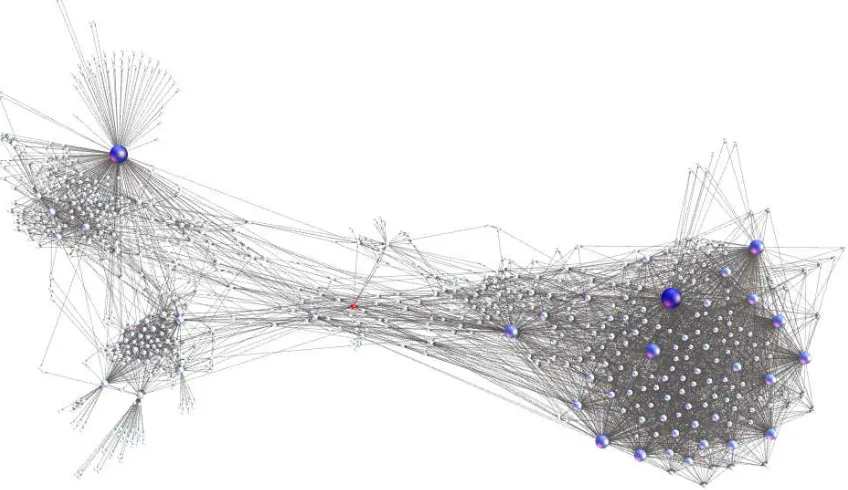
designed for creation and functioning of different social networks and network communities. Russian version of the service appeared in 2008, by now Facebook has 24 million users. Social graph produced by “FacebookRussia” page with the selection depth of 2, is presented on Figure 1 (the social graph is constructed on the basis of the principle of connectivity with the similar elements by means of “Like”). “Like” button activated by “Facebook” platform in February 2009 [12] has become a social plug-in that is used beyond the Facebook platform which enables the platform users sharing their social experience transforming the whole web into a giant social graph [8].
4. CROWDSOURCING IN RUSSIA: RESULTS
OF THE FACEBOOK PLATFORM
RESEARCH
[image:5.612.128.552.278.523.2]We should note that 21.84% of the pages in the given social graph represent governmental bodies and this is the largest block (the right part of the social graph presented in Figure 1), with the Ministry of Foreign Affairs of the RF holding the key position.
Figure 1. Social Graph “Facebookrussia”
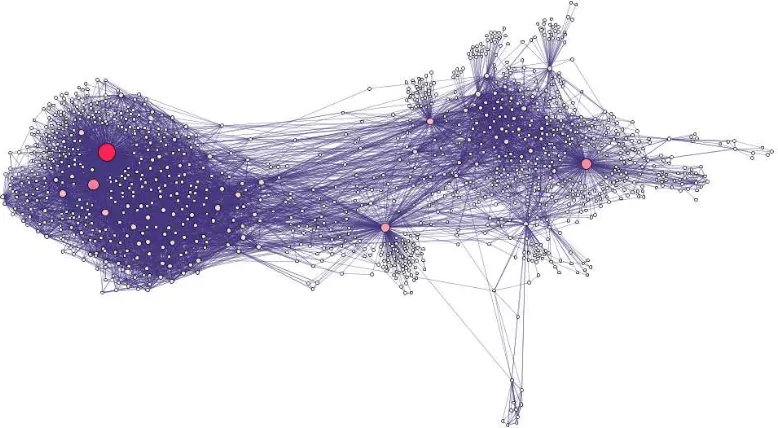
Facebook page of “Lisa Alert” project [7] has more than five thousand “likes”, “Virtual Rynda” Facebook page has about five hundred “like” marks. We import the data on these pages and pages related to them by means of “Like” button. We shall use the imported data to construct the social graphs of these pages, while the chosen pages will be the first nodes of the social graph and the sequent pages will be the neighboring nodes with
ISSN: www.jatit.org E-ISSN:
Figure 2. Social graph – “Virtual Rynda” + “Lisa Alert”
Figure 3. Network community “Crowdsourcing: Facebook-Russia”
The social graph is directed and has 6 vertices and 12 edges. After we rank the vertices by their degree – deg (x) (degree of a vertex is the number of edges of the graph incident with the graph vertex x) we obtain: deg(«Rynda.org»)=9; deg(“Russian
Union of Rescuers Moscow Branch)=5;
deg(“Firerescue Journal on Firefighters and
Rescuers”)=4; deg(“Search-and-Rescue
Detachment POLYARNAYA ZVEZDA”)=2;
[image:6.612.115.504.413.627.2]ISSN: www.jatit.org E-ISSN:
deg(“Search-and-Rescue Detachment “Lisa
Alert”)=2. To construct an online networking community, which is devoted to crowdsourcing technologies in Russia and forms the corresponding part of the information and news field, from the obtained social graph, we choose the vertex with the maximum degree and import its data to the
[image:7.612.93.521.170.401.2]social graph. As a result in the twenty-fifth iteration of the graph incrementing we obtain the network community “Crowdsourcing: Facebook-Russia” (Figure 3).
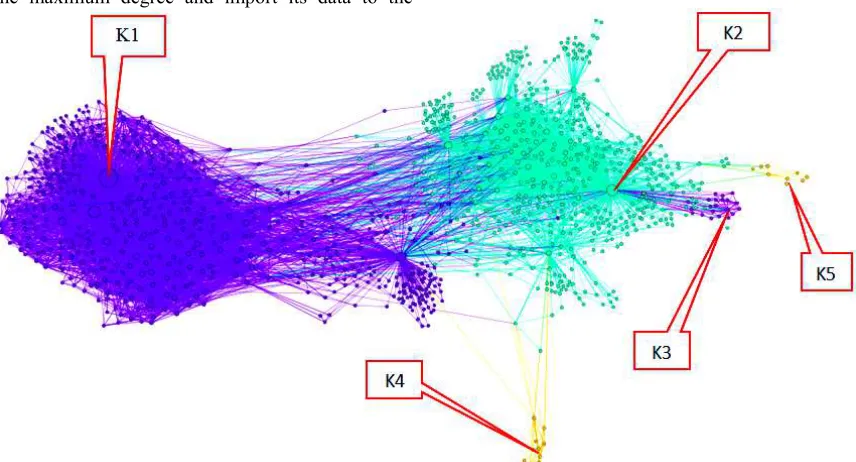
Figure 4. Clusters Of Network Community “Crowdsourcing: Facebook-Russia”
The obtained network community makes a directed social graph, containing 1180 vertices and 7861 edges. The community diameter is equal to 10 (d=10), i.e. the maximum spacing between two vertices is 10 edges [11], and to transmit information from one page to its most distant vertex it is necessary to engage eight pages, while the average distance is 3.795, that means averagely all the pages in the community are connected with each other by three or four links. The community density ratio, which characterizes the degree of the realized connections relative to the total number of connections with regard to potentially possible ones in the community, is equal to 0.006 and thus the community is potentially ready and able to form additional connections and is not a complete social graph.
The assessment of the community characteristics such as modularity (0.481) and clustering coefficient (0.34), which enable directed
modification of social structure to manage its functionality and commitment to a certain result, allows for the conclusion that the community has a low level of cohesion and a very low possibility that it may reach a condition of a “clique”, i.e. the condition when all the community participants interact with each other to the utmost. This bespeaks a low level of interaction of different
crowdsourcing projects, thus making the
community less stable against external influence. In general, five clusters are distinguished in the community: two large clusters with 603 vertices (K1) and 534 vertices (K2) and three small clusters with 19, 14 and 10 vertices respectively (K3, K4, K5) (Figure 4).
The largest cluster K1 is based on the vertices “Department of Culture of Moscow City” and “Vera Hospice Charity Fund”, K2 cluster is based on vertices “Educational portal of Non-Profit Organizations” and “New-Year Charity Fair Hearty Bazaar”. The “Vera Hospice Charity Fund” vertex is the link for the two clusters.
ISSN: www.jatit.org E-ISSN: community “Crowdsourcing: Facebook-Russia”.
Clusters K1 and K2 interact most intensively, and we should note that information is usually produced by K2 cluster and transmitted to K1, thus Non-Profit Organizations portal creates the information-news impulses (cluster K1 consists primarily of the pages of non-profit organizations) for authorities (cluster K2 consists primarily of pages of public authorities).
In general, both the clusters and the network community are formed by the pages initiated by different sectors of civil society and public policy bodies: 16.2% are non-profit organizations; 13.3% - various communities created by individual users of online space; 7.8% - government institutions; 5.8% - local public authorities; 4.7% - mass media (online versions of printed media); 3.98% - mass media operating solely in online mode; 3.9% - representatives of business; 3.39% - bodies related to education, etc.
As we noted previously, cluster K1 is formed by the Department of Culture of Moscow City and this vertex is the largest (by the order) in the whole network community “Crowdsourcing: Facebook-Russia”. The Department of Culture of Moscow City includes different agencies including the “Agency on the Youth Policy and Support of Civic Initiatives”. Within the framework of this office there is “Crowdsourcing” section in the Department site. This section presents the information on the first official Championship on Solving Urban Problems “Moscow Cup” that was held with the participation of the students of the leading higher education establishments under the auspices of the Department of Culture of Moscow City and
Moscow Youth Multiservice Centre. The
Championship aimed to unite the creativity of the best students, resources of big commercial companies and city authorities in solving the capital city’s problems [6]. Besides, the site presents the projects contest “Innovations for the City” - the projects can improve or are already improving the life of all Moscow citizens or a certain house, public area or city community. Young researchers, inventors, scientists suggest their ideas in the following nominations: transport and urban navigation, environment and rational nature
management, IT, advanced materials and
technologies. Mayor’s Office also develops some crowdsourcing projects that result in creation of
“The Active Citizen” portal” [27] and
“Crowdsourcing Projects by Moscow City
Government” [26].
“The Active Citizen” portal enables people to vote for the variants of Moscow City development or express their opinion on the city problems. The results of the electronic referenda have a feedback in a form of some social action and users get scores for participating in the polls. When a citizen’s score amounts 1000, he/she gets the status of “The Active Citizen” and access to the bonus shop, where the scores can be exchanged for some city services – bike hire, parking hours, cinema, theatre, museums tickets, etc. The portal has 25 thousand visitors a day, 1,091,513 users with the “active citizen” status, 26,454,174 polls held, the overall results of the portal work were realized in 90 projects of different social aspects for the period since June 2014 till May 2015.
“Crowdsourcing Projects by Moscow City
Government” portal informs about the
crowdsourcing projects that Moscow government implements. Six projects are presented in the portal “Our City”, “My Routes”, “My Office of Public Services”, “Moscow Standard of Children’s
Recreation”, “Models of Forming School
Management Boards”, “Moscow Polyclinic”.
The above mentioned activity generally explains the central position of the page of the Department of Culture of Moscow City in Facebook. Building and analysis of social networks with the help of graph theory makes it possible to describe and forecast the behavior of complex systems.
4. CONCLUSIONS
The final results of crowdsourcing activity in public policy are institutional political innovations, fixed in political practices of citizens. The reason for their high-speed spread in public policy is that the innovations diffusion is driven by interpersonal communication between the representatives of the social groups.
Crowdsourcing cannot exist beyond the network
communities, that produce socio-political
innovations and at the same time act as agents of their distribution in the public sphere. The results of crowdsourcing activity are institutionally fixed by means of social learning, which changes the normative and analytical patterns of the participants forming a certain practice.
Crowdsourcing activity by means of social
learning of participating citizens promotes
ISSN: www.jatit.org E-ISSN: public policy. First come micro-changes that do not
involve legal framework and analytical bases of individual political practices. The second level, due to the increasing inefficiency of the customary public practice, gives rise to seeking crowdsourcing tools to solve the problem, but this search of optimal solutions is carried out within the rigidly set and invariable frames of priorities and
expectations. The third level presupposes
institutional changes and shift of the policy paradigms, the customary ideas and routine methods are replaced by new ideas and creative solutions.
Therefore, crowdsourcing in public policy solves several important tasks at a time. First, it encourages consolidation and activation of network civic society in settling real-life social problems, thus causing the transformation of principles of efficient interaction between authorities and institutions of civic society. Second, crowdsourcing in public policy has the aim of initiating and introducing the innovations into the political management system. Crowdsourcing helps the social networks members to integrate to the political expert community and produce innovative projects which facilitate the distribution of efficient management practices, as well as modernization of certain spheres of life.
5. DISCUSSION
Development of online space as a field of political practices enables the researchers in humanities, particularly in political science, to apply the methods of natural science for analyzing comprehensive systems and processes, including online social networks and communities. With the use of graph theory and stochastic modeling it becomes possible to describe the processes occurring in online social networks and to analyze their activity in the context of development of socio-political processes.
Appearance of different social platforms in online space (Facebook, Twitter, VKontakte) enabled not only to construct online social networks and online network communities, but also to fix their parameters, using the complicated tools of the complex networks theory and graph theory. The choice of the modeling tools is conditioned by the fact that socio-political processes are time-continuous while the conditions of the external medium and internal constituent elements are constantly changing. As in social systems there is
always the element of uncertainty, one has to work not only with the mathematically fixed variables, but also with the probability distribution, thus forecasting the state of any social system, including a social network or a network community.
6. ACKNOWLEDGMENTS
The research was financially supported by a grant of the Ministry of Science and Education of Russia, № 2014/75 “The hybrid agencies in public policy: strategies and technologies of interaction with a state in new informational reality”.
REFERENCES:
[1] Asmolov, G. (2014). Virtual Rynda – The atlas
of help: mutual aid as a form of social activism. Crowdsourcing in transition from emergency to
everyday life. Available from:
http://book.globaldigitalactivism.org/chapter/ virtual-rynda-the-atlas-of-help-mutual-aid-as-a-form-of-social-activism/ [Last accessed on 2015 Dec 09].
[2] Bondarenko, S.V. (2002). Social system of cyberspace as a new social community.
Scientific Thought of the Caucasus, 12,
119-147.
[3] Brabham, D. (2008). Crowdsourcing as a model for problem solving: an introduction and cases.
Сonvergence: The International Journal of Research into New Media Technological
Studies, 14(1), 75-90.
[4] Castells, M. (2000). The Information Age.
Economy, Society and Culture. Moscow: Higher
School of Economics Publ.
[5] Castells, M. (1999). Development of society of
network structures. In New post-industrial wave
in the West: anthology. Moscow: Academia.
[6] Championship on Solving Urban Problems
“Moscow Cup”. Available from:
http://kultura.mos.ru/youth_policy/crowdsourci ng [Last accessed on 2015 Dec 15].
[7] Facebook page of “Lisa Alert” project.
Available from:
https://www.facebook.com/lizaalert?sk=wall [Last accessed on 2015 Dec 11].
[8] Fletcher, D. Facebook Looks to Get Personal.
Available from:
ISSN: www.jatit.org E-ISSN:
[9] Giddens, A. (2003). The Constitution of
Society: Outline of the Theory of Structuration.
Moscow: Academic Project.
[10] Hacker, K. L., & Dijk, J.van. (2000). Digital
democracy. Issues of theory & practice.
London: Sage publications.
http://dx.doi.org/10.4135/9781446218891
[11] Harary, F. (1969). Graph Theory. Addison
Wesley.
[12] Kincaid, J. Facebook Activates «Like» Button.
Available from:
http://techcrunch.com/2009/02/09/facebook- activates-like-button-friendfeed-tires-of-sincere-flattery/ [Last accessed on 2015 Dec 12]. [13] Klijn, E.-H., & Koppenjan, J. F. M. (2000).
Public management and Policy Networks. Foundations of a Network Approach to
Governance. Public Management, 2(2),
135-158.
http://dx.doi.org/10.1080/146166700411201 [14] Morozova, E.V., & Miroshnichenko, I.V.
(2015). Crowdsourcing in Public Policy: Technologies, Subjects and Its Socio-Political
Role. Asian Social Science, Vol. 11, 7.
Available from:
http://www.ccsenet.org/journal/index.php/ass/ar ticle/view/46399/25014 [Last accessed on 2015 Dec 08].
[15] Morozova, E. V., & Miroshnichenko, I. V. (2009). “Investors of the political capital”: Social networks in political space of the region.
Political studies, 2, 76-92.
[16] Najbet, T., & Roda, K. (2009). Virtual social
spaces: approaches, practices, prospects.
Sociological Annual. Moscow: The Russian Academy of Sciences (RAN) Publ.
[17] Offe, C. (1997). Varieties of Transition.
Cambridge: Policy.
[18] Pantin, V.I., & Semenenko, I.S. Issues of
identity and Russian modernization. Available
from: http://spkurdyumov.narod.ru/pantin.htm. [Last accessed on 2015 Dec 05].
[19] Ryabchenko, N.A. (2011). Online-social
networks in public policy, "seven bridges" of
Egypt. Human. Community. Management:
Scientific Information Journal, 4, 92-104.
[20] Ryabchenko, N.A., & Miroshnichenko I.V.
(2012). The institutionalization of public policy
in the online space of modern Russia.
Krasnodar: Education-South.
[21] Sokolova, M.E. (2010). Social scientific
networks of Runet and open code of Google
generation. Sociological annual. Moscow: The
Russian Academy of Sciences (RAN) Publ., 129–242.
[22] The Constitution of Iceland. Available from:
http://norse.ulver.com/hist/construs.html [Last
accessed on 2015 Dec 05].
[23] Web-site of “Lisa Alert” project. Available
from: http://lizaalert.org/ [Last accessed on 2015 Dec 10].
[24] Web-site of “Virtual Rynda” project. Available
from: http://rynda.org [Last accessed on 2015 Dec 1].
[25] Wexler, M. (2011). Reconfiguring the sociology of the crowd: Exploring crowdsourcing.
International Journal of Sociology and Social
Policy, 31(1/2), 6-20.
http://dx.doi.org/10.1108/01443331111104779 [26]“Crowdsourcing Projects by Moscow City
Government” portal. Available from:
http://crowd.mos.ru/about/ [Last accessed on 2015 Dec 05].
[27] “The Active Citizen” portal”. Available from: http://ag.mos.ru/ [Last accessed on 2015 Dec 07].