ISSN: 1992-8645 www.jatit.org E-ISSN: 1817-3195
E-LEARNING SYSTEM IN THE UNIVERSITY OF
JORDAN: PROBLEM SOLVING CASE STUDY
1WALA'A QUTECHATE, 2 TAMARA ALMARABEH, 3 REEM ALFAYEZ
1,2,3 Department Of Computer Information Systems, King Abdullah II School For Information
Technology,The University Of Jordan, 11942 Amman, Jordan
E-mail:[email protected] , [email protected] , [email protected]
ABSTRACT
No one can deny the role of Information and communication technology (ICT) in our lives, and integrating it with the various sectors. The education sector is not immune of these sectors. The learning process is a complex process where student’s motivation, teacher, learning material and several other aspects interact with each other. This paper investigates two areas which are learner motivation toward e-learning and the learning preferences of students by using Visual, Aural, and Kinesthetic (VAK) Model, measuring students satisfaction and motivation, the difficulty they encountered, and time consumed. Good response toward e-learning, where e-learning students scores were the same with traditional learning even higher in the kinesthetic e-learning approach with increasing satisfaction ,reduction of the difficulty, and excellent results in time reduction. Students exhibit a high level of preference for kinesthetic learning even they have a shallow background about dealing with computer systems.
Keywords: E-Learning, Learning Style Model, VAK Model.
1. INTRODUCTION
Information and communication technology (ICT) has become an important part of most organizations and businesses these days [1]. Previously, education was very teacher centered in the academic level with traditional lessons and practices which makes students passive. Wong et al. [2] point out that technology can play a part in supporting face- to-face teaching and learning in the classroom.
E-learning is used to illustrate a learning environment that takes place away from the real traditional classroom and campus. It involves all type of electronically supported teaching and learning [15]. E-learning can be defined as the use of computer and network technology to deliver knowledge to individuals [3]. It includes computer-based learning, virtual classroom benefits and digital collaboration, and web based leaning [4].
People in general (including university students) differ from each other in learning styles. Some like to read, whereas others prefer to listen, which will have a great impact on their grades and performance, Therefore importance appeared for considering learning styles in
course preparation and in bringing issues that help faculty and administrators.
Learning styles are various approaches of learning. They allow individual to learn best. Most people prefer an identifiable way of interacting with, taking in, and processing information. “People learn differently and there is said to be dissimilar learners” [6]. Based on this concept, the idea "learning styles" originated in the 1970s [4]. We can’t say there is right way to learn and wrong way to learn in a specific situation. Everyone has his/her own style on learning which can also vary from one situation to another.
Learning styles are learners’ preferences in learning. There are many models of learning styles, like: Kolb’s learning style model, Felder-Silverman learning style model, and the Visual-Auditory-Kinesthetic (VAK) model is one of the simplest and is based on observation channels vision, hearing and feeling, which is used here in this paper.
ISSN: 1992-8645 www.jatit.org E-ISSN: 1817-3195
humanities students faced problems with this part rather than the other parts, like problem in higher thinking and problem solving skills, which affect negatively on their grades. Because of the specified time for lectures and course contents, as teachers we can’t take into account individual differences among students, so we tried in our experiment depending on VAK model to solve these issues, and asking the students if they prefer this type of learning or the traditional way. This paper is organized as follows: in section 2, background, and related work with revision for 3 learning styles. Section 3 explains our experiment with the results.
2. BACKGROUND AND RELATED
WORK
Learning styles are based on the research results of cognitive psychology about processing information, active learning and the structure of information [6]. Learning styles aren't tight and don't outline each other, which means that a person might prefer some learning style over others and use aspects of other styles. The learners can mix several learning styles together to obtain the most suitable combination for each learning event.
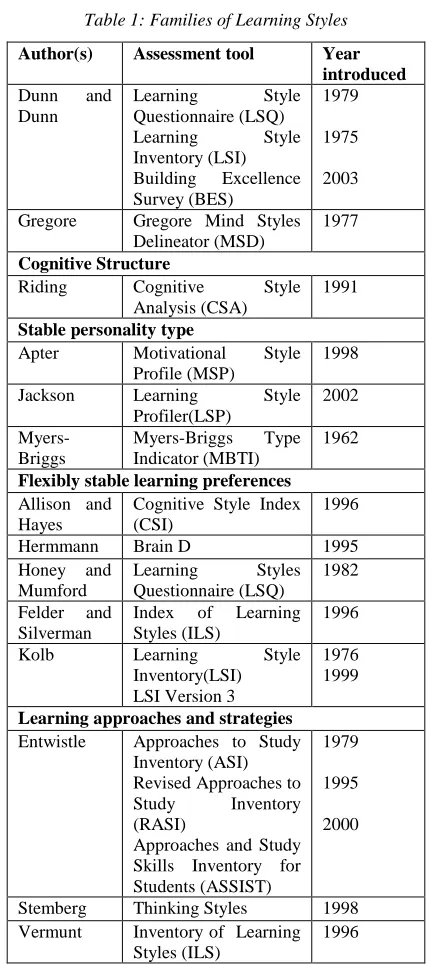
Coffield et.al. [7] List 71 different learning styles in their review on learning style and pedagogy. They divided learning styles in five groups, as shown in Table 1:
1. Genetic and other constitutionally based learning styles and preferences including the four modalities: Visual-Auditory-Kinesthetic-Tactile (VAKT) 2. Cognitive structure
3. Stable personality type
4. Flexibly stable learning preferences 5. Learning approaches and strategies
[image:2.612.315.530.89.577.2]There are many different types of learning style models based on different aspects: In this paper 3 of them discussed, but in our experiment we used VAK learning style model.
Table 1: Families of Learning Styles
A)Kolb’s learning style model
David Kolb developed his learning style model depending on others research, i.e. Piaget, and Rogers. His learning theory includes four different learning styles, which are based on four stage learning cycle, which are:
Concrete Experience (CE)(feeling) Reflective Observation (RO)(watching) Abstract Conceptualization (AC)
(thinking)
Active Experimentation (AE)(doing) He said that concrete experiences lead to observations which in turns are translated into
Year introduced Assessment tool
Author(s)
1979
1975
2003 Learning Style Questionnaire (LSQ)
Learning Style Inventory (LSI)
Building Excellence Survey (BES)
Dunn and Dunn
1977 Gregore Mind Styles Delineator (MSD) Gregore
Cognitive Structure
1991 Cognitive Style Analysis (CSA)
Riding
Stable personality type
1998 Motivational Style Profile (MSP)
Apter
2002 Learning Style Profiler(LSP)
Jackson
1962 Myers-Briggs Type Indicator (MBTI)
Myers-Briggs
Flexibly stable learning preferences 1996 Cognitive Style Index (CSI)
Allison and Hayes
1995 Brain D
Hermmann
1982 Learning Styles Questionnaire (LSQ)
Honey and Mumford
1996 Index of Learning Styles (ILS)
Felder and Silverman
1976 1999 Learning Style Inventory(LSI)
LSI Version 3 Kolb
Learning approaches and strategies 1979
1995
2000 Approaches to Study Inventory (ASI) Revised Approaches to Study Inventory (RASI)
Approaches and Study Skills Inventory for Students (ASSIST) Entwistle
1998 Thinking Styles
Stemberg
1996 Inventory of Learning Styles (ILS)
ISSN: 1992-8645 www.jatit.org E-ISSN: 1817-3195
abstract concepts, which can be tested and experimented where this enables creation of new experiences to start a new cycle.
David Kolb divides learning styles in four categories:
Diverging(CE/RO) Assimilating (AC/RO) Converging (AC/AE) Accommodating(CE/AE)
The diverging learning style is learning through feeling and watching. People in this style prefer to work in groups, receive personal feedback, gather information and use imagination to solve problems [8].
The assimilating learning style is learning through thinking and watching. People here prefer reading, lectures and exploring analytical models [8].
The converging learning style is learning by doing and thinking. People prefer technical tasks, like to experiment with new ideas, to simulate and to work with practical applications [8]. The accommodating learning style combines doing and feeling as ways to learn. Learners take a practical and experiential approach to learned material. They prefer to work in teams to complete tasks [8].
B) Felder-Silverman learning style model This learning style was created in 1988. It focuses on aspects of learning styles on engineering students. The modified model had four dimensions, which are:
Sensory/intuitive Visual/verbal Active/reflective Sequential/global.
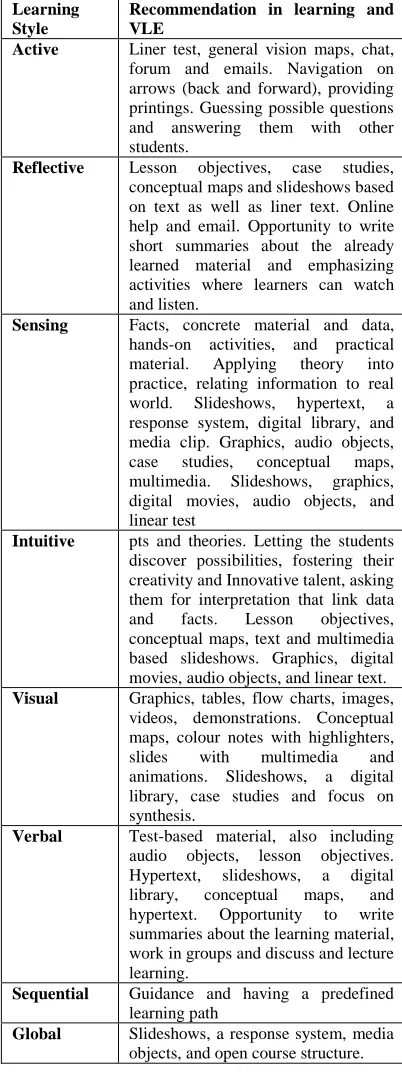
[image:3.612.325.526.150.690.2]The recommended activities [9] according to this learning style model you can find them in Table 2.
C) Visual-Auditory-Kinesthetic (VAK) Learning Style Model
This model concentrates on human observation channels; vision, hearing and feeling. Fleming [10], proposed the VARK model (sometimes VAK), illustrates learning styles as "preferred ways of gathering, organizing, and thinking about information." This model is one of the most widely-used categorizations of the various types of learning styles [4]:
1. Visual learners 2. Auditory learners
3. Kinesthetic learners or tactile learners.
Table 2: Recommended activities in learning VLE according to the Felder-Silverman Learning Style
Model
Fleming claimed that visual learners prefer to learn via seeing (i.e. overhead slides, diagrams, handouts, etc.). Auditory learners have a
Recommendation in learning and VLE
Learning Style
Liner test, general vision maps, chat, forum and emails. Navigation on arrows (back and forward), providing printings. Guessing possible questions and answering them with other students.
Active
Lesson objectives, case studies, conceptual maps and slideshows based on text as well as liner text. Online help and email. Opportunity to write short summaries about the already learned material and emphasizing activities where learners can watch and listen.
Reflective
Facts, concrete material and data, hands-on activities, and practical material. Applying theory into practice, relating information to real world. Slideshows, hypertext, a response system, digital library, and media clip. Graphics, audio objects, case studies, conceptual maps, multimedia. Slideshows, graphics, digital movies, audio objects, and linear test
Sensing
pts and theories. Letting the students discover possibilities, fostering their creativity and Innovative talent, asking them for interpretation that link data and facts. Lesson objectives, conceptual maps, text and multimedia based slideshows. Graphics, digital movies, audio objects, and linear text.
Intuitive
Graphics, tables, flow charts, images, videos, demonstrations. Conceptual maps, colour notes with highlighters, slides with multimedia and animations. Slideshows, a digital library, case studies and focus on synthesis.
Visual
Test-based material, also including audio objects, lesson objectives. Hypertext, slideshows, a digital library, conceptual maps, and hypertext. Opportunity to write summaries about the learning material, work in groups and discuss and lecture learning.
Verbal
Guidance and having a predefined learning path
Sequential
Slideshows, a response system, media objects, and open course structure.
ISSN: 1992-8645 www.jatit.org E-ISSN: 1817-3195
preference for listening (lectures, discussions, tapes, etc.). Tactile/kinesthetic learners’ best learn through experience—moving, touching, and doing (science projects, experiments, etc.). Using this model not only allows teachers to prepare classes that address each of these areas, but also allows students to identify their preferred learning style and increases their educational experience by focusing on what benefits them the most [4].
3. MATERIALS AND METHODS
In order to conduct a comparison between traditional learning and technology enhanced learning, we designed several e-lessons with different styles of learning according to VAK model. These e-lessons are intended to explain arithmetic, logical and relational computer operations for students. The study aims at comparing students’ results after studying this course in different learning styles which are: traditional, visual, audio, and kinesthetic styles, the last three styles represent VAK model. Each e-lesson is structured as following:
• Lesson 1 : Arithmetic operations lesson: ( precedence rules and examples )
• Lesson 2 : Relational operations lesson: ( precedence rules and examples )
• Lesson 3 : Logical operations lesson: (Precedence rules and examples)
• Lesson 4: Precedence rules of combination of all types of operations with examples
Several e-lessons were designed to explain these lessons but in different learning styles explained in the VAK model which are: Visual, Auditory, and Kinesthetic learning styles. To satisfy the student's preferences 3 e-lessons were designed to correspond to these 3 learning styles: visual e-lesson, auditory e-lesson and kinesthetic e-lesson.
In visual e-lesson, the students watch video lessons that explain precedence of operations in the lesson in moving symbols. Also, lessons give an example on how to solve an equation containing one or more operation in moving symbols, where the movement of the operations shows the correct operation execution precedence.
In auditory lessons, audio is added to the video lesson. The audio is voice recorded that explain the lesson being viewed in video. In this style, students can hear and see explanation of
different lessons with equations examples solved in the same style.
In kinesthetic lessons, students are able to move objects representing operations by dragging them into their correct order according to the precedence rules. Using this style students interact with equations and learn the lessons by trial and error. this is similar in nature to active learning techniques, which is recommended by many researchers in order to reach a higher percentage of students[11].
In order to conduct the comparison between traditional learning and technology enhanced learning, several experiments are conducted to test students’ achievement after taking these lessons in the previously described e-lessons. A description of all experiments conducted and their results are described in the following section.
4. RESULTS
The objective of this case study is to compare students’ learning outcomes after taking e-Lessons or traditional learning lessons on how to solve Arithmetic, Logical and Relational Computer Operator. The participants in the experiments conducted are students registered for Remedial Computer Skills course on fall semester 2012/2013 at the University of Jordan in Amman, Jordan. This course is a mandatory course for all humanities and medicine faculties’ students. There were 306 students from 19 different faculties and 65 majors in the sample participated in this experiment.
In order to accomplish the objective of this research, we measured the results of students who took the e-lessons against traditional learning via a quiz. The quiz results demonstrates whether there were any differences between the learning outcomes of the student who took the lessons using traditional learning style, and those who took lessons via e-lesson and in different learning styles. Also, we took into consideration the following points in the comparison conducted: Students satisfaction and motivation, e-lessons difficulty, and time consumed deliver the content of the lessons to students.
ISSN: 1992-8645 www.jatit.org E-ISSN: 1817-3195
of the remaining 3 groups took the lessons in different e-lesson style; one group took the visual lesson, the second took the auditory lesson, and last group took the kinesthetic e-lesson.
Usually in traditional learning style, students are taught about arithmetic, logical and relational operations in a class, of at least 50 students, by an instructor over a period of 2-3 one hour lectures.
[image:5.612.322.519.261.411.2]As mentioned above, the comparison was based on quiz results taken by all the students and on time consumed. The quiz is fairly simple, contains 4 questions which are equations containing mix of the arithmetic, logical and relational operations studied. Figure 1 represents the average scores for each group in each question in the quiz.
Figure 1: Average Quiz Scores for Each Group in Every Question
Figure1 shows that the results of the kinesthetic group are the best and the results of auditory group are better than the visual group. Also, the figure points out that the kinesthetic group has the highest average of the four questions in the quiz which is 93.3% as you can notice from table 3, even a higher grade than traditional learning tested groups this because student of the kinesthetic test group become an active learner which is as improvement on passive learning that occurs in lecture based classes, therefore, better material perceiving. Meanwhile the average of the three rest groups where almost the same with small difference as shown in table 3. The Aural tested group took the lowest Average at all whish is 87.9%. Fleming also reports a higher level of learning when learning styles of students matches their learning activities [12].
Table3: Average Quiz Score for each Group
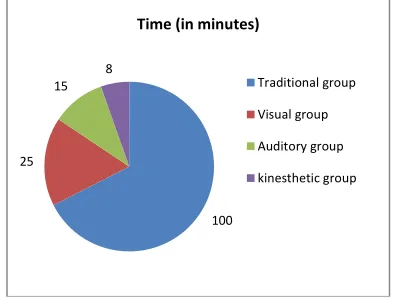
[image:5.612.91.291.312.455.2]Other than the quiz results, a comparison of the 4 different styles of learning is conducted based on time spent, satisfaction, and difficulty faced by students in the groups. Figure 2, illustrated the time spent, in minutes, by each group to finish the lessons.
Figure 2: Time Spent by the 4 Groups in Minutes
As the figure show, it is apparent that students spent less time studying the e-lessons than the traditional style. Also, the kinesthetic group spent the least amount of time on learning the lessons than all the groups although their results in figure 1 are the best of all.
Several studies [13, 14] suggest that students’ satisfaction and motivation are important factors in measuring the success or effectiveness of the e-learning process. Thus, in order to measure the satisfaction of students and the level of difficulty they encountered, so we asked for their feed back by answering these two yes/No questions.
Q1: Did you encounter any difficulty in understanding the lesson?
Q2: Were you satisfied and more motivated to learn using the e-lesson?
As shown in Fig 3, the difficulty decreases and the students’ satisfaction increase when you go from the visual tested group to the kinesthetic tested group.
0 10 20 30 40 50 60 70 80 90 100
Q1 Q2 Q3 Q4
Q
ui
z S
co
re G1: Traditional group
G2: Visual group G3: Auditory group
G4: kinesthetic group
100 25
15 8
Time (in minutes)
Traditional group
Visual group
Auditory group
kinesthetic group Group Average quiz score G1: Traditional group 88.4%
ISSN: 1992-8645 www.jatit.org E-ISSN: 1817-3195
0 10 20 30 40 50 60 70 80 90
Visual
group Auditorygroup Kinestheticgroup
Q1 Difficulty
Q2 Satisfaction
Figure 3: Answers for the two questions
5. CONCLUSION
This paper presented an e-learning case study whish use s the VAK model to investigates using e-learning and learning styles in delivering the content of the learning material to students. The result obtained have shown that using e-learning and taking into account student learning styles decreases the time consumed to deliver the learning material to students as long as increases student satisfaction and motivation to learn. Our work is still in progress and we are in process in gathering more data about student styles and make the learning material adapt to their preferred learning style, we also aim to improve our study to involve lecturers and take them feedback into consideration.
REFERENCES
[1] Zhang, P., & Aikman, S. (2007). Attitudes in ICT Acceptance and Use.In J. Jacko (Ed.), Human-Computer Interaction (1021-1130). Berlin, Heidelberg: Springer-Verlag Berlin Heidelberg.
[2] Wong,A. F. L, Quek, C.-L.,Divaharan, S., Liu, W.-C., Peer, J., & Willimas, M.D. (2006).Singapore students’ and teachers’ perceptions of computer-supported project work classroom learning environments. Journal of Research on Technology in Education, 38(4), 449-479.
[3] Elizabeth T. Welsh,Connie R. Wanberg, Kenneth G. Brown and Marcia J. Simmering,E-learning: emerging uses, empirical results and future directions,(2003), International Journal of Training and Development, 245-258.
[4] Retrieved on 17.12.2012, from: http://www.wikipedia.org/wiki/E-learning
[5] Verkko-tutor. Tampereen yliopiston täydennyskoulutuskeskus. Available: http://www.uta.fi/tyt/verkkotutor/
[6] Vainionpää, J. Erilaiset oppijat ja oppimateriaalit verkko-opiskelussa. Tampere 2006.
[7] Coffield, F., Moseley, D., Hall, E. & Ecclestone, K., Learning styles and pedagogy in post-16 learning, A systematic and critical review. Learning and skills research center, 2004.
[8] Smith, M. K., David A. Kolb on experiential learning, 2001. [retrieved on 17.12.2012]. Available: http://www.infed.org/biblio/b-explrn.htm
[9] Graf, S., Ph.D. Thesis: Adaptivity in Learning Management Systems Focussing on Learning Styles Vienna University of Technology, December 2007.
[10] Fleming, N.D. (1995) I’m different, not dumb. Modes of presentation (VARK) in the tertiary classroom, in Zelmer, A., (ed) Research and Development in Higher Education. Proceedings of the 1995 Annual Conference of the Higher Education and Research Development Society of Australasia (HERDSA), 18, pp. 308-313.
[11] Powner, L.C. and Allendoerfer, M.G. (2008). Evaluating Hypotheses about Active Learning. International Studies Perspectives, 9, pp. 75-89.
[12] Fleming, N.D. (2001, 2006). Teaching and Learning Styles: VARK Strategies. Christchurch, New Zealand: N.D. Fleming.
[13] Bures, E.M., Abrami, P.C., Amundsen, C.: Student motivation to learn via computer Conferencing. Research in Higher Education, 41(5), 593–621 (2000).
[14] Piccoli, G., Ahmad, R., Ives, B.: Web-based virtual learning environments: A research Framework and a preliminary assessment of effectiveness in basic IT skills training. MIS Quarterly, 25(4), 401–426 (2001).