I
1111111
IIIIIJIIIIIIIII
1111 1111 DIGITAL EIUIPnENT CORPORATIONDigital Press Editorial Board
Samuel H. Fuller, Chairman Richard·W. Beane
Donald Z. Harbert William R. Hawe Richard J. Hollingsworth Richard F. Lary
Alpha AXP Architecture Reference Manual
Second Edition
Richard L. Sites Richard T. Witek
Contributing Authors for the Second Edition
Wayne M. Cardoza Anton Chernoff John A. DeRosa Daniel W. Dobberpuhl John H. Edmondson Kent Glossop Henry N. Grieb Richard B. Grove Michael S. Harvey Steven O. Hobbs Robert F. Hoffman
Nancy P. Kronenberg Raymond J. Lanza Derrick R. Meyer Stephen J. Morris Joseph Notarangelo William B. Noyce Mary H. Payne Audrey R. Reith Robert M. Supnik Benjamin J. Thomas
Digital Press
Copyright©1995 Digital Equipment Corporation
- - - )
Digital Press™ isan imprint of Butterworth-Heinemann, Publisher for Digital Equipment Corporation. No part of this publication may be reproduced, stored in a retrieval system, or transmitted in any form or by any means, electronic, mechanical, photocopying, recording, or otherwise, without the prior written permission of the publisher.
~Recognizing the importance of preserving what has been written, Butterworth-Heinemann prints its books on
'eJ acid-free paper whenever possible.
Digital believes that the information in this publication is accurate as of its publication date; such information is subject to change without notice. Digital is not responsible for any inadvertent errors. The following are trademarks of Digital Equipment Corporation: Alpha AXP, AXP, DEC, Digital, OpenVMS, PDP-II, VAX, VAX DOCUMENT, VMS, ULTRIX, and the DIGITAL logo.
Cray is a registered trademark of Cray Research, Inc. IBM is a registered trademark of International Business Machines Corporation. OSF/l is a registered trademark of Open Software Foundation, Inc. UNIX is a registered trademark in the United States and other countries licensed exclusively through X/Open Company Ltd. Windows NT is a trademark of Microsoft Corporation. X Window System is a common law trademark of the Massachusetts Institute of Technology.
This document was prepared using VAX DOCUMENT, Version 2.1-1. Technical Writer: Charles Greenman
Production Editor: Kathe Rhoades Technical Illustrator: Lynne Kenison Cover Designer: Marshall Henrichs
Library of Congress Cataloging-in-Publication Data
Sites, Richard L.
Alpha AXP architecture reference manual/Richard L. Sites, Richard T. Witek. -- 2nd ed. / contributing authors, Wayne M. Cardoza ... [et al.l
p. cm.
Rev. ed. of: Alpha architecture reference manual. c 1992. Includes index.
ISBN 1-55558-145-5
1. Computer architecture. 2. Reduced instruction set computers. I. Witek, Richard T. II. Title. III. Title: Alpha architecture reference manual
QA76.9.A73A46 1995
004.2'565~c20 95-22578
CIP
The publisher offers discounts on bulk orders of this book. For information, please write:
Manager of Special Sales, Digital Press Butterworth-Heinemann
313 Washington Street Newton, MA 02158-1626 Order number: EY-TI32E-DP 10987654321
Foreword Notes
Preface to First Edition Preface to Second Edition PartII Common Architecture
1 Introduction 2 Basic Architecture 3 Instruction Formats 4 Instruction Descriptions
5 System Architecture and Programming Implications 6 Common PALcode Architecture
7 Console Subsystem Overview 8 Input/Output Overview
Part II-A
I
OpenVMS AXP Software 1 Introduction to OpenVMS AXP2 OpenVMS AXP PALcode Instruction Descriptions 3 OpenVMS AXP Memory Management
4 OpenVMS AXP Process Structure
5 OpenVMS AXP Internal Processor Registers
6 OpenVMS AXP Exceptions, Interrupts, and Machine Checks
Part 11-8I DECOSF/1 Software 1 Introduction to DECOSF/l
2 DECOSF/lPALcode Instruction Descriptions 3 DECOSF/}Memory Management
4 DECOSF/}Process Structure 5 DECOSF/}Exceptions and Interrupts
Part II-C
I
Windows NT AXP Software 1 Introduction to Windows NT AXP Software2 Processor, Process, and Thread Structures and Registers 3 Memory Management
4 Exceptions, Interrupts, and Machine Checks 5 Windows NT AXP PALcode Instruction Descriptions 6 Initialization and Firmware Transitions
Part
1111
Console Interface Architecture 1 Console Subsystem Overview2 Console Interface to Operating System Software 3 System Bootstrapping
Appendixes
A Software Considerations
B IEEE Floating-Point Conformance C Instruction Summary
D Waivers and Implementation-Dependent Functionality
Index
FOREWORD
In the foreword to the first edition of theVAX Architecture Reference Manual, Sam
Fuller stated "Computer design continues to be a dynamic field; I expect we will see more rather than less change and innovation in the decades ahead." TheAlpha AXP Architecture Reference Manual demonstrates the accuracy of that prediction.
Alpha follows VAX by about fifteen years. The intervening years have witnessed an eruption in computer technology, one that shows no sign of abating:
• More than a 1000-fold increase in the performance of microprocessors • More than a 1000-fold increase in the density of semiconductor memories • More than a 500-fold increase in the density of magnetic storage devices • More than a 100-fold increase in the speed of network connections
During the same period, the internal organization of computer systems has changed as well, based on developments such as RISC architecture, symmetric multiprocess-ing, and coherent distributed systems. Moreover, the fundamental paradigms of computing have been changed not once, but several times, with the introduction of personal computers, networked workstations, local area networks, and client/server computing.
These developments present an enormous challenge for computing in the 21st cen-tury. Future computers will be called upon to solve problems of great complexity, worldwide, in a distributed manner. They will have to provide unprecedented per-formance, flexibility, reliability, and scalability in order to implement a global infras-tructure of information, and to give users an untrammelled window on the world. Alpha is Digital's response to the challenge of 21st century computing. It represents the culmination of the company's knowledge and belief about how the next gener-ation of computers should be built. Alpha is based on a decade's experimental and engineering work in RISC architecture, high-speed implementation, software com-patibility and migration, and system serviceability. It provides the foundation for future implementations, from mobile computing units to massively parallel super-computers.
Alpha is designed to handle the largest computing problems of today and tomorrow. It represents a major advance over its predecessor, the VAX. Comparing Alpha to VAX, two differences stand out immediately. First, Alpha is a 64-bit architecture; VAX is a 32-bit architecture. This means that Alpha's virtual address capability extends to a 64-bit linear range of bytes in memory. Supporting this extended virtual address space are an extended maximum physical address range (up to 48 bits) and larger pages (8 KB to 64 KB). Alpha's extended virtual address range allows direct manipulation of the gigabytes and terabytes of data produced in electrical and mechanical design, database and transaction processing, and imaging.
are characterized by simple, fixed-length instruction formats; a small number of ad-dressing modes; large register files; and a load-store instruction set architecture. In-structions are typically decoded and executed directly by hardware. Alpha's stream-lined organization allows high-speed implementation in a variety of technologies, while providing strong compatibility for programs and data with today's computers. CISC stands for Complex Instruction Set Computer. CISC architectures generally have variable length instruction formats; a large number of addressing modes; small to medium sized register files; and a full set of register-to-memory (or even memory-to-memory) instructions. Instructions are typically decoded and interpreted by a microprogram.
The following table contrasts the architectural differences between VAX and Alpha. Characteristic
Architecture
Virtual address range Physical address range Page size
Instruction length General registers Addressing modes
Instruction set architecture Directly supported data types
VAX
CISC 32-bit Up to 32-bit 512 bytes 1-51 bytes 1632-bit 21 General Integer, floating, bit field, queue, character string, decimal string
Alpha
RISC Up to 64-bit Up to 48-bit 8 KB-64 KB 4 bytes 6464-bit 3
Load-store Integer, floating
This book is the culmination of an effort that began in 1988. Since that time, Alpha has grown from a paper specification to a cohesive set of chips, systems, and software, spanning the computer spectrum. This achievement is due to the efforts of many hundreds of people in Engineering, Marketing, Sales, Service, and Manufacturing. This book is documentation of, and a tribute to, the outstanding work they have done.
Bob Supnik
A Note on the Structure of This Book
TheAlpha AXP Architecture Reference Manual is divided into 3 Parts, 4 appendixes,
and an index.
Each part or section of a part describes a major portion of the Alpha AXP architecture. Each contains its own Table of Contents. Additional sections will be incorporated as development proceeds on the architecture.
The following table outlines the contents of the manual: Name Symbol Contents
Part One
Part Two (I)
(II)
Common Architecture
This part describes the architecture that is common to and required by all implementations.
Specific Operating System PALcode Architecture
This part containssections that describe how the following
operating systems relate to the AlphaAXP architecture:
Section Name and Contents
OpenVMSAXP Software DEC OSF/l Software Windows NTAXPSoftware
Symbol
(II-A) (II-B) (II-C) Part Three (III)
Appendixes
Index
Console Interface Architecture
This part describes an architected console firmware implementation.
Because information in the appendixes can be shared by more than one section, appendixes are grouped together at the end of the manual.
Preface to the First Edition
The Alpha architecture is a RISe architecture that was designed for high perfor-mance and longevity. Following Amdahl, Blaauw, and Brooks1 , we distinguish be-tweenarchitecture and implementation:
• Computer architecture is defined as the attributes of a computer seen by a
machine-language programmer. This definition includes the instruction set, in-struction formats, operation codes, addressing modes, and all registers and mem-ory locations that may be directly manipulated by a machine-language program-mer.
• Implementation is defined as the actual hardware structure, logic design, and
data-path organization.
This architecture book describes the required behavior of all Alpha implementations, as seen by the machine-language programmer. The architecture does not speak to implementation considerations such has how fast a program runs, what specific bit pattern is left in a hardware register after an unpredictable operation, how to sched-ule code for a particular chip, or how to wire up a given chip; those considerations are described in implementation-specific documents.
Various Alpha implementations are expected over the coming years, starting with the Digital 21064 chip.
Goals
When we started the Alpha project in the fall of 1988, we had a small number of goals:
1. High performance
2. Longevity
3. Run VMS and UNIX
4. Easy migration from VAX. (and soon-to-be MIPS) customer base
As principal architects, Rich Witek and I made design decisions that were driven directly by these goals.
We assumed that high performance was needed to make a new architecture attrac-tive in the marketplace, and to keep Digital competiattrac-tive.
We set a 15-25 year design horizon (longevity) and tried to avoid any design elements that we thought would become limitations during this time. The design horizon led
1 Amdahl, G.M., G.A. Blaauw, and F.P. Brooks, Jr. "Architecture of the IBM System/360." IBM Journal of Research and
directly to the conclusion that Alpha could not be a 32-bit architecture: 32-bit ad-dresses will be too small within 10 years. We thus adopted a full 64-bit architecture, with a minimal number of 32-bit operations for backward compatibility. Wherever possible, 32-bit operands are put in registers in a 64-bit canonical form and operated upon with 64-bit operations.
The longevity goal also caused us to examine how the performance of implementa-tions would scale up over 25 years. Over the past 25 years, computers have become about 1000 times faster. This suggested to us that Alpha implementations would need to do the same, or we would have to bet that the industry would falloff the historical performance curve. We were unwilling to bet against the industry, and were unwilling to ignore the issue, so we seriously examined the consequences of longevity.
We thought that it would be realistic for implementors to improve clock speeds by a factor of 10 over 25 years, but not by a factor of 100 or 1000. (Clock speeds have improved by about a factor of 100 over the past 25 years, but physical limits are now slowing down the rate of increase.)
We concluded that the remaining factor of 100 would have to come from other design dimensions. If you cannot make the clock faster, the next dimension is to do more work per clock cycle. So the Alpha architecture is focused on allowing implemen-tations that issue many instructions every clock cycle. We thought that it would be realistic for implementors to achieve about a factor of 10 over 25 years by using multiple instruction issue, but not a factor of 100. Even a factor of 10 will require perhaps a decade of compiler research.
We concluded that the remaining factor of 10 would have to come from some other design dimension. If you cannot make the clock faster, and cannot do more work per clock, the next dimension is to have multiple clocked instruction streams, that is, multiple processors. So the Alpha architecture is focused on allowing implementa-tions that apply multiple processors to a single problem. We thought that it would be realistic for implementors to achieve the remaining factor of 10 over 25 years by using multiple processors.
Overall, the factor-of-1000 increase in performance looked reasonable, but required factor-of-10 increases in three different dimensions. These three dimensions there-fore formed part of our design framework:
• Gracefully allow fast cycle time implementations
• Gracefully allow multiple-instruction-issue implementations • Gracefully allow multiple-processor implementations
load-Iocked/store-conditional sequences as the .atomic-update primitive, and eliminated ,strict read-. write ordering between processors.
All of the above design decisions were driven directly by the performance and longevity goals. The lack of byte writes, precise arithmetic traps, and multipro-cessor read/write ordering have been the most controversial decisions, so far. Clean Sheet of Paper
To run both OpenVMS and UNIX without burdening the hardware implementa-tions with elaborate (and sometimes conflicting) operating system underpinnings, we adopted an idea from a previous Digital RISC design. Alpha places the under-pinnings for interrupt delivery and return, exceptions, context switching, memory management, and error handling in a set of privileged software subroutines called PALcode. PALcode subroutines have controlled entries, run with interrupts turned off, and have access to real hardware (implementation) registers. By having dif-ferent sets of PALcode for difdif-ferent operating systems, the architecture itself is not biased toward a specific operating system or computing style.
PALcode allowed us to design an architecture that could run OpenVMS gracefully without elaborate hardware and without massively rewriting the VMS synchroniza-tion and protecsynchroniza-tion mecharlisms. PALcode lets the Alpha architecture support some complex VAX primitives (such as the interlocked queue instructions) that are heavily used by OpenVMS, without burdening a UNIX implementation in any way.
Finally, we also considered how to move VAX and MIPS code to Alpha. We rejected various forms of "compatibility mode" hardware, because they would have severely compromised the performance and time-to-market of the first implementation. After some experimentation, we adopted the strategy of running existing binary code by building software translators. One translator converts OpenVMS VAX images to functionally identical OpenVMS Alpha images. A second translator converts MIPS ULTRIX images to functionally identical DEC OSF/l Alpha images.
Fundamentally, PALcode gave us a migration path for existing operating systems, and the translators (and native compilers) gave us a migration path for existing user-mode code. PALcode and the translators provided a clean sheet of design paper for the bulk of the Alpha architecture. Other than an extra set of VAX floating-point formats (included for good business reasons, but subsettable later), no specific VAX or MIPS features are carried directly into the Alpha architecture for compatibility reasons.
These considerations substantially shaped the architecture described in the rest of this book.
Organization
routines for each operating system-the specific operating system PALcode architec-ture.
Acknowledgments
My collaboration with Rich Witek over the past few years has been extremely re-warding, both personally and professionally. By combining our backgrounds and viewpoints, we have produced an architecture that is substantially better than ei-ther of us could have produced alone. Thank you, Rich.
A work of this magnitude cannot be done on a shoestring or in isolation. Rich and I were blessed with a rich environment of dozens and later hundreds of bright, thoughtful, and outspoken professional peers. I thank the management of Digital Equipment Corporation for providing that rich environment, and those peers for making the architecture so much more robust and well-considered.
Three people have especially influenced my views of computer architecture, through personal interaction and landmark machine design: Fred Brooks, John Cocke, and Seymour Cray. This work is built directly upon theirs, and could not exist without them.
The organization, editing, and production of this text in final form is largely the work of Charlie Greenman, whose clear writing is much appreciated.
Preface to the Second Edition
The Second Edition of the architecture manual continues to describe the required behavior for all Alpha implementations, as seen by the machine-level programmer. A number of Alpha CPU implementations have been produced to date, designed according to the dictates of this architecture. The first generation implementation, the DECchip 21064, set new standards for high performance and was the basis for several chips that followed. The DECchip 21066 increased the level of integration on the chip by including the PCI interface and memory interface control logic on the chip itself. The DECchip 21064A further enhanced the performance by shrinking to the next generation CMOS process, providing an increase in operating frequency and doubling the internal cache size.
The second generation implementation, the DECchip 21164, has expanded beyond the DECchip 21064A in width of issue and operating frequency, and provides a much higher-performance memory interface. In fact, since its introduction, an Alpha has been the highest performance microprocessor on the market. The third generation chip, currently under development, will continue that trend.
The first Alpha systems were workstations and midrange systems that were directed to the traditional VAX and MIPS customer base. Since then, the range of Alpha systems has been greatly expanded. Alpha systems have been designed in the PC price range to support Windows NT and X Window terminals. Alpha single-board computers have been introduced to cover the high-end embedded controller market. And Cray Research has introduced the Cray T3D, an Alpha based MPP, that can support up to 1024 Alpha CPU's in an MPP system.
PALcode has made much of this variety possible. By having different sets of PALcode for different operating systems, the architecture itself is not biased toward a specific operating system or computing style. PALcode has provided a flexible means, for example, of supporting Windows NT and the Cray T3D without hardware changes.
Organization
The organization of the Second Edition is similar that of the first. Part One of this book describes the instruction-set architecture, and is largely self-contained for read-ers who work with compilread-ers or assembly-language programs. Part Two describes the supporting PALcode routines for three operating systems - the specific oper-ating system PALcode architecture. PALcode for Windows NT on Alpha is covered in this edition. Part Three describes a particular console implementation that is specific to platforms that support the OpenVMS AXP or DECOSF/I operating
Acknowledgments
The list of people who have contributed to Alpha's current success has grown too large to itemize. Rather, we want to acknowledge the software and hardware engineers who have worked since long before Alpha's introduction to provide the whole system. On the software side, engineers have put in countless hours writing, porting, and optimizing code for the operating systems, compilers, run time libraries, CASE tools, and applications. Hardware engineers have spent long hours designing the broad range of products that today span a 2000X price range. We sincerely acknowledge their efforts.
The organization, editing, and production of this text in final form remain largely the work of Charlie Greenman, whose clear writing is much appreciated.
Common Architecture (I)
This part describes the common Alpha AXP architecture and contains the following chapters:
• Chapter 1, Introduction (I)
• Chapter 2, Basic Architecture (I)
• Chapter 3, Instruction Formats (I)
• Chapter 4, Instruction Descriptions (I)
• Chapter 5, System Architecture and Programming Implications (I)
• Chapter 6, Common PALcode Architecture (I)
• Chapter 7, Console Subsystem Overview (I)
Contents
Chapter 1 Introduction (I)
1.1 The Alpha AXP Approach to RISC Architecture .
1.2 Data Format Overview .
1.3 Instruction Format Overview .
1.4 Instruction Overview .
1.5 Instruction Set Characteristics .
1.6 Terminology and Conventions .
1.6.1 Numbering .
1.6.2 Security Holes .
1.6.3 UNPREDICTABLE and UNDEFINED .
1.6.4 Ranges and Extents .
1.6.5 ALIGNED and UNALIGNED .
1.6.6 Must Be Zero (MBZ) .
1.6.7 Read As Zero (RAZ) .
1.6.8 Should Be Zero (SBZ) .
1.6.9 Ignore (IGN) .
1.6.10 Implementation Dependent (IMP) .
1.6.11 Figure Drawing Conventions .
1.6.12 Macro Code Example Conventions .
Chapter 2 Basic Architecture (I)
2.1 Addressing .
2.2 Data 1YI>es .
2.2.1 Byte .
2.2.2 Word .
2.2.3 Longword .
2.2.4 Quadword .
2.2.5 VAX Floating-Point Formats .
2.2.5.1 F_floating .
2.2.5.2 G_floating .
2.2.5.3 D_floating .
2.2.6 IEEE Floating-Point Formats .
2.2.6.1 S_Floating .
2.2.6.2 T_floating .
2.2.6.3 X_Floating .
2.2.7 Longword Integer Format in Floating-Point Unit .
2.2.8 Quadword Integer Format in Floating-Point Unit .
2.2.9 Data 1YI>es with No Hardware Support .
2.3 Big-endian Addressing Support. . . .. 2-14
Chapter 3 Instruction Formats (I)
3.1 Alpha AXP Registers . . . 3-1 3.1.1 Program Counter. . . 3-1 3.1.2 Integer Registers . . . 3-1 3.1.3 Floating-Point Registers. . . 3-2 3.1.4 Lock Registers . . . 3-2
3.1.5 Processor Cycle Counter (PCC) Register 3-2
3.1.6 Optional Registers. . . 3-3
3.1.6.1 Memory Prefetch Registers 3-3
3.1.6.2 VAX Compatibility Register. . . 3-3 3.2 Notation. . . 3-3
3.2.1 Operand Notation 3-3
3.2.2 Instruction Operand Notation . . . 3-4 3.2.3 Operators. . . 3-6 3.2.4 Notation Conventions. . . 3-8 3.3 Instruction Formats. . . 3-9 3.3.1 Memory Instruction Format. . . 3-9 3.3.1.1 Memory Format Instructions with a Function Code. . . .. 3-10 3.3.1.2 Memory Format Jump Instructions . . . .. 3-10
3.3.2 Branch Instruction Format 3-10
3.3.3 Operate Instruction Format. . . .. 3-11 3.3.4 Floating-Point Operate Instruction Format . . . .. 3-12 3.3.4.1 Floating-Point Convert Instructions. . . .. 3-13
3.3.5 PALcode Instruction Format 3-13
Chapter 4 Instruction Descriptions (I)
4.1 Instruction Set Overview. . . 4-1
4.1.1 Subsetting Rules 4-2
4.1.1.1 Floating-Point Subsets. . . 4-2 4.1.2 Software Emulation Rules . . . 4-2 4.1.3 Opcode Qualifiers. . . 4-3 4.2 Memory Integer Load/Store Instructions . . . 4-4 4.2.1 Load Address. . . 4-5 4.2.2 Load Memory Data into Integer Register. . . 4-6 4.2.3 Load Unaligned Memory Data into Integer Register. . . 4-7 4.2.4 Load Memory Data into Integer Register Locked " . . . 4-8 4.2.5 Store Integer Register Data into Memory Conditional. . . .. 4-11
4.2.6 Store Integer Register Data into Memory 4-14
4.2.7 Store Unaligned Integer Register Data into Memory. . . .. 4-15 4.3 Control Instructions. . . .. 4-16
4.3.1 Conditional Branch 4-18
4.3.2 Unconditional Branch .
4.3.3 Jumps .
4.4 Integer Arithmetic Instructions .
4.4.1 Longword Add .
4.4.2 Scaled Longword Add .
4.4.3 Quadword Add .
4.4.4 Scaled Quadword Add .
4.4.5 Integer Signed Compare .
4.4.6 Integer Unsigned Compare .
4.4.7 Longword Multiply .
4.4.8 Quadword Multiply .
4.4.9 Unsigned Quadword Multiply High .
4.4.10 Longword Subtract .
4.4.11 Scaled Longword Subtract .
4.4.12 Quadword Subtract .
4.4.13 Scaled Quadword Subtract .
4.5 Logical and Shift Instructions .
4.5.1 Logical Functions .
4.5.2 Conditional Move Integer .
4.5.3 Shift Logical .
4.5.4 Shift Arithmetic .
4.6 Byte-Manipulation Instructions .
4.6.1 Compare Byte .
4.6.2 Extract Byte .
4.6.3 Byte Insert .
4.6.4 Byte Mask .
4.6.5 Zero Bytes .
4.7 Floating-Point Instructions .
4.7.1 Floating-Point Single-Precision Operations .
4.7.2 Floating Subsets and Floating Faults .
4.7.3 Definitions .
4.7.4 Encodings .
4.7.5 Floating-Point Rounding Modes .
4.7.6 Floating-Point Trapping Modes .
4.7.6.1 Imprecise /Software Completion Trap Modes .
4.7.6.2 Invalid Operation (INV) Arithmetic Trap .
4.7.6.3 Division by Zero (DZE) Arithmetic Trap .
4.7.6.4 Overflow (OVF) Arithmetic Trap .
4.7.6.5 Underflow (UNF) Arithmetic Trap .
4.7.6.6 Inexact Result (INE) Arithmetic Trap .
4.7.6.7 Integer Overflow (IOV) Arithmetic Trap .
4.7.6.8 Floating-Point Trap Disable Bits .
4.7.7 FPCR Register and Dynamic Rounding Mode .
4.7.7.1 Accessing the FPCR .
4.7.7.2 Default Values of the FPCR .
4.7.7.3 Saving and Restoring the FPCR .
4.7.8 Floating-Point Computational Models .
4.7.9 Floating-Point Instruction Function Field Format .
4.7.10 IEEE Standard .
4.7.10.1 Conversion of NaN and Infinity Values .
4.7.10.2 Copying NaN Values .
4.7.10.3 Generating NaN Values .
4.7.10.4 Propagating NaN Values .
4.8 Memory Format Floating-Point Instructions .
4.8.1 Load F_floating .
4.8.2 Load G_floating .
4.8.3 Load S_floating .
4.8.4 Load T_floating .
4.8.5 Store F_floating .
4.8.6 Store G_floating .
4.8.7 Store S_floating .
4.8.8 Store T_floating " .
4.9 Branch Format Floating-Point Instructions .
4.9.1 Conditional Branch .
4.10 Floating-Point Operate Format Instructions .
4.10.1 Copy Sign .
4.10.2 Convert Integer to Integer .
4.10.3 Floating-Point Conditional Move .
4.10.4 Move from/to Floating-Point Control Register .
4.10.5 VAX. Floating Add .
4.10.6 IEEE Floating Add .
4.10.7 VAX. Floating Compare .
4.10.8 IEEE Floating Compare .
4.10.9 Convert VAX Floating to Integer .
4.10.10 Convert Integer to VAX. Floating .
4.10.11 Convert VAX Floating to VAX Floating .
4.10.12 Convert IEEE Floating to Integer .
4.10.13 Convert Integer to IEEE Floating .
4.10.14 Convert IEEE S_Floating to IEEE T_Floating . 4.10.15 Convert IEEE T_Floating to IEEE S_Floating .
4.10.16 VAX. Floating Divide .
4.10.17 IEEE Floating Divide .
4.10.18 VAX Floating Multiply .
4.10.19 IEEE Floating Multiply .
4.10.20 VAX Floating Subtract .
4.10.21 IEEE Floating Subtract .
4.11 Miscellaneous Instructions .
4.11.1 Call Privileged Architecture Library .
4.11.2 Exception Barrier .
4.11.3 Prefetch Data .
4.11.4 Memory Barrier 4-124
4.11.5 Read Processor Cycle Counter 4-125
4.11.6 Tr-ap Barrier 4-126
4.11.7 Write Memory Barrier 4-127
4.12 VAX Compatibility Instructions 4-128
4.12.1 VAX Compatibility Instructions 4-129
Chapter 5 System Architecture and Programming Implications (I)
5.1 Introduction .
5.2 Physical Address Space Characteristics .
5.2.1 Coherency of Memory Access .
5.2.2 Granularity of Memory Access .
5.2.3 Width of Memory Access .
5.2.4 Memory-Like and Non-Memory-Like Behavior .
5.3 Translation Buffers and Virtual Caches .
5.4 Caches and Write Buffers .
5.5 Data Sharing .
5.5.1 Atomic Change of a Single Datum .
5.5.2 Atomic Update of a Single Datum .
5.5.3 Atomic Update of Data Structures .
5.5.4 Ordering Considerations for Shared Data Structures .
5.6 ReadlWrite Ordering .
5.6.1 Alpha AXP Shared Memory Model .
5.6.1.1 Architectural Definition of Processor Issue Sequence .
5.6.1.2 Definition of Processor Issue Order .
5.6.1.3 Definition of Memory Access Sequence .
5.6.1.4 Definition of Location Access Order .
5.6.1.5 Effect of Access Size .
5.6.1.6 Definition of Storage .
5.6.1.7 Relationship Between Issue Order and Access Order .
5.6.1.8 Definition of Before and After .
5.6.1.9 Timeliness .
5.6.2 Litmus Tests .
5.6.2.1 Litmus Test 1 (Impossible Sequence) .
5.6.2.2 Litmus Test 2 (Impossible Sequence) .
5.6.2.3 Litmus Test 3 (Impossible Sequence) .
5.6.2.4 Litmus Test 4 (Sequence Okay) .
5.6.2.5 Litmus Test 5 (Sequence Okay) .
5.6.2.6 Litmus Test 6 (Sequence Okay) .
5.6.2.7 Litmus Test 7 (Impossible Sequence) .
5.6.2.8 Litmus Test 8 (Impossible Sequence) .
5.6.2.9 Litmus Test 9 (Impossible Sequence) .
5.6.2.10 Litmus Test 10 (Sequence Okay) .
5.6.2.11 Litmus Test 11 (Impossible Sequence) .
5.6.3 Implied Barriers. . . .. 5-20 5.6.4 Implications for Software . . . .. 5-20 5.6.4.1 Single-Processor Data Stream . . . .. 5-20 5.6.4.2 Single-Processor Instruction Stream . . . .. 5-20 5.6.4.3 Multiple-Processor Data Stream (Including Single Processor with DMA 110) ... 5-20 5.6.4.4 Multiple-Processor Instruction Stream (Including Single Processor with DMA 110) 5-21
5.6.4.5 Multiple-Processor Context Switch 5-22
5.6.4.6 Multiple-Processor SendlReceive Interrupt 5-24 5.6.4.7 Implications for Memory Mapped 110. . . .. 5-24 5.6.5 Implications for Hardware. . . .. 5-25 5.7 Arithmetic '!'.raps. . . .. 5-26
Chapter 6 Common PALcode Architecture (I)
6.1 PALcode . . . 6-1 6.2 PALcode Instructions and Functions . . . 6-1 6.3 PALcode Environment . . . 6-2 6.4 Special Functions Required for PALcode . . . 6-2 6.5 PALcode Effects on System Code . . . 6-3
6.6 PALcode Replacement . . . 6-3
6.7 Required PALcode Instructions 6-4
6.7.1 Drain Aborts 6-6
6.7.2 Halt. . . 6-8 6.7.3 Instruction Memory Barrier. . . 6-9
Chapter 7 Console Subsystem Overview (I)
Chapter 8 Input/Output Overview (I)
Figures
1-1 Instruction Format Overview. . . 1-4 2-1 Byte Format. . . 2-1 2-2 Word Format . . . 2-2 2-3 L9ngword Format. . . 2-2 2-4 Quadword Format . . . 2-3 2-5 F_floating Datum . . . 2-3
2-6 F_floating Register Format 2-3
2-7 G_floating Datum. . . 2-5 2-8 G_floating Format . . . 2-5 2-9 D_floating Datum. . . 2-6 2-10 D_floating Register Format . . . 2-6 2-11 S_floating Datum. . . 2-8
2-12 S_floating Register Format 2-8
Tables
2-1 F_floating Load Exponent Mapping (MAP_F) .
2-2 S_floating Load Exponent Mapping (MAP_S) .
3-1 Operand Notation .
3-2 Operand Value Notation .
3-3 Expression Operand Notation .
3-4 Operators .
4-1 Opcode Qualifiers . . . .
4-2 Memory Integer Load/Store Instructions .
4-3 Control Instructions Summary .
4-4 Jump Instructions Branch Prediction .
4-5 Integer Arithmetic Instructions Summary .
4-6 Logical and Shift Instructions Summary .
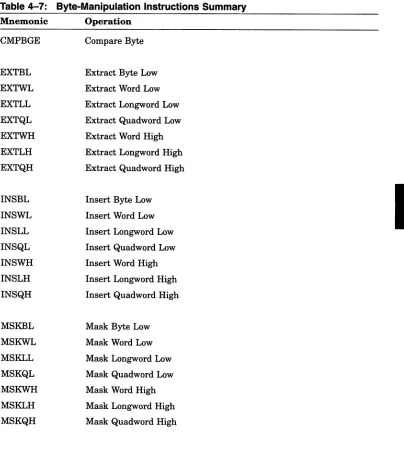
4-7 Byte-Manipulation Instructions Summary .
4-8 Floating-Point Control Register (FPCR) Bit Descriptions . 4-9 IEEE Floating-Point Function Field Bit Summary . 4-10 VAX Floating-Point Function Field Bit Summary . 4-11 Memory Format Floating-Point Instructions Summary .
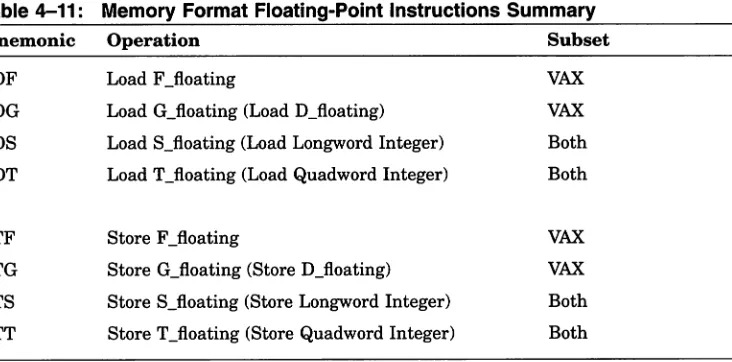
4-12 Floating-Point Branch Instructions Summary .
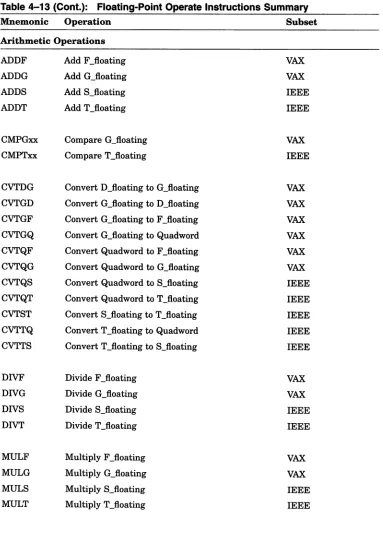
4-13 Floating-Point Operate Instructions Summary .
4-14 Miscellaneous Instructions Summary .
4-15 VAX Compatibility Instructions Summary .
2-13 2-14 2-15 2-16 2-17 2-18 2-19 2-20 2-21 2-22 2-23 2-24 3-1 3-2 3-3 3-4 3-5 3-6 4-1 4-2 8-1
T_floating Datum .
T_floating Register Format .
X_Floating Datum .
X_Floating Register Format .
X_Floating Big-Endian Datum .
X_Floating Big-Endian Register Format .
Longword Integer Datum .
Longword Integer Floating-Register Format .
Quadword Integer Datum .
Quadword Integer Floating-Register Format .
Little-Endian Byte Addressing .
Big-Endian Byte Addressing .
Memory Instruction Format .
Memory Instruction with Function Code Format .
Branch Instruction Format .
Operate Instruction Format .
Floating-Point Operate Instruction Format .
PALcode Instruction Format .
Floating-Point Control Register (FPCR) Format .
Floating-Point Instruction Function Field .
Alpha AXP System Overview .
5-1 5-2 5-3 5-4 6-1 6-2
x
Processor Issue Order .
Location Access Order .
Processor Issue Order With Access Size Effect . Location Access Order With Access Size Effect . PALcode Instructions that Require Recognition .
Required PALcode Instructions .
Chapter 1
Introduction (I)
Alpha AXP is a 64-bit load/store RISC architecture that is designed with particular emphasis on the three elements that most affect performance: clock speed, multiple instruction issue, and multiple processors.
The Alpha AXP architects examined and analyzed current and theoretical RISC architecture design elements and developed high-performance alternatives for the Alpha AXP architecture. The architects adopted only those design elements that appeared valuable for a projected 25-year design horizon. Thus, Alpha AXP becomes the first 21st century computer architecture.
The Alpha AXP architecture is designed to avoid bias toward any particular operating system or programming language. Alpha AXP supports the OpenVMS AXP, DEC OSF/l, and Windows NT AXP operating systems and supports simple software migration for applications that run on those operating systems.
This manual describes in detail how Alpha AXP is designed to be the leadership 64-bit architecture of the computer industry.
1.1 The Alpha AXP Approach to RiSe Architecture
Alpha AXP Is a True 64-Bit Architecture
Alpha AXP was designed as a 64-bit architecture. All registers are 64 bits in length and all operations are performed between 64-bit registers. It is not a 32-bit architecture that was later expanded to 64 32-bits.
Alpha AXP Is Designed for Very High-Speed Implementations
The instructions are very simple. All instructions are 32 bits in length. Memory operations are either loads or stores. All data manipulation is done between registers.
The Alpha AXP architecture facilitates pipelining multiple instances of the same operations because there are no special registers and no condition codes.
The instructions interact with each other only by one instruction writing a register or memory and another instruction reading from the same place. That makes it particularly easy to build implementations that issue multiple instructions every CPU cycle. (The first implementation issues two instructions per cycle.)
Alpha AXP makes it easy to maintain binary compatibility across multiple implementations and easy to maintain full speed on multiple-issue implementations. For example, there are no implementation-specific pipeline timing hazards, no load-delay slots, and no branch-load-delay slots.
Introduction (I) 1-1
The Alpha AXP Approach to Byte Manipulation
The Alpha AXP architecture does byte shifting and masking with normal 64-bit register-to-register instructions, crafted to keep instruction sequences short.
Alpha AXP does not include single-byte store instructions. This has several advantages:
• Cache and memory implementations need not include byte shift-and-mask logic, and sequencer logic need not perform read-modify-write on memory locations. Such logic is awkward for high-speed implementation and tends to slow down cache access to normal 32-bit or 64-bit aligned quantities.
• The Alpha AXP approach to byte manipulation makes it easier to build a high-speed error-correcting write-back cache, which is often needed to keep a very fast RISe implementation busy.
• The Alpha AXP approach can make it easier to pipeline multiple byte operations. The Alpha AXP Approach to Arithmetic Traps
Alpha AXP lets the software implementor determine the precision of arithmetic traps. With the Alpha AXP architecture, arithmetic traps (such as overflow and underflow) are imprecise-they can be delivered an arbitrary number of instructions after the instruction that triggered the trap. Also, traps from many different instructions can be reported at once. That makes implementations that use pipelining and multiple issue substantially easier to build.
However, if precise arithmetic exceptions are desired, trap barrier instructions can be explicitly inserted in the program to force traps to be delivered at specific points. The Alpha AXP Approach to MUltiprocessor Shared Memory
Asviewed from a second processor (including an 110 device), a sequence of reads and writes issued by one processor may be arbitrarily reordered by an implementation. This allows implementations to use multibank caches, bypassed write buffers, write merging, pipelined writes with retry on error, and so forth. If strict ordering between two accesses must be maintained, explicit memory barrier instructions can be inserted in the program.
The basic multiprocessor interlocking primitive is a RISC-style load_locked, modify, store_conditional sequence. If the sequence runs without interrupt, exception, or an interfering write from another processor, then the conditional store succeeds. Otherwise, the store fails and the program eventually must branch back and retry the sequence. This style of interlocking scales well with very fast caches, and makes Alpha AXP an especially attractive architecture for building multiple-processor systems.
Alpha AXP Instructions Include Hints for Achieving Higher Speed
A number of Alpha AXP instructions include hints for implementations, all aimed at achieving higher speed.
• Calculated jump instructions have a target hint that can allow much faster subroutine calls and returns.
• There are prefetching hints for the memory system that can allow much higher cache hit rates.
• There are granularity hints for the virtual-address mapping that can allow much more effective use of translation lookaside buffers for large contiguous -structures. PALcode-The Alpha AXP Very Flexible Privileged Software Library
A Privileged Architecture Library (PALcode) is a set of subroutines that are specific to a particular Alpha AXP operating system implementation. These subroutines provide operating-system primitives for context switching, interrupts, exceptions, and memory management. PALcode is similar to the BIOS libraries that are provided in personal computers.
PALcode subroutines are invoked by implementation hardware or by software CALL_PAL instructions.
PALcode is written in standard machine code with some implementation-specific extensions to provide access to low-level hardware.
PALcode lets Alpha AXP implementations run the full OpenVMS AXP, DECOSF/l, and Windows NT AXP operating systems. PALcode can provide this functionality with little overhead. For example, the OpenVMS AXP PALcode instructions let Alpha AXP run OpenVMS with little more hardware than that found on a conventional RISC machine: the PAL mode bit itself, plus 4 extra protection bits in each translation buffer entry.
Other versions of PALcode_ can be developed for real-time, teaching, and other applications.
PALcode makes Alpha AXP an especially attractive architecture for multiple operating systems.
Alpha AXP and Programming Languages
Alpha AXP is an attractive architecture for compiling a large variety of programming languages. Alpha AXP has been carefully designed to avoid bias toward one or two programminglan~ages.For example:
• Alpha. AXP does not contain a subroutine call instruction that moves a register window by a fixed amount. Thus, Alpha AXP is a good match for programming languages with many parameters and programming languages with no parameters.
• Alpha AXP does not contain a global integer overflow enable bit. Such a bit would need to be changed at every subroutine boundary when a FORTRAN program calls a C program.
1.2 Data Format Overview
Alpha AXP is a load/store RISC architecture with the following data characteristics: • All operations are done between 64-bit registers.
Introduction (I) 1-3
• Memory is accessed via 64-bit virtual byte addresses, using the little-endian or, optionally, the big-endian byte numbering convention.
• There are 32 integer registers and 32 floating-point registers. • Longword (32-bit) and quadword (64-bit) integers are supported. • Five floating-point data types are supported:
VAX F_floating (32-bit) VAX G_floating (64-bit) IEEE single (32-bit) IEEE double (64-bit) IEEE extended (128-bit)
1.3 Instruction Format Overview
As shown in Figure 1-1, Alpha AXP instructions are all 32 bits in length. As represented in Figure 1-1, there are four major instruction format classes that contain 0, 1, 2, or 3 register fields. All formats have a 6-bit opcode.
Figure 1-1: Instruction Format Overview
31 26 25 21 20 16 15 5 4
Opcode Number Opcode RA Disp Opcode RA RB Disp Opcode RA RB Function
I
RCPALcode Format Branch Format Memory Format Operate Format
• PALcode instructions specify, in the function code field, one of a few dozen complex operations to be performed.
• Conditional branch instructions test register Ra and specify a signed 21-bit PC-relative longword target displacement. Subroutine calls put the return address in register Ra.
• Load and store instructions move longwords or quadwords between register Ra and memory, using Rb plus a signed 16-bit displacement as the memory address.
• Operate instructions for floating-point and integer operations are both represented in Figure 1-1 by the operate format illustration and are as follows:
Floating-point operations use Ra and Rb as source registers, and write the result in register Rc. There is an 11-bit extended opcode in the function field.
Integer operations use Ra and Rb or an 8-bit literal as the source operand, and write the result in register Rc.
Integer operate instructions can use the Rb field and part of the function field to specify an 8-bit literal. There is a 7-bit extended opcode in the function field.
1.4 Instruction Overview
PALcode Instructions
As described above, a Privileged Architecture Library (PALcode) is a set of subroutines that is specific to a particular Alpha AXP operating-system implementation. These subroutines can be invoked by hardware or by software CALL_PAL instructions, which use the function field to vector to the specified subroutine.
Branch Instructions
Conditional branch instructions can test a register for positive/negative or for zero /nonzero. They can also test integer registers for even/odd.
Unconditional branch instructions can write a return address into a register. There is also a calculated jump instruction that branches to an arbitrary 64-bit address in a register.
Load/Store Instructions
I
Load and store instructions move either 32-bit or 64-bit aligned quantities from and to memory. Memory addresses are flat 64-bit virtual addresses, with no segmentation.
The VAX floating-point load/store instructions swap words to give a consistent register format for floating-point operations.
A 32-bit integer datum is placed in a register in a canonical form that makes 33 copies of the high bit of the datum. A 32-bit floating-point datum is placed in a register in a canonical form that extends the exponent by 3 bits and extends the fraction with 29 low-order zeros. The 32-bit operates preserve these canonical forms.
There are facilities for doing byte manipulation in registers, eliminating the need for 8-bit or 16-bit load/store instructions.
Compilers, as directed by user declarations, can generate any mixture of 32-bit and 64-bit operations. The Alpha AXP architecture has no 32/64 mode bit.
Integer Operate Instructions
The integer operate instructions manipulate full 64-bit values, and include the usual assortment of arithmetic, compare, logical, and shift instructions.
There are just three 32-bit integer operates: add, subtract, and multiply. They differ from their 64-bit counterparts only in overflow detection and in producing 32-bit canonical results.
There is no integer divide instruction.
The Alpha AXP architecture also supports the following additional operations: • Scaled add/subtract instructions for quick subscript calculation
• 128-bit multiply for division by a constant, and multiprecision arithmetic • Conditional move instructions for avoiding branch instructions
• Anextensive set of in-register byte and word manipulation instructions
Integer overflow trap enable is encoded in the function field of each instruction, rather than kept in a global state bit. Thus, for example, bothADDQNand ADDQ opcodes exist for specifying 64-bit ADD with and without overflow checking. That makes it easier to pipeline implementations.
Floating-Point Operate Instructions
The floating-point operate instructions include four complete sets of VAX and IEEE arithmetic instructions, plus instructions for performing conversions between floating-point and integer quantities.
In addition to the operations found in conventional RISC architectures, Alpha AXP includes conditional move instructions for avoiding branches and merge sign /exponent instructions for simple field manipulation.
The arithmetic trap enables and rounding mode are encoded in the function field of each instruction, rather then kept in global state bits. That makes it easier to pipeline implementations.
1.5 Instruction Set Characteristics
Alpha AXP instruction set characteristics are as follows: • All instructions are 32 bits long and have a regular format.
• There are 32 integer registers (RO through R31), each 64 bits wide. R31 reads as zero, and writes to R31 are ignored.
• There are 32 floating-point registers (FO through F31), each 64 bits wide. F31 reads as zero, and writes to F31 are ignored.
• All integer data manipulation is between integer registers, with up to two variable register source operands (one may be an 8-bit literal), and one register destination operand.
• All floating-point data manipulation is between floating-point registers, with up to two register source operands and one register destination operand.
• All memory reference instructions are of the load/store type that move data between registers and memory.
• There are no branch condition codes. Branch instructions test an integer or floating-point register value, which may be the result of a previous compare. • Integer and logical instructions operate on quadwords.
• Floating-point instructions operate on G_floating, F_floating, IEEE double, and IEEE single operands. D_floating "format compatibility," in which binary files of D_floating numbers may be processed, but without the last 3 bits of fraction precision, is also provided.
• A minimal number of VAX compatibility instructions are included.
1.6 Terminology and Conventions
The following sections describe the terminology and conventions used in this book.
1.6.1 Numbering
All numbers are decimal unless otherwise indicated. Where there is ambiguity, numbers other than decimal are indicated with the name of the base in subscript form, for example, 1016 .
1.6.2 Security Holes
A security hole is an error of commission, omission, or oversight in a system that allows protection mechanisms to be bypassed.
Security holes exist when unprivileged software (that is, software running outside of kernel mode) can:
• Affect the operation of another process without authorization from the operating system;
• Amplify its privilege without authorization from the operating system; or • Communicate with another process, either overtly or covertly, without
authorization from the operating system.
The Alpha AXP architecture has been designed to contain no architectural security holes. Hardware (processors, buses, controllers, and so on) and software should likewise be designed to avoid security holes.
1.6.3 UNPREDICTABLE and UNDEFINED
The terms UNPREDICTABLE and UNDEFINED are used throughout this book. Their meanings are quite different and must be carefully distinguished.
In particular, only privileged software (software running in kernel mode) can trigger UNDEFINED operations. Unprivileged software cannot trigger UNDEFINED operations. However, either privileged or unprivileged software can trigger UNPREDICTABLE results or occurences.
UNPREDICTABLE results or occurences do not disrupt the basic operation of the processor; it continues to execute instructions in its normal manner. In contrast, UNDEFINED operation can halt the processor or cause it to lose information. The terms UNPREDICTABLE and UNDEFINED can be further described as follows:
Introduction (I) 1-7
UNPREDICTABLE
• Results or occurrences specified as UNPREDICTABLE may vary from moment to moment, implementation to implementation, and instruction to instruction within implementations. Software can never depend on results specified as UNPREDICTABLE.
• An UNPREDICTABLE result may acquire an arbitrary value subject to a few constraints. Such a result may be an arbitrary function of the input operands or of any state information that is accessible to the process in its current access mode. UNPREDICTABLE results may be unchanged from their previous values. Operations that produce UNPREDICTABLE results may also produce exceptions. • Anoccurrence specified as UNPREDICTABLE may happen or not based on an arbitrary choice function. The choice function is subject to the same constraints as are UNPREDICTABLE results and, in particular, must not constitute a security hole.
Specifically, UNPREDICTABLE results must not depend upon, or be a function of, the contents of memory locations or registers which are inaccessible to the current process in the current access mode.
Also, operations that may produce UNPREDICTABLE results must not:
- Write or modify the contents of memory locations or registers to which the current process in the current access mode does not have access, or
- Halt or hang the system or any of its components.
For example, a security hole would exist if some UNPREDICTABLE result depended on the value of a register in another process, on the contents of processor temporary registers left behind by some previously running process, or on a sequence of actions of different processes.
UNDEFINED
• Operations specified as UNDEFINED may vary from moment to moment, implementation to implementation, and instruction to instruction within implementations. The operation may vary in effect from nothing, to stopping system operation.
• UNDEFINED operations may halt the processor or cause it to lose information. However, UNDEFINED operations must not cause the processor to hang, that is, reach an unhalted state from which there is no transition to a normal state in which the machine executes instructions.
1.6.4 Ranges and Extents
Ranges are specified by a pair of numbers separated by a ".." and are inclusive. For example, a range of integers 0..4 includes the integers 0, 1, 2, 3, and 4.
Extents are specified by a pair of numbers in angle brackets separated by a colon and are inclusive. For example, bits <7:3> specify an extent of bits including bits 7, 6, 5, 4, and 3.
1.6.5 ALIGNED and UNALIGNED
In this document the terms ALIGNED and NATURALLY ALIGNED are used interchangeably to refer to data objects that are powers of two in size. An aligned datum of size 2**N is stored in memory at a byte address that is a multiple of 2**N, that is, one that has N low-order zeros. Thus, an aligned 64-byte stack frame has a memory address that is a multiple of 64.
If a datum of size 2**N is stored at a byte address that is not a multiple of 2**N, it is called UNALIGNED.
1.6.6 Must Be Zero (MBZ)
Fields specified as Must be Zero (MBZ) must never be filled by software with a non-zero value. These fields may be used at some future time. If the processor encounters a non-zero value in a field specified as MBZ, an Illegal Operand exception occurs.
1.6.7 Read As Zero (RAZ)
Fields specified as Read as Zero (RAZ) return a zero when read.
1.6.8 Should Be Zero (SBZ)
Fields specified as Should be Zero (SBZ) should be filled by software with a zero
I
value. Non-zero values in SBZ fields produce UNPREDICTABLE results and mayproduce extraneous instruction-issue delays.
1.6.9 Ignore (IGN)
Fields specified as Ignore (IGN) are ignored when written.
1.6.10 Implementation Dependent (IMP)
Fields specified as Implementation Dependent (IMP) may be used for implementation-specific purposes. Each implementation must document fully the behavior of all fields marked as IMP by the Alpha AXP specification.
1.6.11 Figure Drawing Conventions
Figures that depict registers or memory follow the convention that increasing addresses run right to left and top to bottom.
1.6.12 Macro Code Example Conventions
All instructions in macro code examples are either listed in Chapter 4 orOpenVMS AXP Software II-A, Chapter 2, or are stylized code forms found in Appendix A.
Chapter
2
Basic Architecture (I)
2.1 Addressing
The basic addressable unit in the Alpha AXP architecture is the 8-bit byte. Virtual addresses are 64 bits long. Animplementation may support a smaller virtual address space. The minimum virtual address size is 43 bits.
Virtual addresses as seen by the program are translated into physical memory addresses by the memory management mechanism.
Although the data types in Section 2.2 are described in terms of little-endian byte addressing, implementations may also include big-endian addressing support, as described in Section 2.3. All current implementations have some big-endian support.
2.2
Data Types
Following are descriptions of the Alpha AXP architecture data types.
2.2.1 Byte
I
A byte is 8 contiguous bits starting on an addressable byte boundary. The bits are numbered from right to left, 0 through 7, as shown in Figure 2-1.
Figure 2-1: Byte Format
7 0
D:A
A byte is specified by its address A. A byte is an 8-bit value. The byte is only supported in Alpha AXP by the extract, mask, insert, and zap instructions.
2.2.2 Word
A word is 2 contiguous bytes starting on an arbitrary byte boundary. The bits are numbered from right to left, 0 through 15, as shown in Figure 2-2.
Figure2-2: Word Format
15 0
A word is specified by its address, the address of the byte containing bit
o.
A word is a 16-bit value. The word is only supported in AlphaAX.P by the extract, mask, and insert instructions.
2.2.3 Longword
A longword is 4 contiguous bytes starting on an arbitrary byte boundary. The bits are numbered from right to left, 0 through 31, as shown in Figure 2-3.
Figure2-3: Longword Format
31 0
1"--_ _
I:A
A longword is specified by its address A, the address of the byte containing bit
o.
A longword is a 32-bit value.When interpreted arithmetically, a longword is a two's-complement integer with bits of increasing significance from 0 through 30. Bit 31 is the sign bit. The longword is only supported in Alpha AX.P by sign-extended load and store instructions and by longword arithmetic instructions.
Note:
AlphaAX.P implementations will impose a significant performance penalty when accessing longword operands that are not naturally aligned. (A naturally aligned longword has zero as the low-order two bits of its address.)
2.2.4 Quadword
A quadword is 8 contiguous bytes starting on an arbitrary byte boundary. The bits are numbered from right to left, 0 through 63, as shown in Figure 2-4.
Figure 2-4: Quadword Format
63 0
IL....--
I:A
A quadword is specified by its address A, the address of the byte containing bit
o.
A quadword is a 64-bit value. When interpreted arithmetically, a quadword is either a two's-complement integer with bits of increasing significance from 0 through 62 and bit 63 as the sign bit, or an unsigned integer with bits of increasing significance from 0 through 63.Note:
Alpha AXP implementations will impose a significant performance penalty when accessing quadword operands that are not naturally aligned. (A naturally aligned quadword has zero as the low-order three bits of its address.)
2.2.5 VAX Floating-Point Formats
VAX. floating-point numbers are stored in one set of formats in memory and in a second set of formats in registers. The floating-point load and store instructions convert between these formats purely by rearranging bits; no rounding or range-checking is done by the load and store instructions.
2.2.5.1 F_floating
An F_floating datum is 4 contiguous bytes in memory starting on an arbitrary byte boundary. The bits are labeled from right to left, 0 through 31, as shown in Figure 2-5.
Figure 2-5: F_floating Datum
31 161514 7 6 0
I---F-ra-c-tio-n-L-o--I~l--E-x-p.-""'I-F-ra-c-. -Hi~I:A
[image:40.492.70.405.549.588.2]An F_floating operand occupies 64 bits in a floating register, left-justified in the 64-bit register, as shown in Figure 2-6.
Figure 2-6: F_floating Register Format
I
63 62 5251
~
Exp. I Fraction2928
I
oThe F_floating load instruction reorders bits on the way in from memory, expands the exponent from 8 to 11 bits, and sets the low-order fraction bits to zero. This produces in the register an equivalent G_floating number suitable for either F_floating or G_ floating operations. The mapping from 8-bit memory-format exponents to II-bit register-format exponents is shown in Table 2-1.
Table 2-1: F_floating Load Exponent Mapping (MAP_F)
Memory <14:7> Register <62:52>
11111111
1xxxxxxx
o
xxxxxxxo
00000001 000 1111111
1 000 xxxxxxx (xxxxxxx notall l's)
o
111 xxxxxxx (xxxxxxx not all O's)o
000 0000000This mapping preserves both normal values and exceptional values.
The F_floating store instruction reorders register bits on the way to memory and does no checking of the low-order fraction bits. Register bits <61:59> and <28:0> are ignored by the store instruction.
An F_floating datum is specified by its address A, the address of the byte containing bit O. The memory form of an F_floating datum is sign magnitude with bit 15 the sign bit, bits <14:7> an excess-128 binary exponent, and bits <6:0> and <31:16> a normalized 24-bit fraction with the redundant most significant fraction bit not represented. Within the fraction, bits of increasing significance are from 16 through 31 and 0 through 6. The 8-bit exponent field encodes the values 0 through 255. An exponent value of 0, together with a sign bit of 0, is taken to indicate that the F_floating datum has a value of O.
If the result of a VAX. floating-point format instruction has a value of zero, the instruction always produces a datum with a sign bit of 0, an exponent of 0, and all fraction bits of
o.
Exponent values of 1..255 indicate true binary exponents of -127..127. An exponent value of 0, together with a sign bit of 1, is taken as a reserved operand. Floating-point instructions processing a reserved operand take an arithmetic exception. The value of an F_floating datum is in the approximate range 0.29*10**-38 through 1.7*10**38. The precision of an F_floating datum is approximately one part in 2**23, typically 7 decimal digits. See Section 4.7.Note:
Alpha AXP implementations will impose a significant performance penalty when accessing F_floating operands that are not naturally aligned. (A naturally aligned F_floating datum has zero as the low-order two bits of its address.)
2.2.5.2 G_floating
A G_floating datum in memory is 8 contiguous bytes starting on an arbitrary byte boundary. The bits are labeled from right to left, 0 through 63, as shown in Figure 2-7.
Figure 2-7: G_floating Datum
31 161514 4 3 0
Fraction Midh
81
Exp. IFrac.Hi Fraction Lo Fraction Midi:A :A+4
A G_floating operand occupies 64 bits in a floating register, arranged as shown in Figure 2-8.
Figure 2-8: G_floating Format
63 62 5251
~1
Exp.I
Fraction Hi3231
I
Fraction Loo
I:F'
A G_floating datum is specified by its address A, the address of the byte containing
I
bit O. The form of a G_fioating datum is sign magnitude with bit 15 the sign bit, bits <14:4> an excess-1024 binary exponent, and bits <3:0> and <63:16> a normalized 53-bit fraction with the redundant most significant fraction 53-bit not represented. Within the fraction, bits of increasing significance are from 48 through 63,32 through 47,16 through 31, and 0 through 3. The II-bit exponent field encodes the values 0 through 2047. An exponent value of 0, together with a sign bit of 0, is taken to indicate that the G_floating datum has a value of O.If the result ofa floating-point instruction has a value of zero, the instruction always produces a datum with a sign bit of 0, an exponent of 0, and all fraction bits of O. Exponent values of 1..2047 indicate true binary exponents of -1023.. 1023. An exponent value of 0, together with a sign bit of 1, is taken as a reserved operand. Floating-point instructions processing a reserved operand take a user-visible arithmetic exception. The value of a G_floating datum is in the approximate range 0.56*10**-308 through 0.9*10**308. The precision of a G_floating datum is approximately one part in 2**52, typically 15 decimal digits. See Section 4.7. Note:
Alpha AXP implementations will impose a significant performance penalty when accessing G_floating operands that are not naturally aligned. (A naturally aligned G_floating datum has zero as the low-order three bits of its address.)
2.2.5.3 D_floating
A D_floating datum in memory is 8 contiguous bytes starting on an arbitrary byte boundary. The bits are labeled from right to left, 0 through 63, as shown in Figure 2-9.
Figure 2-9: D_floating Datum
31 161514 7 6 o
Fraction Midh
81
Exp.I
Frac.Hi Fraction Lo Fraction Midi:A :A+4
A D_floating operand occupies 64 bits in a floating register, arranged as shown in Figure 2-10.
Figure 2-10: D_floating Register Format
6362 5554 4847 3231 1615
8 Exp. Frac. Hi Fraction Midh Fraction Midi Fraction Lo :Fx
The reordering of bits required for a D_floating load or store are identical to those required for a G_floating load or store. The G_floating load and store instructions are therefore used for loading or storing D_floating data.
A D_floating datum is specified by its address A, the address of the byte containing bit
o.
The memory form of a D_floating datum is identical to an F_floating datum except for 32 additional low significance fraction bits. Within the fraction, bits of increasing significance are from 48 through 63, 32 through 47, 16 through 31, and 0 through 6. The exponent conventions and approximate range of values is the same for D_floating as F_floating. The precision of a D_floating datum is approximately one part in 2**55, typically 16 decimal digits.Notes:
• D_floating is not a fully supported data type; no D_floating arithmetic operations are provided in the architecture. For backward compatibility, exact D_ floating arithmetic may be provided via software emulation. D_floating "format compatibility" in which binary files ofD_floating numbers may be processed, but without the last 3 bits of fraction precision, can be obtained via conversions to G_floating, G arithmetic operations, then conversion back to D_floating.
• Alpha AXP implementations will impose a significant performance penalty on access to D_floating operands that are not naturally aligned. (A naturally aligned D_floating datum has zero as the low-order three bits of its address.)
2.2.6 IEEE Floating-Point Formats
The IEEE standard for binary floating-point arithmetic, ANSIIIEEE 754-1985, defines four floating-point formats in two groups, basic and extended, each having two widths, single and double. The Alpha AXP architecture supports the basic single and double formats, with the basic double format serving as the extended single format. The values representable within a format are specified by using three integer parameters:
1. P-the number of fraction bits
2. Emax-the maximum exponent 3. Emin-the minimum exponent
Within each format, only the following entities are permitted:
1. Numbers of the form (-l)**S x 2**E x b(O).b(1)b(2)..b(P-1) where: a. S
=
0or 1b. E = any integer between Emin and Emax, inclusive
c. b(n)=0or 1
2. Two infinities-positive and negative 3. At least one Signaling NaN
4. At least one Quiet NaN
NaN is an acronym for Not-a-Number. A NaN is an IEEE floating-point bit pattern that represents something other than a number. NaNs come in two forms: Signaling NaNs and Quiet NaNs. Signaling NaNs are used to provide values for uninitialized variables and for arithmetic enhancements. Quiet NaNs provide retrospective diagnostic information regarding previous invalid or unavailable data and results. Signaling NaNs signal an invalid operation when they are an operand to an arithmetic instruction, and may generate an arithmetic exception. Quiet NaNs propagate through almost every operation without generating an arithmetic exception.
Arithmetic with the infinities is handled as if the operands were of arbitrarily large magnitude. Negative infinity is less than every finite number; positive infinity is greater than every finite number.
2.2.6.1 S_Floating
An IEEE single-precision, or S_floating, datum occupies 4 contiguous bytes in memory starting on an arbitrary byte boundary. The bits are labeled from right to left, 0 through 31, as shown in Figure 2-11.
Basic Architecture (I) 2-7
Figure 2-11: S_floating Datum
3130 2322
~
Exp.I
Fractiono
I:A
An S_floating operand occupies 64 bits in a floating register, left-justified in the 64-bit register, as shown in Figure 2-12.
Figure 2-12: S_floating Register Format
63 62 5251
~
Exp. IFraction
2928
I
oo
I:FX
The S_floating load instruction reorders bits on the way in from memory, expanding the exponent from 8 to 11 bits, and sets the low-order fraction bits to zero. This produces in the register an equivalent T_floating number, suitable for either S_ floating or T_floating operations. The mapping from 8-bit memory-format exponents to II-bit register-format exponents is shown in Table 2-2.
Table 2-2: S_floating Load Exponent Mapping (MAP_S)
Memory <30:23> Register <62:52>
11111111 1 xxxxxxx
o
xxxxxxxo
00000001 111 1111111 1000xxxxxxx
o
111 xxxxxxxo
000 0000000(xxxxxxx not all l's) (xxxxxxx not all O's)
This mapping preserves both normal values and exceptional values. Note that the mapping for alII's differs from that of F_floating load, since for S_floating alII's is an exceptional value and for F_floating alII's is a normal value.
The S_floating store instruction reorders register bits on the way to memory and does no checking of the low-order fraction bits. Register bits <61:59> and <28:0> are ignored by the store instruction. The S_floating load instruction does no checking of the input.
The S_floating store instruction does no checking of the data; the preceding operation should have specified an S_floating result.
AnS_floating datum is specified by its address A, the address of the byte containing bit