DESIGN AND EVALUATION OF TOURIST ROUTES
1
YANMEI YANG, 2JIANYONG DI, 3 QIUMEI LIU
1Assoc. Prof., College of Science, Hebei United University, China 2Asstt Prof., College of Science, Hebei United University, China 3
Asstt Prof., College of Science, Hebei United University, China E-mail: [email protected],
ABSTRACT
Design traveling route for tourist is a challenging problem. According to the actual scenic spots, the mathematical model of the traveling routes was established. In order to get the best attractions which we want to choose, the complex decisions are analyzed by method of analytic hierarchy process. And four relative important aspects of the objectives are compared including culture and history, beautiful scenery, traffic and flowing rate of visitors. After the decisions of scenic spots, then the graph model of tourist routes are established. Optimized traveling route are proposed by studying traveling salesman problem. And applying dynamic programming algorithm of TSP, the optimized route are obtain. The route can be reach each scenic spot exactly once and returns to the origin after finishing the travel, and this method can be used in other traveling maps easily.
Keywords: Optimal Route, Analytic Hierarchy Process, TSP, Dynamic Programming Algorithm
1.
INTRODUCTIONIt is important to modeling the optimal travel route for the traveler to use the limited resource to visit tourist spots. The problem of optimal travel route can be modeled as an undirected weighted graph, such that traveling sites are the graph's vertices, paths are the graph's edges, and a path's distance is the edge's length [1-5]. The problem of optimal travel route can be converted into Traveling Salesman Problem (TSP). TSP is one of the most famous problems in the field of mathematics [6,7]. Suppose there is a travelling businessman to visit n cities, given a list of cities and their pairwise distances, the task is to find the shortest possible route that visits each city exactly once and returns to the origin city. TSP is an NP-hard problem in combinatorial optimization studied in operations research and theoretical computer science.
Another problem of travel route is the determination of traveling scenic spots. The analytic hierarchy process (AHP) is a structured technique for organizing and analyzing complex decisions [8]. Rather than prescribing a "correct" decision, the AHP helps decision makers find one that best suits their goal and their understanding of the problem [9]. It provides a comprehensive and rational framework for structuring a decision problem, for representing and quantifying its elements, for relating those elements to overall goals, and for evaluating alternative solutions. It is the overall goal of the decision elements down into
target, standards, and scheme level, based on the qualitative and quantitative analysis for the decision-making method. This method was developed by Thomas L. Saaty in the United States which belongs to operations research. the application of the network system theory and multi-objective synthesis evaluation method, puts forward a kind of level of weight decision analysis method [10-12]. Analytical hierarchy process has a lot of advantages; one of the most important is simple and clear. Analytic hierarchy process not only applicable to the uncertainties and subjective information, also allows to logical way using experience, insight, and intuition [13-16].
2. SITE SELECTION BY AHP METHOD
2.1. Building Mathematic Model
Weixian has many competitive advantages in the tourist sector by its extraordinary natural, cultural and historical diversity, and then we take Weixian as the research object of the individual traveling route problem in this paper.
First, on the map eight scenic spots located in Weixian are selected, A is the Weixian station that is the starting point for travelling, B represents for martyr cemetery, C stands for manjusri temple, D stands for culture square of turtle carrying city, E for MoChi LiXianTai, F for JinGui lake, G for YiMin mountain, H for Kongrong culture square, I for ecological park.
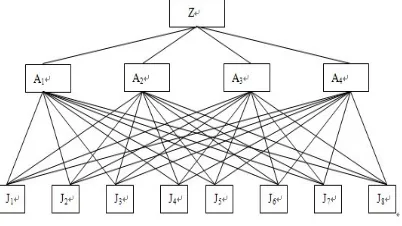
Based on method of analytic hierarchy process, model the problem as a hierarchy containing the decision goal, the alternatives for reaching it, and the criteria for evaluating the alternatives. Set a modeling about this problem, decision-making for Z, select scenic spots. Four criticisms of evaluation are selected, A1 represents "culture and history", A2 is for "scene", A3 represents "traffic", A4 represents "flowing rate of visitors". J1-J8 is scheme layer which represent eight scenic spots in Weixian separately, as shown in figure 1.
Figure 1. An AHP hierarchy of Weixian scenic spots.
The goal is to select the most suitable scenic spots from scenic spots in Weixian. The factors to be considered are"culture and history","scene", "traffic", and "flowing rate of visitors". Alternatives are J1-J8 representing eight scenic spots.
2.2.Definition Of Comparison Matrix
A is comparison matrix about the four
evaluation criteria. A1represents culture history, A2
is for "scene", A3 represents "traffic", A4 represents
"flowing rate of visitors". A is the following matrix
1
1 2 4
2
2 1 4 8
1 1 1 2 2 4
1 1 1
1
4 8 2
B1, B2, B3, B4 are four respectively comparison matrix of evaluation criteria which stand for eight attractions for "history and culture", " scene ", "traffic" and " flowing rate of visitors " . Taking B1 for example, B1 is the standard of evaluation for "history and culture", Eight weight of each scenic spots respectively for 2,4,2,8,4,4,1,8. For example, scenic spots J1 " MoChi LiXianTai," J3 "JinGui lake" two spots of weight for 2, demonstrated that the two spots in the aspect of culture and history can be equal, which have the same weight of "history and culture". While the weight of J7 manjusri temple is 1, representatives of the weight of manjusri temple is, the two times that of MoChi LiXianTai about "history and culture". Definition comparison matrix B1, B2, B3, B4 is following as
1
1 2 1 4 2 2 4 1 2 1 4 2 4 4 2
2
1 1 1 1 1
1 2 1 1 2 1 2 1 2 2 1
2 2 4 2 2
1
1 2 1 4 2 2 4 1 2 1 4 2 4 4 2
2
1 1 1 1 1 1 1 1 1 1 1
1 1 1 1 1
4 2 4 2 2 8 ; 4 2 4 2 2
1 1 1 1 1
1 2 1 1 2 1 2 1 2 2 1
2 2 4 2 2
1 1 1 1 1
1 1 1
1 1 1
1 2 1 1 2
4 2 4 2 2
2 2 4
1 1
2 4 2 8 4 4 1 8
4 2
1 1 1 1 1 1
1 1
4 2 4 2 2 8
1 1 1
1 1 1
4 2 2
1 1
1 2 1 2 2 1
2 2
1 1 1 1 1
1 1 1 4 1 4 2 1 1 1 2
2 2 4 2 4
1 1 1 1
2 1 2 2 8 2 8 4 1 1 1 2
2 4 2 4
1 1 1 1 1
1 1 1 4 1 4 2 1 1 1 2
2 2 4 2 4
1 1 1
1 1 1 4 1 4 2 2 2 2 1 1 4
2 ; 2 2
1 1 1 1 1 1
1 1 4 4 4 2 1 2 1 8
4 8 4 4 4 2
1 1 1
1 1 1 4 1 4 2 2 2 2 1 1 4
2 2 2
1 1 1 1 1 1
1 1 4 4 4 2
4 8 4 4 4 2
1 1 1 1 1
2 2 1
2 4 2 2 2
1 2 1 8 1 1 1 1 1 1 1
1 2 2 2 4 8 4 8
2.3. Calculating The Weight Vectors Of Single Order Level
The features value and feature vector about comparison matrix A.
[image:2.612.94.295.435.548.2]the fourth list a vector for feature vector, namely:
ω=
1
2
8
4
Normalization:
0667 . 0
1333 . 0
5333 . 0
2667 . 0
Similarly, for J1, J2, J3, J4, J5, J6, J7, J8 respectively, for evaluation criteria A1, A2, A3, A4 level single sort such as table 1 for:
J1 0.16667 0.23529 0.14286 0.06452
J2 0.08333 0.11765 0.28571 0.06452
J3 0.16667 0.23529 0.14286 0.06452
J4 0.04167 0.05882 0.14286 0.12903
J5 0.08333 0.11765 0.03571 0.25806
J6 0.08333 0.05882 0.14286 0.12903
J7 0.33333 0.05882 0.03571 0.25806
J8 0.04167 0.11765 0.07143 0.03226
2.4. Computing Hierarchy Total Arrangement Order Weights
The overall goal of the weight of the value of J1 is:
0.16667*0.2667+0.23529*0.5333+0.14286*0.1333 +0.06452*0.0667=0.1933
Similarly, J2 =0.1273; J3=0.1933; J4==0.0710; J5=0.1069; J6=0.0821; J7=0.1423; J8=0.0855
B1, B2, B3, B4 for 8 order is multiplicative matrix, their only the zero roots for features are all the same as λ = 8, λ = n = 8, so B1, B2, B3, B4 for consistent array.
The overall goal of the decision-making right vector for:{0.1933、0.1273、0.1933、0.0710、
0.1069、0.0821、0.1423、0.0855}.
Through the "culture and history", "beautiful", "traffic," and "flowing rate of visitors" four aspects of hierarchical analysis, it is concluded that the overall goal of each spots the right value: J1 which represente " MoChi LiXianTai ", is 0.1933; J2 which represente " culture square of turtle carrying city”, is 0.1273; J3 ("JinGui lake”) is 0.1933; J4 ("YiMin mountain park”) is 0.0710; J5 ("WeiXian martyr cemetery”)is 0.1069; J6 ("Jung let pear culture square") is 0.0821; J7 ("manjusri temple”) is 0.1423; J8 ("The ecological park" ) is 0.0855.
Take a value greater than 0.1 rights of spots, It got five spots: MoChi ritual XianTai, turtle carry city culture park, JinGui lake, Weixian martyr cemetery, manjusri temple. As shown in figure 2.
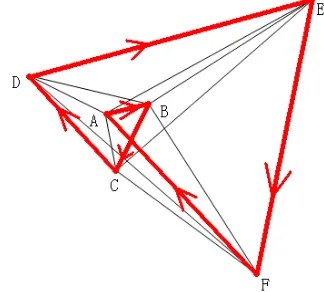
Figure 2. Modeling figure Weixian attractions distribution (A starting point for the station, B is martyr cemetery, C is manjusri temple, D is culture square of turtle carrying city, E is MoChi LiXianTai, F is ceremony for JinGui Lake)
3. TSP MODEL OF TRANELLING
Traveling salesman problem, we call it pass through (Tour), this problem is NP-Complete problems, so the traveling salesman problem mostly in the heuristic method. TSP is one of the most intensively studied problems in optimization. It is used as a benchmark for many optimization methods. Even though the problem is computationally difficult, a large number of heuristics and exact methods are known, so that some instances with tens of thousands of cities can be solved.
3.1. Tour Construction Procedures
Produce an approximate optimal solution approach from a distance of matrix has the following kinds of solution:
1) Nearest Neighbor Procedure: First to find demand point from stations recently as the starting line the first customers, since then looking for the last to join the route from customer recently demand point until the end.
[image:3.612.92.295.203.369.2]put back, and then calculated between route with save quantity, will save in descending order quantity and in turn merger route until the end.
3) Insertion procedures: Such as the latest insertion method, the most provinces insertion method, optional insertion method, insertion method, maximum Angle farthest insertion method, etc.
3.2. Tour Improvement Procedure
First given a feasible paths, and then improve and has been to so far does not improve. Have the following kinds of solution:
1) K-Opt (two-thirds Opt): Not yet in the path of the article K line temporarily replace the current quarter the path in article K day line, and calculated the cost (or the distance), if the cost reduction (distance reduce), then replace, until cannot improve so far, K usually for 2 or 3.
2) Or-Opt: In the same path adjacent demand point, linking itself or other path and still keep the path, the direction of exchange, and calculated the cost (or the distance), if the cost reduction (distance reduce), then replace, can not improve until now.
3.3. Composite Procedure
First by the method of construction group starting group generated, and then use method to seek the best paths to improve solution, also known as two paragraphs solution (two phase method). Have the following kinds of solution:
1) Starting solution + 2-Opt: Paths to construct method to establish an initial solution, garnish with 2-Opt to improve the way group, until can't improve so far.
2) Starting solution + 3-Opt: Paths to construct method to establish an initial solution, garnish with 3-Opt to improve the way group, until can't improve so far. Kruskal algorithm is based on the theory of "cut the optimal condition" and "circle the optimal conditions". Beginning a support hypothesis is the son of the arc set for figure T empty set, the algorithm operation process will continue to put some arc to join the son figure, and every time the join T arc will be finally found a member of the minimum spanning tree, and will not withdraw from T. Kruskal algorithm is a greedy algorithm. Minimum spanning tree graph theory is often used in traffic route choice. And Kruskal algorithm will use to tourist line design. In empowerment find a figure the champion tree, to meet the minimum shortest path connecting the tourist destination and minimum construction costs.
Set 1 for A "starting point the station", 2 for B "martyr cemetery", 3 for C "manjusri temple", 4 for D "turtle carry city culture square", 5 for the E "MoChi ritual XianTai", 6 for F "JinGui lake". The known attractions distance to:
AB=1700m; AC=2100m; AD=2700m;
AE=9100m; AF=8900m; BC=2600m;
BD=3700m; BE=8800m; BF=7200m;
CD=4600m; CE=9100m; CF=7100m;
DE=9700m; DF=11800m; EF=7900m;
[image:4.612.341.503.298.444.2]Operational result is shown in figure 3. The best path 1-2-3-4-5-6-1, which A-B-C-D-E-F-A, as the "starting point the station"-"martyr cemetery-temple"-"manjusri turtle carry city culture square"-"MoChil LiXianTai"-"JinGui lake"-"the station", the total distance of 25800 meters.
Figure 3. The Optimal Route Of Weixian.
4 CONCLUSIONS
method are described in detail and the c programming language are using.
ACKNOWLEDGEMENTS
This work was supported by grants from The National Natural Science Foundation of China (No. 31100913) and the Startup Foundation for Doctors of Hebei Polytechnic University (No.35377601).
REFRENCES:
[1] Jorgen Bang-Jensen and Gregory Gutin, “Digraphs: Theory Algorithms and Applications”, Springer, 2011.
[2] G.Gutin, A.Yeo, A. Zverovich, “Traveling salesman should not be greedy: domination analysis of greedy-type heuristics for the TSP”, Discrete Applied Mathematics 117 (1–3), 2002, 81–86.
[3] L. M. Adleman. “Molecular computation of solutions to combinatorial problems”, Science, 266(11), 1994, 1021-1024
[4] D. Cherition and R. E. Tarjan, “Finding minimum spanning trees”. In: SIAM Journal on Computing, vol. 5, 724–741, 1976.
[5] Thomas H. Cormen, Charles E. Leiserson, Ronald L. Rivest, and Clifford Stein, "Introduction to Algorithms", Third Edition, MIT Press, 2009, pp.631–638.
[6] Christos H. Papadimitriou. "The Euclidean travelling salesman problem is NP-complete". Theoretical Computer Science 4:237–244, 1977. [7] S. S. Ray, S. Bandyopadhyay and S. K. Pal,
"Genetic Operators for Combinatorial Optimization in TSP and Microarray Gene Ordering," Applied Intelligence, 26(3), 2007, pp. 183-195.
[8] Bhushan, Navneet; Kanwal Rai. Strategic Decision Making: Applying the Analytic Hierarchy Process. 2004.
[9] Saaty, Thomas L. "Relative Measurement and its Generalization in Decision Making: Why Pairwise Comparisons are Central in Mathematics for the Measurement of Intangible Factors - The Analytic Hierarchy/Network Process". RACSAM (Review of the Royal spanish Academy of Sciences, Series A, Mathematics) 102 (2), 2008 251–318.
[10] Fredman, M. L, Willard, D. E., "Trans-dichotomous algorithms for minimum spanning
trees and shortest paths", Journal of Computer and System Sciences 48 (3), 2004, 533–551. [11] E. W. Dijkstra, "A note on two problems in
connexion with graphs". In: Numerische Mathematik. 1959, 269–271.
[12] S. S. Ray, S. Bandyopadhyay and S. K. Pal, "Genetic Operators for Combinatorial Optimization in TSP and Microarray Gene Ordering," Applied Intelligence, 26(3). 2007, pp. 183-195.
[13]Zhan, F. Benjamin; Noon, Charles E. "Shortest Path Algorithms: An Evaluation Using Real Road Networks". Transportation Science, 32 (1): 1998, 65–73.
[14] Eppstein, David, "Spanning trees and spanners". In Sack, J.-R., Urrutia J., Handbook of Computational Geometry, 1999,pp. 425–461. [15] Mareš, Martin, "Two linear time algorithms for
MST on minor closed graph classes", Archivum mathematicum, 40(3): 2004, 315–320.
[16] D. Granot, "Minimum cost spanning tree games", Mathematical Programming, 21 (1), 1-18, 1981.
[17] M. Dorigo,V. Mmaniezzo, A. Colomi. “Ant system. Optimization by a colony of
cooperating agents”, IEEE Trans on
SMC,1996,26(1):28-41.
[18] J.A. M. Potters, I.J. Curiel, Stef H. Tijs, "Traveling salesman games", Mathematical Programming, 53 (1-3), 1992,199-211.