401
A HYBRID GLOBAL NUMERICAL OPTIMIZATION WITH
COMBINATION OF EXTREMAL OPTIMIZATION AND
SEQUENTIAL QUADRATIC PROGRAMMING
1,2
PENGCHEN, 3ZAI-SHENG PAN, 4YONG-ZAI LU
1
Zhejiang Supcon Research Co., LTD., Hangzhou, P. R. China 2
Department of Control science and engineering, Zhejiang University, Hangzhou, P. R. China 3
Department of Control science and engineering, Zhejiang University, Hangzhou, P. R. China 4
Department of Control science and engineering, Zhejiang University, Hangzhou, P. R. China
E-mail: [email protected], [email protected], [email protected]
ABSTRACT
In recent years, many efforts have focused on cooperative (or hybrid) optimization approaches for their robustness and efficiency to solve decision and optimization problems. This paper proposes a novel hybrid solution with the integration of bio-inspired computational intelligence extremal optimization (EO) and deterministic sequential quadratic programming (SQP) for numerical optimization, which combines the unique features of self-organized criticality (SOC), non-equilibrium dynamics and global search capability in EO with local search efficiency of SQP. The performance of proposed EO-SQP algorithm is tested on twelve benchmark numerical optimization problems and compared with some other state-of-the-art approaches. The experimental results show the EO-SQP method is capable of finding the optimal or near optimal solutions for nonlinear programming problems effectively and efficiently.
Keywords: Extremal optimization (EO), Sequential quadratic programming (SQP), Memetic algorithms
(MA), Nonlinear programming (NLP), Numerical optimization
1. INTRODUCTION
With the high demand in decision and optimization for many real-world problems and the progress in computer science, the research on novel global optimization solutions has been a challenge to academic and industrial societies. During past few decades, various optimization techniques have been intensively studied; those techniques follow different approaches and can be divided roughly into three main categories, namely, the deterministic methods [1], stochastic methods [2] and bio-inspired computational intelligence [3].
In general, most global optimization problems are intractable, especially when the optimization problem has complex landscape and the feasible region is concave and covers a very small part of the whole search space [4]. Solution accuracy and global convergence are two important factors in the development of optimization techniques. Deterministic search methods are known to be very efficient with high accuracy. Unfortunately, they are easily trapped in local minima [5]. On the other hand, the methods of computational intelligence [3] are much more effective for traversing these
complex surfaces and inherently better suited for avoiding local minima. However, computational intelligence has its weakness in slow convergence and providing a precise enough solution because of the failure to exploit local information [6]. Moreover, for constrained optimization problems involving a number of constraints with which the optimal solution must satisfy, computational intelligence methods often lack an explicit mechanism to bias the search in feasible regions [4][7][8].
During the last decades, a particular class of global-local search hybrids named “memetic algorithms” (MAs) are proposed [9], which are motivated by Richard Dawkins’s theory [10]. MAs are a class of stochastic heuristics for global optimization which combine the global search nature of EA with local search to improve individual solution [11]. They have been successfully applied to hundreds of real-world problems such as optimization of combinatorial optimization [12], multi-objective optimization [13], bioinformatics [14], etc.
402 extremal optimization (EO) and the popular deterministic sequential quadratic programming (SQP) under the conceptual umbrella of MA. EO is a general-purpose heuristic algorithm, with the superior features of self-organized criticality (SOC), non-equilibrium dynamics, co-evolutions in statistical mechanics and ecosystems respectively [15] [16]. SQP has been one of the most popular methods for nonlinear optimization because of its efficiency of solving medium and small size nonlinear programming problems [1][17]. It guarantees local optima as it follows a gradient search direction from the starting point towards the optimum point and has special advantages in dealing with various constraints [18]. This will be particularly helpful for the hybrid EO-SQP algorithm when solving constrained optimization problems: the SQP can also serve as a means of “repairing” infeasible solutions during EO evolution. The proposed method balances both aspects through the hybridization of heuristic EO as the global search scheme and deterministic SQP as the local search scheme.
The rest of this paper is organized as follows: In section 2, the nonlinear optimization problem with/without constraints is described in a general formulation. Section 3 presents the EO-SQP fundamental and algorithm in detail. In section 4, the proposed approach is used to solve twelve benchmark test functions, and the results are quantitatively compared with genetic algorithm (GA), particle swarm optimization (PSO), SQP and some other popular methods such as Stochastic Ranking (SR) [8], Simple Multimembered Evolution Strategy (SMES) [19] and Auxiliary Function Method (AFM) [20]. Finally, the concluding remarks are addressed in Section 5.
2. PROBLEM FORMULATION
Many real-world optimization problems can be mathematically modeled in terms of a desired objective function subject to a set of constraints as follows:
1 2
Minimize ( ), f X X =[ ,x x,...,xn] (1)
subject to
( ) 0; 1, 2,..., t
g X ≤ t= p (2)
( ) 0; 1, 2,..., u
h X = u= q (3)
; 1, 2,...,
v v v
x ≤x ≤x v= n (4)
where X∈Rn is an n-dimensional vector representing the solution of the problem (1) - (4),
( )
f X is the objective function, which needs to
satisfy p-inequality constraints g Xt( ) , q-equality constraints h Xu( ) , xv and xv are the lower and upper bounds of the variable xv.
The above formulation is an instance of the well-known nonlinear programming (NLP) problem. In general, the global optimization of NLP is one of the toughest NP-hard problems. Solving this type of problems has become a challenge to computer science and operations research.
3. EO-SQP OPTIMIZATION INSPIRED BY
MEMETIC ALGORITHM
3.1 Extremal Optimization
The Extremal Optimization (EO) proposed by Boettcher and Percus [15][16] is derived from the fundamentals of statistical physics and self-organized criticality (SOC) [21] based on Bak-Sneppen (BS) model [22] which simulates far-from equilibrium dynamics in statistical physics and co-evolution[23]. Generally speaking, EO is particularly applicable in dealing with large complex problems with rough landscape, phase transitions passing “easy-hard-easy” boundaries or multiple local optima. It is less likely to be trapped in local minima than traditional gradient-based search algorithms. The research results by Chen and Lu show EO and its derivatives can be effectively applied in solving multi-objective combinatorial hard benchmarks and real-world optimization problems [24] [25] [26] [27].
3.2 Sequential quadratic programming (SQP)
After its initial proposal by Wilson in 1963 [28], the sequential quadratic programming (SQP) method was popularized in the 1970’s by Han [29] and Powell [30]. SQP proves itself as the most successful method and outperforms other nonlinear programming methods in terms of efficiency and accuracy to solve nonlinear optimization problems. The solution procedure is on the basis of formulating and solving a quadratic sub-problem with iterative search.
3.3 MA based Hybrid EO-SQP algorithm
403 Theorem by Wolpert and Macready [31], a search algorithm strictly performs in accordance with the amount and quality of the problem knowledge they incorporate. This fact clearly underpins the exploitation of problem knowledge intrinsic to MAs [32]. Under the framework of MAs, the stochastic global search heuristics work together with problem-specific solvers, in which Neo-Darwinian’s natural evolution principles are combined with Dawkins’ concept of a meme [10] defined as a unit of cultural evolution that is capable of performing individual learning (local refinement). The global character of the search is given by the evolutionary nature of computational intelligence approaches while the local search is usually performed by means of constructive methods, intelligent local search heuristics or other search techniques [11]. The hybrid algorithms can combine the global explorative power of computational intelligence methods with the local exploitation behavior of conventional optimization techniques, complement their individual weak points, and thus outperform either one used alone.
In this study, a MA based hybrid EO-SQP algorithm is developed and applied to nonlinear programming problems. The proposed algorithm is a hybridization of EO and SQP. We intend to make use of the capacity of both algorithms: the ability of EO to find a solution close to the global optimum and effectively dealing with phase transition; the ability of SQP to fine-tune a solution quickly by means of local search and repair infeasible solutions. To implement EO-SQP optimization, the following practical issues need to be addressed.
3.4 Fitness function definition
The fitness function measures how fit an individual (i.e., solution) is, and the “fittest” one has more chance to be inherited into the next generation. A “global fitness” must be defined to evaluate a solution in the proposed EO-SQP algorithm. To solve the NLP optimization problems, the global fitness is defined as the object function value in Eq. (1) for unconstrained benchmark problems:
( ) ( ) global
Fitness S = f S (5)
For constrained NLP optimization problems, a popular penalization strategy is used in EO-SQP evolution in order to transform the constrained problem to unconstrained one. If a solution is infeasible, its fitness value is penalized according to the violations of constraints defined in Eq. (2) and Eq. (3):
,
( ) ( ) ( )
t u
global
g h
Fitness S =f S +Penalty S
∏ ∏ (6)
Unlike GA, which works with a population of candidate solutions, EO depends on a single individual (i.e. chromosome) based evolution. Through always performing mutation on the worst component and its neighbors successively, the individual in EO can evolve itself toward the global optimal solution generation by generation. This requires a suitable representation which permits each component to be assigned with a quality measure (i.e. fitness) called “local fitness”. In this paper, the local fitness λk is defined as an improvement in global fitness Fitnessglobal made by the mutation imposed on the kth component of best-so-far chromosome S:
( ) ( )
( ) ( )
k local global
global global k
Fitness k Fitness k
Fitness S Fitness S
λ = = ∆
′
= − (7)
3.5 Termination criteria
Termination criteria are used for the detection of an appropriate time to stop the optimization run. In this paper, the termination criteria are designed based on two widely used rules. If the predefined maximum generation is exceeded; or an error measure in dependence on the known optimum is satisfied (we can assume that the algorithm has managed to discover the global minimum), the algorithm should terminate. Denote Sbest as the best-so-far solution found by the algorithms and S*
as the optimum solution of the functions. The search is considered successful, or in other words, the near-optimal solution is found, if Sbest satisfies that (F*−F) /F* <1e−3 (for the case optimum value
* 0
F ≠ ) or (F*−F) <1e−3 (for the case optimum
value F*=0). These criteria are perfectly suitable
for comparing the performance of different algorithms.
3.6 Workflow and Algorithm
404 operator) are applied to the best-so-far solution S
based on a probability parameter pm in each generation. In contrast to the standard EO mutation, when SQP mutation or Multi-start Gaussian mutation is adopted, we use the “GEOvar” [33]
strategy to evolve the current solution by improving all variables simultaneously, as an attempt to speed up the process of local search. The flowchart of the proposed EO-SQP algorithm is shown in Figure. 1.
4. EXPERIMENTAL TEST ON
BENCHMARK FUNCTIONS
In this section, twelve widely used NLP benchmark problems are introduced, which have been already extensively discussed in many published literatures. These benchmark functions make it possible to study the proposed EO-SQP
algorithm in comparison with other state-of-the-art methods and some well-known results published recently.
4.1 Unconstrained problems
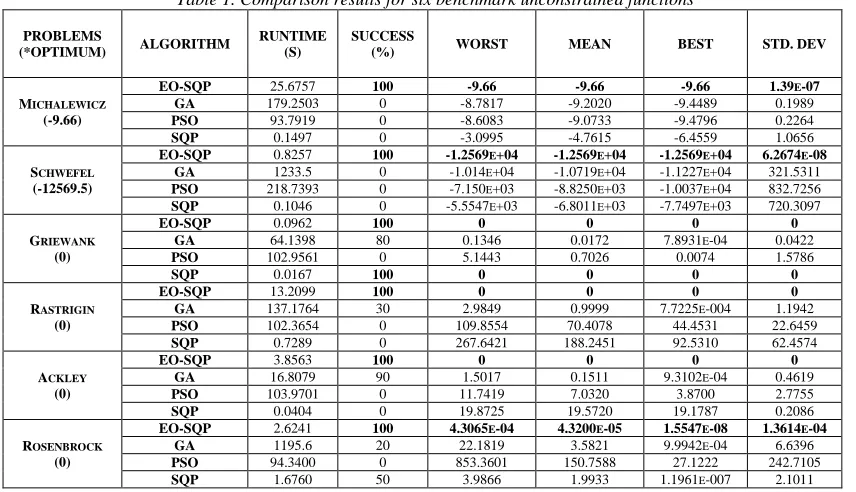
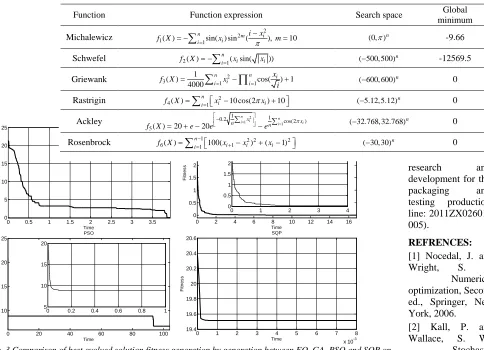
First, the performance of the proposed algorithm is tested on six well-known unconstrained problems with the detailed description in appendix. For close comparison of solution accuracy, the Runtime, success rate, best, average, worst and standard deviation values obtained from total 10 independent runs of proposed EO-SQP, standard GA, standard PSO and standard SQP on the six test functions are presented in Table 1. The best results among the four approaches are shown in bold. “Success” represents the success rate (percentage of success to discover the global minimum), and “Runtime” is the average runtime when the algorithm stops according to the termination criteria defined in section 3.5. In our experiments, the population size of GA and PSO are set to 100 and 50, respectively.
As shown in Table 1, the EO-SQP algorithm proposed in this study is able to find the global optima consistently for all six unconstrained benchmark functions. The GA, PSO, SQP have a very low successful rate for most benchmark problems (Michalewicz, Schwefel, Rastrigin and Rosenbrock functions). In contrast, the proposed EO-SQP algorithm achieved a success rate of 100% for all the six problems. Moreover, EO-SQP is a quite efficient method; the computational time is significantly reduced in comparison with GA and Termination?
New Generation
Randomly generate the mutation step for each component
Optimize the Best-so-far solution for N
iterations using SQP algorithm
Mutation on the worst component Calculate localized fitness
for the each component
Find the worst component
Randomly generate new chromosome by adding a
Gaussian distributed vector to best-so-far solution
Y N
Stop Global Fitness Calculation
If current solution is better than best so far solution
Replace the best solution with current solution
Y N
EO mutation SQP mutation Multi-start Gaussian mutation Select the Mutation operator based on a randomly
generated probability
EO Evolution Cycle
To Fitness evaluation Evolve new generated
chromosome for M iterations by SQP Mutations for EO-SQP
algorithm Start
[image:4.612.91.299.210.357.2]Create the initial Solution randomly
[image:4.612.94.522.479.725.2]Figure. 1 Flowchart of the EO-SQP algorithm
Table 1. Comparison results for six benchmark unconstrained functions
PROBLEMS
(*OPTIMUM) ALGORITHM
RUNTIME (S)
SUCCESS
(%) WORST MEAN BEST STD. DEV
MICHALEWICZ (-9.66)
EO-SQP 25.6757 100 -9.66 -9.66 -9.66 1.39E-07 GA 179.2503 0 -8.7817 -9.2020 -9.4489 0.1989
PSO 93.7919 0 -8.6083 -9.0733 -9.4796 0.2264
SQP 0.1497 0 -3.0995 -4.7615 -6.4559 1.0656
SCHWEFEL (-12569.5)
EO-SQP 0.8257 100 -1.2569E+04 -1.2569E+04 -1.2569E+04 6.2674E-08 GA 1233.5 0 -1.014E+04 -1.0719E+04 -1.1227E+04 321.5311
PSO 218.7393 0 -7.150E+03 -8.8250E+03 -1.0037E+04 832.7256
SQP 0.1046 0 -5.5547E+03 -6.8011E+03 -7.7497E+03 720.3097
GRIEWANK (0)
EO-SQP 0.0962 100 0 0 0 0
GA 64.1398 80 0.1346 0.0172 7.8931E-04 0.0422
PSO 102.9561 0 5.1443 0.7026 0.0074 1.5786
SQP 0.0167 100 0 0 0 0
RASTRIGIN (0)
EO-SQP 13.2099 100 0 0 0 0
GA 137.1764 30 2.9849 0.9999 7.7225E-004 1.1942
PSO 102.3654 0 109.8554 70.4078 44.4531 22.6459
SQP 0.7289 0 267.6421 188.2451 92.5310 62.4574
ACKLEY (0)
EO-SQP 3.8563 100 0 0 0 0
GA 16.8079 90 1.5017 0.1511 9.3102E-04 0.4619
PSO 103.9701 0 11.7419 7.0320 3.8700 2.7755
SQP 0.0404 0 19.8725 19.5720 19.1787 0.2086
ROSENBROCK (0)
EO-SQP 2.6241 100 4.3065E-04 4.3200E-05 1.5547E-08 1.3614E-04 GA 1195.6 20 22.1819 3.5821 9.9942E-04 6.6396
PSO 94.3400 0 853.3601 150.7588 27.1222 242.7105
405 PSO. Although the deterministic SQP is the fastest method among the four, it is easily trapped in local
minima as shown in simulation results
(Michalewicz, Schwefel, Rastrigin, Ackley and Rosenbrock functions). The proposed EO-SQP method can successfully prevent solutions from falling into the deep local minimal which is far from the global optimum, reduce evolution process significantly with efficiency, and converge to the global optimum or its close vicinity.
4.2 Constrained problems
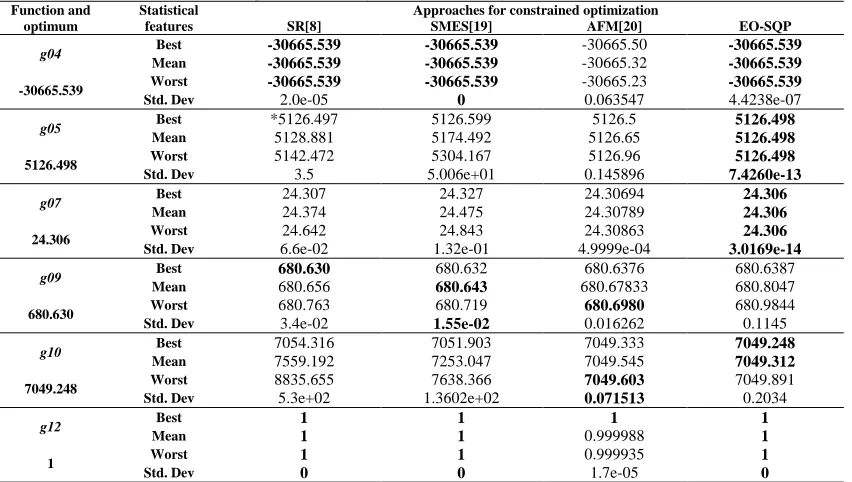
In this study, we selected six (g04, g05, g07, g09, g10 and g12) out of thirteen benchmark functions published in [8][19][20] as constrained test problems, since the characteristics of those functions contain the “difficulties” in having global optimization problems by using an evolutionary algorithm. Table 2 shows the performance comparisons among Stochastic Ranking (SR) [8], Simple Multimembered Evolution Strategy (SMES) [19], Auxiliary Function Method (AFM) [20] and proposed hybrid EO-SQP. The best results among the four approaches are shown in bold.
Among these four methods (see Table 2), the EO-SQP appears to be more promising. It provided three better “best” results (g05, g07 and g10) among six functions, and two similar “best” results (g04 and g12). Moreover, the EO-SQP provided better “mean” results for three problems (g05, g07
and g10), and similar “mean” results in other two
(g04 and g12). Finally, the EO-SQP obtained better “worst” results in two problems (g05 and g07), and it reached similar “worst” solutions in other two problems (g04 and g12). The proposed EO-SQP can produce the better, if not optimal, solutions for most of the six benchmark problems with the exception of test function g09. With respect to test function
g09, although the EO-SQP fails to provide superior results, the performance of the four methods are very close actually. Generally, constrained optimization problems with equality constraints are very difficult to solve. It should be noted that for the three test functions with equality constraints (g05, g07, and g10), EO-SQP can provide better performance than other three methods, the optimum solutions are found by EO-SQP for all the three problems with equality constraints; while the SR, SMES and AFM fail to find the global optimums. This is due to the hybrid mechanism that the EO-SQP can benefit from the strong capability of EO-SQP to deal with constraints during the EO evolution.
4.3 Dynamics analysis of the hybrid EO-SQP
The convergence and the dynamics during the optimization of EO and its derivatives remain up to now challenging open problems. In this section, we use a typical optimization run of Ackley function ( F*=0 ) as an example to analyze evolution
406 Figure. 2 shows the search dynamics of basic EO and the hybrid EO-SQP, which demonstrates the fitness evolution of the current solution in a typical run on Ackley function. The figure shows that both basic EO and hybrid EO-SQP descend sufficiently fast to a near-optimal solution with enough fluctuations to escape from local optima and explore new regions of configuration space. It can be seen quite clearly that with the help of SQP, the
hybrid EO-SQP can execute a more deeply search in comparison with basic EO. The search efficiency of basic EO can be improved significantly by incorporating local search method SQP into the evolution, when EO-SQP converges to the close
vicinity of the global optimum, the SQP mutation will help to find the global optimum point in just a few runs, as shown in Figure. 2.
Evolutions of best solution fitness as a function of time for EO-SQP, GA, PSO and SQP on Ackley function are also shown in Figure. 3. The convergence rate of the proposed EO-SQP algorithm is a little slower than GA and PSO at the early stage, due to better solution diversity of population based methods (GA and PSO); however, when the solution approach to a near region of the global optimum, the convergence rate of EO-SQP increases rapidly and reaches the global minimum very fast due to the efficiency of gradient based SQP local search. On the other hand, the conventional SQP converges to a local minimal far from the global optimum with high efficiency and can’t escape from it during the rest runs due to the weakness of gradient search.
As a general remark on the comparisons above, EO-SQP shows better performance with respect to state-of-the-art approaches in terms of the quality, the robustness, and the efficiency of search. The results show that the proposed EO-SQP finds optimal or near-optimal solutions quickly, and has more
statistical soundness and faster convergence rate than the
compared algorithms. It should be noted that the factors contributing to the performance of the proposed EO-SQP method are the global search capability of EO and the capability of the gradient-based SQP method to search local
optimum efficiently with high accuracy and deal with various constraints.
[image:6.612.94.288.86.226.2]5. CONCLUDING REMARKS
Table 2. Comparison results for six benchmark functions with constraints Function and
optimum
Statistical features
Approaches for constrained optimization
SR[8] SMES[19] AFM[20] EO-SQP
g04 Best -30665.539 -30665.539 -30665.50 -30665.539
Mean -30665.539 -30665.539 -30665.32 -30665.539
-30665.539 Worst -30665.539 -30665.539 -30665.23 -30665.539
Std. Dev 2.0e-05 0 0.063547 4.4238e-07
g05 Best *5126.497 5126.599 5126.5 5126.498
Mean 5128.881 5174.492 5126.65 5126.498
5126.498 Worst 5142.472 5304.167 5126.96 5126.498
Std. Dev 3.5 5.006e+01 0.145896 7.4260e-13
g07 Best 24.307 24.327 24.30694 24.306
Mean 24.374 24.475 24.30789 24.306
24.306 Worst 24.642 24.843 24.30863 24.306
Std. Dev 6.6e-02 1.32e-01 4.9999e-04 3.0169e-14
g09 Best 680.630 680.632 680.6376 680.6387
Mean 680.656 680.643 680.67833 680.8047
680.630 Worst 680.763 680.719 680.6980 680.9844
Std. Dev 3.4e-02 1.55e-02 0.016262 0.1145
g10 Best 7054.316 7051.903 7049.333 7049.248
Mean 7559.192 7253.047 7049.545 7049.312
7049.248 Worst 8835.655 7638.366 7049.603 7049.891
Std. Dev 5.3e+02 1.3602e+02 0.071513 0.2034
g12 Best 1 1 1 1
Mean 1 1 0.999988 1
1 Worst 1 1 0.999935 1
Std. Dev 0 0 1.7e-05 0
* The best result of problem g05 by SR is even better than the optimal solution of 5126.498. This is the consequence of transforming equality constraints into inequality constraints by a relaxed parameter ε [8].
0 100 200 300 400 500 600 700 800 900 1000
0 5 10 15 20 25
F
itnes
s
Iterations Comparison of Searching dynamics between basic EO and EO-SQP
Basic EO EO-SQP
Figure. 2 Comparison of current solution fitness generation by generation between EO and EO-SQP on
[image:6.612.6.432.386.627.2]407 In this paper, a novel MA based Hybrid EO-SQP algorithm is proposed for global optimization of NLP problems which are typically quite difficult to solve exactly. Traditional deterministic methods are more vulnerable to getting trapped in the local minima; while most computational intelligence based optimization methods with global search capability tend to suffer from high computation cost. Therefore, under the framework of MA, the general-purpose heuristic EO with deterministic local search method SQP are combined together in order to develop a robust and fast optimization
technique with global search capability and mechanism to deal with constraints. The hybrid method avoids the possibility of local minimum by providing the gradient search method with the exploration ability of EO. Those advantages have been clearly demonstrated by the comparison with some other state-of-the-art approaches over 12 widely used benchmark functions.
The future studies involve more fundamental research on evolution dynamics of the proposed method and the application of EO-SQP for more benchmark and real-world problems.
ACKNOWLEDGEMENTS
The author would like to thank the anonymous referees for their helpful comments and suggestions on this manuscript. This work was supported by the major project of the National Science and Technology (scheduling and control software
research and development for the packaging and testing production line: 2011ZX02601-005).
REFRENCES:
[1] Nocedal, J. and
Wright, S. J.,
Numerical optimization, Second ed., Springer, New York, 2006.
[2] Kall, P. and Wallace, S. W.,
Stochastic Programming, John Wiley & Sons, Chichester, UK, 1994.
[3] Engelbrecht, A. P., Computational Intelligence, An introduction, Second ed., John Wiley & Sons, New York, 2007.
[4] Wang, Y., Cai, Z., Zhou, Y. and Fan, Z., Constrained optimization based on hybrid
0 0.5 1 1.5 2 2.5 3 3.5
0 5 10 15 20 25 F it nes s Time EO-SQP
0 2 4 6 8 10 12 14 16
0 0.5 1 1.5 2 2.5 3 3.5 F it nes s Time GA
0 20 40 60 80 100
10 15 20 25 F it nes s Time PSO
0 1 2 3 4 5 6 7 8
x 10-3 19.4 19.6 19.8 20 20.2 20.4 20.6 F it nes s Time SQP
0 1 2 3 4
0 0.5 1 1.5 2 2.5 3 3.5
0 0.2 0.4 0.6 0.8 1
[image:7.612.32.516.278.628.2]5 10 15 20
Figure. 3 Comparison of best evolved solution fitness generation by generation between EO, GA, PSO and SQP on Ackley Function
APPENDIX:
Function Function expression Search space Global
minimum
Michalewicz 2 2
1( ) 1sin( ) sin ( ), 10
n m i
i i
i x
f X = −
∑
= x −π m= (0, )π n -9.66Schwefel 2( ) 1( sin( ))
n
i i
i
f X = −
∑
= x x ( 500, 500)− n -12569.5Griewank 2
3 1 1
1
( ) cos( ) 1
4000 n n i i i i x
f X x
i
= =
=
∑
−∏
+ ( 600, 600)− n 0Rastrigin 2
4( ) 1 10 cos(2 ) 10
n
i i
i
f X =
∑
=x − πx + ( 5.12, 5.12)− n 0Ackley 12 1
1 1
0.2 cos(2 )
5( ) 20 20
n n
i
i x i xi
n n
f X e e = e = π
−
∑ ∑
= + − − ( 32.768, 32.768)− n 0
Rosenbrock 1 2 2 2
6( ) 1 100( 1 ) ( 1)
n
i i i
i
408 evolutionary algorithm and adaptive
constraint-handling technique, Structural and
Multidisciplinary Optimization, v37, 2009, pp.395-413.
[5] Vargas, M. C., Torres-Jimenez, J. and Ruiz-Suarez, J., C. Analysis of X-ray diffraction data using a hybrid stochastic optimization method.
Journal of Physics A: Mathematical and General, v35, 2002, pp.3865-3876.
[6] Tahk, M. J., Woo, H. W. and Park, M. S., A hybrid optimization method of evolutionary and gradient search, Engineering Optimization, v39, 2007, pp.87-104.
[7] Zhang, M., Luo, W. and Wang, X., Differential evolution with dynamic stochastic selection for constrained optimization, Information Sciences, v178, 2008, pp.3043-3074.
[8] Runarsson, T. P. and Yao, X., Stochastic Ranking for Constrained Evolutionary
Optimization. IEEE Transactions on
Evolutionary Computation, v4, 2000, pp.284-294.
[9] Moscato, P., On Evolution, Search,
Optimization, Genetic Algorithms, and Martial Arts: Towards Memetic Algorithms, Technical Report Caltech Concurrent Computation Program, Report 826, California Institute of Technology, Pasadena, California, USA, 1989. [10] Dawkins, R., the Selfish Gene, Oxford
University Press, Oxford, UK, 1976.
[11] Hart, W. E., Krasnogor, N. and Smith, J. E., Recent advances in memetic algorithms. Springer, Berlin, 2004.
[12] Merz, P., Memetic Algorithms for
Combinatorial Optimization Problems: Fitness Landscapes and Effective Search Strategies, Ph.D. dissertation, Department of Electrical Engineering and Computer Science, University of Siegen, Germany, 2000.
[13] Knowles, J. D. and Come, D. W., A comparative assessment of memetic, evolutionary, and constructive algorithms for the multiobjective D-MST problem, In Proceedings of Genetic and Evolutionary Computation Conference Workshop Program, 2001, pp.162-167.
[14] Krasnogor, N., Self-generating metaheuristics in bioinformatics: The protein structure comparison case, Genetic Programming and Evolvable Machines, v5, 2004, pp.181-201. [15] Boettcher, S. and Percus, A. G., Extremal
Optimization: Methods derived from Co-Evolution, In Proceedings of Genetic and
Evolutionary Computation Conference, 1999, pp.825-832.
[16] Boettcher, S. and Percus, A. G., Combining local search with co-evolution in a remarkably simple way, in Proceedings of the Congress on Evolutionary Computation, 2000, pp.1578-1584.
[17] Bazaraa, M. S., Sherali, H. D. and Shetty, C. M., Nonlinear Programming: Theory and Algorithms, Third ed., Wiley, New York, 2006. [18] Boggs, P. T. and Tolle, J. W., Sequential
Quadratic Programming, Acta Numerica, Cambridge University Press, Cambridge, v4, 1995, pp.1-51.
[19] Mezura-Montes, E. and Carlos, A. C. C., A Simple Multimembered Evolution Strategy to Solve Constrained Optimization Problems.
IEEE Transactions on Evolutionary Computation, v9, 2005, pp.1-17.
[20] Zhu, W. and Ali, M. M., Solving nonlinearly constrained global optimization problem via an auxiliary function method, Journal of Computational and Applied Mathematics, v230, 2009, pp.491-503.
[21] Bak, P., Tang, C. and Wiesenfeld, K., Self-organized criticality: An explanation of the 1/f noise, Physical Review Letters, v59, 1987, pp.381-384.
[22] Bak, P. and Sneppen, K., Punctuated equilibrium and criticality in a simple model of evolution, Physical Review Letters, v71, 1993, pp.4083-4086.
[23] Boettcher, S. and Percus, A. G., Nature’s way of optimizing, Artificial Intelligence, v119, 2000, pp.275-286.
[24] Chen, P., Chen, Y. W. and Lu, Y. Z., Extremal Optimization Combined with LM Gradient Search for MLP Network Learning.
International Journal of Computational Intelligence Systems, v3, 2010, pp.622-631. [25] Chen, M. R. and Lu, Y. Z., A novel elitist
multiobjective optimization algorithm: Multiobjective extremal optimization, European Journal of Operational Research, v188, 2008, pp.637-651.
[26] Chen, Y. W., Lu, Y. Z. and Chen, P., Optimization with extremal dynamics for the traveling salesman problem, Physica A, v385, 2007, pp.115-123.
409
of Zhejiang University-SCIENCE C, v12, 2011, pp.297-306.
[28] Wilson, R. B., A simplicial algorithm for concave programming, Ph.D. thesis, Graduate School of Business Administration, Harvard University, 1963.
[29] Han, S. P., Superlinearly convergent variable metric algorithms for general nonlinear
programming problems, Mathematical
Programming, v11, 1976, pp.263-282.
[30] Powell, M. J. D., A fast algorithm for nonlinearly constrained optimization calculations, Lecture Notes in Mathematics, v630, 1978, pp.144-157.
[31] Wolpert, D. H. and Macready, W. G., No free lunch theorems for optimization. IEEE Transactions on Evolutionary Computation, v1, 1997, pp.67-82.
[32] Moscato, P. and Cotta, C., A gentle introduction to memetic algorithms, in: Handbook of Metaheuristics, 2003, pp.105-143. [33] Sousa, F. L., Vlassov, V. and Ramos, F. M.,