of Multiplex Ligation-Dependent Probe Amplification–Binary Typing
Angela J. Cornelius,aOlivier Vandenberg,b,cBeth Robson,aBrent J. Gilpin,aStephanie M. Brandt,aPaula Scholes,aDelphine Martiny,b
Philip E. Carter,dPaul van Vught,eJan Schouten,eStephen L. W. Ona
Institute of Environmental Science and Research (ESR), Christchurch, New Zealanda
; National Reference Center for Campylobacter, Saint Pierre University Hospital, Brussels, Belgiumb
; Ecole de Santé Publique, Université Libre de Bruxelles, Brussels, Belgiumc
; Institute of Environmental Science and Research (ESR), Wellington, New Zealandd
; MRC-Holland, Amsterdam, The Netherlandse
Campylobacteriosis is the most commonly reported form of human bacterial gastroenteritis in the world. Sound identification of infectious sources requires subtyping, but the most widely used methods have turnaround times measured in days and re-quire specialist equipment and skills. A multiplex ligation-dependent probe amplification-binary typing (MBiT) assay was devel-oped for subtypingCampylobacter jejuniandCampylobacter coli. It was tested on 245 isolates, including recent isolates from Belgium and New Zealand, and compared to multilocus sequence typing (MLST). When used in an outbreak setting, MBiT iden-tified the predominant genotype and possible additional cases days before pulsed-field gel electrophoresis (PFGE) results were available. MBiT was more discriminatory than MLST and, being a single assay with results produced within 6 h, was more rapid and cost-effective than both MLST and PFGE. In addition, MBiT requires only basic molecular biology equipment and skills.
C
ampylobacterspecies, notablyCampylobacter jejuniand Cam-pylobacter coli, are the most commonly reported bacterial causes of human gastroenteritis in the world (1). They are widely distributed in nature (2), and ingestion of contaminated food or water is a major route of human infection (3). Identification of sources and infectious trends is often vital for informing control measures, and this process requires subtyping of isolates. A variety of subtyping methods are available forCampylobacter, with the most widely used being multilocus sequence typing (MLST) (4) and pulsed-field gel electrophoresis (PFGE) (5). Neither of these techniques is particularly rapid, with analysis times of several days (6,7). Data processing can also be complex (7,8).With the aim of making subtyping of all C. jejuni isolates achievable for laboratories globally, our group previously devel-oped an 18-target PCR binary typing (P-BIT) system forC. jejuni based on pathogenicity- or survival-associated genes that required no specialized laboratory resources (9). P-BIT does, however, re-quire 18 individual PCRs per isolate. Multiplex ligation-depen-dent probe amplification (MLPA) is a modification of PCR that allows up to 40 targets to be detected in a single reaction (10). It requires a standard thermal cycler, and PCR products can be vi-sualized using a range of detection platforms. This paper reports on the conversion of the P-BIT system to the MLPA-binary typing (MBiT) format, which allows all 18 products to be examined in a single reaction. We also demonstrate its utility in an outbreak setting.
MATERIALS AND METHODS
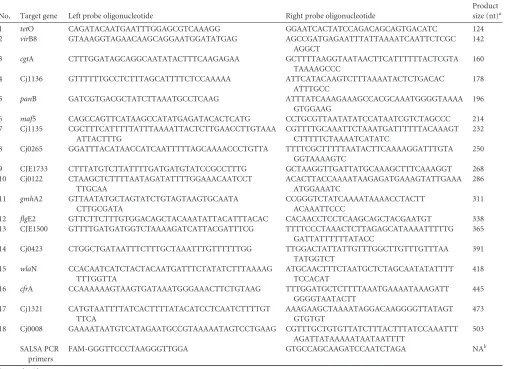
MLPA probes were designed for the 18 discriminatory gene targets used in theCampylobacterP-BIT system (9) according to the instructions pro-vided by the pioneers of MLPA, MRC-Holland (Amsterdam, The Neth-erlands). The probes were manufactured as described by Schouten and colleagues (11) at MRC-Holland. The target genes, specific probe se-quences, primer sese-quences, and product sizes are listed inTable 1.
Each of the 222C. jejuni, 22C. coli, and 1Campylobacter lariisolates listed in Data Set S1 (in the supplemental material) were grown on Co-lumbia sheep blood agar plates at 42°C under microaerobic conditions for 48 to 72 h. Suspensions were prepared in phosphate-buffered saline (BR0014G; Oxoid, Basingstoke, England) to a density of 0.8 using a
tur-bidity meter (Dade International, West Sacramento, CA), and DNA was extracted using the method described previously (9). Each DNA extract was diluted to 20 ng/l in Tris-EDTA (TE) buffer (Life Technologies) and analyzed using the standard MLPA protocol, SALSA MLPA reagent kits (MRC-Holland), andCampylobacterMBiT probe mixes. The hybridiza-tion time was shortened from 16 h to 1 to 2 h. The MLPA products were diluted 1:100 in water and separated using the ABI genetic analyzer 3130XL with POP-7 polymer and GeneScan 600 LIZ size standard (Life Technologies). The data were analyzed using GeneMapper (Life Technol-ogies). The presence or absence of each product was scored as 0 or 1 to make a binary code and converted to a 6-digit type, as described for the earlier P-BIT assay (9).
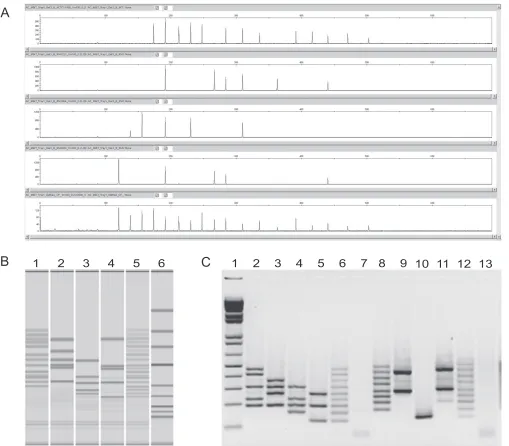
The ability of a variety of detection methods to differentiate MBiT products was evaluated using three fully sequencedC. jejuni isolates (NCTC11168, RM1221, and RM1864 [81-176]), one fully sequencedC. coliisolate (RM2228), and the control plasmids supplied with the Cam-pylobacterMBiT probe mixes. Each sample was tested using probe mixes containing (i) all 18 probe pairs, (ii) the odd-numbered probe pairs, and (iii) the even-numbered probe pairs (Table 1). The remainder of the MLPA assay was performed as described above. The products were de-tected (i) diluted 1 in 100 in water on the ABI genetic analyzer as above, (ii) undiluted on the MCE-202 MultiNA microchip electrophoresis sys-tem (Shimadzu Corporation, Kyoto, Japan) using standard operating procedures for on-chip mixing with the DNA 1000 reagent kit (Shi-madzu), and (iii) undiluted in a 2% agarose gel in 1⫻Tris-borate-EDTA (TBE) at 110 V for 70 min and visualized using ethidium bromide.
Received24 March 2014Returned for modification30 April 2014
Accepted29 June 2014
Published ahead of print2 July 2014
Editor:D. J. Diekema
Address correspondence to Angela J. Cornelius, [email protected]. Supplemental material for this article may be found athttp://dx.doi.org/10.1128
/JCM.00815-14.
Copyright © 2014, American Society for Microbiology. All Rights Reserved.
doi:10.1128/JCM.00815-14
The authors have paid a fee to allow immediate free access to this article.
on May 16, 2020 by guest
http://jcm.asm.org/
For comparison,C. jejuniandC. colistrains were also analyzed using C. jejunimultilocus sequence typing (MLST) (12). Amplification was per-formed in a 25-l volume using AmpliTaq Gold master mixture (Life Technologies) and 5 pmol of each primer. Products were sequenced with the ABI genetic analyzer and alleles were assigned using theCampylobacter PubMLST database (http://pubmlst.org/campylobacter/) (13). Novel al-leles and sequence types (ST) were submitted for clonal complex (CC) designations.
To demonstrate the usefulness of MBiT in an outbreak setting, 51 humanC. jejuniandC. coliisolates recovered by Christchurch clinical laboratories over the period in which an outbreak of waterborne gastro-enteritis was occurring in the nearby town of Darfield were subtyped using PFGE (14) and MBiT. Either a single colony from the primary isolation plate or a small section of a PFGE plug (1/8 of the size used for PFGE) was added to 5l of TE buffer and used as the sample for MBiT analysis.
RESULTS
Strain MBiT profiles derived from the genetic analyzer or MultiNA systems were consistent for all samples and probe mixes. MBiT products, with length differences as small as 18 nucleotides, were detectable in as little as 5 min with the MultiNA. Further-more, the individual MLPA were distinguished using agarose gel electrophoresis when the odd- and even-numbered probes were tested in separate tubes (seeFig. 1for examples).
From the 245 strains examined, MBiT produced 120 types with a Simpson’s index of diversity (ID) (http://darwin .phyloviz.net/ComparingPartitions) of 0.987. Using MLST, 105 sequence types (ID, 0.979) and 26 clonal complexes (ID, 0.897) were identified.
To compare genomic differences between recently isolated hu-manC. jejuniandC. colithat are geographically distant, we com-pared MBiT results for the New Zealand strains isolated in 2009 with the Belgian strains isolated in 2010. Of interest,tetO, which encodes tetracycline resistance, and CJE1733, which encodes an arsenical-resistance protein (provisional), were observed more frequently in Belgian isolates than New Zealand isolates (Belgium, 40 isolates; New Zealand, 4 isolates [Fisher Exact, 2-tailedP⫽0] and Belgium, 42 isolates; New Zealand, 25 isolates [P⫽0.014], respec-tively). Conversely, Cj1135, a putative two-domain glycosyltrans-ferase, was observed more frequently in isolates from New Zealand (Belgium, 27 isolates; New Zealand, 47 isolates [P⫽0.041]).
[image:2.585.42.550.79.448.2]Of the 51 humanC. jejuniandC. coliisolates received by the Institute of Environmental Science and Research (ESR) from Christchurch clinical laboratories during the Darfield waterborne gastroenteritis outbreak, 27 (representing 25 cases) were isolated from cases with home addresses in Darfield. The majority (22/27, TABLE 1Target genes, specific probe sequences, and primer sequences used inCampylobacterMBiT
No. Target gene Left probe oligonucleotide Right probe oligonucleotide
Product size (nt)a
1 tetO CAGATACAATGAATTTGGAGCGTCAAAGG GGAATCACTATCCAGACAGCAGTGACATC 124
2 virB8 GTAAAGGTAGAACAAGCAGGAATGGATATGAG AGCCGATGAGAATTTATTAAAATCAATTCTCGC
AGGCT
142
3 cgtA CTTTGGATAGCAGGCAATATACTTTCAAGAGAA GCTTTTAAGGTAATAACTTCATTTTTTACTCGTA
TAAAAGCCC
160
4 Cj1136 GTTTTTTGCCTCTTTAGCATTTTCTCCAAAAA ATTCATACAAGTCTTTAAAATACTCTGACAC
ATTTGCC
178
5 panB GATCGTGACGCTATCTTAAATGCCTCAAG ATTTATCAAAGAAAGCCACGCAAATGGGGTAAAA
GTGGAAG
196
6 maf5 CAGCCAGTTCATAAGCCATATGAGATACACTCATG CCTGCGTTAATATATCCATAATCGTCTAGCCC 214
7 Cj1135 CGCTTTCATTTTTATTTAAAATTACTCTTGAACCTTGTAAA ATTACTTTG
CGTTTTGCAAATTCTAAATGATTTTTTACAAAGT CTTTTTCTAAAATCATATC
232
8 Cj0265 GGATTTACATAACCATCAATTTTTAGCAAAACCCTGTTA TTTTCGCTTTTTAATACTTCAAAAGGATTTGTA GGTAAAAGTC
250
9 CJE1733 CTTTATGTCTTATTTTGATGATGTATCCGCCTTTG GCTAAGGTTGATTATGCAAAGCTTTCAAAGGT 268 10 Cj0122 CTAAGCTCTTTTAATAGATATTTTGGAAACAATCCT
TTGCAA
ACACTTACCAAAATAAGAGATGAAAGTATTGAAA ATGGAAATC
286
11 gmhA2 GTTAATATGCTAGTATCTGTAGTAAGTGCAATA CTTGCGATA
CCGGGTCTATCAAAATAAAACCTACTT ACAAATTCCC
311
12 flgE2 GTTCTTCTTTGTGGACAGCTACAAATATTACATTTACAC CACAACCTCCTCAAGCAGCTACGAATGT 338 13 CJE1500 GTTTTGATGATGGTCTAAAAGATCATTACGATTTCG TTTTCCCTAAACTCTTAGAGCATAAAATTTTTG
GATTATTTTTTATACC
365
14 Cj0423 CTGGCTGATAATTTCTTTGCTAAATTTGTTTTTTGG TTGGACTATTATTGTTTGGCTTGTTTGTTTAA TATGGTCT
391
15 wlaN CCACAATCATCTACTACAATGATTTCTATATCTTTAAAAG TTTGGTTA
ATGCAACTTTCTAATGCTCTAGCAATATATTTT TCCACAT
418
16 cfrA CCAAAAAAGTAAGTGATAAATGGGAAACTTCTGTAAG TTTGGATGCTCTTTTAAATGAAAATAAAGATT GGGGTAATACTT
445
17 Cj1321 CATGTAATTTTATCACTTTTATACATCCTCAATCTTTTGT TTCA
AAAGAAGCTAAAATAGGACAAGGGGTTATAGT GTGTGT
473
18 Cj0008 GAAAATAATGTCATAGAATGCCGTAAAAATAGTCCTGAAG CGTTTGCTGTGTTATCTTTACTTTATCCAAATTT AGATTATAAAAATAATAATTTT
503
SALSA PCR primers
FAM-GGGTTCCCTAAGGGTTGGA GTGCCAGCAAGATCCAATCTAGA NAb
ant, nucleotides.
b
NA, not applicable. SALSA PCR primers are used to amplify all MLPA probes once the left and right probe oligonucleotides are ligated.
on May 16, 2020 by guest
http://jcm.asm.org/
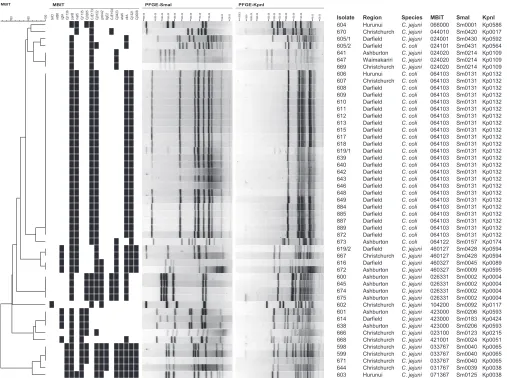
81%) of the Darfield isolates wereC. coliwith the Sm0131:Kp0132 PFGE profile and 064103 MBiT type, 1 was aC. coli with the Sm0431:Kp0564 PFGE profile and 024101 MBiT type, and the remaining 4 wereC. jejuniwith different PFGE profiles and MBiT types (Fig. 2).
Isolates from two cases that did not live in Darfield wereC. coli with the outbreak PFGE profile and MBiT type. One of these cases, with a Christchurch address, was contacted by a local health pro-tection officer, and it was confirmed that this individual had been working in Darfield and drinking from the town water supply during the exposure period of the outbreak. The other case with the outbreak PFGE profile and MBiT type was not contacted. Three clusters of 2 to 4 strains, each with indistinguishable PFGE and MBiT profiles, from Ashburton or Christchurch cases were
also identified. Two other clusters of 2 to 3 strains with indistin-guishable profiles comprised cases from different geographical lo-cations.
DISCUSSION
This pilot study demonstrates that MBiT achieved several of the performance criteria first proposed by Struelens (15) and updated by van Belkum and colleagues (16). It has high typeability, with all 245 isolates producing positive results for at least one target gene. It has high discriminatory power, with an ID greater than that of MLST. It has clear applicability to the investigation and identifi-cation of outbreaks.CampylobacterMBiT produces results within 6 h and uses readily accessible reagents, equipment, and skills. For laboratories with access to multichannel pipettes and automated FIG 1Illustration of alternativeCampylobacterMBiT detection methods using fully sequenced isolates and control plasmids. In each image the order is NCTC11168 (MBiT 073767), RM1221 (MBiT 024311), RM1864 (MBiT 621200), RM2228 (MBiT 164101), and control plasmids (MBiT 777777). (A) ABI genetic analyzer; (B) MultiNA with lane 1, Fermentas GeneRuler Low Range DNA Ladder; (C) agarose gel electrophoresis with lane 1, Life Technologies 1 kb Plus DNA Ladder; lanes 7 and 13, TE; lanes 2 to 7, odd-numbered probes only; lanes 8 to 13, even-numbered probes only.
on May 16, 2020 by guest
http://jcm.asm.org/
[image:3.585.41.550.64.510.2]electrophoresis equipment, such as the genetic analyzer and MultiNA, theCampylobacterMBiT assay offers an easy, single-tube assay with the potential for high-throughput subtyping of large numbers of isolates. The two-tube testing option required for detection by gel electrophoresis is still easy to perform but uses more reagents and consumables. It also requires controls to run more frequently in order to compensate for fragment migration fluctuations on the gel. Thus, the two-tube system is more expen-sive than the single-tube option and has limited throughput capa-bility. Nonetheless, by designing theCampylobacterMBiT assay with single- and two-tube options, we have designed a system that is accessible to a wide range of laboratories from (i) reference laboratories with expensive equipment, software, and highly skilled practitioners testing hundreds of isolates a week to (ii) front-line public health laboratories, food industry laboratories, and laboratories in developing countries that are likely to have limited equipment, practitioners with less-developed skills, and fewer isolates to test. The six-digit MBiT code is highly portable and also amenable to computerized analysis and incorporation into electronic databases. All of these features make MBiT a very convenient subtyping system (16). In addition to these perfor-mance and convenience criteria, the choice of virulence- and
sur-vival-associated genes means theCampylobacterMBiT assay may generate data useful for molecular risk assessment (8) and evalu-ation of the genetic effects of intervention strategies or changes in industry practices over time.
The differences in carriage of the antibiotic resistance genes
tetO and CJE1733 in human isolates from Belgium and New
Zealand reflects the prevalence of antimicrobial resistance phenotypes in the two countries. Of the 318 humanCampylobacterisolates tested in New Zealand during 2009, none were resistant to erythromycin and 5 (1.6%) were resistant to fluoroquinolone (https://surv.esr .cri.nz/PDF_surveillance/Antimicrobial/AR/National_AR_2009 .pdf). Conversely, of a set of 354 humanCampylobacterisolates tested in Belgium during 2010, 11 (3.1%), 186 (52.5%), and 204 (57.6%) were resistant to erythromycin, ciprofloxacin (a fluoro-quinolone), and ampicillin, respectively (17). Similar differences in antimicrobial resistance rates have been observed in isolates from meat and poultry in the two countries (17,18).
The carriage of Cj1135, which encodes an enzyme that may be involved in the production of surface-associated sugars, may reflect bacterial cell surface features that increase its ability to infect human intestinal cells and thus may be partially responsible for the high rate of campylobacteriosis in New Zealand (1). Interestingly, Cj1135 has
Isolate Region Species MBiT SmaI KpnI
604 Hurunui C. jejuni 066000 Sm0001 Kp0586 670 Christchurch C. jejuni 044010 Sm0420 Kp0017 605/1 Darfield C. jejuni 024001 Sm0430 Kp0592 605/2 Darfield C. coli 024101 Sm0431 Kp0564 641 Ashburton C. jejuni 024020 Sm0214 Kp0109 647 Waimakariri C. jejuni 024020 Sm0214 Kp0109 669 Christchurch C. jejuni 024020 Sm0214 Kp0109 606 Hurunui C. coli 064103 Sm0131 Kp0132 607 Christchurch C. coli 064103 Sm0131 Kp0132 608 Darfield C. coli 064103 Sm0131 Kp0132 609 Darfield C. coli 064103 Sm0131 Kp0132 610 Darfield C. coli 064103 Sm0131 Kp0132 611 Darfield C. coli 064103 Sm0131 Kp0132 612 Darfield C. coli 064103 Sm0131 Kp0132 613 Darfield C. coli 064103 Sm0131 Kp0132 615 Darfield C. coli 064103 Sm0131 Kp0132 617 Darfield C. coli 064103 Sm0131 Kp0132 618 Darfield C. coli 064103 Sm0131 Kp0132 619/1 Darfield C. coli 064103 Sm0131 Kp0132 639 Darfield C. coli 064103 Sm0131 Kp0132 640 Darfield C. coli 064103 Sm0131 Kp0132 642 Darfield C. coli 064103 Sm0131 Kp0132 643 Darfield C. coli 064103 Sm0131 Kp0132 646 Darfield C. coli 064103 Sm0131 Kp0132 648 Darfield C. coli 064103 Sm0131 Kp0132 649 Darfield C. coli 064103 Sm0131 Kp0132 884 Darfield C. coli 064103 Sm0131 Kp0132 885 Darfield C. coli 064103 Sm0131 Kp0132 887 Darfield C. coli 064103 Sm0131 Kp0132 889 Darfield C. coli 064103 Sm0131 Kp0132 872 Darfield C. coli 064103 Sm0131 Kp0132 673 Ashburton C. coli 064122 Sm0157 Kp0174 619/2 Darfield C. jejuni 460127 Sm0428 Kp0594 667 Christchurch C. jejuni 460127 Sm0428 Kp0594 616 Darfield C. jejuni 460327 Sm0045 Kp0089 672 Ashburton C. jejuni 460327 Sm0009 Kp0595 600 Ashburton C. jejuni 026331 Sm0002 Kp0004 645 Ashburton C. jejuni 026331 Sm0002 Kp0004 674 Ashburton C. jejuni 026331 Sm0002 Kp0004 675 Ashburton C. jejuni 026331 Sm0002 Kp0004 602 Christchurch C. jejuni 104200 Sm0092 Kp0117 601 Ashburton C. jejuni 423000 Sm0206 Kp0593 614 Darfield C. jejuni 423000 Sm0183 Kp0424 638 Ashburton C. jejuni 423000 Sm0206 Kp0593 666 Christchurch C. jejuni 023100 Sm0123 Kp0215 668 Christchurch C. jejuni 421001 Sm0024 Kp0051 598 Christchurch C. jejuni 033767 Sm0040 Kp0065 599 Christchurch C. jejuni 033767 Sm0040 Kp0065 671 Christchurch C. jejuni 033767 Sm0040 Kp0065 644 Christchurch C. jejuni 031767 Sm0039 Kp0038 603 Hurunui C. jejuni 071367 Sm0125 Kp0038 MBIT 100 80 60 MBIT tetO virB 8
cgtA Cj1136 panB maf5 Cj1135 Cj0265 CJE173
3 C j0122 gmhA 2 flgE 2 C JE150 0 C j0423 wl a N
cfrA Cj1321 Cj0008 PFGE-SmaI 20. 00 40. 00 100. 0 0 150. 0 0 200. 0 0 250. 0 0 300. 0 0 350. 0 0 400. 0 0 500. 0 0 800. 0 0 PFGE-KpnI 20. 00 40. 00 100. 0 0 150. 0 0 200. 0 0 250. 0 0 300. 0 0 350. 0 0 500. 0 0 600. 0 0 1000 4. 00E 3
FIG 2Cluster analysis ofCampylobacterMBiT data for the isolates submitted during the Darfield waterborne gastroenteritis outbreak, prepared using simple matching and unweighted-pair group method with arithmetic mean (UPGMA).
on May 16, 2020 by guest
http://jcm.asm.org/
[image:4.585.41.548.65.443.2]been found to have a higher carriage rate among enteritis-associated strains from The Netherlands, Curaçao, and Japan (19), suggesting a possible human intestinal cell-specific interaction.
The utility of the MBiT assay in outbreak settings was observed in real time during the waterborne gastroenteritis outbreak in Darfield. MBiT results for the first set of samples received by ESR were available early the following morning. These results demon-strated that the majority of isolates from Darfield residents had a single MBiT type and that a Christchurch resident also had the outbreak MBiT type. Rapid follow-up by a health protection offi-cer was possible and confirmed the patient had consumed Dar-field town water during the exposure period, and so this case was formally included in the outbreak. PFGE results, which were avail-able 2 days later, confirmed the MBiT results.
Although the P-BIT assay, from which the Campylobacter MBiT was adapted, was designed forC. jejuni, it appears also to provide useful subtyping information forC. coli, as demonstrated by the 12 different MBiT types observed for the 22C. coliisolates in the validation study and the ability to identify the predominant type in an outbreak involvingC. coli. Different MBiT types have so far been observed forC. jejuni andC. coliisolates. The C. lari isolate from the P-BIT paper was also typeable using the Campy-lobacterMBiT assay. The utility of the assay onCampylobactersp. other thanC. jejuniandC. coliis yet to be established. In future developments of theCampylobacterMBiT assay, we aim to iden-tify targets that provide additional subtyping information forC. coliand potentially otherCampylobactersp.
The identification of several other small clusters of cases with indistinguishable PFGE profiles and MBiT types suggests that small outbreaks may be relatively common. No follow-up inves-tigation was undertaken to identify common infection sources for these small clusters of cases. A small 2002 study of human cases in the same catchment area as the current study also observed nu-merous small clusters of cases with indistinguishable PFGE pro-files (20). A larger 2009 to 2010 study in the same geographical location (21), which also observed clustering of cases based on PFGE, demonstrated how, even with typing data from human, environmental, and food-related isolates, source identification can be difficult. The authors of that paper suggested that a more rapid subtyping method, with turnaround time measured in hours rather than days, would allow more efficient use of epide-miological resources (21), thus facilitating a more rapid response with consequent benefits to public health and economics. Moni-toring of small clusters may also facilitate the identification of point sources linked to recurrent events that, taken together, rep-resent significant numbers of human cases and thus are worthy of additional public health resources and interventions. An example would be a producer, supplier, or restaurant linked to several small clusters of divergent types over a period of several months. MBiT is rapid and cheap enough that, for the first time, subtyping of allC. jejuni/C. coliisolated from human cases is possible. This will make it possible to use subtyping data alongside, or poten-tially to focus, epidemiological data collection to identify, investi-gate, and monitor clusters of all sizes.
In conclusion, the speed and cost of theCampylobacterMBiT assay make it an ideal candidate for use as a front-line subtyping system for both industrialized and developing countries and make possible the real-time subtyping of allC. jejuniandC. coliisolates. This assay is commercially available from MRC-Holland.
ACKNOWLEDGMENTS
This work was supported by ESR Core Funding from the New Zealand Ministry for Science and Innovation.
Jan Schouten, the founder and owner of MRC-Holland, is the Euro-pean patent holder for multiplex ligation-dependent probe amplification (MLPA), which is the basis for the assay described in the paper and is now commercially available. Paul van Vught works at MRC-Holland. ESR en-tered into a collaborative agreement with MRC-Holland on March 5, 2014, facilitating payment of royalties to ESR for the sale of this assay by MRC-Holland.
REFERENCES
1.World Health Organization.2012. The global view of campylobacterio-sis: report of expert consultation, Utrecht, Netherlands, 9 to 11 July 2012. World Health Organization, Geneva, Switzerland.
2.Brown PE, Christensen OF, Clough HE, Diggle PJ, Hart CA, Hazel S, Kemp R, Leatherbarrow AJ, Moore A, Sutherst J, Turner J, Williams NJ, Wright EJ, French NP.2004. Frequency and spatial distribution of environmentalCampylobacterspp. Appl. Environ. Microbiol.70:6501– 6511.http://dx.doi.org/10.1128/AEM.70.11.6501-6511.2004.
3.Miller WG, Mandrell RE.2005. Prevalence ofCampylobacterin the food and water supply: incidence, outbreaks, isolation and detection, p 101– 163.InKetley JM, Konkel ME (ed),Campylobacter. Molecular and cellular biology. Horizon Bioscience, Norfolk, United Kingdom.
4.On SLW.2013. Isolation, identification and subtyping ofCampylobacter: where to from here? J. Microbiol. Methods95:3–7.http://dx.doi.org/10 .1016/j.mimet.2013.06.011.
5.On SLW, McCarthy N, Miller WG, Gilpin BJ. 2008. Molecular
epidemiology ofCampylobacterspecies, p 191–211.InBlaser MJ, Szy-manski CM, Nachamkin I (ed),Campylobacter, 3rd ed. ASM Press, Wash-ington, DC.
6.Ahmed MU, Dunn L, Ivanova EP.2012. Evaluation of current mo-lecular approaches for genotyping ofCampylobacter jejunistrains. Food-borne Pathog. Dis.9:375–385.http://dx.doi.org/10.1089/fpd.2011.0988. 7.Allerberger F.2012. Molecular typing in public health laboratories: from
an academic indulgence to an infection control imperative. J. Prev. Med. Public Health45:1–7.http://dx.doi.org/10.3961/jpmph.2012.45.1.1. 8.Taboada EN, Clark CG, Sproston EL, Carrillo CD. 2013. Current
methods for molecular typing of Campylobacterspecies. J. Microbiol. Methods95:24 –31.http://dx.doi.org/10.1016/j.mimet.2013.07.007. 9.Cornelius AJ, Gilpin B, Carter P, Nicol C, On SLW.2010. Comparison
of PCR binary typing (P-BIT), a new approach to epidemiological subtyp-ing ofCampylobacter jejuni, with serotyping, pulsed-field gel electropho-resis and multilocus sequence typing methods. Appl. Environ. Microbiol. 76:1533–1544.http://dx.doi.org/10.1128/AEM.02215-09.
10. Sellner LN, Taylor GR.2004. MLPA and MAPH: new techniques for detection of gene deletions. Hum. Mutat.23:413– 419.http://dx.doi.org /10.1002/humu.20035.
11. Schouten JP, McElgunn CJ, Waaijer R, Zwijnenburg D, Diepvens F, Pals G. 2002. Relative quantification of 40 nucleic acid sequences by multiplex ligation-dependent probe amplification. Nucleic Acid Res.30: e57.http://dx.doi.org/10.1093/nar/gnf056.
12. Dingle KE, Colles FM, Wareing DRA, Ure R, Fox AJ, Bolton FE, Bootsma HJ, Willems RJL, Urwin R, Maiden MCJ.2001. Multilocus sequence typing system forCampylobacter jejuni. J. Clin. Microbiol.39: 14 –23.http://dx.doi.org/10.1128/JCM.39.1.14-23.2001.
13. Jolley KA, Chan M-S, Maiden MCJ.2004. mlstbNet— distributed mul-tilocus sequence typing (MLST) databases. BMC Bioinformatics5:86. http://dx.doi.org/10.1186/1471-2105-5-86.
14. Bartholomew N, Brunton C, Gilpin B, Mitchell P, Williamson J. 3 February 2014. A waterborne outbreak of campylobacteriosis in the South Island of New Zealand due to a failure to implement a multibarrier ap-proach. J. Water Health.
15. Struelens MJ.1996. Consensus guidelines for appropriate use and evalu-ation of microbial epidemiologic typing systems. Clin. Microbiol. Infect. 2:2–11.http://dx.doi.org/10.1111/j.1469-0691.1996.tb00193.x. 16. van Belkum A, Tassios PT, Dijkshoorn L, Haeggman S, Cookson B, Fry
NK, Fussing V, Green J, Feil E, Gerner-Smidt P, Brisse S, Struelens M, European Society of Clinical Microbiology and Infectious Diseases (ESCMID) Study Group on Epidemiological Markers (ESGEM).2007. Guidelines for the validation and application of typing methods for use in
on May 16, 2020 by guest
http://jcm.asm.org/
bacterial epidemiology. Clin. Microbiol. Infect.13:1– 46.http://dx.doi.org /10.1111/j.1469-0691.2007.01786.x.
17. Federal Agency for the Safety of the Food Chain Scientific Institute of Public Health Veterinary and Agrochemical Research Centre.2012. Trends and sources 2010 to 2011. Report on zoonotic agents in Belgium. Federal Agency for the Safety of the Food Chain Scientific Institute of Public Health Veterinary and Agrochemical Research Centre, Brussels, Belgium. 18. Heffernan H, Wong T, Lindsay J, Bowen B, Woodhouse R.2011. A
baseline survey of antimicrobial resistance in bacteria from selected New Zealand foods, 2009 to 2010. MAF Technical Paper 2011/53. Ministry of Agriculture and Forestry, Wellington, New Zealand.
19. Taboada EN, van Belkum A, Yuki N, Acedillo RR, Godschalk PC, Koga M, Endtz HP, Gilbert M, Nash JH.2007. Comparative genomic analysis
ofCampylobacter jejuniassociated with Guillain-Barre and Miller Fisher syndromes: neuropathogenic and enteritis-associated isolates can share high levels of genomic similarity. BMC Genomics8:359.http://dx.doi.org /10.1186/1471-2164-8-359.
20. Gilpin B, Cornelius AJ, Robson B, Boxall N, Ferguson A, Nicol C, Henderson T.2006. Application of pulsed-field gel electrophoesis to identify potential outbreaks of campylobacteriosis in New Zealand. J. Clin. Microbiol.44:406 – 412.http://dx.doi.org/10.1128/JCM.44.2.406 -412.2006.
21. Gilpin BJ, Walshe G, On SL, Smith D, Marshall JC, French NP.2013. Application of molecular epidemiology to understanding campylobacte-riosis in the Canterbury region of New Zealand. Epidemiol. Infect.141: 1253–1266.http://dx.doi.org/10.1017/S0950268812001719.