Declan O’Sullivan, Vincent Wade, and David Lewis
Trinity College Dublin
Understanding as We Roam
Increasingly, the problem for roaming users isn’t discovering local Web services
or local context information or even getting their applications to interoperate with them at a syntactic level, but rather achieving interoperation at a semantic
level. Developers are beginning to use Semantic Web technologies such as ontologies to expose the semantics of context models and Web services.
However, different ontologies arise due to natural human diversity in modeling domains. It’s therefore important to develop mappings between ontologies. This article describes a practical ontology-mapping process specified in the Unified
Modeling Language, as well as its deployment.
I
magine you arrive for a meeting after a long-haul flight with a couple of hours to spare. You want a good lunch to replenish lost energy, but when you download your email, you find a docu-ment you must read before your meeting. You hate reading anything large on a PDA screen, so you ask your PDA to locate an eatery that serves the kind of food you like, has a free printing service, is located near the meeting venue, and will let you make a reservation that gives you enough time to walk to the meeting on schedule. To do this, your personal applications will have to interact with a diverse set of applications and services in the local environment.Roaming users bring with them appli-cations that increasingly must interact with the local computing environment via local Web services or by accessing local context information. Although de-velopers have proposed several uniform platforms for retrieving context informa-tion, service providers continue to
pub-lish this information in a wide variety of formats and semantics. Although emerg-ing standards such as the Semantic Markup for Web Services (OWL-S) and the Web Service Modeling Ontology (WSMO) represent Web service semantics, it’s unlikely that service developers will use exactly the same semantic models in their Web service signatures.
To address this gap, we’ve developed a practical ontology-mapping process specified in a technology-neutral manner by using the Unified Modeling Language (UML). Although implementations show that our process and tools can successfully identi-fy mappings and structural mismatches and help reduce effort and mapping errors, several chal-lenges must be overcome before ontology mapping for roaming can become a widespread activity.
Ontology Mapping:
Why,What, and How
Ontologies aim to let people and application sys-tems share and communicate an understanding of a domain.2However, human diversity means that different ontologies will arise in modeling a domain — that is, people typically create ontolo-gies from a particular perspective. Thus, to achieve roaming, we’ll need to map ontologies that repre-sent the semantics of personal information and the applications on the mobile platform to ontologies in the visited environment. Creating such map-pings for ordinary roaming users will benefit mobile application vendors and local service envi-ronment managers (such as local tourist boards) as well as large organizations with roaming users.
Mappings between ontology elements are usu-ally expressed as pairs of related entities in some mapping expression, which can range from simple equivalences to complex correspondences. An example simple equivalence is when eateryin the user’s ontology is equivalent to restaurantin the city’s tourist Web service ontology. An example complex correspondence is when a priceproperty in the user’s ontology is equivalent to the cost property plus the local-taxproperty in the restau-rant’s ontology. The mapping system typically out-puts these expressions as separate documents, so it can manage the mappings independently of the ontologies.
Ontology mapping as a field of study is much younger than either ontology engineering or data-base schema mapping. Consequently, tools and techniques to support it have emerged primarily as extensions to database schema mapping approach-es or ontology editors, or as developments support-ing only the mappsupport-ing activity . Subsequently, no commonly agreed-upon life-cycle model of ontol-ogy mapping yet exists. We’ve introduced a four-phase ontology-mapping life cycle to assist in analyzing the current state of play.
The characterization phaseencompasses
activ-ities that discover ontologies for mapping, analyze the potential difficulties involved in undertaking a mapping, and generate candidate matches between the ontologies. Practically, the character-ization phase helps organcharacter-izations avoid wasted human effort or tool processing when attempting to map incompatible or poor-quality ontologies. However, current ontology-mapping systems con-centrate mainly on finding matches between ontology elements. They use matching techniques that range from simple lexical matching to seman-tic model matching.3,4Some of these techniques operate on schema information alone, some on instance information, and some on both. Few of the current ontology-mapping systems help users analyze ontology quality or potential difficulties in mapping particular ontologies.
example, the Information Interpretation and Inte-gration Conference (I3CON) and the Evaluation of Ontology-based tools (EON) contests featured XML-based formats for comparing the output of a variety of matching tools. Experience from these contests proved positive10and led to the develop-ment of an ontology-aligndevelop-ment format11that can be rendered into several other formats (Semantic Web Rule Language, OWL, and so on) for interpre-tation. Other researchers have proposed a generic mapping language that must be grounded in a declarative logical language and so requires a rea-soner.8It’s too early to tell which of these
propos-als will dominate or whether, instead, the Rule Interchange Format emerging from W3C will prove attractive for expressing the ontology mappings. The management phaseis responsible for the ongoing maintenance and management of the mappings once they’re deployed. Although notable exceptions exist (such as Mafra and Coma++), ontology-mapping systems often treat mapping management as an afterthought. In addition, few researchers have explored the challenges associat-ed with managing sharassociat-ed of ontology mappings.
The Process
With the significant progress in developing some of the technologies needed for mapping systems, many of the current challenges involve these sys-tems’ world deployment. Moving to real-world deployments requires moving away from closed ontology-mapping systems and toward ontology-mapping frameworks comprising process and tools. A framework approach can help organ-izations situate the ontology-mapping process within their current processes and communicate with contributors of supporting solutions.
Specifying the process independently of the tools (for example, using UML) lets you tailor the process to specific parts of an organization to support dif-ferent tasks and allows for deployment of tools from different vendors. Moreover, you can implement individual parts of the process in various ways: man-ually, semiautomatically, and automatically.
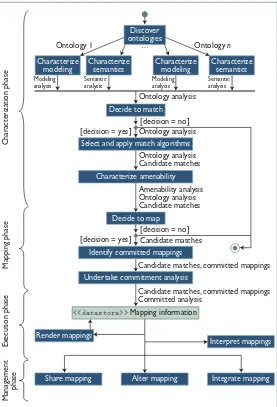
In current ontology-mapping systems, the process isn’t independent of the implementation. So, before creating our ontology-mapping system, we specified our process in UML. The UML activi-ty diagram in Figure 1 summarizes the ontology interoperability in support of semantic interoper-ability(OISIN) process. In particular, the figure shows all activities following directly from each other and the data entities flowing between the activities. In reality, different roles are likely to per-form the activities at different times, so the more detailed documented process12includes UML sig-nals and data stores.
[image:3.585.33.310.67.474.2]No two organizations are the same — even in the same organization, different use cases for ontology mapping can exist — so the process’s design was nontrivial. The process must support the organization’s choice of activities to include as well as the organization’s choice of each activity as manual, semiautomatic, or automatic. Take, for example, a large organization with roaming users.
Figure 1. Summary Unified Modeling Language activity diagram for the ontology interoperability in support of semantic interoperability process. The diagram of the full OISIN process12includes Unified Modeling Language signals and data stores, showing how different roles can perform activities at different times.
Characterizatio
n
phase
Ma
ppi
ng
phase
Ex
ec
u
tio
n
phase
Ma
n
a
g
e
m
e
n
t
phase
[decision = no] [decision = yes]
Render mappings
Share mapping
Interpret mappings
Alter mapping Integrate mapping
Discover ontologies
Ontology 1 … Ontology n
Ontology analysis
Ontology analysis
Ontology analysis Candidate matches
Decide to match
Decide to map
<<datastore>> Mapping information
Select and apply match algorithms
Identify committed mappings
Undertake commitment analysis Characterize amenability
[decision = no] [decision = yes]
Candidate matches, committed mappings Committed analysis
Candidate matches, committed mappings Amenability analysis
Ontology analysis Candidate matches
Candidate matches
Characterize
modeling
Characterize semantics
Characterize
modeling
Characterize semantics
Modeling
analysis
Semantic analysis
Modeling
analysis
Such an organization’s technical department will want to ensure that the ontologies of context-sen-sitive corporate applications that the corporate sales force uses will map to the context applica-tions provided by the public authorities, such as location-based services in particular sales territo-ries. Given the mappings’ importance, such an organization will likely need a mix of manual, semiautomatic, and automatic activities. A con-trasting example is a local tourist board that wants to support as many roaming applications as pos-sible, but doesn’t consider this a core objective. This organization would likely attempt a “best-effort” approach, implementing a fully automatic process that would attempt mappings for ontolo-gies submitted by mobile application vendors or would attempt to reuse mappings created by sister tourist boards nationally or internationally.
Characterization Phase
The discover ontologiesactivity varies depending on the use case that the ontology mapping supports within an organization. For a systems-integration use case, the ontologies are likely to be known and presented to the integrator. For an open corpus-integration use case, the integrator might need to discover ontologies through a Web search.
The characterize modelingactivity character-izes the ontologies using their quality, dimensions, and modeling style. From an automation perspec-tive, modeling style is the most difficult of these three characteristics to determine.
The characterize semantics activity aims to analyze the ontology’s content by characterizing how amenable the ontology is to either human or tool-based matching. It does this by examining the nature of the terms used in the ontology modeling for naming classes and properties, which can vary greatly. Understanding the terms’ nature can pos-itively impact the next activity.
The decide to matchactivity analyzes relevant information and decides whether to attempt to match the ontologies. If it makes a positive deci-sion, the system performs the select and apply match algorithmsactivity to analyze the degree of overlap between the ontologies. Depending on the type of approach desired, the system can choose from a wide range of match algorithms — from lexical-match schemes to semantic-model-based schemes.3Match algorithms can also perform dif-ferently depending on the characteristics of the schemas involved.
The final activity in the characterization phase — the characterize amenabilityactivity — examines the characteristics of the ontologies and the nature of the candidate matches discovered in previous activities; it then elicits key information items indi-cating the expected difficulty in mapping. This activity provides a natural boundary between the characterization and mapping phases, letting the organization perform the different phases in dif-ferent departments or at difdif-ferent times. A sepa-rate activity also lets the organization choose relevant characteristics for consideration, especial-ly if it uses third-party tools that output a wide range of ontology characteristics.
Mapping Phase
Organizations use policies to govern human and computing resource expenditures, and the organi-zation will have to decide whether a mapping effort should occur. The decide to map activity applies organizational policies governing this deci-sion making. In some cases, for example, the organization will have no choice but to undertake the mapping, so this activity will simply record information related to the mapping task to be allo-cated (it might record an estimate of time needed based on the task’s degree of difficulty).
The mapping system must allow for two use cases in the mapping phase:
• In the first, an expert user determines the map-pings that would generally satisfy an applica-tion set’s needs.
• In the second, an individual application deter-mines the mappings depending on the particu-lar application’s perspective and usage context.
Because entities in an ontology are highly interrelated, the availability of information about the committed mappings has implications for other match information. Thus, the undertake commitment analysis aims to analyze and enhance the other match information in light of the committed mappings.
Execution Phase
The mapping process’s ultimate aim is to enable semantic interoperability for a diversity of situa-tions. To support this goal, the mapping informa-tion must be available in human and software interpretable form. In the execution phase, an application interprets the mapping information (consisting of the candidate matches, committed mappings, and committed analysis entities) gen-erated in the mapping phase to create mappings that are relevant to the usage context. In addition, in line with our requirements, the mapping infor-mation should be in a widely interpretable format. A data store stores the mapping information for retrieval and management purposes. The render mappingactivity renders mapping information in different mapping formats. The interpret mapping activity interprets the mapping information to enable semantic interoperability between applica-tions or people.
Management Phase
The share mappingactivity lets the system share mapping information with other systems that
require mappings for semantic interoperability purposes or that undertake an ontology-mapping task.
Conversely, the integrate mapping activity focuses on managing the receipt and integration of mappings that are being shared in the local mapping system. Finally, an alter mapping activ-ity lets the system alter or retire existing map-ping information.
Implementation Experiences
Our implementation’s scope was to support the ontology-mapping process’s characterization, mapping, and execution phase activities. Eight different applications support the process. The applications don’t call each other directly but depend on information processed by other appli-cations in a persistent store. This approach facil-itates the addition or substitution of applications. It also lets us execute the process’s different activities at different times and execute them manually, semiautomatically, or automatically. We use XML to represent the information entities consumed or produced by each of the tools, and the HP Jena toolkit to convert the initial OWL representation of the ontologies into a canonical form. The Java-based tools manipulate the XML models by executing XQueries using Fraunhofer’s IPSI-XQ engine.
To examine whether our process could support a continuum of deployment strategies, we imple-mented two organizational deployment scenarios. In the first, some key activities are semiautomat-ed. To do this, we implemented semiautomated tools to support the mapping decision, identify committed mappings, and undertake commitment analysis activities, and used automated tools to support the other activities. In the second deploy-ment scenario, the organization requires a fully automated ontology-mapping process, which was made possible through the availability of pre-existing committed mappings that guided the rest of the mapping generation.
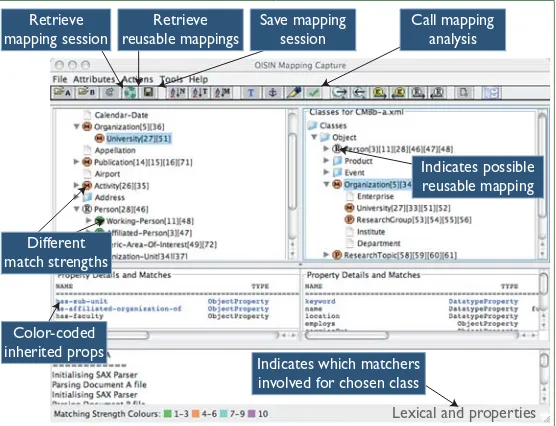
Figure 2 is a screenshot of the tool we used to identify and analyze committed mappings. It’s similar in style to the graphical capture tools used elsewhere for capturing mappings.
We used Microsoft Excel to support the decide-to-map activity because it can aid decision mak-ing and most professionals are familiar with it. This approach lets us easily import and display characteristic information numerically and
graph-Figure 2. OISIN mapping tool. This graphical-capture-style tool identifies and analyzes committed mappings.
Lexical and properties
Color-coded inherited props
Different
match strengths
Indicates possible reusable mapping
[image:5.585.33.311.69.282.2]ically, as well as embed organizational policies and calculations related to decision making in the spreadsheet.
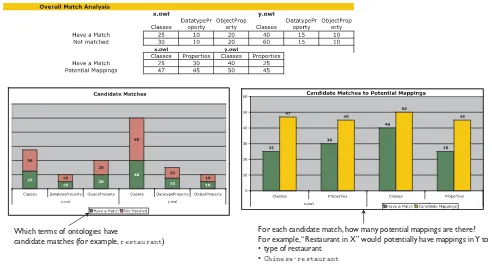
Figure 3 shows one of the spreadsheet pages. The page shows candidate matches of terms and composite terms in table and graphical format by type (that is, classes, data type properties, and object properties), indicating the number of terms having a candidate match in the other ontology. The “Candidate Matches to Potential Mappings” table and chart shows the number of potential mappings. The class term Restaurant, for exam-ple, might potentially map to a class term
Chinese-Restaurantor the Hotelclass property
type_of_restaurant, showing that one candidate match could potentially have two mappings. So, this information can indicate the number of choic-es the user will need to consider during the map-ping stage and help suggest the amount of effort that might be required.
We evaluated our process and software tools through two experiments (described in detail else-where12) and the ongoing use of OISIN in several research projects. The first experiment showed that the information generated by the characteri-zation phase activities was useful in identifying mapping difficulties that might be involved in a
mapping task. The second experiment showed that the mapping phase’s semiautomated tools, arti-facts, and guidance were useful in identifying mappings and structural mismatches. The tools also helped reduce the effort required and any mapping errors.
[image:6.585.59.551.74.339.2]We’re using the mappings generated from the tools in a wide range of domains where we’re researching the achievement of dynamic seman-tic interoperability through semanseman-tic mappings. In the pervasive computing domain, for example, we use the mappings to support both the query-ing of context information over a range of hetero-geneous and widely distributed information sources13and to support the dynamic composition of Web services.14 In the telecommunications domain, we use the mappings to route, via a knowledge-based network (that is, a publish subscribe network in which the routers use onto-logical reasoning), heterogeneous alarm messages, and configuration policies.15More recently, we’ve started to research how we can learn ordinary people’s personal ontologies and their mappings to other ontologies through their interaction with Internet communication channels (such as RSS feeds and online communities) rather than through explicit engineering.
Figure 3. Example page of the decide-to-map spreadsheet. The page gives matching information in both numeric and graphical forms.
Which terms of ontologies have
candidate matches (for example, restaurant)
For each candidate match, how many potential mappings are there? For example, “Restaurant in X” would potentially have mappings in Y to • type of restaurant
O
ur near-term goal is to offer roaming users an interaction experience identical to that they would experience in their native environment. This requires shielding users from semantic interoper-ability problems between personal applications and services in the roamed environment. Organi-zations have typically solved the semantic inter-operability problem by adopting standards. However, with the increased diversity of services and a growing number of service providers, the semantic interoperability problem will likely become significantly worse, and commonly agreed-upon standards are unlikely to keep pace with the rapid pace of growth and innovation. Ontologies are one way to model application and service semantics that will allow for mapping spec-ifications that can potentially overcome the semantic interoperability problem. Thus the need for ontology mapping is likely to increase in line with the growth in the number and diversity of applications and services.It’s unlikely that roaming users will undertake such ontology mapping themselves because cur-rent tools assume use by ontologically aware experts. Rather, roaming users will download the mappings to their devices either prior to travel (perhaps from their company’s Web site) or upon first contact with a service provider in the new environment (such as in conjunction with the local tourist board). These mappings will be simple text documents that users can easily download and store. Another advantage of the ontology-based approach is that mappings can cater for language differences during roaming.
Thus, we envisage that in the near term, onto-logically aware people will be the primary users of ontology-mapping tools. An organization with many roaming users might even deploy specialist mapping staff and computing resources. In con-trast, a local tourist board might outsource auto-matic mapping management to a third-party IT support company.
Although researchers have made progress in the ontology-mapping field, several challenges remain before we can realize its benefit for roaming.
First, we need a commonly agreed practical ontology-mapping life cycle to stimulate the emer-gence of a vibrant market for software solutions to support ontology mapping. Our experience with OISIN has shown that having the process defined in UML provides tremendous flexibility for deploy-ment in a variety of organizational types. Without
such a practical process, the uptake by organiza-tions involved in supporting roaming users will be insufficient.
Second, developers must agree on a common way to specify the results of matching algorithms and mapping systems. Without this agreement, the use of downloaded mappings by roaming users will quickly become limited.
Third, we need solutions to spot conflicts when mappings are downloaded into the roaming user’s personal devices, especially when being downloaded from the service provider of a roamed environment. We believe, however, that these challenges are surmountable, and a roaming experience that can easily cope with the wide variety of Web services and context information can be achieved through the use of ontology mappings.
References
1. N. Shadbolt, T. Berners-Lee, and W. Hall, “The Semantic Web Revisited,” IEEE Intelligent Systems, vol. 21, no. 3, 2006, pp. 96101.
2. D. Fensel, Ontologies: Silver Bullet for Knowledge Manage-ment and Electronic Commerce, 2nd ed., Springer-Verlag, 2003.
3. P. Shvaiko and J. Euzenat, “A Survey of Schema-Based Matching Approaches,” J. Data Semantics, vol. 4, no. 3730, 2005, pp. 146–171.
4. E. Rahm and P. Bernstein, “A Survey of Approaches to Automatic Schema Matching,” VLDB J., vol. 10, no. 4, 2001, pp. 334350.
5. D. Aumüller et al., “Schema and Ontology Matching with COMA++,” Proc. 2005 ACM SIGMOD Int’l Conf. Manage-ment of Data, ACM Press, 2005, pp. 906908.
6. A. Kalyanpur et al., “Hypermedia Inspired Ontology Engi-neering Environment: Swoop,” 3rd Int’l Semantic Web Conf.(ISWC), poster session, 2004; www.mindswap.org/ papers/SWOOP-Poster.pdf.
7. N. Noy and M. Musen, “Anchor-PROMPT: Using Non-Local Context for Semantic Matching,” Proc. IJCAI Work-shop Ontologies and Information Sharing, AAAI Press, 2001, pp. 6370.
8. J. deBruijn, D. Foxvog, and K. Zimmerman, “Ontology Mediation Patterns Library,” EU-IST Integrated Project IST-2003-506826 SEKT, D4.3.1, Feb. 2005; www.sekt -project.org/rd/deliverables/wp04/sekt-d-4-3-1-Patterns %20library.pdf.
9. A. Maedche et al., “MAFRA — A Mapping Framework for Distributed Ontologies in the Semantic Web,” Proc. Work-shop Knowledge Transformation for the Semantic Web
10. J. Euzenat, “Evaluating Ontology Alignment Methods,”
Semantic Interoperability and Integration, Dagstuhl Semi-nar Proc., Schloss Dagstuhl, 2005; http://drops.dagstuhl.de/ opus/volltexte/2005/36/.
11. J. Euzenat, “An API for Ontology Alignment (version 1.3),” June 2005, http://co4.inrialpes.fr/align/align.pdf. 12. D. O’Sullivan, The OISIN Framework: Ontology
Interoper-ability in Support of Semantic InteroperInteroper-ability, PhD thesis, Dept. of Computer Science, Trinity College Dublin, Univ. of Dublin, 2006.
13. R. Power and D. O’Sullivan, “Cashua: A Context Awareness Service for Heterogeneous Ubicomp Applications,” Proc. 3rd Int’l Workshop Managing Ubiquitous Computing and Ser-vices(MUCS), Cork Inst. Technology Press, in press. 14. D. O’Sullivan and D. Lewis, “Semantically Driven Service
Interoperability for Pervasive Computing,” Proc. 3rd ACM Int’l Workshop Data Eng. for Wireless and Mobile Access, ACM Press, 2003, pp. 8092.
15. D. Lewis et al., “Towards a Managed Extensible Control Plane for Knowledge-Based Networking,” Proc. 17th IFIP/IEEE Int’l Workshop Distributed Systems: Operations and Management Large Scale Management(DSOM 06), LNCS 4269, Springer, 2006, pp. 98–111.
Declan O’Sullivanis a lecturer and research team leader at
Trin-ity College Dublin for the Higher Education AuthorTrin-ity- Authority-funded M-Zones research program into the management of smart spaces, and for the Knowledge and Data Engineer-ing Group’s (KDEG) involvement in the self-management activity of the Center for Telecommunications Value Chain Research (CTVR). His research interests are in telecommu-nications, their management, and their use of ontology-driven semantic interoperability. O’Sullivan has a PhD and an MSc in computer science from Trinity College Dublin. Contact him at [email protected].
Vincent Wadeis research director for KDEG in the Department
of Computer Science, Trinity College Dublin and director of Trinity’s Center for Academic Practice and Student Learning (CAPSL). Wade has a Phd in computer science from Trinity College Dublin. He received a visiting scien-tist position in IBM’s Centre for Advanced Studies for his research in adaptive hypermedia and knowledge manage-ment. Contact him at [email protected].
David Lewisis a research lecturer at KDEG. His research interests
include the engineering of open distributed systems for net-work and service management and the knowledge-driven engineering of autonomic pervasive computing and com-munication systems. Lewis has a PhD in computer science from University College London. Contact him at dave. [email protected].
New nonmember
rate of
$29
for
S&P
!
IEEE Security & Privacyis the premier magazine for security professionals. Each issue is packed with information about cybercrime, security & policy, privacy and legal issues, and intellectual property protection.
S&Pfeatures regular contributions by noted security experts, including Gary McGraw & Bruce Schneier.
Top security professionals in the field share information you can rely on:
• Wireless Security • Intellectual Property
Protection and Piracy • Designing for
Infrastructure Security • Privacy Issues
• Legal Issues • Cybercrime • The Security
Profession
• Education