Abstract —Topology for reactive power compensation suitablefor dynamic loads in closed loop is presented. The scheme consists of Thyristor Binary Switched Capacitor (TBSC) banks. TBSC is based on a chain of Thyristor Switched Capacitor (TSC) banks arranged in binary sequential manner. A transient free switching of TBSCs is carried out. Proposed topology allows stepless reactive power compensation for dynamic loads in very fast responding closed loop. Simulation results show that the proposed scheme can achieve reactive power compensation cycle to cycle basis and the harmonics contents of source are maintained at insignificant levels due to filtering action of TBSC.
Index Terms—Reactive power compensation, TBSC, transient free switching
I. INTRODUCTION
T is well documented in literature and through public discussions at various levels that a substantial power loss is taking place in our low voltage distribution systems on account of poor power factor, due to inadequate reactive power compensation facilities and their improper control. Switched LT capacitors can directly supply the reactive power of loads and improve the operating condition. Government of India has been insisting on shunt capacitor installations in massive way and encouraging the state electricity boards through Rural Electrification Corporation and various other financing bodies.
The expansion of rural power distribution systems with new connections and catering to agricultural sector in wide spread remote areas, giving rise to more inductive loads resulting in very low power factors. The voltages at the remote ends are low and the farmer‘s use high HP motors operating at low load levels with low efficiencies. This is giving rise to large losses in the distribution network. Thus there exists a great necessity to closely match reactive power with the load so as to improve power factor, boost the voltage and reduce the losses. The conventional methods of reactive power supply are through switched LT capacitors, mostly in equal steps in various automatic power factor controllers developed by number of companies.
In this paper, a more reliable, technically sound, fast acting and low cost scheme is presented by arranging the thyristor switched capacitor units in five binary sequential steps. This enables the reactive power variation with the least possible resolution.
Manuscript received July 3rd, 2013; revised August 01, 2013. This
work was supported in partly by the Electrical Engineering Department of AnnasahebDange College of Endineering, Ashta, Maharashtra India as UG project. Swapnil D Patil, Yogesh V Shinde, KhushalV Shende are a UG scholor with AnnasahebDange College of Endineering, Ashta, Maharashtra India. [email protected]
Prof. Dr.U. Gudaru is with AnnasahebDange College of Endineering, Ashta, Maharashtra India. [email protected]
Dr. D.R.Patil is Prof. & Head of Department Walchand College of Engineering, Sangli, India. [email protected].
As there is reduction in loss with shunt compensation in the feeders, the efficiency increases and conservation of energy takes place. Besides the enhancement of transformer loading capability the shunt capacitor also improves the feeder performance, reduces voltage drop in the feeder and transformer, better voltage at load end, improves power factor and improves system security, increases over all efficiency, saves energy due to reduced system losses, avoids low power factor penalty, and reduces maximum demand charges.
II.DESIRABLEFEATURES
The desirable features of the proposed scheme are as follows:
• It maintains the power factor at the PCC to any specified value.
• It compensates for rapid variation in reactive power or voltages.
• Maximum compensation time is 20 msec.
• No transients or harmonics are allowed to be present due to fast selective instants of switching in well co-ordinated manner.
• It is adaptive in the sense that the amount of the compensation is determined and provided on a cycle by cycle basis.
• It can compensate each phase independently which makes ideal for unbalanced systems.
• Capacitors are sized in binary sequential ratio for minimum size of switching steps.
• The control strategy is error activated to match with the load reactive power for the chosen time interval.
• It eliminates possible over compensation and resulting leading power factor.
• It is flexible to choose required number of steps as per the resolution.
• Resolution can be made small with more number of steps. • Simple in principle, elegant in usage and of low cost.
• Possible to incorporate the idea presented in the controllers for large size transformers at substations.
III. PROPOSED TOPOLOGY DESCRIPTION
This paper presents a simple topology, which is shown in Fig.1. The proposed scheme consists of Thyristor Switched Capacitor (TSC) banks in binary sequential stepsknown as Thyristor Binary Switched Capacitor (TBSC). This TBSC facilitates stepless control of reactive power closely matching with load requirements so as to maintain desired power factor. The proposed topology has following distinctive features:
1) TSC banks are arranged in Binary sequential steps to provide almost continuous reactive power compensation. 2) Transient free switching is obtained by pre-charging the capacitors to the negative/positive peak of supply voltage and firing the thyristors at the negative/positive peak of supply voltage.
3) It compensates for rapid variation in reactive power.
Transient Free TBSC Compensator for Dynamic
Reactive Load with Closed Loop Control
Swapnil Patil, Yogesh Shinde, Khushal Shende U. Gudaru, Senior Member IEEE, D. R. Patil Member,IAENG
.
Micro controller Based Capacitor Switching
In Binary sequence Mode Operation
Point of Common coupling
3 Phase, 50 Hz, 440V Bus Bar
11 Kv/440V
Distribution Transformer
C 0 C 1 C 2 C 3 C 4
TH 0 TH 1 TH 2 TH 3 TH 3
S 1
S0
S 2 S3 S 4
TH0-TH4 -Thyristyor C0-C1-Capacitor
L0 - L1-Current Limiting Reactor
C.T-Current Transformer P.T-Potential Transformer S0-S1-Switching signal Dynamic Load
PT CT
V
I
L0
L1
L2
L3
L4
.
Fig.1 TBSC Compensator
4)Reactive power compensation is achieved in cycle by cycle basis
TBSC compensator connected at the point of common coupling (PCC) for reactive power compensation is shown in Fig.1. The operating principle of each equipment is analyzed in the following sections.
A. TBSC
TBSC consists of an anti-parallel connected thyristor and diode as a bidirectional switch in series with a capacitor and a current limiting small reactor. Transient free switching of capacitors is obtained by satisfying following two conditions.
a. Firing the thyristors at the negative/positive peak of supply voltage.
b. Precharging the Capacitors to the negative/positive peak of supply voltage
TSC current is sinusoidal and free from harmonics, thuseliminating the need for any filters. Small-series inductor is placed in series with capacitor. It serves following purposes
a.
It limits current transients during overvoltage conditions
and when switching at incorrect instants or at the inappropriate voltage polarity.b. The chosen inductor magnitude gives a natural resonant frequency of many times the system nominal frequency. This ensures that the inductance neither creates a harmonic-resonant circuit with the network nor hampers the TSC control system.
In the proposed paper capacitor bank step values are chosen in binary sequence weights to make the resolution small. If such ‘n’ capacitor steps are used then 2n different compensation levels can be provided [6]. In this paper five TBSC banks are arranged as 2.5: 5: 10: 20: 40 KVAR in star connected with neutral grounded configuration.
B. CONTROLLER
Controller is the heart of compensator. Voltage V and current I at PCC are sensed by Potential Transformer
(P.T.) & Current Transformer (C.T.) respectively and given to controller. Controller determines the value of reactive power required to achieve the desired power factor & then generates the control signals (gate signals) which are given to TBSC banks. By coordinating the control of TBSC, it is possible to obtain fully stepless control of reactive power in closed loop.
IV.CONTROLLER DESCRIPTION
A. TBSC Closed Loop Operation
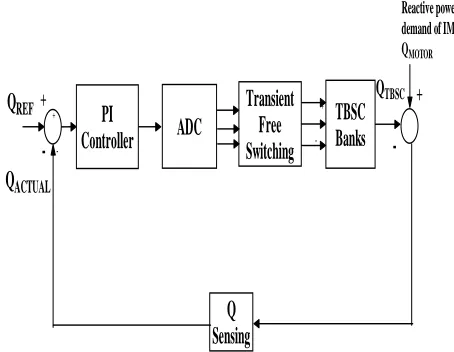
A block diagram of reactive power compensator using TBSC banks is shown in Fig. 2. Reference reactive power, QRef
is calculated from the desired power factor. Actual reactive
power at PCC, QActual is calculated by sensing voltage and current at PCC by P.T. and C.T. respectively. Error between
QRef and Q Actualis given to PI Controller. A Discrete PI
Controller is used. Output of PI Controller is given to ADC and
its output is given to TBSC banks in such a way that no transients occur. In this way closed loop operation of TBSC banks for reactive power compensation is achieved.
PI
Controller
Q
Sensing
Transient
Free
Switching
TBSC
Banks
Q
TBSC-+ +
-Q
REFQ
ACTUALReactive power demand of IM QMOTOR
ADC
+
-+
[image:2.612.311.538.556.732.2]-V.SIMULATION RESULTS Data used in Simulation:- a. Source:-
Voltage V = 400 V, Rs = 0.0287Ω, Ls = 0.20471mH
b. TBSC banks:-
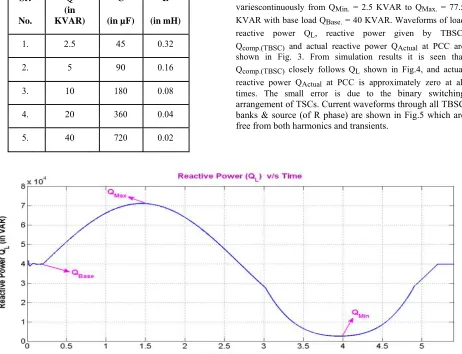
Five TBSC banks are used in the simulation whose values are shown in Table I
TABLE I: TBSC values for Q,C
and L
Sr. Q C L
No.
(in
KVAR)
(in µF) (in mH)
1. 2.5 45 0.32
2.
5 90 0.16
3. 10 180 0.08
4. 20 360 0.04
5.
40 720 0.02
Continuously changing reactive power, QL is obtained by simulating three phase dynamic load. The nature of load variation is as shown in Fig.3. Minimum reactive power Qminmaximum reactive power QMax, and base reactive power QBase can be varied by changing the parameters of three phase dynamic load. In all simulations QRef is set to zero since it is assumed that desired P.F.is unity at all times.
A TBSC Closed Loop Operation
Discrete PI controller with KP = 0.565 & KI = 25 is used. 5 bit ADC is used in simulation. Parameters of Three-phase dynamic load block are adjusted in such a way that QL variescontinuously from QMin. = 2.5 KVAR to QMax. = 77.5
KVAR with base load QBase. = 40 KVAR. Waveforms of load
reactive power QL, reactive power given by TBSC.
Qcomp.(TBSC) and actual reactive power QActual at PCC are
shown in Fig. 3. From simulation results it is seen that Qcomp.(TBSC) closely follows QL shown in Fig.4, and actual
reactive power QActual at PCC is approximately zero at all
[image:3.612.77.539.201.555.2]times. The small error is due to the binary switching arrangement of TSCs. Current waveforms through all TBSC banks & source (of R phase) are shown in Fig.5 which are free from both harmonics and transients.
Fig.3 Simulation of three phase dynamic load
VI. CONCLUSION
A topology using a TBSC has been presented. The TSC bank step values are chosen in binary sequence weights to make the resolution small. Current flowing through TBSC as well as source is transient free. Harmonic content in source current is negligibly small. By coordinating the control of TBSC, it is possible to obtain fully stepless control of reactive power.Also one can operate the system at any desired power factor. Proposed topology can
Figg. 4 Simulation resu 0
0 1 2 3 4 5 6 7 8 9 10
x 104
Re
c
ti
v
e
P
o
we
r
(Q
L
)
0 -1
0 1 2 3 4 5x 10
4
Re
a
c
ti
v
e
P
o
we
r (
Q
L
)
ults of TBSC close
0.5 1
0.5 1
ed loop operation 1.5
1.5
2
2
2.5 3
time
2.5 3
time
3.5
3 3.5
4 ....
----4
4.5 . Qactual -- Qcomp
4.5
5
generating loads. It gives following benefits. • Maintaining the power factor at unity. •Minimum feeder current and loss reduction. •Improvement in distribution feeder efficiency •Improvement in the voltage at load end.
•Relief in maximum demand and effective utilization of transformer capacity.
•Saving in monthly bill due to reduction in penalty on account of poor power factor, and reduction in maximum demand charges.
•Conservation of energy takes place
It is possible to get stepless control of Q closely matching with load requirements.
• The combination offers greater flexibility in control
REFERENCES
[1] R. SastryVedam&Mulukutla S. Sarma, Power Quality - VAR
compensation in power systems, CRC press, Taylor & Francis
Group2009, pp.19–20.
[2] C.Sankaran, Power Quality, CRC press LLC, 2002. pp.12–24. [3] Juan Dixon, Luis Morán, José Rodríguez, RicardoDomke, “Reactive
Power Compensation Technologies, State of- the-Art
Review”,proceedings of the IEEE, vol. 93, no. 12, pp. 2144-2164,
2005.
[4] L. Smith, “A practical approach in substation capacitor bankapplications to calculating, limiting and reducing the effects of transient current,” IEEE Trans. Ind. Applicat., vol. 31, pp. 721–724, July/Aug.1995.
[5] R. Mohan Mathur& Rajiv K. Varma, Thyristor-based
FACTScontrollers for electrical transmission systems, a John Wiley
& sons,Inc. Publication, 2002, pp.47–82.
[6] U. Gudaru and D. R. Patil, “An Innovative Transient Free Adaptive
SVCin Stepless Mode of Control”, World Academy of Science
Engineeringand Technology 77 2011, pp.200-207.
Swapnil D. Patilaged 23 has obtained his B.E. inElectrical Engineering with First Class in 2013 from Shivaji University, Kolhapur (MS). He is working wiyh ADECT, Ashta. His areas of interest are Power System, FACTS and Power Quality.
Yogesh V. Shinde aged 25 has obtained his B.E. inElectrical Engineering with First Class in 2013 from Shivaji University, Kolhapur (MS). His areas of interest are Power System and FACTS.
Khushal V. Shendeaged 23 has obtained his B.E. inElectrical Engineering with First Class in 2013 from Shivaji University, Kolhapur (MS). His areas of interest are Power System and Embedded System.
D. R. Patilaged 57 has obtained his B.E. (Electrical) infirst class in 1981 and M.E. (Electrical) in first class from Shivaji university, Kolhapur. He started his teaching carrier from 1985, as a lecturer in Electrical department of Walchand College of Engineering, Sangli (INDIA). Subsequently in 1993 he promoted as a assistant professor of control systems on the post graduate.. He has been actively associated with teaching various subjects of control systems as well as power systems at post graduate levels. He has guided almost 70 dissertation / project at post graduate level and about 30 projects at under graduate levels. He has about 20 international conference and 15 national conference / seminars publications.. He conducted 3 workshops and 3 training programs in the institute. Also, he has attended 12 summer / winter schools. His areas of interest are control systems applicable to power systems. He submitted the Ph.D. Thesis under Prof. Dr. U. Gudaru.
U. Gudaru, aged 73 years has obtained his B.E. in1962, M.E. in 1966 and Ph.D in 1983. He published three papers at International level, and presented / published 32 other papers at National seminars / Journals. After superannuation in 1999, the All India Council for Technical Education (AICTE) has awarded Emeritus Fellowship for carrying out research work on the topic, ―Measures for Power Quality Improvement .