AN EFFECTS ANALYSIS OF MODIFYING RISK PRIORITY NUMBER
IN FAILURE MODES: A PRACTICAL APPROACH
N. Sellappan1, Dr.B. A. Sarvanan2 Department of Mechanical Engineering
1,2
Himalayan University, Arunachal Pradesh (India)
ABSTRACT
Failure modes and effect analysis (FMEA) significantly encourages the endeavors of mechanical makers in organizing failures that require remedial activities to persistently enhance item quality. Notwithstanding, the routine approach neglects to give palatable outcomes in some down to earth applications. Along these lines, this paper shows a changed plan of risk priority number (RPN) utilized as a part of FMEA by considering quality cost as an extra determinant to mean the priority level for every failure mode. Adequacy of the modified RPN plan is assessed on an assembling chain of aluminum jars utilized for lager and soda pops. Examination comes about show that the adjusted plan beats RPN in lessening the rate of blemished items, i.e. from 14% preceding the test to 4% by the modified number contrasted and 6% by the conventional one.
Keywords: Failure modes and effect analysis, risk priority number
1. INTRODUCTION
Failure modes and effect examination (FMEA) has been considered as a viable analysis apparatus generally utilized as a part of a few created nations, for example, Japan, USA, and Europe in various businesses, for example, vehicle, hardware, family units, vitality plants, media communications, drug store, social insurance administrations, online business, item outline, and so forth., since it gives both subjective and quantitative measures to recognize failures and their belongings towards the nature of items/administration. Especially, FMEA [1] assesses failure modes and their conceivable causes in a
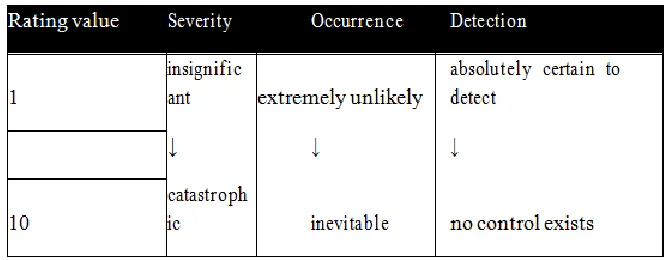
size of 10 for three distinct angles, including: Severity rating (S), Occurrence rating (O), and Detection rating (D) in light of the rules in Table 1.
From the above appraisals, a supposed Risk Priority Number (RPN) for a specific cause is dictated by Eq. 1. A cause with higher RPN ought to be priorly treated; i.e. restorative activities to either dispense with or lessen failures ought to begin with the most elevated organized causes. All things considered, FMEA is a compelling device in organizing failures that require remedial activities to enhance item quality.
International Research Journal of Mathematics, Engineering and IT Vol. 4, Issue 2, February 2017 Impact Factor- 5.489 ISSN: (2349-0322)
© Associated Asia Research Foundation (AARF)
RPN=S*O*D
Nonetheless, traditional FMEA neglects to give adequate segregation control in a few conditions since it selects a similar weight for the greater part of the evaluations [2]; implying that they effectly affect the RPN. Indeed, S and O are two noteworthy influencing elements that ought to be more organized [3]. For cases, how about we consider a failure mode with three distinct causes A, B, and C whose evaluations are individually given as (SA=8, OA=5, DA=4), (SB=10, OB=4, DB=4), and (SC=5, OC=4, DC=8); and their RPNs along these lines are all equivalent to 160.
For this situation, if just RPN is thought about paying little heed to the appraisals of seriousness, event, and discovery, none of the causes ought to be organized, prompting to scattering and wasteful usage of constrained assets, or even a few causes that have significantly negative effects may neglect to pull in extraordinary consideration.
[image:2.595.130.463.312.442.2]To conquer the above inadequacy in incline producing frameworks, [4] proposed an option list called Risk Assessment Value (RAV) decided by Eq. 2
Table 1: Rating scaleguidelines
They trusted that productive location and control of failure assume essential part in limiting failure event and failure seriousness. Benchmarking the execution amongst RPN and RAV, [5] pointed that RAV gives better priority orders. In any case, with our previously mentioned illustration, the RAV of A, B, and C are individually gotten as RAVA = 10, RAVB=10, and RAVC=2.5; henceforth, amongst A and B, which one ought to be organized is still obscure. This demonstrates however RAV performs superior to RPN, despite everything it neglects to give adequate matchless quality in settling on ultimate conclusion in such cases.
RAV=O×S×D
notoriety/brand would truly influence the execution of the entire association. These costs, hereinafter, are alluded in a more broad term as "Quality cost". Therefore, to cure the above downsides, this paper proposes incorporating the quality cost as an extra figure the routine RPN equation to improve its segregation control in dissecting failure modes and their belongings. Our proposed recipe is called "Modified Risk Priority Number" (MRPN) [7].
Whatever is left of this paper is sorted out as the accompanying. Area 2 presents essential definitions generally utilized as a part of FMEA while MRPN is developed in Section 3. Segment 4 talks about a contextual analysis at an organization creating aluminum jars for lager and soda pop industry to show the down to earth appropriateness of our proposed MRPN.
2. PRIMARY DEFINITIONS Failure modes
Failures are any errors or defects, especially ones that affect the potential or actual customers. “Failure modes” means the ways that failures arise. Keyinputs and production process play critical role in the quality of product/service. Thus, fully identify possible failures at each stage of the process is always expected so that manufacturers/ service providers can implement suitable actions to either eliminate or reduce their negative effect, minimize production cost, and satisfy customer demands [8].
Effects
Effects of a failure refer to the consequences caused by the failure to the quality of a product/service. They can be evaluated with the satisfaction level or perception of customers who are either external customers or internal customers who are the users in the next stages of the process [9].
Cause
Cause is the source of variations and failures. Hence, to improve the quality of product/service, it is the best that possible causes should be fully identified so that we can have proper solutions to effectively deal with them. One of the commonly used tools is the Cause-Effect Diagram, also called Fishbone Diagram [10].
Control system
3. PROPOSED MODIFIED RISK PRIORITY NUMBER
This section presents the development of our proposed modified risk priority number (MRPN).
Assume that there are n identified failure modes existing in a production process. For jth mode (j=1, 2,..., n), the following denotations are used.
:occurrence probability of the jth mode (given by experts); :detection probability of the jth
mode (given by experts); :severity level of the jth mode
from technicalperspective (in service industry, is actually the timing of the process);
evaluated in a traditional scale of 10;
:severity level from economic perspective in internally dealing with the jth mode; thus, it closely relates to a so-called “internal failure costs”;
: Severity level from economic perspective in externally dealing with the jth mode; i.e. the level of external costs occurred after non-detected faulty product/service is delivered to external customers; thus, it closely relates to a so-called “external failurecosts”.
Then, a new index MRPNj of the jth failure mode is determined by:
𝑀𝑅𝑃𝑁𝑗 = 𝑃𝑜𝑗 × 𝑆𝑡𝑗 × 𝑚𝑎𝑥 𝑃𝐷1,𝑃𝐷2…𝑃𝐷𝑛
𝑃𝐷𝑗 × 𝑆𝐼 𝑗
+ 1 − 𝑃𝐷𝑗 × 𝑆𝐸𝑗 (3)
Eq. 3 with the quantity of 1 − 𝑃𝐷𝑗 obviously considers the effects of a failure when it is not detected by the control system. Besides, MRPN and the conventional RPN have some similar characteristics; for example, the lower
detection probability in MRPN (i.e. 𝑃𝐷𝑗 smaller) is respectively to the higher of D
in RPN, which is shown in 𝑚𝑎𝑥 𝑃𝐷
1,𝑃 𝐷2…𝑃𝐷𝑛
𝑃𝐷𝑗 in
Eq. 3. Moreover, 1 − 𝑃𝐷𝑗 so reflects the effect of external failure costs on the amplitude of MRPN; specifically, if the probability of detecting failures is low, the chance of a faulty product/service delivered to customers is certainly high, resulting in higher MRPN; meaning that the jth failure mode would be more prioritized. The values of ST, SI, and SE are evaluated as the following [12].
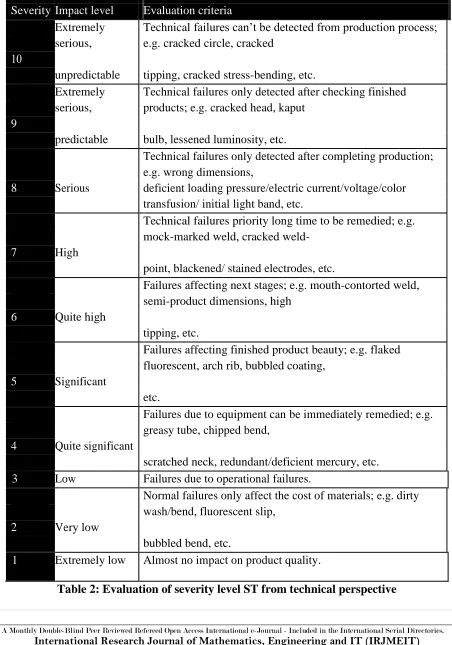
Evaluation of severity of failures from technical perspective ST
assess its negative effects on the following stages in the creation procedure, item quality and client discernment. Therefore, the seriousness ST in MRPN is really the seriousness level S in the conventional
[image:5.595.71.523.143.788.2]RPN. Table 2 represents a case of the assessment of the specialized seriousness ST utilized for reduced fluorescent tube produced in Company P specified in Section 4 [13].
Table 2: Evaluation of severity level ST from technical perspective
Severity Impact level Evaluation criteria
10
Extremely serious,
Technical failures can’t be detected from production process; e.g. cracked circle, cracked
unpredictable tipping, cracked stress-bending, etc.
9
Extremely serious,
Technical failures only detected after checking finished products; e.g. cracked head, kaput
predictable bulb, lessened luminosity, etc.
8 Serious
Technical failures only detected after completing production; e.g. wrong dimensions,
deficient loading pressure/electric current/voltage/color transfusion/ initial light band, etc.
7 High
Technical failures priority long time to be remedied; e.g. mock-marked weld, cracked weld-
point, blackened/ stained electrodes, etc.
6 Quite high
Failures affecting next stages; e.g. mouth-contorted weld, semi-product dimensions, high
tipping, etc.
5 Significant
Failures affecting finished product beauty; e.g. flaked fluorescent, arch rib, bubbled coating,
etc.
4 Quite significant
Failures due to equipment can be immediately remedied; e.g. greasy tube, chipped bend,
scratched neck, redundant/deficient mercury, etc.
3 Low Failures due to operational failures.
2 Very low
Normal failures only affect the cost of materials; e.g. dirty wash/bend, fluorescent slip,
bubbled bend, etc.
As mentioned above, quality cost closely related to quality assurance of semi-products and finished semi-products in all stages of production process from inputs to outputs and using period by customers. The quality cost can be divided into four groups: (1) Prevention costs; (2) Appraisal costs; (3) Internal failure costs; and (4) External failure costs (Montgomery, 2013). Among them, the first two groups are controllable while the last two ones directly relate to production process which accounts for a significant part of the total cost of an organization. So, this paper investigates the last two groups as a key component in our proposed MRPN [14].
Internal failure cost (IFC)
IFC are actually the costs occurred due to the quality incompliance of any component, part, material, product, and/or related service provided that defective products are detected before being delivered to customer. IFC takes a value of 0 if no defective product is found prior to delivery. Particularly, it consists of the following components: scrap; rework; retest; failure analysis; downtime; and yield losses, etc.
External failure cost (EFC)
EFC includes all costs occurred due to the failures detected after products are delivered to customers. It takes a value of 0 when all products meet specified requirements. EFC consists of the following components: field servicing and handling complaints; recalls, returns, replacements; warranty; other indirect costs because defective products/services lead to the dissatisfaction of customers and their negative impression about the
products/services and the
manufacturers/providers; consequently, damage customer good-will, lose sales due to bad reputation, etc.
Therefore, for every failure mode, we priority to carefully and fully identify associated IFC and EFC so that we can have proper solutions for quality improvement.IFC and EFC can be respectively converted into SI and SE with the following procedure. Assume that we have n failure modes inthe production process of a product. Let 𝐼𝐹𝐶𝑗 and
𝐸𝐹𝐶𝑗 𝑗 = 1, 𝑛 respectively denote the
internal and external failure costs of the jth
mode. 𝑆𝐼𝑗and𝑆𝐸𝑗are then determined by:
𝑆𝐼𝑗 = 𝐼𝐹𝐶𝑗
𝐹𝐶𝑚𝑖𝑛
; 𝑆𝐸
𝑗
= 𝐸𝐹𝐶𝑗
𝐹𝐶𝑚𝑖𝑛
(4)
The determination of and shown in Eq. 4obviously not only overcomes the shortcomings of the RPN in conventional FMEA approach and the RAVproposed by Sawhney et al. (2010) but also considers the severity level of two prominent quality costs namely IFC and EFC of the same failure mode; i.e. for a failure whose SE is
eliminate the causes for the failures in each stage of the production process [15].
4. PRACTICAL APPLICATION
In order to evaluate the applicability of the proposed MRPN, we conduct a practical study at Company P specializing in producing aluminum cans used in beer and soft drink industry, located in Dong Nai province, Vietnam. Basically, the company usually has a critical problem in delivery schedule because their defective cans account for about 14% of total
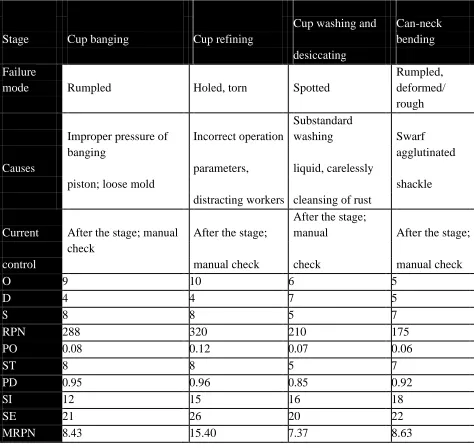
manufactured products. Such high percentage of defective cans certainly reduces the annual performance of the company. To deal with this problem and minimize the number of defective products, we set up an FMEA team consisting of 15 members who are administrators, top engineers, leaders of related departments, and group leaders. The team focuses on analyzing production process and identifying major failure modes in each production stage as shown in Table 3 [16].
Table 3: Evaluation of severity level ST from technical perspective
Production stage/phase Failure modes
Oil coating Superfluous oil, insufficient oil
Cup banging Irregular thickness, scratched/ rumpled body, rumpled bottom Cup refining Holed/ rumpled/ torn cup
Edge cutting Irregular cut, swarf agglutination, uneven/ unusual height Cup washing and desiccating Oily cup, spotted body and bottom
Vanish coating Uneven coat, overlapped coat, inside-cup vanish
Printing Incorrect tone, unexpected printing stroke, blurred colour Lacquer coating and IBO
desiccating Uneven coat
Can-neck bending Rumpled can-neck, deformed/rough edge With the FMEA approach, the team
determines the occurrence rate of each mode (PO), detection rate (PD), the severity levels of failures from technical and economic perspectives (ST, SI, SE). Consequently, the MRPN for each failure mode can be easily obtained.Finally, the team agrees to take corrective actionsagainst four modes that have the highest RPN and MRPN as shown in Table 4 clearly
Table 4: Four major failure modes with the highest RPN and MRPN
Stage
Cup banging
Cup refining
Cup washing and
Can-neck bending
desiccating
Failure
mode Rumpled Holed, torn Spotted
Rumpled, deformed/
rough
Improper pressure of banging
Incorrect operation
Substandard
washing Swarf
agglutinated
Causes parameters, liquid, carelessly
piston; loose mold shackle
distracting workers cleansing of rust
Current After the stage; manual
check
After the stage;
After the stage;
manual After the stage;
control manual check check manual check
O 9 10 6 5
D 4 4 7 5
S 8 8 5 7
RPN 288 320 210 175
PO 0.08 0.12 0.07 0.06
ST 8 8 5 7
PD 0.95 0.96 0.85 0.92
SI 12 15 16 18
SE 21 26 20 22
MRPN 8.43 15.40 7.37 8.63
5. CONCLUSION
FMEA approach has been widely applied in analyzing failure modes and their effects towards product/service quality as it can help manufacturers/ service providers to identify failures/ defects of their products/services, their severity levels as well as their negative effect on related stakeholders and their business
quality cost and the capability of failure detection system because the capability intimately relates to the possibility of defective products/services delivered to customers, i.e. such capability can either establish or damage the quality reputation of an organization. The performance of our modified index MRPN was tested in an empirical case at a company
specializing in producing aluminum cans used in beer and soft drink industry. We found that the percentage of defective cans has been significantly reduced from about 14% before the trial period to 4% with the MRPN or 6% with the traditional RPN after the trial. Hence, MRPN outperforms RPN in identifying priority order to deal with detected failures.
REFERENCES
1. Benjamin DM (2003). Reducing medication errors and increasing patient safety: case studies in clinical pharmacology. The
Journal of Clinical
Pharmacology, 43(7): 768-783.
2. Bonnabry P, Cingria L, Sadeghipour F, Ing H, Fonzo-Christe C and Pfister RE (2005). Use of a systematic risk analysis method to improve safety in the production of paediatric parenteral nutrition solutions. Quality and Safety in Health Care, 14(2): 93-98.
3. Chen JK (2007). Utility priority number evaluation for FMEA. Journal of Failure Analysis and Prevention, 7(5): 321-328.
4. Cox LAT (2008). What's wrong with risk matrices?. Risk Analysis, 28(2): 497-512.
5. Cox LAT, Babayev D and Huber W (2005). Some limitations of qualitative risk rating systems. Risk Analysis, 25(3): 651-662.
6. Daily KW (2004). The FMEA Pocket Handbook. 1st Edition, DW Publishing Co, Port St Lucie, USA.
7. Davidson GG and Labib AW (2003). Learning from failures: design improvements using a multiple criteria decision-making process. Proceedings of the Institution of Mechanical Engineers, Part G: Journal of Aerospace Engineering, 217(4): 207-216.
8. Gilchrist W (1993). Modelling failure modes and effects analysis. International Journal of Quality and Reliability Management, 10(5): 16-23.
9. Hsiao SW (2002). Concurrent design method for developing a new product. International Journal of Industrial Ergonomics, 29(1): 41-55.
10.Hung GQ, Nie M and Mak KL (1999). Web-based failure mode and effect analysis (FMEA). Computers and Industrial Engineering, 37(1): 177-180.
11.Karthik S, Sivakumar A and Sevvel P (2015). Comparative study of risk assessment value against risk priority number. International Journal of Innovative Research in Science, Engineering and Technology, 4(2): 114-123.
effects analysis using expected cost. Journal of Mechanical Design, 126(6): 1027-1035.
13.Linton JD (2003). Facing the challenges of service automation: an enabler for e-commerce and productivity gain in traditional
services. Engineering
Management, IEEE Transactions on, 50(4): 478-484.
14.Montesi G and Lechi A (2009). Prevention of medication errors: detection and audit. British Journal of Clinical Pharmacology, 67(6): 651-655.
15.Montgomery DC (2013). Statistical Quality Control – A Modern Introduction. 7th Ed, Wiley, Asia.
16.O'ConnorP and Kleyner A (2011). Practical reliability engineering. 5th Edition, John Wiley & Sons, New Jersey, USA.