UNIVERSITAT POLITÈCNICA DE CATALUNYA (UPC)
BARCELONATECH
COMPUTER ARCHITECTURE DEPARTMENT (DAC)
Programming models to support
Data Science workflows
P
H.D. T
HESIS2020 | S
PRINGS
EMESTERAuthor:
Cristián RAMÓN-CORTÉS VILARRODONA
Advisors:
Dra. Rosa M. BADIA SALA [email protected] Dr. Jorge EJARQUEARTIGAS [email protected]
iii
”Apenas él le amalaba el noema, a ella se le agolpaba el clémiso y caían en hidromurias, en salvajes ambonios, en sustalos exas-perantes. Cada vez que él procuraba relamar las incopelusas, se enredaba en un grimado quejumbroso y tenía que envul-sionarse de cara al nóvalo, sintiendo cómo poco a poco las arnillas se espejunaban, se iban apeltronando, reduplimiendo, hasta quedar tendido como el trimalciato de ergomanina al que se le han dejado caer unas fílulas de cariaconcia. Y sin em-bargo era apenas el principio, porque en un momento dado ella se tordulaba los hurgalios, consintiendo en que él aprox-imara suavemente sus orfelunios. Apenas se entreplumaban, algo como un ulucordio los encrestoriaba, los extrayuxtaba y paramovía, de pronto era el clinón, la esterfurosa convulcante de las mátricas, la jadehollante embocapluvia del orgumio, los esproemios del merpasmo en una sobrehumítica agopausa. ¡Evohé! ¡Evohé! Volposados en la cresta del murelio, se sen-tían balpamar, perlinos y márulos. Temblaba el troc, se vencían las marioplumas, y todo se resolviraba en un profundo pínice, en niolamas de argutendidas gasas, en carinias casi crueles que los ordopenaban hasta el límite de las gunfias.”
Julio Cortázar,
Rayuela
v
Dedication
This work would not have been possible without the effort and patience of the people around me. Thank you for encouraging me to get to this point and sharing so many great moments on the way.
To Laura, for her kindness and devotion, and for supporting me through thick and thin despite my difficult character. Special thanks to my loving mother and father, who have al-ways guided and encouraged me to never stop learning; and who bought me my first computer.
Last but not least, to my sweet little sister, Marta, who always stands on my side and whose affection and support keeps me always up.
Wholeheartedly,
vii
Declaration of authorship
I hereby declare that, except where specific reference is made to the work of others, this thesis dissertation has been composed by me and it is based on my own work. None of the contents of this dissertation has been previously published nor submitted, in whole or in part, to any other examination in this or any other university.
Signed:
ix
Acknowledgements
I gratefully thank my supervisors Rosa M. Badia Sala and Jorge Ejarque Artigas for all their assistance during my career at theBarcelona Supercomputing Center (BSC-CNS)and for giving me the opportunity to collaborate on this project.
I also thank all my colleagues, current and former members of theWorkflows and Dis-tributed Computing team from the Barcelona Supercomputing Center (BSC), for their useful comments, remarks, and engagement through the learning process of this thesis: Francesc Lordan, Javier Alvarez, Francisco Javier Conejero, Daniele Lezzi, Ramon Amela, Pol Al-varez, Sergio Rodríguez, Carlos Segarra, Marc Dominguez, Salvi Solà, Hatem Elshazly, and Nihad Mammadli.
On the other hand, this thesis has been financed by the Ministry of Economy and Com-petitiveness with a predoctoral grant under contract BES-2016-076791. This work has also been partially supported by the Spanish Government (SEV2015-0493); the Spanish Ministry of Science and Innovation (contract TIN2015-65316-P); the Generalitat de Catalunya (con-tract 2014-SGR-1051); the Joint Laboratory for Extreme Scale Computing (JLESC); the Intel-BSC Exascale Lab; and the European Commission through the Horizon 2020 Research and Innovation program under contracts 687584 (TANGO project), 676556 (MuG project), 690116 (EUBra-BIGSEA project), 671591 (NEXTGenIO project), and 800898 (ExaQUte project).
xi
UNIVERSITAT POLITÈCNICA DE CATALUNYA (UPC) BARCELONATECH Computer Architecture Department (DAC)
Abstract
Programming models to support Data Science workflows
by Cristián RAMÓN-CORTÉSVILARRODONA
Data Science workflows have become a must to progress in many scientific areas such as life, health, and earth sciences. In contrast to traditional HPC workflows, they are more heterogeneous; combining binary executions, MPI simulations, multi-threaded applications, custom analysis (possibly written in Java, Python, C/C++ or R), and real-time processing. Furthermore, in the past, field experts were capable of programming and running small simulations. However, nowadays, simulations requiring hundreds or thousands of cores are widely used and, to this point, efficiently programming them becomes a challenge even for computer sciences. Thus, programming languages and models make a considerable effort to ease the programmability while maintaining acceptable performance.
This thesis contributes to the adaptation of High-Performance frameworks to support the needs and challenges of Data Science workflows by extending COMPSs, a mature, gene-ral-purpose, task-based, distributed programming model. First, we enhance our prototype to orchestrate different frameworks inside a single programming model so that non-expert users can build complex workflows where some steps require highly optimised state of the art frameworks. This extension includes the@binary, @OmpSs,@MPI, @COMPSs, and @MultiNodeannotations for both Java and Python workflows.
Second, we integrate container technologies to enable developers to easily port, dis-tribute, and scale their applications to distributed computing platforms. This combination provides a straightforward methodology to parallelise applications from sequential codes along with efficient image management and application deployment that ease the pack-aging and distribution of applications. We distinguish between static, HPC, and dynamic container management and provide representative use cases for each scenario using Docker, Singularity, and Mesos.
Third, we design, implement and integrate AutoParallel, a Python module to automati-cally find an appropriate task-based parallelisation of affine loop nests and execute them in parallel in a distributed computing infrastructure. It is based on sequential programming and requires one single annotation (the@parallelPython decorator) so that anyone with intermediate-level programming skills can scale up an application to hundreds of cores.
Finally, we propose a way to extend task-based management systems to support continu-ous input and output data to enable the combination of task-based workflows and dataflows (Hybrid Workflows) using one single programming model. Hence, developers can build complex Data Science workflows with different approaches depending on the requirements without the effort of combining several frameworks at the same time. Also, to illustrate the capabilities of Hybrid Workflows, we have built a Distributed Stream Library that can be easily integrated with existing task-based frameworks to provide support for dataflows. The library provides a homogeneous, generic, and simple representation of object and file streams in both Java and Python; enabling complex workflows to handle any data type without dealing directly with the streaming back-end.
Keywords: Distributed Computing, High-Performance Computing, Data Science pipe-lines, Task-based Workflows, Dataflows, Containers, COMPSs, PyCOMPSs, AutoParallel, Docker, Pluto, Kafka
xiii
UNIVERSITAT POLITÈCNICA DE CATALUNYA (UPC) BARCELONATECH Computer Architecture Department (DAC)
Resumen
Programming models to support Data Science workflows
por Cristián RAMÓN-CORTÉSVILARRODONA
Los flujos de trabajo de Data Science se han convertido en una necesidad para progresar en muchas áreas científicas como las ciencias de la vida, la salud y la tierra. A diferencia de los flujos de trabajo tradicionales para la CAP, los flujos de Data Science son más heterogé-neos; combinando la ejecución de binarios, simulaciones MPI, aplicaciones multiproceso, análisis personalizados (posiblemente escritos en Java, Python, C/C++ o R) y computa-ciones en tiempo real. Mientras que en el pasado los expertos de cada campo eran capaces de programar y ejecutar pequeñas simulaciones, hoy en día, estas simulaciones representan un desafío incluso para los expertos ya que requieren cientos o miles de núcleos. Por esta razón, los lenguajes y modelos de programación actuales se esfuerzan considerablemente en incrementar la programabilidad manteniendo un rendimiento aceptable.
Esta tesis contribuye a la adaptación de modelos de programación para la CAP para afrontar las necesidades y desafíos de los flujos de Data Science extendiendo COMPSs, un modelo de programación distribuida maduro, de propósito general, y basado en tareas. En primer lugar, mejoramos nuestro prototipo para orquestar diferentes software para que los usuarios no expertos puedan crear flujos complejos usando un único modelo donde algunos pasos requieran tecnologías altamente optimizadas. Esta extensión incluye las anotaciones de@binary,@OmpSs,@MPI,@COMPSs, y@MultiNodepara flujos en Java y Python.
En segundo lugar, integramos tecnologías de contenedores para permitir a los desarrol-ladores portar, distribuir y escalar fácilmente sus aplicaciones en plataformas distribuidas. Además de una metodología sencilla para paralelizar aplicaciones a partir de códigos se-cuenciales, esta combinación proporciona una gestión de imágenes y una implementación de aplicaciones eficientes que facilitan el empaquetado y la distribución de aplicaciones. Distinguimos entre gestión de contenedores estática, CAP y dinámica y proporcionamos casos de uso representativos para cada escenario con Docker, Singularity y Mesos.
En tercer lugar, diseñamos, implementamos e integramos AutoParallel, un módulo de Python para determinar automáticamente la paralelización basada en tareas de nidos de bucles afines y ejecutarlos en paralelo en una infraestructura distribuida. AutoParallel está basado en programación secuencial, requiere una sola anotación (el decorador@parallel) y permite a un usuario intermedio escalar una aplicación a cientos de núcleos.
Finalmente, proponemos una forma de extender los sistemas basados en tareas para ad-mitir datos de entrada y salida continuos; permitiendo así la combinación de flujos de tra-bajo y datos (Flujos Híbridos) en un único modelo. Consecuentemente, los desarrolladores pueden crear flujos complejos siguiendo diferentes patrones sin el esfuerzo de combinar varios modelos al mismo tiempo. Además, para ilustrar las capacidades de los Flujos Híbri-dos, hemos creado una biblioteca (DistroStreamLib) que se integra fácilmente a los mode-los basados en tareas para soportar flujos de datos. La bilblioteca proporciona una repre-sentación homogénea, genérica y simple de secuencias continuas de objetos y archivos en Java y Python; permitiendo manejar cualquier tipo de datos sin tratar directamente con el back-end de streaming.
Palabras clave:Computación Distribuida, Computación de Altas Prestaciones, Flujos de Data Science, Flujos de Tareas, Flujos de Datos, Containers, COMPSs, PyCOMPSs, AutoPar-allel, Docker, Pluto, Kafka
xv
UNIVERSITAT POLITÈCNICA DE CATALUNYA (UPC) BARCELONATECH Computer Architecture Department (DAC)
Resum
Programming models to support Data Science workflows
per Cristián RAMÓN-CORTÉSVILARRODONA
Els fluxos de treball de Data Science s’han convertit en una necessitat per progressar en moltes àrees científiques com les ciències de la vida, la salut i la terra. A diferència dels fluxos de treball tradicionals per a la CAP, els fluxos de Data Science són més heterogenis; combi-nant l’execució de binaris, simulacions MPI, aplicacions multiprocés, anàlisi personalitzats (possiblement escrits en Java, Python, C / C ++ o R) i computacions en temps real. Mentre que en el passat els experts de cada camp eren capaços de programar i executar petites sim-ulacions, avui dia, aquestes simulacions representen un repte fins i tot per als experts ja que requereixen centenars o milers de nuclis. Per aquesta raó, els llenguatges i models de pro-gramació actuals s’esforcen considerablement en incrementar la programabilitat mantenint un rendiment acceptable.
Aquesta tesi contribueix a l’adaptació de models de programació per a la CAP per afron-tar les necessitats i reptes dels fluxos de Data Science estenent COMPSs, un model de progra-mació distribuïda madur, de propòsit general, i basat en tasques. En primer lloc, millorem el nostre prototip per orquestrar diferent programari per a que els usuaris no experts puguin crear fluxos complexos usant un únic model on alguns passos requereixin tecnologies al-tament optimitzades. Aquesta extensió inclou les anotacions de@binary,@OmpSs,@MPI, @COMPSs, i@MultiNodeper a fluxos en Java i Python.
En segon lloc, integrem tecnologies de contenidors per permetre als desenvolupadors portar, distribuir i escalar fàcilment les seves aplicacions en plataformes distribuïdes. A més d’una metodologia senzilla per a paral·lelitzar aplicacions a partir de codis seqüencials, aquesta combinació proporciona una gestió d’imatges i una implementació d’aplicacions eficients que faciliten l’empaquetat i la distribució d’aplicacions. Distingim entre la gestió de contenidors estàtica, CAP i dinàmica i proporcionem casos d’ús representatius per a cada escenari amb Docker, Singularity i Mesos.
En tercer lloc, dissenyem, implementem i integrem AutoParallel, un mòdul de Python per determinar automàticament la paral·lelització basada en tasques de nius de bucles afins i executar-los en paral·lel en una infraestructura distribuïda. AutoParallel està basat en pro-gramació seqüencial, requereix una sola anotació (el decorador @parallel) i permet a un usuari intermig escalar una aplicació a centenars de nuclis.
Finalment, proposem una forma d’estendre els sistemes basats en tasques per adme-tre dades d’entrada i sortida continus; permetent així la combinació de fluxos de adme-treball i dades (Fluxos Híbrids) en un únic model. Conseqüentment, els desenvolupadors poden crear fluxos complexos seguint diferents patrons sense l’esforç de combinar diversos mod-els al mateix temps. A més, per a il·lustrar les capacitats dmod-els Fluxos Híbrids, hem creat una biblioteca (DistroStreamLib) que s’integra fàcilment amb els models basats en tasques per suportar fluxos de dades. La biblioteca proporciona una representació homogènia, genèrica i simple de seqüències contínues d’objectes i arxius en Java i Python; permetent gestionar qualsevol tipus de dades sense tractar directament amb el back-end de streaming.
Paraules clau:Computació Distribuïda, Computació d’Altes Prestacions, Fluxos de Data Science, Fluxos de Tasques, Fluxos de Dades, Containers, COMPSs, PyCOMPSs, AutoParal-lel, Docker, Pluto, Kafka
xvii
Contents
Dedication v
Declaration of authorship vii
Acknowledgements ix
Abstract xi
Resumen xiii
Resum xv
Contents xxi
List of Figures xxiv
List of Listings xxv
List of Tables xxvii
List of Abbreviations xxx
Glossary xxxiv
I Introduction 1
1 Introduction 3
1.1 Context . . . 3
1.1.1 The Distributed Computing era . . . 3
1.1.2 The joint venture towards the Exascale Computing . . . 3
1.1.3 Task-based Workflows and Dataflows . . . 4
1.1.4 Batch Processing and Continous Processing . . . 4
1.2 Objectives and contributions . . . 5
1.2.1 Research Questions . . . 6
1.2.2 Detailed objectives . . . 7
1.2.3 Contributions to the field . . . 7
1.2.4 Publications . . . 8
1.3 Tools and methodology . . . 9
1.3.1 Tools . . . 9
1.3.2 Methodology . . . 9
1.3.2.1 Scientific method design . . . 9
1.3.2.2 Development strategy . . . 10
1.3.2.3 Validation strategy . . . 10
xviii
2 State of the art 13
2.1 Distributed Computing . . . 13
2.2 Task-based Workflows . . . 14
2.2.1 Software discussion and examples . . . 14
2.2.2 Taxonomy . . . 14
2.2.3 Analysis . . . 16
2.3 Dataflows . . . 16
2.3.1 Software discussion and examples . . . 17
2.3.2 Taxonomy . . . 17 2.3.3 Analysis . . . 18 3 Background 21 3.1 COMPSs . . . 21 3.1.1 Programming model . . . 22 3.1.1.1 Java . . . 22 3.1.1.2 Python . . . 25 3.1.1.3 Annotations’ summary . . . 26 3.1.2 Runtime system . . . 28 3.1.3 Task life-cycle . . . 29 3.2 MPI . . . 30 II Contributions 33 4 Orchestration of complex workflows 35 4.1 General overview . . . 36
4.2 Related Work . . . 36
4.3 Programming model annotations . . . 37
4.3.1 Method annotations . . . 37
4.3.1.1 Java . . . 38
4.3.1.2 Python . . . 40
4.3.2 Parameter annotations . . . 41
4.3.2.1 Prefix parameter annotation . . . 43
4.4 Runtime master . . . 46
4.4.1 Task detection . . . 46
4.4.2 Task scheduler . . . 46
4.5 Worker executors . . . 49
4.5.1 Invokers . . . 50
4.6 Use Case: NMMB-MONARCH . . . 50
4.6.1 Application overview . . . 51 4.6.2 Parallelisation design . . . 52 4.6.3 Evaluation . . . 54 4.6.3.1 Parallelisation analysis . . . 54 4.6.3.2 Computing infrastructure . . . 54 4.6.3.3 Simulation dataset . . . 55 4.6.3.4 Global performance . . . 56
4.6.3.5 Performance per step . . . 56
4.6.3.6 Behaviour analysis . . . 57
xix
5 Computational resources using container techonologies 61
5.1 General overview . . . 62
5.2 Related Work . . . 63
5.3 Resource Orchestration Platforms . . . 64
5.3.1 Batch ROP . . . 65
5.3.1.1 Software discussion and examples . . . 65
5.3.1.2 Taxonomy . . . 65
5.3.1.3 Analysis . . . 66
5.3.2 Interactive ROP . . . 66
5.3.2.1 Software discussion and examples . . . 67
5.3.2.2 Taxonomy . . . 67
5.3.2.3 Analysis . . . 67
5.4 Description of reference ROP . . . 68
5.4.1 OpenStack . . . 68 5.4.2 OpenNebula . . . 69 5.4.3 Docker framework . . . 69 5.4.4 Kubernetes . . . 69 5.4.5 Singularity . . . 70 5.4.6 Mesos . . . 70 5.5 Architecture . . . 71
5.5.1 Static computational resources . . . 71
5.5.1.1 COMPSs static resources management . . . 71
5.5.1.2 New static container management . . . 72
5.5.1.2.1 Submission command . . . 72
5.5.1.2.2 Container image creation . . . 73
5.5.1.2.3 Container execution . . . 74
5.5.1.3 Use Case 1: Docker . . . 74
5.5.2 HPC computational resources . . . 76
5.5.2.1 COMPSs HPC resources management . . . 76
5.5.2.2 New HPC container management . . . 77
5.5.2.3 Use Case 2: Singularity . . . 77
5.5.3 Dynamic computational resources . . . 78
5.5.3.1 COMPSs dynamic resources management . . . 78
5.5.3.2 New dynamic container management . . . 80
5.5.3.3 Use Case 3: Docker . . . 80
5.5.3.4 Use Case 4: Mesos . . . 80
5.6 Evaluation . . . 82 5.6.1 Computing infrastructure . . . 82 5.6.2 Benchmark applications . . . 83 5.6.3 Docker . . . 84 5.6.3.1 Deployment evaluation . . . 84 5.6.3.2 Performance evaluation . . . 85 5.6.3.3 Adaptation evaluation . . . 87 5.6.4 Singularity . . . 88 5.6.4.1 Deployment evaluation . . . 88 5.6.4.2 Performance evaluation . . . 88
5.6.4.3 Porting of a real-world application: GUIDANCE . . . 89
5.6.5 Mesos . . . 90
5.6.5.1 Deployment evaluation . . . 90
5.6.5.2 Performance evaluation . . . 90
xx 6 Automatic parallelisation 93 6.1 General overview . . . 94 6.2 Related work . . . 94 6.3 PLUTO . . . 95 6.3.1 Loop tiling . . . 96 6.4 Architecture . . . 97 6.4.1 AutoParallel module . . . 98
6.4.2 Taskification of loop tiles . . . 100
6.4.3 Python extension for CLooG . . . 101
6.5 Programmability evaluation . . . 102
6.5.1 Centre of Mass . . . 102
6.6 Performance evaluation . . . 106
6.6.1 Computing infrastructure . . . 106
6.6.2 General description of the applications . . . 106
6.6.3 Cholesky . . . 107
6.6.4 LU . . . 108
6.6.5 QR . . . 110
6.7 Evaluation of the automatic data blocking . . . 111
6.7.1 GEMM . . . 111
6.8 Discussion . . . 114
7 Transparent execution of Hybrid Workflows 115 7.1 General overview . . . 116 7.2 Related work . . . 117 7.2.1 Task-based frameworks . . . 117 7.2.2 Dataflow frameworks . . . 118 7.2.3 Hybrid frameworks . . . 119 7.3 Kafka . . . 119 7.4 Architecture . . . 121
7.4.1 Distributed Stream interface . . . 121
7.4.2 Distributed Stream implementations . . . 122
7.4.2.1 Object streams . . . 122
7.4.2.2 File streams . . . 124
7.4.3 Distributed Stream Library . . . 125
7.4.4 Programming model extensions . . . 126
7.4.5 Runtime extensions . . . 126
7.5 Use cases . . . 128
7.5.1 Use case 1: Continuous data generation . . . 128
7.5.2 Use case 2: Asynchronous data exchange . . . 131
7.5.3 Use case 3: External streams . . . 132
7.5.4 Use case 4: Dataflows with nested task-based workflows . . . 133
7.6 Evaluation . . . 134
7.6.1 Experimental setup . . . 134
7.6.2 Gain of processing data continuously . . . 134
7.6.3 Gain of removing synchronisations . . . 136
7.6.4 Stream writers and readers scalability and load balance . . . 138
7.6.5 Runtime overhead . . . 140
xxi
III Conclusions and future work 147
8 Conclusions and future work 149
8.1 Conclusions . . . 149 8.2 Future work . . . 150
IV Bibliography 153
xxiii
List of Figures
1.1 Lines of work to support Data Science workflows. . . 5 2.1 Classification of high abstraction frameworks forApplication Development. . . 13 3.1 COMPSs overview. . . 21 3.2 COMPSs Java example: COMPSs execution of Increment. . . 25 3.3 COMPSs structure. . . 28 3.4 COMPSs Runtime overview. . . 28 3.5 COMPSs task execution workflow. . . 29 3.6 Hello MPI: Diagram of execution. . . 32 4.1 Example of a single node task flow. . . 47 4.2 Example of a multi-node task flow. . . 48 4.3 NMMB-MONARCH: Structure diagram. . . 51 4.4 NMMB-MONARCH: Structure diagram with tasks definition. . . 53 4.5 NMMB-MONARCH: Dependency graph of three days simulation. . . 55 4.6 NMMB-MONARCH: Execution time and speed-up. . . 56 4.7 NMMB-MONARCH: Paraver trace of the Python version. . . 58 4.8 NMMB-MONARCH: Visual outputs. . . 59 5.1 Classification of Resource Orchestration Platforms (ROP) . . . 65 5.2 COMPSs static resources management . . . 71 5.3 Integration with containers platforms. . . 72 5.4 Image generation phase. . . 73 5.5 Deployment phase. . . 74 5.6 Dynamic integration with Docker. . . 75 5.7 COMPSs HPC resources management . . . 76 5.8 Containers HPC resources management . . . 77 5.9 Application deployment with Singularity. . . 78 5.10 COMPSs dynamic resources management . . . 79 5.11 Dynamic integration with Mesos. . . 81 5.12 Chameleon Cloud testbed environment configurations. . . 82 5.13 MareNostrum 3 testbed environment configurations. . . 83 5.14 Scalability evaluation of the Matrix Multiplication. . . 85 5.15 Overhead evaluation of the Matrix Multiplication. . . 85 5.16 Scalability evaluation of the Embarrassingly Parallel application. . . 86 5.17 Overhead evaluation of the Embarrassingly Parallel application. . . 87 5.18 Deployment time effect in the Matrix Multiplication resource adaptation. . . . 87 5.19 Matrix Multiplication application execution with Singularity. . . 89 5.20 Mesos scalability evaluation of the Matrix Multiplication . . . 90 5.21 Mesos overhead evaluation of the Matrix Multiplication. . . 90 6.1 PLUTO overview. . . 95 6.2 PLUTO source-to-source transformation. . . 96
xxiv
6.3 Overview of the AutoParallel Module. . . 98 6.4 AutoParallel Module Internals. . . 99 6.5 Cholesky: Execution times and speed-up. . . 108 6.6 LU: Execution times and speed-up. . . 109 6.7 LU: Paraver trace. . . 110 6.8 QR: Execution times and speed-up. . . 111 6.9 GEMM: Execution time and slow-down. . . 112 6.10 GEMM with object annotations: Execution time and speed-up. . . 113 7.1 Equivalent Task-based Worflow and Dataflow. . . 116 7.2 Description of Kafka’s basic concepts. . . 120 7.3 General architecture. . . 121 7.4 DistroStream class relationship. . . 122 7.5 Sequence diagram of the Distributed Stream Library components. . . 125 7.6 Structure of the internal COMPSs components. . . 127 7.7 COMPSs and Distributed Stream Library deployment. . . 127 7.8 Task graph of the simulation application without streaming. . . 129 7.9 Task graph of the simulation application with streaming. . . 131 7.10 Task graph of the multi-simulations application. . . 131 7.11 Task graph of the sensor application. . . 132 7.12 Task graph of the hybrid nested application. . . 133 7.13 Paraver traces to illustrate the gain of processing data continuously. . . 134 7.14 Average execution time and gain of a simulation with increasing generation
time. . . 135 7.15 Average execution time and gain of a simulation with increasing process time. 136 7.16 Comparison of parallel iterative computations using pure Task-based
Work-flows and Hybrid WorkWork-flows. . . 137 7.17 Average execution time and gain of a simulation with an increasing number
of iterations. . . 137 7.18 Average execution time with increasing number of readers and different
num-ber of writers. . . 138 7.19 Efficiency with increasing number of readers and different number of writers. 139 7.20 Number of stream elements processed per reader. . . 139 7.21 Task analysis average time for one single parameter with increasing sizes and
number of parameters. . . 141 7.22 Task scheduling average time for one single parameter with increasing sizes
and number of parameters. . . 142 7.23 Task execution average time for one single parameter with increasing sizes
and number of parameters. . . 143 7.24 Total execution time with increasing number of parameters. . . 144
xxv
List of Listings
3.1 COMPSs Java example: Increment main class. . . 23 3.2 COMPSs Java example: Increment helper methods class. . . 23 3.3 COMPSs Java example: Increment Interface. . . 24 3.4 COMPSs Java example: Sequential execution of Increment. . . 24 3.5 COMPSs Python example: Task annotation. . . 25 3.6 COMPSs Python example: Call to synchronisation API. . . 26 3.7 Hello MPI example in C. . . 31 3.8 Hello MPI: Execution example. . . 31 4.1 Binary task definition example in Java. . . 39 4.2 Binary remote method definition example in Java. . . 40 4.3 Binary task invocation example in Java. . . 40 4.4 Binary task definition, remote method and invocation example in Python. . . 41 4.5 Example of the different return types of the non-native tasks. . . 41 4.6 Example of the different standard I/O stream annotations. . . 42 4.7 Example of the different stream annotations for non-native tasks in Python. . 43 4.8 Binary tasks example in Java for joint prefixes. . . 44 4.9 Main code example in Java for joint prefixes. . . 44 4.10 Example of the main code calls to tasks with prefixes. . . 45 4.11 Example of the command executed inside each task using prefixes. . . 45 4.12 Interface example of an application with prefixes. . . 45 4.13 NMMB-MONARCH: Annotation of thedeeptemperaturebinary in Java. . 52 4.14 NMMB-MONARCH: Annotation of thedeeptemperaturebinary in Python. 52 4.15 NMMB-MONARCH: Annotation of thenemsMPI binary in Java. . . 53 4.16 NMMB-MONARCH: Annotation of thenemsMPI binary in Python. . . 53 5.1 Comparison between normal and container execution. . . 72 5.2 Usage of theruncompss_containercommand with Docker. . . 75 5.3 Submission comparison between a normal and a Singularity cluster. . . 78 5.4 Definition of an application execution with Chronos. . . 81 6.1 Tiling example. . . 97 6.2 EP example: user code. . . 99 6.3 EP example: auto-generated code. . . 100 6.4 EP example: user code with taskification of loop tiles. . . 100 6.5 EP example: auto-generated code with taskification of loop tiles. . . 101 6.6 Centre of mass: sequential code. . . 103 6.7 Centre of mass: AutoParallel annotations. . . 103 6.8 Centre of mass: Automatically generated tasks. . . 104 6.9 Centre of mass: Automatically generated loop nest. . . 105 7.1 Distributed Stream Interface in Java. . . 122 7.2 Object Streams (ODS) example in Java. . . 123 7.3 File Streams (FDS) example in Java. . . 124 7.4 Stream parameter annotation example in Java. . . 126 7.5 Example combining stream and file parameters in Java. . . 126 7.6 Simulations’ application in Python without streams. . . 128 7.7 Simulations’ application in Python with streams. . . 130
xxvii
List of Tables
1.1 Relation between research questions, objectives, and contributions. . . 7 2.1 Comparison of the different software targetingTask-based Workflows. . . 15 2.2 Comparison of the different software targetingDataflows. . . 17 3.1 List of PyCOMPSs API functions. . . 26 3.2 Method and Parameter Annotations for Python. . . 26 3.3 Method and Parameter Annotations for Java. . . 27 4.1 Java package and class for non-native tasks’ remote methods. . . 38 4.2 Definition of external tasks for Java workflows. . . 39 4.3 Definition of external tasks for Python workflows. . . 40 4.4 Available stream types with their valid directions and execution behaviour. . 43 4.5 Environment variables defined by the worker. . . 50 4.6 NMMB-MONARCH: Original number of lines of code. . . 54 4.7 NMMB-MONARCH: Final number of lines of code. . . 54 4.8 NMMB-MONARCH: Performance per step with 4 workers (64 cores). . . 57 5.1 Comparison of container support in state of the art frameworks . . . 64 5.2 Classification ofBatch ROP. . . 66 5.3 Classification ofInteractive ROP. . . 68 5.4 Docker deployment evaluation. . . 84 5.5 Docker networking evaluation. . . 86 5.6 Singularity deployment evaluation. . . 88 6.1 List of flags for the@paralleldecorator. . . 97 6.2 Centre of mass: code and loop analysis. . . 104 6.3 Cholesky: code and loop analysis. . . 107 6.4 LU: code and loop analysis. . . 108 6.5 QR: code and loop analysis. . . 110 6.6 GEMM: code and loop analysis. . . 112
xxix
List of Abbreviations
API ApplicationProgrammingInterface
BDA Big Data Analytics COMPSs COMP Superscalar
CPU CentralProcessingUnit
DAG Directed Acyclic Graph GUI GraphicalUserInterface
HPC High Performance Computing I/O Input /Output
MPI MessagePassingInterface
NEMS NOAAEnvironmentalModelingSystem
NMMB NonhydrostaticMultiscaleModel on theB-grid
NOAA NationalOceanic andAtmosphericAdministration
OmpSs OpenMPStarSs
OS OperatingSystem
PyCOMPSs Python binding forCOMP Superscalar
RAM RandomAccessMemory
SSH SecureSHell
VM VirtualMachine
xxxi
Glossary
API
An Application Programming Interface (API) is a set of methods and functions that are used by other software to produce an abstraction layer.
Binary
A file containing a list of machine code instructions to perform a list of tasks.
Big Data Analytics
The process of analysing Big Data (large data sets) to find patterns or correlations.
Container
A lightweight, standalone, executable package of software. Their purpose is to contain applications with all the parts they need but keeping them isolated from the host system that they run on. They are designed to provide a consistent and replicable environment.
Core
An individual processor that actually executes program instructions. Current single chip CPUs contain many cores and are referred to as multi-processor or multi-cores.
CPU
The Central Processing Unit (CPU) is the part of the computer that contains all the ele-ments required to execute the instructions of software programs. Its main components are the main memory, the Processing Unit (PU) and the Control Unit (CU). Modern computers use multi-core processors, which are a single chip containing one or more cores.
Distributed Computing
Field of computer science that studies Distributed Systems.
Distributed System
Set of components located on different networked computers that must communicate and coordinate to execute a common set of actions (e.g., application).
Environment Variable
In Linux systems, each process has an execution environment. This environment can be inherited from the user session environment and can be extended with specific process variables. An Environment Variable is a value stored in the process environment that can affect its execution.
Framework
A set of standardized concepts, practices or criterias used to face a given problem. Specif-ically, it defines a set of programs, libraries, languages, and programming models used jointly in a project.
Graphical User Interface
The Graphical User Interface (GUI) is the software that graphically interacts with the user of a computer to ease the data manipulation.
xxxii
High Performance Computing
Refers to the practice of aggregating the power of several nodes achieving much higher performance in order to solve large problems in science, engineering, or business. The ag-gregated power is in terms of computation, memory, storage, etc.
Library
Collection of resources with a well-defined interface that can be used simultaneously by multiple independent computer programs and still exhibit the same behaviour. Usually, libraries contain a set of calls that higher level programs can use without implementing them repeatedly.
Master/Worker
Communication model where one process (master) controls and orchestrates one or more other processes (workers or slaves).
Node
A compute node refers to a single system within a cluster of many systems.
Operating System
System software that manages the hardware and provides services for computer soft-ware.
Parallel Computing
Computation where a set of processes inside the same machine carry out calculations simultaneously.
Programming Language
Set of instructions to execute specific tasks in a computing device. Usually, it refers to high-level languages (such as C, C++, Java, Python, and FORTRAN) that contain two main components: syntax (form) and semantics (meaning).
Programming Model
Programming style composed by a set of API calls where the execution model differs from the one of the base programming language in which the code is written. Often, the programming model exposes features of the hardware and is invoked as library calls.
Scratch Space
Supercomputers generally have what is called scratch space: disk space available for temporary use and only accessible from the compute nodes.
Script
A program stored in a plain file to automate the execution of tasks. Scripts are usually simple; combining elementary tasks and API calls to define more complex programs.
Software Stack
Set of software needed to create a complete solution (known as a platform) so that any additional software is required to execute the user applications.
SSH
A protocol to securely connect to a remote computer. This connection is generally for a command-line interface, but it is possible to use GUI programs through SSH.
xxxiii
Workflow
A composition of tasks and dependencies between tasks. Workflows are commonly rep-resented as graphs, with the nodes being tasks and the arrows representing the dependen-cies. Somehow, tasks must represent an action that must be done (i.e. the execution of a binary), and the dependencies must represent the requirements that must be satisfied to be able to execute the task (i.e. the machine availability or the required data).
WSDL
Web Services Description Language (WSDL) is an Extensible Markup Language (XML) used to describe web services.
1
Part I
3
Chapter 1
Introduction
1.1
Context
1.1.1 The Distributed Computing era
Several years ago, the IT community shifted from sequential programming to parallel programming [30] to fully exploit the computing resources of multi-core processors. The current generation of software applications requires more resources than those offered by a single computing node [88]. Thus, the community has been forced to evolve again towards distributed computing, that is, to obtain a larger amount of computing power by using several interconnected machines [129].
However, one of the major issues that arise from both parallel and distributed program-ming is that writing in parallel is not as easy as writing sequential programs [137] and, more often than expected, people that can develop useful and complete end-user applications are not capable of writing efficient parallel codes (and the other way around). We can some-how consider that scientists interpreting results do not care about the computational load or distribution (how results are computed), but do care of the results quality, the time spent to retrieve the results and the robustness of the system. In this line of “writing programs that scale with increasing number of cores should be as easy as writing programs for se-quential computers” [29], several libraries, tools, frameworks, programming models, and programming languages have emerged to help the programmer to handle the underlying infrastructure.
1.1.2 The joint venture towards the Exascale Computing
Currently, the IT community requires parallelisation and distributed systems to handle large amounts of data [124, 205]. Towards this, Big-Data Analytics (BDA) [204] appeared some years ago; allowing the community to store, check, retrieve and transform enormous amounts of data in acceptable response times. In addition, several programming models have also arisen that are utterly different to the ones used by theHigh Performance Computing (HPC)community.
In the race towardsExascale Computing[74], the IT community has realised that unifying
HPCplatforms and Big-Data (BD) Ecosystems is a must. Currently, these two ecosystems differ significantly at hardware and software level, but “programming models and tools are perhaps the biggest points of divergence between the scientific-computing andBig-Data Ecosystems” [200]. In this respect, “there is a clear desire on the part of a number of domain and computer scientists to see a convergence between the two high-level types of comput-ing systems, software, and applications: Big Data Analyticsand High Performance Comput-ing” [65].
A large number of libraries, tools, frameworks, programming models, and program-ming languages have appeared to fulfil the BDA and HPC needs. In fact, the contributions
4 Chapter 1. Introduction have gone one step further by building complex software stacks to provide a high-level ab-straction for the development of distributed applications. From the point of view of the developers of distributed applications, this fact has lead to the possibility of choosing the most suitable software stack for the final application; promoting an (in)sane competition between them that has finally exploited in an uncontrollable and uncountable number of possibilities.
1.1.3 Task-based Workflows and Dataflows
In a general fashion, the distributed software can be classified into two different para-digms: Task-based WorkflowsandDataflows. On the one hand, Task-based Workflows[67] or-chestrate the execution of several pieces of code (tasks) that process and generate data val-ues. These tasks have no state and, during its execution, they are isolated from other tasks. Hence, Task-based Workflows consist of defining the data dependencies among tasks. The users can explicitly or implicitly define these dependencies by means of a Graphical User Interface (GUI), a Command Line Interface, a receipt file, a programming model or even a programming language. However, all the software that belongs to this paradigm shares that the Data Dependency Graph is based on the task definition and does not vary depending on the input data. Notice that this does not mean that only static graphs can be managed; many software supports conditional flows, loop structures, and even dynamic graphs, but the Data Dependency Graph construction is based on the code that defines the tasks rather than in the input data. In one sentence,Task-based Workflowsdefine a workflow of tasks to be executed in a certain order.
On the other hand,Dataflows[142] assume that tasks are persistent executions with state that continuously receive/produce data values (streams). Through dataflows, developers describe how the composing tasks communicate to each other. This means that tasks are treated as stages or transformations that data must go through to achieve the destination. Notice that, in contrast to the previous paradigm, the Data Dependency Graph varies de-pending on the input data, even if the code that defines the tasks is not modified. For in-stance, Task-based Workflows always execute one task per input data, while Dataflows exe-cute a single task instance for several input data. Finally, in one sentence,Dataflowsdefine a flow of data that is transformed from source to destination.
1.1.4 Batch Processing and Continous Processing
Some new concepts have become popular among the recent literature to emphasise the data continuity difference between the distributed software. Kindly stolen from the ma-terials processing industry, many authors refer to Batch Processing andContinous Process-ing[208].
On the one hand, Batch Processing(Batching) refers to software that acts similarly to a traditional factory. First, a bulk of data is packed (batch) and then, it advances through each step (task) of the workflow until it is fully processed. Notice that all batches are treated separately and that a task can only process one batch at a time.
On the other hand, to keep the industry metaphor,Continous Processingrefers to software that acts similarly to novel factories which involves moving one data at a time through each step (task) of the workflow without breaks in time. Notice that this implies adapting the number of workers (tasks) on-demand to fulfil the requirements. We must highlight that Continous Processing is a general term that is also known asReal Time Processingwhen the system reacts to the input data or as Streamingwhen the system acts (transforms) on the input data.
1.2. Objectives and contributions 5 Finally, although it is easy to imagine Dataflows performing either Batch Processing or Continous Processing, it is hard it is hard to imagine Task-based Workflows performing Con-tinous Processing since they do not depend on the input data and its definition is strongly related to the Batch Processing behaviour. For this purpose, many Task-based Workflow Managers have lowered down they batch size requirements to be as near as possible to Con-tinous Processing, raising what is known asMicro-Batching.
1.2
Objectives and contributions
In the aforementioned context, an extense variety of software has appeared to fulfil dif-ferent final end-user application requirements. However, application developers find hard to master many of this software, and little effort has been made to homogenise or inte-grate them. Hence, many developers spend valuable time translating applications from one model to another because of compatibility issues. Moreover, we consider that there is a need of such a framework because scientific simulations and complex applications often require combining different models because of the nature of its calculations; either because its most efficient implementation requires specific software, or either because of legacy compatibili-ties.
In this sense, this thesis benefits from the joint venture between HPC and BDA to in-vestigate high-level abstraction frameworks capable of executing hybrid Data Science and HPC workflows. Figure 1.1 describes the four approaches used in this thesis to address the problem: (1) orchestrate the execution of multiple binaries, tools, and frameworks in-side the same workflow, (2) ease the application packaging and deployment, (3) ease the development and execution of distributed applications, and (4) execute hybrid Task-based Workflows and Dataflows.
6 Chapter 1. Introduction First, in contrast to HPC Workflows, Data Science Workflows are more likely to require hybrid executions, and their workload varies faster at execution time. We consider that a programming model capable of acting both as a Workflow Executor and Orchestrator eases the development of distributed applications significantly. Hence, using this model, the users must be capable of designing complex workflows that include native tasks, bina-ries, MPI [159] simulations, multi-threading applications (i.e. OpenMP [48] or OmpSs [75, 220]), nested COMPSs [32] workflows, and many others.
Second, containers provide an easy way to pack and distribute applications. Hence, by combining container technologies, our prototype enables developers to easily port, dis-tribute, and scale their applications using distributed infrastructures. Moreover, due to the containers’ light deployment times, our prototype will be able to adapt faster the resources to the application’s remaining workload; reducing the execution cost significantly and al-lowing other jobs to consume the freed resources.
Third, although programming models have done a huge effort to overcome the distribu-ted computing issues, we believe that there is still room for improvement. Considering that many parallel frameworks are capable of automatically parallelising some sequential code structures, it is easy to imagine that distributed frameworks should act similarly.
Fourth, we believe that Task-based Workflows and Dataflows can cohabit in a single model, allowing the users to change from one to another inside the same workflow depend-ing on their needs. Furthermore, as far as we are concerned, no one has been workdepend-ing on such interaction. Notice that this extension expands from the traditional HPC requirements to the BDA needs; bringing our prototype closer to the Continuous Processing requirements. Furthermore, our prototype is based on extending the COMPSs Programming Model. Considering that this thesis focuses on non-expert users, COMPSs provides a unique pro-grammability and adaptability that no other state of the art framework can offer. On the one hand, it is based on sequential programming so the users do not need to deal directly with any parallelisation and distribution issue. Instead, COMPSs programmers select methods to be considered as tasks, and the COMPSs Runtime orchestrates its execution asynchronously. On the other hand, the COMPSs model abstracts the application from the underlying in-frastructure so that they do not include any platform related detail. Hence, COMPSs ap-plications are portable between any infrastructure and can be executed either locally or in clusters, clouds or containers. For a more extense overview of COMPSs, please refer to Chapter 3.
Finally, next subsections detail the specific objectives, the main contributions, and the associated publications of this thesis.
1.2.1 Research Questions
The following points summarise the research questions that this thesis tries to solve: • Q1: How to orchestrate the execution of multiple binaries, tools, and frameworks
in-side the same Data Science workflow?
• Q2: How to use container technologies to ease the installation of software dependen-cies and better adapt the computing resources to the workload of the application? • Q3: Can we automatically parallelise and distributedly execute sequential code
with-out any user interaction?
1.2. Objectives and contributions 7
1.2.2 Detailed objectives
Related to the aforementioned research questions, the following points summarise the main goals of this project:
• O1: Create a high-level abstraction framework capable orchestrating complex work-flows that include the execution of binaries, MPI simulations, multi-threading appli-cations (i.e. OpenMP or OmpSs), nested COMPSs workflows, Big Data Frameworks, Machine Learning tools, and other frameworks.
• O2:Create a high-level abstraction framework capable orchestrating containerised ap-plications and better adapt the computational resources to the pending workload. • O3: Create a high-level abstraction framework to parallelise some sequential code
s-tructures automatically and execute them distributedly.
• O4:Create a high-level abstraction framework capable of executing hybrid Task-based Workflows and Dataflows.
• O5: Validate the proposal by porting real-world Life science and Earth science appli-cations.
On the other hand, we want the end users to focus on the applications’ development without dealing explicitly with the distributed challenges. In this sense, the proposal must support a sequential fashion (either in Java, Python, C or C++) to develop applications and trust in an underlying runtime to exploit the application’s inherent parallelism and manage the available computing resources.
1.2.3 Contributions to the field
The main contributions of this thesis are:
• C1: A methodology and an implementation to transparently execute complex work-flows by orchestrating different binaries, tools, and frameworks.
• C2: A methodology and an implementation to integrate container technologies as Re-source Orchestration Providers (ROP).
• C3: A methodology and an implementation to distributedly execute automatically parallelised sequential code.
• C4: A methodology and an implementation to distributedly execute a combination of Task-based Workflows and Dataflows.
Contribution Objectives Research Questions
C1 O1, O5 Q1
C2 O2, O5 Q2
C3 O3, O5 Q3
C4 O4, O5 Q4
TABLE 1.1: Relation between research questions, objectives, and contribu-tions.
8 Chapter 1. Introduction Table 1.1 summarizes the relation between the research questions and detailed objec-tives listed in the previous sections and the contributions. Notice that the validation of our proposal by porting real-world Life science and Earth science applications (O5) is achieved transversely across the contributions of this thesis.
1.2.4 Publications
Next, we provide the list of publications that support each contribution of this thesis: • State of the art
– A Survey on the Distributed Computing stack.
Cristian Ramon-Cortes, Pol Alvarez, Francesc Lordan, Javier Alvarez, Jorge Ejar-que, Rosa M. Badia.
Computer Science Review (COSREV). Submitted May 2020.
Impact Factors - SJR: 1.431, CiteScore: 10.05. • C1: Orchestration of complex workflows
– Boosting Atmospheric Dust Forecast with PyCOMPSs.
Javier Conejero,Cristian Ramon-Cortes, Kim Serradell, Rosa M. Badia. IEEE eScience.
September 2018. Core Rank: A.
• C2: Dynamic computational resources using container techonologies
– Transparent Orchestration of Task-based Parallel Applications in Containers Platforms.
Cristian Ramon-Cortes, Albert Serven, Jorge Ejarque, Daniele Lezzi, Rosa M. Badia.
Journal of Grid Computing (JoGC). December 2017.
Impact Factor (JCR): 3.288 (Q1).
– Transparent Execution of Task-Based Parallel Applications in Docker with COMP Super-scalar.
Victor Anton,Cristian Ramon-Cortes, Jorge Ejarque, Rosa M. Badia.
25th Euromicro International Conference on Parallel, Distributed and Network-based Processing (PDP).
March 2017. Core Rank: C.
• C3: Automatic parallelisation
– AutoParallel: Automatic parallelisation and distributed execution of affine loop nests in Python.
Cristian Ramon-Cortes, Ramon Amela, Jorge Ejarque, Philippe Clauss, Rosa M Badia.
The International Journal of High Performance Computing Applications (IJH-PCA).
Accepted, May 2020.
1.3. Tools and methodology 9
– AutoParallel: A Python module for automatic parallelization and distributed execution of affine loop nests.
Cristian Ramon-Cortes, Ramon Amela, Jorge Ejarque, Philippe Clauss, Rosa M Badia.
Proceedings of the 8th Workshop on Python for High-Performance and Scientific Computing (PyHPC - SC).
November 2018.
• C4: Transparent execution of Hybrid Workflows
– A Programming Model for Hybrid Workflows: combining Task-based Workflows and Dataflows all-in-one.
Cristian Ramon-Cortes, Francesc Lordan, Jorge Ejarque, Rosa M Badia.
Future Generation Computer Systems (FGCS), The International Journal of e-Science.
Accepted July 2020.
Impact Factor (JCR): 5.768 (Q1).
1.3
Tools and methodology
1.3.1 Tools
The principal tool used during this thesis has been COMPSs [32]. Since the COMPSs Runtime was developed in Java [121], the biggest part of the development has been per-formed in the Java language using the Eclipse [77] IDE and the Apache Maven [22] Soft-ware Project Management. The implementation has also required of C [126], C++ [212], and Python [196] implementations to extend the new features to the COMPSs bindings. Moreover, some BASH [95] scripts have been required for the COMPSs user commands, the deployment tools, and the experimentation testbed. Finally, for the results and the evalu-ation, we have used Extrae [83] and Paraver [183] to validate the parallel executions and GnuPlot [99] to illustrate simulation results.
1.3.2 Methodology
The methodology of this thesis has been based on the Design Research Method combined with a Test Driven Development strategy, always bearing in mind that the main goal of this thesis was to provide a generic approach to support Data Science workflows with high-level abstraction programming models. Next subsections provide in-depth information about the scientific method design (Subsection 1.3.2.1), the development strategy (Subsection 1.3.2.2) and the validation strategy (Subsection 1.3.2.3).
1.3.2.1 Scientific method design
In the first step, during the Relevance Cycle, we have analysed in-depth the Data Science workflows and the state of the art programming languages, programming models, frame-works, tools, and libraries (see Chapter 2 for more details). During this analysis, we have determined the main contributions of this thesis (see Section 1.2).
The second step, the Design Cycle, has fulfiled the needs of the Data Science workflows by proposing a generalizable extension of the COMPSs Programming Model to orchestrate the execution of complex workflows and to support the execution of hybrid Task-based Workflows and Dataflows. Notice that this step has required several iterations since every
10 Chapter 1. Introduction proposal must be implemented, documented, evaluated, and validated. Our plan was based on the Test Driven Strategy, where we validate our proposals against incremental use cases, from the simplest use cases up to the real world Data Science workflows.
Finally, during the Rigor Cycle, we have deployed the project in a production environ-ment and largely docuenviron-mented the new artifacts to share the knowledge with the community.
1.3.2.2 Development strategy
The development has been based on the Test Driven Development Strategy, building applications from the simplest use cases up to the real world Data Science workflows. Form our experience, this is a robust and flexible methodology that keeps the project’s goal in mind during the whole development of the project.
More in-depth, we have first defined all the Data Science workflows’ requirements and created an easy-to-run test for each of them. Next, we have incrementally implemented the required features to fulfil every requirement. At this point, since the application re-quirements are more strong at the programming model’s API level, we have followed a top-bottom implementation. Finally, once all the requirements are separately fulfiled, we have evaluated the proposal against more complex use cases and real-world Data Science workflows.
We would like to highlight that we have found the Test Driven Development signifi-cantly useful in making this process iterative, since all the use cases have been easily tested and have incrementally guided the development towards the end goal.
1.3.2.3 Validation strategy
Even if all the features have been tested locally, an extense validation has been performed against real-world Data Science workflows. This validation process has included porting the proposal and all the use cases to the MareNostrum 4 supercomputer [149] and performing an in-depth analysis of the application.
1.4
Dissertation structure
The rest of the document is structured as follows. First, regarding the rest of chapters of Part I, Chapter 2 describes the work that has been done in the field and, Chapter 3 introduces the starting point of our research.
Next, Part II details the contributions of this thesis; including a separated chapter for each contribution and a brief summary at the beginning of each chapter. This part contains the following chapters:
• Chapter 4 reports the integration with other frameworks to build complex Data Sci-ence workflows where some steps require highly optimised state of the art frame-works. Our solution provides several annotations (i.e., @binary, @OmpSs, @MPI, @COMPSs, and@MultiNode) for both Java and Python workflows so that non-expert users can orchestrate different frameworks within the same programming model. • Chapter 5 describes the integration of container technologies as Resource
Orchestra-tion Providers (ROP). This combinaOrchestra-tion provides a straightforward methodology to parallelise applications from sequential codes along with efficient image management and application deployment that ease the packaging and distribution of applications. We distinguish between static, HPC, and dynamic container management and provide representative use cases for each scenario using Docker, Singularity, and Mesos.
1.4. Dissertation structure 11 • Chapter 6 introduces the automatic parallelisation techniques included in our proto-type. This extension provides a single Python annotation (the@parallelPython dec-orator) to automatically parallelise affine loop nests and execute them in distributed infrastructures so that anyone with intermediate-level programming skills can scale up an application to hundreds of cores.
• Chapter 7 presents the main characteristics of our solution to execute Hybrid Work-flows: a combination of Task-based Workflows and Dataflows. This extension enables developers to build complex Data Science workflows with different approaches de-pending on the requirements without the effort of combining several frameworks at the same time. Moreover, this chapter describes the Distributed Stream Library that provides a homogeneous, generic and simple representation of object and file streams for both Java and Python.
13
Chapter 2
State of the art
This chapter provides an overview of the general state of the art and context of this thesis. The specific related work of each contribution is discussed in-depth at the begining of each chapter (see Sections 4.2, 5.2, 6.2, and 7.2).
2.1
Distributed Computing
The distributed computing premise is simple: solving a large problem with an enormous amount of computations as fast as possible by dividing it into smaller problems, dealing with them parallelly and distributedly, and gathering the results back. However, its imple-mentation is not that simple because it can either lead to significant speed-ups or overheads due to the distributed computing challenges. These challenges range from theResource Man-agement to the Data Distribution, going through theCoordination and theMonitoring of the different distributed components.
In this sense, the community increasingly prefers to rely on high-abstraction frameworks to focus only on the application development by using any programming language, pro-gramming model or framework that fully abstracts the user from the distributed computing challenges; either by relying on other state of the art software, or by handling them explic-itly. Moreover, these frameworks are expected to be easy to install, configure, and use so that they can be rapidly adapted to any application.
Representing the highest layer of the software stack and providing an almost ready-to-use option to implement distributed applications are the crucial points of the success of the
Application Developmentsoftware. However, at the technical level, they are also the worst black spots since high abstraction can only be achieved by building huge software stacks or extensive frameworks that are, in both cases, hard to maintain. Furthermore, ready-to-use
FIGURE2.1: Classification of high abstraction frameworks forApplication De-velopment.
14 Chapter 2. State of the art tools require automatic configurations that must support several heterogeneous underlying platforms that are continuously upgraded.
As shown in Figure 2.1, we have divided the high abstraction frameworks into two cat-egories depending on the software purpose. Next subsections provide further information about each category and its latest software.
2.2
Task-based Workflows
The software targetingTask-based Workflowsallows the users to define pieces of code to be remotely executed astasksand dependencies between tasks to combine them together into
workflows. The main common feature in this family of software is that the principal working unit is thetask.
2.2.1 Software discussion and examples
Regarding the execution model, some frameworks, like Aneka [227] or Jolie [157], require application users to create tasks and add them to a bag explicitly. The tasks inside the bag are then selected to be executed by the model with equal probability. In this sense, the main drawback of using a Bag of Tasksis that users need to handle data dependencies between tasks before introducing a new task to the bag.
Other frameworks restrict the workflow to a predefined parallelism pattern (Skeleton
programming), such as MapReduce [63]. In this kind of models, programmers only need to specify a set of methods that compose the predefined workflow. In contrast to the previ-ous approach, skeleton models do handle data dependencies between tasks, but the users’ application is pigeonholed into the predefined parallelism pattern.
Finally, other models go one step further by generalising theSkeletonmodel and allow-ing users to define Directed Acyclic Graph (DAG) of tasks. In this approach, applications are represented as DAGs, where tasks are represented by vertices, and data dependencies are represented by edges. In contrast withSkeletonmodels, DAG models allow application developers to describe any kind of workflow with any custom operation. Although all the frameworks within this group hide the data dependencies and the communication between the distributed processes, they can be classified by its workflow definition. On the one hand, some models require to explicitly define the workflow by means of a Graphical User Inter-face (such as Taverna [113], Kepler [219, 146] or Galaxy [5]), a Command Line InterInter-face (such as Copernicus [190]), a receipt file (such as Askalon [84], AUTOSUBMIT [31], Fireworks [10] or Netflix Conductor [168]) or a language API (such as Pegasus [66], Apache Airflow [11] or ecFlow [76]). This methodology allows users to specifically control the dependencies be-tween the different stages and have a clear overview of how the framework executes their application but makes tedious to design complex, large workflows. On the other hand, there are programming models and languages that opt to automatically infer the workflow from the user code, e.g., Spark [237], COMPSs [32, 144], Dask [202, 61], Apache Crunch [15], Cel-ery [45], and Swift [232]. This workflow definition allows users to develop applications in an almost sequential manner, without explicitly handling the tasks spawned, and reducing the programming complexity to almost zero. However, the main disadvantage is that the users do not know beforehand how the framework will execute their application (for example, how many tasks will be created in a specific call).
2.2.2 Taxonomy
Table 2.1 presents our taxonomy of the surveyed task-based frameworks. Regarding the programming, we have categorised the different interfaces into Graphical User Interface
2.2. Task-based Workflows 15
Software Features
Prog. Workflow Definition Workflow Exec. Res. Management F. Tolerance Security
Interface Language Execution Model T ask Dependency Definition T ask T ype Dynamic Nested Str eam Support Parallel Execution Load Balancing Execution Analysis Native Scheduling Policy Configurable Sched. Policies Num. Surr ogates Heter ogeneous Surr ogates Cluster Cloud Container Elasticity Checkpointing Lineage
Replication Resubmission Failover
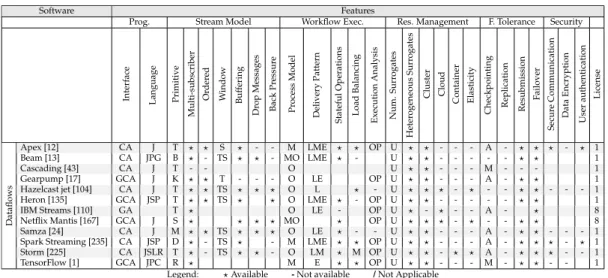
Secur e Communication Data Encryption User authentication License Airflow [11] GA P D E A ? - - ? - O R - U ? ? - A - - - ? - ? - ? 1 Aneka [227] G V B / A - - - ? ? O - U ? ? ? - A - - - ? ? ? ? - 8 Askalon [84] GR / D I A - - ? ? O ? U ? ? - - A A - ? ? - - - - 8 AUTOSUBMIT [31] R B D E U - - - ? - OP U ? ? - - - 3 Celery [45] PA P D I A ? ? - ? O U ? ? - - A - - - ? - - 5 CIEL [163] LA JO D I A ? ? ? ? ? - O - U ? ? - - - - ? - ? ? - - - 5 COMPSs [54] PA JPC D I A ? - - ? ? OP O ? U ? ? ? ? A - - - ? - - - - 1 Copernicus [190] R PX D E P - - - ? O U ? ? - - - AM - - ? ? ? - ? 2 Crunch [15] CA J D I A ? - ? ? 1 Dask [202, 61] GA P D I A ? ? ? ? ? OP L ? U ? - - - ? M ? ? ? 5 EcFlow [76] CAG PB D I A - - - ? - U ? ? ? ? - - - - ? ? - - ? 1 FireWorks [10] R PNY D E A ? ? - ? - OP F - U ? ? - - - ? - - - - 5 Galaxy [5] G / D E S - - - ? - F U / / / / / - - - ? 7 Google MapReduce [63] A C S I U - - - ? ? - O - U ? ? - - - ? ? ? - - - 8 Jolie [157] L / B / S - - - ? - - / / / ? ? ? ? - - - 4 Kepler [146] G / D E A - ? - - - - / / / / / / / / - - - 5 Netflix Conductor [168] R N D I S ? ? - ? OP R - U ? / / / / 1 Pegasus [66] RA JPL D E A ? ? - ? ? OP F ? U ? ? ? ? A ? - ? - - - - 1 Spark [237] CA JSPR D I A ? ? ? ? ? O F ? U ? ? ? ? A - ? ? ? ? - ? ? 1 Swift [232] L / D I A - ? OP U ? ? - - - A - - ? - - - - 1 T ask-based W orkflows Taverna [113] G / D E S - ? ? ? - OP F / / / / / / / - - - ? ? ? - ? 4 Legend: ?Available -Not available /Not Applicable
TABLE 2.1: Comparison of the different software targeting Task-based Work-flows.
(G in the table), Command Line Interface (C), receipt file (R), annotations or pragmas (P), programming API (A), or programming language (L). Also, we have distinguished the lan-guage supported by each framework: Java (J), Scala (S), Python (P), C++ (C), Visual C (V), R (R), Pearl (L), Bash (B), XML (X), JSON (N), YAML (Y), and OCaml (O).
Regarding the workflow definition, a distinction is made between the different execu-tion model’s types: bag of tasks (B in the table), skeleton (S), or DAG (D). We have also considered whether the users must explicitly (E) or implicitly (I) define the task dependen-cies and classified the supported task types into only pre-defined methods (P), only services (S), only user defined methods (U), or any (A). Also, we have distinguished the support for workflows that can vary during the application’s execution (dynamic workflows), for nested executions, and for data streams.
When focusing on the application execution, the main difference is the framework’s ca-pability of executing in parallel or not. However, we have also distinguished more advanced features such as load balancing techniques, built-in tools for the application’s execution anal-ysis - online (O) or post-mortem (P) -, the native scheduling policy - ready (R), FIFO (F), LIFO (L) or optimised (O) -, and the support for customisable scheduling policies.
Regarding the resource management, we have distinguished between frameworks capa-ble of handling a bounded or an unbounded number of surrogates. In this sense, we have also considered the capability of managing heterogeneous infrastructures, clusters, clouds, and containers. We have also evaluated the framework’s capability to provide resource elas-ticity during the application’s execution time, categorising this feature into automatic (A) or manual (M).
For advanced users, fault tolerance mechanisms and security might be an issue. For this purpose, we have also distinguished those frameworks that provide any kind of checkpoint-ing - automatic (A) or manual (M) -, lineage (i.e., the ability to re-generate a lost or corrupt data by executing again the chain of operations that was used to generate it), replication, re-submission or fail-over, and those that provide secure communication, data encryption or user authentication.
16 Chapter 2. State of the art Finally, we consider that the framework’s availability is a high-priority issue for appli-cation developers. For this purpose, we also consider the license of each framework follow-ing the next nomenclature: (1 in the table) Apache 2.0 [21], (2) GNU GPL2 [96], (3) GNU GPL3 [97], (4) GNU LGPL2 [98], (5) BSD [42], (6) MIT License [156], (7) other public open-source software licenses (e.g., Academic Free License v3 [3], Mozilla Public License 2 [158], Eclipse Public License v1.0 [78]), and (8) custom private license or patent.
2.2.3 Analysis
First, the programming model’s interface differs significantly between frameworks being the most common ones the programming API (A in the table) and the receipt file (R). How-ever, many of them provide (or have planned to provide in the near future) an attractive easy-to-use Graphical User Interface (G) that includes advanced online and post-mortem execution analysis tools.
Second, although some frameworks include support for several languages (e.g., CIEL, COMPSs, Copernicus, EcFlow, FireWorks, Pegasus, and Spark), the rest of them only sup-ports a single language. Hence, application developers should consider the application’s language before selecting the appropriate framework. Also, it is worth mentioning that CIEL uses a custom language (Skywriting) but also provides APIs for Java and OCaml.
Third, most of the frameworks support user-defined (U) or any type (A) of tasks (except Copernicus which is developed for pre-defined methods and Galaxy, Jolie, Netflix Conduc-tor, and Taverna which are developed for services) and are using the DAG execution model (except Aneka, Google MapReduce, and Jolie) to support complex workflows. Neverthe-less, there are significant differences on the task dependency definition approach. From our point of view, the frameworks using explicit task dependency definition are more suitable for small applications while frameworks using implicit task dependency definition are bet-ter for large and complex application workflows.
Fourth, we are surprised by the lack of support for advanced workflow features (i.e., dynamic and nested workflows, and support for streams) and new infrastructures (mainly the cloud and containers). Although the software might still be evolving, modern applica-tions require complex workflow features and elasticity mechanisms to automatically handle the application’s resource usage (i.e., by man