Lehigh University
Lehigh Preserve
Theses and Dissertations2017
Robust Mobile Visual Recognition System: From
Bag of Visual Words to Deep Learning
Dawei Li
Lehigh University
Follow this and additional works at:http://preserve.lehigh.edu/etd Part of theComputer Sciences Commons
This Dissertation is brought to you for free and open access by Lehigh Preserve. It has been accepted for inclusion in Theses and Dissertations by an authorized administrator of Lehigh Preserve. For more information, please [email protected].
Recommended Citation
Li, Dawei, "Robust Mobile Visual Recognition System: From Bag of Visual Words to Deep Learning" (2017).Theses and Dissertations. 2682.
Robust Mobile Visual Recognition System:
From Bag of Visual Words to Deep Learning
by
Dawei Li
A Dissertation
Presented to the Graduate Committee of Lehigh University
in Candidacy for the Degree of Doctor of Philosophy
in
Computer Science
Lehigh University May 2017
Copyright Dawei Li
Approved and recommended for acceptance as a dissertation in partial fulfill-ment of the requirefulfill-ments for the degree of Doctor of Philosophy.
Dawei Li
Robust Mobile Visual Recognition System: From Bag of Visual Words to Deep Learning
Date
Professor Mooi Choo Chuah, Dissertation Director, Chair
(Must Sign with Blue Ink)
Accepted Date
Committee Members
Professor Brian D. Davison
Professor Michael Spear
Acknowledgements
First of all, I would like to express my sincere gratitude to my advisor, Professor Mooi Choo Chuah, for her generous support, guidance, patience, and encouragement throughout the PhD study. Professor Chuah taught me a lot from critical thinking, motivating new problem, scientific evaluation, presentation organization to seeing the big picture. I am very grateful that Professor Chuah provides me the freedom to explore many interesting research problems and she is always helpful both on stimulating research ideas and on providing favorable research facilities. Without her advice, I could not have finished this dissertation.
I am also very grateful to Professor Brian D. Davison, Professor Michael Spear and Professor Wei-Min Huang for providing excellent suggestions for my dissertation and serving as my committee members.
I greatly appreciate Dr. Theodoros Salonidis, Dr. Nirmit Desai and Dr. Bong Jun Ko from IBM Research, and Dr. Xiaolong Wang and Dr. Jon Currey from Samsung Research America for offering me internship opportunities where part of this dissertation was done. I would also like to thank my collaborators Dr. Deguang Kong and Jian Huang who I met and know during the internship. In addition, the internship experiences provide me the opportunity to learn how my research can impact the world from from the perspective of the industry. I also made many good friends, have learned a lot from them and benefited greatly.
I gratefully acknowledge the support from the research sponsors, including Na-tional Science Foundation through CSR grant 1217379 and CSR grant 1016296, as well as Nvidia for an equipment grant.
Many thanks to my colleagues and friends in Lehigh University who offered help to me and my family in various ways. I thank my fellow labmates in Lehigh WiNS Lab: Qinghan Xue, Wenbo Li, Xin Li, Ziyuan Qin, Li Tian, Xin Wang for discussion and help on a wide area of topics.
Finally and most importantly, I am most grateful of my family for their love, support, and sacrifices. My wife, Lei Zhang has been with me all the time during my
graduate study and her optimistic attitude toward life created a loving atmosphere in our home. My children, Jack and Karen have brought me the greatest joy and motivated me to finish this thesis with the greatest determination. I saved the final word of acknowledge for my parents, Tijin Li and Xiuxia Sun, for offering me unconditional love and belief.
Contents
Table of Contents . . . vii
List of Tables . . . xi
List of Figures . . . xiii
Abstract . . . 1
1 Overview 3 1.1 Mobile Visual Recognition . . . 3
1.2 Cloud Computing and Their Limitations . . . 5
1.3 Detailed Research Challenges . . . 7
1.3.1 Bag of Visual Words Based Retrieval Systems . . . 7
1.3.2 Deep Learning Based Systems . . . 9
1.4 Contributions . . . 10
1.5 Organization . . . 15
2 EMOD: An Efficient On-device Mobile Visual Search System 18 2.1 Introduction . . . 19
2.2 BOVW Background and Related Work . . . 22
2.3 System Overview . . . 25
2.3.1 Design Principle . . . 26
2.3.2 Database Construction Pipeline . . . 27
2.3.3 Image Query Pipeline . . . 28
2.4 Detailed Algorithmic Design . . . 31
2.4.2 Useful Word Selection . . . 34
2.4.3 Top Inverted Index Ranking . . . 39
2.4.4 Re-ranking with Ranking Consistency . . . 40
2.5 2-Stage KNN Re-ranking . . . 42 2.5.1 k-NN Expansion . . . 44 2.5.2 k-NN Re-ranking . . . 45 2.5.3 Re-ranking Speed-up . . . 47 2.6 System Evaluation . . . 47 2.6.1 Datasets . . . 47
2.6.2 System Performance Metrics . . . 49
2.6.3 Experimental Setup . . . 51
2.6.4 Visual Dictionary and The Baseline . . . 52
2.6.5 Compact Signature . . . 53
2.6.6 Ranking Consistency based Re-ranking . . . 57
2.6.7 Total Memory Cost For a 10K Database . . . 58
2.6.8 Mobile Efficiency . . . 59
2.6.9 Evaluation for 2-Stage k-NN Re-Ranking . . . 64
2.7 Summary . . . 72
3 Moca: Energy-Efficient and Privacy-Preserving Deep Processing for Mobile Vision Applications 73 3.1 Introduction . . . 74
3.2 DNN Challenges on Mobile . . . 78
3.3 System Model and Threat Model . . . 82
3.3.1 System Model . . . 82
3.3.2 Threat Model . . . 82
3.4 Design and Implementation . . . 83
3.4.1 Design Goals of Moca . . . 83
3.4.2 Preserving Privacy with Feature Map . . . 84
3.4.3 Differentiated Privacy with Quantification . . . 86
3.4.5 Adaptive Model Reconstruction . . . 95 3.4.6 Implementation Details . . . 98 3.5 Evaluation . . . 99 3.5.1 Experimental Setup . . . 100 3.5.2 Photography Recognition . . . 103 3.5.3 Scene Analysis . . . 107 3.5.4 Face Authentication . . . 107 3.5.5 Object Detection . . . 109
3.5.6 Applicability in Different CNN Architectures . . . 111
3.5.7 Privacy Discussion . . . 112
3.6 Related Work . . . 113
3.7 Summary . . . 115
4 DeepCham: Collaborative Edge-Mediated Adaptive Deep Learning for Mobile Object Recognition 116 4.1 Introduction . . . 117
4.2 Motivation, Challenges and Related Work . . . 121
4.2.1 Motivation . . . 121
4.2.2 Challenges . . . 121
4.2.3 Related Work . . . 122
4.3 DeepCham Adaptation Traning . . . 125
4.3.1 Training System Overview . . . 125
4.3.2 Task Initialization . . . 126
4.3.3 Domain-Aware Image Selection . . . 128
4.3.4 Training Instance Generation Pipeline . . . 132
4.3.5 Adaptation pipeline: model construction . . . 137
4.4 DeepCham Object Recognition . . . 137
4.4.1 Domain-Constrained Deep Model . . . 139
4.4.2 Late-fusion based Recognition . . . 139
4.5 Evaluation . . . 140
4.5.2 Mobile Context Image Dataset (MCID) . . . 141
4.5.3 Baseline Adaptation Performance . . . 142
4.5.4 Impact of Distributed Image Pruning . . . 149
4.5.5 EBBS performance . . . 153
4.5.6 Object Recognition Accuracy using DeepCham Generated Train-ing Instances . . . 155
4.5.7 Prototype System Evaluation . . . 156
4.6 Discussion . . . 160 4.7 Summary . . . 162 5 Conclusion 163 5.1 Summary . . . 163 5.2 Future Work . . . 166 Vita 193
List of Tables
2.1 Mobile Devices in Experiment . . . 51
2.2 The Performance of Various Dictionary Configurations. . . 52
2.3 Iterative RBO vs Direct RBO . . . 58
2.4 Performance Improvement with Ranking Consistency . . . 59
2.5 Query Images . . . 59
2.6 mAP for both inital and re-ranked retrieval results . . . 65
2.7 Re-ranking by tuning r (k= 10) . . . 70
2.8 Re-ranking by tuning k (r = 0.4) . . . 70
2.9 Re-ranking comparison with other methods (Holiday) . . . 71
2.10 Re-ranking comparison with other methods (Ukbench) . . . 71
2.11 Re-ranking comparison with other methods (1 Million) . . . 72
3.1 Optimizations for feature map extraction. . . 89
3.2 Optimized tucker decomposition: it reduces the number of feature maps and their size dramatically with small accuracy loss, for a layer in ResNet-50 object recognition model. The layer originally generates 64 feature maps. . . 90
3.3 Scalar quantization and Huffman coding for a layer in ResNet-50 model for object recognition. . . 95
3.4 Moca API . . . 98
3.5 Mobile device and cloud server used for evaluating Moca in this chapter. . . 100
3.6 Summarized results. The privacy values, the lower the better. For accuracy values, the higher the better. The energy efficiency column shows the energy saving of Moca compared to ML-SDK (left) and
MobileOnly (right). MOnly: MobileOnly; SDK: ML-SDK; ACC:
Accuracy. . . 103
4.1 Meta-Data Attribute Values of MCID . . . 141
4.2 MCID Terminologies . . . 142
4.3 MCID Statistics . . . 142
4.4 System Running Time . . . 157
4.5 System Memory Cost . . . 158
List of Figures
2.1 EMOD System Overview . . . 25 2.2 The Efficient On-device Mobile Visual Search System. The unique
processing components are highlighted as red italics. . . 29 2.3 Features detected on an image of the Memorial Church contains many
noises from trees, cloud etc. . . 34 2.4 k-NN Re-ranking Example (K = 3). The rank of the 3rd nearest
neighbor n3, which is an irrelevant image (in red dashed box), will be
dropped since the similarity between its k-NN to the query’sk-NN is very low. On the other hand, the images ranked at positions l (nl)
and t (nt) will be promoted since (1) they are reciprocal k-NN of
the queries high-ranked neighbors (nl is n2’s reciprocal k-NN and nt
is n1’s reciprocal k-NN), and (2) their k-NN lists are similar to the
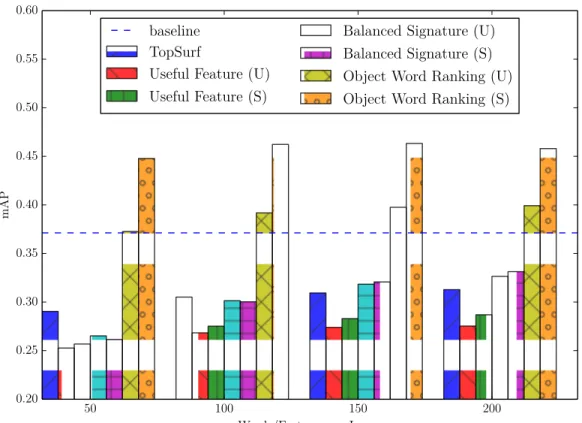
query’s k-NN list (e.g. sharing common elements). . . 43 2.5 mAP. (S) denotes the supervised scenario and (U) denotes the
unsu-pervised scenario. . . 54 2.6 ANMRR. (S) denotes the supervised scenario and (U) denotes the
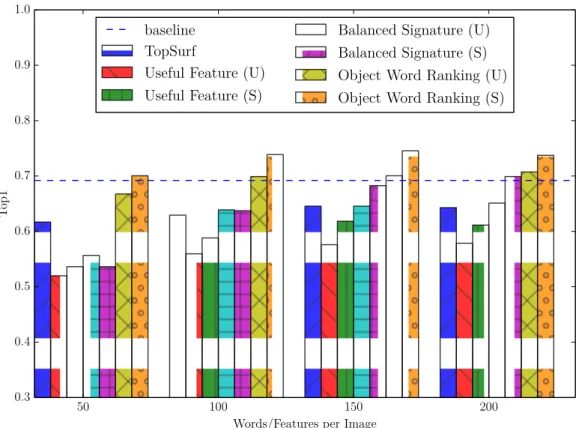
unsupervised scenario. . . 55 2.7 Top1. (S) denotes the supervised scenario and (U) denotes the
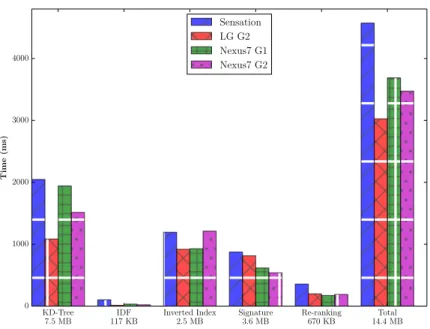
unsu-pervised scenario. . . 56 2.8 Image Database Loading Time . . . 60 2.9 Total Query Latency: (S) denotes result of single threaded computing
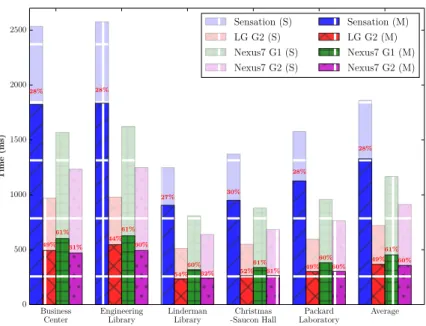
model; (M) denotes result of multi-threaded computing model. The latency reduction is given with percentage in red color. . . 61
2.10 Three examples of re-ranking from Holidays dataset. For each query (left), initial ranked list (the first row) and re-ranked list (the second row) are demonstrated. . . 65 2.11 The total number of ground truth images that are excluded for
re-ranking when different number of top ranked images K are used for UKbench dataset. . . 67 2.12 The total number of low-rank ground truth images that are promoted
for re-ranking after expansion under different k for UKbench dataset (K=50). . . 68 2.13 The average number of promoted low-rank images (both ground truth
and noise) per query under different k for UKbench dataset (K=50). 69 3.1 Motivation scenarios for Moca: deep processing photos and videos
with object recognition DNNs on mobile device directly vs. offloading data to cloud via WiFi for further deep processing with highly accu-rate DNN models. Compared to highly accuaccu-rate models, compressed models consume 5–10x (80%–90%) less energy as shown in (a) and (b) at the cost of dropping DNN accuracy by 18.3% as shown in (c); the mobile-cloud offloading approaches consume 155–232x (99.35%– 99.57%) less energy but run the risk of leaking personal data on un-trusted cloud. The large highly accurate model fails in all application cases due to the limited memory capacity on modern mobile devices. 75 3.2 System overview of Moca. It uses the feature maps extracted from
the first few layers in DNN models as the input for further deep pro-cessing on cloud. These extracted feature maps preserve strong pri-vacy for user data and high accuracy for application services. More-over, Moca has low energy overhead, as only a few layers of DNN
models are executed on mobiles, and several optimizations on model reconstruction and feature extraction are proposed for improving its energy efficiency. . . 79
3.3 Illustration of feature maps extracted in different layers. The visual-ized feature maps show that the content details on images decrease along with the increasing layers. For example, feature maps generated from the first layer still contain the facial information. However, when the CNN model moves to deeper layer, these facial details disappear. 81 3.4 An example: Cloud server may analyze images sent by a user to learn
her private information. Capturing such a raw image may expose the medicine the user is taking and thus infer the kind of disease she is suffering. . . 82 3.5 A case study of convolution and deconvolution: the convolution
en-coder reduces the feature size from 112 x 112 x 3 to 56 x 56 x 5 (2.4x reduction). . . 91 3.6 Benefits of parameter-free layer merging. The latency is measured
using Caffe on Samsung Galaxy S5. . . 92
3.7 Branch Reduction Example on Google’s Inception Network. Two
branches are reduced. . . 93 3.8 An example of Scalar quantization and Huffman coding. 6.7x (85%)
feature size reduction is achieved. . . 94 3.9 Overview of Adaptive Model Reconstruction. . . 97
3.10 Running CNN-based photography recognition services with
MobileOnly vs. ML-SDK vs. Moca. The figure demonstrates the
(a) energy overhead, (b) latency, (c) accuracy and privacy levels of the photo recognition service. With executing two layers on mo-bile, Moca reduces the energy consumption by 17.1-36.7x
(94.15%-97.28%) and 1.2-3.4x (16.67%-70.59%) compared to MobileOnly and ML-SDK respectively, and decreases the latency by 6.9-11.0x (85.51%-90.91%) and 1.3-1.9x (23.08%-47.37%) compared to MobileOnly and ML-SDK respectively, while providing much stronger privacy than ML-SDK with the similar service accuracy. . . 101
3.11 Running CNN-based scene analysis on videos with MobileOnly
vs. ML-SDK vs. Moca. With executing two layers on mobile,
Moca reduces the energy consumption by 27.1x (96.31%) and 1.2x
(16.67%) compared to MobileOnly and ML-SDK respectively, and de-creases the latency by 12.9x (92.25%) and 1.7x (41.17%) compared to MobileOnly and ML-SDK respectively, while providing much stronger
privacy than ML-SDK with the same service accuracy. . . 105
3.12 The latency and energy usage breakdown of deep processing a pho-tograph for face authentication. . . 108
3.13 Running CNN-based object detectionon video frames with ML-SDK vs. Moca. Moca reduces the energy usage on mobile by 1.9x - 6.7x (47.37%-85.07%) compared to ML-SDK. . . 110
3.14 Energy usage of running different DNN models with ML-SDK vs. Moca. . . 111
3.15 Service accuracy and privacy evaluation of using ML-SDK vs. Moca with different DNN models. . . 111
4.1 The Adaptation Training Overview . . . 123
4.2 An Example “On-site” Adaptation Task Specifications. . . 126
4.3 Interactive Labeling. . . 133
4.4 Object Recognition with Late-Fusion. . . 138
4.5 Example of mirror images. . . 143
4.6 Generic Deep Model Performance. . . 143
4.7 Adaptation Performance. . . 144
4.8 Time Variance. . . 145
4.9 Device Variation. . . 145
4.10 Location Variance. . . 146
4.11 Late-Fusion Performance. . . 150
4.12 Distributed Image Pruning Performance. . . 151
Abstract
With billions of images captured by mobile users everyday, automatically recog-nizing contents in such images has become a particularly important feature for various mobile apps, including augmented reality, product search, visual-based au-thentication etc. Traditionally, a client-server architecture is adopted such that the mobile client sends captured images/video frames to a cloud server, which runs a set of task-specific computer vision algorithms and sends back the recognition re-sults. However, such scheme may cause problems related to user privacy, network stability/availability and device energy.
In this dissertation, we investigate the problem of building a robust mobile vi-sual recognition system that achieves high accuracy, low latency, low energy cost and privacy protection. Generally, we study two broad types of recognition meth-ods: the bag of visual words (BOVW) based retrieval methods, which search the nearest neighbor image to a query image, and the state-of-the-art deep learning based methods, which recognize a given image using a trained deep neural network. The challenges of deploying BOVW based retrieval methods include: size of in-dexed image database, query latency, feature extraction efficiency and re-ranking performance. To address such challenges, we first proposed EMOD which enables efficient on-device image retrieval on a downloaded context-dependent partial image database. The efficiency is achieved by analyzing the BOVW processing pipeline and optimizing each module with algorithmic improvement.
Recent deep learning based recognition approaches have been shown to greatly exceed the performance of traditional approaches. We identify several challenges of applying deep learning based recognition methods on mobile scenarios, namely
energy efficiency and privacy protection for real-time visual processing, and mo-bile visual domain biases. Thus, we proposed two techniques to address them, (i) efficiently splitting the workload across heterogeneous computing resources, i.e., mobile devices and the cloud using our Moca framework, and (ii) using mobile
visual domain adaptation as proposed in our collaborative edge-mediated platform DeepCham. Our extensive experiments on large-scale benchmark datasets and off-the-shelf mobile devices show our solutions provide better results than the state-of-the-art solutions.
Chapter 1
Overview
In this chapter, we provide an overview of this dissertation. We start by briefly reviewing some useful mobile visual recognition applications. Then we investigate the limitations of traditional mobile-cloud based vision systems. After that, we study two types of visual recognition methods and discuss the challenges of deploying them for mobile scenarios. Finally, we summarize our contributions and present the organization of this dissertation.
1.1
Mobile Visual Recognition
Nowadays, smartphones equipped with capable cameras enable people to generate new visual content (i.e., images and videos) anytime anywhere. According to a recent prediction, around 1.2 trillion photos will be be taken by mobile users worldwide in the year 2017 [1]. In addition, the increasing popularity of mobile social apps (e.g., Facebook, Instagram, Snapchat, Twitter, WeChat etc.) makes visual content sharing more convenient. The fact that mobile users are creating and receiving a
huge number of images/videos from time to time, makes mobile visual recognition a particularly interesting and important feature.
One very useful application is image based product search. For example, by recognizing a garment item in an image, an interested user can match it to the same item in an online shop [2][3]. For such applications, a database of product images is pre-built and indexed using extracted image features. By searching the database (e.g., finding k nearest neighbors using Euclidean distance), the system returns a short list of hyperlinks associated with product images most similar to the query. By clicking on a returned image, users can be redirected to its online shop. Such image retrieval based visual recognition technique is also being applied to other interesting mobile apps such as recognitions of plants in botanical gardens [4], artworks [5], landmarks [6] etc.
Mobile augmented reality (AR) apps [7] such as Pokmon GO [8] and Field Trip [9] have recently attracted a lot of attention. Mobile AR apps add overlaid com-ponents to object recognized in streamed video frames captured by mobile devices’ cameras, and provide much richer and possibly interactive content on the physical world (e.g., Pokmon GO superimposes a Pocket Monster over a recognized sur-face). Meanwhile, the emerging smart wearable glasses such as Google Glasses have brought many more possibilities for future mobile AR apps. Novel AR services nowadays can provide augmented information on real-world objects including build-ing landmarks in travel apps [9, 10], human face recognition in a conference meetbuild-ing [11], supplement work instructions for maintenance and repair [12], museum exhibits appreciation instruction [13] etc.
[14] can help mobile cameras to automatically select the best scene mode which will produce the best results possible. Mobile check deposit allows bank customers to deposit checks by recognizing information with mobile camera. Printed word translation [15] can translate a book in an unknown language in real-time. All those applications rely on certain computer vision algorithms over captures visual contents by cameras of mobile devices.
1.2
Cloud Computing and Their Limitations
Relatively large-scale mobile visual recognition problem (e.g., retrieval over a 1-million image database, or classification over 1000 object categories) is currectly solved using a mobile-cloud system architecture (e.g., Google Goggles [16], CamFind [17]), considering the complexity of advanced computer vision algorithms as well as the constraint computing resources on mobile devices. A mobile client sends captured visual content (i.e., images or video clips) to the cloud which runs the specified computer vision algorithms on the input and sends back the recognition result to the mobile client. This system design assumes that cloud servers have powerful processing units with huge amounts of memory and storage, and thus can generally run many computer vision algorithms in real-time and scale well with increasing number of user requests. Meanwhile, it simplifies the mobile client design, i.e., no matter what kind of mobile devices the user is using (whether Android, iOS, or Windows), all it needs to do is to send captured visual content over the Internet. Although the mobile-cloud architecture have some benefits, there are some seri-ous drawbacks:
• User Privacy Leakage: Visual content captured by mobile devices may contain sensitive information such as faces, medicines a user is taking, personal items. Such private personal information can be captured by the cloud service and be leaked or sold to many unrelated parties.
• Networking Issues: The Internet connection is not always available for mo-bile users and may be unstable. The system may cause large recognition latency and even be completely unusable in such scenarios. Meanwhile, send-ing large visual contents over the Internet ussend-ing cellular links is financially expensive when Wi-Fi is unavailable.
• Device Energy Consumption: Battery energy is still a scarse resource for mobile device and most mobile phones need to be charged at least once per day. Though a mobile client doesn’t need to run complex computer vision algorithms on the device, sending multimedia data over the Internet is energy inefficient especially when the data is transferred over the cellular network, e.g. 4G LTE [18].
Though there have been much on-going research on solving those problems indi-vidually, a complete solution may need breakthroughs in several different research as-pects including security, networking, GPU hardware design and battery etc. There-fore, in this dissertation, we aim to design a robust mobile visual recognition system by considering the overall system design approach and may involve heterogeneous computing resources, e.g., mobile devices, Edge server as well as the cloud.
1.3
Detailed Research Challenges
It is not trivial to build robust mobile visual recognition systems especially when users would like to perform relatively large-scale recognition tasks. Here, we elabo-rate challenges faced in designing two major categories of visual recognition systems.
1.3.1
Bag of Visual Words Based Retrieval Systems
Image retrieval systems match a query image/video frame to an image database and returns the visually most similar image(s) and(or) associated information (e.g., the history of a landmark). One perfect solution to eliminate all the drawbacks of cloud-based systems discussed above would be to run the complete retrieval pipeline efficiently on the mobile devices. However, such a solution faces the challenges due to the limited computing, storage and energy resources of the off-the-shelf mobile devices. In this dissertation, our explore typical challenges that one will face when designing such a system using the popular bag-of-visual-word (BOVW) framework [19]:
• Searching Space Reduction: The key problem for real-time image retrieval is in designing an effective searching space reduction method, i.e., a method which can significantly reduce the number of database images that need to be compared to a query image. For mobile image retrieval, if the context of the application scenario (e.g., location) can be inferred, we may reduce the searching space to only images matching the current context. However, such a strategy must be applied conservatively so that the target ground truth image is not excluded. One can further reduce the searching space in a BOVW
framework by comparing a query image to database images that share common visual words. However, selecting a good visual vocabulary size is challenging as using a large vocabulary will consume too much run-time memory, while using a small vocabulary may not effectively reduce the searching space.
• Indexing Memory Cost: On-device image retrieval assumes an image database is pre-constructed and already indexed for future searches. The database con-struction complexity is a one-time cost that can be performed on powerful cloud servers. However, the size of the database index should be compact enough to fit within the memory size of mobile devices. Existing work solves this problem by directly reducing the number of local features (e.g., SIFT [20] or SURF [21]) extracted from database images [22, 23]. However, such an approach only works on images without complex background or occlusion objects, otherwise the recognition accuracy significantly drops. For example, an image of a landmark may be occluded by trees, vehicles or people. Image features detected on those objects are actually irrelevant to the landmark it-self [6]. Thus, it is not easy to select a true representative and compact set of features for an image.
• Re-ranking Efficiency: Re-ranking algorithms have been proposed to sig-nificantly improve the final retrieval accuracy. Up to now, many existing work [6, 22–25] rely on features’ geometric information to exclude outlier features using a method like RANSAC [26]. However, such schemes require that each database image maintains the geometric metadata, e.g., the feature coordi-nates, which significantly increases the memory overhead on a mobile device.
Recently proposed k-nearest neighbor (KNN) based re-ranking method com-pares the similarity of the query image’s KNN with the KNNs of top returned database images, and promotes images whose KNN is more consistent to the query image [27, 28]. Though this method dose not require additional mem-ory space, it is computationally expensive since processing each query actually involves searching multiple images, i.e., both the query image and the top re-turned images.
1.3.2
Deep Learning Based Systems
Deep learning based visual recognition systems feed an input image or video frames to a trained deep neural network (normally a convolutional neural network [29]) which achieves high accuracy on many traditionally hard visual recognition tasks such as large-scale object classification [29–31] and object detection (i.e., simulta-neously locate the object and recognize what the object is in an image) [31–34]. However, one faces challenges if we want to apply deep learning based approaches in mobile scenarios:
• Energy/Privacy Tradeoff: State-of-the-art deep neural networks are com-posed of many neural network layers [31]. With powerful high-end GPUs, deep learning methods can still be executed in real-time on a cloud server. How-ever, such design requires mobile users sending raw images over the Internet which may compromise users’ privacy. Encrypting images can guarantee no privacy information is leaked during the transmission, but in most scenarios, encrypted images need to be decrypted before they are being fed into a deep learning algorithm but often cloud servers are untrusted. On the other hand,
researchers have recently proposed methods to accelerate the execution of deep learning algorithms [35–37] so that it can be deployed entirely on a mobile de-vice. However, the energy cost for processing each image is still considerably high even with those accelerated deep learning models (up to 50x more than a cloud-based system).
• Visual Domain Bias: A visual domain is the context or the environment where the deep learning model is applied to. Each domain (e.g., a library or a museum) has a subset of objects and has unique attributes such as lighting condition, background etc. The visual domain bias phenomenon means that trained deep learning models have bias on different visual domains, and the actual accuracy obtained can be dramatically different. Thus, visual domain adaptation is necessary for high-accuracy recognition during deployment[38]. Existing work solves this adaptation issue by fine-tuning a trained deep learn-ing model [39, 40] on the subset of objects in a target visual domain, but such fine-tuning requires dedicated GPU servers and well-labeled high-quality training images. For mobile visual recognition in the wild, the possible number of different visual domains can be endless, and therefore it is really challenge to adapt a deep learning model in every visual domain.
1.4
Contributions
In this dissertation, we discuss how to design robust mobile visual recognition sys-tems and our discussion focuses on two major types of recognition methods, namely
bag of visual words (BOVW) based image retrieval approaches and deep learn-ing based visual recognition approaches. We design and implement novel systems which address most of the challenges discussed above. We also demonstrate that our proposed systems achieve better performance than the state-of-the-art systems via extensive system evaluations:
• For the bag of visual words based image retrieval systems, we propose and implement EMOD, an efficient image retrieval system which performs on-device image retrieval on context limited image database. EMOD adopts our new algorithm design and leverages the parallel computing capabilities made possible by multi-core mobile processors. Our EMOD prototype system on Android platform achieves real-time high-accuracy retrieval with significantly reduced memory and energy consumption.
– We address the problem of indexing memory cost by proposing an object word ranking algorithm to identify the most useful visual words of a database image, so that each image can be represented using a concise signature with 85% memory saving.
– We propose a top-inverted-index ranking method that applies to the bag-of-visual-word framework to reduce 95% of searching space for real-time on-device image retrieval.
– We propose a novel unsupervised 2-stage k nearest neighbor (KNN) based ranking method. Our algorithm outperforms state-of-the-art re-ranking algorithms on several benchmark datasets with minimum mem-ory cost and reduced time latency.
• For deep learning based systems, we propose Mocaan energy-preserving and
privacy-preserving mobile visual recognition system. It decouples the hierar-chical layers of DNN models and splits them across mobile and cloud. It uses privacy-preserving feature maps extracted from DNNs on mobile as the input for further deep processing on cloud to protect personal user data.
– We propose five novel techniques for improving the energy efficiency of the feature map extraction process on mobiles which include layer decompo-sition, parameter-free layer merging and branch reduction. Experimental results with a variety of deep learning based mobile applications demon-strate that the privacy of these data are well preserved, while the energy overhead on mobile device is 1.2x - 6.7x (16.67% - 85.07%) 1 lower than the state-of-the-art approach.
– We propose a deep learning based framework that allows mobile applica-tion developers to quantify the privacy level for user data based on their own privacy criteria. We present the differentiated privacy mechanism for DNN-based mobile applications, and enable adaptive DNN model recon-struction to utilize mobile resources and achieve better privacy guarantee.
• We propose an edge-mediated framework, DeepCham, to adapt deep learning models for object recognition under different mobile visual domains. DeepCham generates high-quality domain-aware adaptation instances from crowd-sourced 1Here is how the values are calculated and converted: suppose that system A has energy cost
ea and system B has energy costeb, ifeb/ea=6.7, we say that system A’s energy overhead is 6.7x
lower than system B and or system A’s energy overhead is 85.07% lower than system B which is calculated as (eb-ea)/eb.
in-situ mobile photos, and the adaptation can be agilely executed in real-time without dedicated GPU server.
– We create a new image dataset, Mobile Context Image Dataset (MCID), which enables controlled experimental evaluation of deep model adap-tation of different mobile visual domains. Using MCID, We show that DeepCham achieves as much as 150% accuracy improvement over the baseline deep learning model without an adaptation.
We now discuss the contributions in detail:
We first study the image retrieval problem using the popular bag-of-visual-word framework. Our proposed EMOD system identifies the potential for reducing run-time memory cost by analyzing the database image indexing pipeline. To construct a concise representation for a searchable object, it is critical to identify the most salient features or visual words of such object. We address this problem by proposing an object work ranking algorithm which ranks the importance of a visual word for a target object using multiple wild-captured images each from a different point of view. We show that our method greatly reduces the size of database image signatures, but also increases the retrieval accuracy due to the filtering of less important or noisy visual words. Then we analyze the potential for search space reduction by analyzing the query image searching pipeline, and propose a novel method to ignore database images with few common visual words to the query. In addition, we propose an efficient 2-stage KNN based re-ranking algorithm: we locate potential low-ranked ground-truth images in the first step and compare the KNN similarity in
step two using a new KNN similarity measure. For computation efficiency, we pre-calculate the KNN of all database images which are loaded in memory. Compared to geometric based re-ranking method, we achieve up to 90% memory saving, while we show that the retrieval accuracy after re-ranking outperforms the state-of-the-art on several benchmark datasets (including a large 1 million image dataset). Finally, we analyze the parallelism in the query pipeline by leveraging multiple-core processors of modern mobile devices for further speed-up. Experimental results show that real-time and high-accuracy retrieval over a large image database is achieved while the memory and energy overhead has negligible impact on off-the-shelf mobile devices. For deep learning based visual recognition, our first contribution is, Moca, which aims for energy-efficient and privacy-preserving deep processing for mobile visual recognition. Recently an increasing number of mobile vision applications are demanding deep learning techniques to empower intelligent services, such as face recognition and object detection. However, it is still unattractive to run these com-putationally intensive services on resource-constrained commodity mobile devices. Offloading these services to cloud reduces the burdens on mobiles, but may expose users sensitive data to untrusted cloud servers. Moca decouples the hierarchical neural network layers and splits them across mobile and cloud for energy-efficiency.
Mocaleverages the privacy-preserving feature maps extracted from deep models to
protect personal data privacy. Mocaalso enables differentiated privacy settings via
a DNN-based privacy quantification framework (under the threat model we defined in chapter 3) to meet the varying privacy requirements of different mobile applica-tions. Our experiments with various mobile vision applications against thousands of photos and videos from a variety of validation datasets demonstrate thatMoca
has up to 6.7x (85.07%) lower energy overhead on mobile devices compared to the state-of-the-art approaches, while providing stronger data privacy with negligible impact on application accuracy.
Finally, we present DeepCham, a crowd-sourced deep learning model adaptation framework. DeepCham is the first piece of work that solves the mobile visual domain bias problem using a trained large-scale deep learning model. The proposed adapta-tion method does not require high-end GPU servers or expert-created high-quality training images. Instead, DeepCham leverages abundant metadata-rich (e.g., GPS location, time) photos that have already been taken by mobile users, and trains a shallow adaptation model (e.g., SVM) in real-time on a mobile device. To achieve this, DeepCham includes an attribute-based visual domain specification module that identify photos matching a target visual domain, an efficient object bounding box proposal method to locate objects shown in a photo, and an interactive object label-ing pipeline which suggests labels for an input image uslabel-ing a generic deep learnlabel-ing model. Our experiment on a new collected Mobile Context Image Dataset (MCID) obtains as much as 150% accuracy improvement. Our prototype system shows that all modules can run on a mobile device so that the user privacy is well protected. In addition, we demonstrate that our system is more energy efficient than cloud computing solutions.
1.5
Organization
This dissertation is organized as follows.
retrieval framework, and present our EMOD system [41] for efficient image retrieval. EMOD includes three novel algorithms: the object word ranking algorithm to re-duce the indexing memory cost of database images, the top-inverted-index ranking algorithm to reduce the query searching space, and the light-weight 2-stage KNN re-ranking method to increase accuracy. We further parallelize the image query pipeline with multi-threaded processing on multi-core mobile processors and achieve better efficiency.
In Chapter 3, we study the problem of optimizing the energy cost and the pri-vacy protection of deep learning based visual recognition, and present our Moca
system. Mocauploads only privacy-preserving visual features extracted from users data to the cloud, while utilizing the cloud for high-performance deep processing. To accelerate the feature extraction procedure and reduce the feature size, several optimizations including layer decomposition and parameter-free layer merging are proposed and implemented in Moca. It also enables differentiated privacy for
dif-ferent mobile applications.
In Chapter 4, we study the problem of mobile visual domain adaptation in deep learning based mobile visual recognition system, and present our DeepCham framework [42], the first adaptive mobile object recognition framework that allows deep learning model to be used successfully in mobile environments. Specifically, DeepCham is mediated by an edge master server which coordinates with participat-ing mobile users to collaboratively train a domain-aware adaptation model which can yield much better object recognition accuracy when used together with a domain-constrained deep model.
Chapter 2
EMOD: An Efficient On-device
Mobile Visual Search System
Recently, researchers have proposed solutions to build on-device mobile visual search (ODMVS) systems. Different from traditional client-server mobile visual search systems, an ODMVS supports image searching directly within a mobile de-vice. An ODMVS needs to be designed with constrained hardware in mind e.g. limited memory, less powerful CPU. In this chapter, we present, EMOD, an efficient on-device mobile visual search system based on the Bag-of-Visual-Word (BOVW) framework. Based on users’ mobile context (e.g., location), EMOD downloads an indexed partial image database to the mobile devices for on-device image retrieval. An Object Word Ranking (OWR) algorithm is proposed to efficiently identify the most useful visual words of an image so as to construct a compact image signature for fast retrieval and greatly improved retrieval performance. Due to having a small
visual dictionary, we propose the Top Inverted Index Ranking scheme to reduce the number of candidate images for similarity calculation. In addition, we propose an efficient 2-stage k-NN based re-ranking method as an essential final step to improve the retrieval accuracy. Via extensive experimental evaluations, we demonstrate that our prototype EMOD system yields better retrieval accuracy and query response time than the state-of-the-art for a database with over 10K images.
2.1
Introduction
Visual search application allows a user to obtain information about objects in his proximity by taking an image of the object and using this to search a database of known objects. Such applications have become very popular among mobile users as mobile devices become more powerful with advancements in processing power, screen size and availability of higher wide area wireless bandwidth. Today, mobile visual search is available through services such as Google Goggles [16] or CamFind [17]. Such mobile visual search systems allow users to recognize visual objects in their vicinity. Interesting applications include recognitions of CD covers [43] or products [17] for online shopping, recognitions of plants in botanical gardens [4], artworks [5], or landmarks [44]. In addition, such image search applications are also very useful for government organizations e.g. criminal suspect identification [45], disease detection and diagnosis [46].
Traditionally, the mobile visual search systems [43][44] [47][5] adopt a client-server (CS) architecture. A user uses his mobile device to send a compressed im-age or an imim-age signature extracted from the captured imim-age to a remote server
which performs visual search related operations on an image database. However, such cloud-based systems typically face performance related issues either due to insufficient mobile network coverage or the inability of the recognition engine to process large quantity of simultaneous image matching quickly against a large im-age database. Such performance issues can potentially hamper the adoption rate of emerging mobile visual search applications e.g. a scan-and-purchase clothing application.
With the advances in mobile devices, on-device mobile visual search systems (ODMVS) have been recently proposed to solve the above problems [48][22][49]. Compared to the client-server architecture, ODMVS has several benefits such as network independence, better privacy control, and low query latency. Meanwhile, ODMVS can be integrated to an existing client-server based system. For example, a landmark recognition application allows a user to download a subset of a large image database, e.g. based on his location information, in the presence of a good quality network connection (e.g. WiFi). Then, a user can perform on-device visual search whenever he wishes without having to contact the remote server.
Due to the hardware limitations of mobile devices, more efficient image process-ing and matchprocess-ing techniques need to be designed for ODMVS. In this chapter, we present the design and evaluation of an efficient on-device mobile visual search sys-tem (EMOD) based on the popular Bag-of-Visual-Word (BOVW) framework [50]. Our EMOD design includes (1) pipelining the image database construction to re-duce its memory impact, and (2) pipelining the image query process to rere-duce the query processing latency. Efficient techniques are proposed to identify (a) compact image signatures during image database construction, and (b) images which match
a query image efficiently. Such techniques ensure that EMOD yields satisfactory retrieval performance with low latency.
In summary, EMOD makes the following contributions:
• designs an efficient ODMVS which uses optimized Bag-of-Visual-Word frame-work with improved retrieval performance, and lower resource cost.
• uses our proposed Object Word Ranking algorithm to identify the most useful visual words of a database image so that each image can be represented using a concise signature with 85% memory storage saving,
• uses a modified inverted index scheme, named Top Inverted Index Ranking, to reduce the number of candidate images, and hence improves the query response time,
• uses our proposed efficient 2-stage re-ranking method to re-rank retrieved im-ages for improved retrieval accuracy,
• achieves low query response time by exploiting the parallel computing capa-bilities made possible by mobile devices with multi-cores.
The rest of the chapter is organized as follows: we introduce the background of the Bag-of-visual-word framework in section 2.2 and review the related work; the system overview and our design principles are presented in section 2.3. This is followed by a detailed system algorithmic design in section 2.4 and the 2-stage k-NN re-ranking algorithm in section 2.5. We present the extensive system evaluations in section 2.6.
2.2
BOVW Background and Related Work
The Bag-of-visual-word (BOVW) framework was proposed [50] to effectively reduce the storage and computation overhead of a visual search system. The visual words are centroids of clusters formed using feature descriptors, e.g. SIFT [20] and SURF [21] extracted from training images. Typically, a very large visual dictionary, e.g. 1M visual words, is required to achieve the best retrieval performance. Once a visual dictionary is constructed, the feature descriptors from a single image are then quantized into a word histogram, i.e. each descriptor is classified to the nearest word in the dictionary. When a very large dictionary is used, the resulting word histogram of an image is a very sparse vector, and thus one can construct a compact signature for each image, i.e. only words with frequency greater than 0, and their index are kept. With such a representation, the signature of an image with 1000 SURF descriptors only consumes fewer than 5 KB. Next, a selected weighting scheme, typically based on the tf-idf of visual words, is applied to an image signature, and the similarity between two images are then computed as the distance (e.g. Euclidean or Cosine distance) between the two weighted image signatures. To speed-up the matching process, an inverted index is built in which a visual word is linked to a list of images containing this visual word. When a query image is received, the system identifies database images with common visual word(s) as the query image as candidate images. With a large visual dictionary, normally only a small number K of candidate images (i.e. the candidates) need to be compared with the query image, which significantly reduces the computational overhead. Finally, the top Nr
of the ranked candidates are re-ranked, for example, using the geometric information associated with the raw image features, and the re-ranked image list is returned.
Any real-time visual search system built using the BOVW framework needs to efficiently perform feature quantization, i.e., to classify an extracted feature descrip-tor to the nearest visual word in the dictionary. For a large visual dictionary with 1 Million visual words, each image feature has to be compared against each visual word in the dictionary to find a nearest neighbor. Two main approaches are used to speed up this feature quantization process: the hierarchical k-means (HKM) ap-proach using a visual vocabulary tree [51] and the approximate nearest neighbor (ANN) approach using a plain dictionary [52]. We will discuss both schemes in detail in section2.4.1.
ODMVS requires compact signatures to represent the data-base images. Thomee et al. [23] proposed to use only the most frequent or top weighted words, but using a large dictionary means that the majority of visual words has only a few counts and the noisy words cannot be detected ahead of time. Turcot et al. [53] and some follow-up work [54][44] suggest only keeping useful features in a database image. Such features are determined by matching against other database images containing the same object. Meanwhile, a word augmentation method is introduced to incorporate words from other images containing the same object into the signature of an image considering that each image shows a different view of the object. However, two factors can affect the performance of this approach under the BOVW framework. First, as explained in [55][52], matched features can be quantized into different words and hence such “falsely” matched features cannot be detected. Second, the number of matched features varies greatly for each database image which results in varying image signature length. Such variation has a negative impact on the retrieval performance. In this chapter, we propose the “Object Word Ranking”
algorithm to solve these two problems (see section2.4.2).
ODMVS can only afford a relatively small visual dictionary so that the entire dictionary can be loaded into the system memory. Hartl et al. [22] proposed to reduce the 64-value SURF descriptor into 32 values so that the visual dictionary can be reduced by half. However, the retrieval accuracy using this approach significantly reduced. Chen et al. [49] adopted a variant of the BOVW scheme, which generates an image signature using a residual visual vector instead of using the raw word histogram. This scheme performs well using a 128-word visual dictionary, and each database image can be represented with a signature of 533 bytes. However, with such a small dictionary, it cannot take advantage of the inverted index to reduce the number of candidate images for similarity calculation, and thus yields to relatively large query latency. In contrast, EMOD uses a larger 30K visual dictionary, and we propose a modified inverted index scheme to speed up the query processing (see section2.4.3).
Re-ranking schemes are proposed to improve the final retrieval performance. Up to now, many existing work [49][22] [44][52][53] uses RANSAC [56] to verify the matched features geometrically so that images with more inlier matches are promoted to a higher rank. However, this scheme requires that each database image maintains the geometric metadata, e.g. the feature coordinates, which significantly increases the memory overhead. In this chapter, we propose an efficient 2-stage KNN based re-rankingRanking Consistency [57] method, which proves to be as powerful as the geometric verification method but consumes considerably less memory space (see section2.4.4).
Various compression and encoding methods are proposed to the BOVW frame-work [48][58][59][60] to further reduce the memory impact. Those methods are not discussed in this chapter, but can be easily integrated into our system.
2.3
System Overview
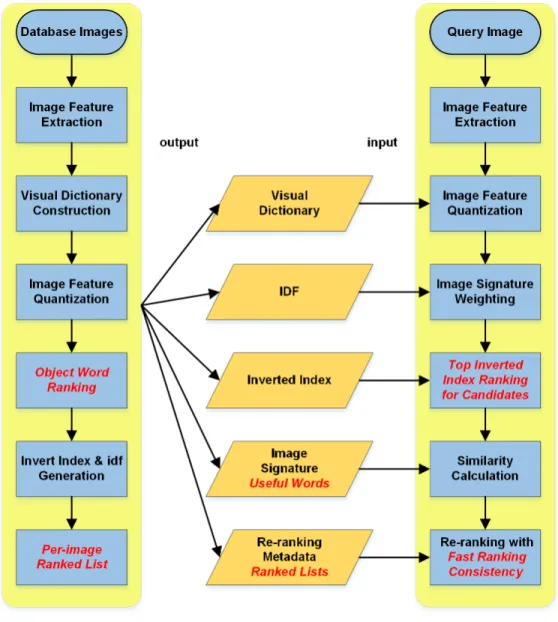
Figure 2.1: EMOD System Overview
Figure 2.1 illustrates the overview of our EMOD system, which allows users to operate with (online mode) and without network access (offline mode).
In the online mode, a user sends image queries to a remote server just like those traditional client-server (CS) mobile visual search systems. The received query result can be displayed on the screen of that user’s mobile device or augmented over the query image. Besides the image retrieval function, our system allows users to download a subset of image database according to the context of the mobile application (e.g., based on a pre-specified geographical city region), when a suitable network connection is present (e.g., a good Wi-Fi connection) so that users can operate in an offline mode.
The offline mode can be manually activated by a user or automatically activated when a network connection is slow/lost. In the offline mode, the mobile device first loads the downloaded image database as well as its associated metadata (e.g. the visual dictionary, the inverted index etc.) to the memory. When a query image is captured, it is processed locally on the mobile device, and any query result can then be displayed directly on that device.
Here, we focus our work on the design of the offline mode feature, and our goal is to achieve real-time image query using a 10K image dataset on the mobile device with decent retrieval performance and minimal memory cost.
2.3.1
Design Principle
Figure 2.2 illustrates the our algorithmic optimization of EMOD over the BOVW framework. The design of EMOD adheres to the following two principles:
(1)As small as possible: given an image dataset, we want the system to consume as small memory cost as possible. With the BOVW framework, we aim to reduce the size of the constructed image database(all orange blocks shown in Figure 2.2). Meanwhile, we must maintain the retrieval performance at a good level.
(2) As fast as possible: given a query image, the system should return the query result as fast as possible. With the BOVW framework, we aim to reduce the com-puting latency of each component in the image retrieval pipeline (the yellow blocks shown in the right in Figure 2.2). We must also ensure that the speed-up does not significantly degrade the retrieval performance.
2.3.2
Database Construction Pipeline
The image database is typically constructed in an offline manner, and it includes (i) the visual dictionary, (ii) the image signatures,(iii) additional supporting data structures (e.g. the inverted index, the IDF table), and other useful metadata.
Visual Dictionary: Considering the memory limitation of mobile devices, we must use a smaller dictionary of size W than those (e.g. 1M) used in the server-side image search engines. In this chapter, we show that we are able to build an efficient
ODMVS with a W = 30K dictionary. The 30K dictionary consumes only 7.5 MB
memory which is acceptable for most mobile devices.
Image Signature: We proposed an Object Word Ranking (OWR) algorithm to select theN most useful visual words per image. Thus, each database image signa-ture can be represented using two vectors ofN elements: one for storing the visual word indices and the other for storing the frequency of such visual words in that particular image. WithN=100, an image signature only consumes 300 bytes. The evaluation result shows that such compact signature is more representative of the image than all quantized visual words from the raw signature, and hence improve the retrieval performance of our EMOD system. (Details in section 2.4.2)
Inverted Index Table: This table is used to generate the Top K candidate image list during query processing. It contains entries of visual words and their associ-ated lists of image identifiers which contain that visual word. The table size is a function of the number of visual words in each image signature N. When N=100, each database image adds only 200 bytes (assuming each image identifier is a short integer) to the memory consumed by the inverted index table.
IDF: The IDF is an array of weighting values for each visual word in the dictio-nary. For the 30K visual dictionary, this table only consumes 117 KB memory.
Metadata: The metadata of each database image is used to re-rank the returned image list so that images containing the same object can be promoted to a higher rank. The traditional geometric verification-based re-ranking approach requires each image to store the geometric information (e.g. the coordinates) of each detected feature. However, even with the most advanced compression scheme [61], each feature still requires 6 bytes additional memory, and an image with 1000 detected features requires almost 6KB just to store such metadata. For efficient re-ranking, our system adopts a novel KNN based re-ranking scheme. For a database of V images, each image only needs to maintain a list of h=0.005*V top ranked image identifiers by using that database image as a query. (Details provided in section
2.4.4)
2.3.3
Image Query Pipeline
Each image query requires real-time response, and hence we aim to reduce the com-puting complexity of each processing component in the image query pipeline. In this work, we do not attempt to modify the feature detection [62] and descrip-tor calculation step [21][20] but adopts the de facto standard scheme as used in [44][52][49][57][50][23].
Feature Quantization: To achieve real-time feature quantization, we adopt the fast approximate nearest neighbor [63][52] approach. The computing complexity to quantize each feature is reduced from O(W) (for brute-force nearest neighbor search) to O(logW), whereW is the size of the visual dictionary. (Details in section
Figure 2.2: The Efficient On-device Mobile Visual Search System. The unique process-ing components are highlighted as red italics.
2.4.1)
Candidates Generation: The baseline BOVW system generates candidates im-ages using the inverted index in a naive way: all database imim-ages containing visual
word(s) common to the query image are treated as Candidates. However, with a small visual dictionary and thousands of database images, too manyCandidates are generated for image matching. In this work, we use our Top Inverted Index Ranking method to generate the top K database images with the most common words to the query image as Candidates, and thus achieve a fast image matching. (Details provided in section 2.4.3)
Similarity Calculation: The similarity between two images are calculated as the cosine distance of two normalizedtf-idf weighted signatures. Here, there is a tradeoff between the system memory cost, and the query processing speed as to whether the normalized tf-idf weighted signature of database images should be pre-computed or be calculated in real-time. The pre-computed signature would consume 300 more bytes per image for storing such weights. However, as shown in our performance evaluation, the extra memory cost only brings a slight decrease in query latency. Therefore, in this chapter, we compute the weights of the database image signature in real time for significant memory saving.
Result Re-ranking: In this work, we use the Ranking Consistency scheme for efficient result re-ranking. Instead of using the iterative re-ranking method proposed by the authors in [57], we use a simplified re-ranking method that substantially reduces the re-ranking latency but only has a slight degradation on the re-ranking performance. (Details in section 2.4.4) Furthermore, we propose an efficient 2-stage re-ranking scheme for greatly improved re-ranking accuracy. In 2-stage one, we generate an expanded list of candidate database images to re-rank so that some lower ranked ground truth images will not be ignored for the next stage. In stage two, we re-rank the list of candidate images using a confidence score which is calculated
based on both ranking consistency and reciprocal k-NN property. (Details in section
2.5)
In addition, since modern mobile devices tend to have more CPU cores, the query processing components such as feature quantization and similarity calculation can be parallelized to speed up such computation steps. We discuss the performance improvement of parallelism in the system evaluation section.
2.4
Detailed Algorithmic Design
In this section, we provide more detailed description of our algorithm optimization that solves the following problems: visual dictionary construction, useful visual word selection, efficient image matching and re-ranking. With our proposed techniques, EMOD only consumes 13 MB for a database of 10K images. Real-time image query response time is also achieved with good retrieval performance.
2.4.1
Visual Dictionary Construction
In the BOVW framework, a visual dictionary is used to quantize image features into individual visual words which are later used for similarity calculation. When used in a real-time visual search system, the quantization is desired to be processed as fast as possible. Up to now, there are two main trends for fast feature quantization: the visual vocabulary tree (VVT) approach, and the fast approximate nearest neighbor (ANN) approach using a plain dictionary.
Visual Vocabulary Tree: Nister et al. proposed the popular Visual Vocabu-lary Tree (VVT) scheme [51], which is a hierarchical data structure constructed by
clustering the training feature descriptors with hierarchical k-means algorithm. A VVT can be defined as a B by D tree, where B is the branching factor, and D is the depth of the tree. The VVT is built iteratively: (1) all training descriptors are initially clustered into B clusters; (2) descriptors in each cluster are further clus-tered intoB sub-clusters; (3) the process continues until depthD is reached. In [51], Nister et al. state that both leaf nodes and internal nodes can be regarded as visual words. However, Philbin et al. [52] show that using only leaf nodes results in better retrieval performance than including internal nodes as visual words. Therefore a 1M visual dictionary can be represented using aB10D6 VVT. For feature quantization, one searches from the root to the leaf node level of the tree to find the best leaf node as the quantized visual word of every feature. This search process finds a nearest neighbor at each tree level and searches only the sub-tree of that nearest neighbor. Therefore, the quantization complexity for a feature is O(B∗D) on a single CPU core, and it requires only 50% additional memory than the plain dictionary contain-ing the same number of visual words. VVT is adopted or compared in some prior ODMVS related work [22][49].
Fast Approximate Nearest Neighbor on a Plain Dictionary: A plain
visual dictionary of size W is created by clustering the training descriptors to W clusters, and each cluster centroid is regarded as a visual word. For feature quan-tization, each feature descriptor finds its nearest neighbor in the dictionary, which can be done quickly using fast approximate nearest neighbor methods. The most commonly used fast ANN method is the randomizedkd-trees [64]. In the proposed scheme, a query data (i.e. the feature descriptor) is searched simultaneously in n randmoized kd-trees in a Best Bin First [65] manner. The search in each kd-tree
stops when i leaf nodes are reached, and the best candidate is returned. With properly selected n and i values, the query performance can be optimized [63], i.e. achieving a balance between query time and error rate. In a kd-tree, the query complexity is determined by the number of nodes explored for similarity computa-tions (typically Euclidean distance calculacomputa-tions), nd. Therefore with n trees, the
quantization complexity for a feature is bounded by O(nd∗n) on a single CPU core.
However, with the “Early Termination” technique proposed by Keogh [66] 1, the actual quantization complexity is much smaller. In our experiment, we found that the quantization complexity of the randomized kd-trees scheme is approximately bounded by O(i∗n), i.e. the number of leaf nodes reached in each tree multiplied by the number of trees. On the other hand, additional memory is required for each kd-tree which is constructed using all the words in the visual dictionary.
Scheme Selection Criterion:In [52], Philbin et al. pointed out that VVT data structure generally produces more quantization errors than the plain dictionary using the randomized kd-trees scheme. However, they did not compare CPU and storage cost of these schemes. To determine which scheme we should use, we conduct an experiment using both schemes where we constrain the amount of memory cost for storing the visual dictionary, and the amount of CPU cycles for performing feature quantization. Then, we select the scheme which yields a better retrieval performance. We present our controlled comparison results in the system evaluation section.
1The “Early Termination” technique is also applied to the VVT data structure for finding the
nearest neighbor in each level. However, only very limited speed-up is observed when the number of candidates in each tree level is small.
(a) All Detected Features (b) Selected Useful Features
Figure 2.3: Features detected on an image of the Memorial Church contains many noises from trees, cloud etc.
2.4.2
Useful Word Selection
A small vocabulary dictionary may lead to degraded retrieval performance. To com-pensate for this accuracy loss and to reduce the memory cost of image signatures, we propose the Object Word Ranking (OWR) method to retain only useful words of an image. Before describing OWR, we first describe the ”Useful Feature” scheme proposed in an earlier work and its limitations. We also suggest a simple improve-ment to this scheme. In this section, we regard images containing the same object asfriend images to ease our explanation.
“Useful Feature” and The Problems
Photos taken by a mobile device contain many noisy features as shown in Figure 2.3(a). Although it is possible to manually crop an image to keep only the de-sired object (e.g. the church in Figure 3), it will be tedious to do so for every single database image. Besides, one may continually add new images to the database. Tur-cot and Lowe in [53] proposed to find useful features by matching an image against other database images containing the same object (i.e. thefriend images) followed by geometric verification. Only top Nf features with most matched feature(s) are
reserved for word quantization (as shown in Figure 2.3(b)). A word augmentation method is introduced so that an image can incorporate visual words from other images containing the same object, assuming that each image represents a different view of the same object. The authors also provided solutions to deal with a database of unlabeled images: each database image is used as a query image to find the topM matched images which are further verified using the geometric verification method, and the images with more thank matched features are regarded as friend images.
This solution has two problems:
Quantization Error: Matched features may be quantized into different visual words due to quantization errors[55]. Such “mismatches” cannot be detected and would degrade the retrieval performance.
Unbalanced Signature Length: Even though the authors suggested that each image reserves at mostNf matched features, the number of total matched features
varies greatly2 for each database image. Meanwhile, since multiple features can be 2In our experiment, the number of matched features per image ranges from 21 to 776 with a
quantized to the same visual words, two images with the same number of features can have signatures with different numbers of visual words. This varying signature length has a negative impact on the retrieval performance which is confirmed by our experiment.
Simple Method for Balancing the Signature
We propose a simple improvement to the “Useful Feature” method to produce bal-anced image signatures of length N. It works as follows:
Step 1 Balanced Feature Quantization: Instead of reserving top Nf features,
each image initially reverses all the features which have at least one matched feature in otherfriend images, in a ranked list (ranked by the number of matched features). Iterating though the ranked list, each accessed feature is quantized to a visual word to form the image signature. The iteration stops when the signature length reaches N or all the features in the ranked list have been accessed.
Step 2 Balanced Word Augmentation: After step 1, for those images with sig-nature length smaller than N, we add words from their friend images3 until the
signature length reachesN. The friend images are ranked by the number of matched features, and we first add words from the higher ranked images.
Step 3 Final Balance: It is quite likely that after the first two steps, there are still images that have signatures shorter thanN. For those images, we quantize the image features with no matched feature in “friend” images into visual words, and calculate the weighted value of those additional visual words using thetf-idf scheme. Those more heavily weighted visual words are incorporated into the image signature 3In our experiment, we also incorporate level-2 friends which are the friend images’ friends as
until the signature length reachesN.
This simple improvement solves that problem of unbalanced image signatures, but still has feature quantization errors.
Algorithm 1 Object Word Ranking Algorithm (Supervised Version).
Input: A set of raw image signaturesSraw={Raw1, Raw2, ..., Rawk} for images containing the
same object
Output: A set of compact signatureScpt={Cpt1, Cpt2, ..., Cptk}
1: Scpt←null
2: Ranked List←null
3: wordCountM ap←null
4: foreach raw signatureRawi∈Sraw do
5: foreachW ordj∈Rawi do
6: if W ordj ∈/ wordCountM apthen
7: wordCountM ap[W ordj]←1
8: else
9: wordCountM ap[W ordj] + +
10: Sort wordCountM apby count
11: Ranked List←[wordi ∈wordCountM ap]
12: foreach raw signatureRawi∈Sraw do
13: Cpti ←null
14: foreachW ordj∈Ranked List do
15: if W ordj ∈Rawi then
16: Cpti.add(W ordj)
17: if Cpti.length > N then
18: break
19: Scpt.add(Cpti)
returnScpt
Object Word Ranking
In this subsection, we introduce the Object Word Ranking algorithm which solves both problems of the “Useful Feature” method. Basically, for each object, we gen-erate a ranked list of each word by its occurrence count in all images containing this object (i.e. the number of images containing this word). Thus, if a useful feature is quantized into different words with its matched feature in another image, those words will get a low rank in the ranking list. After that, each image ranks its own
words based on the word ranking list of that object, and the topN ranked words are reserved as the image signature. For words with equal occurrence frequency, we use theirtf-idf weights to break the tie. For images containing two or more objects, we generate one signature for each object. The pseudo-code for the supervised scenario (i.e. all training images are labelled) is presented in Algorithm 1.
Algorithm 2 Object Word Ranking Algorithm (Unsupervised Version).
Input: The raw image signature of an image Raw0 and the set of raw signatures Sraw = {Raw1, Raw2, ..., Rawk} for its “friend” images
Output: The compact signatureCpt0
1: W t←1 . Initial Weighting Factor
2: Cpt0←null
3: Ranked List←null
4: wordCountM ap←null
5: foreachW ordj ∈Raw0 do
6: wordCountM ap[W ordj]←W0
<