eCommons@AKU
Department of Family Medicine
Medical College, Pakistan
January 2014
Multiple Mini-Interviews (MMI) and
Semistructured Interviews for the Selection of
Family Medicine Residents: A Comparative
Analysis
Marie Andrades
Aga Khan University, [email protected]
Seema Bhanji
Aga Khan University
Samreen Kausar
Aga Khan University
Fouad Majeed
Sheilla Pinjani
Aga Khan University, [email protected]
Follow this and additional works at:
https://ecommons.aku.edu/pakistan_fhs_mc_fam_med
Part of the
Family Medicine Commons
Recommended Citation
Andrades, M., Bhanji, S., Kausar, S., Majeed, F., Pinjani, S. (2014). Multiple Mini-Interviews (MMI) and Semistructured Interviews for the Selection of Family Medicine Residents: A Comparative Analysis.International Scholarly Research Notices, 2014, 747168.
Research Article
Multiple Mini-Interviews (MMI) and Semistructured
Interviews for the Selection of Family Medicine Residents:
A Comparative Analysis
Marie Andrades,
1Seema Bhanji,
1Samreen Kausar,
1Fouad Majeed,
2and Sheilla Pinjani
3 1Faculty Family Medicine, Aga Khan University, Karachi 3500, Pakistan2Consultant Family Medicine, Prince Salman Armed Forces Hospital, Tabuk 71411, Saudi Arabia 3Faculty Departement of Educational Development, Aga Khan University, Karachi 74800, Pakistan
Correspondence should be addressed to Samreen Kausar; [email protected] Received 6 March 2014; Revised 8 May 2014; Accepted 12 May 2014; Published 5 August 2014 Academic Editor: Ravi Shankar
Copyright © 2014 Marie Andrades et al. This is an open access article distributed under the Creative Commons Attribution License, which permits unrestricted use, distribution, and reproduction in any medium, provided the original work is properly cited.
Background. Family Medicine Residency Program at the Aga Khan University has applicants for the residency position in excess of the positions offered resulting in formulation of certain selection criteria. The objective of this study was to compare MMI versus semistructured interviews for assessing noncognitive domains in the selection of residents. The secondary objectives were
to determine perceptions of the interviewers and candidates for the acceptability and feasibility of MMI as a selection tool.Methods.
The candidates underwent semistructured interviews along with MMI and identical attributes were tested in both. The attributes tested were safe doctor, communication skills, professionalism, problem solving, team approach, ethical issues, reasons for selecting family medicine, and commitment to the program. Descriptive statistics were calculated and comparison between ratings for MMI
and interview was performed by Wilcoxon sign rank test.Results. Total number of candidates was 14. On comparison between
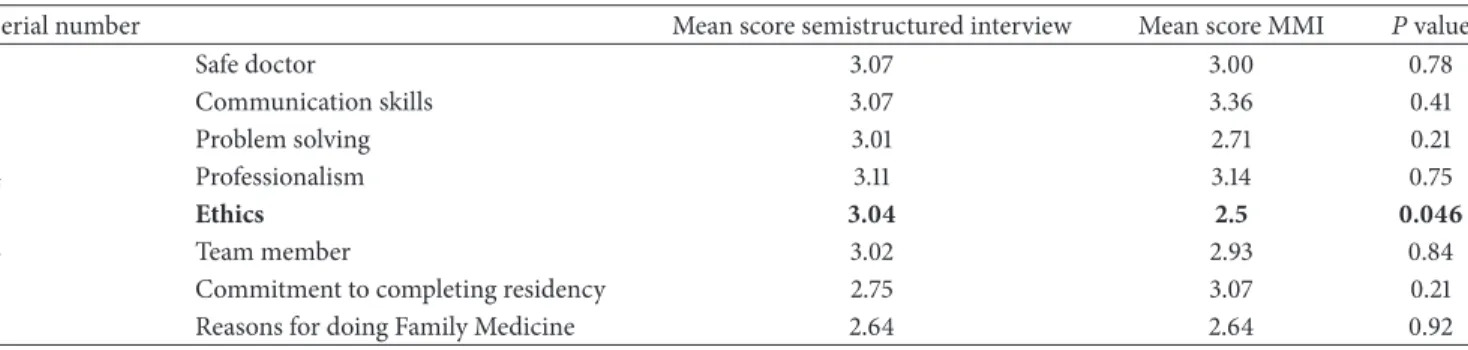
interview and MMI, the scores were not statistically different for all attributes except ethics (mean interview scores: 3.04, mean
MMI scores: 2.5, andPvalue 0.046).Conclusion. The study showed no difference between MMI and semistructured interviews.
However, it needs to be replicated in order to determine the predictive validity and feasibility of MMI over time.
1. Background
Globally residency positions offered are generally limited as compared to the number of candidates applying resulting in certain selection criteria [1]. Hence efforts are made to ensure that selection processes are fair and merit based, with reliable/valid/objective and standardized tools.
Currently several admission strategies have been adopted in residency programs [2]. The applicants’ cognitive (aca-demic) achievements are evaluated by written examinations and aptitude tests. The noncognitive domains like motivation and attributes of professionalism are assessed through
inter-views [1,3]. However challenges to reliability and validity of
interviews remain due to lack of training, structuring, and
variation in scoring [4,5].
The MMI is an internationally validated tool which comprises multiple station interviews with one or two inter-viewers rating candidates’ responses. MMI has demonstrated evidence for generalizability and validity in relation to future clinical and licensing examination performance as compared to traditional interview methods. It has been used to mea-sure professionalism for international graduates in residency
selection at University of Calgary [6, 7]. In addition MMI
has established acceptability with stakeholder groups at the admission level for both undergraduates and postgraduates
[8,9].
Family Medicine Residency Program at Aga Khan Uni-versity (AKU) has the distinction of being the first residency-training program in family medicine in Pakistan [10]. Since inception the Residency Selection Committee (RSC) has used Volume 2014, Article ID 747168, 6 pages
2 International Scholarly Research Notices a semistructured interview format. An internal review of
the residency program recommended incorporating a tool to better assess the noncognitive domains which may improve the selection process particularly as issues of professionalism were arising among the residents.
The objective of this study was to compare MMI ver-sus semistructured interviews for assessing noncognitive domains in the selection of Family Medicine residents
(Table1).
The secondary objectives were to determine perceptions of the interviewers and candidates for the acceptability and feasibility of MMI as a selection tool.
2. Methods
2.1. Current Selection Process. Family Medicine Residency at
Aga Khan University has a two tiered process for selection in which the cognitive domain is assessed through a written test. Those candidates shortlisted from the written test are then assessed for noncognitive attributes by an interview process. An average of 40–50 residency applicants competing for six positions sit for the test and about 15–18 applicants are shortlisted for the semistructured interviews.
The interview process consists of two separate panels of interviewers comprising three Family Medicine Faculty members in each panel. Each candidate is being interviewed by both the panels. The interview is semistructured (the ques-tions are identical case scenarios for both panels; however there is no uniform accepted answer option). The attributes tested are safe doctor, communication skills, professionalism, problem solving, team approach, ethical issues, reasons for selecting Family Medicine, and commitment to the program. Each panel interview is of 20-minute duration in which a seven-point Likert scale is used by each faculty for scoring
(see Table3).
In 2010 we had a total of 49 candidate applications. Forty-seven appeared for the test and the first 16 highest scorers were shortlisted for the semistructured interview and MMI. As this MMI was a pilot selection method, the candidates were informed that they would be selected based on the interview scores and not MMI. Approval for the study was obtained from Ethical Review Committee of AKU.
The same attributes tested in interviews were used to develop the MMI stations. Eight stations were developed comprising situations the applicant would most likely face in
a Family Medicine Residency (sample station AppendixB).
Each station lasted for seven minutes and was designed to measure single or two to three of the attributes (mentioned before). Interviews were expected to rate on a Likert scale
from 1–7 with 1 being poor and 7 being outstanding [11,12].
Face validity of the stations was ensured through prior dis-cussion with Family Medicine Faculty. MMI was conducted on the day following the semistructured interviews. A total of 16 candidates appeared for the interviews and 14 for the MMI. Two candidates regretted due to personal reasons. Each candidate rotated through the circuit comprising eight stations with 7 minutes per station adding to a total of 56 minutes per candidate in the circuit and was evaluated by a
different interviewer at each station. Two circuits were run to accommodate the 16 candidates. The interviewers included senior Family Medicine Faculty residents and from the Department of Family Medicine and Educational Develop-ment (DED). Interviewers were trained through a combined training session conducted by the Family Medicine Depart-ment and DED. Immediate debriefing through structured questionnaires was obtained from the candidates regarding acceptability and from the interviewers for feasibility and acceptability after the MMI. Briefing about MMI was given to the candidates before the start of circuit. The clinical scenario based questions were pasted in at each station and candidates were required to read the question before beginning each station.
Candidate’s feedback regarding MMI was assessed by a questionnaire using a seven-point Likert rating scale
(Table2). The questionnaire included the ability to portray
themselves accurately, level of anxiety as compared to inter-views, adequacy of pre-MMI instructions, need for specific knowledge for the stations, difficulty level of stations, time allocation for the stations, and reliability of the process. Sim-ilarly interviewer’s feedback after the MMI was taken using the same attributes as above with the addition of feasibility in administration of interviews versus MMI and their opinion about replacing interviews with MMI. Descriptive statistics were calculated and comparison between ratings for MMI and interviews was performed by means of Wilcoxon sign rank test. The candidates and interviewers feedback was analyzed as frequencies.
3. Results
Demographic background: a total of 16 candidates (12 female) sat in the interviews and a total of 14 sat in the MMI (11 female). Comparison was conducted for the 14 candidates who sat in both the tests. Eight out of 14 candidates had graduated within the last three years. Seven candidates have
secured>70% marks in their final MBBS examination.
Interviewers’ Responses to Post-MMI Survey. A total of eight interviewers were surveyed. Majority (87%) of the interview-ers believed that they were able to get an accurate portrayal of the candidates. Fifty percent (4 out of 8) interviewers were unsure of the feasibility of conducting an MMI compared to the interviews. All but one of the interviewers thought that interviews can be replaced by MMI. The open narrative comments by faculty members included need for sound proof venue for the MMI stations and a post hoc analysis of the process.
4. Discussion
This studydoes notdemonstrate a statistical difference between MMI and semistructured interviews. A plausible explanation could be the type of questions in semistructured interview and examiner training could be one reason. Literature also supports the reliability of semistructured interviews [13]. Ethics was the only domain where the scores for MMI were less than that of semistructured interviews.
Table 1: Comparison of ratings of semistructured interviews and MMI stations (𝑛 = 14).
Serial number Mean score semistructured interview Mean score MMI 𝑃value
1 Safe doctor 3.07 3.00 0.78 2 Communication skills 3.07 3.36 0.41 3 Problem solving 3.01 2.71 0.21 4 Professionalism 3.11 3.14 0.75 5 Ethics 3.04 2.5 0.046 6 Team member 3.02 2.93 0.84
7 Commitment to completing residency 2.75 3.07 0.21
8 Reasons for doing Family Medicine 2.64 2.64 0.92
Table 2: Frequencies of candidate’s feedback response of MMI. Serial
number Attributes
None Somewhat A lot
1 2 3 4 5 6 7 1 Ability to portray themselves accurately — — — 1 3 7 3 2 Anxiety during the selection process 5 3 1 — 4 1 — 3 Specialized knowledge needed for the stations 1 2 3 1 5 2 — 4 Reliability of selection method — — 2 3 2 5 2 5 Difficulty of exam 1 2 1 6 3 1 — 6 Adequate time allocation — — — 4 8 1 1
Scoring by number of candidates (𝑛 = 14).
A possible reason for this could be the large number of interviewers in the semistructured interview leading to a greater exploration of the subject. The results of this study are similar to a study done in United Kingdom where no difference was found between MMI and interviews for undergraduate applicants. MMI was found to be reliable, feasible, and acceptable to all the stakeholders [14]. Our experience of conducting the MMI was time and resource intense compared to interviews. A greater number of faculty and administrative staff were required for the MMI and a large venue was a challenge to obtain. Reviewing literature
the same experiences is shared by others [15,16].
Majority of the candidates felt they were being portrayed well through MMI. Most did not experience added anxiety during MMI versus the interview. MMI was considered to be a reliable selection tool by the candidates. Most were of the opinion that specific knowledge related to the attribute is required for each station. Other studies have also shown that participants have found MMI to be a positive experience
[4, 17, 18]. Most interviewers felt that MMI can replace
semistructured interviews as it accurately reflected the can-didate’s abilities [19].
Limitations of this study include a small sample size. In addition we had eight stations rather than the minimum of ten which was not possible because of limited availability of resources.
5. Conclusion
The purpose of conducting MMI is to select candidates who have the most suited desirable attributes for Family Medicine Residency Program. Based on this study there was no difference between semistructured interviews and MMI. Hence it is expected for the program to continue with semistructured interviews as MMI is more resource intensive. However, this study needs to be done longitudinally over time in order to have a better idea of its reliability and predictive validity.
Appendices
A.
See Table3.
B. Sample Multiple Mini-Interview (MMI)
Station: Testing Professionalism
Some time ago, there wasbreaking newsof a professor being
sacked/fired because of a death of a patient after a pair of scissors was left inside the peritoneum by a senior registrar during laparotomy, while a resident and nurse technician were assisting.
(1) Who do you think was responsible?
(2) Should it be communicated to other team members and hospital staff?
(3) What would be your response, had you been assisting the senior registrar and left the scissors inside? (4) Having learned from this situation, what would you
do in the future?
(5) In your opinion who should talk to the patient’s family?
Attributes are professionalism: ethics/confidentiality, teamwork, and reflection.
4 International Scholarly Research Notices
Table 3: Candidate interview evaluation form.
Candidate name. . . Date:. . . .
Serial
number Attributes
Poor Adequate Outstanding
1 2 3 4 5 6 7
1
Safe doctor:
knows his own limits, readily consults senior, cautious in taking risky decisions, and so forth.
2 Communication skills:
able to communicate clearly with colleagues, patients, and families 3 Problem solving skills:
logical and systematic in approach to clinical problems 4
Professional attitude:
empathic and compassionate towards patients and families: courteous towards all colleagues
5 Ethical:
sensitive towards confidentiality, patient rights, and moral values 6 Team member/interpersonal relationships:
efficient team member and utilizes input from other colleague 7 Reason for choosing Family Medicine:
8 Commitment:
commitment to completing residency and the profession 9 General comments:. . . .
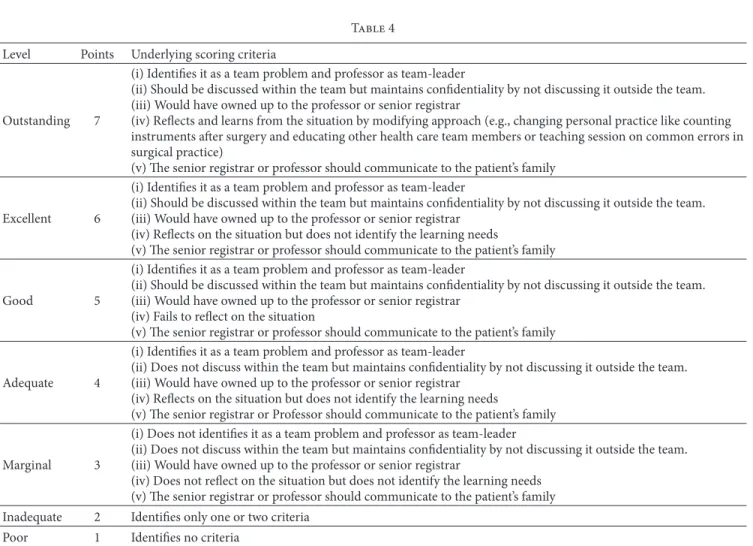
Table 4
Level Points Underlying scoring criteria
Outstanding 7
(i) Identifies it as a team problem and professor as team-leader
(ii) Should be discussed within the team but maintains confidentiality by not discussing it outside the team. (iii) Would have owned up to the professor or senior registrar
(iv) Reflects and learns from the situation by modifying approach (e.g., changing personal practice like counting instruments after surgery and educating other health care team members or teaching session on common errors in surgical practice)
(v) The senior registrar or professor should communicate to the patient’s family
Excellent 6
(i) Identifies it as a team problem and professor as team-leader
(ii) Should be discussed within the team but maintains confidentiality by not discussing it outside the team. (iii) Would have owned up to the professor or senior registrar
(iv) Reflects on the situation but does not identify the learning needs
(v) The senior registrar or professor should communicate to the patient’s family
Good 5
(i) Identifies it as a team problem and professor as team-leader
(ii) Should be discussed within the team but maintains confidentiality by not discussing it outside the team. (iii) Would have owned up to the professor or senior registrar
(iv) Fails to reflect on the situation
(v) The senior registrar or professor should communicate to the patient’s family
Adequate 4
(i) Identifies it as a team problem and professor as team-leader
(ii) Does not discuss within the team but maintains confidentiality by not discussing it outside the team. (iii) Would have owned up to the professor or senior registrar
(iv) Reflects on the situation but does not identify the learning needs
(v) The senior registrar or Professor should communicate to the patient’s family
Marginal 3
(i) Does not identifies it as a team problem and professor as team-leader
(ii) Does not discuss within the team but maintains confidentiality by not discussing it outside the team. (iii) Would have owned up to the professor or senior registrar
(iv) Does not reflect on the situation but does not identify the learning needs (v) The senior registrar or professor should communicate to the patient’s family
Inadequate 2 Identifies only one or two criteria
Most important attribute in this case is professionalism. Instructions for Interviewers. This is a station where you will have to explore the attributes of professionalism, from the candidate. Let the candidate speak first and go through the scenario.
Key Positives
(i) Identifies it as a team problem and professor as the team-leader
(ii) Should be discussed within the team but maintains confidentiality by not discussing it outside the team. (iii) Would have owned up to the professor or senior
registrar
(iv) Reflects and learns from the situation by modifying their approach (e.g., changing personal practice like counting instruments after surgery and educating other health care team members or teaching session on common errors in surgical practice),
(v) Maybe the senior registrar or the professor should communicate to the patient’s family.
Negatives
(i) Discusses the situation with the family him/her self (ii) Blames one or everyone responsible for the incident (iii) Does not want to communicate with the team (iv) Has insufficient insight of the implications of the
problem
Marking Key (see Table4)
Expectations. A candidate should have situation awareness (gravity of the situation), understanding of team responsibility, ability to reflect, propose solu-tions as change in practice (evidence of initiative), and maintains confidentiality.
Indicators for this domain include
(i) understanding the needs of communication within team and family
(ii) understanding of responsibility as a team mem-ber
(iii) reflections on implications of critical incident on self and change in practice
(iv) implications of maintaining confidentiality and its breach.
Conflict of Interests
The authors declare that there is no conflict of interests regarding the publication of this paper.
Acknowledgment
The authors would like to acknowledge the Family Medicine Faculty for sparing their time for this pilot and the candidates for agreeing to participate in this study.
References
[1] F. Patterson and P. Lane, “Assessment for recruitment,” in
Assessment in Medical Education and Training, N. Jackson, F. Jamieson, and A. Khan, Eds., pp. 62–73, Radcliffe Publishing, Oxford, UK, 2007.
[2] J. Benbassat and R. Baumal, “Uncertainties in the selection
of applicants for medical school,”Advances in Health Sciences
Education, vol. 12, no. 4, pp. 509–521, 2007.
[3] K. W. Eva, J. Rosenfeld, H. I. Reiter, and G. R. Norman,
“An admissions OSCE: the multiple mini-interview,”Medical
Education, vol. 38, no. 3, pp. 314–326, 2004.
[4] J. Dowell, B. Lynch, H. Till, B. Kumwenda, and A. Husbands, “The multiple mini-interview in the UK context: 3 years of
experience at Dundee,”Medical Teacher, vol. 34, no. 4, pp. 297–
304, 2012.
[5] D. Blouin, G. A. Day, and A. Pavlov, “Comparative reliability of structured versus unstructured interviews in the admission
process of a residency program,”Journal of Graduate Medical
Education, vol. 3, no. 4, pp. 517–523, 2011.
[6] M. Hofmeister, J. Lockyer, and R. Crutcher, “The multiple mini-interview for selection of international medical graduates into
family medicine residency education,”Medical Education, vol.
43, no. 6, pp. 573–579, 2009.
[7] K. W. Eva, H. I. Reiter, K. Trinh, P. Wasi, J. Rosenfeld, and G. R. Norman, “Predictive validity of the multiple mini-interview for
selecting medical trainees,”Medical Education, vol. 43, no. 8, pp.
767–775, 2009.
[8] M. Hofmeister, J. Lockyer, and R. Crutcher, “The acceptability
of the multiple mini interview for resident selection,”Family
Medicine, vol. 40, no. 10, pp. 734–740, 2008.
[9] K. L. Dore, S. Kreuger, M. Ladhani et al., “The reliability and acceptability of the multiple mini-interview as a selection
instrument for postgraduate admissions,”Academic Medicine,
vol. 85, no. 10, pp. S60–S63, 2010.
[10] Aga Khan University Post Graduate Medical Education Depart-ment, Residency Program in Family Medicine, 2010.
[11] G. Norman, “Likert scales, levels of measurement and the “laws”
of statistics,”Advances in Health Sciences Education, vol. 15, no.
5, pp. 625–632, 2010.
[12] J. Dawes, “Do data characteristics change according to the number of scale points used? An experiment using 5-point,
7-point and 10-point scales,”International Journal of Market
Research, vol. 50, no. 1, pp. 61–104, 2008.
[13] D. Blouin, “Reliability of a structured interview for admission
to an emergency medicine residency program,”Teaching and
Learning in Medicine, vol. 22, no. 4, pp. 246–250, 2010. [14] A. O'Brien, J. Harvey, M. Shannon, K. Lewis, and O. Valencia,
“A comparison of multiple mini-interviews and structured
interviews in a UK setting,”Medical Teacher, vol. 33, no. 5, pp.
397–402, 2011.
[15] J. M. Rosenfeld, H. I. Reiter, K. Trinh, and K. W. Eva, “A cost efficiency comparison between the multiple mini-interview and
traditional admissions interviews,”Advances in Health Sciences
6 International Scholarly Research Notices [16] C. Roberts, M. Walton, I. Rothnie et al., “Factors affecting the
utility of the multiple mini-interview in selecting candidates for
graduate-entry medical school,”Medical Education, vol. 42, no.
4, pp. 396–404, 2008.
[17] R. McAndrew and J. Ellis, “An evaluation of the multiple
mini-interview as a selection tool for dental students,”British Dental
Journal, vol. 212, no. 7, pp. 331–335, 2012.
[18] S. Razack, S. Faremo, F. Drolet, L. Snell, J. Wiseman, and J. Pick-ering, “Multiple mini-interviews versus traditional interviews:
stakeholder acceptability comparison,”Medical Education, vol.
43, no. 10, pp. 993–1000, 2009.
[19] S. Humphrey, S. Dowson, D. Wall, V. Diwakar, and H. M. Goodyear, “Multiple mini-interviews: opinions of candidates
and interviewers,”Medical Education, vol. 42, no. 2, pp. 207–213,
Submit your manuscripts at
http://www.hindawi.com
Stem Cells
International
Hindawi Publishing Corporation
http://www.hindawi.com Volume 2014
Hindawi Publishing Corporation
http://www.hindawi.com Volume 2014
INFLAMMATION
Hindawi Publishing Corporation
http://www.hindawi.com Volume 2014
Behavioural
Neurology
Endocrinology
International Journal ofHindawi Publishing Corporation
http://www.hindawi.com Volume 2014
Hindawi Publishing Corporation
http://www.hindawi.com Volume 2014
Disease Markers
Hindawi Publishing Corporation
http://www.hindawi.com Volume 2014
BioMed
Research International
Oncology
Journal ofHindawi Publishing Corporation
http://www.hindawi.com Volume 2014
Hindawi Publishing Corporation
http://www.hindawi.com Volume 2014
Oxidative Medicine and Cellular Longevity
Hindawi Publishing Corporation
http://www.hindawi.com Volume 2014
PPAR Research
The Scientific
World Journal
Hindawi Publishing Corporationhttp://www.hindawi.com Volume 2014
Immunology Research
Hindawi Publishing Corporation
http://www.hindawi.com Volume 2014
Journal of
Obesity
Journal ofHindawi Publishing Corporation
http://www.hindawi.com Volume 2014
Hindawi Publishing Corporation
http://www.hindawi.com Volume 2014
Computational and Mathematical Methods in Medicine
Ophthalmology
Journal ofHindawi Publishing Corporation
http://www.hindawi.com Volume 2014
Diabetes Research
Journal ofHindawi Publishing Corporation
http://www.hindawi.com Volume 2014
Hindawi Publishing Corporation
http://www.hindawi.com Volume 2014
Research and Treatment
AIDS
Hindawi Publishing Corporation
http://www.hindawi.com Volume 2014
Gastroenterology Research and Practice
Hindawi Publishing Corporation
http://www.hindawi.com Volume 2014
Parkinson’s
Disease
Evidence-Based Complementary and Alternative Medicine Volume 2014Hindawi Publishing Corporation http://www.hindawi.com