(IJSBAR)
ISSN 2307-4531
(Print & Online)
http://gssrr.org/index.php?journal=JournalOfBasicAndApplied
---
189
Bit Error Rate Performance of OFDM/OQPSK and CPM
with Channel Coding Over AWGN Channel
Joseph M. Môm
a*, Gabriel A. Igwue
b, Silas Soo
caDepartment of Electrical and Electronics Engineering, Federal University of Agriculture, Makurdi, Nigeria
aEmail: [email protected]
Abstract
In this paper, Bit Error Rate performance of Orthogonal Frequency Division Multiplexing/Offset Quadrature Phase Shift Keying (OFDM/OQPSK) and Continuous Phase Modulation (CPM) over Additive White Gaussian Noise (AWGN) channel is presented. The Bit Error Rate (BER) performance for OFDM/OQPSK and CPM is compared in two separate simulations. The first without channel coding while the second with the block and convolutional coding scheme. The use of OFDM has proven to be effective as its sub carriers are orthogonal to each other providing the advantage of lesser inter-symbol interference. The simulation setup is such that signals are generated from a Bernoulli binary source where they undergo modulation by OFDM/OQPSK and CPM in separate simulations before entering the AWGN channel after which demodulation takes place. Outputs from the demodulator goes into the error rate calculator where charts showing the bit error rates are obtained. The simulation results showed a bit error rate of 1.7402e-05 at the 5dB point for the OFDM/OQPSK case with convolutional block coding while the block coding error correction technique had a slightly higher BER of 0.0074 due to its hard-decoding. Lastly, the no coding case had the highest BER of 0.0125 at the 5db point due to the absence of any error correction technique.
Keywords: BER; OFDM/OQPSK; CPM; AWGN.
--- * Corresponding author.
190
1.IntroductionQuadrature Phase Shift Keying (QPSK) has to do with splitting a quadrature stream as well as an in-phase stream in a situation where both the streams have half the bit rate of the data stream [1]. The major problem with QPSK has been a sudden phase reversal due to the cosine and sine modulation function which can throw the amplifier into saturation causing non-linearity in the circuitry of the amplifier. Linear amplifiers aid in combating this sudden phase reversal but are expensive to setup [2]. For this reason, the Offset Quadrature Phase Shift Keying (OQPSK) comes to play. By using OQPSK both the phase and quadrature streams are offset in alignment meaning half a symbol period causing the envelope not to go to zero as it does with QPSK. OQPSK and continuous phase modulation have similar advantages of higher spectral efficiency than QPSK. In Continuous Phase Modulation (CPM) the carrier phase is modulated in a continuous manner with a constant transmit carrier power and doesn’t reset to zero at the start of every symbol as is the case with QPSK [3]. The only drawback with CPM is the high implementation complexity required for an optimal receiver. The Additive white Gaussian noise (AWGN) models assume that the magnitude of a signal passing through it will vary randomly. The basic setup of this study is to modulate input signals using OQSPK and CPM in separate simulations, then pass them through the AWGN channel to estimate their bit error rates (BER).
2.Materials and methods
AWGN channel model is widely used in studying OFDM [4]. In this model there is only linear addition of white noise with a constant spectral density and Gaussian distribution of amplitude. The model does not consider fading, frequency selectivity, or interference. Although it is not much suitable for most of the terrestrial links yet being used for providing simple and controlled mathematical models to study the basic behavior of a system in the absence of the above mentioned factors.
2.1 Additive White Gaussian Noise (AWGN)
AWGN is a basic noise model used in Information theory to mimic the effect of many random processes that occur in nature.
2.2 Orthogonal Frequency Division Multiplexing (OFDM)
OFDM has proven to be effective in combating the effects of fading [5]. In OFDM sub-carriers are orthogonal to each other which makes it a multichannel system. It does not require individual band limited filters and oscillators for each sub-channel and the spectra of the subcarriers are overlapped for bandwidth efficiency.
2.3 Continuous Phase Modulation
Complex base band equivalent for CPM is given by:
191
(2)
Where:
(3)
Where,
If the CPM signal is known to be in full response. Hence if ,
The signal is known to be in partial response. The standard form of representation of a baseband signal is:
(4)
(5)
From the above relation, is the accumulated excess phase and is the excess phase for the current symbol.
(6)
Common characteristics that describe CPM are the Modulation index and Average Frequency Deviation given by:
(7)
(8)
192
MSK is a special case of binary continuous phase frequency shift keying (CPFSK). It is a derivative of CPM and has the advantage of constant envelope carrier signals with no amplitude [4]. It can be written as:
(9)
Therefore, the carrier phase during the interval is given by:
(10)
(11)
2.5 Probability of Error for Flat Fading Channels
Considering the transmitted waveform
(12)
For a flat fading received model if
(13)
Where
AWGN Channel
Attenuation in the amplitude of the signal due to fading for a flat and slow channel
It follows that:
Therefore is effectively a constant over the symbol duration.
Let (14)
For a constant the receiver structure remains the same. It hence can be shown that,
(15)
193
(16)
2.6 Channel coding
Channel coding involves encoding data in a communications channel in a way that adds patterns of redundancy into the transmission path in order to lower the error rate [6]. Channel coding can be done in two ways the first being convolutional coding which encodes much longer inputs at once and hopes to take advantage of this by spreading error correcting information over a long area this makes it much easier to protect against burst errors. Block codes however, encode one block at a time, independent of all other blocks that will be encoded.
2.7 Simulation setup
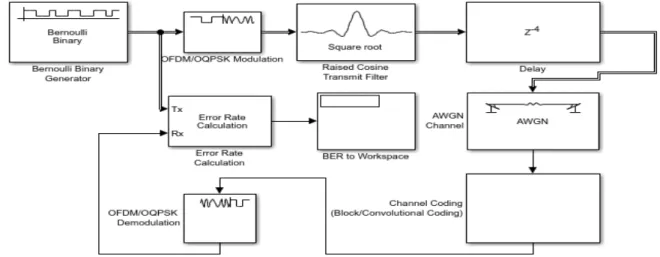
The OFDM signal is generated and passed through the raised cosine filter and the AWGN channel. The OFDMs physical layer splits the information signal across 52 separate subcarriers. 4 subcarriers are pilot subcarriers and remaining 48 subcarriers to provide separate wireless pathways for sending the information in a parallel manner.
Table 1: Simulation Parameters
Raised Cosine Filter AWGN Channel Binary Generator Delay Length
Roll off factor: 0.2
Filter shape: Square root
Linear filter gain: 1
Number of bits per symbol:1
Input signal power: 1
Symbol power: 1 second
Sample time: 0.001
Probability of a zero:0.5 4
Simulation Time: 100 seconds
AWGN Channel: The channel adds white Gaussian noise to the signal that passes through it. It is created using the AWGNChannel system object in MATLAB or the AWGN function.
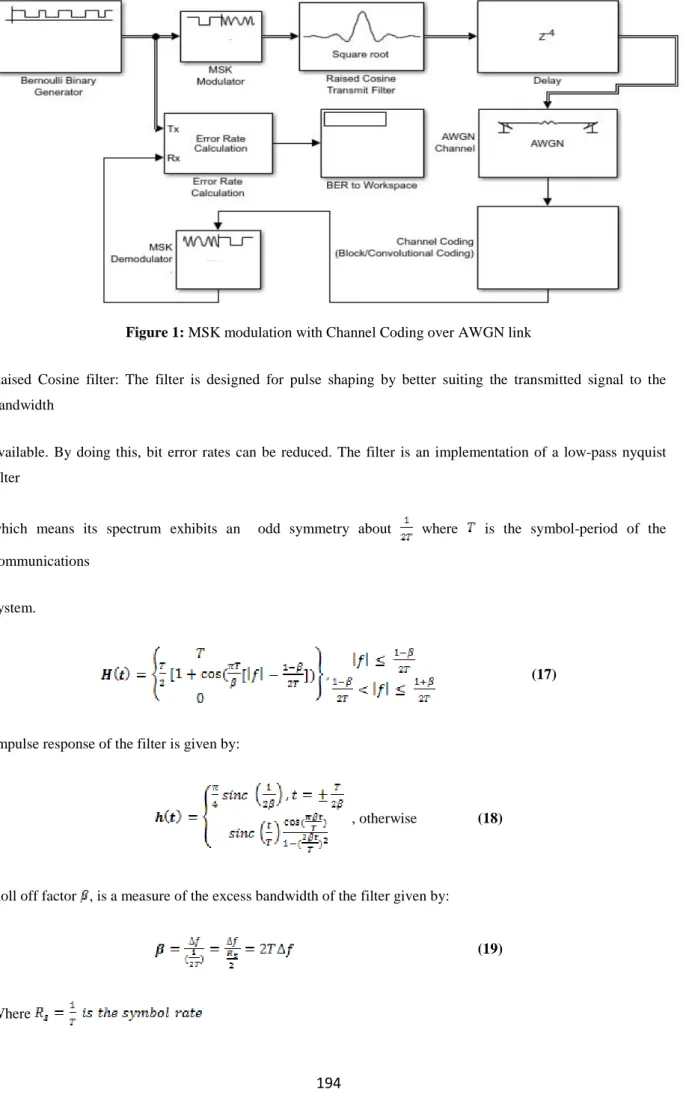
MSK Modulator: The MSK Modulator Baseband block modulates using the minimum shift keying method. The output is a baseband representation of the modulated signal.
194
Figure 1: MSK modulation with Channel Coding over AWGN link
Raised Cosine filter: The filter is designed for pulse shaping by better suiting the transmitted signal to the bandwidth
available. By doing this, bit error rates can be reduced. The filter is an implementation of a low-pass nyquist filter
which means its spectrum exhibits an odd symmetry about where is the symbol-period of the communications
system.
(17)
Impulse response of the filter is given by:
, otherwise (18)
Roll off factor , is a measure of the excess bandwidth of the filter given by:
(19)
195
The bandwidth of a raised cosine filter is most commonly defined as the width of the non zero portion of its spectrum
(20)
Figure 2: OFDM/OQPSK with Channel Coding over AWGN link
Bit error rate (BER) to workspace: The Error Rate Calculation block compares input data from a transmitter with input data from a receiver. It calculates the error rate as a running statistic, by dividing the total number of unequal pairs of data elements by the total number of input data elements from one source.
3.Results
The OFDM system is developed, simulated and analyzed in MATLAB version 8.5. Bit Error Rate is calculated for convolutional coding, block coding and no coding scenarios over the AWGN channel.
Figure 3: BER Performance for OQPSK
196
this is because of the absence of extra data bits to make the transmission robust to disturbances present on the transmission. In the case of convolutional coding, error correcting information is spread over a longer area which made it have the lowest bit error rate of 1.74e-05. Lastly, due to the fact that in block coding only one block is encoded at a time, it has proven to be less efficient when compared to convolutional coding as seen with a slightly higher bit error rate of 0.0073.
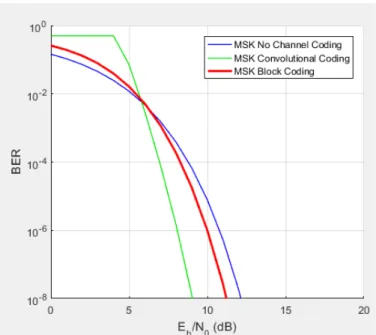
Figure 4: BER Performance for MSK
From the Figure 2, a rapid decrease in BER is noticed in the MSK convolutional coding case at around 4dB. While both the no channel coding and block coding case experienced rapid decrease in BER around the same region of 6dB.
4.Discussion
From Figure 1 BER begins to drop rapidly after the 2dB point producing the lowest BER value of 1.7402e-05 at 5dB. This is because of the sliding nature of the convolutional codes facilitated by trellis decoding using the time- invariant method making them soft-decision decoded with reasonable complexity. At the same 5dB point, the block coding had a BER of 0.0074 because of their algebraic block codes which are typically hard-decoded using algebraic decoders. Lastly, the setup without any form of coding produced a BER of 0.0125 at the 5dB point due to the absence of error correction. From Figures 1 and 2, it can be seen that OQPSK performs slightly better than MSK although for higher bandwidths, it is expected that MSK would produce better BER than OQPSK.
5.Conclusion
Bit error rates for both OQPSK and MSK have been evaluated using three separate scenarios. The no channel coding case, convolutional coding and block coding. And it was seen that convolutional coding had the lowest
197
bit error rate while the no channel coding case had the highest bit error rate. This is due to the fact that in convolutional coding, the information bits are spread along the sequence yielding better error correction when compared to its counterparts. The basic aim of this study was to obtain bit error rates for both block and convolutional coding schemes over the AWGN link to obtain their bit error rates. By doing this, error correcting algorithms can be adjusted regularly based on their performances to achieve a certain degree of quality of service.
References
[1] P. Anurag, S. Sandeep, “BER Performance of OFDM System in AWGN and Rayleigh Fading Channel.” International Journal of Engineering Trends and Technology, vol. 13, pp. 126-128, July. 2014
[2] V. Kumar, D. Parveen, “Performance Analysis of MIMO-OFDM System using MSK Modulation Scheme for AWGN channel.” International Journal of Computer Application, vol. 5, pp. 63-68, June. 2015
[3] S.A., Gronemeyer, M. Alan, “MSK and Offset QPSK Modulation.” IEEE Transactions on Communications, vol. 24, pp. 809-819, August. 1976
[4] S.V., Patil, A. Shirke, “Analysis, Modelling and Simulation of Co-operative OFDM System to implement Amplify and Forward transmission in wireless Relay Communications.” International Journal of Current Research and Academic Review, vol. 5, pp. 84-93, January. 2017
[5] H.N., Tan, T., Inoue, K., Tanizawa, “Optical Nyquist Filtering for Elastic OTDM Signals: Fundamentals and Demonstrations” Lightwave Technology Journal, vol. 33. 2015
[6] L. Wan, V.K. Dubey, “Bit error probability of OFDM system over frequency nonselective fast Rayleigh fading channels.” IEEE Electronic letters vol. 36, pp.15-20, Nov, 2000
[7] E.F, Casas, C. Leung, “OFDM for data communication over mobile radio FM channels”. IEEE Transactions on Communications, vol. 39, pp. 21-26, July, 1999