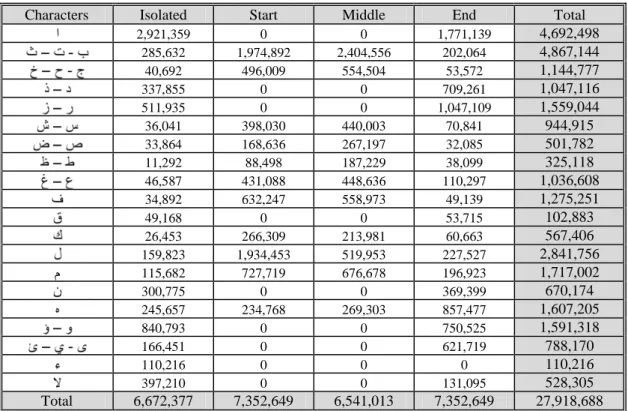
character recognition. PhD thesis, University of
Nottingham.
Access from the University of Nottingham repository:
http://eprints.nottingham.ac.uk/12601/1/FinalSubmissionThesis.pdf Copyright and reuse:
The Nottingham ePrints service makes this work by researchers of the University of Nottingham available open access under the following conditions.
· Copyright and all moral rights to the version of the paper presented here belong to the individual author(s) and/or other copyright owners.
· To the extent reasonable and practicable the material made available in Nottingham ePrints has been checked for eligibility before being made available.
· Copies of full items can be used for personal research or study, educational, or not-for-profit purposes without prior permission or charge provided that the authors, title and full bibliographic details are credited, a hyperlink and/or URL is given for the original metadata page and the content is not changed in any way.
· Quotations or similar reproductions must be sufficiently acknowledged.
Please see our full end user licence at:
http://eprints.nottingham.ac.uk/end_user_agreement.pdf
A note on versions:
The version presented here may differ from the published version or from the version of record. If you wish to cite this item you are advised to consult the publisher’s version. Please see the repository url above for details on accessing the published version and note that access may require a subscription.
School of Computer Science
Offline printed Arabic character recognition
Ashraf AbdelRaouf
Thesis submitted to the University of Nottingham for the degree of Doctor of Philosophy
i
Abstract
Optical Character Recognition (OCR) shows great potential for rapid data entry, but has limited success when applied to the Arabic language. Normal OCR problems are compounded by the right-to-left nature of Arabic and because the script is largely connected. This research investigates current approaches to the Arabic character recognition problem and innovates a new approach.
The main work involves a Haar-Cascade Classifier (HCC) approach modified for the first time for Arabic character recognition. This technique eliminates the problematic steps in the pre-processing and recognition phases in additional to the character segmentation stage. A classifier was produced for each of the 61 Arabic glyphs that exist after the removal of diacritical marks. These 61 classifiers were trained and tested on an average of about 2,000 images each.
A Multi-Modal Arabic Corpus (MMAC) has also been developed to support this work. MMAC makes innovative use of the new concept of connected segments of Arabic words (PAWs) with and without diacritics marks. These new tokens have significance for linguistic as well as OCR research and applications and have been applied here in the post-processing phase.
A complete Arabic OCR application has been developed to manipulate the scanned images and extract a list of detected words. It consists of the HCC to extract glyphs, systems for parsing and correcting these glyphs and the MMAC to apply linguistic constrains. The HCC produces a recognition rate for Arabic glyphs of 87%. MMAC is based on 6 million words, is published on the web and has been applied and validated both in research and commercial use.
ii
Acknowledgements
First I would like to thank my main supervisor, Dr. Colin Higgins, for his participation throughout this research. His ideas and suggestions were of great benefit to me. I would also like to thank my supervisors, Dr. Tony Pridmore, Dr. Mahmoud Khalil, and Prof. Dave Elliman. I appreciate their guidance and comments on this thesis and for their honest support along my research.
Special appreciation to Prof. Graham Kendall whose help was very important at several times. He is also one of the best friends I got to know during my study time in Nottingham.
Special thanks to Essam Eliwa who is a very good friend. He made life much easier for me at Nottingham. It was a pleasure, not only to share the same lab with him over the last few years, but also to know him.
I would like to thank all my friends and colleagues at my home university, Misr International University (MIU). Many special thanks to my manager, Mr. Hassan ElRashidy, for his continues encouragement and support that I appreciate so much. His support was essential to help me pass many difficult times throughout my PhD study.
There are no adequate words to express my love and gratitude to my beloved wife, Meral, who has been by my side throughout the years. Supporting me, encouraging me and carrying more responsibilities during my study. She made me happy during difficult times. My sweet kids; Eraj, Nadine, Mona and Mohamed, I would like to tell you that all I do is for you and for a better future for you.
I am indebted and grateful to my whole family, especially to my father for his backing and advice that motivated me to study for a Ph.D. degree. I would also like to thank my mother for her continuous support. They both made me what I am today. Thank you all, Ashraf AbdelRaouf
iii
Table of Contents
Abstract ... i
Acknowledgements ... ii
Table of Contents ... iii
List of Figures ... vii
List of tables ... ix Chapter 1. Introduction ... 1 1.1 Background ... 2 1.1.1 Motivation ... 3 1.1.2 Scope ... 4 1.2 Brief Overview ... 9
1.2.1 General aims and objectives... 9
1.2.2 Problems and specific objectives ... 10
1.2.3 Approach ... 11
1.2.4 Contributions ... 13
1.3 Organization of the thesis ... 14
Chapter 2. A review of character recognition ... 17
2.1 Introduction ... 17
2.1.1 Overview ... 17
2.1.2 Different categories of readable information ... 20
2.1.3 OCR Applications ... 21
2.2 The written Arabic language ... 23
2.2.1 Key features of written Arabic ... 24
2.2.2 Recognizing written Arabic ... 27
2.2.3 PAWs and NPAWs ... 29
2.2.4 Arabic language morphology ... 30
2.3 Pre-processing Phase ... 30
2.3.1 Document layout analysis and decomposition ... 31
2.3.2 Binarization and noise removal ... 32
2.3.3 Thinning ... 33
2.3.4 Slant / skew detection and correction... 33
2.3.5 Textline / Baseline detection ... 34
2.3.6 Word normalization ... 35
2.4 Feature extraction Phase ... 35
2.4.1 Moments ... 36
2.4.2 Hough transform ... 37
2.4.3 Fourier descriptors ... 37
2.4.4 Linear transforms ... 37
2.4.5 Haar-like feature extraction... 38
2.5 Character segmentation Phase ... 43
2.5.1 Isolated / pre-segmented characters ... 44
iv
2.5.3 Segmenting a word into primitives ... 44
2.5.4 Integration of recognition and character segmentation ... 45
2.5.5 Character segmentation-free systems ... 45
2.6 Classification Phase ... 46
2.6.1 Statistical methods ... 46
2.6.2 Structural methods ... 47
2.6.3 Artificial Neural Networks (ANN) ... 48
2.6.4 Support Vector Machine (SVM) ... 48
2.6.5 Classification with multiple classifiers ... 49
2.6.6 Cascade of boosting classifiers ... 49
2.6.7 Integration of feature extraction and classification ... 50
2.7 Post-processing Phase ... 52
2.7.1 Enhancing recognition using a confusion marix ... 53
2.7.2 Look-up dictionary ... 54
2.7.3 String correction ... 58
2.7.4 Language correction using corpus ... 59
2.8 Summary ... 64
Chapter 3. A Multi-Modal Arabic Corpus ... 66
3.1 Building a Multi-Modal Arabic Corpus from textual data ... 68
3.1.1 Coverage and Sources ... 68
3.1.2 Text data collection ... 69
3.1.3 Creating NWords, PAWs and NPAWs ... 70
3.1.4 Creating images from corpus text data... 70
3.1.5 Degrading the computer-generated token images ... 72
3.1.6 Ground truthing the computer-generated token images ... 73
3.2 Building a Multi-Modal Corpus: real images ... 74
3.2.1 Paragraph image dataset ... 75
3.2.2 Full page real image dataset ... 76
3.3 Using MMAC in Arabic OCR development ... 77
3.3.1 Computer generated token images ... 78
3.3.2 Computer generated token images with artificial noise ... 79
3.3.3 Paragraph documents ... 79
3.3.4 Real scanned documents ... 80
3.4 Enhancing MMAC using a lexicon/stemming approach ... 80
3.4.1 Approach applied in solving the problem ... 81
3.4.2 The proposed light stemmer affixes ... 81
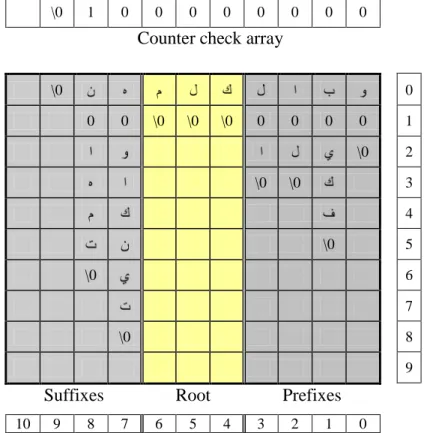
3.4.3 The proposed lexicon / stemmer algorithm ... 82
3.4.4 Implementing the lexicon / stemming approach ... 84
3.5 Statistical analysis of the MMAC corpus ... 85
3.5.1 Frequency list ... 85
3.5.2 Analysis of words, PAWs and characters ... 85
3.5.3 Discussion ... 88
3.6 Testing the corpus’ validity ... 91
3.6.1 Testing words and PAWs ... 91
3.6.2 Checking corpus accuracy... 92
3.6.3 Testing lexicon / stemming approach validity ... 93
v
3.7 The online MMAC corpus ... 95
3.7.1 MMAC corpus contents ... 95
3.7.2 Transliteration encoding... 96
3.7.3 Buckwalter modified transliteration encoding ... 98
3.8 Summary ... 99
Chapter 4. Glyph recognition using a Haar Cascade Classifier ... 100
4.1 Using a Haar Cascade Classifier with Arabic character recognition ... 100
4.1.1 Arabic character recognition difficulties ... 100
4.1.2 Benefits of using the Haar Cascade Classifier approach ... 101
4.1.3 Dealing with variations ... 102
4.1.4 How to apply the approach ... 102
4.2 Problem solving approach ... 103
4.2.1 The pilot experiment to detect the isolated letter Ain ( ) ... 103
4.2.2 The extended experiment to detect 15 different glyphs ... 104
4.2.3 The auxiliary experiments to improve the training parameters ... 104
4.2.4 The final experiment to detect naked Arabic glyphs ... 105
4.3 The pilot experiment ... 105
4.3.1 Planning the experiment ... 105
4.3.2 Data Selection and preparation ... 106
4.3.3 Training the Ain classifier ... 109
4.3.4 Testing the Haar-cascade classifier ... 110
4.3.5 Results and conclusions ... 111
4.4 The extended experiment ... 113
4.4.1 Planning the experiment ... 113
4.4.2 Data preparation ... 115
4.4.3 Data selection ... 119
4.4.4 Training the extended experiment classifiers ... 121
4.4.5 Testing the extended experiment classifiers ... 122
4.4.6 Results and conclusions ... 124
4.5 The auxiliary experiments ... 129
4.5.1 Testing the training width and height... 130
4.5.2 Testing the number of splits and minimum hit rate ... 131
4.5.3 Test the boosting type and number of splits... 133
4.6 The final experiments ... 134
4.6.1 Planning the experiment ... 134
4.6.2 Data preparation ... 136
4.6.3 Training the final experiment classifiers ... 137
4.6.4 Testing the final experiment classifiers... 139
4.6.5 Results and conclusions ... 140
4.7 Summary ... 143
Chapter 5. HCC tokens recognition ... 144
5.1 Introduction ... 144
5.1.1 HCC tokens recognizer overview ... 145
5.1.2 Preparing the tokens testing dataset ... 146
5.1.3 Document statistical information ... 148
5.2 The single token classifier ... 149
vi
5.2.2 Running the classifiers ... 151
5.2.3 Keeping a list of glyphs... 153
5.3 The HCC tokens recognizer ... 154
5.3.1 Text line extraction ... 155
5.3.2 Parsing the detected glyphs ... 156
5.3.3 Testing the Arabic tokens recognizer ... 159
5.4 Enhancing recognition using a confusion matrix ... 162
5.4.1 Generating the confusion matrix ... 162
5.4.2 Applying the confusion matrix... 164
5.4.3 Testing the confusion matrix enhancement results ... 166
5.5 Summary ... 168
Chapter 6. Post-processing HCC tokens ... 169
6.1 Introduction ... 169
6.1.1 Naked words versus naked PAWs ... 170
6.2 Applying a post-processing technique ... 171
6.2.1 Searching using a trie structure ... 171
6.2.2 Token correction using Levenshtein distance ... 173
6.3 Testing the Post-processing technique ... 173
6.3.1 Testing the NWords dictionary ... 174
6.3.2 Testing NPAWs dictionary ... 175
6.3.3 Post-processing test results ... 176
6.4 Summary ... 178
Chapter 7. Conclusions and Future work ... 179
7.1 Meeting the objectives ... 179
7.2 Future work ... 183 7.2.1 General topics... 183 7.2.2 Arabic corpus ... 184 7.2.3 HCC glyphs recognition ... 185 7.2.4 HCC tokens recognizer ... 185 7.2.5 Post-processing ... 186 7.3 Conclusions ... 187 7.4 Closing remarks ... 189 References ... 190
vii
List of Figures
Figure 1.1: The machine recognition categories of readable information ... 5
Figure 1.2: A general framework for character recognition ... 7
Figure 1.3: The framework of the proposed Arabic OCR approach ... 8
Figure 2.1: The baseline location of text in English and Arabic ... 34
Figure 2.2: Upright and 45° rotated rectangle of detection window ... 40
Figure 2.3: Haar-like features prototype ... 41
Figure 2.4: Supplementary image illustration SAT and RSAT ... 43
Figure 2.5: Cascade of classifiers with N stages ... 49
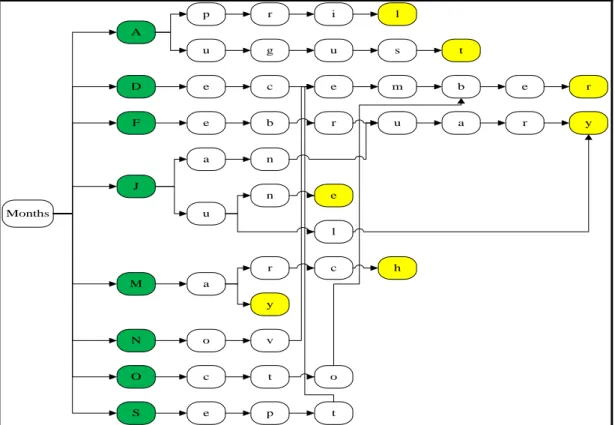
Figure 2.6: Trie structure of a simple lexicon of 12 English months ... 55
Figure 2.7: Tail-end trie of a simple lexicon of 12 months ... 56
Figure 2.8: DAWG graph structure of a simple lexicon of 12 months ... 57
Figure 2.9: Levenshtein distance between the two words ‘Saturday’ and ‘Sunday’ . 59 Figure 3.1: A word images of ( ) in three different Arabic fonts ... 71
Figure 3.2: (a) word ( ) image. (b) Skewed image. (c) Noised image... 73
Figure 3.3: Ground truth XML file for the word ( ) ... 74
Figure 3.4: Samples of the three categories of paragraph images... 76
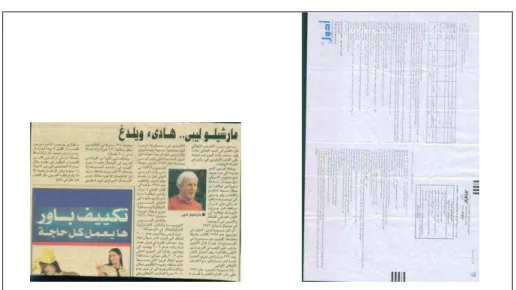
Figure 3.5: Two samples of real scanned document images ... 77
Figure 3.6: The typical process of testing OCR application using MMAC ... 78
Figure 3.7: The structure of the lexicon / stemming algorithm... 84
Figure 3.8: The relationship between top 10 and top 25 most repeated tokens ... 89
Figure 3.9: Relationship between distinct tokens and words as samples increases ... 89
Figure 4.1: The different images of the letter ( ) used in the pilot experiment ... 107
Figure 4.2: Samples of the pilot experiment negative images ... 107
Figure 4.3: Sample of positive in image pilot experiment and OpenCV ... 109
Figure 4.4: The pilot experiment testing results and detected Ain ( ) image ... 112
Figure 4.5: The sensitivity ROC of the pilot experiment of the Ain classifier ... 112
Figure 4.6: Testing the pilot experiment with a real scanned Arabic document ... 113
Figure 4.7: Sample of positive and negative image for Heh middle glyph... 116
Figure 4.8: Sample of converting a positive image to negative ... 118
Figure 4.9: Recognition accuracy between HCC and commercial software ... 128
Figure 4.10: Glyphs definition for the final experiment ... 136
Figure 5.1: Flowchart showing HCC tokens recognition process... 145
Figure 5.2: Different samples of Tokens testing dataset ... 148
Figure 5.3: A document image after running ten classifiers over it ... 152
Figure 5.4: Baseline locations for a document image (shown in red) ... 155
Figure 5.5: Different cases of relationship between each contiguous glyph... 159
Figure 6.1: Relationship between look-up dictionaries’ levels and nodes number .. 172
ix
List of tables
Table 2.1: Arabic joining groups and group letters, with their English name ... 25
Table 2.2: Arabic joining groups and group letters, defined with letters location ... 26
Table 2.3: Arabic letters and their shapes at different locations within words ... 26
Table 2.4: Arabic letters with dots distribution ... 27
Table 2.5: A confusion matrix with two class classifier ... 53
Table 3.1: Total Number of images for Words, NWords, PAWs and NPAWs ... 72
Table 3.2: The average letters per token, width and height in pixels of tokens ... 72
Table 3.3: Artificially added noise to computer generated documents ... 79
Table 3.4: Affixes of different light stemming types ... 82
Table 3.5: Statistical summary for Words, NWords, PAWs and NPAWs ... 86
Table 3.6: The average characters/Word, characters/PAW and PAWs/Word ... 86
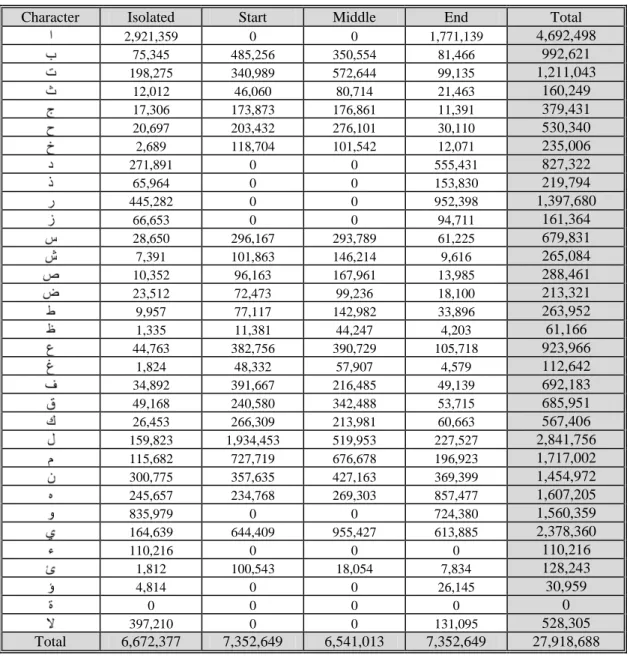
Table 3.7: The number of occurrence of letters in their different locations ... 87
Table 3.8: The number of occurrence of naked letters in their different locations .... 88
Table 3.9: Tokens that occurred once in relation to total unique and total tokens .... 90
Table 3.10: The 25 most repeated tokens. Number and percentage of repetitions .... 90
Table 3.11: The corpus testing dataset tokens with their unique number ... 91
Table 3.12: Number & percent of unique found tokens of testing data in MMAC ... 92
Table 3.13: Number & percentage of missed tokens of testing data from MMAC ... 92
Table 3.14: Number and percentage of tokens using trusted and un-trusted lists... 94
Table 3.15: Total number and percentage of tokens using trusted list... 94
Table 3.16: Total number and percentage of tokens using un-trusted list ... 95
Table 3.17: Buckwalter Transliteration encoding ... 97
Table 3.18: Buckwalter Modified Transliteration encoding ... 98
Table 4.1: Different image parameters used in testing the pilot experiment ... 111
Table 4.2: The number of original negative and positive images of each glyph ... 117
Table 4.3: Proposed glyphs with occurrences, locations and reasons for selection . 120 Table 4.4: The training information for each of the 15 selected glyphs ... 122
Table 4.5: The testing information for each of the 15 selected glyphs ... 123
Table 4.6: Percentage testing results of the extended experiment for 15 glyphs ... 125
Table 4.7: Numbers testing results of glyphs using three types of document ... 126
Table 4.8: Testing results in percentages defined by glyph location ... 126
Table 4.9: Testing results between the HCC and commercial software ... 128
Table 4.10: Testing different training values of widths and heights of glyphs ... 131
Table 4.11: Testing different values of number of splits and minimum hit rate ... 133
Table 4.12: Testing different number of splits with different boosting types ... 134
Table 4.13: The Arabic naked glyphs as used in the final experiment ... 135
x
Table 4.15: Training information of glyphs in isolated and start location ... 138
Table 4.16: Training information of glyphs in middle and end location ... 138
Table 4.17: The testing information for all the glyphs in all locations ... 139
Table 4.18: Testing results as a percentage for all glyphs in different locations ... 141
Table 4.19: Testing results in numbers for all glyphs in different locations... 141
Table 5.1: Tokens testing dataset files description ... 147
Table 5.2: Classifiers list of the HCC approach ... 150
Table 5.3: Sample of applying a Tokens classifier over a document image ... 154
Table 5.4: Sample of detected glyphs with text lines and letters sorted ... 156
Table 5.5: Recognition results of commercial software and HCC recognizer ... 161
Table 5.6: Part of confusion matrix with a sample of six classifiers ... 163
Table 5.7: Confusion matrix likelihood alternatives glyphs list ... 165
Table 5.8: Confusion matrix results in comparison to the tokens recognizer ... 167
Table 6.1: Post-processing test results of naked words... 174
Chapter 1.
Introduction
Computer processing of data has increased dramatically over time, to the extent that there are now massive demands for the rapid transfer of printed and handwritten information into computer readable format. Frequently this data must be accurately typed by human operators, which is time consuming and prone to error. This operation has recently been ameliorated by the invention of Optical Character Recognition (OCR) techniques. An OCR application reads written or printed data by recognizing the text at high speed. OCR applications are still quite limited in their use and can only recognize small amounts of the available data. Hence, more effort is needed in order to enable OCR applications to read printed and handwritten characters more quickly and accurately (Cheriet, Kharma et al. 2007). OCR applications for non-western characters, particularly partially connected scripts such as Arabic and Persian, are still relatively weak. The work reported here is concerned with the OCR of machine printed Arabic text.
Why do we need OCR generally? OCR is an essential technique that enables the transfer of printed documents to a computer readable form. OCR allows for the automated archiving and retrieving of old documents, especially old books. OCR has various applications at this time and still has great potential, as it offers a variety of applications for mail sorting (Govindan and Shivaprasad 1990), bank cheque processing (Senior 1992) and reading machines for the blind (Abdelazim 2006) among other uses. OCR research studies have a great influence on pattern recognition applications, for example; face recognition, fingerprint recognition and iris recognition. Such applications are used for some security issues such as criminal tracking. Recently, some systems have integrated OCR with new research topics such as automatic translation and voice commands. These systems would play an important role in developing such new topics (Chang, Chen et al. 2009).
Why do we need Arabic OCR specifically? Arabic OCR lacks research studies when compared to Latin character OCR. The recognition accuracy of Latin character OCR is far beyond that of Arabic OCR because the Arabic language is different in its cursive script and its letter shape, which is context sensitive (Khorsheed 2002). The population of those using the Arabic language is 350 million speakers (Statistics 2010) and it is the fourth most spoken language in the world after Chinese, English and Spanish (Education 2009). This indicates the need for more research studies in Arabic OCR. An improved and more powerful approach for Arabic OCR would be useful for the continuity of the language and in order to keep its history recorded.
1.1
Background
Pattern recognition classifies data based on knowledge extracted from known patterns. Pattern recognition is concerned with defined pattern domains (such as: character, iris, fingerprint, voice, face) and extracts some features from this pattern (either geometrical or structural) and then applies a classification algorithm in order to identify the pattern based on previously known features.
Pattern recognition is important in many applications and fields, for example; speech recognition for customer authentication, voice commands to computers and for converting speech to text (Cheriet, Kharma et al. 2007); for the role it takes in understanding and recognising engineering drawings (Elliman 2001); for medical and bioinformatics applications such as the understanding of the electrocardiogram (ECG) (Jafari, Noshadi et al. 2006); for human identification, such as face recognition (Bowyer, Chang et al. 2005; Tan, Chen et al. 2006; Mian, Bennamoun et al. 2007), iris recognition (Bowyer, Hollingsworth et al. 2008; He, Tan et al. 2009; Kumar and Passi 2010) and fingerprint recognition (O'Gorman 1998; Maltoni and Cappelli 2009); for research and industrial use of robotics (Bradski and Kaehler 2008) and for text understanding in character recognition.
Character recognition is the transformation of text images, generally captured by a scanner, into machine-editable text. This process is known as Optical Character Recognition (OCR). The objective of OCR is to emulate the human capability of accurately reading a document but at a higher speed.
OCR is currently very important and has many applications. One of the main uses of OCR is for office automation and document archiving as some companies tend to replace paper archiving for electronic archiving (Khorsheed 2002). Normally they keep two electronic copies of the same old paper document; an image for archiving and a text document for further use. Another usage of OCR is obvious in banks as they utilize the offline handwritten recognition applications with cheques in order to recognize names and values written on the cheques. Also, mail sorters use the same type of applications in order to recognize the names and addresses from the mail (Govindan and Shivaprasad 1990).
1.1.1
Motivation
The Arabic language has been used since the fifth century when written forms were stimulated by Islam. It is the native language of 350 million speakers (Statistics 2010) and it is the fourth most spoken language in the world after Chinese, English and Spanish (Education 2009). It is one of the six main languages of the United Nations (beside Chinese, English, French, Russian and Spanish) (Nations 2007). It has been estimated to be one of the ten most used languages on the Internet (Statistics 2010) and is the official language of 22 countries located in the geographical area of the Middle East (UCLA 2006).
The Arabic language is a particularly important language for all Muslims around the world. There are 1.5 billion Muslims, representing around a quarter of the world’s population (worldwide 2009). The Arabic language is the original language of the holy Quran and, although the holy Quran is translated into many other languages, Muslims use the Arabic language in their religious rituals.
Research studies regarding OCR have been widely developed during the last five decades in common languages like English, Chinese and Japanese (Cheriet, Kharma et al. 2007). These research studies concentrated mainly on Latin based languages, while Arabic based languages tend to be neglected (Harty and Ghaddar 2004; Cheriet, Kharma et al. 2007; Lorigo and Govindaraju May, 2006). Although there has been a recognizable increase in Arabic OCR research studies during the last decade, there is still a need for more (Abdelazim 2006). Specific features of the Arabic language (shown in section 2.2) create uniqueness in the necessary OCR
applications. It is this uniqueness that increases the demand for more research regarding Arabic language recognition (Hamada 2007).
Language engineering is the use of computer technologies for the creation, archiving, processing and retrieval of machine processed language data and is a common research topic involving computer science and linguistics (Maynard, Tablan et al. 2002). The research studies of language engineering in the Arabic language are very limited (AbdelRaouf, Higgins et al. 2010). So, for instance, the Arabic language lacks a robust Arabic corpus. The creation of a well established Arabic corpus encourages Arabic language research and enhances the development of Arabic OCR applications. Therefore, it is essential for the corpus to be flexible regarding its continuous updating of size and contents in such a way as to meet the innovative needs of research.
1.1.2
Scope
The scope of this research is to introduce an innovative approach for offline printed Arabic recognition, while the wider scope is the machine recognition of readable information. Figure 1.1 shows the different categories of machine recognition of
readable information. The two main types of readable information are “offline
(OCR)” or “online”. The online character recognition recognizes the dynamic
handwriting motion during typing which is widely used in tablet PCs, handheld PDAs, smart phones and tablet devices (Plamondon and Srihari 2000). The online readable information is not included in this research. The offline readable information (OCR) is either machine printed or handwritten (Abdelazim 2006). Handwritten OCR uses a computer application in order to translate scanned paper documents written by hand into electronic word documents (Lorigo and Govindaraju May, 2006). Handwritten OCR is outside of the scope of this research.
The machine printed OCR contains different categories (Govindan and Shivaprasad 1990); Firstly, cursive / partially cursive - such as the Arabic OCR - which includes character segmentation-free recognition, as in the case of this research. It also includes the recognition of isolated characters only. Moreover, it includes recognition by segmenting the word into its characters or primitives. It can recognize the whole word without character segmentation (Khorsheed 2002; Abdelazim 2006).
Secondly, separated characters; for example, in the case of Latin character based languages, it recognizes alphabets, numerals and symbols. Thirdly, the mathematical formula recognizes symbols, numerals and so on. Fourthly, the ideogram languages such as Chinese and Japanese are totally symbolic languages. This type is out of the scope of this research. Finally, other types which include; for example, the Indian, Russian and Greek languages (see section 2.1.2).
Machine printed Offline (OCR) Handwritten Cursive/ Partially Cursive Characters Mathematical formula Alphabets Isolated characters Partially words Whole words Online Readable information Symbols Numerals Symbols Numerals Ideogram Segmentation free
Figure 1.1: The machine recognition categories of readable information
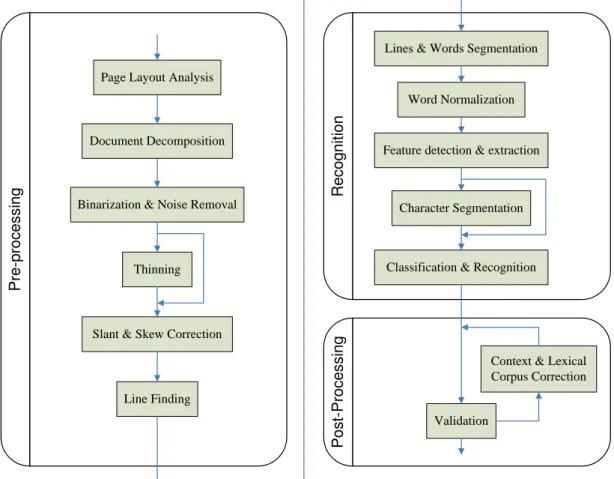
The established approach of solving the Arabic OCR problem was investigated in order to achieve the scope of this research. An OCR application normally consists of three main parts: pre-processing, recognition and post-processing as shown in Figure 1.2 (Khorsheed 2002; Cheriet, Kharma et al. 2007; Lorigo and Govindaraju May, 2006). The pre-processing part is responsible for preparing the document image for the recognition part. The more successful the pre-processing algorithms are, the better the recognition rate of the application. The recognition part handles the document image after line finding. In turn, the recognition part outputs the machine readable recognized form of a document image. Finally, the post-processing part receives the series of recognized letters / words and it indicates which possible words are best in this situation, based on linguistic or statistical data.
The pre-processing phase cleans the image using image processing techniques. It converts the image to a more concise representation. The pre-processing part normally includes the following steps (Senior 1992; Lorigo and Govindaraju May, 2006):
1. Page layout analysis is responsible for analysing the contents of the document image. It defines the blocks of data inside the image whether text or non-text (Cheriet, Kharma et al. 2007).
2. Document decomposition separates the document image into its main components (paragraphs or non-text). This step is considered to be a preliminary step of dealing with the document image before the pre-processing stages that enhance the document image (Cheriet, Kharma et al. 2007).
3. Binarization is responsible for receiving the scanned image and converting the document from a grey-scale image to a binary, black and white image. Noise removal removes small erroneous regions and pixels from the binarized image. 4. A thinning step is normally used with handwritten input and is sometimes used
with printed input. This step removes the stroke width and leaves a skeleton stroke with a width of one pixel.
5. Slant and skew detection and correction detect the slant and skew in the document image and correct them. Slant is the sheer inclining of the word from a horizontal line as in italic words. Skew is the rotation of the whole document image which results from the rotation of the document image while scanning. 6. Line finding identifies the baselines of the text lines in the paragraph of text. The
baseline is the horizontal line that passes through the connected primitives of the line of text (Khorsheed 2002) or just under the descending letters for non-connected text.
The recognition part normally includes the following steps:
1. Lines and words segmentation separate the image of a paragraph of text to its images of text lines. Separate the line of text to its images of words. It ends up with the images of separate words inside the paragraph.
2. Word normalization scales the word image to fit a required standard height for the training process.
3. Feature detection and extraction defines the type of features that can be extracted from the document images and extracts these features during the training process of the application.
4. Character segmentation segments the word into its letters or sub-letters (primitives) contents.
5. Classification & recognition: classifies the letters of the words based on the features extracted in the previous step. This step ends with defining the letters of the words or all the words.
Line Finding Thinning
Feature detection & extraction Lines & Words Segmentation
Character Segmentation
Validation
Context & Lexical Corpus Correction Page Layout Analysis
Slant & Skew Correction
Word Normalization Pre -p ro ce ssi n g Re co g n it io n Po st -Pro ce ssi n g
Binarization & Noise Removal Document Decomposition
Classification & Recognition
The post-processing part includes the following two steps:
1. Validation checks the word resulting from the classification and recognition step from a statistical, lexicographic or grammatical point of view, deciding whether it is the best suite word or not.
2. Context and lexical corpus correction step supplies the OCR application with suggested likelihood alternative words, driven from the corpus context.
Feature detection & extraction
Classification
Text line extraction
Validation
Context & Lexical Correction Corpus R e co g n it io n Po st -Pro ce ssi n g Recognition Page Layout Analysis
Pre -p ro ce ssi n g Document Decomposition
Figure 1.3: The framework of the proposed Arabic OCR approach
Figure 1.3 shows the framework of the proposed approach which defines the scope of this research. It is clear from the proposed approach that some of the pre-processing and recognition steps (Binarization & Noise Removal, Thinning, Slant & Skew Correction, Line Finding, Lines & Words Segmentation and Word
Normalization) are eliminated and the character segmentation stage is also totally eliminated. This indicates that a lot of steps might not be needed for the recognition of Arabic OCR.
The scope of this research is wide enough to include other languages that use Arabic alphabets, for example; Pashto, Persian, Sindhi, and Urdu. All languages that use Arabic alphabets have common features such as partial cursive script, context sensitivity of letter shapes and reading direction (Khorsheed 2002). These common features facilitate the opportunity to share research studies.
1.2
Brief Overview
This section introduces the general aims and objectives of this research with a detailed definition of the problems and specific objectives. The approach followed in solving the problem is defined. The contributions of this research are explained briefly.
1.2.1
General aims and objectives
The aim of this research is to investigate, suggest, design and analyze a set of OCR techniques in order to significantly increase the recognition accuracy and speed of offline printed Arabic character recognition. A number of practical questions relating to Arabic OCR applications set the foundation and objectives for this research: 1. What are the advantages and disadvantages of the established way of solving the
problem of printed Arabic OCR?
2. To what extent are the steps in the pre-processing and recognition stages essential and can these steps be eliminated totally or partially?
3. Can Arabic printed text be recognized without the character segmentation phase?
4. If some steps from the pre-processing and recognition stages in additional to character segmentation are eliminated, then can a complete Arabic OCR application be developed?
5. Can the connected segments or pieces of Arabic words (PAWs) as well as naked pieces of Arabic words (NPAWs); PAWs without diacritical marks shown in section 2.2 (AbdelRaouf, Higgins et al. 2008) be considered as the smallest Arabic tokens to replace words and naked words in Arabic OCR applications? 6. Are the available Arabic corpora sufficient to cover Arabic OCR research? These represent the research questions that were tackled during the development of this research. Acquiring answers to these questions is the final objective of this research.
1.2.2
Problems and specific objectives
Three major problem areas need to be considered in order to answer the set of questions presented in section 1.2.1.
The first problem area is concerned with the pre-processing and recognition stages, which affects the recognition accuracy according to the quality of the document image (Khorsheed 2002). All the steps of the pre-processing and recognition stages have many algorithms and different approaches available. Sometimes one approach achieves good results with a document image and fails with another (Baird 1987). The variety of approaches in each step sometimes misleads the researchers. These stages are considered to be one of the reasons for the slowness in the character recognition time (Cheriet, Kharma et al. 2007). Initially, this research intended to reduce the pre-processing and recognition steps as much as possible for the sake of enhancing the recognition accuracy and speed.
The second problem area is concerned with the character segmentation phase. It is one of the reasons for reducing recognition speed and accuracy. It is clear that the character segmentation phase is always the major bottle neck in Arabic OCR research (Abdelazim 2006). Although there are some research studies trying to achieve character segmentation-free Arabic OCR, this is still limited to a certain number of words and fonts (Abdelazim 2006). The current research aims to eliminate the character segmentation phase in the recognition of printed Arabic text. The character segmentation problem was tackled by attempting a completely new
approach that can detect the glyph image from the document image without any character segmentation.
The third problem area is concerned with Arabic corpora. A corpus is a large structured set of texts, electronically sorted and processed. Corpora have become very important in the study of languages and they are the key to the development of OCR applications. Excellent corpora have been developed for Latin based languages, but not for the Arabic language. Access to a corpus of both language and images is essential during OCR development, particularly while training and testing a recognition application (AbdelRaouf, Higgins et al. 2010). The aim of constructing and providing a comprehensive study and analysis of a multi-modal Arabic corpus was essential for this research and for all the research studies of printed Arabic OCR. These represent the research problems that were tackled during the development of this research. Acquiring a solution to these problems is the final target of the research.
1.2.3
Approach
The previous two sections (1.2.1, 1.2.2) describe the aims and objectives of this research. In order to achieve these aims, this research investigated a novel approach that disregarded steps from the pre-processing and recognition stages and recognized the glyphs without a character segmentation phase as shown in Figure 1.3. This novel approach achieved at the end a full Arabic OCR application using the proposed research objectives.
The research studies and applications of Arabic OCR were investigated in order to identify the advantages and disadvantages of the established way of solving the Arabic OCR problem as shown in Figure 1.2.
A multi-modal Arabic corpus (MMAC) was constructed in order to facilitate the generation of Arabic OCR applications. Unlike other corpora, MMAC also includes tokens such as PAWs and NPAWs that are beneficial to OCR research (AbdelRaouf, Higgins et al. 2010). A lexicon / stemming algorithm had been developed for providing a list of alternatives for uncertain words to improve the performance of the corpus. The lexicon / stemming algorithm also assures the continuous updating of the
size and contents of the corpus, which copes with the innovative needs of Arabic OCR research.
This research depended on utilising an already existing approach that had been used and tested regarding face detection applications (Viola and Jones 2001). This approach is applied on character recognition using a cascade of boosted classifiers based on Haar-like features. The approach used the rotated Haar-like wavelet feature extraction algorithm and the cascade of boosted classification algorithm. The feature extraction algorithm obtains rectangular regions of the image and sums up the pixels in that region. This summing up is used in order to categorize images. Thus, it could categorize all images having Haar-like features in a certain range of values as one category and those deviating out of this range in another category. This procedure could be recursively carried out by dividing the image clusters (Viola and Jones 2001).
The boosting classification is a powerful machine learning technique. It merges the performance of many "weak" or base classifiers in order to construct a powerful one whose performance is significantly better than that of any of its base classifiers (Bishop 2006). A “weak” or base classifier only needs to perform better than chance, and thus can be straightforward and computationally inexpensive (Lienhart, Kuranov et al. 2002). This Haar Cascade Classifier (HCC) approach will be explained later in Chapter 4. The HCC approach has been selected for the following reasons:
1. It can be used with grey-scale images, so there is no need to apply binarization and noise removal algorithms that convert a document from a grey-scale to a black and white image. Nor is there a need to remove noise.
2. It uses a document image without slant and skew corrections as the rotated Haar-like features accept rotated images up to ±45°.
3. It handles a document image without segmenting each word to its letters or primitives content; which means that it can pick out any glyph image from inside the document image without character segmentation. This novel approach represents a real character segmentation free approach.
4. It manages different font sizes. The approach starts detecting the glyph from the width and height given in the training parameter up to the size of the whole document image, hence there is no need for any word normalization.
5. It can be extended to any cursive handwritten language not only the Arabic language. (Using this approach on handwriting could avoid the thinning step in the pre-processing stage.)
6. This approach can be applied to create a Portable Document Format (pdf) file upon extracting the position of the recognized glyph. This could be used with text from any scanned Arabic document.
A simple approach was applied to implement an HCC classifier and recognizer that was built based on the classifiers generated from the HCC glyphs classifiers. The confusion matrix was applied in order to enhance the recognition accuracy of the HCC approach. A simple post-processing technique was finally applied in order to enhance the recognition rate of the HCC approach.
1.2.4
Contributions
The main contribution of this research is to develop an Arabic OCR application completely without character segmentation and pre-processing. This research contributes to the research area of Arabic OCR in the following aspects:
1. A multi-modal Arabic corpus (MMAC) was collected, generated, verified, tested and justified. MMAC was tested with a commercial Arabic OCR application and provided variety of results which proof its usability. The MMAC was used by a commercial company to make a comparison between different Arabic OCR applications. The corpus is complemented by a newly developed lexicon / stemming algorithm in order to improve the performance of MMAC. MMAC has an application that allows adding and verifying any new lists of words to the corpus. (see Chapter 3)
2. A new approach to solving the problem of Arabic OCR was followed. This approach works without steps from the pre-processing and recognition phases to enhance recognition accuracy and time. (see Chapter 4)
3. Other research studies have attempted to use character segmentation-free recognition (see section 2.5.5), but these attempts failed either to present a concrete application or to achieve reasonable results (Abdelazim 2006). This research followed a new approach in order to achieve true character segmentation-free recognition depending on Haar-like features, which use the visual object detection algorithm. This approach led to a true character segmentation-free recognition application. (see Chapter 4)
4. A complete Arabic OCR application has been successfully created using a Haar Cascade Classifier (HCC) approach. The application has similar functionality to, and has been tested against, another Arabic OCR commercial application. (see Chapter 5 and Chapter 6)
5. The HCC approach is for the first time to be applied with character recognition and specifically Arabic character recognition. Although this approach was originally developed for face detection, it is usually used in face detection, eye detection, pedestrian detection and even in bowls detection (Adolf 2003). (see Chapter 4)
1.3
Organization of the thesis
This chapter presented the background information, including motivation and scope of this research. A brief overview was introduced to include general aims and objectives of this research. It introduced the three main problem areas, sets out the general objectives, explains the approach and highlights the contributions.
Chapter 2 introduces key concepts in the area of printed character recognition with the focus on the Arabic language. It presents an overview of OCR history and research topics related to OCR. It also presents different categories of OCR applications and OCR commercial applications. It provides an overview of the written Arabic language and its recognition features. It highlights and considers a detailed survey study of different phases of established OCR applications. It demonstrate the survey study of the new approaches applied in this research.
Chapter 3 reports the construction of a Multi-Modal Arabic Corpus (MMAC). The MMAC is generated from both text and images of existing documents. A ground truth annotation is offered for corpus images. Statistical analysis and verification of the corpus has been carried out and is presented. Moreover, the MMAC was tested using commercial OCR software. A new lexicon / stemming algorithm is proposed in order to enhance corpus information retrieval. A tool is added to continually improve the corpus by adding new words and justifying them using the lexicon / stemming algorithm.
Chapter 4 describes the approach of the Haar-Cascade Classifier (HCC), with an explanation of how to apply the HCC approach to Arabic character recognition. The relationship between Arabic glyphs and faces is explained. The usefulness of the approach to Arabic character recognition is also indicated. It shows the steps and experiments that were followed in order to justify that the HCC approach is appropriate for Arabic character recognition applications. An experiment was introduced to include all the Arabic glyphs in the HCC approach and its testing results and conclusions are presented.
Chapter 5 presents an HCC tokens recognition. It explains the generation of testing dataset for testing the next steps. It describes the generation of a single tokens classifier from the different classifiers that were produced in Chapter 4. The generation of the tokens recognizer is given with its different components, including the testing process. It describes the generation and applying of a confusion matrix with an overview of how it can enhance the recognition rate of the OCR application. The testing of the HCC approach after applying the confusion matrix was presented against commercial software.
Chapter 6 describes the application of a post-processing technique to the HCC approach. A comparison between naked words and naked PAWs is presented. Applying trie structure in searching inside the look-up dictionaries of the two token types (Nwords and NPAWs) is presented. Implementing the Levenshtein distance algorithm in order to enhance the recognition rate of the HCC approach is explained using the two different token types. Testing the post-processing technique with the two token types is introduced with the results and conclusion of the testing.
Chapter 7 presents the conclusions and suggestions for future work of the research. How the objective of the research was met is explained. The future work that can enhance the final results of the research is introduced and explained for each part of the thesis. The conclusion of the research is explained briefly. Closing remarks of the thesis are presented.
Chapter 2.
A review of character recognition
This chapter introduces a survey across OCR research studies in general. The survey includes OCR applications and related research. It provides an overview of the written Arabic language and discusses the problems occurring to the developer of an OCR application. It introduces the main stages involved in developing any OCR application. The main focus of this research is Arabic printed OCR, therefore a large proportion of the survey presented was centred on this. A survey regarding commercial OCR applications is also presented.
OCR is the automatic reading of text which is then saved onto the computer. The text can be in any format or language. Normally, the OCR application goes through many phases to generate the overall application where each phase includes different steps. Each step can usually apply one of many different algorithms. The importance of the steps differs from one OCR classification type to another. Figure 1.2 shows the phases and steps of an OCR application. A survey study is introduced in this chapter containing all the OCR phases with their normal steps.
2.1
Introduction
2.1.1
Overview
The history of OCR demonstrates the progress made in the field from the early beginnings of this research topic. Moreover it tells the enhancements made in the recognition rate and algorithms over time. Research topics related to OCR gives more information regarding the approaches and techniques used. These approaches may be of benefit to the development of OCR.
2.1.1.1 History of OCR
The history of OCR explains how it was developed throughout early research from the first OCR device to the current improved OCR applications. Interestingly OCR began as a hardware device. The problem at that time was finding a way to enable the computer to scan document images.
The origins of OCR were founded in early 1870 as an aid to the visually handicapped, and the first successful version was created by the Russian scientist Tyurin in 1900 (Govindan and Shivaprasad 1990). In 1928, Gustav Tauschek of Austria had a patent of a basic OCR "reading machine". It was based on using light-detecting photocells to recognize patterns on paper or card (Woodford 2010).
The photomultiplier machine was invented in the early 1950s. The machine captured the images of characters and text by mechanical and optical means of rotating disks and photomultipliers. It was the first real recorded OCR application. The development of OCR applications started to show real improvement beginning with the invention of scanner machines (Cheriet, Kharma et al. 2007).
The modern computerized version of OCR appeared in the mid 1950s. Following this, the flatbed scanner was invented which was capable of high speed scanning. These important developments accelerated the speed of character recognition, reduced the cost and allowed a wide variety of forms and documents to be scanned (Govindan and Shivaprasad 1990). Since then extensive research has been carried out and a large number of research studies have been published by various researchers in the area of character recognition (Govindan and Shivaprasad 1990). At that time, the motive for developing OCR applications was governed by the need to process an enormous amount of documents such as bank checks, government records, credit card imprints and for mail sorting (Cheriet, Kharma et al. 2007).
2.1.1.2 Research topics related to OCR
OCR research topics are part of many other broad research areas. This section serves to explore the relationship between OCR and those areas. These broad research areas are artificial intelligence, machine learning, computer vision, digital image processing, pattern recognition and natural language processing.
Artificial intelligence facilitates computers to carry out tasks which are usually done by people, thus, enabling computers to recognize documents rather than people is considered to be an artificial intelligence approach (Senior 1992).
Machine learning is concerned with the design and development of algorithms that allow computers to evolve behaviours based on empirical data, such as databases (Bishop 2006). The feature detection and extraction phase is considered to be a machine learning methodology.
Computer vision aims to duplicate the effort of human vision by electronically perceiving and understanding an image. The machine extracts important information from the image which enables the solving of some tasks in order to understand the image (Sonka, Hlavac et al. 1998). The pre-processing stage includes computer vision algorithms (Abdelazim 2006).
Digital image processing is the processing of digital images by digital computers (Gonzalez and Woods 2007). The digital image is composed of a fixed number of elements. Each element is a pixel on the image and has a location and value. Most of the steps of OCR handle the document image as a digital image and use different algorithms - usually applied in image processing.
Pattern recognition is concerned with defined pattern domains (such as iris, fingerprint, voice and face) and extracts some features from this pattern (either geometrical or structural) and then applies a classification algorithm to identify the pattern based on previous known examples. OCR is a branch of pattern recognition and the domain, in the case of OCR, is the text (Khorsheed 2002).
Natural language processing (NLP) is a common research topic involving computer science and linguistics. It is concerned with the computers’ processing of human (natural) languages (Bates 1995). This computer processing is generated using language engineering algorithms (Maynard, Tablan et al. 2002). OCR uses language engineering in generating and exploiting corpora.
2.1.2
Different categories of readable information
Different categories of readable information explain the main features of machine recognition as shown in Figure 1.1. Readable information can be categorized based on either online versus offline (OCR) or on being machine printed versus handwritten. The latter categorization is based on the type of language used.
2.1.2.1 Online versus offline classifications
Online character recognition is an application that saves input at the time of writing via direct input from the user stylus. Examples of this application include the tablet PC, smart phones and tablet devices. This category depends mainly on the direction of the movement of the stylus during writing in order for the application to recognize the characters in real time (Plamondon and Srihari 2000; Abdelazim 2006). The feature extraction and classification phases in this category use some definite algorithms in text recognition.
Offline character recognition is the transformation of text images, generally captured by a scanner, into machine-editable text. These inputted text images can be machine printed or handwritten (Senior 1992; Lorigo and Govindaraju May, 2006). Handwritten OCR is the most sophisticated category and usually has a low recognition rate (Abdelazim 2006). Machine printed OCR for non-cursive languages is the most straightforward category and achieves a high recognition accuracy (Senior 1992).
2.1.2.2 Machine printed versus handwritten categories
Machine printed OCR operates on characters created using a typewriter or computer printer. Machine print is usually consistent in the size of the characters and the recognition rate is extremely high. The shapes of a single character are extremely limited compared to handwriting. The distance between characters is uniform and the distance between words is also consistent. The baseline is uniform and can be picked out easily. Non-cursive languages (e.g. Latin based) need no character segmentation phase for recognition (Khorsheed 2002; Abdelazim 2006).
Handwritten OCR is more complicated than machine printed. The thinning step in the pre-processing phase is more important than in the case of machine print. The shapes of a single character can vary hugely and the application is continually
required to learn these shapes. The inter-distance between letters and words is also inconsistent and the baseline detection process requires a complicated algorithm. In addition to this, a complicated character segmentation algorithm is required to segment the characters from the words. The post-processing phase is extremely important. Hence, the influence of prediction is higher in this category (Senior 1992; Lorigo and Govindaraju May, 2006).
2.1.2.3 Language based category
OCR is categorized based on the languages’ alphabets. The Latin based languages
(for example English, French and German) can be included in one category which is
based on the Latin characters’ alphabets. The Far Eastern (Ideogram) languages (for
example Chinese and Japanese) can be included in another category (Govindan and Shivaprasad 1990). The South Eastern Asian languages (such as Indian, Tamil and Tai) can also be included in another category (Shanthi and Duraiswamy 2010). The last category is the Middle Eastern languages which are based on Arabic alphabets, Hebrew can be included in this category (Govindan and Shivaprasad 1990).
Each language category has its own different properties. Latin based languages is the simplest category, it needs no character segmentation for recognition. The Far Eastern category includes around 5,000 characters which is why two levels are used to classify the characters; one to group them and the second to classify the character (Govindan and Shivaprasad 1990). The South Eastern Asian category uses also two levels of classification. The number of characters are less than that for the Far East category and are cursive characters (Shanthi and Duraiswamy 2010). The Middle Eastern category has cursive letters and is read from right to left. Normally it uses character segmentation algorithms for recognition.
2.1.3
OCR Applications
There are many commercial OCR applications on the market with different prices and degrees of accuracy. These applications are commonly used with the English language. The character recognition accuracy, page layout reconstruction, support for languages, support for PDF output, speed and user interface are the main features that differentiate between OCR applications (Simple Software 2012).
From varies OCR applications on the market, it was settled for ABBYY FineReader 11 (ABBYY 2012), OmniPage Professional 18 (ScanStore 2011) and Readiris Pro 12 (IRIS 2011) to be the best OCR applications on the market (World 2010; Network 2012; Simple Software 2012). NovoVerus from Novo Dynamics (Dynamics 2012) and OCR from Sakhr software (Software 2011) were first known Arabic OCR applications.
2.1.3.1 ABBYY FineReader 11 - ABBYY
ABBYY is one of the leader companies in optical character recognition (OCR), document processing, linguistic and translation technologies. The ABBYY FineReader 11 application is the latest OCR version produced by the AABBYY Company (ABBYY 2012).
ABBYY FineReader 11 version enhances the speed and accuracy of recognition. It creates editable and searchable files from scans. Productivity enhancement include one-click wizard which enable doing more tasks with fewer steps. Supports multi-language documents with 189 supported multi-language including Arabic (ABBYY 2012).
2.1.3.2 OmniPage Professional 18 - Nuance
Nuance is one of the leader world companies from speech technologies, to healthcare solutions, to imaging technologies that convert physical documents into searchable digital files. The OmniPage Professional 18 application is the latest OCR application produced by the Nuance Company (ScanStore 2011).
OmniPage 18 is fast and precise application that deals with paper, PDF files, and digital camera pictures. OmniPage 18 ensures that the converted document is look like the original with its text, graphics, columns, and tables. It offers many advanced features, including Digital Camera 3DC technology that automatically corrects any distortions of images. Automatically detects Asian languages, which suits documents contain mixed languages, but not include Arabic language (ScanStore 2011).
2.1.3.3 Readiris Pro 12 - IRIS
Readiris Pro is manufactured by a large worldwide global company called I.R.I.S. started in 1987 and specialized in OCR applications. The company manufactures a
number of other optical character recognition products including pen scanners, card scanners, mobile scanners and a digital pen (Network 2012).
Readiris Pro 12 is a competitive OCR package with a number of features including table recognition, handwritten recognition and picture enhancement tools. However, it is in the middle of the recognition accuracy. Readiris pro12 recognizes more than 120 different languages. Dedicated versions for Asian, Hebrew and Arabic characters are also available (IRIS 2011).
2.1.3.4 NovoVerus – Novo Dynamics
NovoDynamics had been established since two decades and is specialized in the OCR applications. It provides fast and accurate 64-bit, multi-core, cross-platform document capture applications. NovoDynamics delivers intelligent applications that add clarity and insight to help customers (Dynamics 2012).
NovoVerus automatically detect and extract different languages. In addition, to apply image enhancement to damaged pages, poor photocopies and low quality documents. NovoVerus supports Roman, Asian, Cyrillic and Middle Eastern languages. Convenient user interface features facilitate zone and text editing prior to processing with machine translation systems, which can easily be integrated (Dynamics 2012).
2.1.3.5 OCR – Sakhr Software
Sakhr was established in 1982 to support Arabic language for information technology. Sakhr has produced many industry first commercial products and solutions with outstanding accuracy and performance. U.S. government evaluators assess Sakhr as the best available Arabic OCR (Software 2011).
Sakhr OCR recognizes scanned Arabic text or handwriting with high accuracy. Supports Arabic, Farsi, Pashto, Jawi, and Urdu. It supports bilingual documents.
2.2
The written Arabic language
This section provides an overview of the written Arabic language and discusses the problems occurring to the developer of an OCR application. These problems also have an impact upon the design of successful corpora. The Unicode naming
convention has been adopted here, though other schemes are in use (Consortium 2003; Unicode 2007).
2.2.1
Key features of written Arabic
Written Arabic is both rich and complex, features of note are:
The Arabic language consists of 28 Arabic letters (Consortium 2003) and is written from right to left. Arabic script is cursive even when printed and Arabic letters are connected by the baseline of the word (see Figure 5.4). The Arabic language makes no distinction between capital and lower-case letters; it contains only one case.
The widths of letters in Arabic are variable (for example and ).
The connecting letter known as Tatweel or Kashida is used to adjust the left and right alignments; this letter has no meaning in the language, it does not exist at all in any semantic sense.
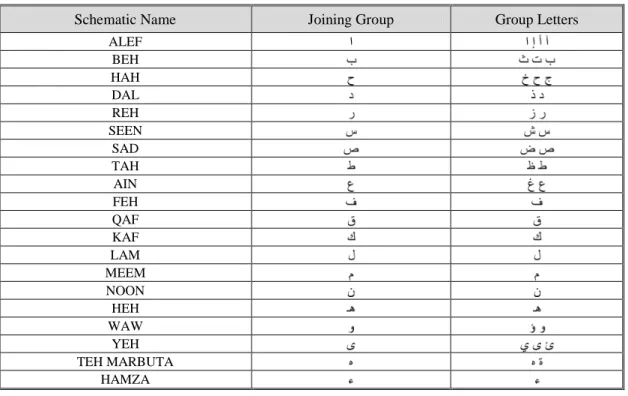
Arabic alphabets depend on dots to differentiate between letters. There are 19
“joining groups” (Unicode 1991-2006). Each joining group contains more than
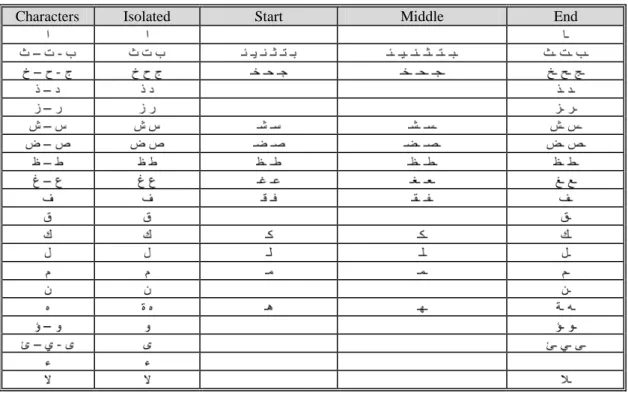
one similar letter which differs in the number and place of the dots, as for example ( ) which have the same joining group ( ) but with differences in the place of dots. Table 2.1 lists the joining groups, their schematic names and their group letters. The Hamza ( ) is used as a joining group, although it is not included in Unicode. Table 2.2 shows the same joining groups but the letters are shown in their location in the word. The character in its different location is called a glyph.
The Arabic language incorporates ligatures such as (Lam Alef ) which actually consist of two letters ( ) but when connected produce another glyph. In some fonts like Traditional Arabic there are ligatures like (ـ ) which come from two letters ( ).
Table 2.1: Arabic joining groups and group letters, with their English name
Schematic Name Joining Group Group Letters
ALEF BEH HAH DAL REH SEEN SAD TAH AIN FEH QAF KAF LAM MEEM NOON HEH WAW YEH TEH MARBUTA HAMZA
Arabic script can use diacritical marking above and below the letters such as ( ) termed Harakat (Consortium 2003) to help in pronouncing the words and in indicating their meaning (Fahmy and Ali 2001). These diacritical markings are not considered in this research.
The three letters Ain, Ghain and Heh ( ) have four different glyph shapes according to their location in the word, while the rest of the Arabic letters have two different glyphs in different locations inside the PAW. This is shown in Table 2.3.
An Arabic word may consist of one or more sub-words. We have termed these disconnected sub-words PAWs (Pieces of Arabic Word) (Amin 1997; Lorigo and Govindaraju May, 2006). For example ( ) is an Arabic word with three PAWs ( ). The first and inner PAWs of the word must end with one of the six letters ( ) as these are not left connected. Hamza is a separate PAW.
Table 2.2: Arabic joining groups and group letters, defined with letters location
Characters Isolated Start Middle End
Table 2.3: Arabic letters and their shapes at different locations within words English Name Arabic Letter Isolated Start Middle End
ALEF BEH THE THEH JEEM HAH KHAH DAL THAL REH ZAIN SEEN SHEEN SAD DAD TAH ZAH AIN GHAIN FEH QAF KAF LAM MEEM NOON HEH WAW YEH
Arabic letters have four different shapes according to their location in the word (Lorigo and Govindaraju May, 2006); Start, Middle, End and Isolated. For the six letters ( ) there is no Start or Middle location shape. The letter following these six letters must be used in its Start or Isolated location shape. In the joining type defined by the Unicode standard all the Arabic letters are Dual Joining, except the previous six letters and the Teh Marbota ( ) which is joined from the right side only. The Hamza ( ) is not a joining letter. Table 2.3 shows the different shapes Arabic letters adopt in different locations and gives their English names.
Fifteen Arabic letters have dots: 12 letters have dots above the baseline; while three have dots below it. 10 of the fifteen letters use one dot, three use two dots and two use three dots (Khorsheed 2002). Table 2.4 shows the dots different distribution among letters.
Table 2.4: Arabic letters with dots distribution
Description Arabic Letters
Letters with dots above baseline Letters with dots below baseline
One dot Letters
Two dots letters
Three dots letters
2.2.2
Recognizing written Arabic
The Arabic language is not an easy language for automatic recognition. Some of the particular difficulties that must be faced by the developers of OCR applications are:
Characters are cursive and not separated, as in the case of Latin script. Hence, recognition normally requires a sophisticated character segmentation algorithm.
Characters change shape depending on their location in the word. The distinction between isolated characters is lost when they appear in the middle of a word.
Sometimes Arabic writers neglect to include whitespace between words when the word ends with one of the six letters ( ). This is known as the connected word