Short -Term Stabilisation Versus
Long-Term Price Stability: Evaluating Namibia’s
Membership of the Common Monetary
Area
Meshack Tunee Tjirongo
WPS/95-18
December 1995Centre for the Study of African Economies Institute of Economics andStatistics
University of Oxford St Cross Building
Manor Road Oxford OX1 3UL
Abstract: It was found in this paper that (i) because of the high degree of openness of the Namibian economy and its small size, the use of nominal exchange rate as an instrument of adjustment will have limited effects; (ii) that the costs associated with the loss of monetary autonomy are small; and (iii) that there exists a wide range of instruments to address the effects of asymmetric shocks, irrespective of loss of nominal exchange rate instrument. For example, adverse shocks to incomes in Namibia can be cushioned by flows of financial capital, which may involve holdings of assets which are claims to outside
Member countries include, Angola, Botswana, Lesotho, Malawi, Mauritius, Mozambique, Namibia,
1
Swaziland, Tanzania, Zambia, and Zimbabwe. SADC was established in 1980 to promote cooperation in a wide range of areas, i.e. trade, political and development among its members, and by so doing lessen their dependence on South Africa. However, South Africa joined SADC in 1994 and the organization has since shifted its focus to promoting stronger regional integration among its members.
In 1986 Swaziland insistent on renegotiating the Rand Monetary Area Agreement in the light of the
2
imposition of financial sanctions against the South African economy and the depreciation of the rand. The new agreement is known as the Common Monetary Area (CMA) agreement.
1. Introduction
Regional integration continues to be a high priority in Europe, North America, Latin America, and Asia. Notwithstanding Africa's disappointing experience with regional integration, interest in such schemes on the continent continue to influence research agendas. This is due to the belief that the benefits of regional integration remain valid for Africa (see Elbadawi, 1995). The view is widely held that Southern Africa, with South Africa the dominating partner, could lead regional integration in Africa (African Development Bank, 1993).
South Africa's accession to the Southern African Development Coordination (SADC ) and recent1
proposals to enlarge that agreement have implications for the role and functions of the Common Monetary Area (CMA). It might well be the case, as the experience of the CFA-zone countries would suggest, that a monetary union be a necessary condition for the success of regional trade integration. However, in 1976 Botswana left the CMA (this is discussed in section 4), while more recently Swaziland considered opting out in order to gain control over its exchange rate in order to insulate its economy against the effects of external shocks on the South African economy . The2
demands for national autonomy over monetary policy as well as closer regional integration and the stimulation of intra-regional trade in Southern Africa, may seem to be in conflict.
Namibia is the most recent country in Southern Africa to gain independence. As such it has to redefine and establish its role within SADC and the CMA based on its own national development priorities. Its decision with regard to the CMA might be indicative as to the direction in which regional integration will develop. The Namibian economy is an extreme case of an open economy with a small non-tradable sector. The country is thus particularly susceptible to the asymmetric effects of external shocks to the region, and might therefore be at a disadvantage without control over its nominal exchange rate. Furthermore, the economic theory of optimum currency areas has developed in new directions where policy credibility and time consistency are emphasised as necessary conditions to attract and stimulate investment and growth. This suggests that there might be a trade-off in a country's decision to join a monetary union, namely between short-term stabilisation and long-term growth. This is because when a country joins a currency union, it gives up the use of the nominal exchange rate as an instrument of adjustment. Accordingly, in the face of external imbalance, the country cannot invoke instruments that will ensure expenditure-switching, hence the country has to rely on expenditure reduction and fiscal retrenchment, which prolongs the effect of a negative shock. However, the long-term price stability and reduced exchange rate instability engendered by a currency union are hoped to be necessary building blocks for the promotion of investment and hence long-term growth.
In light of the above, the purpose of this paper is to evaluate Namibia's membership of the CMA, and to generalise the findings to the Southern African region. This will inform the policy debate on
SACU evolved from previous regional integration arrangements involving the Customs Union
3
Convention between the Cape Colony and the Orange Free State Republic of 1889; which was expanded in 1906 to incorporate the Transvaal, Natal, Southern Rhodesia, North-Western Rhodesia, and the three High Commission
ways to facilitate greater regional integration. The structure of the paper is as follows: section 2 briefly describes the SACU and the CMA agreements; in section 3 the costs and benefits of Namibia's participation in the CMA are assessed; section 4 investigates the optimal ways that Namibian authorities can reduce the country's vulnerability to external shocks within the CMA context. Section 5 provides a summary and conclusion.
2. The Southern Africa Customs Union and the Common
Monetary Area
The Southern Africa Customs Union (SACU) is one of the oldest regional integration schemes in sub-Saharan Africa . It provides for a duty-free flow of goods and services between member states,3
a uniform external tariff and a mechanism to distribute the tariff revenue arising from trade among themselves and with other countries. It also allows member countries to develop their own industries with protection against producers from the common customs area.
Several costs and benefits of SACU membership for Namibia can be discerned. Possible costs are: (i) the abdication of the external tariff as an economic policy instrument (this is especially so, because South Africa merely informed other partners rather than consulting them about changes of external tariffs); (ii) the price-raising effect of Common External Tariff (CET) on goods originating outside the customs area, and (iii) a possible polarisation of industry, since South Africa is industrially more developed than the BLNS countries. The possible benefits are (i) less uncertainty and greater stability in receipts of revenues from the common customs revenue pool; (ii) trade creation due to the enlargement of the market for locally produced goods and the exploitation of scale economies in order to stimulate technological change, investment and inter-industry linkages; and (iii) welfare effects from the elimination of duties (akin to transactions costs in the case of a currency union) on goods and services between member states.
The revenue sharing formula provides for compensation of the BLNS countries for the possible price-raising effects of CET and for possible trade diversion effects as well . As a proportion of4
South Africa's total trade the shares of SACU member countries is estimated at 5%. However, SACU member countries purchase a large portion (about 90% of imports) of their imports from South Africa.
Like SACU, the Common Monetary Area (CMA), formerly the Rand Monetary Area, evolved from
5
informal monetary integration of the BLS countries with South Africa. The four countries were at one stage ruled by Britain, using the pound sterling as their common currency, later replaced by the Rand in 1961. Thus, when the BLS countries gained independence in the 1960s, they were already not only members of SACU, but also de facto members of a currency union with South Africa, which was formalised in 1974 (Guma, 1985).
The Common Monetary Area (CMA) consists of South Africa, Namibia, Lesotho, and Swaziland.5
Botswana was a member until 1976. The CMA is a hybrid of currency board and monetary union. It is a currency board because domestic currency issuance is backed by foreign assets. The system does not allow the monetization of fiscal deficits. However, unlike an orthodox currency board, the monetary system in Namibia is administered by a central bank. The central bank has the mandate to perform the normal functions ordinarily performed by such institutions, including the possibility of extending loans to their respective governments. In the CMA, the South African currency, Rand, is the dominant currency. Key aspects of the CMA Agreement are highlighted in Appendix A. The CMA Agreement can be divided into three subdivisions: (i) definitional, (ii) operational, and (iii) economic. The definitional category provides the legal interpretations of the agreement. The second set of articles outline operational procedures, such as the collection and exchange of monetary statistics (Article 7); provision of consultation on matters of common interest (Article 8); procedures for settling disputes (Article 9); and procedures for terminating or amending the agreement (Articles 10 and 11). The economic provisions of the agreement deal with issues such as legal tender, intra-CMA transfers of funds, access to capital markets, foreign exchange transactions and compensatory payments for seigniorage forgone by the LNS countries for using rand.
Swaziland introduced a national currency in 1974 and eliminated the Rand's legal tender status in 1989 (although the rand still circulates in Swaziland). Lesotho and Namibia introduced their national currencies in 1980 and 1993, respectively. The rand remains legal tender in both countries. In all these countries, since the introduction of national currencies, a fixed (1:1) parity with respect to the rand had been maintained, backed 100% by foreign exchange reserves. However, the fixed parity is not irrevocable.
2.1 Implications for Monetary and Fiscal Policy
The convertibility requirement implies that 100% of the Namibian currency issued is fully backed by foreign exchange assets. Thus, in principle, fiscal deficits cannot be accommodated by printing money. In addition, the free flow of capital between Namibia and the rest of the CMA ensures that interest rates in Namibia are determined in the larger money and capital markets of South Africa. Hence, interest rates are exogenous. Membership of the CMA, however, implies foremost that Namibia loses control over the nominal exchange rate as an instrument of economic policy. The question is thus frequently posed in Namibia whether or not it is in the interest of that country to remain within the CMA. This question has to be addressed within the framework of the nature and effects of external shocks to the Namibian economy.
The lack of the nominal exchange rate becomes more of a problem should Namibia be affected differently by external shocks from South Africa. The structures of the two economies are different. Namibia's production and export base is small, heavily dependent on minerals (mainly diamonds), fish and livestock production. In contrast, the South African economy is highly diversified in terms of its mineral, agricultural, and manufacturing production base. Gold is the dominant mineral export
commodity for South Africa. Further, the Namibian economy is highly open with a very small non-tradable sector. Thus, given these factors: high specialised production, concentration of exports in few commodities (diamonds, and livestock), Namibia is subject to external shocks. In this respect, the loss of the nominal exchange rate as an instrument of adjustment may be costly.
3. External Shocks to the Namibian Economy
This section assesses the nature and frequency of external shocks to the Namibian economy in order to assess the costs if not adjusting the exchange rate to restore external balance. By all measures , the Namibian economy is highly open, which renders the country particularly susceptible6
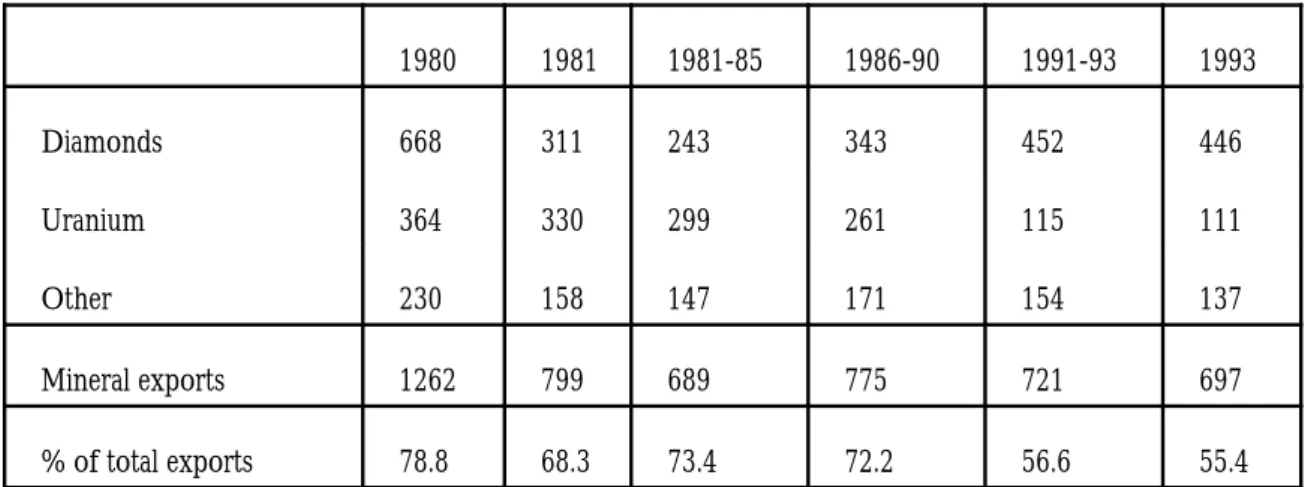
to external shocks. The major external shocks that the Namibian economy was subject to between 1980 and 1992 were due to (i) changes in the demand for minerals and in mineral prices, (ii) adverse weather conditions and (iii) the political unrest in South Africa. The impact of (i) and (ii) can be seen from figure 1, which shows the time profile of diamonds, uranium, manufactures and agricultural exports.
It is particularly noticeable that uranium exports are showing a secular decline (as shown in figure 1). The other series fluctuate significantly around an almost constant long-run mean, with diamonds perhaps the most volatile. The international demand for diamonds plummeted
incomes and exports. On a sectoral basis, agriculture absorbs nearly 75% of the total labour force.
Table 1: Mineral Exports ($'000 million)
1980 1981 1981-85 1986-90 1991-93 1993 Diamonds 668 311 243 343 452 446 Uranium 364 330 299 261 115 111 Other 230 158 147 171 154 137 Mineral exports 1262 799 689 775 721 697 % of total exports 78.8 68.3 73.4 72.2 56.6 55.4
Source: Bank of Namibia, Annual Reports, and Economic and Statistical Review, Ministry of Finance, various issues.
The third exogenous source of shocks was the instability in South Africa. The impact of trade and financial sanctions imposed on South Africa in 1986 negatively affected sales contracts for Namibia's uranium. During 1980-84 uranium partially offset the fall in diamonds, but since 1986 its significance has diminished. Owing largely to sanctions, Namibia could not renew its long-term sales contracts for uranium. In 1990 when the sanctions were lifted on Namibia, uranium spot prices were depressed due to the glut in the market caused by sales of uranium from the former Eastern Bloc. As a consequence uranium output fell sharply from a peak of 5 000 short tons in 1980 to less than 2000 short tons in 1992. Similarly, export earnings from uranium fell to $111 million in 1992 from over $400 million recorded in 1986.
There were no immediate policy measures undertaken in response to the shocks affecting the Namibian economy. However, following the debt crisis in 1985 and the subsequent imposition of trade and financial sanctions in 1986, a few policy measures were taken by the South African authorities. These included the reintroduction of the financial rand in 1985, tightening of domestic credit conditions, import surcharges and further increases in import quotas in 1988 and 1989. By then economic conditions in Namibia necessitated a different policy response. Diamond market conditions had improved and the sales quota was lifted, while the drought had also lifted. Expansionary policy would have been the rational policy response, initially, in order to aid the economic recovery. Thus the tight monetary and fiscal policy stance was not the appropriate policy response to the problems that the Namibian economy was facing at the time. The experience of Lesotho and Swaziland in 1985 shows the potential problems inherent in a hegemonic monetary
External shocks and the resulting reaction they require would suggest that a case could be made for de-inking and re-establishing control of the nominal exchange rate. Any such decision should, however, be made within the realization that costs and benefits of a currency union are broader. These are examined in the next section.
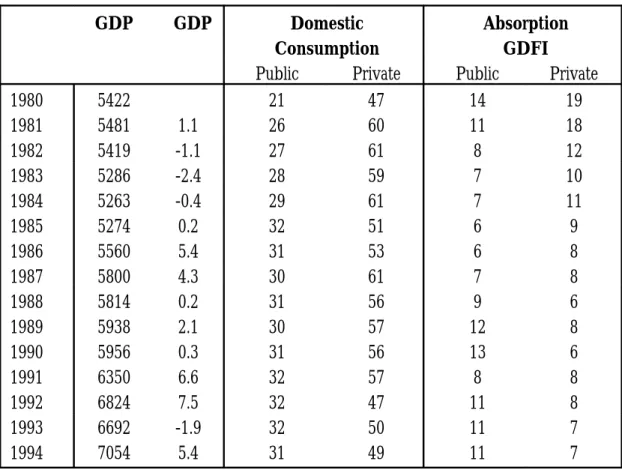
The possible effects of the shocks on the overall performance of the economy are summarised in Table 2 and Figure 2. During the 1980-94, the Namibian economy experienced a lacklustre performance. Notably, it can be observed that despite the poor growth performance of the economy there was no corresponding adjustment. As a consequence, the bulk of the adjustment seems to have been absorbed by the contraction in investment expenditure. As shown in Chart 4 the ratio of gross domestic fixed investment (GDFI) to GDP declined to 14% in 1991 from a peak of 33% in 1980.
4. Costs and Benefits of CMA for Namibia
There are different forms and levels of monetary integration (see Tavlas, 1993; Corden, 1972). Cobham and Robson (1994) asserts that while the costs for any form of monetary integration are the same (i.e. the loss of nominal exchange rate), the benefits are, however, substantially higher with higher forms of monetary integration. The CMA is a hybrid of a currency board and monetary union. When will greater monetary integration of, say countries A and B, be mutually beneficial? The earlier literature on optimum currency areas pointed to certain characteristics with respect to factor mobility, size, openness and degree of diversification to determine whether or not monetary integration is beneficial or not (Mundell, 1961; McKinnon, 1963; and Kenen, 1969). In the first subsection of this chapter these will be applied to the case of Namibia. The traditional literature is often supplemented by a discussion of positive and negative aspects of optimum currency areas. These will be set out in subsequent sections. The insights of the new theory of optimum currency areas will be discussed for the Namibian context.
4.1 Criteria for Optimum Currency Areas
The criteria discussed in the literature include (i) factor mobility, (ii) size, (iii) openness of the economy and (iv) the degree of diversification of the economy (see Mundell, 1961, McKinnon, 1963 and Kenen, 1969).
Table 2:
Selected Economic Indicators
GDP >>GDP Domestic Absorption
Consumption GDFI
Public Private Public Private
1980 5422 21 47 14 19 1981 5481 1.1 26 60 11 18 1982 5419 -1.1 27 61 8 12 1983 5286 -2.4 28 59 7 10 1984 5263 -0.4 29 61 7 11 1985 5274 0.2 32 51 6 9 1986 5560 5.4 31 53 6 8 1987 5800 4.3 30 61 7 8 1988 5814 0.2 31 56 9 6 1989 5938 2.1 30 57 12 8 1990 5956 0.3 31 56 13 6 1991 6350 6.6 32 57 8 8 1992 6824 7.5 32 47 11 8 1993 6692 -1.9 32 50 11 7 1994 7054 5.4 31 49 11 7
Source: Central Statistical Office, Namibia.
4.1.1 Factor Mobility
In Mundell's (1961) original analysis of this issue, the advantage of a common currency area is that if a country's trade is more concentrated with a group of countries, the formation of a monetary union can enhance the common currency's functions. Eichengreen (1995) states that
" a currency ceases to function as a useful unit of account if you are the only one who denominates prices in it, or accepts it in settlements".
It therefore enhances a currency's functions as a means-of-payment and unit of account. If the monetary union is also formed with a currency that exhibits greater price stability, the domestic currency's function as a store-of-value is enhanced as well. It would also reduce transactions costs and the unfavourable effects of exchange rate uncertainty on tradeand investment.
0 5 10 15 20 25 30 35 1980 81 82 83 84 85 86 87 88 89 90 91 92 93 94 GDFI public private
Total migrant labour from South Africa's neighbouring countries amounted to 44% of total labour in
8
mining in 1992, from Lesotho (25%), Mozambique (12%), Swaziland (4%) and Botswana (3%). See also Corden (1973).
9
Figure 2:
Gross Domestic Fixed Investment (% of GDP)
(labour and capital) are fully mobile between countries. Thus, according to this criteria, countries between which there exists high mobility of labour are good candidates for a monetary union. Therefore Mundell contends that the criterion for an optimum currency area was a region or country in which factor mobility was high. Blanchard and Katz (1992) confirm that labour flows between the US regions play a role in adjustment to disturbances within the US economic and monetary union. However, this criterion should be considered in the context of labour market flexibility. Mundell (1961) did not distinguish between capital mobility and labour mobility. Labour movements between South Africa and its neighbouring countries have been extensive, but rather more so in mining . Labour movement of this type between Namibia and South Africa has8
been very small, owing to the fact that mining is itself a dominating activity in the Namibian economy. It should be noted, however, that several barriers to inter-CMA migration (i.e. immigration restrictions, language and cultural differences, and hostilities to foreigners) place doubts on the efficacy of labour mobility as compared with conventional mechanisms of payments disequilibria. Labour mobility also involves both real costs and psychological costs of adjusting to a new environment, Lanyi (1969) . While differences between present and expected income and9
4.1.2 Openness of the Economy
The more open an economy, the smaller the share of non-traded goods in output. This results in the nominal exchange rate not being an effective instrument to bring about changes in relative prices (McKinnon, 1963). For instance, to maintain external balance following a fall in the real demand for a country's exports, resources in a fully employed economy must be shifted towards production of traded goods and away from non-traded goods sectors. The smaller the non-traded goods sector the larger the exchange rate needed to transfer a given amount of resources, and the larger the required movement in relative prices. Given the objective of price stability, therefore, very open economies are good candidates for fixed exchange rates against their trading partners. This includes the possibility of joining with them in a currency union, provided the policies of their neighbours are consistent with price stability (see Masson and Taylor, 1993).
Melitz (1993) demonstrated that in more open economies, import prices and wages respond more quickly to exchange rate changes, suggesting that the real income effect of exchange rate variations would be so obvious to workers that they would not accept wage changes tied to a price index excluding imports. Therefore, in an extreme case of openness, exchange rate changes would induce proportional changes in costs, depriving the flexible exchange rate of all its corrective functions. The argument that exchange rate changes were ineffective implies that a devaluation can only work if workers suffer from money illusion. However, such assertion is not empirically supported (Johnson 1973; Ingram 1973; Willet and Al-Marhubi, 1994). While the distinction between anticipated and unanticipated policy changes is important, Willet and Al-Marhubi (1994) point out that many economies display sufficient short run wage and price rigidities, which provides at least some scope for short run macroeconomic stabilization policy. Further, Edwards (1992) and Corden (1993) argued that even in open economies nominal exchange rate changes affect the real exchange rate, and hence if openness is associated with a decision to forsake monetary autonomy for currency unification, this must reflect the savings in transactions costs rather than any irrelevance of exchange rate changes for adjustment. For instance, in a situation where there is wage and price stickiness and low labour mobility, exchange rate adjustments can reduce coordination problems and allow adjustment to take place with low transitional unemployment costs than would be caused by domestic inflation. This suggests that the exchange rate adjustments lose their ability to have real effects only in extremely small open economies (although, the concept of small is not clearly addressed in the literature), where there may be few non-traded good and services so that the exchange rate may do little than change the domestic price.
Corden (1972), however, pointed out that the openness criterion applied only to microeconomic demand changes in the domestic economy and did not apply to macroeconomic disturbances that occurred abroad, and to the extent the latter was the
primary cause of payments disequilibrium then the economy must be insulated by flexible exchange rates. The case for participation in a currency union may also be strengthened if small open economies tend to be financially undisciplined in which case the self-imposition of fixed exchange rates is supposed to lead to sounder economic management, or if they belong to an extreme category of the open economy where money illusion becomes irrelevant (Ishiyama, 1975). Further, Eichengreen (1995) shows that an inflation-prone country may also be inclined to join a monetary union to enhance the anti-inflationary credibility of its own monetary policy. This explains why a country like Argentina established a rigid dollar link following repeated failure to resist inflationary pressures.
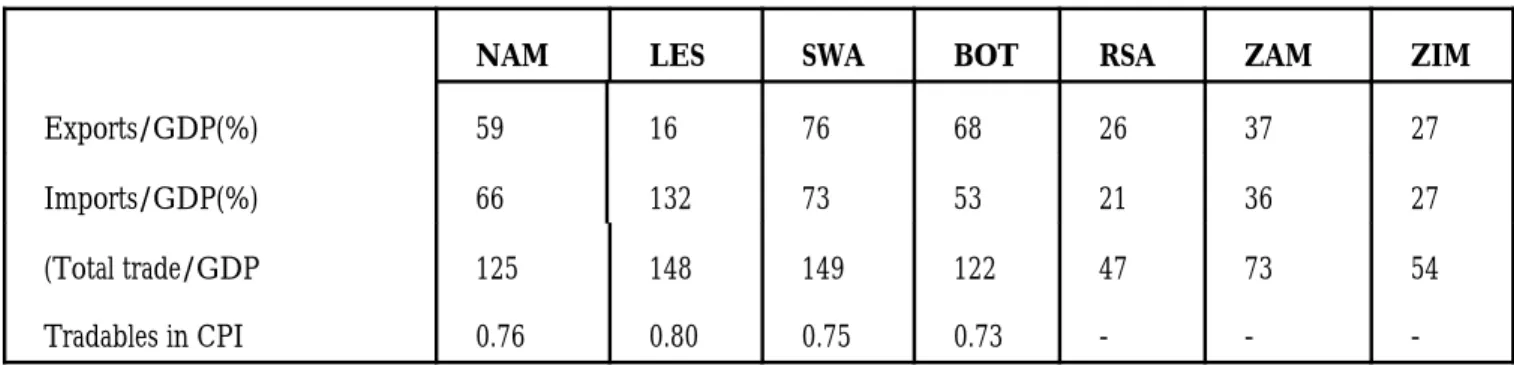
Table 3:
Indices of Openness
NAM LES SWA BOT RSA ZAM ZIM
Exports/GDP(%) 59 16 76 68 26 37 27
Imports/GDP(%) 66 132 73 53 21 36 27
(Total trade/GDP 125 148 149 122 47 73 54
Tradables in CPI 0.76 0.80 0.75 0.73 - -
-Source: International Financial Statistics, IMF, various issues.
From Table 3 it can be deduced that, compared to South Africa, Zimbabwe and Zambia, the BLNS economies can be regarded as being doubly dependent on external trade. The BLNS countries are also very small compared to South Africa, with about 5.5 million inhabitants (against 39 million in South Africa).
4.1.3 Degree of Diversification
The degree of diversification is an important consideration in whether to surrender control over nominal exchange rates by joining a monetary union, since for a country producing a small variety of products and exporting only one or a few products, a decline in export revenue would result in relatively higher unemployment than in a more diversified economy with fixed exchange rate (Masson and Taylor, 1993). However, even in a well-diversified economy, unemployment will only be avoided if there exists significant inter-sectoral factor mobility. Thus, a monetary union would perhaps be better suited to diversified countries where the need for flexible exchange rates would be less (Kenen, 1969). However, as Masson and Taylor (1993) note, with exchange rate flexibility a negative terms-of-trade movement or commodity price shock will increase the CPI and inflation through an exchange rate depreciation.
There is some contradiction between the criteria of diversification and size (Kenen, 1969). Normally, the more diversified an economy, the larger it would be and the smaller would be the proportion of tradables to non-tradables. Thus, relatively small adjustments in exchange rate may suffice to alter relative prices, and such a country would have little incentive to join a currency union. Further, the contradicting conclusions reached by McKinnon and Kenen are from different assumptions concerning the principal source of the payments disequilibria (Ishiyama, 1975).
McKinnon is concerned with internal and Kenen with external disturbances to exports. When instability is assumed to exist in the rest of the world, it is natural to have a flexible exchange rate to insulate the economy from outside disturbances.
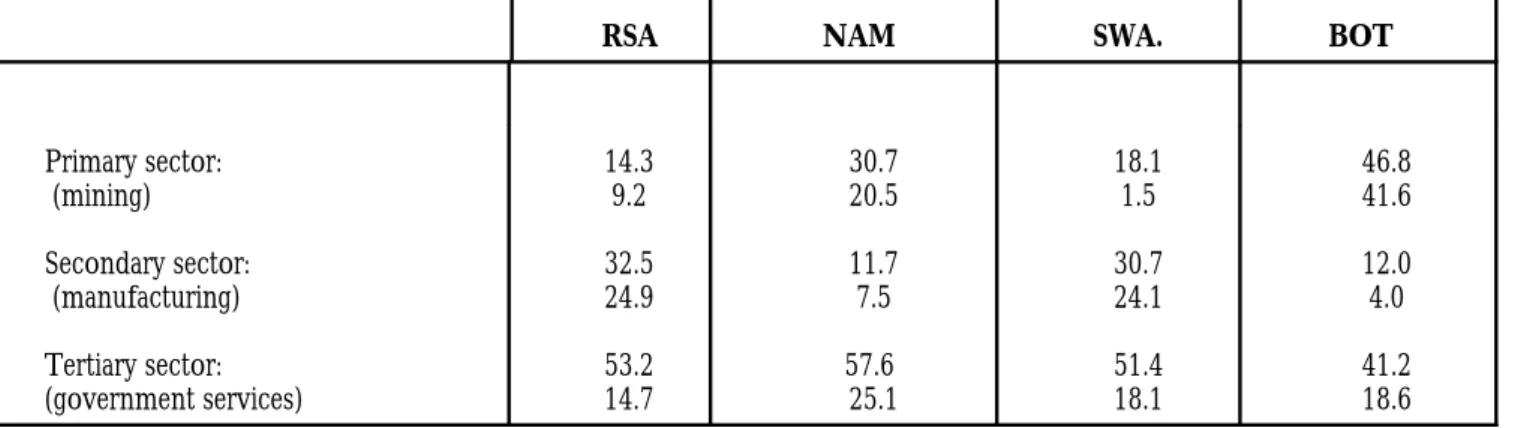
Table 4:
Degree of Diversification
RSA NAM SWA. BOT
Primary sector: 14.3 30.7 18.1 46.8 (mining) 9.2 20.5 1.5 41.6 Secondary sector: 32.5 11.7 30.7 12.0 (manufacturing) 24.9 7.5 24.1 4.0 Tertiary sector: 53.2 57.6 51.4 41.2 (government services) 14.7 25.1 18.1 18.6
Sources: Quarterly Bulletins of the Bank of Botswana, Bank of Namibia, South African Reserve Bank and the Bank of Swaziland.
The degree of diversity in the Namibian economy is shown in Table 3 relative to that of South Africa, Swaziland and Botswana. Table 4 shows that for Namibia, mining (mainly diamonds) dominates the economy. In this respect, it is similar to Botswana. In South Africa, and also Swaziland (another member of CMA) manufacturing contributes a larger share to total GDP. While it can be acknowledged that mining in South Africa is historically important, it represents only 9% as a share of GDP compared with manufacturing which has a share of about 25% in total output. The differing production structures, especially as regards Namibia and Botswana vis-a-vis South Africa is that shocks to the region are likely to have asymmetric effects, hence necessitating different responses.
From Table 4 it appears the Namibian economy has the largest share of the services sector, and possibly a larger non-tradable sector. Contributing to this, is the larger share of the government sector in Namibia. This is due to the fact that at independence the new government had to consolidate 11 ethnic-based "second tier authorities", an equal number of third tier authorities (municipalities), several statutory entities, one administration for whites, and one central authority. The immense duplication is apparent. The government recently carried out a Public Expenditure Review (PER) exercise (with the assistance of the World Bank) to help streamline its spending priorities. As expected the bloated civil service was found to be a cause for concern. Furthermore, it is very difficult in the context of SACU to determine a priori which services are indeed non-tradable.
4.2 Analysis of Costs and Benefits of CMA Membership
4.2.1 BenefitsBenefits of participating in a currency union relevant to the CMA include, efficiency gains from elimination of transactions costs, welfare gains from price stability, and less uncertainty in exchange rate movements between the national currencies and that of their major trading partner, South Africa.
4.2.1.1 Efficiency Gains from Elimination of Transactions Costs Transactions costs involved in converting one currency into another, gathering and processing information regarding forecasting future exchange rate developments represent a dead-weight loss. Using a common currency as a medium of exchange reduces transactions costs. De Grauwe (1994) maintains that there are welfare gains to society as a whole by eliminating such dead-weight costs. However, Eichengreen (1992) challenges the argument that monetary unification can be justified by the reduction in transactions costs that come with a single currency. He argues instead that the reduction in transactions costs should be weighed against the benefits of policy autonomy that will be lost when separate currencies are abolished.
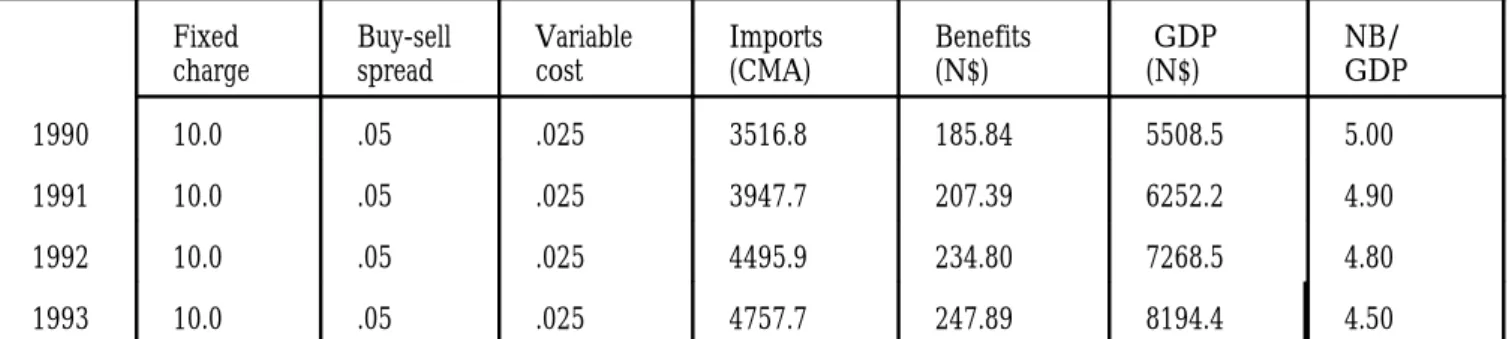
Table 5:
Benefits from Elimination of Transactions Costs, Namibia
Fixed Buy-sell Variable Imports Benefits GDP NB/
charge spread cost (CMA) (N$) (N$) GDP
1990 10.0 .05 .025 3516.8 185.84 5508.5 5.00
1991 10.0 .05 .025 3947.7 207.39 6252.2 4.90
1992 10.0 .05 .025 4495.9 234.80 7268.5 4.80
1993 10.0 .05 .025 4757.7 247.89 8194.4 4.50
Source: Bank of Namibia, Annual Reports, various issues
Notes: NB (net benefits) .The costs of foreign exchange transactions include the buy/sell spread estimated at 5 cents per N$1 exchanged, and a fixed commission of N$10 which is invariant to the volume of transactions plus 2.5% charged on transactions on amounts exceeding N$1000. These rough estimates are based on the current charges for foreign transactions by banks in Namibia.
The welfare gains to the Namibian society as a whole from the elimination of transactions costs are probably substantial, since 90% of Namibia's imports and 27% of its exports are effected through the rand. It is shown in Table 5 that the net benefits from elimination of transactions costs could be estimated to amount to about 5% of GDP.
4.2.1.2 Resource Savings on Foreign Exchange Reserves As indicated in Table 6, a large part of the LNS goods are exported to industrial countries, while nearly all their imports come
from South Africa - 90% of Namibia's imports are from South Africa. The advantage of the CMA in this regard is that the payments imbalances within the CMA are settled in the same currency.
Table 6:
BLNS Countries Trade with South Africa (1990)
Exports to RSA Imports from RSA
Botswana R311 802 (20%) R4 168 784 (78%) Lesotho 101 698 (75%) 1 802 216 (95%) Namibia 921 700 (25%) 2 529 040 (90%) Swaziland 556 815 (65%) 1 548 154 (90%)
Source: Bank of Botswana; Bank of Namibia, Bank Lesotho and Bank of Swaziland, annual reports, various issues; *own estimates.
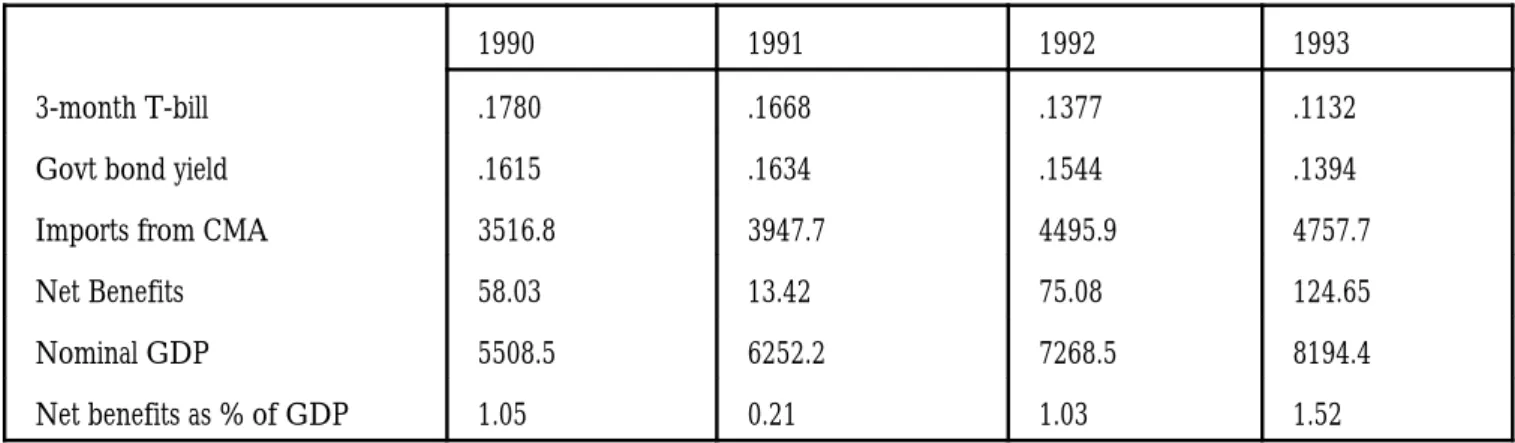
The implication is that the balance of payments imbalances between the CMA countries and South Africa do not force these countries to keep a substantial part of their foreign exchange reserves in short term assets, whose yields are low. This benefit, although not mentioned in the literature on optimum currency areas, probably has more far reaching consequences than it is believed. For example, the problem of shortage of foreign exchange (which has had paralysing effects on the economies of many African countries) is practically insignificant in the LNS countries. In table 7 the net benefits arising from savings on foreign exchange reserves are estimated at about 1% of GDP.
If member countries do not simultaneously incur a balance of payments deficit, and if economic shocks do not simultaneously affect them, a smaller pool of foreign reserves to support extra-union transactions may be required than if they managed their foreign exchange reserves individually. This will be beneficial to members.
4.2.1.3 Certainty of Exchange Rate in the CMA and Price Stability A further benefit of the CMA is the elimination of uncertainty facing producers and consumers. Intra-CMA trade patterns reveal that LNS countries are net importers of goods and services from South Africa. With separate currencies, uncertainties faced by both South African producers as well as Namibian producers and consumers will increase. These uncertainties could, in principle, be hedged through use of appropriate financial instruments, but for these markets to develop greater regional integration is in any case required to lend depth to the market and pool the risks involved. Furthermore, one of the primary reasons for the failure of regional integration schemes in Africa is limited trade between member countries. Often this is due to uncertainty of payments owing to foreign exchange scarcity. In the CMA this uncertainty is avoided since payments imbalances are all settled in the same currency. A CMA appears (at least in the African context) a necessary condition for greater regional
Because 90% of Namibia imports come from South Africa, Namibia would maintain some rand in its
10
foreign exchange reserve portfolio. For this reason, the opportunity cost of holding reserves was proxied by the trade off between investments in South African short-term assets (Treasury bills) and long-term assets (15-year government bond).
For a more elaborate discussion of these phenomenon, see De Grauwe, (1994:68-9; Stiglitz and Weiss
11
(1981).
Table 7: Namibia's Foreign Exchange Reserves Savings From Intra-CMA Trade10
1990 1991 1992 1993
3-month T-bill .1780 .1668 .1377 .1132
Govt bond yield .1615 .1634 .1544 .1394
Imports from CMA 3516.8 3947.7 4495.9 4757.7
Net Benefits 58.03 13.42 75.08 124.65
Nominal GDP 5508.5 6252.2 7268.5 8194.4
Net benefits as % of GDP 1.05 0.21 1.03 1.52
Source: Bank of Namibia, Annual Reports, various issues.
Table 8:
Namibia's Direction of Trade (N$ Million)
CMA ROW Trade Balance Total TB Exports Imports Exports Imports CMA ROW
1990 693 2629 2111 282 -1,936 1,829 -107
1991 737 2803 2664 305 -2,066 2,359 293
1992 893 3157 2933 410 -2,264 2,523 259
1993 949 3229 3275 483 -2,280 2,792 512
Source: Bank of Namibia, Annual Reports, various issues.
Exchange rate uncertainty introduces uncertainty about future prices of goods and services. Price uncertainty is likely to lead to an increase in risk, which will generally increase the real interest rate. Higher interest rates lead to increased problems of selecting investment projects, i.e. the problems of moral hazard and adverse selection , which lead to the selection of more risky11
investment projects, thereby increasing the systemic risk. Wihlborg (1994), argues that if there was a common source of increases in both the exchange rate and interest rate, then no conclusion about the contribution of exchange rate risk to total risk can be drawn. Therefore, in the long run, exchange rate flexibility would not contribute to an increase in macroeconomic risk, but short-term un-hedged positions would be subject to more risk under floating exchange rates. A currency union eliminates this exchange rate uncertainty so that the price mechanism serves as a better guide to make informed economic decisions. Further, eliminating exchange rate risks will lead to a larger welfare gain in small and open economies than in large and relatively closed economies (see McKinnon 1963).
The welfare gains from less uncertainty of the exchange rate is, however, controversial. For example, De Grauwe, (1994: 66) argues that:
"if gains from a common currency and the ensuing reduction in risk are to be expected, they should be found elsewhere than in the static welfare gains".
He elaborates that:
"from the point of view of the firm, it is generally the case that price uncertainty may increase the average profits of the firm; while in terms of welfare comparisons it is unclear whether welfare increases or decreases with uncertainty from the viewpoint of both firms and consumers".
Further, empirical studies have failed to uncover statistical evidence that exchange rate variability has had a depressing effect on international trade volumes. In fact international trade has continued to expand more rapidly than output throughout the last two decades of widely fluctuating exchange rates (Isard, 1995).
Krugman (1989) argues that exchange rate uncertainty may in some cases delay productive investments or in other cases, firms may be induced to install excess capacity, spread over different countries, in order to be able quickly to switch production to low-cost locations subsequent to any exchange rate movements. This new conceptual framework thus provides a new rationalisation for the long-standing view that a s system of fixed (stable) exchange rates, other things being equal, is conducive to economic integration, efficient investment and growth (see Isard, 1995).
4.1.2.4 Fiscal Discipline, Credibility, and Macroeconomic Stability In a situation of high capital12
mobility, exchange rate and monetary policies are linked so that fixing the exchange rate against a dominant currency means adopting monetary policies that are consistent with those of the country issuing the dominant currency. If this country's low-inflation policy is credible and the fixed rate also perceived as firm, the nominal anchor achieves two objectives: discipline and credibility.
is that should Namibia suffer a terms-of-trade shock, normally it could either (i) reduce expenditure and consumption or face an economic contraction, or (ii) borrow from the international market, or (iii) use inflation tax. With a monetary union such as CMA, option (iii) becomes impossible. This leaves foreign borrowing, which is not available in unlimited amounts. Thus, the eventual brunt of adjustment will fall on fiscal retrenchment. Within the CMA, the Bank of Namibia can use its overdraft facility with the South African Reserve Bank to borrow reserves. The amount borrowed carries interest at market rates, and the Bank of Namibia Act of 1990, specifies that government borrowing cannot exceed 25% of its average total revenue achieved in the past three years. These factors thus all limit the financing of fiscal deficits in Namibia.
It can be argued that this discipline, and the macroeconomic stability it engenders, should be highly beneficial for stimulating investment and attracting direct foreign investment in particular. The exchange rate commitment disciplines the monetary authority as it allows little discretion over domestic credit creation, which in turn should condition the government's budgetary process. For this reason, it is argued that pegging alone, without the support of other policy measures, will not help in gaining credibility. Credibility of the exchange rate commitment depends on the perception by economic agents that discipline will be maintained (see Cukierman, et al 1993).
The requirement that the domestic currency issued be exchanged for foreign exchange limits the extent to which the government's deficits can be accommodated by the Bank of Namibia. The Bank of Namibia operates a discount window or overnight credit facility for its customers (i.e. commercial banks and the government). At the time of its inception, the maximum amount was limited to N$20 million at a time, apportioned equally between the banks and the government. The interest charged on these loans will have to be at market rates or higher and indeed the Bank of Namibia overdraft rates have been maintained at 2.5 percentage points above the South African Reserve Bank's lowest rediscount rate on Treasury bills. The combined effect of all these factors limits financing of government's deficits by the central bank. Further, commercial banks in Namibia have so far used the credit facility for clearing purposes only, while borrowing through their parent banks in South Africa.
Johnson (1971) argued that participating in a currency union imposes constraints on government domestic borrowing, which compel the government to resort to international borrowing on competitive terms, and not the creation of money in their favour. In the Namibian case, where financial markets are highly integrated, resorting to this form of financing can encourage an outflow of capital into other parts of the union.
4.2.2 Costs
Participation in a currency union involves some costs associated with loss of autonomy over monetary and exchange rate policy. The costs may be higher, especially in high inflation-prone countries, where seigniorage constitutes a significant source of government revenue (see Dornbusch, 1992). The nature of shocks a country experiences may also determine the degree to which a nominal exchange rate policy is used as an instrument of adjustment. Besides economic considerations, political objectives may influence a decision either to participate in a currency union or to maintain an independent currency.
4.2.2.1 Potential loss of Seigniorage In many African countries, the fact that the government is the13
sole issuer of money is important. Because countries face different collection costs for conventional taxes, and hence their optimal inflation rates differ, this suggests that any common currency constraint that makes the inflation rates of two countries converge must decrease the revenue of at least one of the countries (Goldberg, et al 1994). The less developed the tax system, the greater the economic costs in raising revenue by increasing taxes, and the lower the costs of increasing revenues through inflation. This implies that, for a high-inflation country converging to a lower rate of the currency union will involve a cost in terms of seigniorage revenue. However, the validity of the assumption that inflation rates and hence seigniorage revenues are optimally chosen, is dubious. As Masson and Taylor (1993) noted, in many cases, inflation is an unintended consequence of undisciplined policies. The bias toward over-expansionary monetary policies, whether for the purpose of increasing economic activity or for public finance reasons, is likely to be strong. Further, Masson and Taylor (1993) show that there are economic benefits associated with domestic control of inflation tax, especially because of its insurance value. For example, highly indebted countries can issue debt at significantly reduced costs if investors know that there exists a purchaser of last resort, namely the central bank, to backstop the market in the event of a debt run. A credible purchaser of last resort is sure to exist only when the central bank remains under domestic control; otherwise investors would demand a significant risk premium to hold domestic currency-denominated government debt.
The foregoing arguments suggest that the goal of price stability pursued through a currency union may conflict with an attempt to use monetary expansion to finance government expenditure, as an alternative to raising revenue by conventional forms of taxation or issuing debt. This benefit should, however, be viewed in the context of the costs such a strategy will engender. Most forms of taxation produce distortions which rise with the tax rate. The distortions associated with inflation are so high that it is apt to be optimal not to use it at all (see Canzoneri and Rogers 1990). The reliance on issuing money as a means of financing government expenditure varies considerably across CMA countries and the non-CMA countries (Botswana, Zambia and Zimbabwe). Estimates of seigniorage as a percentage of GDP are given in Table 9 below.
Seigniorage was derived as follows: S=Fxm where ` is the rate of growth in nominal money supply and
14
m the real money stock. The period covered is 1987-91. Monetary shocks are ruled out in a currency union.
15
Table 9:
Seigniorage Revenue
14Namibia Lesotho SWA. RSA Botswana Zambia Zimbabwe
1.6 2.6 1.2 2.7 1.1 4.8 2.2
Source: International Financial Statistics, various issues.
Based on the experiences of developing countries, Cukierman, Edwards and Tabellini (1992) show that country reliance on seigniorage significantly increases with the share of agricultural output in an economy, with the degree of urbanisation, and with observed political polarisation and instability. Reliance on seigniorage declines with the extent of industrialization and dependence of an economy on foreign trade. For Namibia there is heavy reliance on external tariffs or SACU transfers (collected from the common revenue pool) and mining taxation. Hence, this may reduce the propensity to resort to money printing to extract inflation tax.
4.2.2.2 Asymmetric Disturbances and Real Exchange Rates Even if a strong case for a monetary union can be made, relinquishing the exchange rate instrument may involve a cost when the country is faced with external disturbances . One central aspect is whether shocks are symmetric or15
asymmetric (hit the countries differently). Different industrial structures may imply that real shocks facing the CMA countries can have asymmetric effects. The second aspect concerns whether shocks are temporary or permanent. Temporary shocks, to the great extent, can be cushioned by flows of financial capital, including financing, while permanent shocks require adjustment. Third, the origin of shocks, whether they are primarily nominal (i.e. to the price level) or real, domestic or foreign. Nominal exchange rate flexibility is likely to do the best in insulating the domestic economy from foreign, nominal disturbances. Fourth, whether financial market shocks occur primarily in demands for money, or across domestic interest-bearing assets, or for foreign assets. For example, if shocks occur in foreign exchange markets and are unrelated to economic fundamentals, then fixing the exchange rate may be the best solution.
A real exchange rate depreciation can be achieved through a nominal devaluation and/or through a contraction of aggregate demand, which eventually results in the decline of nominal wages and prices of non-tradables. In the long-run the two policies lead to the same effect on output and the trade balance, but the short-run dynamics are different. With a nominal devaluation, the country avoids the severe deflationary effects on domestic output during the transition, although inevitably with higher inflation. Whereas, with expenditure-reducing policies, inflation is avoided but output declines during the transition. Because of the assumption of downward rigidity in nominal wages, nominal devaluation helps the system to move to a new wage structure that is acceptable in the labour market. But when there is real wage rigidity, the nominal wage rises so that the desired devaluation is not achieved, instead it generates more inflation (see De Grauwe, 1994).
Even when confronted with symmetric shocks, individual countries may require different responses arising from differences in initial positions and differences in behavioral parameters about fundamental matters such as price and wage flexibility, tax structure, and trade responsiveness (Melitz, 1991). Thus two countries subject to symmetric shocks may have exchange rates aligned (i.e., differences in initial conditions) at levels that produce external disequilibria.
In a single currency area an implication of endogenous growth effects is that production is likely to become more spatially concentrated and more specialised, increasing the vulnerability of regions within the area to asymmetric shocks (Artis, 1991). In contrast, Emersson, et al (1992), argue that monetary integration increases industrial integration, rendering the effects of sector specific shocks to be more symmetric. In the CMA the observation by Artis seems to be relevant.
In Section 3, a broad pattern of external shocks, decomposed into quantity and price components, was estimated for Namibia. Diamonds prices were found to have a stabilizing effect on export unit prices, implying that most of the fluctuations in export receipts were attributable to changes in export volumes. The shocks that affect Namibia could be described as temporary, and accordingly economic agents react by dis-saving and/or borrowing externally to maintain current levels of consumption. In this context, access to foreign finance (from the South African financial markets) that bears no exchange rate is thus advantageous. The asymmetric effects of the external shocks also imply that the nominal exchange rate instrument may be desirable.
4.2.2.3 Differences in Regional Growth Another cost associated with a currency union is the possible deterioration of regional economies. It is argued that because of relative ease of capital compared with labour migration, monetary integration is likely to result in acceleration of economic distress and stagnation of certain regions or countries. This stems from the fact that fast-growing regions tend to attract capital because of their lower unit costs relative to the slow-growth regions (see Kaldor, 1970). Economic development of poorer countries and regions is a desirable feature of any monetary system, and it is thus important to question as to whether a currency union assists in the convergence of per capita income among the constituent parts (Masson and Taylor, 1993). Future research should quantify these effects-in the current context specifically to determine the degree of convergence between economic growth in South Africa and Namibia. Such considerations are important because income levels in the LNS countries lag far behind that in South Africa. A supranational fiscal transfer system may be desirable in the CMA to mitigate regional distress, and future research is recommended along these lines.
Recent economic theories emphasize the importance of dynamics and locational effects of regional and multilateral trade liberalization. In this respect, Namibia's membership in the CMA should promote investment and, therefore, boost economic growth. Further research is needed, however, to identify and quantify the sources and magnitudes of the relevant effects in this regard. But it should be noted that the lower risk due to less exchange rate variability reduces the expected future return on investment. Consequently, the reduction in risk has an ambiguous effect on investment
The most recent discussion of these issues can be found in Corden (1994), De Grauwe (1994) and Tavlas 16
(1993) as well the various discussion papers on EMS.
to confirm that the degree of exchange rate variability has a weak impact on the growth rates of investment, trade and output (De Grauwe, 1994).
Despite the reservations about the positive effects of the exchange rate stability on investment, monetary integration may benefit Namibia through its potential to promote macroeconomic stability and therefore stimulate growth. Cobham and Robson (1994) note that in Africa the dominant motivation behind monetary integration is to achieve faster growth. A related motivation is the hope that monetary integration will contribute to macroeconomic stability. In an evaluation of the CFA Franc Zone, Devarajan et al (1987) observed that the inflation rates in member countries were low in comparison with a group of comparator countries. They argued that this was due to the constraints imposed by the union in the use of monetary and exchange rate policies. In terms of growth these countries also outperformed their counterparts outside the union, at least until the early 1980s. The relatively strong performance appeared to be the result of the discipline forced upon these countries by the monetary arrangement.
4.2.2.4 Spill-over Effects of Fiscal and Monetary Policies in South Africa The hegemonic monetary arrangement whereby money supply and interest rates in the currency union are determined by actions of the Reserve Bank of South Africa, acting on the interest of South Africa alone, has a potential to raise conflicts. When South Africa engages in expansionary monetary policy, the ensuing inflationary pressures are transmitted to Namibia. In this respect, Namibia loses not only its ability to conduct an independent monetary policy, but experiences money supply effects that exacerbate the business cycle. The Estonian monetary system, where the currency board operates a hard currency peg rather than the ruble because of the economic instability in Russia, offers useful lessons for Namibia, in the case where South African policies become the source of adverse shocks. Further, if the trading partners are inflating rapidly, then a flexible exchange rate may be an important mechanism for reducing the importation of inflation. Alternatively, a supranational currency peg, such as the CFA-franc zone might be desirable.
4.3 New Theory of Optimum Currency Areas
The new theory of optimum currency areas recasts the traditional arguments in terms of new developments in expectations formation, time consistency and credibility problems, labour mobility under conditions of uncertainty, and exchange rate determination . In this section, some of the16
new contributions are highlighted, in respect to how they strengthen or weaken some of the arguments presented earlier.
4.3.1 Permanent Trade-Off between Inflation and Employment
There now seems a convergence in intuition among economists that the authorities cannot choose an optimal combination of inflation and unemployment. The permanent trade-off between inflation and unemployment along its Phillips curve was undermined by several developments: (i) the Friedman-Phelps hypothesis that the steady state unemployment rate is not related to the steady inflation rate when the Phillips relationship is augmented by a variable representing the expected
inflation rate (i.e. labour negotiates on the basis of the real, not nominal wages); (ii) the Lucas' observation that even in the short-run, perfectly anticipated changes in policy could undermine certain conditions, exert no impact upon real variables; and (iii) the experience of many countries during the 1970s and 1980s of rising unemployment in association with rising inflation (see De Grauwe, 1994; Corden, 1994). Since, unemployment is determined by the natural rate (independent of inflation), there is nothing to be gained by maintaining different inflation rates. By fixing their currencies and hence equal inflation rates, does not give rise to any cost in terms of unemployment in the long run (Corden, 1994). Convergence to a common inflation target involves adjustment costs whether the country chooses to join a monetary union or not. Hence the relevant question to ask is whether it is costly to do it within or outside the union. Examples abound of deflationary policies in the 1980s that gave rise to increased unemployment. For example, the French experience in the 1980s.
4.3.2 Time Inconsistency
The big advantage of a monetary union for Namibia, is that it improves time consistency of Namibia's economic policy measures. In a seminal article, Kydland and Prescott (1977) (later developed by Barro and Gordon, 1983) illustrated that, to gain a reputation of credibility, governments should pursue a policy that is not time inconsistent. Time consistency is best explained by an example. The public recognises, for instance, that while the policy makers may have every reason to announce a low-inflation target, similarly, there is a temptation to renege on that commitment once the private sector has formed expectations. Hence the public will not believe that the policy makers can convince them of their commitment. If not, such a rule or policy is said to be time inconsistent. But such opportunism produces, on average, a worse outcome than if the government had its hands tied (Blanchard and Fischer, 1989). In this context, tying the hands of the authorities (abolishing national monetary sovereignty) by joining a monetary union with a low inflation country may engender the benefits of low inflation reputation without much loss of output and employment (the short-run transition cost will still be relevant).
4.3.3 Commitment to an Exchange Rate Rule
What then lends credibility to pegging an exchange rate through the CMA? Credibility requires that the Namibian authorities incur a cost when failing to maintain the exchange rate peg (membership). The tighter or stronger the commitment, the larger the costs (especially political costs) of reneging from it. Cukierman et al. (1992) discuss the factors that determine the strength of commitment that policy makers choose to back a fixed exchange rate system. They decide how much to commit under uncertainty. The benefits from making a strong commitment must be weighted against the potential costs of being forced to renege on the fixed exchange rate commitment may be first due to adverse external shocks. However, as the proceeding discussion made clear, in the case of Namibia, a flexible exchange rate is not likely to alleviate these problems. Because reneging on
It is clear that the commitment is not irrevocable.
Participation in a currency union may be strengthened if small open economies tend to be financially undisciplined in which case the self-imposition of fixed exchange rates may lead to sounder economic management (see Ishiyama, 1975), or if they belong to an extreme category of the open economy where money illusion becomes irrelevant, since import prices and wages respond more quickly to exchange rate changes in small open economies, depriving the flexible exchange rate of all its corrective functions (Goldstein and Khan, 1985).
For African countries, a monetary union formed along the lines of CAMA and WAMU which has a supranational central bank has a clear advantage in terms of reputation and credibility. This is because there are no national banks (outside South Africa) in the region that either have the reputation or independence to provide a strong and stable anchor. (Cobham and Robson, 1994)
4.3.4 The Process of External Adjustment
In a flow model of exchange rate determination, exchange rate variation was seen to provide a speedy and effective adjustment for external disequilibrium since exchange rates were thought to be influenced primarily by movements in trade flows. In contrast, using the asset model of exchange rate determination, it is possible that exchange rate adjustments could involve long lags, than implied by the flow model (De Grauwe, 1992). This is illustrated by an example. Assume that domestic and foreign bonds are imperfect substitutes. Under these conditions, sustained current account deficits tend to increase the risk premium required to induce investors to hold securities denominated in domestic currency. This leads to a transfer of wealth abroad, decreasing the demand for financial assets denominated in domestic currency. Assuming perfect foresight, the current account influences the exchange rate indirectly, via the influence of wealth on risk premia (i.e. uncovered interest rate parity does not hold and domestic and foreign assets are imperfect substitutes). Therefore, the adjustment process is likely to be lengthy.
The speed of real exchange rate adjustment brought about by nominal exchange rate changes is also affected by the sunk cost considerations. The sunk costs model (due to Krugman, 1989) asserts that because of costs already incurred, exporters are hesitant to adjust their patterns of specialisation in response to exchange rates movements. Hence they may operate at a loss over the short term if they expect their operations to be profitable over the longer term.
The above analyses show that the speed of economic adjustment could involve long lags even with nominal exchange rates movements.
Further, concerning adjustment through factor mobility, Bertola (1993) asserts that the more uncertain the environment, the less should be the unwillingness of national economic agents to undertake adjustment that may ex-post be regretted. He models an agent who faces a decision between remaining in his present occupation or location or moving to another, with income uncertain in both locations and with fixed costs of moving. To induce movement, the expected income differential must exceed the fixed moving cost by an amount that is related to the probability that the agent may want to reverse the movement in the future. This amount can be modelled as the price of an option to move.
In this case Bertola shows that the pattern of movement exhibits hysteresis. Within a range of expected income differentials, there is no movement, and the width of this range depends positively on the degree of uncertainty. Thus the higher the uncertainty about earnings in different locations or sectors, the more reluctant an individual should be to move- because she is aware that migrating back will be costly if the wage differential changes sign as larger earning differentials will induce migration by others, reducing the income available to her in the new location. Asymmetric shocks increase income variability. Since the higher is income variability the less mobile is labour between two areas, more stable exchange rates reduce factor mobility. Conversely under flexible exchange rates, monetary policy can aim at stabilizing income; with less income variability, factor mobility is higher than it would be (other things being equal) under a fixed exchange rate regime.
To conclude this section, the fixed exchange rate required of Namibia by the CMA has been criticised for preventing efficient adjustment to external shocks. However, there were other considerations which suggest that this disadvantage might be outweighed by the benefits of belonging to the CMA. These are static benefits. However, if the CMA has a beneficial effect on investment and thus growth, then questions pertaining to long-term growth become pertinent. Seen in such a light, the criticisms against the CMA ignore an important trade off between short and long run efficiency.
Table 10:
Characteristics of the Namibian Economy Relevant to OCA
Analysis
Labour Mobility Less mobile within CMA, but greater potential for technical and professional labour.
Major players
Wage/salaries sector closer to those in South Africa.
Unionisation Formal sector labour is unionised, but represents only small a fraction of total labour force. Majority are Government and the mines (CDM)
Govt. salary scales inherited from South Africa; wages and salaries for skilled labour in the private
underemployed in the informal sector or traditional agriculture, and it is not unionised.
Capital Mobility open capital account vis-a-vis CMA
Financial capital some investment inflows from the union
Physicalcapital
Diversification Production mining: 30% of GDP; agriculture: 10%; manufacturing: 5%
Exports diamonds, uranium and other minerals: 70% of total exports.
Direction of trade Exports: RoW: 75%%, CMA: 25% Imports: ROW: 10%, CMA: 90%
Openness Exports/GDP ratio: 61%
Incidence of shocks droughts: 1981-82, 1991-1992. dwindling of fish stocks
imposition of sanctions on South Africa, 1985. quota on diamonds sales: 1981-83, 1992-market glut for uranium: since 1989
5. Optimal Responses to External Shocks within the CMA
Having established in the previous sections that it might be beneficial for Namibia to remain within the CMA, the problem of dealing with external shocks within the CMA remains to be addressed. This section suggests that without such an instrument (nominal exchange rate) the following strategies could produce moderation of the effects of asymmetric external shocks: diversification of assets through financial markets, external borrowing coupled with a well planned debt and foreign exchange reserve management strategy, and diversification of the economy. Although a coherent and consistent strategy remains to be determined, a preliminary discussion of the important considerations is appropriate.
5.1 Financial Integration
Should monetary union also be characterised by a high degree of integration in the financial market, it might lessen the need for flexible exchange rates, because only fractional changes in interest rates are required to elicit sufficient equilibrating capital movements across national frontiers (Ingram, 1959).
Johnson (1971) argued that participating in a currency union compels the government to resort to international borrowing on competitive terms, instead of creating money in their favour. However,
a large share of Namibia's government revenue is from external tariffs, SACU transfers from the common revenue pool, and mining taxation. As was stressed in the previous section, arguments about inflation tax being `the revenue of last resort' and providing investors with a purchaser of last resort (see Goodhart, 1995) is fraught with danger, since should a country switch from borrowing to, say, inflation, the government, in effect, reneges on its loans with the consequent deterioration of its reputation. The conclusion is that the fiscal stability and constraints on fiscal policy implied by membership of the CMA might in fact be an advantage in lending credible and time consistent the policies in Namibia. Through this it might attract significant foreign investment.
The current CMA provides for Namibia to have access to the South African money and capital markets. It should be noted, however, that such capital mobility serves to finance rather than to adjust to the consequences of external shocks (Tower and Willet, 1970). Another criticism is that monetary integration might result in highly mobile capital moving out of certain regions and thus causing the stagnation of certain countries at the periphery, unless a supranational fiscal transfer system is in place (Fleming, 1971).
Since capital mobility may serve to accommodate country-specific shocks, or to address long-term imbalances in regional development, it is important to distinguish between financial capital and physical capital . In view of the lags involved in the installation of plant and equipment, physical17
capital mobility is likely to assist mainly in narrowing persistent regional disparities, whereas financial capital can provide insurance against purely regional shocks, and could make consumption independent of shocks.
High mobility of financial capital should allow for financing differences between national savings and investment. Because of undeveloped financial markets in Namibia, the major problem is that of matching long-term savings to investment. Therefore, the intra-union mobility of physical capital may be more important. For this reason, one of the objectives of the currency union should be to encourage capital flows to modernize the less developed partners. However, it should be noted that even within a country, movements of physical capital are often insufficient to ensure development of depressed areas. In this respect, it is doubtful that the formation of a currency union can lead to a sufficient mobility of physical capital either to cushion shocks completely or to lead to quick elimination of underdevelopment. This point is further underscored by El-Agraa (1990), who contends that no region or country can borrow indefinitely on a private market, no matter how efficient and open the market is to sustain levels of real wages, and hence real consumption levels, which are too high, given the productivity level in the country.
Mobility of physical capital is typically within than between countries because of: the absence of exchange rate risk, uniformity of tax codes, similarity of regulations, common national characteristics (language, political goals, etc.). Notwithstanding, the absence of exchange rate risk, the factors such as differences in tax codes, regulations, and political goals could influence intra-union mobility of physical capital. With perfect capital mobility there should be no correlation between domestic saving and domestic investment. Saving in each country responds to worldwide
Union representation is most strong in the mining sector, although total mining employment only 18
represents about 3% of the total labour force.
opportunities for investment, while investment in that country is financed by a worldwide pool of capital (Feldstein and Horioka 1980). In Namibia, domestic savings represent over 80% of investment on average, while foreign savings represent only a small fraction of domestic investment. This observation suggests that although an open capital account could allow domestic investment to move independently of domestic savings, in practice the two variables would be close together. Future research should investigate the degree of mobility of physical capital to and from Namibia.
5.2 Wage Flexibility
It has been pointed out that the theory of optimum currency areas suggests that the response of wages and prices to nominal exchange rate changes can be large enough to limit the usefulness of nominal exchange rate changes. This may particularly be the case with wage indexation, i.e. rigid real wages.
The distinction between nominal and real wages is important. If real wages are perfectly flexible, then if nominal wages are sticky, the freedom of authorities over nominal exchange rate may be useful. However, it is redundant if nominal wages themselves are flexible to alter the real exchange rate (Eichengreen, 1995). This suggests that labour market circumstances be adjusted to enable flexible nominal and real wages to be established. Accordingly, the CMA membership conveys the message to workers and firms that an inappropriate level of money wages cannot be validated by nominal exchange rate adjustments and should be more likely to write contracts that deliver a greater degree of wage flexibility. Whereas if the government was prepared to adjust the nominal exchange rate in response to shocks, workers and firms will have less reason to write contracts allowing for changes in money wages. In Namibia, wage indexation is not widely practised. In view of the fact that the labour market exhibits disproportional union representation , and a large part18
of the labour force is either unemployed or underemployed in subsistence agriculture there is scope for wage flexibility. The employment structure of the Namibian economy is highlighted below to support the assumptions discussed above.
5.2.1 Employment Structure of the Namibian Economy
On a sectoral basis, agriculture is the major industry engaging almost half (48%) of the employed, followed by services (23%) and retail trade (10%). Mining, while it accounts for nearly a third of total income or GDP, employs less than 4% of the labour force. Nearly two-thirds of the employment in the services is generated in the public sector. The Namibian employment structure displays a wide variation between rural and urban segments of the economy. In urban areas the bulk of the labour is absorbed in services (42%), retail trade (20%) and construction, (10%). In contrast, agriculture accounts for about 70% of the total employment in the rural areas. Nearly 80% of women are employed in the agriculture and services sectors. The latter reflects the dominance of women in private households activities as domestic workers and in education. In contrast the shares of males in mining, construction and transport outnumber those of females.
The occupational composition of employment reflects the predominance of low skilled labour. Nearly 60% of the employed fall in the category of relatively less skilled and unskilled occupations of farm workers, domestic workers, etc. The top four categories (managers, professional, technicians and clericals) account for 15% of total employment. Occupational composition of the employed differs greatly by locality, such as rural and urban areas. The share of the top occupational categories in total employment is 32% in urban areas, in contrast to 7% in the rural areas. Three-fourths of the rural employees fall in the bottom occupational categories of farm workers or unskilled workers. In urban areas these categories account for 26% of total formal employment. The impact of the past practice of apartheid is manifested in the occupational composition of black and white Namibians. White Namibians have a disproportionately large share in the occupational categories of managers (70%) and professionals (50%).
A large section of the Namibian employed force has either primary education (34%) or no schooling (28%). Those with post-secondary school education account for less than 6% of the total employed. When it comes to the rural/urban distribution, about 75% of those employed in rural areas have either only primary education or no schooling at all.
There is a significant variation and spread of wages across industrial and occupational categories (see Figure 4). Mining pays the highest wages, with the average of nearly N$3000 per month. This is followed by finance and real estate, construction and central government sectors. The sectors which account for nearly 80% of the formal employment pay the lowest wages and salaries.
Table 11:
Distribution of Employed by Industry, Urban/Rural and by
Gender(%)
Industry Total Urban Rural M F
Agricultur