(will be inserted by the editor)
Feature Selection for High Dimensional Classification
using A Competitive Swarm Optimizer
Shenkai Gu · Ran Cheng · Yaochu Jin
Received: date / Accepted: date
Abstract When solving many machine learning problems such as classifica-tion, there exists a large number of input features. However, not all features are relevant for solving the problem, and sometimes, including irrelevant features may deteriorate the learning performance. Therefore, it is essential to select the most relevant features, which is known as feature selection. Many feature selection algorithms have been developed, including evolutionary algorithms or particle swarm optimization (PSO) algorithms, to find a subset of the most important features for accomplishing a particular machine learning task. How-ever, the traditional PSO does not perform well for large scale optimization problems, which degrades the effectiveness of PSO for feature selection when the number of features dramatically increases. In this paper, we propose to use a very recent PSO variant, known as competitive swarm optimizer (CSO) that was dedicated to large-scale optimization, for solving high-dimensional feature selection problems. In addition, the CSO, which was originally developed for continuous optimization, is adapted to performing feature selection that can be considered as a combinatorial optimization problem. An archive technique is also introduced to reduce computational cost. Experiments on six bench-mark datasets demonstrate that compared to the canonical PSO based and a state-of-the-art PSO variant for feature selection, the proposed CSO-based
Shenkai Gu
Department of Computer Science, University of Surrey, Guildford, Surrey, GU2 7XH, United Kingdom
Ran Cheng
Department of Computer Science, University of Surrey, Guildford, Surrey, GU2 7XH, United Kingdom
Yaochu Jin
1 Department of Computer Science, University of Surrey, Guildford, Surrey, GU2 7XH, United Kingdom
2 School of Management Science and Engineering, Dalian University of Technology, Dalian, China; 116023
feature selection algorithm not only selects a much smaller number of features, but result in better classification performance as well.
Keywords Feature selection· High dimensionality · Large-scale optimiza-tion·Classification·Competitive swarm optimization
1 Introduction
In machine learning and data mining, the target concepts of a dataset is usually described by a group of features. To build reliable models for solving problems such as classification, it is expected that the features contain as much useful information as possible, and the number of features can be as small as possible. However, since there is often little priori knowledge on the dataset, it is difficult to distinguish which features are relevant and which are not. As a consequence, there are usually a large number of features to be taken into consideration, including many irrelevant and redundant features. Unfortunately, irrelevant and redundant features will not only reduce the training efficiency, but also negatively influence the performance of machine learning thus trained with them, which is mainly caused by thecurse of dimensionality [16].
To eliminate the negative impact of the irrelevant and redundant features, various feature selection methods have been proposed [6]. The main target of feature selection is to choose relevant features from a large feature set [24, 17]. From the optimization point of view, feature selection is a difficult combina-torial optimization problem [16]. Firstly, since the size of the feature subset is not knowna priori, the dimensionality of the decision space is non-reducible. Secondly, since the features may have complementary or contradictory inter-actions with each other, the decision space is non-separable. Thus, given an
m-dimensional feature set, the number of all possible feature subsets is as large as 2m, which makes it very unlikely (if not impossible) to solve it with traditional exhaustive search approaches.
Due to the inefficiency of traditional search approaches in solving complex combinatorial optimization problems, various metaheuristics have been pro-posed, such as genetic algorithms (GAs) [19], differential evolution (DE) [31], and particle swarm optimization (PSO) [4], among many others [5]. Among various metaheuristics, PSO is well known for its algorithmic simplicity and computational efficiency. Recently, some researchers have proposed to apply PSO to feature selection [36, 13]. However, canonical PSO has many limi-tations for feature selection [41, 42]. Firstly, PSO was originally proposed for continuous optimization problems, while feature selection is a combinatorial optimization problem. Secondly, although PSO shows promising performance on low-dimensional problems, it suffers from the curse of big dimensional-ity [43]. Very recently, Cheng and Jin have proposed a PSO variant, known as competitive swarm optimizer (CSO), for large-scale optimization [10]. In CSO, both the global best position and the personal best position are removed. In-stead of learning from the global and personal best positions, the particles in
CSO learn from randomly selected competitors. CSO shows promising perfor-mance on a variety of continuous test problems of a dimension up to 5000, in comparison with some state-of-the-art algorithms for large-scale optimization. In this work, we propose to adopt CSO for high-dimensional feature selec-tion. To this end, CSO is modified to be suited for combinatorial optimizaselec-tion. The modified CSO variant is then embedded in a wrapper feature selection approach. The remainder of this paper is organized as follows. Section 2 briefly describes related work, including the canonical PSO algorithm and its relevant variants. Section 3 details the proposed method. We present the experimental results and discussions in Section 4. Finally, Section 5 concludes this paper.
2 Background
2.1 The Canonical PSO Algorithm
The canonical PSO algorithm was developed by Kennedy and Eberhart in 1995 to solve optimization problems by emulating social swarm behaviors of animals like bird flocking [21].
In PSO, each particle maintains a position and a velocity in ann-dimensional search space, representing a candidate solution and direction to a potentially better solution. To search for the position of the global optimum, each particle is iteratively updated as follows:
vit+1=ωvit+φ1Rt1(ˆg t −xti) +φ2Rt2(ˆx t i−x t i) (1) xti+1=xti+vit+1 (2)
where t denotes the generation number, xt
i and vit denote the position and velocity of the i-th particle in the t-th generation, respectively, ω is termed inertia weight [33],φ1 andφ2are acceleration coefficients,Rt1andRt2are two
randomly generated vectors within the range [0,1]n, ˆgt is the best solution found by all particles so far, also known as the global best position, and ˆxt
i is the best solution found byi-th particle so far, also known as the personal best position.
Although PSO has witnessed a great success over the past two decades, its performance is still limited when the optimization problem has a high-dimensional and complex search space [25, 11]. In order to enhance the per-formance of PSO, a number of PSO variants have been proposed, including the parameter adaptation based variants [44, 20], the new topological structure based variants [26, 9], and the hybridization based variants [7, 37], to name a few.
2.2 The CSO Algorithm
Despite many PSO variants have been proposed, not much work has been done on developing PSO for large-scale optimization. The performance improvement
of most existing PSO variants is at the cost of higher computational complex-ity and more complex algorithmic implementation. In addition, existing PSO variants attempt to modify the global or personal best positions, resulting in only limited performance improvement for large-scale optimization.
The recently proposed CSO [10] has shown to be efficient for large-scale optimization. In CSO, the particles learn from randomly selected competitors, instead of from the global or the personal best position. In each iteration, the swarm is randomly divided into two groups and pairwise competitions are carried out between the particles from each group. After each competition, the winner particle is directly passed to the next iteration, while the loser particle will update its position and velocity by learning from the winner particle:
vtl+1=Rt1vtl+Rt2(xwt −xtl) +φR3t(¯xt−xtl) (3)
xtl+1=xtl+vlt+1 (4)
wheretis the iteration counter,Rt
1,R2t,Rt3are three randomly generated
vec-tors within [0,1]n,xt
wandxtldenote the winner particle and the loser particle, respectively, ¯xtdenotes the mean position of current swarm in iterationt, and
φcontrols the influence of ¯xt. The detailed procedure of CSO is summarized in Algorithm 1.
Algorithm 1The CSO algorithm
1: t←0
2: for allparticlept i= xt i, vti in swarmPt do 3: initialize positionxt iand velocityvti 4: end for
5: whiletermination criteria is not metdo
6: for allparticlept ido 7: calculate fitnessf(xt i) 8: end for 9: Pt+1← ∅ 10: whilePt6= ∅do
11: randomly chose two different particlespt
r1andptr2fromPt
12: iff(xt
r1) is better thanf(xtr2)then
13: pt w←ptr1,ptl←p t r2 14: else 15: pt w←ptr2,ptl←ptr1 16: end if 17: vtl+1=Rt 1vlt+Rt2(xtw−xtl) +φRt3(¯xt−xtl) 18: xtl+1=xt l+v t+1 l 19: Pt+1←Pt+1∪ {pt w, ptl+1} 20: Pt←Pt\ {pt r1, ptr2} 21: end while 22: t←t+ 1 23: end while
2.3 Metaheuristics for Feature Selection
Traditional feature selection approaches can be roughly categorized into two classes, filter approaches and wrapper approaches. Filter approaches are inde-pendent of any specific learning algorithms [22, 2], while wrapper approaches involve learning algorithms as part of the evaluation procedure [39, 23].Some representative wrapping methods include Sequential Floating Selection (SFS) [39], Sequential Forward Floating Selection (SFFS) [32] and sparse logistic regres-sion based methods [27, 29, 14, 34].
Using metaheuristics for feature selection has been popular recently. For example, Zhu et al. have proposed to use a GA combined with local search in a hybrid wrapper and filter feature selection algorithm [45]. Neshatian and Zhang designed a genetic programming (GP) based multi-objective algorithm for filter feature selection in [30]. Chen et al. have applied ant colony opti-mization (ACO) together with rough set theory for feature selection [8]. In particular, PSO, as a popular metaheuristics, has also been widely adopted for feature selection [40]. Chuang et al. have developed an improved binary PSO algorithm for feature selection using gene expression data [12]. Wanget al. have suggested a filter feature selection approach based on rough set and PSO [38]. Li and Chen have reported a wrapper feature selection algorithm based on PSO and a linear discrimination analysis (LDA) algorithm, known as the PSOLDA [28]. Xueet al.have presented a multi-objective PSO algorithm for feature selection in [41]. In spite of the various metaheuristics applied to feature selection, however, little study has been dedicated to selecting a subset from a large-scale feature except some recent works [15, 35].
3 Proposed Method
In our proposed method, feature selection can be formulated as the following minimization problem:
min x f(x)
s.t. x∈ X (5)
where X ∈ RN denotes the feasible solution set. To represent the selected
feature sets, x is encoded by a number of N binary bits, where N is the total number of features in the original feature set. For each bit inx, ‘1’ and ‘0’ denotes that the corresponding feature is or is not selected, respectively. In this way, feature selection becomes a combinatorial optimization problem where the objective is to find the best feature subsetx∗to minimize the error rate of the classification models thus trained with the selected features, which is represented by the fitness functionf(x).
To solve high-dimensional feature selection problem presented in (5), CSO algorithm is employed in this work. However, in feature selection, the search landscape is discrete, while the original CSO algorithm has been proposed for continuous optimization. In order to address this issue, we use a threshold
parameter λ to determine whether a feature is selected or not, as shown in Algorithm 2.
Algorithm 2 Converting continuous values to discrete (binary) values for feature selection
1: S ←∅,Sis the selected feature subset;
2: for alldi∈x, i= 1, . . . , N do,xis the particle,diis thei-th dimension ofx;
3: ifdi> λthen
4: S ← S ∪ {i};
5: end if
6: end for
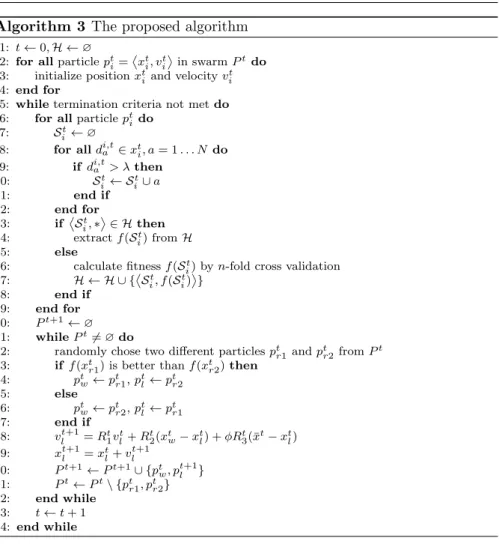
It is worth noting that since training a classifier model with large amount of data is usually highly time-consuming, fitness evaluations in a high-dimensional feature selection is computationally very expensive. As we found empirically that many particles may have the similar positions, it is possible to avoid some computationally expensive fitness evaluations that will result in the same se-lected feature subset. For this purpose, an archive is designed to record the historical fitness values of all previous selected feature subset such that we can check if a certain feature selection result has already been evaluated before performing real fitness evaluation for it.
1. Lookup thearchive Hif the current selected feature has been evaluated; 2. If it has been evaluated, extract the fitness value and assign it to the
particle;
3. If it has not been evaluated, build the classifier model with selected fea-tures, and test its error rate. Assign the fitness, i.e., the average error rate, to the particle and add the selection and fitness intoH.
Our empirical tests show that this simple strategy has significantly reduced the time consumption in the search, especially when the swarm is converging and many particles have a similar position.
The proposed CSO based feature selection method together with the above two strategies is summarized in Algorithm 3, whereHdenotes the archive that records the fitness values of all the particles in history.
4 Experimental Studies
4.1 Experimental Settings
To assess the performance of proposed algorithm, we conducted a set of ex-periments on several datasets from UCI Machine Learning Repository [3]. The properties of datasets are listed in Table 1.
For each dataset, we use 70% samples in the dataset as training data, and the rest for testing. The selection of training and test sets is randomized, while the original ratio of class distribution is preserved in both sets.
Algorithm 3The proposed algorithm
1: t←0,H ←∅
2: for allparticlept i= xt i, vti in swarmPt do 3: initialize positionxt iand velocityvti 4: end for
5: whiletermination criteria not metdo
6: for allparticleptido
7: St
i ←∅
8: for alldi,ta ∈xti, a= 1. . . N do
9: ifdi,ta > λthen 10: St i ← Sit∪a 11: end if 12: end for 13: if St i,∗ ∈ Hthen 14: extractf(St i) fromH 15: else 16: calculate fitnessf(St
i) byn-fold cross validation
17: H ← H ∪ { St i, f(Sit) } 18: end if 19: end for 20: Pt+1← ∅ 21: whilePt6=∅do
22: randomly chose two different particlespt
r1andptr2fromPt
23: iff(xt
r1) is better thanf(xtr2)then
24: pt w←ptr1,ptl←ptr2 25: else 26: pt w←ptr2,ptl←p t r1 27: end if 28: vtl+1=Rt 1vlt+Rt2(xtw−xtl) +φRt3(¯xt−xtl) 29: xtl+1=xt l+v t+1 l 30: Pt+1←Pt+1∪ {pt w, p t+1 l } 31: Pt←Pt\ {pt r1, ptr2} 32: end while 33: t←t+ 1 34: end while
Table 1: Dataset characteristics
Dataset Features Size Class
movement 90 360 15 musk 167 6598 2 arrhythmia 279 452 16 madelon 500 2600 2 isolet5 617 1559 26 InterAd 1588 3279 2
The algorithms are implemented on Java SE 8 (revision 1.8.0 45), using Weka [18] data mining library version 3.7.12 for the base classification algo-rithm.
In order to test the effectiveness of the feature selection, we chose to use only simple classification models, i.e., the k-nearest-neighbour (kNN) classi-fier [1] withk= 5. In order to reduce the risk of overfitting, we use the average
error rates ofn-fold cross-validation (withn= 10) on training data as the fit-ness function. PSO, four variants of PSO proposed in Xue’s paper for feature selection [41] and the principal component analysis (PCA) are compared with the proposed algorithm, along with classification with all features.
To make comparisons between CSO and PSO-based feature selection, we accordingly modify the PSO algorithm to be suited for feature selection. The modification consists of the conversion from continuous values into discrete values for feature selection and the archive strategy. The swarm size is set to 100 for both algorithms, and the maximal number of generations is set as 200. Note that, as CSO only updates half of the population in each iteration, it only generates a half of new solutions that the PSO-based algorithms generate.
The PSO variants in Xue’s paper are denoted as Xue1-kNN, Xue2-kNN, Xue3-kNN and Xue4-kNN, respectively. The major difference between Xue’s algorithms is the number of features selected in the initial population, while Xue1-kNN uses the traditional initialization strategy in which about half of the features are selected in each individuals, Xue2-kNN uses small initializa-tion strategy where only about 10% features are selected in each individuals, Xue3-kNN uses large initialization strategy where more than half (we used about 2/3 in the experiment) of the features are selected in each individuals, and Xue4-kNN uses a combined initialization where a major (we used 2/3 in the experiment) of the individuals are initialized with the mall initialization strategy (about 10% features in the experiment), while the rest are initialized with the large initialization strategy (about 2/3 features in the experiment). Another main difference between Xue’s algorithms and traditional PSO-based algorithms is that in Xue’s algorithm, the threshold parameterλis set to 0.6 while the traditional algorithm uses 0.5 as the threshold parameter.
Other parameters of the training algorithms are: w in the PSO-kNN is set to 0.7298, and both c1 and c2 are 1.49618; φ in the CSO-kNN is set to 0.1. The particles in all algorithms are randomly initialized between [0,1] and the threshold parameter λ= 0.5 is applied on CSO-kNN and PSO-kNN while λ= 0.6 is applied on Xue’s algorithms. The variance covered in PCA-based feature selection (PCA-kNN) is 0.95. To obtain statistical results, each algorithm is run for 30 times independently.
4.2 Results
4.2.1 Error rate
The ultimate target of classification is to improve generalization ability, which means a lower error rate on unseen data. Therefore we firstly examine the average error rate of all compared algorithms. The results are summarized in Table 2. We also adopted the Wilcoxon rank sum test to compare the results obtained by the CSO-kNN algorithm and other compared algorithms at a significance level of 0.05. The result is also listed in Table 2, where symbol ‘+’ denotes the particular algorithm is significantly outperformed by the
CSO-kNN algorithm according to the Wilcoxon rank sum test, while ‘-’ denotes the particular algorithm is significantly better than the CSO-kNN algorithm, and ‘=’ denotes that there is no statistically significant difference between the results obtained by the CSO-kNN algorithm and the particular algorithm.
Table 2: Average error rate
Dataset CSO-kNN PSO-kNN Xue1-kNN Xue2-kNN Xue3-kNN Xue4-kNN PCA-kNN SC-kNN
movement 0.2394 0.2850+ 0.2850+ 0.2896+ 0.2832+ 0.2869+ 0.2630+ 0.2801 (±0.0326) (±0.0392) (±0.0399) (±0.0415) (±0.0409) (±0.0327) (±0.0369) (±0.0351) musk 0.0011 0.0034+ 0.0033+ 0.0015= 0.0039+ 0.0016+ 0.0033+ 0.0134 (±0.0009) (±0.0016) (±0.0017) (±0.0009) (±0.0019) (±0.0009) (±0.0020) (±0.0028) arrhythmia 0.3240 0.4059+ 0.4076+ 0.3593+ 0.4098+ 0.3564+ 0.4588+ 0.4270 (±0.0225) (±0.0221) (±0.0203) (±0.0335) (±0.0243) (±0.0294) (±0.0079) (±0.0173) madelon 0.1572 0.4111+ 0.4066+ 0.2704+ 0.4168+ 0.3736+ 0.4829+ 0.4371 (±0.0374) (±0.0189) (±0.0210) (±0.1006) (±0.0230) (±0.1027) (±0.0161) (±0.0124) isolet5 0.1491 0.1875+ 0.1855+ 0.1917+ 0.1922+ 0.1954+ 0.4385+ 0.2140 (±0.0124) (±0.0118) (±0.0141) (±0.0157) (±0.0172) (±0.0149) (±0.0184) (±0.0134) InterAd 0.0289 0.0404+ 0.0406+ 0.0403+ 0.0411+ 0.0401+ 0.0721+ 0.0452 (±0.0044) (±0.0071) (±0.0058) (±0.0055) (±0.0056) (±0.0050) (±0.0054) (±0.0057) win/lose/tie - 6/0/0 6/0/0 5/0/1 6/0/0 6/0/0 6/0/0
-The experimental results show that the CSO-kNN has achieved a statisti-cally lower error rate than all other compared algorithms on all the six datasets. On some datasets, e.g., themusk dataset and themadelon dataset, the error rate achieved by the CSO-kNN is even smaller than half of that achieved by
mostother algorithms. Compared with thekNN, the CSO-kNN is always bet-ter while all other algorithms have instances on which they performed worse thankNN. From these results, we can also see that PCA-kNN is the least ef-fective algorithm as most results it has obtained are worse than those ofkNN. This can be attributed to the fact that PCA is sensitive to noises and outliers, in other words, PCA is less efficient in reducing the accuracy degradation of class-irrelevant attributes.
4.2.2 Performance
In the proposed algorithm, the fitness function is to minimize the average error rate on the training data. The fitness convergence profiles of the algorithms are plotted in Fig. 1. In the figure, X-axes and Y-axes are the generations and the fitness values, respectively.
From Fig. 1, it can be seen that the CSO-kNN is able to always find better solutions, although it may be a bit slower at the early search stage. The
PSO-kNN and Xue’s algorithms tend to be trapped in a premature convergence around generation 20. The only exception is found on the first dataset, where the difference between the CSO-kNN and compared algorithms is negligible, which might be due to the fact that the dimension of this dataset is relatively low (only 90), on which the difference in search performance between PSO and CSO is minor.
As fitness selection is a combinatorial optimization problem, small changes in the particle positions may not result in a change in the selected features.
generation 50 100 150 200 fitness 0 0.05 0.1 0.15 0.2 0.25 0.3 CSO PSO Xue1 Xue2 Xue3 Xue4 (a) movement generation 50 100 150 200 fitness #10-3 0 1 2 3 4 5 6 7 CSO PSO Xue1 Xue2 Xue3 Xue4 (b) musk generation 50 100 150 200 fitness 0 0.05 0.1 0.15 0.2 0.25 0.3 0.35 CSO PSO Xue1 Xue2 Xue3 Xue4 (c) arrhythmia generation 50 100 150 200 fitness 0 0.05 0.1 0.15 0.2 0.25 0.3 0.35 0.4 0.45 CSO PSO Xue1 Xue2 Xue3 Xue4 (d) madelon generation 50 100 150 200 fitness 0 0.05 0.1 0.15 0.2 CSO PSO Xue1 Xue2 Xue3 Xue4 (e) isolet5 generation 50 100 150 200 fitness 0 0.005 0.01 0.015 0.02 0.025 0.03 0.035 0.04 CSO PSO Xue1 Xue2 Xue3 Xue4 (f) InterAd
Fig. 1: Average fitness of the best particle respect to each generation.
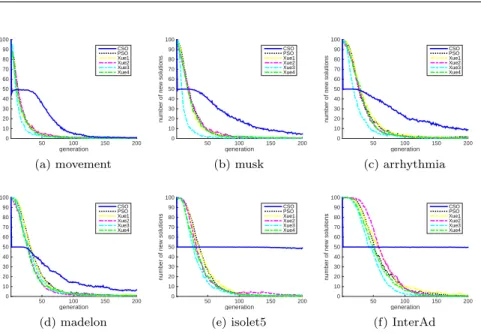
Thus, it is easy to understand that many new solutions are found at the begin-ning of the evolutionary optimization. As the evolution proceeds, the number of new solutions that can be found may dramatically reduce. Thus, the num-ber of new solutions found can be used as another indicator for convergence, which are presented in Fig. 2.
The plots in Fig. 2 visually show that the PSO-based algorithms seem to converge faster than the CSO-kNN, since the PSO-based algorithms have found only few solutions at the later stage of evolution. However, a slower con-vergence rate of CSO-kNN than the PSO variants is expected, which indicates that CSO-kNN has better exploration ability that helps maintain a better swarm diversity, which has also been confirmed by the empirical analyses pre-sented in [10]. Comparing these plots with those in Fig. 1, we can see that the fitness of the PSO-based algorithms improves much more slowly than that of the CSO-kNN. The best fitnesses achieved by the PSO-based algorithms were always worse than those by the CSO-kNN, which strongly indicates that the PSO-based algorithms have got trapped in a local optimum. By contrast, the CSO-kNN can always find better solutions in term of the fitness value. The only exception was on the first dataset, i.e., the datasetmovement. Both PSO-based algorithms and CSO-kNN have found a small number of new solu-tions probably because of the low dimensionality of this dataset. The fact that CSO-kNN continues to find new better feature subsets implies that feature selection is naturally a multi-modal optimization problem, i.e., many different combinations of feature subsets may have similar or the same generalization performance.
generation
50 100 150 200
number of new solutions
0 10 20 30 40 50 60 70 80 90 100 CSO PSO Xue1 Xue2 Xue3 Xue4 (a) movement generation 50 100 150 200
number of new solutions
0 10 20 30 40 50 60 70 80 90 100 CSO PSO Xue1 Xue2 Xue3 Xue4 (b) musk generation 50 100 150 200
number of new solutions
0 10 20 30 40 50 60 70 80 90 100 CSO PSO Xue1 Xue2 Xue3 Xue4 (c) arrhythmia generation 50 100 150 200
number of new solutions
0 10 20 30 40 50 60 70 80 90 100 CSO PSO Xue1 Xue2 Xue3 Xue4 (d) madelon generation 50 100 150 200
number of new solutions
0 10 20 30 40 50 60 70 80 90 100 CSO PSO Xue1 Xue2 Xue3 Xue4 (e) isolet5 generation 50 100 150 200
number of new solutions
0 10 20 30 40 50 60 70 80 90 100 CSO PSO Xue1 Xue2 Xue3 Xue4 (f) InterAd
Fig. 2: Number of new solutions found in each generation.
It also worth mentioning that, apart from the CSO-kNN on the last two datasets, most other experiments have many identical solutions produced dur-ing search, meandur-ing that many fitness evaluations may be redundant. As fitness evaluations are very time-consuming for high-dimensional feature selection, it would have taken significantly more time if we do not use the archive mecha-nism proposed in the proposed algorithm.
4.2.3 Selected features
The second target of feature selection is to remove irrelevant features to en-hance classification performance. Therefore, we have also taken a look at the average number of selected features obtained the PSO-based algorithms and the CSO-kNN. The results are presented in Table 3.
In this comparison, we can see that CSO-kNN selects statistically fewer features than most compared algorithms, except for Xue2-kNN, which initial-izes its population with only 10% of the total features. We found that the number of features selected by the PSO-based algorithms are proportional to the number of features initialized at the first generation. In other words, if particles are initialized with a large number of features, the number of fea-tures selected in the final population will be larger, and vice versa. Therefore, Xue2-kNN is more likely to outperform CSO-kNN in terms of the number of selected features. Furthermore, as Xue4-kNN has a mixed initialization, de-pending on the characteristics of the dataset, the best particle may be evolved from those particles initialized with a small or large number of features. As a result, the best solution in the final population selects either much more or
Table 3: Average number of selected features
Dataset CSO-kNN PSO-kNN Xue1-kNN Xue2-kNN Xue3-kNN Xue4-kNN PCA-kNN #Features
movement 49.40 41.70− 44.10− 24.27− 54.93+ 42.20= 9− 90 (±6.56) (±5.15) (±5.77) (±8.01) (±9.01) (±18.52) musk 12.57 70.33+ 71.13+ 16.63= 75.93+ 16.43+ 122+ 167 (±4.83) (±6.00) (±6.65) (±7.79) (±11.14) (±6.44) arrhythmia 16.23 132.97+ 133.00+ 21.40= 157.73+ 27.97+ 103+ 279 (±6.67) (±8.84) (±11.21) (±12.40) (±15.68) (±31.24) madelon 6.90 249.07+ 256.10+ 33.17= 324.17+ 261.03+ 426+ 500 (±1.81) (±12.58) (±15.34) (±50.73) (±30.97) (±147.09) isolet5 137.40 304.73+ 311.87+ 195.47+ 372.37+ 371.10+ 182+ 617 (±30.20) (±11.25) (±16.85) (±46.21) (±31.06) (±62.56) InterAd 269.97 761.40+ 766.27+ 391.30+ 904.97+ 930.40+ 300= 1558 (±94.97) (±21.72) (±37.90) (±127.37) (±88.46) (±170.62) win/lose/tie - 5/1/0 5/1/0 2/1/3 6/0/0 5/0/1 4/1/1
-less features than CSO-kNN does. By contrast, CSO-kNN is not sensitive to the initialization, which can always find the optimal feature subset regardless the number of features selected during the initialization.
generation
50 100 150 200
number of selected features
0 10 20 30 40 50 60 70 80 CSO PSO Xue1 Xue2 Xue3 Xue4 (a) movement generation 50 100 150 200
number of selected features
0 20 40 60 80 100 120 CSO PSO Xue1 Xue2 Xue3 Xue4 (b) musk generation 50 100 150 200
number of selected features
0 50 100 150 200 CSO PSO Xue1 Xue2 Xue3 Xue4 (c) arrhythmia generation 50 100 150 200
number of selected features
0 100 200 300 400 500 CSOPSO Xue1 Xue2 Xue3 Xue4 (d) madelon generation 50 100 150 200
number of selected features
0 100 200 300 400 500 600 CSO PSO Xue1 Xue2 Xue3 Xue4 (e) isolet5 generation 50 100 150 200
number of selected features
0 500 1000 1500 CSO PSO Xue1 Xue2 Xue3 Xue4 (f) InterAd
Fig. 3: Average number of selected features over generations.
Further observations regarding the number of features that have been se-lected during the search procedure by each algorithm can be found in Fig. 3. We can see that CSO-kNN not only finds smaller feature subsets than the PSO-based algorithms on large-scale problems, but the number of selected features also decreases much faster. The only exception is again the
From Table 2 and Fig. 3, we can conclude that CSO-kNN performs higher degree of exploration than the PSO-based algorithms, which enables it to explore the search space to find a solution that selects a smaller number of features and better performance.
gener ation feature # Zoom 6x (a) CSO-kNN gener ation feature # Zoom 6x (b) PSO-kNN gener ation feature # Zoom 6x (c) Xue1-kNN gener ation feature # Zoom 6x (d) Xue2-kNN gener ation feature # Zoom 6x (e) Xue3-kNN gener ation feature # Zoom 6x (f) Xue4-kNN
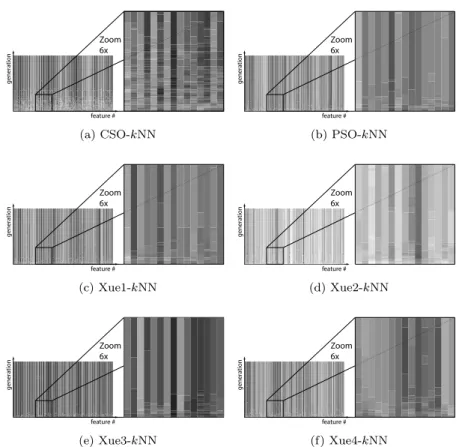
Fig. 4: Graphics showing that the selected features (x-axes) of the best indi-vidual over generations (y-axes) on datasetmovement. The darkness of each block represents the frequency of the corresponding feature that has been se-lected in the respective generation across different experiments - a darker color represents a higher frequency, and vice versa.
In addition to the number of features that have been selected, it is also of interests to see what features have exactly been selected. To this end, we have also plotted the number of selected features over the generations during the evolution in Fig. 4 and 5.
Fig. 4 shows the results on themovementdataset, which has the least num-ber of features among the six tested datasets. On this dataset, all algorithms seem to have found a reasonable feature subset that gives the lowest testing
gener ation feature # (a) CSO-kNN gener ation feature # (b) PSO-kNN gener ation feature # (c) Xue1-kNN gener ation feature # (d) Xue2-kNN gener ation feature # (e) Xue3-kNN gener ation feature # (f) Xue4-kNN
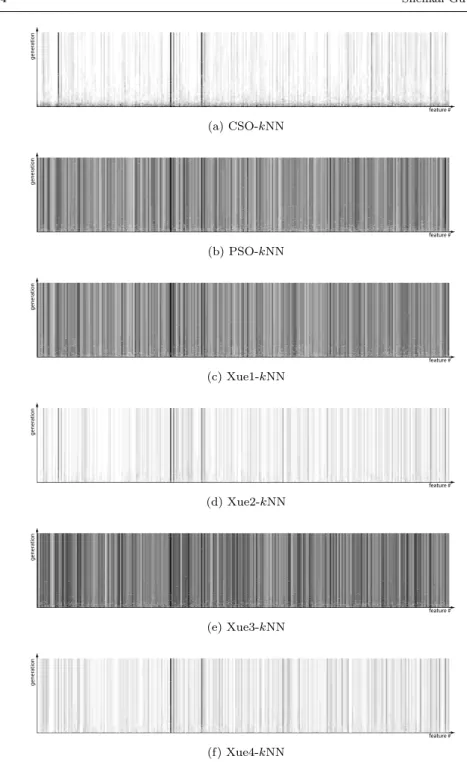
Fig. 5: Graphics showing that the selected features (x-axes) of the best indi-vidual over generations (y-axes) on datasetarrhythmia.
error possible (refer to Table 2 and Fig 3), and a similar number of features is selected, which is indicated by the similar overall darkness of in the plots. However, there are still visible differences between Xue2-kNN and Xue3-kNN, as the initial numbers of selected features aresignificantlydifferent. Further-more, these figures also show that CSO-kNN explores much more potential solutions in comparison to other compared algorithms.
Fig. 5 presents the results on the arrhythmia dataset, where the
CSO-kNN has selected much fewer features and achieved a considerably lower error rate than the compared algorithms. In general, the darkness of the plot for CSO-kNN is much lighter than that of the PSO-kNN, Xue1-kNN and
Xue3-kNN, which implies that the general number of features selected by
CSO-kNN is much smaller than the these algorithms in all independent runs. It is also seen that the overall darkness among CSO-kNN, Xue2-kNN and
Xue4-kNN are similar. However, by close inspection, we can find that the early populations of CSO-kNN are much darker than the other two algorithms, and during the population evolves, the overall darkness becomes lighter. By contrast, all PSO-based algorithms have a similar overall darkness across the generations. This difference indicates that the CSO-kNN is capable of escaping from local optima due to its better exploration ability than the PSO-based algorithms. Nevertheless, a few clearly discernible vertical dark lines can be seen in the plots, especially in the CSO-kNN, Xue2-kNN and Xue4-kNN. These lines represent themostcommonly selected features over all independent runs, while most other lines remain light indicating the scarcely (or even never) selected features. The plots clearly show that the PSO-based algorithms tend to select many other features, which are mostly not helpful, if not harmful to improve the generalization ability.
5 Conclusion
This paper aims to propose an efficient feature selection algorithm to select a small feature subset from a large number of features while maintaining similar or even better classification performance than using all features. The objective has been successfully achieved by adapting the competitive swarm optimiza-tion algorithm to feature selecoptimiza-tion.
Our experimental results demonstrate that the proposed CSO-kNN outper-forms the conventional PCA-based method, the PSO-kNN, and a few recently reported PSO variants on all large-scale datasets with a significant margin. Furthermore, we find that the number of new solutions found by CSO-kNN is considerably larger than that found by the PSO-based methods. Unlike the PSO-based methods whose final optimal results heavily rely on the initializa-tion in term of the number of selected features, the purposed method performs consistently well and is less sensitive to initialization.
In the future, we will investigate further the selection mechanism of the metaheuristics, for example by introducing the multi-objective approach that
simultaneously maximizes the classification performance and minimizes the number of selected features.
Acknowledgements This work was supported in part by National Natural Science Foun-dation of China (No. 71533001), the Joint Research Fund for Overseas Chinese, Hong Kong and Macao Scholars of the National Natural Science Foundation of China (No. 61428302) and an EPSRC grant (No. EP/M017869/1).
References
1. Aha, D., Kibler, D., Albert, M.: Instance-based learning algorithms. Machine Learning
6(1), 37–66 (1991)
2. Almuallim, H., Dietterich, T.G.: Learning boolean concepts in the presence of many
irrelevant features. Artificial Intelligence69(1), 279–305 (1994)
3. Bache, K., Lichman, M.: UCI machine learning repository (2013). URL http://
archive.ics.uci.edu/ml
4. Banks, A., Vincent, J., Anyakoha, C.: A review of particle swarm optimization. part ii: hybridisation, combinatorial, multicriteria and constrained optimization, and indicative
applications. Natural Computing7(1), 109–124 (2008)
5. Bianchi, L., Dorigo, M., Gambardella, L.M., Gutjahr, W.J.: A survey on metaheuristics
for stochastic combinatorial optimization. Natural Computing8(2), 239–287 (2009)
6. Chandrashekar, G., Sahin, F.: A survey on feature selection methods. Computers &
Electrical Engineering40(1), 16–28 (2014)
7. Chen, W.N., Zhang, J., Lin, Y., Chen, N., Zhan, Z.H., Chung, H.S.H., Li, Y., Shi, Y.H.: Particle swarm optimization with an aging leader and challengers. IEEE Transactions
on Evolutionary Computation17(2), 241–258 (2013)
8. Chen, Y., Miao, D., Wang, R.: A rough set approach to feature selection based on ant
colony optimization. Pattern Recognition Letters31(3), 226–233 (2010)
9. Cheng, R., Jin, Y.: Demonstrator selection in a social learning particle swarm optimizer. In: 2014 IEEE Congress on Evolutionary Computation, pp. 3103–3110. IEEE (2014) 10. Cheng, R., Jin, Y.: A competitive swarm optimizer for large scale optimization. IEEE
Transactions on Cybernetics45(2), 191–204 (2015)
11. Cheng, R., Jin, Y.: A social learning particle swarm optimization algorithm for scalable
optimization. Information Sciences291, 43–60 (2015)
12. Chuang, L.Y., Chang, H.W., Tu, C.J., Yang, C.H.: Improved binary pso for feature
selection using gene expression data. Computational Biology and Chemistry 32(1),
29–38 (2008)
13. Chuang, L.Y., Tsai, S.W., Yang, C.H.: Improved binary particle swarm optimization
using catfish effect for feature selection. Expert Systems with Applications 38(10),
12,699–12,707 (2011)
14. Fei, H., Huan, J.: Boosting with structure information in the functional space: An appli-cation to graph classifiappli-cation. In: Proceedings of the 16th ACM SIGKDD International Conference on Knowledge Discovery and Data Mining, pp. 643–652. ACM, New York, NY, USA (2010)
15. Fong, S., Wong, R., Vasilakos, A.V.: Accelerated PSO swarm search feature selection
for data stream mining big data. IEEE Transactions on Services Computing9(1), 33–45
(2016)
16. Gheyas, I.A., Smith, L.S.: Feature subset selection in large dimensionality domains.
Pattern recognition43(1), 5–13 (2010)
17. Guyon, I., Elisseeff, A.: An introduction to variable and feature selection. The Journal
of Machine Learning Research3, 1157–1182 (2003)
18. Hall, M., Frank, E., Holmes, G., Pfahringer, B., Reutemann, P., Witten, I.H.: The weka
data mining software: an update. ACM SIGKDD explorations newsletter11(1), 10–18
19. Han, K.H., Kim, J.H.: Quantum-inspired evolutionary algorithm for a class of
combi-natorial optimization. IEEE Transactions on Evolutionary Computation6(6), 580–593
(2002)
20. Hu, M., Wu, T.F., Weir, J.D.: An adaptive particle swarm optimization with multiple
adaptive methods. IEEE Transactions on Evolutionary Computation17(5), 705–720
(2013)
21. Kennedy, J., Eberhart, R.: Particle swarm optimization. In: Neural Networks, 1995. Proceedings., IEEE International Conference on IS - SN -, pp. 1942–1948 vol.4 (1995) 22. Kira, K., Rendell, L.A.: A practical approach to feature selection. In: Proceedings of
the International Workshop on Machine Learning, pp. 249–256 (1992)
23. Kohavi, R., John, G.H.: Wrappers for feature subset selection. Artificial Intelligence
97(1), 273–324 (1997)
24. Kwak, N., Choi, C.H.: Input feature selection for classification problems. IEEE
Trans-actions on Neural Networks13(1), 143–159 (2002)
25. Li, X., Yao, X.: Cooperatively coevolving particle swarms for large scale optimization.
IEEE Transactions on Evolutionary Computation16(2), 210–224 (2012)
26. Liang, J.J., Qin, A.K., Suganthan, P.N., Baskar, S.: Comprehensive learning particle swarm optimizer for global optimization of multimodal functions. IEEE Transactions
on Evolutionary Computation10(3), 281–295 (2006)
27. Liao, J.G., Chin, K.V.: Logistic regression for disease classification using microarray
data: model selection in a large p and small n case. Bioinformatics23(15), 1945–1951
(2007)
28. Lin, S.W., Chen, S.C.: PSOLDA: A particle swarm optimization approach for enhancing
classification accuracy rate of linear discriminant analysis. Applied Soft Computing9(3),
1008–1015 (2009)
29. Liu, Z., Jiang, F., Tian, G., Wang, S., Sato, F., Meltzer, S.J., Tan, M.: Sparse logis-tic regression with Lp penalty for biomarker identification. Statislogis-tical Applications in
Genetics and Molecular Biology6(1) (2007)
30. Neshatian, K., Zhang, M.: Pareto front feature selection: using genetic programming to explore feature space. In: Proceedings of the Annual Conference on Genetic and Evolutionary Computation, pp. 1027–1034. ACM (2009)
31. Price, K., Storn, R.M., Lampinen, J.A.: Differential evolution: a practical approach to global optimization. Springer Science & Business Media (2006)
32. Pudil, P., Novoviˇcov´a, J., Kittler, J.: Floating search methods in feature selection.
Pat-tern Recognition Letters15(11), 1119–1125 (1994)
33. Shi, Y., Eberhart, R.: A modified particle swarm optimizer. In: Evolutionary Compu-tation Proceedings, 1998. IEEE World Congress on CompuCompu-tational Intelligence., The 1998 IEEE International Conference on IS - SN - VO -, pp. 69–73 (1998)
34. Tan, M., Tsang, I.W., Wang, L.: Minimax sparse logistic regression for very high-dimensional feature selection. IEEE Transactions on Neural Networks and Learning
Systems24(10), 1609–1622 (2013)
35. Tran, B., Xue, B., Zhang, M.: Bare-Bone Particle Swarm Optimisation for
Simulta-neously Discretising and Selecting Features for High-Dimensional Classification. In:
G. Squillero, P. Burelli (eds.) Applications of Evolutionary Computation: 19th Euro-pean Conference, EvoApplications 2016, Porto, Portugal, March 30 – April 1, 2016, Proceedings, Part I, pp. 701–718. Springer International Publishing (2016)
36. Unler, A., Murat, A.: A discrete particle swarm optimization method for feature se-lection in binary classification problems. European Journal of Operational Research
206(3), 528–539 (2010)
37. Wang, H., Sun, H., Li, C., Rahnamayan, S., Pan, J.S.: Diversity enhanced particle swarm
optimization with neighborhood search. Information Sciences223, 119–135 (2013)
38. Wang, X., Yang, J., Teng, X., Xia, W., Jensen, R.: Feature selection based on rough sets
and particle swarm optimization. Pattern Recognition Letters28(4), 459–471 (2007)
39. Whitney, A.W.: A direct method of nonparametric measurement selection. IEEE
Trans-actions on ComputersC-20(9), 1100–1103 (1971)
40. Xue, B., Zhang, M., Browne, W., Yao, X.: A survey on evolutionary computation
ap-proaches to feature selection. IEEE Transactions on Evolutionary ComputationPP(99),
41. Xue, B., Zhang, M., Browne, W.N.: Particle swarm optimization for feature selection
in classification: A multi-objective approach. IEEE Transactions on Cybernetics43(6),
1656–1671 (2013)
42. Xue, B., Zhang, M., Browne, W.N.: Particle swarm optimisation for feature selection in classification: Novel initialisation and updating mechanisms. Applied Soft Computing
18, 261–276 (2014)
43. Zhai, Y., Ong, Y.S., Tsang, I.W.: The emerging ”Big Dimensionality”. Computational
Intelligence Magazine, IEEE9(3), 14–26 (2014)
44. Zhan, Z.H., Zhang, J., Li, Y., Chung, H.S.H.: Adaptive particle swarm optimization.
IEEE Transactions on Systems, Man, and Cybernetics, Part B: Cybernetics 39(6),
1362–1381 (2009)
45. Zhu, Z., Ong, Y.S., Dash, M.: Wrapper–filter feature selection algorithm using a memetic framework. IEEE Transactions on Systems, Man, and Cybernetics, Part B: Cybernetics