This thesis must be used in accordance with the provisions of the Copyright Act 1968.
Reproduction of material protected by copyright may be an infringement of copyright and
copyright owners may be entitled to take legal action against persons who infringe their copyright.
Section 51 (2) of the Copyright Act permits an authorized officer of a university library or archives to provide a copy (by communication or otherwise) of an unpublished thesis kept in the library or archives, to a person who satisfies the authorized officer that he or she requires the reproduction for the purposes of research or study.
The Copyright Act grants the creator of a work a number of moral rights, specifically the right of attribution, the right against false attribution and the right of integrity.
You may infringe the author’s moral rights if you: - fail to acknowledge the author of this thesis if
you quote sections from the work - attribute this thesis to another author - subject this thesis to derogatory treatment
which may prejudice the author’s reputation For further information contact the University’s Director of Copyright Services
Nicky Ringland
Supervisor: James Curran
A thesis submitted
in fulfilment of the requirements for the degree of Doctor of Philosophy in the School of Information Technologies at
The University of Sydney School of Information Technologies
Abstract
The names of people, locations, and organisations play a central role in language, and named entity recognition (NER) has been widely studied, and successfully incorporated, into natural language processing (NLP) applications. The most common variant ofNERinvolves identifying and classifying proper noun mentions of these and miscellaneous entities as linear spans in text.
Unfortunately, this version of NER is no closer to a detailed treatment of named entities than chunking is to a full syntactic analysis. NER, so con-strued, reflects neither the syntactic nor semantic structure ofNEmentions, and provides insufficient categorical distinctions to represent that structure.
Representing this nested structure, where a mention may contain mention(s) of other entities, is critical for applications such as coreference resolution. The lack of this structure creates spurious ambiguity in the linear approximation.
Research in NER has been shaped by the size and detail of the available annotated corpora. The existing structured named entity corpora are either small, in specialist domains, or in languages other than English.
This thesis presents ourNested Named Entity(NNE) corpus of named entities and numerical and temporal expressions, taken from the WSJ portion of the Penn Treebank (PTB, Marcus et al., 1993). We use theBBNPronoun Coreference and Entity Type Corpus (Weischedel and Brunstein, 2005a) as our basis, manu-ally annotating it with a principled, fine-grained, nested annotation scheme and detailed annotation guidelines. The corpus comprises over 279,000 entities over 49,211 sentences (1,173,000 words), including 118,495 top-level entities.
Our annotations were designed using twelve high-level principles that guided the development of the annotation scheme and difficult decisions for annotators. We also monitored the semantic grammar that was being induced during annotation, seeking to identify and reinforce common patterns to main-tain consistent, parsimonious annotations.
The result is a scheme of 118 hierarchical fine-grained entity types and nesting rules, covering all capitalised mentions of entities, and numerical and temporal expressions. Unlike many corpora, we have developed detailed guidelines, including extensive discussion of the edge cases, in an ongoing dia-logue with our annotators which is critical for consistency and reproducibility. We annotated independently from the PTBbracketing, allowing annotators to choose spans which were inconsistent with thePTBconventions and errors, and only refer back to it to resolve genuine ambiguity consistently.
We merged our NNEwith thePTB, requiring some systematic and one-off changes to both annotations. This allows theNNEcorpus to complement other PTBresources, such as PropBank, and inform PTB-derived corpora for other formalisms, such asCCGandHPSG. We compare this corpus againstBBN.
We consider several approaches to integrating thePTBandNNEannotations, which affect the sparsity of grammar rules and visibility of syntactic and NE structure. We explore their impact on parsing the NNE and merged variants using the Berkeley parser (Petrov et al., 2006), which performs surprisingly well without specialisedNERfeatures.
We experiment with flattening theNNEannotations into linearNERvariants with stacked categories, and explore the ability of a maximum entropy and a CRF NERsystem to reproduce them. The CRF performs substantially better, but is infeasible to train on the enormous stacked category sets. The flattened output of the Berkeley parser are almost competitive with theCRF.
Our results demonstrate that theNNEcorpus is feasible for statistical models to reproduce. We invite researchers to explore new, richer models of (joint) parsing andNERon this complex and challenging task.
Our nested named entity corpus will improve a wide range ofNLPtasks, such as coreference resolution and question answering, allowing automated systems to understand and exploit the true structure of named entities.
The completion of this thesis has been a long journey, and I am immensely glad to have had wonderful travelling companions. Foremost thanks must go to James Curran, without whose encouragement, support and guidance I would never have embarked on this journey. Thank you for introducing me to computer science, for nurturing (and occasionally rekindling) my love of computational linguistics, and for encouraging my passion for education.
Thank you to all members of Schwa Lab past and present who have helped me in so many ways. I have been incredibly fortunate to work with such a wonderful group of friends and colleagues. Thanks especially to Ben Hachey, whose extra guidance at the pointy end of things was particularly appreciated, Matt Honnibal, especially for giving me that first glimmer of hope that a lin-guistics student can add that extra ’computational’ adjective, David Vadas, Tara McIntosh, Jonathan Kummerfeld, Stephen Merity, Tim O’Keefe, Daniel Tse, Will Radford, Dominick Ng, James Constable, Glen Pink, and to Tim Dawborn, without whom I would have neither servers to run my experiments on, nor an NER system to evaluate on. Katie Bell, thank you for helping me debug my very first Python program, and for being an inspiration henceforth. Joel Nothman, thank you for the many stimulating discussions, cups of tea, con-tinued encouragement, and for embodying the epitome of a research student. My work is much the better thanks to the good example you have always set. Kellie Webster, thank you for being my thesis writing buddy, for helping me
find words when I was stuck, for keeping me accountable to my deadlines, for the many hours of annotation and proof-reading and for countless other ways your presence and efforts have improved the past few years.
My work rests on that of my annotators: Kellie Webster, Vivian Li, Joanne Yang and Kristy Hughes. Thank you for the many hours of discussion, and for battling through all 50,000WSJarticles with me. I hope that, in time, you can start to enjoy reading newspaper articles again without too many flashbacks.
I gratefully acknowledge the funding received from the Tempe Mann Trav-elling Scholarship, which enabled me to take a mini-sabbatical to Edinburgh, where my research was greatly improved by the efforts of Bonnie Webber, Mark Steedman and the entire computational linguistics group. Thanks also to the research communities of Cambridge, especially Stephen Clark, and the Univer-sity of Texas at Austin, especially Jason Baldridge. Thank you also to the many local academics who have advised, guided and influenced me along the way, especially Alan Fekete and Jon Patrick, and to the support, help navigating various bureaucratic hurdles, and friendship from all the SIT staff, especially Josie Spongberg and Evelyn Riegler.
To the women of SIT, especially Georgina Wilcox, Emma Fitzgerald, Shagh-ayegh Sharif Nabavi, Mahboobeh Moghaddam, and Tara Babaie, thank you for always being ready with tea and chocolate. To the National Computer Science School and Girls’ Programming Network tutors, students and teachers, whose encouragement was always appreciated, even when phrased as the question:
Have you finished yet?
The challenges of a PhD can only be overcome when balanced by incredible friends. Thank you all for helping in more ways than you are probably aware, from much-needed stress relief, to technical support, distractions, laughter and copious amounts of chocolate. Jonathan Usmar, thank you for encouraging me to actually give this computer science thing a try. Lachlan Howe and James
Bailey, thank you for the music and camaraderie. Sophia Di Marco, thank you for always being there, and for your unfaltering confidence in me.
Finally, thank you to my family for being constantly supportive, for raising me with a love of learning, and for being encouraging and patient even while not understanding my work.
And to Sam, perhaps the most patient of all, who has been by my side throughout every minute of this PhD. Thank you.
I certify that:
• I have read and understood the University of Sydney Student Plagiarism: Coursework Policy and Procedure;
• I understand that failure to comply with the Student Pla-giarism: Coursework Policy and Procedure can lead to the University commencing proceedings against me for poten-tial student misconduct under Chapter 8 of the University of Sydney By-Law 1999 (as amended);
• this Work is substantially my own, and to the extent that any part of this Work is not my own I have indicated that it is not my own by Acknowledging the Source of that part or those parts of the Work.
Name: Nicky Ringland
Signature: Date:14th March 2016
1 Introduction 2
1.1 Motivating nested entity structure . . . 4
1.2 Motivation for fine-grained entities . . . 6
1.3 Contributions . . . 8
1.3.1 Learning nested named entities . . . 9
1.3.2 Analysing nested named entities . . . 10
1.4 Outline . . . 10
2 Background 13 2.1 Overview of tasks . . . 14
2.1.1 Parsing . . . 14
2.1.2 Named Entity Recognition . . . 16
2.2 The Penn Treebank corpus . . . 18
2.2.1 Adding Noun Phrase Structure to thePTB . . . 19
2.2.2 Other resources built on thePTB . . . 25
2.2.3 Tokenisation in the Penn Treebank . . . 26
2.2.4 Summary . . . 27
2.3 Named Entity Corpora . . . 27
2.3.1 MUC 6 and 7 andMET . . . 28
2.3.2 CoNLL . . . 29
2.3.3 ACE2004 andACE2008 . . . 31
2.3.4 BBN . . . 34
2.3.5 OntoNotes . . . 36
2.4 NECorpora containing Nested Structures . . . 37
2.4.1 GENIA . . . 37
2.4.2 AnCora . . . 38
2.4.3 ESTER . . . 40
2.4.4 Polish National Corpus . . . 43
2.4.5 PKU Chinese Corpus . . . 44
2.4.6 Historical Archive Corpus . . . 45
2.4.7 KBP EDL 2014 . . . 45
2.4.8 FurtherNERcorpora annotation schemas . . . 47
2.4.9 NERcorpora summary . . . 51
2.5 Summary . . . 51
3 Nested Entity Annotation Scheme 53 3.1 Annotation Principles . . . 54
3.2 Annotation Scheme . . . 60
3.2.1 Comparison to OntoNotes . . . 60
3.2.2 Comparison to Sekine’s Extended Named Entity Hierarchy 62 3.2.3 UnderlyingBBNannotations . . . 62
3.2.4 Categories added to underlyingBBNannotations . . . . 64
3.3 Annotation Guidelines Summary . . . 71
3.3.1 PER . . . 71
3.3.2 ORG . . . 74
3.3.3 FACILITY . . . 88
3.3.4 LOCATION . . . 91
3.3.5 NORP: Nationality, Other, Religion, Political . . . 95
3.3.6 EVENT . . . 96
3.3.7 WORK OF ART . . . 98
3.3.9 GROUP . . . 102
3.3.10 NUMEX . . . 102
3.3.11 TIMEX . . . 109
3.4 Summary . . . 116
4 Annotating theNNEcorpus 117 4.1 Annotation Process . . . 117
4.1.1 AligningBBNand PTB . . . 118
4.1.2 Annotation Pre-process . . . 119
4.1.3 Annotation Tool . . . 121
4.1.4 Annotation Time and Process . . . 122
4.1.5 Inter-annotator agreement . . . 124
4.2 Annotation inconsistencies . . . 129
4.2.1 Annotation Errors . . . 129
4.2.2 Annotation Post-Process . . . 133
4.2.3 Effect of post-processing corpus . . . 137
4.3 Corpus analysis . . . 138
4.3.1 Entity Exemplars . . . 139
4.3.2 Template analysis . . . 140
4.4 Comparison toBBNcorpus . . . 143
4.4.1 Entity spans that do not match . . . 148
4.5 Summary . . . 153
5 Merging Nested Named Entities into the Penn Treebank 154 5.1 Merging process overview . . . 155
5.2 Straightforward Cases . . . 156
5.2.1 Span match . . . 156
5.2.2 Span mismatch . . . 157
5.3.1 Making changes toPTBsyntax andNNE bounds . . . 159
5.3.2 Include / Exclude rules forNNEspans . . . 161
5.3.3 Tree Restructure Rules . . . 172
5.4 Remaining Cases . . . 177
5.4.1 Manual fixes . . . 177
5.4.2 Cases where no merge is possible . . . 178
5.5 Adding syntactic labels to additional nodes . . . 180
5.6 Discussion . . . 181
5.6.1 Impact onNNE annotations . . . 181
5.6.2 Impact onPTBannotations . . . 183
5.6.3 Consistency inPTB after merging process . . . 183
5.7 Summary . . . 184
6 Parsing Nested Named Entities 186 6.1 Parsing Background . . . 186
6.1.1 Hand-written Grammars . . . 187
6.1.2 Penn Treebank Parsing . . . 187
6.1.3 Parser evaluation . . . 190
6.2 Variants of merging nested named entity Structure into the Penn Treebank . . . 191
6.2.1 ‘Joint’ variant: concatenatedPOSand NNElabel . . . 191
6.2.2 HIGH variant . . . 193
6.2.3 LOW variant . . . 194
6.2.4 POSLOW variant . . . 194
6.2.5 ‘Substitution’ (SUB) variant . . . 195
6.2.6 ‘Substitution’ under parent label (SUB LAYER) variant . 196 6.3 Parsing syntactic andNNE structure with the Berkeley Parser . 199 6.3.1 Learning combined syntax andNNE structure is difficult 200 6.3.2 How well does a combined model learn syntax? . . . 202
6.3.3 How well does a combined model learnNNEstructure? 205
6.3.4 Discussion . . . 206
6.3.5 Error Analysis: a more meaningful metric . . . 207
6.4 Summary . . . 214
7 Recognising Nested Entities 216 7.1 NERbackground . . . 216
7.1.1 Machine Learning Approaches toNER . . . 217
7.1.2 State of the Art performance in EnglishNER . . . 219
7.1.3 Unsupervised and Distantly Supervised Approaches . . 220
7.1.4 Gazetteers . . . 221
7.1.5 Evaluating NER . . . 222
7.2 Nested Named Entity Recognition . . . 224
7.2.1 NestedNERin non-English, and other domains . . . 225
7.2.2 Joint parsing and Named Entity Recognition . . . 229
7.2.3 Evaluation of Nested Named Entity Recognition . . . 230
7.3 Mapping structured named entities into flat tags . . . 231
7.3.1 TOP . . . 232 7.3.2 TOP2 . . . 233 7.3.3 BOTTOM . . . 234 7.3.4 BOTTOM2 . . . 235 7.3.5 TOP
_
BOTTOM . . . 235 7.3.6 STACK . . . 236 7.3.7 COMPRESS . . . 237 7.3.8 Variant Discussion . . . 2387.3.9 Using Parsing Models forNERVariant Experiments . . . 243
7.4 Experimental Setup . . . 244
7.4.1 LIBSCHWA NER . . . 244
7.4.3 Results ofLIBSCHWA NER,C&C, Parsing . . . 247
7.4.4 Training Time Comparison ofLIBSCHWA NER, Parsing 250 7.4.5 Error analysis across models and variants . . . 252
7.4.6 Sparse model vs. multipleCRF . . . 255
7.5 NERSummary . . . 256
8 Conclusion 258 8.1 Future Work . . . 258
8.1.1 Extend annotation for use in other corpora . . . 259
8.1.2 Modify systems for better structuredNERlearning . . . 259
8.1.3 Extend the newNNEresource onto other resources . . . 260
8.1.4 Analysis in a practical task, and error analysis . . . 262
8.1.5 Corpus improvements . . . 263
8.2 Conclusion . . . 264
8.3 Summary . . . 268
2.1 Constituent structure for the first sentence of the Penn Treebank. 15 2.2 An example sentence from the Penn Treebank with named
entit-ies marked. . . 20 2.3 An example sentence from the Penn Treebank with named
entit-ies an incorrect substructure marked. . . 22 2.4 CCG derivation from Hockenmaier (2003) . . . 23 2.5 Changes from sentenceWSJ0295_53following addition of noun
phrase structure. . . 24 2.6 Example of nesting of named entities in nominal phrase inACE
2004 data. . . 32 2.7 Sentence fromACE2004 data demonstrating nesting in nominal
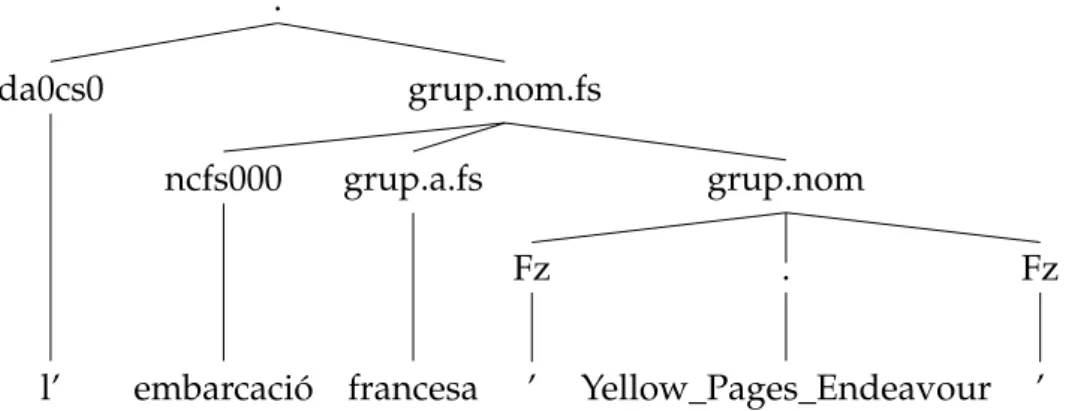
phrases. . . 32 2.8 Example of nesting from AnCora (Borrega et al., 2007), ‘on the
10th of May’. . . 39 2.9 Example of nesting from AnCora (Borrega et al., 2007), ‘the French
ship ‘Yellow Pages Endeavour’’. . . 40 2.10 Example of Person entity nesting, separate from a function ‘role’
annotation, in the ESTER II corpus (Galibert et al., 2011). . . 42 2.11 Example of coordination not combining separate Person entities
in the ESTER II corpus (Galibert et al., 2011). . . 42 2.12 Example of metonymy, Russia acting as the organisation, in the
ESTER II corpus (Galibert et al., 2011). . . 43
2.13 Example of Person entity nesting from in the National Corpus of Poland (Savary and Piskorski, 2011). . . 43 2.14 Examples of nesting in the PKU Chinese corpus (Fu and Luke,
2005) . . . 44 2.15 Example of nesting in Byrne’s Historical Archive Corpus. . . 45 4.1 Annotation tool showing pre-annotation of sentenceWSJ0001_0. 122 4.2 Annotation tool showing suggestions forElsevier N.V.inWSJ0001_1.123 4.3 Annotation tool showing annotation of a particular entity,Norwest
Corp., over all sentences in the corpus. . . 123 4.4 The comparison mode of the annotation tool, showing the
an-notations of two separate annotators. . . 124 4.5 Example derivation showingtag stack used for inter-annotator
agreement. . . 125 4.6 Example of entity with multiple layers of annotation . . . 139 5.1 An example of a perfect match between syntactic and named
entity structure. . . 157 5.2 Phrase demonstrating mapping of NNE and PTB syntactic
in-formation . . . 157 5.3 Phrase demonstrating addition ofNORP
:OTHER
onto anexist-ing token node. . . 157 5.4 Phrase demonstrating addition of aNML node withNNElabel
ORG
:
OTHERwithin a subtree. . . 158 5.5 OriginalPTBanalysis for sentenceWSJ0723_21. . . 160 5.6 Phrase demonstrating the inclusion of DT the in WSJ0120_43,forced byPP attachment. . . 162 5.7 Phrase demonstratingDT inclusion inWSJ0413_9. . . 162 5.8 Phrase demonstratingDT inclusion inWSJ0232_0. . . 162
5.9 Phrase demonstratingDT inclusion inWSJ0016_0. . . 162 5.10 Phrase demonstratingDT inclusion inWSJ0413_56. . . 163 5.11 Phrase demonstrating problems when including DTin entity span163 5.12 Expansion ofPERCENTto includeQUAL-like tokens . . . 164 5.13 Adjectives and adverbs are allowed to growNNE spans, but are
not explicitely marked up. . . 165 5.14 Resulting named entity span incorporating adverbialbarely in
WSJ0239_53. . . 165 5.15 Phrases demonstrating the expansion ofNNE PER spans to
in-clude additional tokens and spans. . . 166 5.16 Phrase fromWSJ0101_14demonstrating expansion ofNNE PER
to includeNML . . . 166 5.17 Phrase fromWSJ0231_41demonstrating expansion ofNNE PER
to includeNML . . . 166 5.18 Phrase demonstrating post-positional QUALinWSJ0219_14 . . . 167 5.19 Structured entity derivation and constituent tree ofbetweenin a
RATE. . . 168 5.20 Phrase demonstrating no valid node for a larger CARDINAL
span inWSJ0550_11. . . 168 5.21 Phrase demonstrating correct flat structure ofweeks of Junestyle
phrase inWSJ0640_1. . . 169 5.22 Phrase demonstrating preposition intoDATE span inWSJ0509_11.169 5.23 Phrase demonstrating inclusion of preposition intoDATEspan
inWSJ1634_98. . . 170 5.24 Phrase demonstrating inclusion of both determiner and
preposi-tion intoDATEspan inWSJ1566_34. . . 170 5.25 Phrase demonstrating addition of prepositionfromtoRATEspan
5.26 Phrase demonstrating full stop annotation error inWSJ1932_15 . 171 5.28 Phrase demonstrating PP attachment breaking NNP span in
WSJ0745_12and required restructuring. . . 172 5.29 Phrase demonstrating PP attachment breaking NNP span in
WSJ0910_12and required restructuring. . . 172 5.27 Full stop PTB annotation inside NPbracket in WSJ2007_22and
WSJ2211_1. . . 172 5.30 Phrase demonstrating restructuringPP attachment forNNP in
WSJ1688_1. . . 173 5.31 Phrase demonstrating original bracketing in WSJ0317_33 and
restructuring to allow for a largerMULTspan. . . 173 5.32 Phrase demonstratingMULTrebracketing inWSJ0118_10. . . 174 5.33 Phrase demonstratingas x asrestructuring inWSJ0451_15. . . . 175 5.34 Phrase demonstratingas x asrestructuring inWSJ0688_0. . . 175 5.35 Phrase demonstratingas x asrestructuring inWSJ0142_55 . . . . 175 5.36 Phrase demonstratingmore thanrestructuring inWSJ0203_15. . . 176 5.37 Phrase demonstratingmore thanrestructuring inWSJ0461_7. . . 177 5.38 Phrase demonstratingmore thanrestructuring inWSJ0774_7. . . 177 5.39 ConflictingPTB analyses forPERCENTstructures . . . 178 5.40 Proposed entity coordination inWSJ0666_28. . . 178 5.41 Fragment from sentence WSJ1556_22demonstrating
incompat-ible syntactic and semantic structure. . . 179 5.42 Examples of adding syntactic label ofPP toDATE entities. . . . 180 6.1 Underlying sentenceWSJ0001_0with PTBandNNE annotations. 191 6.2 SentenceWSJ0001_0withJOINTvariant annotations. . . 192 6.3 Two examples of labels occurring in section 00 that do not occur
in the training data. . . 192 6.4 SentenceWSJ0001_0withHIGHvariant annotations. . . 193
6.5 SentenceWSJ0001_0withLOW variant annotations. . . 194
6.7 Comparison between underlying merged tree andSUBvariant . 195 6.6 SentenceWSJ0001_0withPOSLOWvariant annotations. . . 195
6.8 SentenceWSJ0001_0withSUBvariant annotations. . . 196
6.9 Phrase from sentenceWSJ0001_0withPTBandNNEannotations, and corresponding phrase withSUBvariant annotations. . . 197
6.10 SentenceWSJ0001_0withSUB LAYERvariant annotations. . . . 197
6.11 Error type breakdown for pure PTB, a model trained only on the syntactic output of theLOWvariant, and each of our variants. . 209
6.12 Total number of nodes affected by errors, by type, in section 00, for purePTB, a model trained only on the syntactic output of the LOW variant, and each of our variants. . . 210
6.13 Process for evaluating SUBandSUB LAYERvariants. . . 211
6.14 POSand phrase label error confusion for each model in section 00.213 7.1 Figure showingTOPvariant ofNERlabels. . . 232
7.2 Figure showingTOP2variant ofNERlabels. . . 233
7.3 Figure showingBOTTOMvariant ofNERlabels. . . 234
7.4 Figure showingBOTTOM2variant ofNERlabels. . . 235
7.5 Figure showingTOP
_
BOTTOMvariant ofNERlabels. . . 2362.1 The Penn Treebank phrase level bracket labels and part of speech
(POS) tagset. . . 21
2.2 Comparison of EnglishNERdatasets . . . 29
2.3 Types and Subtypes of entities in theACE2008 English corpus. 33 2.4 Number of instances of subtypes ofORGin theBBNcorpus. . . 35
2.5 Types and Subtypes of entities in the ESTER II corpus. . . 41
2.6 Sekine’s ExtendedNEhierarchy . . . 50
3.1 Comparison of OntoNotes annotation and our annotation scheme for the same sentences . . . 61
3.2 The 30 most frequent non-DESCRIPTORlabels in the Wall Street Journal BBN corpus, the percentage of each tag’s occurrences, and the three most frequent examples. . . 65
3.3 The 10 most frequent DESCRIPTOR labels in the Wall Street Journal BBN corpus, the percentage of each tag’s occurrences, and the three most frequent examples. . . 66
3.4 Category overview of annotation scheme . . . 70
4.1 Inter-annotator Agreement comparing each annotator to the gold standard. . . 126
4.2 Pairwise inter-annotator Agreement on innermost tag. . . 126
4.3 Fleiss kappa Worked Example . . . 128
4.4 Per category consistency checks . . . 134
4.5 Inter-annotator Agreement metric post corpus fixes . . . 137 xviii
4.6 Number of entities at each layer of nesting. . . 139 4.7 Analysis of the 40 most frequent entity labels in our Wall Street
Journal NNEcorpus. . . 141 4.8 Template rules occurring more than 200 times in the corpus. . . 142 4.9 Analysis of matching entities inBBNand our final alignedNNE
corpus. . . 144 4.10 Analysis of entities with the same spans but different tags inBBN
andNNE. . . 147 4.11 Analysis of frequent entity confusions with the correct span
em-bedded within the nestedNNE span. . . 149 4.12 Analysis of entity types with larger spans NNEthanBBN. . . . 149 4.13 Analysis of entity types with smaller spansNNE thanBBN. . . . 152 4.14 Analysis of entities that are inNNE but notBBN. . . 153 5.1 Table showing comparative frequency foras x asconstructions. 174 5.2 Merging modifications toNNEspans and constituency trees. . . 182 6.1 Number of unique labels in each variant. . . 198 6.2 Eval-B Analysis of section 00 for each of the variants. . . 200 6.3 Eval-B Analysis of section 00 for each of the variants when
evalu-ated only on syntactic components . . . 203 6.4 Eval-B Analysis of Syntax only versions derived fromJOINT. . . 205 6.5 Eval-B Analysis and Tagging Accuracy of Entities only, using the
label ‘O’ all for non-entities, or usingPOStags for non-entities, and tagging accuracy for each model. . . 206 6.6 Eval-B Analysis ofSUB LAYER variant over 2415 sentences in
Section 23. . . 214 7.1 Baseline, median and maximumF1-score for the 16 entrants in
7.2 Performance of NER systems outlined in Section 7.1.2 on the OntoNotes 5 English splits proposed by Passos et al. (2014). LIB
-SCHWA NERnumbers from Dawborn (2015). . . 220 7.3 Numbers of categories and entities for differentNE variants. . . 238 7.4 Categories occurring more than 1, 5 and 10 times for each NE
variant. . . 239 7.5 10 most frequent entity labels for differentNEvariants. . . 241 7.6 Results of parsing experiments for different models. . . 242 7.7 Results of training theBOTTOMmodel with variousCRF
smooth-ing values. . . 246 7.8 Results of varyingNERencoding during training. . . 247 7.9 Comparison ofNERresults on different NEvariants usingLIB
-SCHWA NER,C&C and our parsing models. . . 248 7.10 Comparison of training times for different NE variants using
LIBSCHWA NER,C&C and our parsing models. . . 252 7.11 Most frequent labelling errors between variants and systems . . 254 7.12 Comparison of label sparsity vs. multiple taggers forBOTTOM2
What’s Montague? it is nor hand, nor foot, Nor arm, nor face, nor any other part, Belonging to a man. O! be some other name:
What’s in a name?
William Shakespeare The goal of natural language processing (NLP) is to develop computational systems for the interpretation, storage and manipulation of natural language.
People, locations, organisations and othernamed entitiesplay central roles in our lives, and their mentions are central in language. Therefore, named entity recognition (NER) has been a focus for NLPresearch, especially with statistical methods, and is a core component of manyNLPapplications, including search engines, question answering and machine translation.
The standardnamed entity recognitiontask involves identifying proper noun mentions of entities and classifying them according to a pre-defined category scheme. In most schemes, a contiguous sequence of tokens is identified and annotated with a single course-grained category. Theselinear spansare mutually exclusive — they cannot be nested within or overlap each other.
General domain NER includes identifying people (PER), locations (LOC), organisations (ORG) entities, and sometimes includes a catch-all category for miscellaneous (MISC) entities. This coarse-grained task has been extended by splitting these categories into finer-grained distinctions in an entity hierarchy.
It can also include numerical (NUMEX) and temporal (TIMEX) expressions, which may or may not be proper noun mentions, but are often distinguished by a small number of lexical patterns.
Unfortunately, this linear approximation of NER takes us no closer to a detailed semantic interpretation of named entities than chunking is to a full syntactic analysis. NER, so construed, reflects neither the syntactic nor se-mantic structure ofNEmentions, and typically provides insufficient categorical distinctions to represent that structure.
Representing this nested structure, where a mention contains mention(s) of other entities, is critical for applications such as coreference resolution, and the lack of this structure creates spurious ambiguity in the linear annotations.
Research inNER, as with mostNLPtasks, has been shaped by the quantity and quality of the available annotated corpora. As we discuss in Chapter 2, the existing structured named entity corpora are either small, in specialist domains, or in languages other than English. As such, they are unsuitable for our use, and we instead build on the unstructuredBBN(Weischedel and Brunstein, 2005a) entity scheme and annotations, adding structural and finer-grained categories.
This thesis addresses this deficiency, presenting the Nested Named Entity
(NNE) corpus, the first large-scale corpus of manually-annotated, structured, fine-grained named entities for English newswire, taken from theWSJportion of the Penn Treebank (PTB, Marcus et al., 1993). We explore how well existing phrase structure parsers and NER systems perform on this complex nested named entity task, and demonstrate that it is feasible to learn.
1.1
Motivating nested entity structure
A named entity can contain mentions of other entities: [Twinings of[London]loc]CORP
and [[Cambridge]loc University]EDU both contain a nested mention of a CITY: LondonandCambridge.1 These nested mentions are extremely common.
In the linear approximation of NER, all tokens in the span boundaries are labelled with the category of this larger span, soLondonandCambridgewould be labelled as a corporation (CORP) and educational institution (EDU) respectively, when they both function semantically as a mention of a city.
This introduces a type ofspurious ambiguityinto linearNER. Even in the case where the single tokenCambridge (withoutUniversity) refers to the university, the analysis should similarly be[[Cambridge]city]EDU, since the metonymy is
simply due to the elision ofUniversity.
The lack of corpora annotated with nested named entities has limited pro-gress on the structured task, and the most influential resources that have direc-ted research effort (e.g. the CoNLL shared task corpora) lack this information. This has resulted in the vast majority of general domainNERresearch (espe-cially in English) focused on annotations without internal structure, meaning spurious ambiguity is forced onto the analysis of each token.
The lack of nested structure in entities also impacts downstream applications. Consider the task of question answering, for example In which city’s stock exchange did Nike, Inc. first list? A system may identify thatNikelisted on the
New York Stock Exchange, but without knowledge of how to unpack that entity (e.g. [[New York]city Stock Exchange]CORP) and identify theCITY nested within
it, further processing would be required.
1In this thesis, we annotate examples with square brackets and subscripts, and abbreviate unambiguous categories, e.g. we often drop theORGprefix onORGsubtypes. We use colour to differentiate coarse-grained entity types (PER,ORG,LOC,FACILITY,MISC,NUMEX,TIMEX).
Similarly, in question answering information must often be combined from several sources to answer a question.How many days are there between Christmas in 2014 and Easter in 2015? Finding the dates of those two events may be straightforward, but finding a sentence that has already done that calculation is less likely. In this case, we must interpret the two dates as points on a timeline and calculate the difference, which requires an understanding of the internal structure of temporal expressions.
Understanding the internal structure of numerical expressions is also critical. For example,one to two hundred peopleis a single numerical reference (100-200 people), whilerooms can accommodate bookings of one hundred and sixty people respectivelyrefers to two different numbers (not160).
Learning the structure of an entity also gives us more evidence for tasks such as coreference resolution and relation extraction, for example, understanding that people’s names are constructed of first names (FIRST, e.g.[Bill]FIRST) and
family names (NAME e.g. [Gates]NAME) helps us identify that[Mr Gates]PER,
[Bill Gates]PER and[Bill]PERall refer to the same person, one of the founders of
the[Bill and Melinda Gates Foundation]ORG.
Bill and Melinda Gates Foundation first first name
first name
orgcorp
A better representation of the internal structure of a named entity can help in identifying its boundaries, a particularly difficult part ofNER. This is especially true of entities containing prepositions (the[Bank of [England]country]corpor conjunctions ([[[Proctor]name & [Gamble]name]name]corp).2 Syntax can also offer further information for makingNERdecisions. Consider thatI told Lucy Ester couldn’t lose, does not refer to a[Lucy Ester]PER. SimilarlyI gave Oprah Spiderbait
’s new album, can use syntactic clues to separate those entities, and to add information thatOprahis likely to be an animate entity.
By better learning the structure of entities, and combining this knowledge with syntactic and semantic information from a wider context we can hope to correctly analyse even very difficult entities, such as thisCORPfrom sentence
WSJ1249_34of thePTB:
Outplacement firm Challenger , Gray & Christmas finds . . .
name name name name
orgcorp
1.2
Motivation for fine-grained entities
MostNERtasks involves the broad categoriesPER,LOCand ORG, with some tasks also including a miscellaneous category (MISC), and temporal (TIMEX) and numerical (NUMEX) expressions.
In many real-world applications such as relation extraction, named entity linking, and question answering, these very coarse-grained categories are insuf-ficient and whileNERis used in theNLPpipeline, further post-processing and classification into fine-grained categories is required.
Sekine et al. (2002) introduce a detailed category hierarchy, consisting of more than 200 categories. This category hierarchy has been used by Hashimoto et al. (2008) to annotate a Japanese corpus of 8,500 newspaper articles and 400 white papers, though it has not yet been used to annotate a large-scale English corpus. Finer category distinctions are more common in domain-specificNER. For example, theGENIAcorpus in the biomedical domain contains 36 different categories with finer-grained distinctions (and shallow nested structures). In general domain, English corpora, the most widely used corpora: MUC-6
(Sund-heim, 1995),MUC-7 (Chinchor, 1998), and CoNLL 2003 (Tjong Kim Sang and De Meulder, 2003), are not annotated with fine-grained categories.
A fine-grained category hierarchy also allows for clearer signals in machine learning. Consider theMISCcategory, a particularly heterogeneous collection of entities, ranging from works of art to nationalities, products and laws. These are all quite different types of entities, and their surface forms show substantial variation. The names of laws or works of art often contain numerical or temporal references (e.g.[Proposition [13]cd]LAW, or[[1984]year]BOOK), while the names of religions or nationalities rarely do. By distinguishing between these types, we can allow for a much clearer signal for each type of entity.
The clearer signal for fine-grained categories is most evident when combined with syntactic information, such as verb sub-categorisation restrictions, since fine-grained categories behave differently and are used in different syntactic structures in text. A person canattendan educational organisation, such as a school or university, but cannotattenda corporate organisation. Similarly, in coreference resolution,[Mr [Vinken]name]PER is a much more likely reference
than [Mr [Pierre]first]PER. These distinctions are important in order to learn
high-accuracy models of entity types.
While some English corpora do exist with fine-grained entity annotations, such as BBN (Weischedel and Brunstein, 2005a) which is annotated with 64 types of named entity, numerical and time expression, it has not been widely used, and the CoNLL 2003 data set and the four-categoryNERtask (PER,LOC,
ORG,MISC) remains the de-facto standard.
In this work, we build on the BBN(Weischedel and Brunstein, 2005a) entity scheme and annotations, adapting the scheme with the addition of structural and finer-grained categories including some from Sekine et al. (2002). Using the existingBBNannotations allows us to create our nested corpus much more
rapidly, both in terms of annotation speed and the ability to find instances of specific types for designing our schema.
1.3
Contributions
In this thesis, we present the Nested Named Entity (NNE) corpus, the first corpus of nested named entity structure in English newswire text. It comprises nearly 50,000 sentences of fine-grained, structured entity annotations over the Wall Street Journal portion of the Penn Treebank. We use the BBN Pronoun Coreference and Entity Type Corpus (Weischedel and Brunstein, 2005a) as the starting point for our highest layer of entity annotation, and add in nes-ted structures using a hierarchical classification scheme based on the existing annotations (Brunstein, 2002). The NNEcorpus has high inter-annotator agree-ment, achieving a Fleiss’ kappa of 0.834. We perform substantial consistency analysis to ensure a high quality corpus.
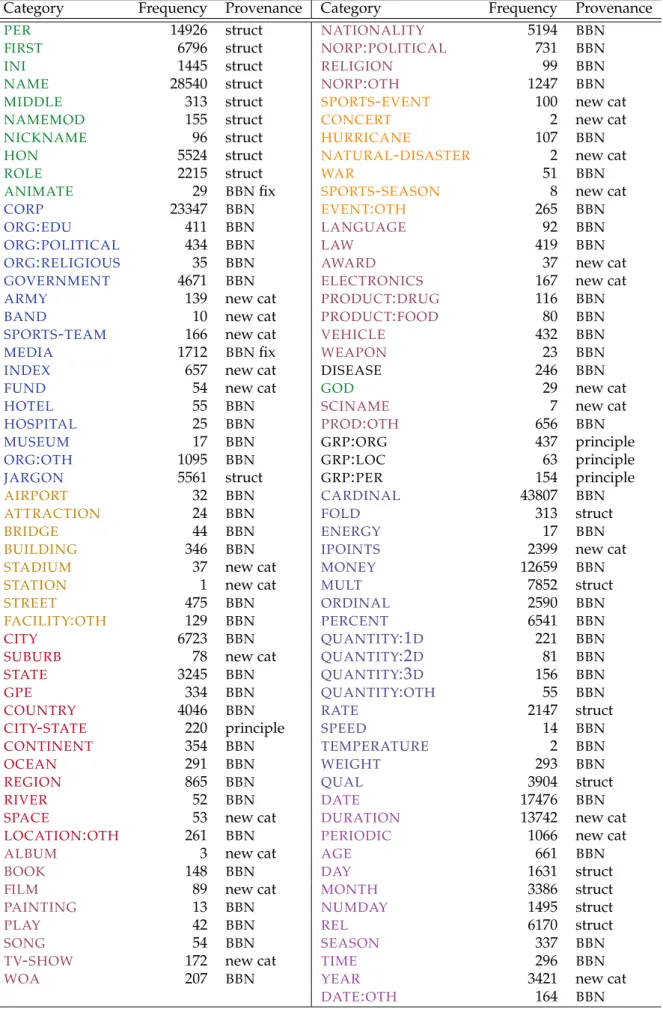
We define twelve high-level principles that guided the development of the annotation scheme and guidelines, and resolved difficult decisions for annotators. We also monitored the induced semantic grammar as it evolved during the annotation process, seeking to identify and document common patterns, such as FIRST + NAME → PER, to maintain consistency between annotators and attempt to minimise rule proliferation.
We present a set of highly detailedNNEannotation guidelines, covering 118 named entities, and numerical and temporal expressions at a fine-grained level. The guidelines are a separate document, and this thesis contains an abridged version. These guidelines bring fine-grained, structural named entities to the same level of detail as the bracketing and part of speech annotation guidelines for the Penn Treebank.
We developed annotation tools that allow annotators to easily see previous annotation decisions within this document and in the entire corpus, and enables annotators to make decisions on a per-document and entire corpus level. This, combined with our detailed annotation guidelines and annotation principles, and with substantial consistency checking, has ensured a highly consistent corpus of structured named entities.
We merged our NNEwith thePTB, requiring some systematic and one-off changes to both annotations. This allows theNNEcorpus to complement other PTBresources, such as PropBank (Kingsbury and Palmer, 2002; Palmer et al., 2005) and NomBank (Meyers et al., 2004), and informPTB-derived corpora for other formalisms, such as Combinatory Categorial Grammar (Hockenmaier, 2003) andLFG(Cahill et al., 2002). We compare this merged corpus against the originalBBNannotations.
1.3.1
Learning nested named entities
We approach the task of learning nested named entities from a parsing perspect-ive, presenting the first results of learning nested entities in English newswire text, and demonstrating that statistical methods can recover them with reason-able accuracy.
We consider several approaches to integrating thePTBandNNEannotations, which affect the sparsity of grammar rules and visibility of syntactic and NE structure. We explore their impact on parsing the NNE and merged variants using the Berkeley parser (Petrov et al., 2006), which performs surprisingly well without specialisedNERfeatures. We perform extensive error analysis on these different approaches.
We experiment with flattening theNNEannotations into linearNERvariants with either top-most, bottom-most and stacked categories, and explore the ability of a maximum entropy and aCRF NERsystem to reproduce them. The
state-of-the-artCRFperforms substantially better, but is infeasible to train on the enormous stacked category sets.
We compare the results of two NER systems to the performance of our parsing models on these semi-structural projections, finding that flattened output of the Berkeley parser are almost competitive with theCRF.
1.3.2
Analysing nested named entities
We present an analysis of the nested entities in the NNE corpus we create, finding a high number of structural entities with multiple layers of annotation. We discuss the analyses of the internal structure that form these nested named entities.
After merging our nested named entities with the syntactic structure of the PTB, we present a novel analysis of the effects of different merging algorithms on both parsing and named entity recognition. We also perform substantial error analysis in both the subtasks of parsing and named entity recognition.
1.4
Outline
We begin by reviewing the main tasks involved in learning the structure of named entities — parsing and named entity recognition — and by investigating the available corpora for both tasks in Chapter 2. We compare various annota-tion schemes used in NERcorpora, and describe the importance of the Penn Treebank (PTB) in both parsing and the widerNLPfield.
Chapter 3 describes the entity scheme used to annotate the corpus, outlining the annotation principles developed to ensure a detailed, consistent and useful corpus. We summarise the detailed entity guidelines used in the creation of the thesis, which bring the same level of detail as the syntacticPTB guidelines to the task of nested NER. We further describe why we elected to augment
the Wall Street Journal section of the Penn Treebank with nested named entity information, and outline the benefits from starting from existing, flat NER annotations from theBBNcorpus.
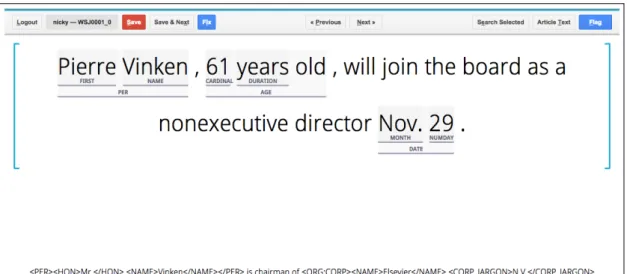
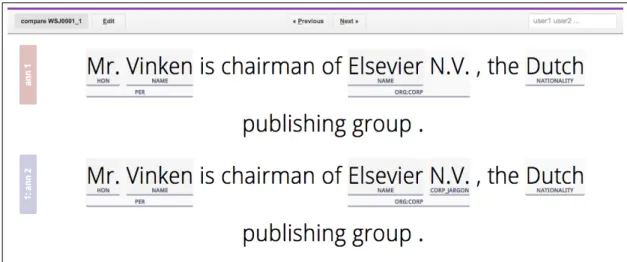
In Chapter 4 we document the creation of the NNE corpus. We outline various pre- and post-processing steps we apply, as well as a custom annotation tool, designed to ensure the creation of an accurate and consistent corpus. We analyse the inter-annotator agreement of our annotators, conduct substantial error analysis, and analyse the resulting finalNNEcorpus.
Chapter 5 describes the process of merging our NNEannotations with the PTBconstituency structure, to ensure a compatible corpus, which is necessary for parsing experiments. We outline the changes we make to both our NNE annotations and the syntactic constituents of thePTB, and evaluate the impact on consistence of both corpora that these changes have had.
In Chapter 6 we describe a number of ways of combining our NNE annota-tions and the syntactic constituents of the PTBinto one corpus, and perform the first analysis of the impact of different methods of combining syntactic and NEsemantic labels in a single constituency tree on the task of parsing. We use the Berkeley Parser (Petrov et al., 2006) to learn these combined structures, and report the first results of combined parsing and nested named entity recogni-tion. We also analyse the effects of the changes made to thePTBin the merging process of Chapter 5, and demonstrate the utility of that syntactic structure in predicting nested named entity structure.
In Chapter 7 we evaluate how well existing NERsystems, LIBSCHWA NER (Dawborn, 2015) and C&C NER tagger (Curran and Clark, 2003b), can learn structuredNERby devising different projections of structured entities into flat individual labels. We compare the results of theseNERsystems to the results of the parsers trained in Chapter 6, and analyse the different types of errors made by the different systems.
Finally, Chapter 8 discusses avenues for future work, both in the specific task ofNERand in various widerNLPtasks, and summarises the core contributions of this thesis.
This thesis contributes a significant new corpus fornested named entity recog-nition, the results of a number of novel experiments and sets the benchmark for the task of fine-grained, structured named entity recognition. In addition to this, it opens the field for further research, allowing nested named entities to be leveraged by systems in a wide range ofNLPapplications.
It is important that we know where we come from, because if you do not know where you come from, then you don’t know where you are, and if you don’t know where you are, you don’t know where you’re going. And if you don’t know where you’re going, you’re probably going wrong.
Terry Pratchett The primary contribution of this thesis is a corpus of nested named entity structure. In this chapter, we outline how the definition of a named entity has developed as new datasets are released. The Message Understanding Conferences (MUC, Chinchor, 1998) originally defined named entities with the broad categories of people, locations and organisations, as well as temporal and numerical expressions. Since then, the largest developments have been the inclusion of a Miscellaneous (MISC) category, and the introduction of fine-grained category hierarchies. Nesting in NEs has always been posited as a logical area for future development, though limitations in the available corpora annotated with nested entity structures have restricted this in standardNER tasks. This thesis addresses this shortfall, providing an accurate, fine-grained and nested named entity corpus.
Since the task of predicting the nested structure of named entities is relat-ively new, there is no single well-established way to learn the task, nor, more
importantly a generally accepted and comparable way to evaluate how well such a learnt model can apply to unseen text. In this thesis, we propose using methods from syntactic parsing to model structured named entity recogni-tion. We consider both the subtasks of constituency parsing and named entity recognition for evaluation.
In this chapter, we therefore discuss both constituency parsing and named entity recognition, both of which will be further discussed in their respective chapters (Section 6.1 and 7.1). We outline the development of constituency parsing, highlighting the important role that the Penn Treebank (PTB, Marcus et al., 1993) has had in allowing for the development of statistical models, and providing the mechanism on which those models are evaluated. We then discussNERbefore reviewing related work on nested named entities primarily in BiomedicalNLP.
2.1
Overview of tasks
In this section, we introduce the main tasks involved in learning the structure of named entities: parsing and named entity recognition. In particular we focus on the formalisms that will be important for understanding the methods used.
2.1.1
Parsing
Parsing, the process of determining the syntactic structure of a sentence, is an important natural language processing (NLP) task. Accurately parsing text is a vital step in many automatic language processing tasks, such as question answering (QA).
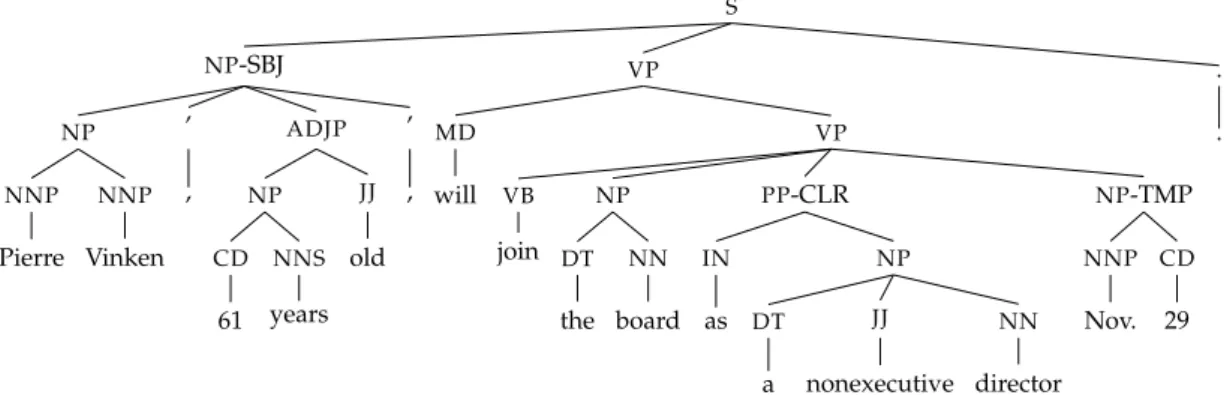
The most common type of syntactic representation of a parse is shown in Figure 2.1, which shows the first sentence of the Penn Treebank, a large-scale corpus annotated with gold-standard parse trees. In a constituency grammar, a
S . . VP VP NP-TMP CD 29 NNP Nov. PP-CLR NP NN director JJ nonexecutive DT a IN as NP NN board DT the VB join MD will NP-SBJ , , ADJP JJ old NP NNS years CD 61 , , NP NNP Vinken NNP Pierre
Figure 2.1:Constituent structure for the first sentence of the Penn Treebank (Marcus et al., 1993).
sentence is recursively decomposed into smaller sequences of words that are each labelled based on their internal structure. Different phrase labels relate to the dominant head word in the phrase. Phrase structures are induced by context-free grammars and are used in a variety of grammatical frameworks including Lexical Functional Grammar (LFG) (Kaplan and Bresnan, 1982), Tree Adjoining Grammar (TAG) (Joshi and Schabes, 1992), and Head-driven Phrase Structure Grammar (HPSG) (Pollard and Sag, 1994). In this thesis, we assume constituent structures as the representation of syntactic elements.
ThePTB is not only a useful standalone resource of its own right, but has also enabled a large number of corpora in different grammatical formalisms to be created. The combination of both phrase labels and Trace elements in the PTBhas enabled it to be used as the basis for statistical models used to generate treebanks in other grammars, such asCCG(Hockenmaier, 2003; Hockenmaier and Steedman, 2007),HPSG(Miyao et al., 2004), andLFG(Cahill et al., 2002).
Thus, an advantage of adding additional annotations to the PTBis that this layer of information can be transferred through to all derivative resources in different formalisms.
2.1.2
Named Entity Recognition
Named entity recognition (NER) is the task of automatically identifying proper names, numerical and temporal expressions in text and classifying them accord-ing to a pre-defined set of categories. General domainNERincludes identifying the names of people (PER), locations (LOC) and organisations (ORG). This has been extended in different ways, both by splitting existing categories into finer-grained distinctions with or without an explicit hierarchy, and by the inclusion of additional categories beyond the scope of people, locations and organisations.
[Nicky Ringland]per attends the [University of Sydney]org.
Finer grained categories are often grouped in a hierarchical structure (Sekine et al., 2002; Li and Roth, 2002; Sekine and Nobata, 2004; Sekine, 2008; Ling and Weld, 2012) whereby, for instance, multiple types of organisation (CORPORATE, EDUCATIONAL,GOVERNMENT, etc.) sitting under anORGANISATION cat-egory. Hierarchical ontologies allow for consistent labeling in certain cases of ambiguity. For instance the soccer teamRed Bull Brasilmay have surface form
Red Bull, and in context it may be unclear whether this refers to the ORGANIZ
-ATION:
CORPORATEor SPORTSTEAM. The parent label (ORGANIZATION) can be used instead. Other categorisation schemes may not allow parent cat-egories to be used as labels, but instead have an category for cases such as this, or for other specific types of organisations not specified by individual categories. Fine grained classification hierarchies are further discussed in Section 2.4.8.Extended named entity categorisations grow the scope of entities of interest. They usually include a miscellaneous category (MISC) which can include works of art, languages and product names. MISC also frequently includes entities which are not nouns, in certain adjectival forms, sometimes known asNORP, standing forNATIONALITY, OTHER,RELIGION andPOLITICAL.
Temporal and Numerical expressions are also occasionally included in the NERtask. Orthographically, their form is very different from otherNEs, and semantically they also differ in that they lack a real-world referent. NUMEX ex-pressions are lowercase, and are relatively detectable based on being primarily composed of numbers and a small set of words. TIMEXexpressions are a mix of both proper (Sunday) and common noun (next week) phrases, and the scope of the category varies between annotation guidelines. NUMEX and TIMEX expressions can be quite complex, yet mostly regular. Unlike other categories in the NER task, a large number of NUMEX and TIMEX expressions can be captured with simple regular expressions.
Annotation categories and corpora vary based on the specific application for NER. In the biomedical domain, corpora are annotated with entities including genes, proteins and chemical substances. For pragmatic reasons, and the low number of instances of these entity types, these entities are rarely annotated in general domain or newswireNERcorpora. Similarly, specific properties of the biomedical domain have resulted in nesting of entities being annotated in some biomedical corpora, further discussed in Section 2.4.1.
The area ofNERdeveloped from the field of information extraction (IE) in the Message Understanding Conferences (MUC) held in the 1990s (Chinchor, 1998). At the time,MUCwas primarily focused onIEtasks where structured information, such as a company or financial ‘event’, is extracted from unstruc-tured text such as newspaper articles.
NERhas since evolved into a distinct task which is an essential pre-processing step in various NLPpipelines including question answering, information re-trieval, coreference resolution and slot filling.
Due to the lack of appropriate resources, mostNERwork has assumed a flat NEstructure. This has meant that entities such as[The University of Sydney]ORG
ambiguity onto the token[Sydney]CITY, which is acting as CITYin both cases. It
also means that we have been unable to utilise structural information in entities such as the[Bill and Melinda Gates Foundation]ORG, from which we should be
able to derive both [Melinda Gates]PER and [Bill Gates]PER, which would be
especially useful for coreference tasks when co-located with [Mr. Gates]PER.
The dependence of machine learning approaches on large annotated training corpora has proven to be a bottleneck in this.
2.2
The Penn Treebank corpus
The development of syntactically annotated corpora revolutionised computa-tional linguistics, allowing the field to develop from predominantly rule-based to statistical methods.
The Penn Treebank (Marcus et al., 1993) has been hugely influential in statistical methods for learning syntactic parse structures in English. Developed between 1989 and 1996, the Penn Treebank was the first large-scale corpus to be manually annotated with gold-standard constituency trees.
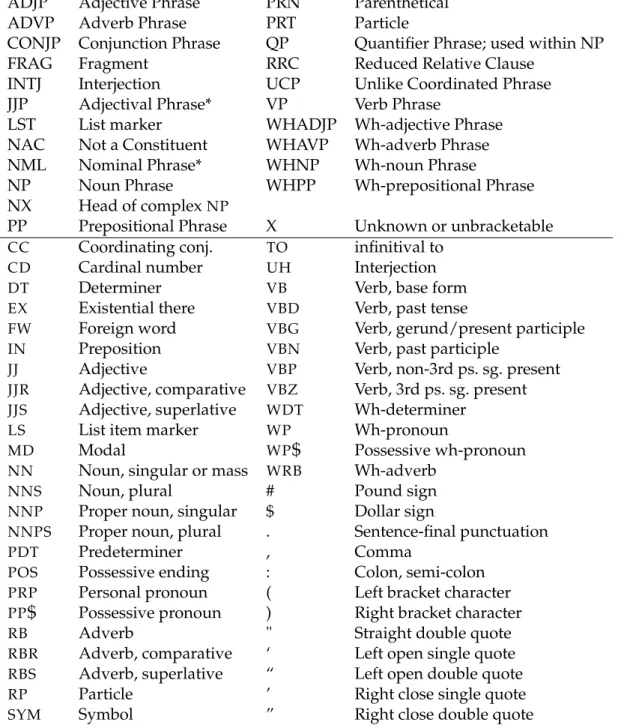
The Treebank has labelled brackets describing the syntactic structure of each constituent in the sentence and part of speech (POS) tags labelling each word. These phrase brackets and POStags are summarised in Table 2.1, and an example of their use is given in Figure 2.2, where[Cotton Inc.]CORP is anNP
composed of two proper nouns (NNP).
The release of the Penn Treebank allowed for supervised, statistical exper-iments in parsing, and it remains the canonical parsing dataset for English. However, the Penn Treebank does have certain known limitations, both with re-spect to the grammatical structures with which it is annotated, and the presence of errors in the data.
The Penn Treebank I was released in 1991 (Marcus and Santorini, 1991), followed by the Penn Treebank II in 1993 (Marcus et al., 1993). The re-release of the corpus updated the bracketing guidelines, modifying the way trace elements are handled, and adding a set of functional markers used to indicate semantic structure. These enabled the modeling of grammatical relations (Marcus et al., 1994). In Figures 2.1 and 2.2, SBJmarks the subjectNP, while LOCandTMP mark locative and temporal elements respectively. The annotation of these semantic elements proved difficult (see Marcus et al., 1994), and the resulting functional markers are used inconsistently throughout the corpus.
The handling of various types ofNEare also captured in Figures 2.2 and 2.3. SomeNEs, e.g. (NP (NNP Cotton)(NNP Inc.))and(NP (NNP Albert)(NNP M.)(NNP Kligman)), form constituentNPs, though only each individual token is identified
as a proper noun, not the larger constituent span. The analysis ofThanksgiving Dayin Figure 2.2 shows an example of inconsistent treatment of a constituent due to proper nouns being analysed with flat structure. The first instance forms its own constituent NP, while the second forms part of a larger NP: Macy ’s Thanksgiving Day Paradeand does not have its own constituent. This is further explored and a solution proposed in Chapter 5.
In Figure 2.3, the analysis for[University of Pennsylvania School of Medicine]ORG
is even more problematic, with the substructure (NP (NP the University of Pennsylvania School)(PP of Medicine))splitting the mentionSchool of Medicine. We further examine these inconsistencies and solve the problem in Chapter 5.
2.2.1
Adding Noun Phrase Structure to the
PTB
The original Penn Treebank annotation guidelines did not include extensive noun phrase structure, electing instead to simplify the annotation task and speed up bracketing decisions by avoiding adding any structure for nominal modifiers as far as possible (Marcus et al., 1993).
( (S (NP-SBJ-1 (NNP Cotton) (NNP Inc.) ) (VP (MD will) (VP (VB spend) (NP (QP (RB nearly) ($ $) (CD 2) (CD million) ) (-NONE- *U*) ) (PP-CLR (IN on) (NP (NN broadcasting) )) (PP-TMP (IN on) (NP (NP (NNP Thanksgiving) (NNP Day) ) (ADVP (RB alone) ))) (, ,) (S-ADV (NP-SBJ (-NONE- *-1) ) (VP (VBG advertising)
(PP-LOC (IN on) (NP
(NP (JJ such) (NNS programs) ) (PP (IN as)
(NP (‘‘ ‘‘)
(NP (JJ Good) (NN Morning) (NNP America) ) (, ,) (’’ ’’) (‘‘ ‘‘)
(NP
*(NP (NNP Macy) (POS ’s) )
(NNP Thanksgiving) (NNP Day) (NNP Parade) ) (’’ ’’)
(CC and)
(NP (DT the) (NNP NFL) (NN holiday) (NN game) ))))))))) (. .) ))
Figure 2.2:An example sentence (WSJ0295_53) from the Penn Treebank (Marcus et al., 1993), with named entities marked in blue.
ADJP Adjective Phrase PRN Parenthetical ADVP Adverb Phrase PRT Particle
CONJP Conjunction Phrase QP Quantifier Phrase; used within NP FRAG Fragment RRC Reduced Relative Clause
INTJ Interjection UCP Unlike Coordinated Phrase JJP Adjectival Phrase* VP Verb Phrase
LST List marker WHADJP Wh-adjective Phrase NAC Not a Constituent WHAVP Wh-adverb Phrase NML Nominal Phrase* WHNP Wh-noun Phrase
NP Noun Phrase WHPP Wh-prepositional Phrase NX Head of complexNP
PP Prepositional Phrase X Unknown or unbracketable CC Coordinating conj. TO infinitival to
CD Cardinal number UH Interjection
DT Determiner VB Verb, base form
EX Existential there VBD Verb, past tense
FW Foreign word VBG Verb, gerund/present participle IN Preposition VBN Verb, past participle
JJ Adjective VBP Verb, non-3rd ps. sg. present JJR Adjective, comparative VBZ Verb, 3rd ps. sg. present JJS Adjective, superlative WDT Wh-determiner
LS List item marker WP Wh-pronoun
MD Modal WP$ Possessive wh-pronoun
NN Noun, singular or mass WRB Wh-adverb
NNS Noun, plural # Pound sign
NNP Proper noun, singular $ Dollar sign
NNPS Proper noun, plural . Sentence-final punctuation
PDT Predeterminer , Comma
POS Possessive ending : Colon, semi-colon PRP Personal pronoun ( Left bracket character PP$ Possessive pronoun ) Right bracket character RB Adverb " Straight double quote RBR Adverb, comparative ‘ Left open single quote RBS Adverb, superlative “ Left open double quote RP Particle ’ Right close single quote
SYM Symbol ” Right close double quote
Table 2.1: The Penn Treebank phrase level bracket labels and part of speech (POS) tagset. *NMLandJJPwere introduced by Vadas and Curran (2007) and Vadas (2007) for noun phrase structure.
( (S (PP-TMP (IN In) (NP (NNP May))) (, ,) (NP-SBJ (NNP University) (NNP Patents) ) (VP (VBD filed) (NP (NP (DT a) (NN suit) ) (PP (-NONE- *ICH*-1) )) (PP-LOC (IN in)
(NP (JJ federal) (NN court) )) (PP-LOC (IN in)
(NP (NNP Philadelphia) )) (PP-1 (IN against) (NP (NP (NNP Albert) (NNP M.) (NNP Kligman) ) (, ,) (NP (NP (DT a) (NN researcher) (CC and) (NN professor) ) (PP-LOC (IN at)
(NP (NP (DT the) (NAC (NNP University) (PP (IN of) (NP (NNP Pennsylvania) ))) (NNP School) ) (PP (IN of) (NP (NNP Medicine) )))) (SBAR (WHNP-182 (WP who) ) (S (NP-SBJ-2 (-NONE- *T*-182) ) (VP (VBD developed) (NP (NNP Retin-A) ) (PP-TMP (IN in) (NP (DT the) (CD 1960s) )) (S-PRP (NP-SBJ (-NONE- *-2) ) (VP (TO to) (VP (VB combat) (NP (NN acne) ))))))))))) (. .) ))
Figure 2.3:An example sentence (WSJ0081_2) from the Penn Treebank (Marcus et al., 1993), with named entities marked in colour. The named entity in red has incorrect substructure.
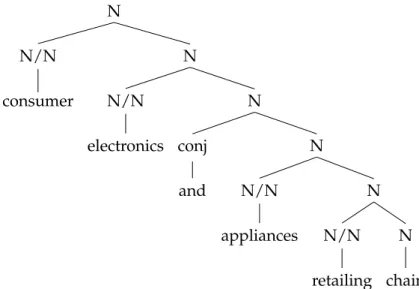
N N N N N N chain N/N retailing N/N appliances conj and N/N electronics N/N consumer
Figure 2.4:CCG derivation from Hockenmaier (2003)
Vadas and Curran (2007) and Vadas (2010) extend the existing Treebank annotations by adding the internal structure of noun phrases. They motivate the task of identifying noun phrase structure in base-NPs, citing their importance inNLPsystems (NPs as factoid answers for Question Answering systems), as well as other annotated data derived from the Penn Treebank.
CCGbank (Hockenmaier, 2003; Hockenmaier and Steedman, 2007), for ex-ample, was created by semi-automatically converting the Treebank phrase structures to Combinatory Categorial Grammar (CCGSteedman, 1996, 2000), a grammatical formalism which is binary branching and, as such, cannot directly represent the flat structures of Penn Treebank noun phrases. The conversion process, in the absence of structuralNPinformation, constructed strictly right-branching trees for all base-NPs, an example of which is shown in Figure 2.4.
The annotation guidelines used by Vadas and Curran (2007) build on those for annotating full sub-NP structures from the biomedical domain (Kulick et al., 2004), which add nominal (NML) nodes to add internal NP structure. Vadas and Curran addNML or Adjectival phrase (JJP) nodes for structures that are left-branching, and leave right-branching structures flat. All potentially ambiguousNPs, defined as NPs with three or more contiguous children that
(NP (NML (JJ Good) (NN Morning) ) (NNP America) ) (NP (NP (NNP Macy) (POS ’s) ) (NML (NNP Thanksgiving) (NNP Day) ) (NNP Parade) )
Figure 2.5: Changes from sentence (WSJ0295_53) following addition of noun phrase structure (Vadas and Curran, 2007). Note the inclusion ofNMLnode labels.
are either single words or otherNPs, in thePTBwere annotated. Some common structures, such as anNPof three words starting with a determiner were filtered out as unambiguous.
Vadas and Curran drew structural suggestions from the boundaries of named entities from the BBN corpus (Weischedel and Brunstein (2005a), see Section 2.3.4), as well as from previous bracketings of the same words. Post-processing checks were carried out to ensure annotation consistency. 22851 NPs of a total of 60959 ambiguous NPs (37.49%) were found to be non right-branching, and had brackets inserted.
Vadas and Curran (2007) used Bikel’s (2004) implementation of Collins’ parser (Collins, 1999) to evaluate the addition ofNPstructure to thePTB, find-ing that the additional brackets make parsfind-ing marginally more difficult (88.46
F1-score, down from 88.92). They further evaluate on only theNML and JJP
brackets which were inserted, achieving anF1-score of 69.63, and
correspond-ingly evaluate excluding theNMLandJJPbrackets which were inserted, achiev-ing anF1-score of 88.89. These results show the difficulty of correctly bracketing
NPs, while also demonstrating that the performance of other phrases is not badly affected by the newNPbrackets that were inserted.
2.2.2
Other resources built on the
PTB
In addition to enabling the automatic creation of corpora in other grammatical formalisms, such asCCG(Hockenmaier, 2003) andLFG(Cahill et al., 2002), the PTBhas also served as the basis of a number of other linguistic resources such as PropBank (Kingsbury and Palmer, 2002; Palmer et al., 2005) and NomBank (Meyers et al., 2004), meaning that these resources are able to be mapped back and through to the derivative treebanks in other grammatical formalisms. PropBank specifies the predicate argument relationships between verbs and the arguments of those verbs. NomBank provides argument structure for instances of common nouns in thePTBcorpus.
The goal of the PropBank and NomBank projects is to lead to the creation of better tools for the automatic analysis of text. Meyers et al. (2004) suggest that the standardisation which is imposed by the annotated data will ensure that more researchers will work within the same set of frameworks, and as such, each individual’s research will be more directly applicable to the larger research community.
Additionally, as the same set of data is annotated with additional layers of annotation, new forms of multistage processing become possible. Consider an information extraction task where acquisitions are of interest. A system using PropBank and NomBank could generalise over patterns involving the verb acquire, learning that[Sony Corp.]CORP acquired[Columbia Pictures]CORP
from both surface formsSony Corp. acquired Columbia Pictures,Columbia Pictures is being acquired by Sony Corp.,Sony’s recent acquisition of Columbia Pictures . . .
etc. When combined with the fine-grainedNEcorpus presented in this thesis, the system could additionally learn that both the first and second argument of
Unfortunately, if these corpora which offer additional annotation layers do not align properly with the Treebank, the utility of the resource is impacted. PropBank and NomBank do not modify the PTB annotations, even in cases of incompatible alignment. By electing to leave the PTB unmodified, some arguments span over incompatible syntactic spans, which is problematic for systems parsing this information, such as those which use parsers for the task of semantic role labelling. These systems essentially incur a penalty, since they are unable to produce the correct PropBank span.
OntoNotes (Hovy et al., 2006; Weischedel et al., 2010, 2013) combines mul-tiple layers of annotation, including thePTB, PropBank and NomBank, as well as additional layers of semantic annotation. Babko-Malaya et al. (2004) describe the merging the English Treebank and PropBank, detailing the changes that were necessary to make to both corpora to address the conflicting annotations. OntoNotes further adds to these annotation layers with resolving word sense ambiguity (linking each to the Omega ontology Philpot et al., 2005), and annot-ating coreference. The OntoNotes project further grew to include named entity annotation in later releases.
The OntoNotes project has been developing in parallel to the work presented in this thesis, and the extension of this work to the OntoNotes corpus would be a natural progression, which we suggest as future work.
2.2.3
Tokenisation in the Penn Treebank
The preprocessing task of tokenisation, that is, splitting a sentence up into discrete tokens, is important for allNLPtasks. In most cases, this is considered a preprocessing step that has already been solved, and the tokens that for a sentence are considered independent lexemes and punctuation marks. Many phenomena complicate tokenisation, including abbreviations (e.g. USPS, the United States Postal Service), date or number expressions (e.g. the 1980s), and
certain adjectival forms (e.g. London-based). Many of these tokenisation issues are of particular interest to the combined task of parsing and NER, however substantial tokenisation changes are rarely made to an existing, establish corpus such as the Penn Treebank. In this thesis, we accept this limitation, but note the issues that are compounded based on tokenisation decisions.
2.2.4
Summary
ThePTBis one of the most influential resource inNLP, alongside other resources such as WordNet (Pedersen et al., 2004). It has had an enormous impact, both directly on the task of parsing, and in the wider field ofNLP. Over time, various deficiencies (such asNPbracketing forNPstructure) have been rectified, and additional resources have been built both from it (CCGbank) and on top of it (PropBank, NomBank) that make it an even richer resource. This thesis builds on top of thePTBand enriches the full ecosystem of resources and systems that stem from it.
2.3
Named Entity Corpora
As with parsing, the dominant methods in current named entity recognition use data-driven statistical approaches. The costs associated with procuring the data are high. For EnglishNERtraining, corpora originating from conference evaluations of named entity technology (MUC, IEER, ACE and CoNLL) are most widely used, in both general and specific domains such as biomedicine. This can affect the usefulness of the corpora since they are, to a large extent, only annotated with the specific labels that are of interest to that particular conference or shared task.
TheBBNPronoun Coreference and Entity Type Corpus (BBN) did not origin-ate from a conference or competition. It contains a wide variety of fine-grained entities, but has not been widely utilised by the research community.
Corpora with annotated named entities are essential for developing and evaluating named entity recognition (NER) systems. NER systems can only be as reliable as their training sources and world knowledge, and can only be as detailed as the training data and annotation schemas. Machine learning approaches to NERrequire training corpora with gold-standard annotations which can be analysed statistically to produce a predictive model. Since training texts are traditionally annotated manually by linguistic experts, they are costly to produce and generally small in size – up to 1.2 million tokens in BBN’s annotation of Wall Street Journal text (Weischedel and Brunstein, 2005b). More recent work has explored a distant supervision approach using Wikipedia to generate corpora automatically (Richman and Schone, 2008; Nothman et al., 2013), however, these large corpora are not extensively used for training or evaluation of NER systems. The domain of the corpus is also important, as performance is considerably lower whenNERsystems are trained on out of domain corpora. This has led to the creation of domain specific corpora, such as Liu et al. (2011), who have annotated named entities in Tweets.
An overview of the size, domain, number of tags and presence of nested entities in commonly used named entity corpora is shown in Table 2.2.
2.3.1
MUC
6 and 7 and
MET
The Message Understanding Conferences (MUC) which ran from 1987 to 1997 were designed to encourage the development of information extraction meth-ods. These competitions involved both the creation of substantial amounts of data and new standards for evaluation. TheMUC-6 (Sundheim, 1995) and MUC-7 (Chinchor, 1998) shared tasks compartmentalised named entity
recogni-Corpus # tags # tokens Nesting Domain
MUC-6 7 23,773∗ no Newswire
MUC-7 7 149,249∗ no Newswire
CoNLL 2003 4 301,418 no Newswire
ACE2004 43 189,620 some Newswire, Broadcast & Web
BBN 64 1,173,766 no Newswire
OntoNotes 18 450,000† yes Newswire
ACE2008 31 245,000‡ some Newswire, Broadcast & Web
GENIA 36 436,967 yes Biomedical
AnCora 6 n/a yes Non-English Newswire
Table 2.2:Statistics of various EnglishNERdatasets. Note that ‘# tags’ includes named entity,TIMEXandNUMEXcategories. *Approximate numbers based on untokenised text. †TheACE2008 token numbers are unavailable for evaluation data; reported is tokens in training and development data. ‡Number of tokens in English documents annotated with named entity information, of a total of 1,631,995 English tokens.
tion from information extraction, and involved participants identifying named entities in text, and categorising them into seven subcategories split over three groups: entity expressions (ENAMEX, which includes LOCATION, ORGAN
-ISATIONandPERSON), temporal expressions (TIMEX, which includesDATE andTIME), and numerical expressions (NUMEX, which includesMONEYand PERCENT). TheMUC-6 andMUC-7 datasets