A Discriminative Syntactic Model for Source Permutation
via Tree Transduction
Maxim Khalilov and Khalil Sima’an Institute for Logic, Language and Computation
University of Amsterdam
{m.khalilov,k.simaan}@uva.nl
Abstract
A major challenge in statistical machine translation is mitigating the word or-der differences between source and tar-get strings. While reordering and lexical translation choices are often conducted in tandem, source string permutation prior to translation is attractive for studying re-ordering using hierarchical and syntactic structure. This work contributes an ap-proach for learning source string permu-tation via transfer of the source syntax tree. We present a novel discriminative, probabilistic tree transduction model, and contribute a set of empirical upperbounds on translation performance for English-to-Dutch source string permutation under sequence and parse tree constraints. Fi-nally, the translation performance of our learning model is shown to outperform the state-of-the-art phrase-based system sig-nificantly.
1 Introduction
From its beginnings, statistical machine transla-tion (SMT) has faced a word reordering challenge that has a major impact on translation quality. While standard mechanisms embedded in phrase-based SMT systems, e.g. (Och and Ney, 2004), deal efficiently with word reordering within a lim-ited window of words, they are still not expected to handle all possible reorderings that involve words beyond this relatively narrow window, e.g., (Tillmann and Ney, 2003; Zens and Ney, 2003; Tillman, 2004). More recent work handles word
order differences between source and target lan-guages using hierarchical methods that draw on Inversion Transduction Grammar (ITG), e.g., (Wu and Wong, 1998; Chiang, 2005). In principle, the latter approach explores reordering defined by the choice of swapping the order of sibling sub-trees under each node in a binary parse-tree of the source/target sentence.
An alternative approach aims at minimizing the need for reordering during translation by permut-ing the source sentence as a pre-translation step, e.g., (Collins et al., 2005; Xia and McCord, 2004; Wang et al., 2007; Khalilov, 2009). In effect, the translation process works with a model for source permutation (s → s0) followed by
trans-lation model (s0 → t), where sandtare source
and target strings ands0is the target-like permuted
source string. In how far can source permutation reduce the need for reordering in conjunction with translation is an empirical question.
In this paper we define source permutation as the problem of learning how to transfer a given source parse-tree into a parse-tree that minimizes the divergence from target word-order. We model the tree transferτs → τs0 as a sequence of local,
independent transduction operations, each trans-forming the current intermediate treeτs0
i into the
next intermediate tree τs0
i+1, with τs0 = τs and
τs0
n = τs0. A transduction operation merely
per-mutes the sequence ofn > 1children of a single node in an intermediate tree, i.e., unlike previous work, we do not binarize the trees. The number of permutations is factorial in n, and learning a
from the limited perspective of sourcestring per-mutation (s → s0), another challenge is to
inte-grate a figure of merit that measures in how fars0
resembles a plausible target word-order.
We contribute solutions to these challenging problems. Firstly, we learn the transduction operations using a discriminative estimate of
P(π(αx)|Nx, αx, contextx), whereNxis the
la-bel of node (address)x,Nx → αxis the
context-free production underx,π(αx)is a permutation of αxandcontextxrepresents a surrounding
syntac-tic context. As a result, this constrains {π(αx)}
only to those found in the training data, and it conditions the transduction application probabil-ity on its specific contexts. Secondly, in every se-quences00 =s, . . . , s0n =s0 resulting from a tree
transductions, we prefer those local transductions on τs0
i−1 that lead to source string permutations
0 i
that are closer to target word order thans0i−1; we
employs0 language model probability ratios as a
measure of word order improvement.
In how far does the assumption of source per-mutation provide any window for improvement over a phrase-based translation system? We con-duct experiments on translating from English into Dutch, two languages which are characterized by a number of systematic divergences between them. Initially, we conduct oracle experiments with varying constraints on source permutation to set upperbounds on performance relative to a state-of-the-art system. Translating the oracle source string permutation (obtained by untangling the crossing alignments) offers a large margin of improvement, whereas the oracle parse tree per-mutation provides a far smaller improvement. A minor change to the latter to also permute con-stituents that include words aligned with NULL, offers further improvement, yet lags bahind bare string permutation. Subsequently, we present translation results using our learning approach, and exhibit a significant improvement in BLEU score over the state-of-the-art baseline system. Our analysis shows that syntactic structure can provide important clues for reordering in trans-lation, especially for dealing with long distance cases found in, e.g., English and Dutch. Yet, tree transduction by merely permuting the order of
sis-ter subtrees might turn out insufficient.
2 Baseline: Phrase-based SMT
Given a word-aligned parallel corpus, phrase-based systems (Och and Ney, 2002; Koehn et al., 2003) work with (in principle) arbitrarily large phrase pairs (also called blocks) acquired from word-aligned parallel data under a simple defi-nition of translational equivalence (Zens et al., 2002). The conditional probabilities of one phrase given its counterpart are interpolated log-linearly together with a set of other model estimates:
ˆ
eI1= arg max
eI
1 ( M
X
m=1
λmhm(eI1, f1J)
) (1)
where a feature function hm refer to a system
model, and the correspondingλmrefers to the
rel-ative weight given to this model. A phrase-based system employs feature functions for a phrase pair translation model, a language model, a reordering model, and a model to score translation hypothesis according to length. The weightsλm are usually
optimized for system performance (Och, 2003) as measured by BLEU (Papineni et al., 2002). Two reordering methods are widely used in phrase-based systems.
Distance-based A simple distance-based re-ordering model default for Moses system is the first reordering technique under consideration. This model provides the decoder with a cost lin-ear to the distance between words that should be reordered.
MSD A lexicalized block-oriented data-driven reordering model (Tillman, 2004) considers three different orientations: monotone (M), swap (S), and discontinuous (D). The reordering probabili-ties are conditioned on the lexical context of each phrase pair, and decoding works with a block se-quence generation process with the possibility of swapping a pair of blocks.
3 Related Work on Source Permutation
Venugopal, 2006). Similarly, the tree-to-string syntax-based transduction approach offers a com-plete translation framework (Galley et al., 2006).
The idea of augmenting SMT by a reordering step prior to translation has often been shown to improve translation quality. Clause restructuring performed with hand-crafted reordering rules for German-to-English and Chinese-to-English tasks are presented in (Collins et al., 2005) and (Wang et al., 2007), respectively. In (Xia and McCord, 2004; Khalilov, 2009) word reordering is ad-dressed by exploiting syntactic representations of source and target texts.
Other reordering models operate provide the decoder with multiple word orders. For ex-ample, the MaxEnt reordering model described in (Xiong et al., 2006) provides a hierarchi-cal phrasal reordering system integrated within a CKY-style decoder. In (Galley and Manning, 2008) the authors present an extension of the fa-mous MSD model (Tillman, 2004) able to handle long-distance word-block permutations. Coming up-to-date, in (PVS, 2010) an effective application of data mining techniques to syntax-driven source reordering for MT is presented.
Recently, Tromble and Eisner (2009) define source permutation as learning source permuta-tions; the model works with a preference matrix for word pairs, expressing preference for their two alternative orders, and a corresponding weight matrix that is fit to the parallel data. The huge space of permutations is then structured using a binary synchronous context-free grammar (Binary ITG) withO(n3)parsing complexity, and the
per-mutation score is calculated recursively over the tree at every node as the accumulation of the relative differences between the word-pair scores taken from the preference matrix. Application to German-to-English translation exhibits some per-formance improvement.
Our work is in the general learning direction taken in (Tromble and Eisner, 2009) but differs both in defining the space of permutations, using local probabilistic tree transductions, as well as in the learning objective aiming at scoring permuta-tions based on a log-linear interpolation of a lo-cal syntax-based model with a global string-based (language) model.
4 Pre-Translation Source Permutation
Given a word-aligned parallel corpus, we define the source string permutation as the task of learn-ing to unfold the crosslearn-ing alignments between sentence pairs in the parallel corpus. Let be given a source-target sentence pair s → t with word
alignment set a between their words.
Unfold-ing the crossUnfold-ing instances ina should lead to as
monotone an alignmenta0 as possible between a
permutations0 ofsand the target string t.
Con-ducting such a “monotonization” on the parallel corpus gives two parallel corpora: (1) a source-to-permutation parallel corpus (s → s0) and
[image:3.595.339.489.345.474.2](2) a source permutation-to-target parallel corpus (s0 → t). The latter corpus is word-aligned au-tomatically again and used for training a phrase-based translation system, while the former corpus is used for training our model for pre-translation source permutation via parse tree transductions.
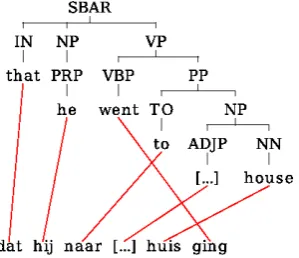
Figure 1: Example of crossing alignments and long-distance reordering using a source parse tree.
In itself, the problem of permuting the source string to unfold the crossing alignments is compu-tationally intractable (see (Tromble and Eisner, 2009)). However, different kinds of constraints can be made on unfolding the crossing alignments ina. A common approach in hierarchical SMT is
4.1 Oracle Performance
As has been shown in the literature (Costa-juss`a and Fonollosa, 2006; Khalilov and Sima’an, 2010; Wang et al., 2007), source and target texts mono-tonization leads to a significant improvement in terms of translation quality. However it is not known how many alignment crossings can be un-folded under different parse tree conditions. In or-der to gauge the impact of corpus monotonization on translation system performance, we trained a set of oracle translation systems, which create target sentences that follow the source language word order using the word alignment links and various constraints.
(a) Word alignment.
(b) Parse tree and corre-sponding alignment. (c) Word alignment
[image:4.595.94.285.277.415.2]and ADJP span.
Figure 2: Reordering example.
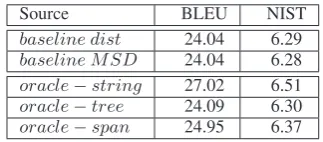
The set-up of our experiments and corpus char-acteristics are detailed in Section 5. Table 1 re-ports translation scores of the oracle systems. No-tice that all the numbers are calculated on the re-aligned corpora. Baseline results are provided for informative purposes.
String permutation The first oracle system under consideration is created by traversing the string from left to right and unfolding all crossing alignment links (we call this system oracle-string). For example in Figure 2(a), the oracle-string system generates a string “do so gladly” swapping the words “do” and “gladly” without considering the parse tree. The first line of the table shows the performance of theoracle-stringsystem with monotone source and target portions of the corpus.
Oracle under tree constraint We use a syntac-tic parser for parsing the English source sentences
that providen-ary constituency parses. Now we
constrain unfolding crossing alignments only to those alignment links which agree with the struc-ture of the source-side parse tree and consider the constituents which include aligned tokens only. Unfolding a crossing alignment is modeled as per-muting the children of a node in the parse tree. We refer to this oracle system asoracle-tree. For ex-ample provided in Figure 2(b), there is no way to construct a monotonized version of the sentence since the word “so” is aligned to NULL and im-pedes swapping the order of VB and ADJP under the VP.
Oracle under relaxed tree constraint The oracle-tree system does not permute the words which are both (1) not found in the alignment and (2) are spanned by the sub-trees sibling to the ordering constituents. Now we introduce a re-laxed version of the parse tree constraint: the or-der of the children of a node is permuted when the node covers the reordering constituents and alsowhen the frontier contains leaf nodes aligned with NULL (oracle-span). For example, in Fig-ure 2(c) the English word “so” is not aligned, but according to the relaxed version, must move to-gether with the word “gladly” since they share a parent node (ADJP).
Source BLEU NIST
baseline dist 24.04 6.29
baseline M SD 24.04 6.28
oracle−string 27.02 6.51
oracle−tree 24.09 6.30 oracle−span 24.95 6.37
Table 1: Translation scores of oracle systems.
The main conclusion which can be drawn from the oracle results is that there is a possibility for relatively big (≈3 BLEU points) improvement with complete unfolding of crossing alignments and very limited (≈0.05 BLEU points) with the same done under the parse tree constraint. A tree-based system that allows for permuting unaligned words that are covered by a dominating parent node shows more improvement in terms of BLEU and NIST scores (≈0.9 BLEU points).
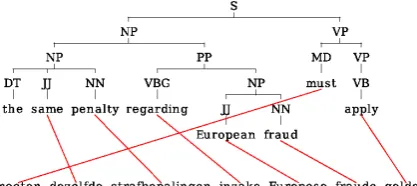
[image:4.595.330.492.454.525.2]cannot be unfolded under trees (illustrated in Fig-ure 3), but possibly also due to parse and align-ment errors.
Figure 3: Example of alignment crossing that does not agree with the parse tree.
4.2 Source Permutation via Syntactic Transfer
Given a parallel corpus with string pairs s → t
with word alignment a, we create a source per-muted parallel corpus s → s0 by unfolding the
crossing alignments ina: this is done by scanning
the stringsfrom left to right and moving words
in-volved in crossing alignments to positions where the crossing alignments are unfolded). The source stringssare parsed, leading to a single parse tree τsper source string.
Our model aims at learning from the source permuted parallel corpus s → s0 a probabilistic optimizationarg maxπ(s)P(π(s)|s, τs). We
as-sume that the set of permutations {π(s)} is de-fined through a finite set of local transductions over the treeτs. Hence, we view the permutations
leading from sto s0 as a sequence of local tree
transductions τs0
0 → . . . → τs0n, where s
0 0 = s
ands0n = s0, and each transductionτs0
i−1 → τs0i
is defined using a tree transduction operation that at most permutes the children of a single node in
τs0
i−1 as defined next. A local transduction τs0
i−1 → τs0i is modelled
by an operation that applies to a single node with addressx inτs0
i−1, labeledNx, and may permute the ordered sequence of childrenαxdominated by
nodex. This constitutes a direct generalization of
the ITG binary inversion transduction operation. We assign a conditional probability to each such
local transduction:
P(τs0
i|τs0i−1)≈P(π(αx)|Nx→αx, Cx) (2) whereπ(αx) is a permutation ofαx (the ordered
sequence of node labels underx) andCxis a local
tree context of node x in tree τs0
i−1. One wrin-kle in this definition is that the number of possi-ble permutations of αx is factorial in the length
ofαx. Fortunately, the source permuted training
data exhibits only a fraction of possible permuta-tions even for longerαxsequences. Furthermore,
by conditioning the probability on local context, the general applicability of the permutation is re-strained.
Given this definition, we define the probabil-ity of the sequence of local tree transductions
τs0
0 →. . .→τs0nas
P(τs0
0 →. . .→τs0n) =
n
Y
i=1 P(τs0
i |τs0i−1) (3)
The problem of calculating the most likely per-mutation under this transduction model is made difficult by the fact that different transduction se-quences may lead to the same permutation, which demands summing over these sequences. Fur-thermore, because every local transduction condi-tions on local context of an intermediate tree, this quickly risks becoming intractable (even when we use packed forests). In practice we take a prag-matic approach and greedily select at every inter-mediate pointτs0
i−1 → τs0i the single most likely
local transduction that can be conducted on any node of the current intermediate treeτs0
i−1 using an interpolation of the term in Equation 2 with string probability ratios as follows:
P(π(αx)|Nx→αx, Cx)×
P(s0i−1)
P(s0i)
The rationale behind this log-linear interpolation is that our source permutation approach aims at finding the optimal permutation s0 of s that can
syntactically informed way to define the space of possible permutations.
We estimate the string probabilitiesP(s0i) us-ing 5-gram language models trained on the s0
side of the source permuted parallel corpus s → s0. We estimate the conditional probability
P(π(αx) | Nx → αx, Cx) using a Maximum-Entropy framework, where feature functions are defined to capture the permutation as a class, the node label Nx and its head POS tag, the child
sequence αx together with the corresponding
se-quence of head POS tags and other features corre-sponding to different contextual information.
We were particularly interested in those linguis-tic features that motivate reordering phenomena from the syntactic and linguistic perspective. The features that were used for training the permuta-tion system are extracted for every internal node of the source tree that has more than one child:
• Local tree topology. Sub-tree instances that include parent node and the ordered se-quence of child node labels.
• Dependency features. Features that deter-mine the POS tag of the head word of the cur-rent node, together with the sequence of POS tags of the head words of its child nodes.
• Syntactic features. Three binary features from this class describe: (1) whether the par-ent node is a child of the node annotated with the same syntactic category, (2) whether the parent node is a descendant of the node an-notated with the same syntactic category, and (3) if the current subtree is embedded into a “SENT-SBAR” sub-tree. The latter feature in-tends to model the divergence in word order in relative clauses between Dutch and En-glish which is illustrated in Figure 1.
In initial experiments we piled up all feature func-tions into a single model. Preliminary results showed that the system performance increases if the set of patterns is split into partial classes con-ditioned on the current node label. Hence, we trained four separate MaxEnt models for the cate-gories with potentially high number of crossing alignments, namely VP, NP, SENT, and SBAR.
For combinatory models we use the following no-tations: M4 = Pi∈[ NP, VP, SENT, SBAR]Mi andM2 =
P
i∈[VP, SENT]Mi.
5 Experiments and results
The SMT system used in the experiments was implemented within the open-source MOSES toolkit (Koehn et al., 2007). Standard train-ing and weight tuntrain-ing procedures which were used to build our system are explained in details on the MOSES web page1. The MSD model
was used together with a distance-based reorder-ing model. Word alignment was estimated with
GIZA++ tool2 (Och, 2003), coupled with
mk-cls3(Och, 1999), which allows for statistical word
clustering for better generalization. An 5-gram target language model was estimated using the
SRI LM toolkit (Stolcke, 2002) and smoothed with modified Kneser-Ney discounting. We use theStanford parser4(Klein and Manning, 2003)
as a source-side parsing engine. The parser was trained on the English treebank set provided with 14 syntactic categories and 48 POS tags. The evaluation conditions were case-sensitive and in-cluded punctuation marks. For Maximum En-tropy modeling we used themaxenttoolkit5.
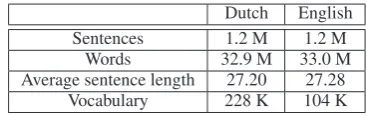
Data The experiment results were obtained us-ing the English-Dutch corpus of the European Par-liament Plenary Session transcription (EuroParl). Training corpus statistics can be found in Table 2.
Dutch English Sentences 1.2 M 1.2 M
Words 32.9 M 33.0 M
[image:6.595.318.502.505.563.2]Average sentence length 27.20 27.28 Vocabulary 228 K 104 K
Table 2: Basic statistics of the English-Dutch Eu-roParl training corpus.
The development and test datasets were ran-domly chosen from the corpus and consisted of
1http://www.statmt.org/moses/ 2code.google.com/p/giza-pp/ 3http://www.fjoch.com/mkcls.html 4http://nlp.stanford.edu/software/
lex-parser.shtml
5http://homepages.inf.ed.ac.uk/
500 and 1,000 sentences, respectively. Both were provided with one reference translation.
Results Evaluation of the system performance is twofold. In the first step, we analyze the qual-ity of reordering method itself. In the next step we look at the automatic translation scores and evaluate the impact which the choice of reorder-ing strategy has on the translation quality. In both stages of evaluation, the results are con-trasted with the performance shown by the stan-dard phrase-based SMT system (baseline) and with oracle results.
Source reordering analysis Table 3 shows the parameters of the reordered system allowing to as-sess the effectiveness of reordering permutations, namely: (1) a total number of crossings found in the word alignment (#C), (2) the size of the re-sulting phrase table (PT), (3) BLEU, NIST, and WER scores obtained using monotonized parallel corpus (oracle) as a reference.
All the numbers are calculated on the re-aligned corpora. Calculations are done on the basis of the 100,000 line extraction from the corpus6and
cor-responding alignment matrix. The baselinerows show the number of alignment crossings found in the original (unmonotonized) corpus.
System #C PT BLEU ScoresNIST WER
Oracle
string 54.6K 48.4M - -
-tree 187.3K 30.3M 71.73 17.01 16.77 span 146.9K 33.0M 73.41 17.11 15.73
Baselines
baselines 187.0K 29.8M 71.70 17.07 16.55 Category models
MN P 188.9K 29.7M 71.63 17.07 16.52 MV P 168.1K 29.8M 73.17 17.16 15.99
MSEN T 171.0K 29.8M 73.08 17.08 16.10 MSBAR 188.6K 29.8M 72.89 16.90 16.41
Combinatory models
M4 193.2K 29.1M 70.98 16.85 16.78
[image:7.595.324.497.190.339.2]M2 165.4K 29.9M 73.07 16.92 15.88
Table 3: Main parameters of the tree-based re-ordering system.
6A smaller portion of the corpus is used for analysis in
order to reduce evaluation time.
Translation scores The evaluation results for the development and test corpora are reported in Table 4. They include twobaselineconfigurations (distandMSD),oracleresults and contrasts them with the performance shown by different combi-nations of single-category tree-based reordering models. Best scores within each experimental sec-tion are placed in cells filled with grey.
System BLEUDev BLEUTestNIST
baseline dist 23.88 24.04 6.29 baseline MSD 24.07 24.04 6.28 oracle-string 26.28 27.02 6.50 oracle-tree 23.84 24.09 6.30 oracle-span 24.79 24.95 6.35
MN P 23.79 23.81 6.27
MV P 24.16 24.55 6.29
MSEN T 24.27 24.56 6.32
MSBAR 23.99 24.12 6.27
M4 23.50 23.86 6.29
M2 24.28 24.64 6.33
Table 4: Experimental results.
Analysis The number of crossings found in word alignment intersection and BLEU/NIST/WER scores estimated on reordered data vs. monotonized data report the reordering algorithm effectiveness. A big gap between num-ber of crossings and total numnum-ber of reorderings per corpus found in oracle-string system7 and
baselinesystems demonstrates the possible reduc-tion of system’s non-monotonicity. The difference in number of crossings and BLEU/NIST/WER scores between the oracle-span and the best performing MaxEnt models (namely,M2) shows
the level of performance of the prediction module. A number of distinct phrase translation pairs in the translation table implicitly reveals the general-ization capabilities of the translation system since it simplifies the translation task. From the other hand, increased number of shorter phrases can add noise in the reordered data and makes decoding more complex. Hence, the size of phrase table it-self can not be considered as a robust indicator of its translation potential.
7The number of crossings fororacleconfiguration is not
[image:7.595.72.295.454.647.2]Table 4 shows that three of six MaxEnt re-ordering systems outperformbaselinesystems by about 0.5-0.6 BLEU points, that is statistically significant8. The combination ofNP,NP,SENT,
andSBARmodels do not show good performance possibly due to increased sparseness of reorder-ing patterns. However, the system that consider only theMV P andMSEN T models achieves 0.62
BLEU score gain over thebaselineconfigurations. The main conclusion which can be drawn from analysis of Tables 3 and 4 is that there is an evident correlation between characteristics of re-ordering system and performance demonstrated by the translation system trained on the corpus with reordered source part.
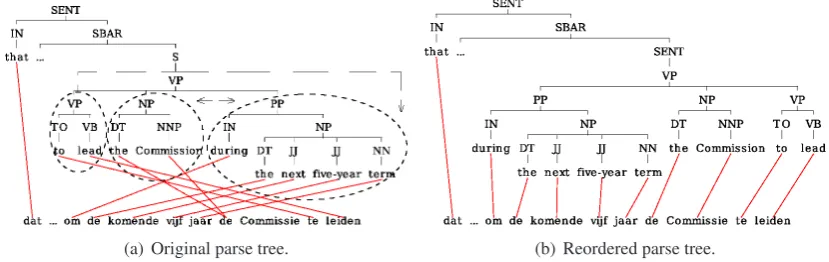
Example Figure 4 exemplifies the sentences that presumably benefits from the monotonization of the source part of the parallel corpus. The ex-ample demonstrates a pervading syntactic distinc-tion between English and Dutch: the reordering of verb-phrase subconstituentsVP NP PPwithin the relative clause intoPP NP VP.
6 Conclusions and future work
We introduced a tree-based reordering model that aims at monotonizing the word order of source
8All statistical significance calculations are done for a
95% confidence interval and 1 000 resamples, following the guidelines from (Koehn, 2004).
and target languages as a pre-translation step. Our model avoids complete generalization of reorder-ing instances by usreorder-ing tree contexts and limit-ing the permutations to data instances. From a learning perspective, our work shows that navigat-ing a large space of intermediate tree transforma-tions can be conducted effectively using both the source-side syntactic tree and a language model of the idealized (target-like) source-permuted lan-guage.
We have shown the potential for translation quality improvement when target sentences are created following the source language word or-der (≈3 BLEU points over the standard phrase-based SMT) and under parse tree constraint (≈0.9 BLEU points). As can be seen from these re-sults, our model exhibits competitive translation performance scores compared with the standard distance-based and lexical reordering.
The gap between the oracle and our system’s results leaves room for improvement. We intend to study extensions of the current tree transfer model to narrow this performance gap. As a first step we are combining isolated models for con-crete syntactic categories and aggregating more features into the MaxEnt model. Algorithmic im-provements, such as beam-search and chart pars-ing, could allow us to apply our method to full parse-forests as opposed to a single parse tree.
(a) Original parse tree. (b) Reordered parse tree.
Src:that ... to lead the Commission during the next five-year term
Ref.:dat ... om de komende vijf jaar de Commissie te leiden
Baseline MSD:dat ... om het voortouw te nemen in de Commissie tijdens de komende vijf jaar
Rrd src:that ... during the next five-year term the Commission to lead
M2:dat ... om de Commissie tijdens de komende vijf jaar te leiden
[image:8.595.88.503.494.625.2](c) Translations.
References
D. Chiang. 2005. A hierarchical phrase-based model for statistical machine translation. InProceedings of ACL’05, pages 263–270.
M. Collins, P. Koehn, and I. Kuˇcerov´a. 2005. Clause restructuring for statistical machine translation. In
Proceedings of ACL’05, pages 531–540.
M. R. Costa-juss`a and J. A. R. Fonollosa. 2006. Statistical machine reordering. InProceedings of
HLT/EMNLP’06, pages 70–76.
M. Galley and Ch. D. Manning. 2008. A simple and effective hierarchical phrase reordering model. In
Proceedings of EMNLP’08, pages 848–856.
M. Galley, J. Graehl, K. Knight, D. Marcu, S. De-Neefe, W. Wang, and I. Thaye. 2006. Scalable in-ference and training of context-rich syntactic trans-lation models. InProc. of COLING/ACL’06, pages 961–968.
M. Khalilov and K. Sima’an. 2010. Source reordering using maxent classifiers and supertags. InProc. of
EAMT’10, pages 292–299.
M. Khalilov. 2009.New statistical and syntactic mod-els for machine translation. Ph.D. thesis, Universi-tat Polit`ecnica de Catalunya, October.
D. Klein and C. Manning. 2003. Accurate unlexi-calized parsing. InProceedings of the 41st Annual
Meeting of the ACL’03, pages 423–430.
Ph. Koehn, F. Och, and D. Marcu. 2003. Statistical phrase-based machine translation. In Proceedings
of the HLT-NAACL 2003, pages 48–54.
Ph. Koehn, H. Hoang, A. Birch, C. Callison-Burch, M. Federico, N. Bertoldi, B. Cowan, W. Shen, C. Moran, R. Zens, C. Dyer, O. Bojar, A. Con-stantin, and E. Herbst. 2007. Moses: open-source toolkit for statistical machine translation. In
Pro-ceedings of ACL 2007, pages 177–180.
Ph. Koehn. 2004. Statistical significance tests for machine translation evaluation. InProceedings of
EMNLP’04, pages 388–395.
F. Och and H. Ney. 2002. Discriminative training and maximum entropy models for statistical ma-chine translation. InProceedings of ACL’02, pages 295–302.
F. Och and H. Ney. 2004. The alignment template approach to statistical machine translation. Compu-tational Linguistics, 30(4):417–449.
F. Och. 1999. An efficient method for determin-ing bildetermin-ingual word classes. InProceedings of ACL 1999, pages 71–76.
F. Och. 2003. Minimum error rate training in statisti-cal machine translation. InProceedings of ACL’03, pages 160–167.
K. Papineni, S. Roukos, T. Ward, and W. Zhu. 2002. Bleu: a method for automatic evaluation of machine translation. InProceedings of ACL’02, pages 311– 318.
A. PVS. 2010. A data mining approach to learn reorder rules for SMT. In Proceedings of
NAACL/HLT’10, pages 52–57.
A. Stolcke. 2002. SRILM: an extensible language modeling toolkit. InProceedings of SLP’02, pages 901–904.
C. Tillman. 2004. A unigram orientation model for statistical machine translation. In Proceedings of
HLT-NAACL’04, pages 101–104.
C. Tillmann and H. Ney. 2003. Word reordering and a dynamic programming beam search algorithm for statistical machine translation. Computational Lin-guistics, 1(29):93–133.
R. Tromble and J. Eisner. 2009. Learning linear order-ing problems for better translation. InProceedings
of EMNLP’09, pages 1007–1016.
C. Wang, M. Collins, and Ph. Koehn. 2007. Chinese syntactic reordering for statistical machine transla-tion. In Proceedings of EMNLP-CoNLL’07, pages 737–745.
D. Wu and H. Wong. 1998. Machine translation wih a stochastic grammatical channel. InProceedings of
ACL-COLING’98, pages 1408–1415.
F. Xia and M. McCord. 2004. Improving a statistical MT system with automatically learned rewrite pat-terns. InProceedings of COLING’04, pages 508– 514.
D. Xiong, Q. Liu, and S. Lin. 2006. Maximum en-tropy based phrase reordering model for statistical machine translation. In Proceedings of ACL’06, pages 521–528.
R. Zens and H. Ney. 2003. A comparative study on reordering constraints in statistical machine transla-tion. InProceedings of ACL’03, pages 144–151.
R. Zens, F. Och, and H. Ney. 2002. Phrase-based sta-tistical machine translation. InProceedings of KI: Advances in Artificial Intelligence, pages 18–32.
A. Zollmann and A. Venugopal. 2006. Syntax aug-mented machine translation via chart parsing. In