Bilingual Event Extraction: a Case Study on Trigger Type
Determina-tion
Zhu Zhu
†Shoushan Li
†*Guodong Zhou
†Rui Xia
‡†
Natural Language Processing Lab
Soochow University, China
{zhuzhu0020,
shoushan.li}@gmail.com,
‡
Department of Computer Science
Nanjing University of Science and
Technology
Abstract
Event extraction generally suffers from the data sparseness problem. In this paper, we address this problem by utilizing the labeled data from two different languages. As a pre-liminary study, we mainly focus on the sub-task of trigger type determination in event extraction. To make the training data in dif-ferent languages help each other, we pro-pose a uniform text representation with bi-lingual features to represent the samples and handle the difficulty of locating the triggers in the translated text from both monolingual and bilingual perspectives. Empirical studies demonstrate the effectiveness of the pro-posed approach to bilingual classification on trigger type determination.
1
Introduction
Event extraction is an increasingly hot and chal-lenging research topic in the natural language processing (NLP) community (Ahn, 2006; Saun et al. 2006; Zhao et al. 2008). It aims to automat-ically extract certain types of events with the ar-guments to present the texts under a structured form. In event extraction, there are four primary subtasks, named trigger identification, trigger type determination, argument identification, and argument role determination (Chen and NG, 2012). As an important technology in infor-mation extraction, event extraction could be ap-plied to many fields such as information retrieval, summarization, text mining, and question an-swering.
Recently, the dominative approach to event extraction is based on supervised learning where a set of labeled samples are exploited to train a model to extract the events. However, the
* Corresponding author
ble labeled data are rather sparse due to various kinds of event categories. For example, the event taxonomy in ACE 20051 (Automatic Content Extraction) includes 8 types of events, with 33 subtypes, such as “Marry/Life” (subtype/type),
and “Transport/Movement”. Moreover, some
subtypes such as “Nominate/Personnel” and
“Convict/Justice” contain less than 10 labeled
samples in the English and Chinese corpus re-spectively. Apparently, such a small scale of training data is difficult to yield a satisfying per-formance.
One possible way to alleviate the data sparse-ness problem in event extraction is to conduct bilingual event extraction with training data from two different languages. This is motivated by the fact that labeled data from a language is highly possible to convey similar information in another language. For example, E1 is an event sample from the English corpus and E2 is another one in the Chinese corpus. Apparently, E1 and the Eng-lish translation text of E2, share some important clues such as meet and Iraq which highly indi-cates the event type of “Meet/Contact”.
E1: Bush arrived in Saint Petersburg on Sat-urday, when he also briefly met German chancel-lor Gerhard Schroeder, whose opposition to the Iraq war had soured his relationship with Wash-ington, at a dinner hosted by Putin.
E2: 美国总统布什将于2月访问德国并与施
罗德会谈 ,伊朗和伊拉克问题将是双方会谈
的重点。(U.S. president George W. Bush will visit Germany in February and meet with Schroeder, Iran and Iraq will be the focus of the talks the two sides.)
In this paper, we address the data sparseness problem in event extraction with a bilingual
1
http://www.nist.gov/speech/tests/ace/2005
cessing approach which aims to exploit bilingual training data to enhance the extraction perfor-mance in each language. As a preliminary work, we mainly focus on the subtask of trigger type determination. Accordingly, our goal is to design a classifier which is trained with labeled data from two different languages and is capable of classifying the test data from both languages. Generally, this task possesses two main chal-lenges.
The first challenge is text representation, namely, how to eliminate the language gap be-tween the two languages. To tackle this, we first employ Google Translate2, a state-of-the-art ma-chine translation system, to gain the translation of an event instance, similar to what has been widely done by previous studies in bilingual classification tasks e.g., Wan (2008); Then, we uniformly represent each text with bilingual word features. That is, we augment each original feature vector into a novel one which contains the translated features.
The second challenge is the translation for some specific features. It is well-known that some specific features, such as the triggers and their context features, are extremely important for determining the event types. For example, in
E3, both trigger “left” and named entity “ Sad-dam” are important features to tell the event type,
i.e., "Transport/Movement". When it is translated to Chinese, it is also required to know trigger “离
开”(left) and named entity “萨达姆” (Saddam) in E4, the Chinese translation of E3.
E3: Saddam's clan is said to have left for a small village in the desert.
E4: Chinese translation: 据 说 萨 达 姆
(Saddam) 家族已经离开(left) 沙漠中的一个
小村庄。
However, it is normally difficult to know which words are the triggers and surrounding entities in the translated sentence. To tackle this issue, we propose to locate the trigger from both monolingual and bilingual perspectives in the translation text. Empirical studies demonstrate that adding the translation of these specific fea-tures substantially improves the classification performance.
The remainder of this paper is organized as follows. Section 2 overviews the related work on event extraction. Section 3 proposes our
2
www.google.com
proach to bilingual event extraction. Section 4 gives the experimental studies. In Section 5, we conclude our work and give some future work.
2
Related Work
In the NLP community, event extraction has been mainly studied in both English and Chinese. In English, various supervised learning ap-proaches have been explored recently. Bethard and Martin (2006) formulate the event identifica-tion as a classificaidentifica-tion problem in a word-chunking paradigm, introducing a variety of lin-guistically motivated features. Ahn (2006) pro-poses a trigger-based method. It first identifies the trigger in an event, and then uses a multi-classifier to implement trigger type determina-tion. Ji and Grishman (2008) employ an ap-proach to propagate consistent event arguments across sentences and documents. Liao and Grishman (2010) apply document level infor-mation to improve the performance of event ex-traction. Hong et al. (2011) leverage cross-entity information to improve traditional event extrac-tion, regarding entity type consistency as a key feature. More recently, Li et al. (2013) propose a joint framework based on structured prediction which extracts triggers and arguments together.
In Chinese, relevant studies in event extraction are in a relatively primary stage with focus on more special characteristics and challenges. Tan et al. (2008) employ local feature selection and explicit discrimination of positive and negative features to ensure the performance of trigger type determination. Chen and Ji (2009) apply lexical, syntactic and semantic features in trigger label-ing and argument labellabel-ing to improve the per-formance. More recently, Li et al. (2012) and Li et al. (2013) introduce two inference mechanisms to infer unknown triggers and recover trigger mentions respectively with morphological struc-tures.
la-beled data from two languages help each other without any other extra resources, which is origi-nal in the study of event extraction.
3
The Proposed Approach
Trigger type determination aims to determine the event type of a trigger given the trigger and its context (e.g., a sentence). Existing approaches to trigger type determination mainly focus on mon-olingual classification. Figure 1 illustrates the framework for Chinese and English.
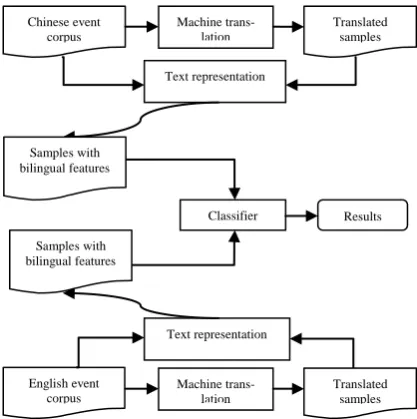
[image:3.595.309.522.235.482.2]In comparison, our approach exploits the cor-pora from two different languages. Figure 2 illus-trates the framework. As shown in the figure, we first get the translated corpora of Chinese and English origin corpora through machine transla-tion. Then, we represent each text with bilingual features, which enables us to merge the training data from both languages so as to make them help each other.
[image:3.595.97.261.339.486.2]Figure 1: The framework of monolingual classifi-cation for trigger type determination
Figure 2: The framework of bilingual classification for trigger type determination
3.1 Text Representation
In a supervised learning approach, labeled data is trained to obtain a classifier. In this approach, the extracted features are the key components to make a successful classifier. Table 1 shows some typical kinds of features in a monolingual classi-fication task for trigger type determination. To better understand these features, the real feature examples in E3 are given in the table.
Given the feature definition, a monolingual sample x is represented as the combination of all the features, i.e.,
1, 2 , , , _ , _ ,
_ , , _ , _
n
e e e Tri POS Tri Tri con x
POS con Ent Ent type Ent subtype
(1)
Features Feature examples in E3
All words
(
e e
1,
2,
e
n)Saddam, clan, is, ... , desert
Trigger (Tri) left POS of the trigger
(POS_Tri) VBN
Trigger's context
words (Tri_con) ...,have, for,... POS of trigger's
context words (POS_con)
...,VB,IN,…
Entities around
trig-ger (Ent) Saddam
Entity type
(Ent_type) PER
Entity subtype
[image:3.595.70.279.531.741.2](Ent_subtype) individual
Table 1: The features and some feature examples for trigger type determination
In bilingual classification, we represent a sam-ple with bilingual features, which makes it possi-ble to train with the data from two languages. To achieve this goal, we employ a single feature augmentation strategy to augment the monolin-gual features into bilinmonolin-gual features, i.e.,
,
Chinese English
xx x (2)
Specifically, a sample x is represented as fol-lows:
1 2
1 2
, , , , _ , _ , _ , , _ , _ , , , , , _ , _ ,
_ , , _ , _
m c c c
c c c
n e e e
e e e
c c c Tri POS Tri Tri con
POS con Ent Ent type Ent subtype x
e e e Tri POS Tri Tri con
POS con Ent Ent type Ent subtype
(3)
Where the tokens with the ‘c’/‘e’ subscript mean
the features generated from the Chinese/English text. From the features, we can see that some
Classifier Results Chinese event
corpus
Machine trans-lation
Translated samples
Text representation
Translated samples English event
corpus
Machine trans-lation Text representation Samples with
bilingual features
Samples with bilingual features
Trigger type determination for Chinese
Trigger type determination for English Chinese event
corpus
Classifier
English event corpus
Classifier
features, such as Tri_con and Ent, depend on the location of the trigger word. Therefore, locating the trigger in the translated text becomes crucial.
3.2 Locating Translated Trigger
Without loss of generality, we consider the case of translating a Chinese event sample into an English one. Formally, the word sequence of a
Chinese event sample is denoted as
1 2
( , , , )
c n
s c c c , while the sequence of the
translated one is denoted asse( ,e e1 2 ,em). Then, the objective is to get the English trigger
e
Tri in se , given the Chinese trigger word
c
Tri in sc. The objective function is given as fol-lows:
_
1 ,
arg max k l e
k l m
P e Tri
(4)
Where ek l_ denotes the substring ( ,e ek k1 , )el
in se and 1k l, m.
In this paper, the above function could be solved in two perspectives: monolingual and bi-lingual ones. The former uses the English train-ing data alone to locate the trigger while the lat-ter exploit the bilingual information to get the translated counterpart of the Chinese trigger.
The monolingual perspective: The objective is to locate the trigger with the monolingual in-formation. That is,
_
1 ,
arg max k l e| e, e
k l m
P e Tri s R
(5)
Where Re denotes the training resource in Eng-lish. In fact, this task is exactly the first subtask in event extraction named trigger identification, as mentioned in Introduction. For a simplified implementation, we first estimate the probabili-ties of P e
k l_ Trie
in Re with maximumlike-lihood estimation when ek l_ se.
The bilingual perspective: The objective is to locate the trigger with the bilingual information. That is,
_
1 ,
arg max k l e| e, ,c c
k l m
P e Tri s s Tri
(6)
Where Tric is the trigger word in Chinese and se
is the translated text towards sc. More generally, this can be solved from a standard word align-ment model in machine translation (Och et al, 1999; Koehn et al, 2003). However, training a
word alignment requires a huge parallel corpus which is not available here.
For a simplified implementation, we first get the Tric ’s translation,denoted as
c
Tri
trans ,
with Google Translate. Then, we estimate
k l_ e
P e Tri as follows:
__
0.9
c
k l Tri
k l e
if e trans P e Tri
others
(7)
Where 0.9 is an empirical value which makes the translation probability become a dominative fac-tor when the translation of the trigger is found in the translated sentence. is a small value which makes the sum of all probabilities equals 1.
The final decision is made according to both the monolingual and bilingual perspectives, i.e.,
_ 1 ,
_
arg max | ,
| , ,
k l e e e
k l m
k l e e c c
P e Tri s R
P e Tri s s Tri
(8)
Note that we reduce the computational cost by make the word length of the trigger less than 3, i.e., l k 3.
4
Experimentation
4.1 Experimental Setting
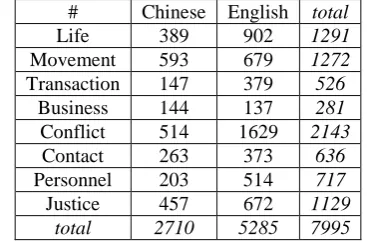
Data sets: The Chinese and English corpus for even extraction are from ACE2005, which in-volves 8 types and 33 subtypes. All our experi-ments are conducted on the subtype case. Due to the space limit, we only report the statistics for each type, as shown in Table 2. For each subtype, 80% samples are used as training data while the rest are as test data.
# Chinese English total
Life 389 902 1291
Movement 593 679 1272 Transaction 147 379 526
Business 144 137 281 Conflict 514 1629 2143 Contact 263 373 636 Personnel 203 514 717 Justice 457 672 1129
[image:4.595.321.505.560.681.2]total 2710 5285 7995
Table 2: Statistics in each event type in both Chinese and English data sets
Classification algorithm: The maximum en-tropy (ME) classifier is implemented with the public tool, Mallet Toolkits3 .
Evaluation metric: The performance of event type recognition is evaluated with F-score.
4.2 Experimental Results
In this section, we evaluate the performance of our approach to bilingual classification on trigger type determination. For comparison, following approaches are implemented:
Monolingual: perform monolingual classi-fication on the Chinese and English corpus individually, as shown in Figure 1.
Bilingual: perform bilingual classification with partial bilingual features, ignoring the context features (e.g., context words, con-text entities) under the assumption that the trigger location task is not done.
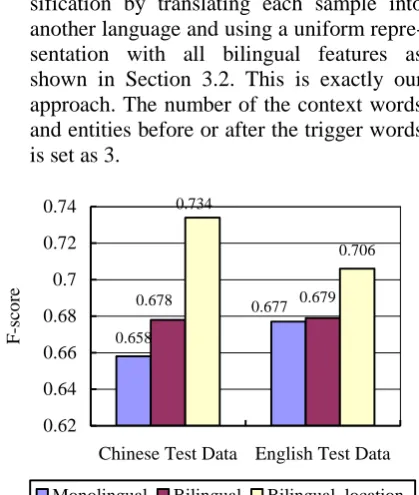
Bilingual_location: perform bilingual clas-sification by translating each sample into another language and using a uniform repre-sentation with all bilingual features as shown in Section 3.2. This is exactly our approach. The number of the context words and entities before or after the trigger words is set as 3.
0.658
0.706
0.677 0.679 0.678
0.734
0.62 0.64 0.66 0.68 0.7 0.72 0.74
Chinese Test Data English Test Data
F-sco
re
[image:5.595.77.287.330.578.2]Monolingual Bilingual Bilingual_location
Figure 3: Performance comparison of the three ap-proaches on the Chinese and English test data
Figure 3 shows the classification results of the three approaches on the Chinese and English test data. From this figure, we can see that Bilin-gual_location apparently outperform Monolin-gual, which verifies the effectiveness of using bilingual corpus. Specifically, the improvement by our approach in Chinese is impressive, reach-ing 7.6%. The results also demonstrate the im-portance of the operation of the trigger location,
3
http://mallet.cs.umass.edu/
without which, bilingual classification can only slightly improve the performance, as shown in the English test data.
The results demonstrate that our bilingual classification approaches are more effective for the Chinese data. This is understandable because the size of English data is much larger than that of Chinese data, 5285 vs. 2710, as shown in Ta-ble 2. Specifically, after checking the results in each subtype, we find that some subtypes in Chi-nese have very few samples while corresponding subtypes in English have a certain number
sam-ples. For example, the subtype of
“Elect/Personnel” only contains 30 samples in
the Chinese data while 161 samples can be found in the English data, which leads a very high im-provement (15.4%) for the Chinese test data. In summary, our bilingual classification approach provides an effective way to handle the data sparseness problem in even extraction.
5
Conclusion and Future Work
This paper addresses the data sparseness problem in event extraction by proposing a bilingual clas-sification approach. In this approach, we use a uniform text representation with bilingual fea-tures and merge the training samples from both languages to enlarge the size of the labeled data. Furthermore, we handle the difficulty of locating the trigger from both the monolingual and bilin-gual perspectives. Empirical studies show that our approach is effective in using bilingual cor-pus to improve monolingual classification in trigger type determination.
Bilingual event extraction is still in its early stage and many related research issues need to be investigated in the future work. For example, it is required to propose novel approaches to the bi-lingual processing tasks in other subtasks of event extraction. Moreover, it is rather challeng-ing to consider a whole bilchalleng-ingual processchalleng-ing framework when all these subtasks are involved together.
Acknowledgments
This research work has been partially supported by two NSFC grants, No.61375073, and No.61273320, one National High-tech Research
and Development Program of China
References
Ahn D. 2006. The Stages of Event Extraction. In Pro-ceedings of the Workshop on Annotating and Rea-soning about Time and Events, pp.1~8.
Bethard S. and J. Martin. 2006. Identification of Event Mentions and Their Semantic Class. In Pro-ceedings of EMNLP-2006, pp.146-154.
Chen C. and V. NG. 2012. Joint Modeling for Chi-nese Event Extraction with Rich Linguistic Fea-tures. In Proceedings of COLING-2012, pp. 529-544.
Chen Z. and H. Ji. 2009. Language Specific Issue and Feature Exploration in Chinese Event Extraction. In Proceedings of NAACL-2009, pp. 209-212.
Haghighi A., P. Liang, T. Berg-Kirkpatrick and D. Klein. 2008. Learning Bilingual Lexicons from Monolingual Corpora. In Proceedings of ACL-2008, pp. 771-779.
Hong Y., J. Zhang., B. Ma., J. Yao., and G. Zhou. 2011. Using Cross-Entity Inference to Improve Event Extraction. In Proceedings ofACL-2011, pp. 1127–1136.
Ismail A., and S. Manandhar. 2010. Bilingual Lexicon Extraction from Comparable Corpora Using In-domain Terms. In Proceedings of COLING-2010, pp.481-489.
Ji H. 2009. Cross-lingual Predicate Cluster Acquisi-tion to Improve Bilingual Event ExtracAcquisi-tion by In-ductive Learning. In Proceedings ofthe Workshop on Unsupervised and Minimally Supervised Learn-ing of Lexical Semantics, pp. 27-35.
Ji H, and R. Grishman. 2008. Refining Event Extrac-tion through Cross-Document Inference. In Pro-ceedings of ACL-2008, pp. 254-262.
Koehn P., F. Och, and D. Marcu. 2003. Statistical Phrase-based Translation. In Proceedings of HTL-NAACL-2003, pp. 127-133.
Li P., and G. Zhou. 2012. Employing Morphological Structures and Sememes for Chinese Event Extrac-tion. In Proceedings of COLING-2012, pp. 1619-1634.
Li P., Q. Zhu and G. Zhou. 2013. Using Composition-al Semantics and Discourse Consistency to Im-prove Chinese Trigger Identification. In Proceed-ings ofCOLING-2013, pp. 399-415.
Li Q, H Ji, and H. Liang. 2013. Joint Event Extraction via Structured Prediction with Global Features. In Proceedings ofACL-2013, pp. 73-82.
Li S, R Wang, H Liu, and CR Huang. 2013. Active Learning for Cross-Lingual Sentiment Classifica-tion. In Proceedings of Natural Language Pro-cessing and Chinese Computing, pp. 236-246.
Liao S and R. Grishman. 2010. Using Document Lev-el Cross-event Inference to Improve Event Extrac-tion. In Proceedings of ACL-2010, pp. 789-797.
Lu B., C. Tan, C. Cardie and B. K. Tsou. 2011. Joint Bilingual Sentiment Classification with Unlabeled Parallel Corpora. In Proceedings ofACL-2011, pp. 320-330.
Och F., C. Tillmann, and H. Ney. 1999. Improved Alignment Models for Statistical Machine Transla-tion. In Proceedings of EMNLP-1999, pp.20-28.
Tan H., T. Zhao, and J. Zheng. 2008. Identification of Chinese Event and Their Argument Roles. In Pro-ceedings of CITWORKSHOPS-2008, pp. 14-19.
Wan X. 2008. Using Bilingual Knowledge and En-semble Techniques for Unsupervised Chinese Sen-timent Analysis. In Proceedings ofEMNLP-2008, pp. 553-561.