Controllability of Strongly and Weakly Dependent Siphons
under Disturbanceless Control
*
Daniel Yuh Chao1, Kuo-Chiang Wu2, Jiun-Ting Chen1, Mike Y. J. Lee1,3
1Department of Management and Information Systems, National Chengchi University, Taipei, Chinese Taipei 2Department of Computer Science & Engineering, Tatung University, Taipei, Chinese Taipei 3Department of Business Administration, China University of Technology, Taipei, Chinese Taipei
E-mail: [email protected], d9206006@ms2.ttu.edu.tw, [email protected], [email protected] Received April 1, 2011; revised June 28, 2011; accepted July 5, 2011
Abstract
Li and Zhou propose to add monitors Vs to elementary siphons S only while controlling the rest of dependent
siphons—important for large systems but far from being maximally permissive. The control policy for weakly dependent siphons (WDS) is rather conservative due to some negative terms in the controllability. We show that this is no longer true as can be shown that it has the same controllability as that for strongly dependent siphons.
Keywords: Petri Nets, Siphons, Controllability, FMS, S3PR
1. Introduction
A flexible manufacturing systems (FMS) consists of several concurrent processes competing for resources such as machines, robotics, etc. to produce different kinds of parts. Each process performs a sequence of operations to manufacture a part of a product. Mutual waiting for resources can bring the system into a deadlock where no process can proceed.
An FMS can be modeled by a Petri net (PN). System properties such as boundedness, liveness and reversi- bility are fundamental for an FMS to operate in a sTable, deadlock-free, and periodic fashion.
Deadlock prevention approaches [1-23] create the con- trol policy in a static way by building a Petri net model first and then adding necessary control to it such that the controlled model is deadlock-free. Control places and rel- ated arcs are often used to attain such purpose resulting in less states reached, but the system runs quicker as a result of no online computation.
A siphon (trap, respectively) is a set of places [where tokens can leak out (inject in, respectively)] of a PN modeling an FMS. Once the siphon has lost all its tokens, output transitions of places in the siphon can never be executed and the net is not live.
Control places and related arcs are often added upon emptiable siphons to disallow them to become unmarked
(no tokens). This disturbs the original model and loses some reachable good states; i.e., less permissive, impact- ing the performance of the supervisor.
Ezpeleta et al. [11] propose adding a monitor upon each problematic siphon for an S3PR which stands for systems of simple sequential processes with resources. This method generally requires adding too many moni- tors due to the fact that there are too many emptiable siphons. The iterative control method in [12] reduces the number of monitors by finding all emptiable siphons in each iteration step. The method becomes very difficult and remains complex even for a moderate-size model.
Furthermore, Ezpeleta et al. [11] move all output (called Type-2, or source) arcs of each monitor S to the output (called source) transition of the entry (called idle place) of input raw materials to limit their rate into the system to avoid generaing new emptiable siphons, called SMSless approach. This may overly constrain the system to reach much fewer reachable states (6287, the same as that by Li et al. [13,14] but with a lot more control elements) than the maximal permissive one using the region method by Uzam and Zhou [15].
V
It is impractical to add a monitor to each emptiable siphon for large systems since the number of emptiable siphons or control elements grows quickly with respect to the size of a Petri net. Li and Zhou [13,14,16,17] tackle this problem by classifying siphons into elemen- tary and dependent ones.
*This work was supported by the National Science Council under Gant
By adding monitors to only elementary siphons, Li and Zhou [13] greatly reduce the number of control nodes and arcs, essential for large systems. Some of the rest of emptiable (called dependent) siphons may already be controlled depending on the controllability.
Otherwise, the control depth variable may need to be increased to avoid the siphon unmarked and reach fewer states. The control policy for weakly dependent siphons is rather conservative [13] (such that fewer states are reached) by ignoring some negative terms in the controllability.
The control place and arcs for siphon , similar to resource places, form a number of elementary circuits. Hence, there is an elementary circuit containing adjacent control places, from which we can synthesize new problematic siphons. To avoid such, output arcs of a control place are moved from sink transitions of the siphon to source transitions of the processes. As a result, the region
S
S
A (called controller region) covered by control arcs is larger than the region (called the complementary set of ) to trap tokens from . The disturbed region becomes larger after the movement of output arcs. This loses more states due to the presence of control places and arcs, which disturbs the markings of the original model.
B
S S
We [1-4,6,7] show that elementary (resp. strongly dependent) siphons in an S3PR (systems of simple
sequential processes with resources) may be synthesized from elementary (resp. compound) resource circuits. There is no need to compute the basis for the set of elementary siphons from the vector space containing all characteristic T-vectors. Furthermore, we add monitors for different types of siphons in some sequence to avoid redundant monitors and losing live states.
It is unclear whether the same advantage can be extended to weakly dependent siphons. We don’t know from what circuits can we synthesize a weakly dependent siphon , and the condition that is controlled. This paper shows that weakly dependent siphons have a similar controllability to that for strongly dependent siphons under the disturbanceless control policy even though Li et al. prove that the policy for weakly dependent siphon is more conservative than strongly dependent siphons.
S S
The rest of the paper is organized as follows: Section 2 and 3 presents the basis to understand the paper. Section 4 reviews the theory on controllability of strongly dependent siphons in Li and Zhou [13,14]. Section 5 develops the theory to weakly dependent siphons based on Proposition 1. It is interesting to observe that weakly and strongly dependent siphons have the same controll- ability for compound siphons. Section 6 concludes the paper.
2. Preliminaries
Please refer to [1] for terms related to Petri nets. We now define characteristic T-vectors, elementary and depend- ent siphons.
Definition 1. [13,14]: Let be a subset of places of N. P-vector
P
is called the characteristic P-vector of iff p , 1
p ; otherwise
p 0 . is called the characteristic T-vector of
, if T =T , where [N] is the incidence matrix. [N]
Physically, the firing of a transition t where
t 0,
t = 0 , and
t 0 increases, maintains and de- creases the number of tokens in S , respectivelyDefinition 2. [13,14]: Let N = (P, T, F) be a net with |P| = m, which has k siphons S1, S2,···, Sk, m, k IN, where IN = {0, 1, 2, ···}. Define
12kTk m and
1 2 .T
k
k m
(resp.
) is called the characteristic P(resp. T)-vector matrix
(resp.
)of the siphons in N. Let S, S, ···, and S (, ,
1, 2, ···, k) be a linear independent maximal set of matrix
. Then E
S S, , ,S
is called a set of elementary siphons.
E
S is called a strongly depen- dent siphon if S
i Si E
ai S
where ai0. S Eis called a weakly dependent siphon if non-empty A,
B
E
, such that A B and
=
S i Si i
Si A S Bi a a Si
where ai0.In [13,14], a strongly dependent siphon is also called a strict redundant one. Li and Zhou propose to find elementary siphons by constructing the characteristic
P-vector (resp. T-vector)-vector matrix [λ] (resp. [η]) of the siphons in N followed by finding linearly inde- pendent vectors in [λ] (resp. [η]) The siphons corre- sponding to these independent vectors are the elementary siphons in the net system.
Note that Def. 2 and the above calculation of linearly independent vectors do not assume N to be an S3PR and
are applicable to arbitrary nets.
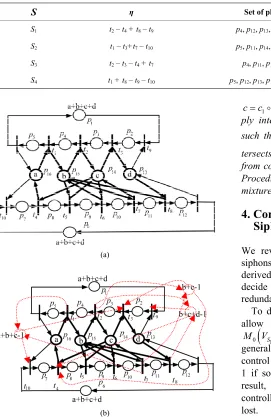
Figure 1(a) shows an example of weakly dependent siphon. Table 1 below lists the four strict minimal siphons and their η, where 4= 1 2 3.
3. Types of SMS
In [2,3,6], we show that SMS can be synthesized from resource or core subnets. New types (such as control siphons) of SMS can be synthesized from control subnets formed by control places. If we add monitors to these different types of siphons in a certain order, then some siphons may be redundant.
Table 1. Four SMS in Figure 1(a) and their , where 4 = 1 + 2−3.
S η Set of places [S]
S1 t2– t4 + t8– t9 p4, p12, p13, p14, p15 p2, p3, p8, p9, p10, p11
S2 t1 – t3+t7– t10 p5, p11, p14, p15, p16 p3, p4, p7, p8, p9, p10
S3 t2– t3 – t4+ t7 p4, p11, p14, p15 p3, p8, p9, p10
S4 t1+ t8– t9– t10 p5, p12, p13, p14, p15, p16 p2, p3, p4, p7, p8, p9, p10, p11
(a)
(b)
Figure 1. (a) Example weakly dependent siphon[14]. ra =
p16, rb = p15, rc = p14, rd = p13, ta = t1, tb = t2, tc = t3, td = t8, tc =
t4; (b) controlled model of that in Figure 1(a).
between two nodes. A PT-handle starts with a place and ends with a transition while a TP-handle starts with a
transition and ends with a place A core subnet can be obtained from an elementary circuit, called core circuit, by repeatedly adding handles.
The control place and arcs for siphon S, similar to resource places, form a number of elementary circuits. Hence, there is an elementary circuit containing adjacent control places, from which we can synthesize new problematic siphons.
Definition 3. An elementary resource circuit is called a basic circuit, denoted by . The siphon constructed from is called a basic siphon. A compound circuit
1 2 n1 n
b c b
c
c c c c c is a circuit consisting of multi- ply interconnected elementary circuits c1, c2, ···, cn
rpi ,rpi Rsuch that cici1 (i.e., ci and ci1 in-
tersects at a resource place i). The SMS synthesized from compound circuit c using the Handle-Construction Procedure in [9] is called an n-compound (resp. control, mixture) siphon S, denoted by .
r
1 2 1
SS S Sn Sn
4. Controllability for Strongly Dependent
Siphons
We review the controllability for strongly dependent siphons to compare with that for weakly ones to be derived in Section 5. We first present the theory below to decide whether a monitor to a compound siphon is redundant.
To disturb the controller region the least, we should allow M([S1]) to reach its maximum; thus setting
0 S = 0 1
M V M S 1
1 ; S is said to be limit controlled. In
general, M V0
S1 =M0
S1 S1, where S1 is thecontrol depth variable.
1 S
1
is adjusted to be greater than 1 if some dependent siphons are not controlled. As a
result, max M([S1]) is less than and the
controller region is more disturbed causing more states lost.
0 1 1
M S
Definition 4. Let M V0
S =M S0
S where1
S
S
is called the control depth variable. S is said to reach its limit state when M(S) = 1; it is limit-controlled iff it is able to reach its limit state but not able to reach unmarked state; i.e., 1 or minM(S) = 1.
Theorem 1. [21]: Let (N0, M0) be a net system and 0
be a strongly dependent SMS w.r.t. elementary siphons S
1
S S2 Sn
=1 n
i i
, ,···, and such that where 0 = , and
1, 2, ,
i n
, SiSj iff 1
i
i j . is ex- tended by n control places
1
S , S2,···, and S such that 1, 2, ···, and are limit-controlled. can never be emptied iff ,
0
N V V
n b M
V
0 S1
n
S S S S0
1
= S =
i i
1, 2, , 1
i n
.
Note that for strongly dependent siphon S S0, iSi1
is a single resource , 0 1 implies that
there is only one token in the initial marking of .
i i5. Controllability for Weakly Dependent
Siphons
This section shows that if S0 weakly depends on 1 and 2, then there exists a third siphon 3—syn- thesized from core circuits 1 and 2, respectively,
such that 0 1 2 3
S
S S
c c
=
. Other properties will also be derived, from which we will derive the controllability of a weakly 2-compound siphon.
Chao [2,3,6], show that in an S3PR, an SMS can be
synthesized from a strongly connected resource subnet and any strongly dependent siphon corresponds to a compound circuit where the intersection between any two elementary circuits is at most a resource place.
Let be a strongly dependent siphon, , , ···,
and be elementary siphons, with
0 1 S2 Sn
0
S n
S S
1
S S2 S
=
. It is shown in Chao [2,3,6]
that 0 (the core circuit from which to synthesize )
is a compound resource circuit containing 1 2 ,
and the intersection between any two i and
c S0
,cn
, ,
c c c cj
c
, i = j − 1 > 0, is exactly a resource place, where i (i =0, 1, 2,···, n) is the core circuit from which to synthesize i. Thus, if S0 is a WDS (weakly dependent siphon), the
intersection between any two ci and cj, i = j − 1 > 0,
must contain more than one resource place.
S
Let and be the SMS synthesized from basic
circuits 1 and 2, respectively, where 1 2 .
One can synthesize a third SMS, denoted by 0, from the strongly connected resource subnet 1 2. For S0 to
be a WDS, must contain more than one resource
place.
1
S
c 2
S c
1c
c c
S c
c
2
c
To simplify the presentation, 1 2 is assumed
to be
c c
r t rb b c
r r r, ,
on Process 1, where b, are two
re-source places, and
r
c
r c
r
a, ,b R c r r
12 b c d as shown in Figure 1(a). The more
complicated case can be treated similarly as in [9]. For R c
instance, in Figure 2, R c
1
p14,p15,p16
and
2
1 p14,p15
(one more place than theabove one). 2 13
, ,
R c p p
It is assumed, that a core circuit spans between process
1 (WP1) and process 2 (WP2) and ( ) denotes
path 1 2 k
r rr
r t r t1 1 2 2rk1tk1 rk
. Let c1
r t ra a b t r t rb c c a
and c2
r t r t r t rb b c c d d b
span between process 1 andprocess 2 [see Figure 1(a), where ra p16, rb p15, 14
p c
r , rd p13 , tat1, tbt2 , tc t3, td t8, 4
c
t t ]. Note that a, b, c, c and td may not be
in the same process; some are in process 1 and the rest are in process 2. Consider the resource path on process 1. There are only 2 possible cases satisfying the above
conditions are as follows: 1) 2)
.Case 2 is equivalent to Case 1 by relabeling by and by , respectively.
t t
r r
t t
a b rc r r r rd b c a a rd
r r r r
rd
r
r r r r
r r
d a
Note that it is possible that
a b c b c b c d
,which can be treated similarly as in Chao [10]. For Case 1, c1 can be broken two paths: one,
r t r t ra a b b c
, in process 1, denoted by
r t r ta a b b rc
1; another,
r t rc c a
,in process 2, denoted by
r tc c ra
2; i.e.,
1 a a b b c Similarly, c2 can be broken
two paths: one, 1 2
.
c a r t rc t r t r
c r
r tb b r t rc c d
, in process 1, denoted by
r tb b r t rc c d
1; another,
r td d rb
, in process 2, denotedby
r t rd d b
2; i.e., 2
b b c d
1 d d b
2. In thesequel, i
c r t r t r t r
refers to the T-characteristic vector of siphon
Si synthesized from ci.
Theorem 2. [9]: Let S=S1S2. Then
0= 1 2 3
.
On the Process 2 side in Figure 1(a), there should be no PP'-path of the form [ c] (resp. [ ]) to form
basic circuit 4 (resp. c4) consisting of only two
resource places of d and c (resp. a and rb), since
0 is no longer a weakly dependent siphon as derived
below. First, and . This leads to
d r t r
r
3
* b a r t
3
c c
=
r
1 4
c c
r
S
[image:4.595.94.503.528.688.2]c c2=c5
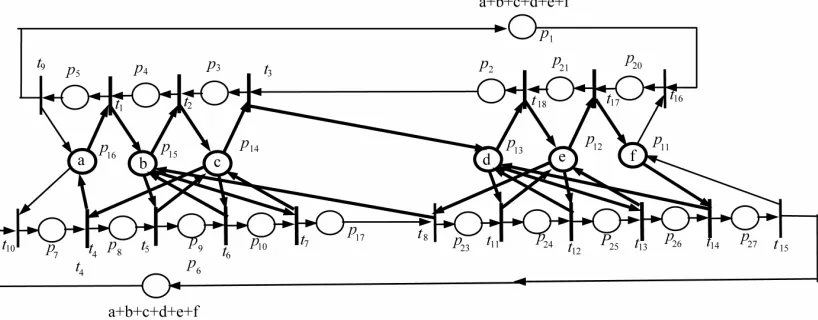
Figure 2. Example a 3-dependent weakly dependent siphon. S0 = S6 = S1 S2 S3, S4 = S1,2, S5 = S2,3 and 0 = 1 + 2 + 3 − 4 − 5.
1= 3 4
, 2= 3 5
= =
, and
2 3 3 4
0 1 5
S S 5 S 0 S
; 0 strongly depends on
3, 4, and and is no longer a weakly
dependent siphon.
S
Lemma 1. [9]: Let (N M0, 0) be a net system and 0
be a weakly dependent SMS w.r.t. elementary siphons
, , and where
S
1
S S2 S3 0= 1 2 3. Then
1)
A B
S3
b
P H r , where
1 2
=
A S S , B=S2
S1
b
, r S3.2) H rc S3
and H r
c
S0
.3) minM S
3 =M0
rc =M S r0
b
.Consider the S3PR in Figure 1(a),
1 2 4
= =
A S S p
b = 15, B=S2[ ] =S1
p11 ,
3. A B H r p
3 8 10
S
Furthermore, rc
= p14,( ) =c , , 3 3, 8, 9, 10
H r p p p
c
0
2, 3,S7, 8,p p p p9, 10
andH r S p p p p p p . Define S12 = S3 and S0 = S1 S2 since
. 1 2 is similar to S1 2 in
that can never be emptied if for both cases.
1 2 is different than 1 2 in that
1 2
3 R S S R S0
S S S
S S
S
S
1
b
S R S
1S2
for the former contains more than one resource place while the latter contains only one resource place.
Consider the S3PR in Figure 2. Table 2 lists eight
SMS S , and core circuits in Figure 2. Note that
1 2 15 2 14
c c p t p
S S S
is not a single resource place and
hence 7 1 2 cannot be a strongly dependent
siphon and is a weakly dependent siphon. Similarly,
2 13 18 12
c c p t p
S S S 3
is not a single resource place and
hence 8 2 3 cannot be a strongly dependent
siphon and is a weakly dependent siphon. Note that c2
contains 4 rather than 3 resource places assumed above. Yet, all relevant theory remains true.
Theorem 3. Let be a net system and 0
be a weakly dependent SMS w.r.t. elementary siphons
1, 2, and 3 where
N M0, 0=
SS S S 0 1 2 3
V V
. 0 is ex- tended by control places
1
S , S2, and , such that
, , and are limit-controlled. Let N
3
V S
1
S S2 S3
1 0
=
A S S , B S2
S0
= , and 3
=
A B S P H r , (by Proposition 1) r S 3,
0 can never be emptied iff ; 2) is
limit controlled iff .
S b M r= 0
=1 S
1 S0
0
= =
b M r
Proof. 1) ( ) Assume 0 is unmarked (hence
, ), while each of 1, 2, and is
marked; i.e., ,
= 0M r S0
r
1 M S
S S S3
0
M S
2 0, and M S
3 0. By Proposition 1, it holds that
3
=
A B S
P H r . Let
1 0
=
S2
since 1 andare marked. 0
S 1 S
M S S M S2
=
H
r
=0
M r M 1 since M r
= 0and M r0
. Now
= 1M S
3
=
B
2M
M H r
1 =M H
P
S3M
2
A
r
. However, , which is impossible. Thus, it is impossible that M S
1
S0
=M S
2
S0
1.This leads to that either M S
1S0
0 or
2 0
0M S S
, which implies that S0 can never be emptied. ( ) Assume contrary and b M r= 0
0.Then it is possible that M A
0 and M B
0such that each of S1, S2, and S3 is marked, while
S
= 0 S S1 0 2 0 or 0 is unmarked
against the assumption that 0 is marked. 2) (
= S
M S S M
) If
0
= =
b M r 1, then there is a reachable marking such that M A
= 1, M B
= 0 or M B
= 1, M A
= 1 .
Either one implies that . ( ) Assume
contrary and
0= 1 M S
r 1S
0 . The proof of part 1 of this
theorem indicates that 0 is unmarked. Hence
cannot be limit controlled against the assumption. =
b M
0
S
Thus, it is similar to a strongly dependent siphon
synthesized from a compound circuit where
is also controlled if b1 and both 1 and 2 are limit controlled. For the S3PR in Figure 2 where each
elementary siphon is limit-controlled and 0 4 is
controlled as well. Assume otherwise and 4 is empty.
Then
S
1 2
c c S
S S = S S S = 1
1 0
M S S =M S2 S0 =1. Let
41 0
= =
A S S p , B=S2
S0 =
p11
,
3
11
= =
A B S P H r p . If b= 1 =M r0
, thenit is impossible that
1 0
.Thus, can never be emptied. 2 0
= S S =
1
M S S M
0
The condition (i.e.,
S
3 =
A B S P H r ,
3
r S ) in Theorem 3 is generally true for vertically stacked S3PR (in most literatures); that is sink transitions
of 1 and 2 are in the same processes. The condition may not hold for horizontally stacked S3PR; that is, sink
transitions of and are in different processes. In this case,
S S
1
S S2
11 0
=
A S S H r and
r2 , 1 . However, it remains
true that 0
=
B S S H 2 r r2
3
=
A B S P . S0 can become unmarked
when M S
1
S0
=M r0
1 0,
2 0
= 0
2 0M S S M r M S
, 3 M A B
0. Define S12 = S3 and S0 = S1 S2 since
1 2
=
3 . 1 2R S S R S S S is similar to 1 2 in
that can never be emptied if for both cases.
1 2
S S
0
S S S
= 1
b
is different than S S1 2 in that R S
1S2
for the former contains more than one resource place while the latter contains only one resource place.
Theorem 4. Let
N M0, 0
be a net system and be a weakly dependent SMS such that 0S
0= 1 2
S S S Sn
1, 2, ,
i n
denoting the fact that
, SiSj holds iff i j 1. Let
0=
i i
A S S , Bi=Si1
S0 ,
, 1
i=
i i i i
A B S P H r , where riSi i, 1 N0
2 V VS3
S S S3 0
S 1
. is extended by control places
1 S
V , ,
12
S , ,
,···, and , such that S1, 2, 12, , 23, ···, and n, n1, are limit-controlled, 1)
can never be emptied iff i 0 i , S V
= =
b M r
32
S
V VSn
S S 1,nn
S V
Sn
1, 2, , 1
i n
;2) S0 is limit controlled iff
Table 2. Eight SMS S, and core circuits in Figure 2.
S Set of places c
S1 p5, p17, p14, p15, p16 1 = c1[p14 t4 p16 t1 p15 t2 p14] + HPP' p15 t5 p14],[p14 t6 p15] and[p15 t7 p14].
e
c [
S2 p c = c2[p15 t2 p [p15 t7 p14]
p
PP
p5, p27, p 15, p16 4, p26, p12, p13, p14, p15 2
e
14 t3 p13 t18 p12 t8 p15]+ HPP'[p13 t11 p12],[p12 t12 p13],[p15 t5 p14],[p14 t6 p15]and S3 2, p27, p11, p12, p13 3
e
c = c3[p13 t18 p12 t17 p11 t14 p13] + HPP'[p13 t11 p12],[p12 t12 p13], and[p13 t13 p12]
S4 p4, p17, p14, p15 c = c4 4[p15 t2 p14 t6 p15] + H
PP'[p
15 t5 p14] + H [p15 t7 p14]
e
S5 p2, p26, p12, p13 5
e
c = c5[p13t18p12 t12 p13]+HPP'[p13 t11 p12], and[p13 t13 p12]
S6 11, p12, p13, p14, p 6 1 2 3
e e e e
c c c c
S7 p5, p26, p12, p13, p14, p15, p16 7 1 2
e e e
c c c
S8 p4, p27, p11, p12, p13, p14, p15 8 2 3
e e e
c c c
By Theorem 3, the
theorem holds f Assume i lds for
0
i i
b M
Proof. 1) Prov
= 1r , i
1, 2, , n= 1 .
e by induction.
or n= 2. t ho k=n1.
We need to prove that it also holds for =k n. Let
* 1
= n n
S S S , Su S1S2 Sn1,
0
== u
A S S , * *
1
= n
A S S and B=Sn
S0 .By Theorem 3.2,
that A*= A and Su is limit controlled. It is easy to see *
1, 1
n n n
=
A B S P .
Hence
H r
1,
n n n1
A B S P H r and
, 1
u n n A BS H
3. 2. ( never be em
r
Theorem ntrolled
art 1 of this theorem,
0
= = 1
i i
b M r , i
2, , n
. () If0
= ( ) = 1
i i
b M r , i
1, 2, , n
. Consider S*,u S ,
.
) If S0
ed. By
1,
0
S can never
is limit co
ti p
be em ,
ptied by then it can p
A, A* and B
theorem. Prov
k n n
that it als
= =
S S S
trolled.
ro pa
e Assume it h s
= 1. The Su is limit controlled since
0
= = 1
i i
b M r , i
1, 2, , n2
. We need to prove o holds r =k n. By Theorem 3, it0
u n S u Sn are limit con-
trolled and bn =M0 n1 = 1. Thus, S0 is limit con-
This theo if the c dition in the
theorem defined by in fo since both
1 in the p of of duction.
S and
r
rt 1 of this old for
holds for
rem implies that on
is satisfied, then the compound siphon is already co
c
nd ntrolled. Thus, Theorem 4 shows that the control- lability for S0=S1S2 Sn for a weakly depen- dent siphon S0 is similar to that for a strongly depen-
dent siphon. A ol for WDS needs no
longer be that onservative as by Li and Zhou.
Table 3 lists eight SMS S and their [S].
0= =
S S S S S , S4=S , S =S a s a result, the contr
6 1 2 3 1,2 5 2,3
=
0 1 2 3 4 5
. It can be verified that
= [ ] =
1 1 2 17
A S S p , B1=S2[ ] =S1
p4
,
1 1 15 1,2
A B H p S .
2 = 2 3 = 26
A S S p , B2 =S3
S2 = p2,
2 2 13 2,3
A B H p S
By Theorem 3, S
.
6 can never be emptied iff
1= 0 15 = 2 0 13
b M p b M p .
firmed using the INA (Integrated resulting controlled net (see sta
model, where
= = 1 This has been con-
Net Analyzer). The
Table 4) reaches 32298 trolled tes out of the total 45135 states of the uncon
0 16 = 0 14 = 0 12 = 0 11 = 2
M p M p M p M p and
0 1 = 0 6 = 2
M p M p . Note that even though some
new siphons (such as control siphons) are generated by the presence of
Why this research.
Physically, for S6 to become empty under
monitor places without adding monitors for these n is so is a subject for future
, the controlled ew siphons.
net is live
M ,
= 0M r , for every resource place in S6. Thus, all
tokens in M r0
must stay in H r
. If M0
p13 1,it is possible that both p2 and p26
plies both S2 an S3 are marked. Even if
are marked, which
im d
M0 p15 1, this token may go to p such that S1 is
also mark 6 may becom ark
tokens in p16 and p go to 7 and p20, respec- tively. Thus, en though each of S1, S2, an
adding a monitor, S6 ay still become
unmarked and ne s a monitor. On the ot hand, if
17
unm ed w
p
m
ed. S e
11 ev marked by ed her hen d all 3
S is
1= 0 15 = 2 = 0 13 = 1
b M p b M p , we sh that i S6
becomes unmarked, at least one o S1, S2, and S3 is
also unmarked contradicting th
ow f
fact that each ding a monitor.
f 1 S , 6 S to e 2
S by ad
to become unmarked, all tokens
of For , and S3 is controlled
in p16 and p11 go
7
p and p20, respectively.
Hence, for S1 and S3 to be marked, p17 and 2
must be both marked since
p
1 6 = 17
S S p and
3 6 = 2
S S p . Now, both p4 an p26 are marked
e
d un
sinc
p p4, 17
H p
15 ,
p p2, 26
H p
13
, and
0 p15 =M0 p13 = 1 But then S is nmark
contradicting the fact that
M .
each o adding a monitor. Thus, the assum
ked is incorrect and we pr
2 u
f S
6
ove that S
ed is controlled by
2
ption that S becomes
con-Table 3. Eight SMS S, [S] and in Figure 2.
S [S]
p3, p4, p7, p8, p9, p10
S1 t1 – t3 + t7 – t10
S2 p2, p3, p8, p9, p10, p17, p21, p23, p24, p25 t2 – t4 + t13 – t17
S3 p20, p21, p23, p24, p25, p26 –t8 + t14 – t16 + t18
S4 p3, p8, p9, p10 t2 – t3 – t4 + t7
S5 p21, p23, p24, p25 –t8 + t13 – t17 + t18
S6 p2, p3, p4, p7, p8, p9, p10, p17, p20, p21, p23, p24, p25, p26 t1 – t10 + t14 – t16
S7 p2, p3, p4, p7,p8, p9, p10, p17, p21, p23, p24, p25 t1 – t10 + t13 – t17
[image:7.595.97.498.277.434.2]S8 p2, p3, p8, p9, p10, p17, p20, p21, p23, p24, p25, p26 t2 – t4 + t14 – t16
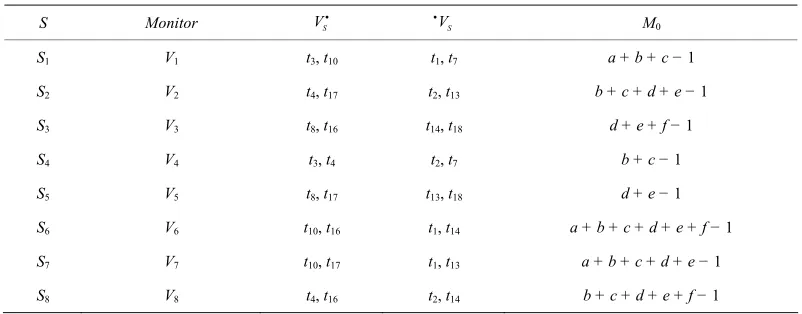
Table 4. Disturbance ss control model of the net in Figure 2.
S Monitor
le
S
V
S
V
M0
S1 V1 t3, t10 t1, t7 a + b + c −1
S2 V2 t4, t 2, t13 b + c + d + e −1
a + b + −1
a + b −1
17 t
S3 V3 t8, t16 t14, t18 d + e + f −1
S4 V4 t3, t4 t2, t7 b + c −1
S5 V5 t8, t17 t13, t18 d + e −1
S6 V6 t10, t16 t1, t14 c + d + e + f
S7 V7 t10, t17 t1, t13 + c + d + e
S8 V8 t4, t16 t2, t14 b + c + d + e + f −1
trolled.
Alternatively, we will prove based on the following bservations from Table 3 that:
o
S6 = S1 S2 S3 S4 S5 ,
S7 = S1 S2 S4 ,and
S8 = S2 S3 S5 .In general, if
j , then
e
following theorem.
Theorem 5. Let
bebe a dependent S elementary siphons d where
0=1 =1
= n m
S i Si n j Sn
i j
a b
n m
n j n j b S or
=1 n
n m
i n j S
j b
shown in th
S 0
=1
=
i
S S
i a
0
=1 =1
= i i
i j
a S
j as
a net system and
N M0, 0 MS w.r.t.2
n
S , ···, an
0
S
1
S ,
2
S , ···, Sn, Sn1, n m
0=1
= n m =
S ai S bn j S a b
S
=1 i n j
i j
,
=1 = n
a i
i
a Si
, and b=
=1 n j
m
S j j
b
.Then
1) S
S S S0, , , , ,1 2 S Sn n1,Sn2, , Sn m
[ ]
S S
, =
(characteristic T-vector of the com tary set of siphon S equals the negative of that of
p en-
).
2)
lem
S
0 = =1 =1
n m
i n j
S i a Si j b Sn j
, where ,
ai
j
b R (set of real numbers), i
1, 2, , n
and
1, 2
j ,,m (characteristic P-vectors of the comple- mentary sets of siphon S , S1, S2, ···, Sn, Sn1,
2
n
S , ···, Sn m follow th
3) The Marking Equality (ME) holds:,
of siphon e sam
eristic T-vect
e equation as that ors).
of the corresponding charact
0
=1
= ,
,
j M S
M R N M
=1
0
n m
i i n j n j
i
a M S b M S
(1)
(total tokens in the complementary sets , S , ···, S , S
S,
1
S 2 n n1, Sn2, ···, Sn m follow the sa
equation as that rresponding character
T-vectors).
Proof. 1) S
S SR
r SR H r
variant
is the sup- port of a P-in I based on Property 1 and
S S . Note that SR S PR . p S
Ss ,
1I p (valid for OPN); otherwise, I p
= 0. Thu ,
= S S
I . T
= T
T
= 0S S
I N N (By the
definition of P-invariant), where 0 is a vector with all components b
controlled, we have M S
0 maxM S
0 or
0
=1 =1
max n i i m m n j n j
i j
M S a M S
in b M S
(2)
To be conse ve, the term associated with the
negative terms is set to zero 0
N
rvati
. That is, if eing 0. = S S on equation 0 b .
2) Based S =a , the fact tha t
=
S S
and T =T
N , we have
0 = =1
n m
i
S a Si b
S S
=1 =10 =1 =1
=
= 0 n j Sn j
i j
n m
T T T
j
i n j
S i Si j Sn j
N a N b N
a b N
0 =1 i n
S i Si j Sn j
T n m
If , then
0 =1 =1
= S in i Si jm n j Sn j 0
a b
isa P-invariant. However, all places in
S0 ,
S1 ,
S2 , ···, and
Sn m
and he
are not ma
g of nce the union of
rked in the i
nitialmarkin N S0
,
S1 ,
S2 , ···, and
Sn m
m
cannot be the P-invariant. This i
support of a plies that 0
0 =
n m
i n j
S a Si b Sn j
.=1 =1
i j
3 Multiplying oth sides of the equation in Equation (1) by ) MT, w have b
0 = =1
n m
T T T
i
S Si
n
M a M
e
=1 0 =1 =1 = .n j S j
i j
n m
i i n j n j
i j
b M
M S a M S b M S
This theorem holds for FMS modeled by OPN [not General PN (GPN)] such as an S3PMR since we have
assumed p S
S , Y p
1odeled by GP
. However, it can be
extended N such as S4PR and
S3PGR2 by replacing to FMS m M with W((M(A))), the weighted
sum of tokens in A S or [S].
This ME says that the total number of tokens trapped in [S0] and [Si], follow the same linear algebraic
relationship between S0 and Si, i = 1, 2, ···, n, n +
1, ···, n + m. This is beca se pu hysically, S
t is thenumber of tokens removed from S by firing t once. Now, maxtM S
i =M0
Si 1 (Si is said to be limit controlled) for Si to have tokens. In order for S0 to be
M S
than max (
=1 n
i i i
a M S
holds. not hold that
s large i
enough to be greater ), then Equa-
tion (2) necessarily However it may
0 1
0
1 1
2
0
2 1
nM S a M S a M S
0
a M Sn n 1
0
Si 1
=1 = i i n a M 0 =1 i
=aM ai
y not be controlled when
After lowering
That is ma each is
limit controlled. 0
S Si
iM S to
0
M Si Si, Si 1 where Si is the c
in Li and Zhou [13], fo
ontro pth
r each , it may hold that
l de
i S
variable mentioned
0 1
2 0
2= n i
S a M S
a M
0 1 S S
M S a M
1 2 0 0 =1 0 = .n n Sn i i
i
aM
a M S S
S
This is exa
the MLI (marking lin In the sequel, we do not negative terms to zero; t controllability.
d S5 (resp. S6, S7, and
d) siphons; they are lim
ctly ear inequality
mentioned in [13]). set the term
associated with the herefore
achieving a better
, , ···, an ) are
. compoun d
1 S basic (re by setting 2 S sp 8 S it-controlle
0 S1 = 1
M V a b c ,
0 S2 = 1
M V b c d e , M V0
S3 =d e f 1,
0 S4 = 1
M V b c , and M V0
S5 =d e 1.
0 6 =
M S a b c d e , M S0
7 =b c d e f ,and M S0
8 =a b c d e f . Table 4 shows thedisturbanceless control model of the net in Figure 2.
i
Simax = 0
M S M V , i = , 1 2,···,5, and
max 7 = max 1 max 2 min 4
M S M S M S M S
part 3 o emma 1) 1 b c d e 1 c
(by Theorem 4 and f L
=a b c
=a b c d e b 2.
elements) iff M S0
7 Mmax
S77
S to be limit-cont
= = 3b , of which one toke
12 p21 s 2
S are marked (
oth S and S are
one
ontrol e
ntr ility
, which implies
d control
elem rolled. For instance,
n goes to
since
Simila
co
that
b < 2or b M= 0
p13 = 1.On the other hand, if b > 1, we need to ad ents for
3
ns to
b
rly,
an
0 1
M p
two toke
p
, p4
d) d
17
p , also a tokens in p16 to p5 and
e tokens in p to . Thi makes S7 emptied and
yet both S1 and consistent with the
fact that 1 2
17S1 and p4S2 and both p4 and p17 are
marked.
can argue that S8 is limit-controlled
(no need for c elem nts) iff M0 p13 = 1 Now
nsider the co ollab of S6.
controlle
.
max 6 1 max 2 max 3
4 min
=
max
min 5
M S M S S M S
S M
M M
1 =
d e f c e
a b c d e f
S
(b
1
3
y Part 3 of Theorem 4)
= a b c 1 b c d
e
b d
(by Part 3 of Lemma 1).
where Mmin
S4 =c and Mmin
S5 =dntrol ele . Thus,
is li ments) 6
S
mit-co
ntrolled (no need for co
iff0 6 max 6
M S M
3 =
S , which imp
0 13 0 15
= p =d =M p 1
and
lies that
= 1. If b d
3 0 n
b d
= = 1, the or
b d b M
M S0 6 M
= max S
6 1, other-wise, b d 3 and M S0 6 Mmax
6
s
rived the controllability fo
ea pendent siph
at they h e the same co proves the conservativ
ao, “A Graphic-Algebr Siphons of BS3PR,” Jour
ineering, Vol. 23, No. 6
.
S ; S6 is
emptie
6. C
sion
We h strongly
(SDS) a kly de S It is
surprised av us,
his paper im d.
on
av r both
ons (WD ). ntrollability. Th e control policy for
aic Computation of
Ele-mentar nal of Information
Sci-, 2007Sci-, pp.
1817-, Vol. 21817-, No. 21817-, 20071817-,
1080/00207540701747210
clu
e de nd w th
y
pp. 168-179
t
WDS in [8].
7. References
[1] D. Y. Chao, “Computation of Elementary Siphons in Petri Nets for Deadlock Control,” The Computer Journal, Vol. 49, No. 4, 2006, pp. 470-479.
[2] D. Y. Ch
ence and Eng
1831.
[3] D. Y. Chao, “Incremental Approach to Computation of Elementary Siphons for Arbitrary S3PR,” IEE Proceed-ings Control Theory & Applications
[4] D. Y. Chao, “Technical Note-Reaching More States for Control of FMS,” International Journal of Production Research, Vol. 48, No. 4, 2008, pp. 1217-1220.
doi:10.
9, No. 3-4, 2008, pp. 317-318.
[5] D. Y. Chao, “Comments on Deadlock Prevention and Avoidance in FMS: A Petri Net Based Approach,” The International Journal of Advanced Manufacturing Tech-nology, Vol. 3
doi:10.1007/s00170-007-1190-x
[6] D. Y. Chao, “An Incremental Approach to Extract Mini-mal Bad Siphons,” Journal of Information Scien Engineering, Vol. 23, No. 1, 2007, pp. 203-214. ce and [7] D. Y. Chao, “Revised Dependent Siphons,” The
Interna-tional Journal of Advanced Manufacturing Technology, Vol. 43, No. 1, 2009, pp. 182-188,
doi:10.1007/s00170-008-1684-1
[8] D. Y. Chao, “Conservative Control Policy for Weakly
ptimal Siphon- and a Well-Known S3PR,”
Dependent Siphons in S3PR Based on Elementary
Si-phons,” IET Control Theory & Applications, Vol. 4, No. 7, 2010, pp. 1298-1302.
[9] D. Y. Chao, “Structure of Weakly Dependent Siphons,” Unpublished Manuscript.
[10] D. Y. Chao, “Improvement of Subo FBM-Based Control Model of
IEEE Transactions on Automation Science and Engi-neering, Vol. 8, No. 2, 2011, pp. 404-411.
doi:10.1109/TASE.2010.2088120
[11] J. Ezpeleta, J. M. Colom and J. Martinez, “A Petri Net
Transactions on Robotics and
Based Deadlock Prevention Policy for Flexible Manu-facturing Systems,” IEEE
Automation, Vol. 11, No. 2, 1995, pp. 173-184.
doi:10.1109/70.370500
[12] M. V. Iordache, J. O. Moody and P. J. Antsaklis, “A Method for the Synthesis of Liveness Enfo
visors in Petri Nets,” Proceedings
rcing
of the 2001 American
ntion in Systems,” IEEE Transactions on
ystems, Man, and Cybernetics Part A:
Sys-Systems and Hu-Control Conference, Arlington, 25-27 June 2001, pp. 4943-4948.
[13] Z. W. Li and M. C. Zhou, “Elementary Siphons of Petri Nets and Their Application to Deadlock Preve Flexible Manufacturing
Systems, Man, and Cybernetics Part A: Systems and Hu-mans, Vol. 34, No. 1, 2004, pp. 38-51.
[14] Z. W. Li and M. C. Zhou, “Clarifications on the Defini-tions of Elementary Siphons in Petri Nets,” IEEE Trans-actions on S
tems and Humans, Vol. 35, No. 6, 2006, pp. 1227-1229. [15] M. Uzam and M. C. Zhou, “An Iterative Synthesis
Ap-proach to Petri Net Based Deadlock Prevention Policy for Flexible Manufacturing Systems,” IEEE Transactions on Systems, Man, and Cybernetics Part A:
mans, Vol. 37, No. 3, 2007, pp. 362-371.
[16] Z. W. Li and M. C. Zhou, “Control of Elementary and Dependent Siphons in Petri Nets and Their Application,”
IEEE Transactions on Systems, Man, and Cybernetics Part A: Systems and Humans, Vol. 38, No. 1, 2008, pp. 133-148.