BEHAVIOURAL PROBLEMS BETWEEN WORKING AND NON WORKING
COMPARATIVE CROSS SECTIONAL SURVEY
1
Pooja Devi,
1
M.sc. (Nursing) 2
nd2
Lecturer, University College of Nursing, Faridkot, Punjab,
3
Associate Professor, University College of Nursing, Faridkot,
ARTICLE INFO ABSTRACT
Background:
interactive relationship with their physical health and
grow they acquire many skills to adjust themselves in environment. Sometimes they acquire good skills but sometimes they develop some unhealthy skills which sometimes turned up to into behavioural problems
health. Time
behavioural problems and its management plays major role in the prevalence of behavioura in their children.
among children (age 3 Materials and Methods:
working mothers from the Peadiatric department of Guru Gobind Singh Medical College and Hospital Faridkot, Punjab. Out of 300 sample 150 children were of working mothers and 150 children were of Non-working mo
collection were
From the results of present it was concluded that 12% children were abnormal in
mothers and 7.3% children were abnormal in case of working mothers. Prevalence of behavioural problems was found more in children of non
present study it appears that association of worki
on the prevalence of behavioral problem in children most of working mothers in present study were educated up to
behavioral pr Copyright © 2019, Pooja Devi et al. This is an open access distribution, and reproduction in any medium, provided
INTRODUCTION
It is easy for parents especially for mothers to identify their child’s physical needs, however, mental and emotional needs may not be as obvious for parent to detect. Good mental health allows a child to think clearly, develop socially and learn new skills (https://www.mentalhealth.org.uk/a-to
young-people). Problems related with mental health affect about 1 in 10 children and young people. They include problems like depression, anxiety and conduct disorder, and are often a direct response to what is happening in their lives (https://www.who.int/mental_health/maternalchild/c
scent/en/). Alarmingly, 70% of children and young people who experience a mental health issues have not had appropriate interventions at a sufficiently early age
aappublications.org/content/138/6/e20163025
*Corresponding author:
ISSN: 0975-833X
Article History:
Received 24th August, 2019 Received in revised form 28th September, 2019 Accepted 25th October, 2019 Published online 26th November, 2019
Citation:Pooja Devi, M.S., Vandna and Dr. Maheshwari, S.K.
comparative cross sectional survey”, International Journal of Current Research
Key Words:
Behavioural Problems, Children ,
Working Mother, Non Working Mothers.
RESEARCH ARTICLE
BEHAVIOURAL PROBLEMS BETWEEN WORKING AND NON WORKING MOTHER’S CHILDREN: A
COMPARATIVE CROSS SECTIONAL SURVEY
Pooja Devi,
2M.S.Vandna and
3Dr. Maheshwari, S.K
nd
year, University College of Nursing, Faridkot, Punjab
University College of Nursing, Faridkot, Punjab,
Associate Professor, University College of Nursing, Faridkot, Punjab
ABSTRACT
Background: Mental health is an essential part of children's overall health interactive relationship with their physical health and their ability to succeed in society
grow they acquire many skills to adjust themselves in environment. Sometimes they acquire good skills but sometimes they develop some unhealthy skills which sometimes turned up to into behavioural problems. Mothers being primary caregiver of child play important role in their mental health. Time spend by mothers with their children, their knowledge and awareness regarding behavioural problems and its management plays major role in the prevalence of behavioura
in their children. Aim: The Present study was aimed to assess the prevalence of behavioural problems among children (age 3-10yrs) of working and non-working mothers in selected areas of Faridkot. Materials and Methods: Cross sectional survey was used to select 300 children of working and non working mothers from the Peadiatric department of Guru Gobind Singh Medical College and Hospital Faridkot, Punjab. Out of 300 sample 150 children were of working mothers and 150 children were of working mothers and were selected with purposive sampling technique. Tool used for data collection were –Socio demographic data sheet and strength and difficulty questionnaire.
From the results of present it was concluded that 12% children were abnormal in
mothers and 7.3% children were abnormal in case of working mothers. Prevalence of behavioural problems was found more in children of non-working mothers.
present study it appears that association of working mothers education and family income had impact on the prevalence of behavioral problem in children most of working mothers in present study were educated up to graduate/more level with good family income and tend to show that prevalence of behavioral problems in their children was less than the children of non
access article distributed under the Creative Commons Attribution the original work is properly cited.
It is easy for parents especially for mothers to identify their however, mental and emotional needs may not be as obvious for parent to detect. Good mental health allows a child to think clearly, develop socially and learn new to-z/c/children-and-d with mental health affect about 1 in 10 children and young people. They include problems like depression, anxiety and conduct disorder, and are often a direct response to what is happening in their lives https://www.who.int/mental_health/maternalchild/child_adole
. Alarmingly, 70% of children and young people who health issues have not had appropriate (https://pediatrics. aappublications.org/content/138/6/e20163025).
Worldwide 10-20% of children and adolescents are those who experience mental disorders. Most of them starts during early childhood but sometimes remain hidden or less dangerous, but as child grows if these problems left untreated
conditions, these conditions severely influence children’s development, their educational attainments and their potential to live fulfilling and productive lives so it is very important for parents to be aware about these problems (https://www.boystown.org/parenting/article/Pages/accentuate the-positive-use-praise-to-modify
aspx). Rarely a child under 5 years are labeled with diagnosis of a serious behavioural disorder. But they may begin displaying symptoms of a disorder that could be diagnosed later in childhood. These may include attention deficit hyperactivity disorder (ADHD),oppositional defiant disorder (ODD),autism spectrum disorder (ASD),anxiety disorde depression, bipolar disorder, learning disorders conduct disorders (https://www.mentalhealth america.net
International Journal of Current Research Vol. 11, Issue, 11, pp.8046-8054, November, 2019
DOI: https://doi.org/10.24941/ijcr.37092.11.2019
Pooja Devi, M.S., Vandna and Dr. Maheshwari, S.K., 2019. “Behavioural problems between working and non working mother’s children: A
International Journal of Current Research, 11, (11), 8046-8054.
Available online at http://www.journalcra.com
MOTHER’S CHILDREN: A
K.
year, University College of Nursing, Faridkot, Punjab
University College of Nursing, Faridkot, Punjab,
Punjab, India
is an essential part of children's overall health and has a complex their ability to succeed in society. As children grow they acquire many skills to adjust themselves in environment. Sometimes they acquire good skills but sometimes they develop some unhealthy skills which sometimes turned up to into Mothers being primary caregiver of child play important role in their mental spend by mothers with their children, their knowledge and awareness regarding behavioural problems and its management plays major role in the prevalence of behavioural problem The Present study was aimed to assess the prevalence of behavioural problems working mothers in selected areas of Faridkot. used to select 300 children of working and non working mothers from the Peadiatric department of Guru Gobind Singh Medical College and Hospital Faridkot, Punjab. Out of 300 sample 150 children were of working mothers and 150 children were of thers and were selected with purposive sampling technique. Tool used for data Socio demographic data sheet and strength and difficulty questionnaire. Results: From the results of present it was concluded that 12% children were abnormal in case of non-working mothers and 7.3% children were abnormal in case of working mothers. Prevalence of behavioural working mothers. Conclusion: From the results of ng mothers education and family income had impact on the prevalence of behavioral problem in children most of working mothers in present study were graduate/more level with good family income and tend to show that prevalence of oblems in their children was less than the children of non-working mothers.
License, which permits unrestricted use,
20% of children and adolescents are those who experience mental disorders. Most of them starts during early childhood but sometimes remain hidden or less dangerous, but as child grows if these problems left untreated leads to worst conditions, these conditions severely influence children’s development, their educational attainments and their potential to live fulfilling and productive lives so it is very important for parents to be aware about these problems
ww.boystown.org/parenting/article/Pages/accentuate-modify-childrens-negative-behavior. . Rarely a child under 5 years are labeled with diagnosis
disorder. But they may begin displaying symptoms of a disorder that could be diagnosed later in childhood. These may include attention deficit hyperactivity disorder (ADHD),oppositional defiant disorder (ODD),autism spectrum disorder (ASD),anxiety disorder, depression, bipolar disorder, learning disorders conduct
https://www.mentalhealth america.net).
INTERNATIONAL JOURNAL OF CURRENT RESEARCH
Praise and reward can reinforce good behaviour. If parents are very busy (like working both father and mothers as well) they may give their attention only for negative behaviour, of their children (https://assets.publishing.service.gov.uk/ government/ uploads/system/uploads/attachment_data/file/755135/Mental_h ealth_and_behaviour_in_schools__.pdf). There is an urgent need to take steps for better understanding of the problem and to be managed properly. As we know that the age period of 3-10 yrs of age is very crucial period for the development of behaviour in child. As the mother is the primary caregiver in child’s earliest days, as mothers is child’s first link of any emotional bonding and attachment. Baby will learn his first emotions in relation to mother. The way mother’s bond with her baby in the earliest months and years will leave a deep impact on child’s overall well-being or development of Psychological problems may lead to dangerous results in future (http://www.prestwich.bury.sch.uk/safeguarding-and-pupil-well+-+being).
This makes me to focus more about the relationship of mothers and child’s behaviour. Researcher found that now a days more mothers are moving towards employment and are able to spend less time with their children and are more stressed with home and job work due to which mental health of child sometimes get neglected and leads to some mental health issues and on other side Some mothers who are living at home and remain busy in their households and stressed and rarely get chance to be exposed with others and it may affect their children’s mental health. Nalini. M et al (May, 2014) conducted a comparative study to assess the behavioural changes of preschool children among working and non –working mothers and results showed no association of between mother’s employment and behavioural changes of preschoolers. Another comparative study conducted by Ms. Alexander. A et al (2014) Study on Behavioral Problems of Preschool Children among Working and Non-Working Mothers shows children of employed mothers have more behavioral problems as compared to non-working mothers. Some studies Hopes et al shows that employment reduces a sense of isolation and relieve, stress and depression for maternal caregivers (whereas underemployment has been found to be associated with reduced life satisfaction and excess risk of depression and distress). These contradictory results insisted me do work on this project.
Objectives
To assess the prevalence of behavioural problems of children among working mothers and non working mothers.
To compare the prevalence of behavioural problems of children between working and non working mothers.
To associate behavioural problems of children with the selected demographic variables.
MATERIALS AND METHODS
Research approach and design: A non experimental
approach was used to assess the prevalence of behavioural problems among children (age 3-10 years) of working and non-working mothers in selected areas of Faridkot. Comparative Cross sectional survey research design was chosen for the study where research implies without any manipulation of the variables.
Research setting Paediatric department of Guru Gobind Singh
Medical Hospital ,Faridkot was selected for the study.
Target population The target Population of the study was
children (age 3-10 yrs) of working and non working mothers in selected setting.
Sampling technique Purposive sampling technique was used
to select the sample. Children of working and non working mothers were selected as study subjects who were meeting the inclusion and exclusion criteria.
Sample And sampling technique Total 300 study subjects
were selected out of which 150 children were of non-working mothers and 150 children were of working mothers.Purposive sampling technique was used to select the sample.
Description of tool
After considering the suggestion of experts, necessary modifications were made in tool.
Section A:- Socio-demographic characteristics of the
subjects. It consist of items which includes age of mother, education of mother, occupation of mother family income, type of family, Age of the child, gender and no. of siblings a child have. Based upon their answer a tick mark was put on appropriate response for each item. Total administration time for this section was 5-10 minutes.
Section B:- The strengths & difficulties questionnaire
(by Goodman.R.19974) is used to assess behavioural problems. It is composed of 25 items which covers 5 domains: Emotional, conduct, hyperactivity, peer problems, and pro-social domains.
Each subscale consist of 5 items. Each item has 3 responses categories: ‘not true”, “some what true” and “certainly true” .Somewhat true is always coded as 1, but the scoring of “not true” and “certainly true’ varies.
Total difficulty score: This is generated by summing up the scores of all the domains except the pro-social which is a (positive behavior domain).
Each item was explained to the respondent and marked appropriately according to their response. Time taken to complete this section was approximately 12-16 minutes.
Data Collection Procedure: Main study data collection was
done for 4 week. All procedure was explained to them. Written informed consent was obtained from the subjects .Firstly socio- demographic data sheet was administered and were asked to respond appropriately. After that SDQ was administered to the study subjects. In case any subject felt any problem in understanding the tool it was explained by the researcher properly to get appropriate responses from the study subjects. Data was collected from total 300 subjects.
Ethical consideration: Study was conducted after getting
permission from principal university college of nursing, Faridkot. Permission for data collection for the study from the Guru Gobind Singh Medical Hospital was also taken. Written informed consent was also obtained from the subjects .
RESULTS
Age: Maximum no. of mothers 66 (44%) were belonging to
Table 1. Socio-demographic characteristics of study subjects
Variables Children of non-working mothers N=150 children of working mothers N=150 Total N=300
Age F %age F %age F %age
Less than 20 2 1.3 0 0 2 0.7
20-25yrs 66 44.0 4 2.7 70 23.3
26-30yrs 31 20.7 75 50.0 106 35.3
31-40yrs 51 34.0 71 47.3 122 40.7
Education
Illiterate 8 5.3 1 0.7 9 3.0
Primary 48 32.0 5 3.3 53 17.7
Metric 35 23.3 15 10.0 50 16.7
Secondary 50 33.3 63 42.0 113 37.7
Graduate/more 9 6.0 66 44.0 75 25.0
Occupation
Housewife 150 100.0 0 0 150 50.0
Govt.job 0 0 73 48.7 73 24.3
Private job 0 0 77 51.3 77 25.7
Type of family
Nuclear 39 26.0 49 32.7 88 29.3
Joint 111 74.0 101 67.3 212 70.7
Salary
10,000-20,000 117 78.0 31 20.7 148 49.3
21,000-30,000 29 19.3 72 48.0 101 33.7
31,000-40,000 4 2.7 33 22.0 37 12.3
More than 40,000 0 0 14 9.3 14 4.7
Age of child
3-5 yrs 47 31.3 37 24.7 84 28.0
6-8yrs 69 46.0 32 21.3 101 33.7
9-10yr 34 22.7 81 54.0 115 38.3
Gender
Male 54 36.0 73 48.7 127 42.3
Female 96 64.0 77 51.3 173 57.7
Siblings
No sibling 17 11.3 39 26.0 56 18.7
One 57 38.0 75 50.0 132 44.0
two 72 48.0 36 24.0 108 36.0
3 or more than 3 4 2.7 0 0 4 1.3
Table 2. Showing frequency and percentage distribution of prevalence of behavioural problem in children of mothers (according to TDS)
N=300
Total difficulty score (TDS) of Behavioral problems Normal Borderline Abnormal
F % F % F %
212 70.6 59 19.7 29 9.7
Table 3. Frequency and percentage distribution of prevalence of behavioural problems with the level of severity in children of all the mothers under study according to category
N=300
BEHAVIORAL PROBLEM Normal Borderline Abnormal
F % F % F %
Emotional 202 67.1 67 22.3 31 10.33
Conduct 242 80.6 40 13.3 18 6
Hyperactivity 243 81 38 12.6 19 6.3
Peer problem 257 85.6 21 7 22 7.3
Pro-social 256 85.3 36 12 8 2.6
Table 4 Frequency and percentage distribution of prevalence of behavioral problems (according to TDS) with the level of severity in children of non- working mothers.
N=150
Behavioral problems Normal Borderline Abnormal
According to total difficulty score F % F % F %
[image:3.595.85.514.587.656.2]respectively followed by 51(34%) in non working and 71(47.3%)in working mothers from age group 31-40 yrs followed by 31(20.7%) from age group 26-30yrs in non working and 4(2.7%) from age group 20-25 yrs in working mothers. Only 2 (1.3%) mothers were belonging to age group of less than 20 yrs only in group of non-working mothers.
Education: Maximum no. of mothers were belonging to
50(33.3%) were belonging to secondary education in case of non-working mother and 66(44%) were from graduate/more category in working mothers. Followed by 48(32%) were educated up to primary in non working mothers and 63(42%) belongs to category of secondary education working mothers Followed by 35(23.3%) and 15(10%) up-to metric class in non-working and working mothers respectively followed by 9(6%) mothers were educated up-to graduate/more category and 5(3.3%) were educated up-to primary class in non working and working mothers respectively. At last 8(5.3%) and 1(0.7%) were Illiterate in non-working and working mothers respectively.
Occupation: In case occupation 150(100%) mothers were non
working. In case of working mothers occupation status Maximum no.77 (51.3%) Mothers were doing private job and 73(48.7%) were having govt. job.
Family type: Maximum no.111(74%) and 101(67.3%) belongs
to joints family non working and working mothers respectively followed by 39(26%) belongs to nuclear family in case of non working mothers and 49(32.7) belongs to nuclear family in case of working mothers.
Family Income: Maximum no. 117(78%) were having family
[image:4.595.78.519.104.180.2]income Rs.10,000-20,000 in non working mothers and 72(48%) were with family income Rs.21,000-30,000 in working mothers followed by 29(19.3%) with family income Rs.21,000-30,000 in non-working and 33(22%) with family income Rs.31,000-40,000 in working mothers, followed by 4(2.7%) with income of Rs. 31,000-40,000 in non working mothers and 31(20.7%) with income Rs.10,000-20,000 in working mothers and 14(9.3%) were having family income
Table-5 Frequency and percentage distribution of prevalence of behavioural problems with the level of severity(according to TDS) in children of non -working mothers
N=150
BEHAVIORAL PROBLEM Normal Borderline Abnormal
F % F % F %
Emotional 104 69.3 34 22.7 12 8.0
Conduct 117 78.0 26 17.3 7 4.7
Hyperactivity 119 79.3 18 12.0 13 8.7
Peer problem 124 82.7 14 9.3 12 8.0
Pro-social 121 80.7 27 18.0 2 1.3
Table 6 . Frequency and percentage distribution of prevalence of behavioral problems with the level of severity in children of working mothers according to category
N=150 Prevalence of behavioral problems
According to total difficulty score
Normal Borderline Abnormal
F % F % F %
[image:4.595.68.525.346.422.2]110 73.3 29 19.3 11 7.3
Table 7. Frequency and percentage distribution of prevalence of behavioral problems with the level of severity in children of working mothers.
N=150
BEHAVIORAL PROBLEMS Normal Borderline Abnormal
F % F % F %
Emotional 98 65.3 33 22.0 19 12.7
Conduct 125 83.3 14 9.3 11 7.3
Hyperactivity 124 82.7 20 13.3 6 4.0
Peer 133 88.7 7 4.7 10 6.7
Pro-social 135 90.0 9 6.0 6 4.0
Table 8. Mean and Standard Deviation score of behavioural problems in both groups
Problems Non-working Mothers 150 Working Mothers 150 T value P value
Mean S.D Mean S.D
Emotional 2.50 1.553 2.80 1.806 -1.542 0.124NS
Conduct 1.63 1.144 1.51 1.886 0.942 0.347NS
Hyperactivity 3.65 1.904 2.91 1.952 3.324 0.001**
Peer 1.59 1.270 1.27 1.192 2.203 0.028*
Total difficulty score 10.22 4.446 9.23 4.173 1.982 0.048*
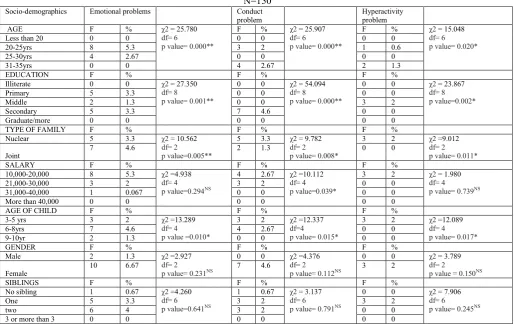
[image:4.595.59.537.466.541.2]Table 9. Association of emotional, conduct and hyperactivity problems in children of non working mothers with selected demo-graphics
N=150
Socio-demographics Emotional problems Conduct
problem
Hyperactivity problem
AGE F % χ2 = 25.780
df= 6
p value= 0.000**
F % χ2 = 25.907
df= 6
p value= 0.000**
F % χ2 = 15.048
df= 6 p value= 0.020*
Less than 20 0 0 0 0 0 0
20-25yrs 8 5.3 3 2 1 0.6
25-30yrs 4 2.67 0 0 0 0
31-35yrs 0 0 4 2.67 2 1.3
EDUCATION F % F % F %
Illiterate 0 0 χ2 = 27.350
df= 8 p value= 0.001**
0 0 χ2 = 54.094
df= 8
p value= 0.000**
0 0 χ2 = 23.867
df= 8 p value=0.002*
Primary 5 3.3 0 0 0 0
Middle 2 1.3 0 0 3 2
Secondary 5 3.3 7 4.6 0 0
Graduate/more 0 0 0 0 0 0
TYPE OF FAMILY F % F % F %
Nuclear 5 3.3 χ2 = 10.562
df= 2 p value=0.005**
5 3.3 χ2 = 9.782
df= 2 p value= 0.008*
3 2 χ2 =9.012
df= 2 p value= 0.011*
Joint
7 4.6 2 1.3 0 0
SALARY F % F % F %
10,000-20,000 8 5.3 χ2 =4.938
df= 4
p value=0.294NS
4 2.67 χ2 =10.112
df= 4 p value=0.039*
3 2 χ2 = 1.980
df= 4
p value= 0.739NS
21,000-30,000 3 2 3 2 0 0
31,000-40,000 1 0.067 0 0 0 0
More than 40,000 0 0 0 0 0 0
AGE OF CHILD F % F % F %
3-5 yrs 3 2 χ2 =13.289
df= 4 p value =0.010*
3 2 χ2 =12.337
df=4 p value= 0.015*
3 2 χ2 =12.089
df= 4 p value= 0.017*
6-8yrs 7 4.6 4 2.67 0 0
9-10yr 2 1.3 0 0 0 0
GENDER F % F % F %
Male 2 1.3 χ2 =2.927
df= 2
p value= 0.231NS
0 0 χ2 =4.376
df= 2
p value= 0.112NS
0 0 χ2 = 3.789
df= 2
p value = 0.150NS
Female
10 6.67 7 4.6 3 2
SIBLINGS F % F % F %
No sibling 1 0.67 χ2 =4.260
df= 6
p value=0.641NS
1 0.67 χ2 = 3.137
df= 6
p value= 0.791NS
0 0 χ2 = 7.906
df= 6
p value= 0.245NS
One 5 3.3 3 2 3 2
two 6 4 3 2 0 0
3 or more than 3 0 0 0 0 0 0
Table 10. Association of peer, pro-social and total difficulty score in children of non working mothers with selected demo-graphics
N=150
Socio-demographics Peer problem Pro social Total difficulty score
AGE N %
χ2 =33.102
df= 6
p value= 0.000**
N %
χ2 = 29.195
df= 6
p value= 0.000**
N %
χ2 = 12.473
df= 6 p value= 0.052*
Less than 20 0 0 0 0 0 0
20-25yrs 10 6.67 0 0 13 8.67
25-30yrs 0 0 0 0 1 0.67
31-35yrs 1 0.67 2 1.3 4 2.67
EDUCATION N % N % N %
Illiterate 0 0 χ2 = 34.217
df= 8
p value= 0.000**
1 0.67 χ2 = 40.184
df= 8
p value= 0.000**
0 0 χ2 = 12.370
df= 8
p value= 0.135NS
Primary 8 5.3 0 0 11 7.3
Middle 1 0.67 0 0 3 2
Secondary 2 1.3 1 0.67 4 2.67
Graduate/more 0 0 0 0 0 0
TYPE OF FAMILY N % N % N %
Nuclear 4 2.67 χ2 = 1.623
df= 2
p value= 0.444NS
0 χ2 = 6.331
df= 2 p value= 0.042*
8 5.3 χ2 = 4.473
df= 2
p value= 0.107NS
Joint
7 4.67 2 10 6.67
SALARY N % N % N %
10,000-20,000 11 7.3 χ2 =22.295
df= 4 p value=0.000**
2 χ2 = 10.555
df= 4 p value= 0.032*
16 10.67 χ2 = 2.835
df= 4
p value= 0.586NS
21,000-30,000 0 0 0 2 1.3
31,000-40,000 0 0 0 0 0
More than 40,000 0 0 0 0
AGE OF CHILD N % N % N %
3-5 yrs 6 4 χ2 = 6.828
df= 4
p value= 0.145NS
0 χ2 = 7.561
df= 4
p value= 0.109NS
7 4.67 χ2 = 7.864
df= 4
pvalue= 0.097NS
6-8yrs 5 3.3 0 11 7.3
9-10yr 0 0 2 0 0
GENDER N % N % N %
Male 5 3.3 χ2 = 3.699
df= 2
p value= 0.157NS
2 χ2 = 4.819
df= 2
pvalue= 0.090NS
3 2 χ2 = 5.494
df= 2 p value= 0.054*
Female
6 4 0 15 10
SIBLINGS N % N % N %
No sibling 1 0.67 χ2 = 3.341
df= 6
p value= 0.765NS
0 0 χ2 = 25.063
df= 6 p value=0.000**
2 1.3 χ2 = 3.334
df= 6
p value= 0.766NS
One 6 4 1 0.67 9 6
two 4 2.67 0 7 4.67
[image:5.595.31.550.460.770.2]Table 11. Association of emotional, conduct and hyperactivity problems in children of working mothers with selected demo-graphics
N=150 Socio-demographics Peer problems Pro-social problem Total difficulty score
AGE F % χ2 = 2.435
df= 4
p value= 0.656NS
F %
χ2 = 2.595
df= 4
p value= 0.628NS
F % χ2 = 3.025
df= 4
p value= 0.554NS
Less than 20 0 0 0 0 0 0
20-25yrs 0 0 0 0 0 0
25-30yrs 7 4.67 4 2.67 9 6
31-35yrs 3 2 2 1.6 2 1.6
EDUCATION F % F % F %
Illiterate 0 0 χ2 = 39.747
df= 8
p value= 0.000**
0 0 χ2 = 28.499
df= 8
p value= 0.000**
0 0 χ2 = 26.636
df= 8 p value= 0.001*
Primary 0 0 0 0 1 0.67
Middle 1 0.33 4 2.67 2 1.6
Secondary 5 3.33 0 0 3 2
Graduate/more 4 2.67 1 0.33 5 3.3
TYPE OF FAMILY F % F % F %
Nuclear 10 6.67 χ2 = 28.444
df= 2
p value= 0.000**
1 0.33 χ2 = 2.883
df= 2
p value= 0.237NS
5 3.3 χ2 =7.593
df= 2 p value= 0.022*
Joint
0 0 5 3.33 6 4
SALARY F % F % F %
10,000-20,000 2 1.33 χ2 = 26.991
df= 6
p value= 0.000**
3 2 χ2 =9.240
df= 6
p value= 0.161NS
4 2.67 χ2 = 18.687
df= 6 p value= 0.005*
21,000-30,000 0 0 3 2 1 0.67
31,000-40,000 8 5.33 0 0 2 1.6
More than 40,000 0 0 0 0 4 2.67
AGE OF CHILD F % F % F %
3-5 yrs 8 5.33 χ2 = 21.042
df= 4
p value = 0.001*
1 0.33 χ2 = 6.450
df= 4
p value= 0.168NS
2 1.6 χ2 = 14.983
df= 4 p value= 0.005*
6-8yrs 2 1.33 3 2 6 4
9-10yr 0 0 2 1.33 3 2
GENDER F % F % F %
Male 2 1.6 χ2 = 3.706
df= 2
p value= 0.157NS
1 0.33 χ2 = 3.629
df= 2
p value= 0.163NS
6 4 χ2 = 0..847
df= 2
p value = 0.655NS
Female
8 5.33 5 3.3 5 3.3
SIBLINGS F % F % F %
No sibling 8 5.33 χ2 = 19.799
df= 4 p value= 0.001*
2 1.6 χ2 = 14.094
df= 4 p value= 0.007*
6 4 χ2 = 7.627
df= 4
p value= 0.106NS
One 2 1.33 1 0.67 3 2
Two 0 0 3 2 2 1.33
3 or more than 3 0 0 0 0 0 0
Table 12 .Association of peer, pro-social and total difficulty score in children of working mothers with selected demo-graphics
N=150
AGE F %
χ2 = 17.514
df= 4 p value= 0.002*
F %
χ2 = 5.128
df= 4
p value= 0.274NS
F % χ2 = 6.646
df= 4 p value=0.054*
Less than 20 0 0 0 0 0 0
20-25yrs 0 0 9 6 1 0.67
25-30yrs 16 10.6 2 1.3 3 2
31-35yrs 3 2 0 0 2 1.3
EDUCATION F % F % F %
Illiterate 0 0
χ2 = 11.860
df= 8
p value= 0.158NS
0 0
χ2 = 21.266
df= 8 p value= 0.006*
0 0 χ2 = 8.447
df= 8
p value= 0.391NS
Primary 2 1.3 0 0 0 0
Middle 7 4.6 3 2 0 0
Secondary 0 0 3 2 0 0
Graduate/more 10 6.67 5 3.3 6 4
TYPE OF FAMILY F % F % F %
Nuclear 2 1.3 χ2 = 29.256
df= 2 p value=0.000**
3 2 χ2 = 0..302
df= 2
p value= 0.860NS
2 1.3 χ2 = 0.573
df= 2
p value= 0.751NS
Joint
17 11.3 8 5.3 4 2.6
SALARY F % F % F %
10,000-20,000 13 8.67
χ2 = 39.044
df= 6
p value= 0.000**
0 0 χ2 =73.992
df=6
p value=0.000**
0 0 χ2 = 5.832
df= 6
p value= 0.442NS
21,000-30,000 2 8.6 1 0.67 3 2
31,000-40,000 3 2 3 2 1 0.67
More than 40,000 1 0.67 7 4.67 2 1.3
AGE OF CHILD F % F % F %
3-5 yrs 0 0 χ2 =1.396
df= 2
p value =0.498NS
3 2 χ2 =25.303
df=2
p value=0.000**
1 1.3 χ2 =1.950
df= 2
p value= 0.745NS
6-8yrs 8 5.3 0 0 1 1.3
9-10yr 11 7.3 8 5.3 4 2.6
GENDER F % F % F %
Male 13 8.67 χ2 =11.086
df= 2 p value= 0.004*
1 0.67 χ2 = 14.610
df= 2
p value= 0.001**
4 2.6 χ2 = 0..890
df=2
p value = 0.641NS
Female
6 4 10 6.67 2 1.3
SIBLINGS F % F % F %
No sibling 9 6 χ2 =15.047
df= 4 p value=0.005*
1 0.67 χ2 = 22.105
df= 4
p value= 0.000**
1 0.67 χ2 = 2.853
df= 4
p value= 0.583NS
One 9 6 3 2 3 2
Two 1 0.67 7 4.67 2 1.3
[image:6.595.43.545.468.781.2]Age of child: Maximum no. of children 69(46%) were from age group 6-8 yrs in non working mothers and 81(54%) were from 9-10 yrs age group in working mothers followed by 47(31.3%) and 37(24.7%) from age group 3-5 yrs in both non-working and non-working mothers respectively. 34(22.7%) were from age group 9-10 yrs in non- working mothers and 32(21.3%) from age group 3-5 yrs in working mothers.
Gender of child: In case of non-working mothers maximum
no. 96(64%) were females 54(36%) were males and. In case of working mother 77(51.3%) were females and 73(48.7%) were males
No. of siblings: Maximum no. of children 72(48%) were
having 2 siblings in non-working mothers in case of working maximum no. of children 75(50%) were having 1 sibling in working others followed by 57(38%) with 1 sibling in non working mothers and 39(26%) with no sibling in working mothers, followed by 17(11.3%) with no sibling in non working group and 36(24%) with 2 siblings in working mothers. 4(2.7%) children with 3 or more than 3 in non – working mothers. Table 2 Shows that 212(70.6 %) children were normal and 59(19.7 %) children were at borderline and 29 (9.7%) were abnormal from both the groups of working and non working mothers. Table-3 Frequency and percentage distribution of prevalence of behavioural problems with the level of severity in children of all the mothers under study according to category.
Table 3 Shows that prevalence of emotional problem was highest with 31(10.33%) children were abnormal, 67(22.3%) were at borderline level and 202(67.15%) were normal and pro-social problem was least prevalent 8(2.6%) children were abnormal, 36(12%) were at borderline and 256(85.3%) children were normal. Table-4 Frequency and percentage distribution of prevalence of behavioral problems (according to TDS) with the level of severity in children of non- working mothers. Table 4 Shows that 102 (68%) children were normal and 30(20%) children were at borderline and 18 (12%) were abnormal in case of non-working. Table -5 Frequency and percentage distribution of prevalence of behavioral problems with the level of severity in children of non- working mothers according to category Table 5 Shows that hyperactivity problem was more prevalent in children of non-working mothers with 13(8.7%) children were abnormal, 18(12%) were at borderline and 119(79.3%) were normal, pro-social problems were least prevalent with 2(1.3%) children were abnormal, 27(18%)children were at borderline and 121(80.7%) children were normal.
Table 6 reveals that 110(73.3%) children were normal and 29(19.3%) children were at borderline and 11 (7.3%) were abnormal in case of working mother. Table 7 shows that emotional problem was most prevalent among children of working mothers in which 19(12.7%) children were abnormal, 33(22%) were at borderline and 98(65.3%) were normal, and pro-social problem was found to be least prevalent with 6(4%) children were found abnormal, 9(6%) children were at borderline and 135(90%) were normal children. Table 8 shows that mean score value of emotional problem in case of working mother’s children was 2.80 whereas mean score value in children of non working mother’s children was 2.50 and p value for this category was found 0.124, which was found non significant at p<0.05 level hence it can be concluded that there
was no significant difference in the emotional problem of working and non working mother’s children
Conduct problem: In case of conduct problem mean score
value in children of non working mothers was found 1.63 whereas mean score value in children of working mothers was found to 1.51 and p value for conduct problem was found 0.347 which was found non significant at p<0.05 level and revealed no significant difference in conduct problem in children of working and non working mothers.
Hyperactivity problem: In case of hyperactivity problem
mean score value in children of non working mothers was found 3.65 whereas mean score value in children of working mothers was found 2.91 and the difference was statistically highly significant at 0.001 level and results concluded significant difference in the hyperactivity problem in children of working and non working mothers and prevalence was more in children of non-working mothers.
Peer problem: In case of peer problem mean score value in
children of non working mothers is found 1.59 where as mean score value in children of working mothers was found 1.27. In case of peer problem p value was found 0.028 and was statistically significant at p<0.05 level and revealed significant difference of peer problem in both group, prevalence was more in children of non-working mothers.
Pro-social: In case pro-social problem mean score in case of
working mothers children was 8.69 whereas mean score value in children of non working mothers 7.43, p value for this category was found 0.001 and difference was statistically highly significant at p<0.001evel in both groups. Prevalence was found more in children of non-working mothers.
Total difficulty score: According to total difficulty score the
mean score value is found high 10.22 in children of non-working mothers as compared to children of non-working mothers 9.23 and p value was found 0.048which was found statistically significant at p<0.05 level and revealed that prevalence of behavioural problem was more in children of non working mothers
Objective iii association of prevalence of behavioural problems with their selected demographic data Table 9
Association of emotional, conduct and hyperactivity problems in children of non working mothers with selected demo-graphics
Association of behavioural problems with the selected demographic variables in children of non-working mothers
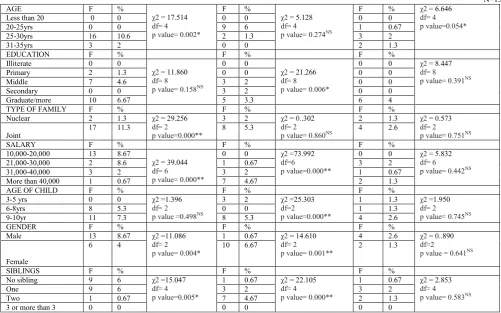
Association of behavioural problems with the selected demographic variables in children of working mothers:
Table 11 shows significant association of emotional problem with age of mother, family type, family income, gender of child and siblings. In case of conduct problem significant association found with educational level, family income, age of child, gender of child and no. of siblings. In case of hyperactivity problem significant association is found with age of mother. Table 12 shows significant association of peer problem with educational level of mother, family type, family income, age of child and no. of siblings. In case of pro-social problem significant association is found with educational level and no. of siblings of child. According to total difficulty score significant association is found with educational level of mother, family type, family income and age of child.
DISCUSSION
The findings of the present study indicated that out of mothers of 300 children 150 were of working and 150 were of non working. According to total difficulty score out of 300, 212( 70.6%) children were normal,59(19.7%) were at borderline 29(9.7%) were normal. The findings are supported by a study conducted for “Assessment of child's mental health problems using Strengths and Difficulties Questionnaire” by George M et al ( jan 2019) . In which total subjects were 168 and results revealed Overall 53% of the children belonged to the normal category, whereas 33% and 14% were under abnormal and borderline categories, respectively. Results of present study revealed that according to the total difficulty score, mean score for children of non-working mothers was found higher than the children of working mothers which showed significant difference.
The findings indicates that prevalence of behavioral problem in children of non working mothers was higher as compared to the children of working mothers. Findings of the study are supported by a study conducted by pusha and Kuruvilla. M(2002) in which results revealed significant difference in the mean score of both working and non working mothers & behavior problems were found to be higher in the case of preschoolers of nonworking mothers as compared to children of working mothers. Similarly a study was conducted by Aghdam.B et al. (2015). “To see the effect of maternal employment on the elementary and junior High School Students’ Mental Health in Maku. General. The findings of the study revealed significant difference between the mental health problems, somatic problems, social functioning, anxiety, and depression of the students with employed and non-employed mothers. As conclusion was found that students with non-working mothers experienced greater mental disorders than those with working mothers.
An other study was conducted by Hafez N et al(2105) on “Child Socio- Emotional Behavior between Employed and Unemployed Mother at primary School age” this study was carried out in 8 primary government schools total 200 sample was taken Findings revealed that More than half of the studied children(53.4%) had mild socio- emotional and behaviors problems, and(12.5%) had moderate and 34% were totally normal and there was no significant difference between employed(working) mothers and unemployed(non-working) mothers regarding to their children socio - emotional behaviors problems. Another study conducted by Ranjan.S (2013) to see
primary school children. The results indicate that children of working mothers show more behavioral problems as compared to those of nonworking mothers. The results of these studies showed contradictory results as findings of some studies showed positive some showed negative and some showed no difference between the behavior problem in children of working and non working mothers. In case of third objective of the present study to find out the association of prevalence behavioral problems with selected socio-demographic in children of working and non working mothers. In present study in case of children of non working mothers according to total difficulty score significant association was found with age of mother and gender of child. In case of children of working mothers according to total difficulty score significant association is found with educational level of mother, family type, family income and age of child.
Findings of present study were congruent with a study conducted by. Alexander.A and Shetty A(2014)“comparative study to assess the behavioral problems among children of working and non working mothers ,results revealed significant association with age and gender of child and behavioral problems in case of non working mothers. Harvey E.(1999)performed a study to see Short-term and long-term effects of early parental employment on children of the National Longitudinal Survey of Youth found that the early parental employment positively affects children's development by increasing family income.
Conclusion
Early childhood is very crucial period for a person whatever a child go through during early childhood period had a great impact in future on his/her mental health a child may own some ill behavior to reduce stress tension and anxiety which are not healthy and develop some behavioral problems. From the results of present study it appears that association of working mothers education and family income had impact on the prevalence of behavioral problem in children most of working mothers in present study were educated up to graduate/more level with good family income and tend to show that prevalence of behavioral problems in their children was less than the children of non-working mothers. Children are likely to be positively affected by maternal employment, if the mother finds satisfaction in work outside the home and if she is supported by family members.
Recommendation
The presented study can be done to assess the knowledge of parents regarding the behavioral problems and its management. A study can be done to assess the knowledge regarding the attitude and knowledge of parents regarding mental health of children before and after structured teaching programme.
REFERENCES
Aghdam, B., Ahmadzadeh S., Hassan Z., Ebrahimi F., Sabzmakan L., Javadivala Z. 2015. The effect of maternal employment on the elementary and junior high school students' mental health in Maku. Glob J Health Sci.
7(2):379-85. Available on https://www.ncbi.nlm.nih.gov/ pubmed/25716412
Oral Res Rev., 11(7)-11-24.Available from: http://www .jorr.org/text.asp?2019/11/1/7/253427
Hafez, N. Farag M., Mohamed S., Elyzeed A. 2015. Child Socio- Emotional Behavior between Employed and Unemployed Mother at primary School age. IOSR Journal of Nursing and Health Science., 4(5):21-27. Available online http://www.iosrjournals.org/iosr-jnhs/papers
Harvey E. 1999. Performed a study to see Short-term and long-term effects of early parental employment on children of the National Longitudinal Survey of Youth. Devpsychol. 35(2)445-59.Available online from https://www.ncbi.nlm.nih.gov/pubmed/10082015
Hope, S., Pearce, A., Whitehead, A., Law, C. 2014. Family employment and child socioemotional behavior, J
Epidemiol Community Health. 68(10): 950–957 available
on https://www.ncbi.nlm.nih.gov/pmc/articles/PMC417 4125/
Management of behavioural problem during early childhood; Available from https://www.boystown.org/ parenting/ article/ Pages/accentuate-the-positive-use-praise-to-modify-childrens-negative-behavior.aspx
Mental health and behaviour in schools; Department for education available from https://assets.publishing. service.gov.uk/government/uploads/system/uploads/attach ment_data/file/755135/Mental_health_and_behaviour_in_s chools__.pdf
Mental health of child; Mental health America available from https://www.mentalhealth america.net
Mental health of People and young child; Mental Health Foundation Available from https://www.mentalhealth. org.uk/a-to-z/c/children-and-young-people .
Mental health status among children; world health Organization available from https://www.who.int/ mental_ health/maternalchild/child_adolescent/en/
Mrs. Alexander A and Dr Shetty P. Comparative Study on Behavioral Problems of Preschool Children among Working and Non-Working Mothers. IOSR Journal of Nursing and Health Science, 2014;3( 6 ):35-38. Available fromhttp://www.iosrjournals.org/iosr-jnhs/papers/vol3-issue6/Version-1/G03613538
Mrs. Alexander A and Dr Shetty P. Comparative Study on Behavioral Problems of Preschool Children among Working and Non-Working Mothers. IOSR Journal of Nursing and Health Science, 2014;3( 6 ):35-38. Available fromhttp://www.iosrjournals.org/iosr-jnhs/papers/vol3-issue6/Version-1/G03613538
Nalini M, Sukesh. A comparative study to assess the behavioral changes of preschool children among working and non working mothers. Journal of International Academic research for multidisciplinary,2014;2(4):551 -555 http://www.jiarm.com /paper 13922.pdf/ reviewed on 5/4/19.
Pusha and Kuruvilla M. 2010. Indian contribution to behavior therapy. Indian J Psychiatry. 52(10)::371-377. Available online from http://www.indianj psychiatry.org/ text.asp?2010/52/7/371/69271
Ranjan S. 2013. Effect of mother's working status on behavioral problems of primary school children, Shaikshik Parisamvad (An International Journal of Education) 34(2): 36–41. Available http://www. spijebhu.in/ SPIJz July13%2036
Safegaurd and pupil well being;Preswich Arts available from http://www.prestwich.bury.sch.uk/safeguarding-and-pupil-well+-+being
Strength and difficulty questionnaire (Goodman, 1997); youthmind available online on https://www.sdqinfo.com/ a0.html
Type of behavioral disorders in children; AAP news & Journals Gateway. Available from https://pediatrics. aappublications.org/content/138/6/e20163025