ISSN Online: 2157-9458 ISSN Print: 2157-944X
DOI: 10.4236/fns.2019.104034 Apr. 26, 2019 459 Food and Nutrition Sciences
Comparative Effects of Selected Underutilized
Wild Beans on Plasma Lipid Profile and Liver
Function of Rats Fed with High Fats Diet
O. A. Awoyinka
1, T. R. Omodara
2, F. C. Oladele
1, D. D. Ajayi
3, H. A. Babalola
4,
B. A. Olofinbiyi
5, G. S. Adeleye
6, E. O. Odesanmi
71Department of Medical Biochemistry, College of Medicine, Ekiti State University, Ado Ekiti, Nigeria 2Department of Microbiology, Faculty of Sciences, Ekiti State University, Ado Ekiti, Nigeria
3Department of Chemical Pathology, Ekiti State University Teaching Hospital, Ado Ekiti, Nigeria 4Department of Science Laboratory (Biochemistry Option), Ekiti State University, Ado Ekiti, Nigeria 5Department of Medicine, College of Medicine, Ekiti State University, Ado Ekiti, Nigeria
6Department of Physiology, Ekiti State University, Ado Ekiti, Nigeria 7Department of Biochemistry, Ekiti State University, Ado Ekiti, Nigeria
Abstract
Dietary fiber content of beans is known to be responsible in the management of metabolic syndrome by delaying the degree of glucose as fuels, changing fat utilization, and controlling appetite through increased satiety, thus lower-ing the risk of cardiovascular diseases. Hence some selected varieties of un-derutilized wild beans were evaluated to study their anti-lipidemic effects. Prior to this, attempts were made to ferment the non-digestible fractions of the beans with fermentable micro-organism and the respective gut metabo-lites were determined. Lipid profile result carried out in the blood showed high density lipoprotein to be significantly (p ≤ 0.05) high in Pakala group with a value of 2.2 ± 0.02 compared to other groups. While for low density lipoprotein (LDL); rats with Otili in their diet had the highest LDL with a value of 0.45 ± 0.01. However, the group of rats fed with Feregede had the least cholesterol level compared to other groups of rats fed with respective wild beans and the negative control group. Otili had the highest ALP with value of 89 ± 1.0. Otili group also had a significant lower value of both aspar-tate amino transferase and alanine amino transferase. The biochemical indic-es reported in this study vary from one type of wild bean to another.
Keywords
Metabolic Syndrome, Dietary Fibres, Anti-Lipidemic, Alanine Aminotransferase, Aspartate Aminotransferase
How to cite this paper: Awoyinka, O.A., Omodara, T.R., Oladele, F.C., Ajayi, D.D., Babalola, H.A., Olofinbiyi, B.A., Adeleye, G.S. and Odesanmi, E.O. (2019) Compara-tive Effects of Selected Underutilized Wild Beans on Plasma Lipid Profile and Liver Function of Rats Fed with High Fats Diet. Food and Nutrition Sciences, 10, 459-468. https://doi.org/10.4236/fns.2019.104034
Received: January 15, 2019 Accepted: April 23, 2019 Published: April 26, 2019
Copyright © 2019 by author(s) and Scientific Research Publishing Inc. This work is licensed under the Creative Commons Attribution International License (CC BY 4.0).
DOI: 10.4236/fns.2019.104034 460 Food and Nutrition Sciences
1. Introduction
Metabolic syndrome is the group of metabolic conditions associated with the risks of cardiovascular diseases elevated serum triglycerides and LDL cholesterol, low HDL cholesterol, central adiposity, high serum glucose, and high blood pressure [1][2]. Consumption of beans in the diet is considered beneficial for healthy individuals as well as those preconditioned for metabolic syndrome by lowering serum total cholesterol and LDL cholesterol [3] [4]. Resistant starch and dietary fiber content of beans are mainly responsible in the management of metabolic syndrome by delaying the degree of glucose as fuels, changing fat uti-lization, and controlling appetite through increased satiety, thus lowering the risk of cardiovascular diseases [5][6].
Fermentation of soluble fiber (SF) as well as resistant starch (RS) by bacteria in the large intestine results in the generation of specific short chain fatty acids (SCFA), propionate being the dominant, which alters metabolic pathways re-sulting in reduced serum cholesterol [7] [8]. Thus, increased production of SCFA by fermentation of RS is an underlying reason for the protective benefits by the consumption of dry beans [7][9]. The cholesterol lowering effect of die-tary fiber has been ascribed to its ability to restrain the intestinal absorption of neutral steroids and bile acids and total steroid excretions [10]. Hypocholestero-lemic effect can also be achieved by regular ingestion of beans that reduce the need to rely on animal proteins by replacing it through plant proteins [11]. In addition to this, beans α-amylase inhibitor is known to have anti-obesity effect as α-amylase inhibitory action to starch digestion causes energy restriction re-sulting in mobilization of body fat reserves [12].
DOI: 10.4236/fns.2019.104034 461 Food and Nutrition Sciences total cholesterol by 5% and 6%, respectively [13]. Against this backdrop the me-chanism of the prevention of the cardiovascular diseases by beans is well studied but not in the perspective of exploring the underutilized wild beans as presented in this study.
2. Materials and Methods
2.1. Collection of Cultivar
As described in our previous study [18] the legumes (beans) used in this work are of two types; Wild-type beans Sphenostyles stenocarp (Otili African yam bean), Cajanuscajan (Feregede Pigeon pea), Phaseolus lunatus (Pakala lima beans) and Edible bean Phaseolus vulgaris (Oloyin kidney bean). They are got-ten from the farmers in Ado-Ekiti.
2.2. Experimental Animals
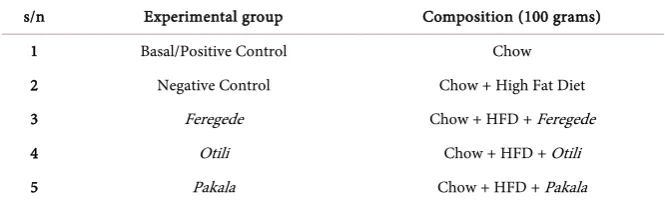
Twenty four albino rats were obtained from the college of medicine Animal house, Ekiti State University, Ado Ekiti, Ekiti state. Their weight ranged between 50 to 100 grams. The animals were acclimatized to the environment for 7 days. In feeding, the method of Shimin et al.,[19] was adopted with slight modifica-tion. The rats were then randomly divided into five groups as shown in Table 1, (4 rats per group) according to average body weight, the groups were fed ad-libitum with a normal chow diet (NCD), a high dietary fiber diet (HD) con-taining 8% fiber supplement in total, a high-fat diet (HF) which provided 45% of its energy from fat, or a high-fat and dietary fiber diet (HFD). The main nutri-tional ingredients in the HD diets were adjusted to levels similar to those of the normal chow diet, and the main nutritional ingredients in the HFD diet were adjusted levels similar to those of the HF diet. The rats were observed every day and weighed every week and the food intakes were recorded for each group throughout the experiment.
2.3. Dissection and Tissue Collection
All of the rats were anesthetized with chloroform and venous blood was col-lected from the orbital vein for hematology and blood biochemical analyses. Then, the rats were killed via an aortic cut and immediately dissected. The liver was collected, frozen and stored at −80˚C for further analysis.
2.4. Lipid Analysis
2.4.1. Preparation of Cholesterol Fraction
DOI: 10.4236/fns.2019.104034 462 Food and Nutrition Sciences
Table 1. Experimental design.
s/n Experimental group Composition (100 grams)
1 Basal/Positive Control Chow
2 Negative Control Chow + High Fat Diet
3 Feregede Chow + HFD + Feregede
4 Otili Chow + HFD + Otili
5 Pakala Chow + HFD + Pakala
2.4.2. Preparation of HDL Fractions
Blood was collected with heparin or citrate to avoid hemolyzes and centrifuge at 2000 × g and 4˚C for 10 minutes. The white buffy layer-plasma was gently re-moved and store on ice. Aliquot samples for testing and store. Dilutions in 1X assay were performed on aliquot samples after storage at −80˚C. Thereafter, 200 μL of sample was added to 200 μL of the precipitation Reagent (Randox, USA) and mixed well by vortexing. The mixture was allowed to incubate 5 - 10 mi-nutes at room temperature before taking absorbance at 570 nm.
2.4.3. Preparation of LDL/VLDL Fraction
Pellet obtained after removal of the HDL fraction was re-suspended and dis-solved in 400 μL of PBS and mixed well to obtain the LDL/VLDL fraction. Assay was carried out immediately by following Random Kit Manufacturer’s instruc-tion.
2.4.4. Liver Function Analyses
For the biochemical analyses, the blood samples were maintained 4˚C for 2 h and then centrifuged at 3000 r/min for 20 min at 4˚C. The supernatant was stored at −80˚C total protein (TP), Alanine aminotransferase (ALT), aspartate aminotransferase (AST), and alkaline phosphatase (ALP), uric acid levels were analyzed following the commercial Random Kit (USA) and absorbance were measured using an automatic Biochemical Analyzer Camspec M106 Spectro-photometer (USA).
3. Results and Discussion
DOI: 10.4236/fns.2019.104034 463 Food and Nutrition Sciences
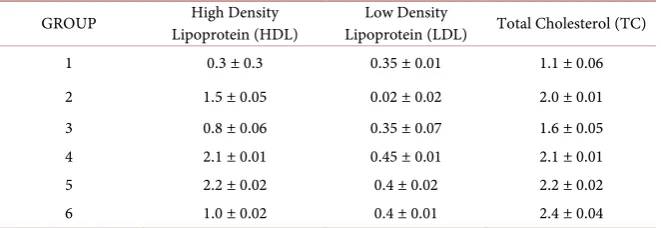
Table 2. Lipid profile in blood.
GROUP Lipoprotein (HDL) High Density Lipoprotein (LDL) Low Density Total Cholesterol (TC)
1 0.3 ± 0.3 0.35 ± 0.01 1.1 ± 0.06
2 1.5 ± 0.05 0.02 ± 0.02 2.0 ± 0.01
3 0.8 ± 0.06 0.35 ± 0.07 1.6 ± 0.05
4 2.1 ± 0.01 0.45 ± 0.01 2.1 ± 0.01
5 2.2 ± 0.02 0.4 ± 0.02 2.2 ± 0.02
6 1.0 ± 0.02 0.4 ± 0.01 2.4 ± 0.04
diseases associated with oxidative stress [20]. While for low density lipoprotein (LDL); rats laced with Otili in their diet had the highest LDL with a value of 0.45 ± 0.01, though not significantly different from other group fed with other wild underutilized beans. Interestingly the negative control significantly lower LDL compared to other groups with a value of 0.2 ± 0.02. LDL particles pose a risk for cardiovascular disease when they invade the endothelium and become oxidized, since the oxidized forms are more easily retained by the proteoglycans. A com-plex set of biochemical reactions regulates the oxidation of LDL particles, chiefly stimulated by presence of necrotic cell debris and free radicals in the endothe-lium. Increased concentration of LDL particles is strongly associated with the development of atherosclerosis over time [22]. However, the group of rats fed with Feregede had the least cholesterol level compared to other groups of rats fed with respective wild beans and the negative control group. The cholesterol level of other groups of rats fed with Otili and Pakala are not significantly dif-ferent from each other and the negative control. High-density lipoprotein (HDL) is good cholesterol and low-density lipoprotein (LDL) is bad cholesterol. High cholesterol in serum is a leading risk factor for human cardiovascular disease such as coronary heart disease and stroke [23]. Against this backdrop it is suffice to declare that Feregede could have protection against heart diseases and other health challenges but the physical observations in the experiment would negate this assumption. The group fed with Feregede was less agile and sick compare to Otili and Pakala groups. The feeding pattern of each group shows that Otili group had more appetite for the feed and this is clearly seen in their body mass gain over the period of the experiment. There was a general similarity in the be-haviour of the rats which have the wild beans in their feed. Unlike the controls and Otili other groups did not huddle together but lay separately, often on their backs with their limbs fully extended. The total protein present in Group 1 is higher with a value of 77 ± 0.15 compare to Group 2, 4, 6 and 5 with value of 75 ± 0.10, 70 ± 0.01, 70 ± 0.03 and 69 ± 0.01 respectively while Group 3 had the lowest with a value of 59 ± 0.04, compared to the control. This indicates that many serve as a protective role against hyperlipidemia and hyperglycemia in rat fed with high fats diet [24][25].
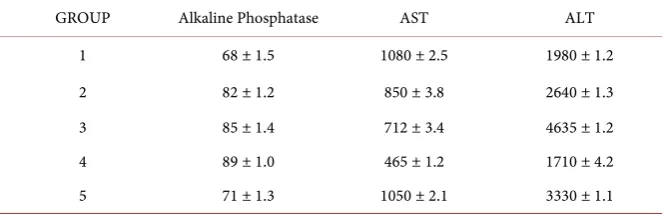
tis-DOI: 10.4236/fns.2019.104034 464 Food and Nutrition Sciences sue are tissue-specific, which means they are found only in the tissues where they are expressed in physiological conditions but may contribute to the circu-lating pool of serum alkaline phosphatase under specific situations when there is increased stimulation of their production. The tissue-nonspecific alkaline phos-phatase forms the majority of the fraction circulating in serum and therefore, is of clinical interest [26]. In this experimental analysis of the liver as shown in Ta-ble 3, the lowest value of alkaline phosphatase (ALP) was found in positive con-trol with the value 68 ± 1.5 and Otili had the highest ALP with value of 89 ± 1.0. Though the value obtained lies within the normal range [32], there is significant (p ≤ 0.05) increase in the presence of alkaline phosphatase in other experimental groups. The principal clinical value of measuring serum alkaline phosphatase lies in the diagnosis of cholestatic liver disease. Some of the highest elevations in al-kaline phosphatases are seen in patients with cholestasis. Usually, four-fold of the upper limit of normal or greater elevation is seen in up to 75% of the patients with cholestasis, either intrahepatic or extra hepatic [26].
[image:6.595.207.541.617.726.2]AST is commonly measured clinically as a part of diagnostic liver function tests, to determine liver health. However, it is important to keep in mind that the source of AST (and, to a lesser extent, ALT) in blood tests may reflect pathology in organs other than the liver. Larry (21) submitted that when the AST is higher than ALT, a muscle source of these enzymes should be considered. For example, muscle inflammation due to dermatomyositis may cause AST > ALT. This is a good reminder that AST and ALT are not good measures of liver function be-cause they do not reliably reflect the synthetic ability of the liver and they may come from tissues other than liver [27]. Compared to the control, the other groups were found to be lower in Aspartate Aminotransferase. Otili group had a significant lower value of 465 ± 1.2 compare to that of the control while the rest experimental group had an increased value of AST compared to the control. Similar result was also found in alanine amino transferase (ALT) where Otili group had lower ALT of 1710 ± 4.2 compare to other groups. Aspartate amino-transferase (AST) and alanine aminoamino-transferase (ALT) are frequently used as markers of hepatocellular injury. AST is expressed in mitochondria of the liver and cytosol of red blood cells and muscles; thus it is not specific for liver injury [28]. Since ALT is less abundant outside of the liver, an increased ALT level is more suggestive of liver disease. Levels of both are markedly elevated (>5 - to
Table 3. Liver function tests.
GROUP Alkaline Phosphatase AST ALT
1 68 ± 1.5 1080 ± 2.5 1980 ± 1.2
2 82 ± 1.2 850 ± 3.8 2640 ± 1.3
3 85 ± 1.4 712 ± 3.4 4635 ± 1.2
4 89 ± 1.0 465 ± 1.2 1710 ± 4.2
DOI: 10.4236/fns.2019.104034 465 Food and Nutrition Sciences 10-fold normal) with hepatocellular injury caused by hepatitis, hepatotoxicity, ischemia, genetic or metabolic liver disorders. Elevation of AST in excess of ALT suggests extra-hepatic source of injury. With acute biliary obstruction, there are initial sharp increases in ALT and AST levels and a rapid decline in 12 - 72 hours as obstruction is relieved. In chronic cholestasis, aminotransferases are usually only mildly elevated. With hepatocellular injury, ALT and AST levels tend to remain more significantly elevated longer. In acute liver failure a rapid decline in ALT and AST levels with worsening coagulopathy is a poor prognostic factor [29][30][31][32].
Generally the pattern in liver protein in the experimental groups-Feregede, Otili and Pakala compare to the two controls may be ascribed to intake of the diet mixed with high fats. Total protein was found to be higher in the liver of the group fed with feregede with the value of 84 ± 8.3. Total protein was found to be higher in Group 3 with the value of 84 ± 8.3 compared to Group 1 having 15.4 ± 0.04. Decreased in the control total protein may be as result of decreased syn-thetic capacity of the rats [33][34]. It may be hoped that determinations of liver protein in varying metabolic states will be useful in trying to define the part played by the liver in the processes of protein metabolism. The effect on the blood tissue is in consonance with the view that all the differences are responses to change in functions [35].
4. Conclusion
In summary, dry beans played an important clinical role in the human nutrition with reduced risk of chronic disease and could be an exceptionally cost effectual approach for improving health. Rats fed with Otili (Sphenostyles stenocarpa) and Feregede (cajanus cajan) expressed higher resistibility ability in the induc-tion of high fat diet but poor resistibility was exhibited or experienced in Pakala (Phaseolus lunatus)and edible bean.
Acknowledgements
The present project was partly funded by Tet Fund Individual Based Research grant 2017-2018 sessions. To embark on this study, the invaluable encourage-ment of Prof. (Mrs.) Rocio Campos-Vega of Autonomous University Queretaro, Mexico is highly acknowledged.
Conflicts of Interest
The authors declare no conflicts of interest regarding the publication of this paper.
References
[1] Anderson, J.W. (1985) Cholesterol Lowering Effects of Canned Beans for Hyper-cholesterolmic. Medical Clinical Resources,33, 871-875.
DOI: 10.4236/fns.2019.104034 466 Food and Nutrition Sciences
Lipids, and Sterol Metabolism in Humans. Journal of Lipid Research, 38, 1120-1128.
[3] Seymour, G., Elliot, W., Christopher, K.Z., Regina, S. and George, J.K. (1987) Com-pensatory Enlargement of Human Atherosclerotic Coronary Arteries. The New England Journal of Medicine, 316, 1371-1375.
https://doi.org/10.1056/NEJM198705283162204
[4] Westerbacka, J., Lammi, K., Hakkinen, A.M., Rissanen, A., Salminen, I., Aro, A., et al. (2005) Dietary Fat Content Modifies Liver Fat in Overweight Nondiabetic Sub-jects. The Journal of Clinical Endocrinology and Metabolism, 90, 2804-2809.
https://doi.org/10.1210/jc.2004-1983
[5] Duhan, A., Khetarpaul, N. and Bishnoi, S. (2001) Saponin Content and Trypsin In-hibitor Activity in Processed and Cooked Pigeon Pea Cultivar. International Journal of Food Science and Nutrition, 52, 53-59.
https://doi.org/10.1080/09637480020027200
[6] Campos-Vega, R., Reynoso-Camacho, R., Pedraza-Aboytes, G., Acosta-Gallegos, J.A., Maldonado, S.H.G., Paredes-Lopez, O., Oomah, B.D. and Loarca-Piña, G. (2009) Chemical Composition and in Vitro Polysaccharide Fermentation of Differ-ent Beans (Phaseolus vulgaris L.). Journal of Food Science, 74, T59.
https://doi.org/10.1111/j.1750-3841.2009.01292.x
[7] Finley, J.W., Burrell, J.B. and Reeves, P.G. (2007) Pinto Bean Consumption Changes SCFA Profiles in Fecal Fermentations, Bacterial Populations of the Lower Bowel, and Lipid Profiles in Blood of Humans. The Journal of Nutrition, 137, 2391-2398.
https://doi.org/10.1093/jn/137.11.2391
[8] Hartley, L., May, M.D., Loveman, E., Colquitt, J.L. and Rees, K. (2016) Dietary Fibre for the Primary Prevention of Cardiovascular Disease. Cochrane Database Syst Rev., 1, Cd011472. https://doi.org/10.1002/14651858.CD011472.pub2
[9] Awoyinka, O.A., Omodara, T.R., Oladele1, F.C., Aina, O.O. and Ajayi, O.E (2018)
In-Vitro Metabolite Colonic Production from Otili (Sphenostylis stenocarpa) as In-fluenced by Selected Gastrointestinal Microbes. Advances in Bioscience and Bio-technology,9, 584-595. http://www.scirp.org/journal/abb
[10] Howarth, N., Saltzman, E. and Roberts, S. (2001) Dietary Fiber and Weight Regula-tion. Nutrition Reviews, 59, 129-139.
https://doi.org/10.1111/j.1753-4887.2001.tb07001.x
[11] Gylling, H. and Miettinen, T.A. (2005) The Effect of Plant Stanol- and Ste-rol-Enriched Foods on Lipid Metabolism, Serum Lipids and Coronary Heart Dis-ease. Annals of Clinical Biochemistry, 42, 254-263.
[12] Layer, P., Carlson, G.L. and Di Magno, E.P. (1985) Partially Purified White Bean Amylase Inhibitor Reduces Starch Digestion in Vitro and Inactivates Intraduodenal Amylase in Human. Gastroenterology, 88, 1895-1902.
https://doi.org/10.1016/0016-5085(85)90016-2
[13] Hutchins, A., Winhan, D.M. and Thompson, S.V. (2012) Phaseolus Beans: Impact on Glycaemic Response and Chronic Disease Risk in Human Subjects. British Journal of Nutrition, 108, S52-S65. https://doi.org/10.1017/S0007114512000761
[14] Hu, F.B. (2003) Plant-Based Foods and Prevention of Cardiovascular Disease: An Overview. American Journal of Clinical Nutrition, 78, 544S-551S.
https://doi.org/10.1093/ajcn/78.3.544S
[15] Jacobs, D.R. and Gallaher, D.D. (2004) Whole Grain Intake and Cardiovascular Disease: A Review. Current Atherosclerosis Reports, 6, 415-423.
DOI: 10.4236/fns.2019.104034 467 Food and Nutrition Sciences
[16] Anderson, G.H. and Moore, S.E. (2004) Dietary Proteins in the Regulation of Food Intake and Body Weight in Humans. Journal of Nutrition, 134, 974-979.
[17] Han, K., Fukushima, M. and Shimizu, K. (2003) Resistant Starches of Beans Reduce the Serum Cholesterol Concentration in Rats. Journal of Nutritional Science and Vitaminology, 49, 281-286.
[18] Awoyinka, O.A., Omodara, T.R., Oladele, F.C., Aina, O.O. and Akinluyi, O. (2018)
In-Vitro Measurement of pH and Antioxidant Capacity during Colonic Fermenta-tion of Selected Underutilized Wild and Edible Beans. Advances in Microbiology, 8, 965-974. https://doi.org/10.4236/aim.2018.812065
[19] Shimin, C., Xingtian, C., Mingzhang, G., Yiling, T., Wentao, X., Kunlun, H. and Yuxing, Z. (2017) Insoluble Dietary Fiber from Pear Pomace Can Prevent High-Fat Diet-Induced Obesity in Rats Mainly by Improving the Structure of the Gut Micro-biota. Journal of Microbiology and Biotechnolog, 27, 856-867.
https://doi.org/10.4014/jmb.1610.10058
[20] Hirokazu, H. (2017) Degenerated HDL and Its Clinical Implications. In: Komoda, T., Ed., The HDL Handbook: Biological Functions and Clinical Implications, 3rd Edition, Elsevier, UK, 37-63.
[21] Larry, R.E. (2015) Hyperlipidemias. In:Engelking, L., Eds., Textbook of Veterinary Physiological Chemistry, Academic Press, Cambridge, 427-433.
https://www.sciencedirect.com/topics/biochemistry-genetics-and-molecular-biolog
y/hyperlipidemia
[22] Pittaway, J.K., Ahuja, K.D., Cehun, M., Chronopoulos, A., Robertson, I.K. and Nes-tel, P.J. (2006) Dietary Supplementation with Chickpeas for at Least 5 Weeks Re-sults in Small but Significant Reductions in Serum Total and Low-Density Lipo-protein Cholesterols in Adult Woman and Men. Annals of Nutrition and Metabol-ism, 50, 512-518. https://doi.org/10.1159/000098143
[23] O’Hare, E.A. (2014) Disruption of Ldlr Causes Increased LDL-c and Vascular Lipid Accumulation in a Zebrafish Model of Hypercholesterolemia. Journal of Lipid Re-search, 55, 2242-2253. https://doi.org/10.1194/jlr.M046540
[24] Grant, G., Dorward, P.M., Buchan, W.C., Armour, J.C. and Pusztai, A. (1995) Con-sumption of Diets Containing Soya Beans (Glycine max), Kidney Beans (Phaseolus vulgaris), Cowpeas (Vigna unguiculata) or Lupin Seeds (Lupinus augustifolius) by Rats for Up to 700 Days: Effects on Body Composition and Organ Weights. British Journal of Nutrition, 73, 17-29. https://doi.org/10.1079/BJN19950005
[25] Jang, H. (2017) The Herbal Formula KH-204 Is Protective against Erectile Dysfunc-tion by Minimizing Oxidative Stress and Improving Lipid Profiles in a Rat Model of Erectile Dysfunction Induced by Hypercholesterolaemia. BMC Complementary and Alternative Medicine, 17, Article ID: 1817.
https://doi.org/10.1186/s12906-017-1588-4
[26] Dhruv, L. and Savio, J. (2018) Alkaline Phosphatase.StatPearls Publishing, Treasure Island. https://www.ncbi.nlm.nih.gov/books/NBK459201/
[27] Shi, J., Arunasalam, K., Yeung, D., Kakuda, Y., Mittal, G. and Jiang, Y. (2004) Sapo-nins from Edible Legumes: Chemistry, Processing, and Health Benefits. Journal of Medicinal Food,7, 67-78. https://doi.org/10.1089/109662004322984734
[28] Hirotsu, K., Goto, M., Okamoto, A. and Miyahara, I. (2005) Dual Substrate Recog-nition of Aminotransferases. The Chemical Record, 5, 160-172.
https://doi.org/10.1002/tcr.20042
DOI: 10.4236/fns.2019.104034 468 Food and Nutrition Sciences
UK, 162-214.
[30] Pusztai, A., Grant, G., Duguid, T., Brown, D.S., Peumans, W.J. and Van Damme, E.J. (1995) Inhibition of Starch Digestion by α-Amylase Inhibitor Reduces the Effi-ciency of Utilization of Dietary Proteins and Lipids and Retards the Growth of Rats.
Journal of Nutrition, 125, 1554-1562.
[31] Kochhar, S. and Christen, P. (1992) Mechanism of Racemization of Amino Acids by Aspartate Aminotransferase.European Journal of Biochemistry, 203, 563-569.
https://doi.org/10.1111/j.1432-1033.1992.tb16584.x
[32] Singh, B.B., Ehlers, J.D., Sharma, B. and Freire, F.R. (2009) Recent Progress in Bei-jing, China. License Number SCXK, BeiBei-jing, 15.
[33] Belitz, H.D. and Weder, J.K.P. (1990) Protein Inhibitors of Hydrolases in Plants Foodstuffs. Food Reviews International, 6, 151-211.
https://doi.org/10.1080/87559129009540866
[34] Cassidy, A., Albertazzi, P., Lise, I., Nielsen, W., Hall, G., Williamson, I. and Tetens. (2006) Critical Review of Health Effects of Soyabean Phyto-Oestrogens in Post-Menopausal Women. The Proceedings of the Nutrition Society, 65, 76-92.
https://doi.org/10.1079/PNS2005476
[35] Ryan, E., Galvin, K., O’Connor, T.P., Maguire, A.R. and O’Brien, N.M. (2007) Phy-tosterol, Squalene, Tocopherol Content and Fatty Acid Profile of Selected Seeds, Grains, and Legumes. Plant Foods for Human Nutrition, 62, 85-91.