38
A neural parser as a direct classifier for head-final languages
Hiroshi Kanayama Masayasu Muraoka Ryosuke Kohita IBM Research
Tokyo, Japan
{hkana, mmuraoka}@jp.ibm.com, [email protected]
Abstract
This paper demonstrates a neural parser implementation suitable for consistently head-final languages such as Japanese. Unlike the transition- and graph-based al-gorithms in most state-of-the-art parsers, our parser directly selects the head word of a dependent from a limited number
of candidates. This method drastically
simplifies the model so that we can eas-ily interpret the output of the neural model. Moreover, by exploiting grammat-ical knowledge to restrict possible modifi-cation types, we can control the output of the parser to reduce specific errors with-out adding annotated corpora. The neu-ral parser performed well both on conven-tional Japanese corpora and the Japanese version of Universal Dependency corpus, and the advantages of distributed represen-tations were observed in the comparison with the non-neural conventional model.
1 Introduction
Dependency parsing helps a lot to give intu-itive relationships between words such as
noun-verb and adjective-noun combinations. Those
outputs are consumed in text mining systems (Nasukawa and Nagano,2001) and rule-based ap-proaches such as in fine-grained sentiment
extrac-tors (Kanayama et al., 2004), though some of
re-cent end-to-end systems do not require intermedi-ate parsing structures.
Many recent dependency parsers have been im-plemented with neural net (NN) methods with (typically bidirectional) LSTM and distributed
word vectors (Dozat et al.,2017;Shi et al.,2017),
as we can see in the 2017 shared task on de-pendency parsing from raw text for 49
lan-guages (Zeman et al., 2017) based on the
multi-lingual corpora of Universal Dependencies (UD) (Nivre et al.,2015).
Most of such dependency parsers exploit a
transition-based algorithm (Nivre et al., 2007), a
graph-based algorithm (McDonald et al., 2005)
or a combination of both (Nivre and McDonald,
2008). Those algorithms addressed several
prob-lems in multilingual dependency analysis such as bidirectional dependency relationships and non-projective sentences. However, it is hard to in-tuitively interpret the actions to be trained on the transition-based parser. Though it can handle the history of past parsing actions, the output may vi-olate syntactic constraints due to the limitation of visible histories. The graph-based approach cap-tures global information in a sentence, but the dif-ficulty in reflecting the interaction of attachment decisions causes contradictory labels in a tree.
The parsing results from the participants in the 2017 shared task show low scores on Japanese (67
to 82%in the UAS scores, excluding the team that
provided the data) in particular, which shows that the language-universal approaches do not work
ef-fectively for Japanese.1
The syntactic structures in the Japanese version
of Universal Dependencies (Tanaka et al., 2016;
Asahara et al., 2018) have dependencies in both directions, as well as in other languages, since it is based on the word level annotations and the content-head dependency schema. However, when the syntactic structures are expressed with the dependencies between phrasal units (so-called
bunsetsus in Japanese; ‘PU’ hereafter in this pa-per), the head element always comes in the right position, since Japanese is a consistently head-final language. This allows us to apply a method for such languages to simplify the model. We
con-1Note that another factor in the low score was the
男の子 otokonoko ‘boy’ NOUN nsubj ? は
ha -TOPIC
ADP
case
?
赤い
akai ‘red’ ADJ
acl
?
ボール
boru ‘ball’ NOUN
obj
? を
wo -ACC
ADP
case
?
買っ
kat-‘buy’ VERB
advcl
? て
te -ADV SCONJ
mark
?
学校
gakko ‘school’
NOUN
obl
? で
de -LOC
ADP
case
?
遊ん
ason ‘play’ VERB
root
? で
de -ADV SCONJ
mark
?
いる
[image:2.595.75.534.69.156.2]iru -PROG AUX aux ? 。 . ‘.’ PUNCT punct ?
Figure 1: Japanese word-level dependencies in the UD-style content-head schema for an example
sen-tence “男の子は赤いボールを買って学校で遊んでいる。” (‘A boy bought a red ball and is playing at
the school’) .
男の子
‘boy’ NOUN
? は
-TOPIC ADP
赤い
‘red’ ADJ
?
ボール
‘ball’ NOUN
? を
-ACC ADP
買っ
‘buy’ VERB
? て
-ADV SCONJ
学校
‘school’ NOUN
? で
-LOC ADP
遊ん
‘play’ VERB
root
? で
-ADV SCONJ
いる
-PROG AUX
。
[image:2.595.77.535.212.291.2]‘.’ PUNCT
Figure 2: Japanese dependencies in PUs (phrasal units). There is a strict head-final constraint.
structed a neural parsing model to directly select the head word among the limited candidates. The model works as a classifier that outputs intuitive and consistent results while exploiting grammati-cal knowledge.
Section 2 reviews the head-final property
of Japanese and the Triplet/Quadruplet Model (Kanayama et al., 2000) to exploit syntactic
knowledge in a machine-learning parser. Section3
designs our neural model relying on the grammati-cal knowledge, and its experimental results are
re-ported in Section 4. Other head-final languages
are discussed in Section 5 and some related
ap-proaches are discussed in Section 6. Section 7
concludes this paper.
2 Background
First, Section2.1shows the head-final property of
the Japanese language. and Sections 2.2 and2.3
explain the main ideas in the Triplet/Quadruplet Model: the methods of simplification of depen-dency parsing task using the linguistic knowledge.
2.1 Head-final structure in Japanese
Figure 1 shows an example of a word-level
de-pendency structure of a Japanese sentence in the representation of Universal Dependencies. Tradi-tionally Japanese dependency parsers have been
evaluated on the unit of bunsetsu, a phrasal unit
(PU), as performed in Kyoto University Text
Cor-pus (Kawahara et al., 2002). A PU consists of a
content word2 and optional functional words and
prefixes and suffixes. Figure2depicts the
depen-dency structure represented in PUs, where the all dependencies are in a single direction. The head PU is always in the right and the rightmost PU is always the root, as long as exceptional inversion cases are not cared. In this paper we exploit this property to apply a simplified parsing algorithm: the parsing can be regarded as the selection of the head PU from the limited number of candidates PUs located to the right of the dependent in
ques-tion. For example, the second PU “赤い” (‘red’)
in Figure2must modify one of the four PUs from
the third “ボール を” (‘ball’-ACC) to the sixth PU
“遊ん で いる” (‘play’-PROG). The correct head is “ボール を” (‘ball’-ACC).
2.2 Restriction of modification candidates
The head-final feature can further simplify the de-pendency parsing by adding syntactic constraints. The Triplet/Quadruplet Model (Kanayama et al.,
2000) has been proposed to achieve the
statisti-cal dependency parsing making most of the lin-guistic knowledge and heuristics. In their work, a small number (about 50) of hand-crafted grammar rules determine whether a PU can modify each PU
to its right in a sentence as shown in Table1. In
the rules, the modified PUs are determined on the conditions of the rightmost morpheme in the mod-ifier PU. In addition to PoS-level relationships,
2In case of compound nouns and verbs, multiple content
Rightmost morpheme of the modifier PU Conditions for the modified PUs
postpositional “を”wo(accusative) verb, adjective
postpositional “から”kara(‘from’) verb, adjective
postpositional “から”kara(‘from’) nominal followed by postpositonal “まで”made(‘to’)
proper noun + postpositional “から“ proper noun followed by postpositional “の” (-GEN)
postpositional “の”no(genitive, nominative) noun, verb, adjective
postpositional “と”to(conjunctive) noun, verb, adjective
postpositional “と”to(conjunctive) adverb “一緒に”isshoni(‘together’)
[image:3.595.72.304.268.383.2]adverb verb, adjective, adverb, nominal with copula
Table 1: The excerpt of Japanese grammar rules. The left side is the condition of the modifier PU specified with the rightmost morpheme (except for punctuation) with optional preceding morphemes, and the right side is the list of the condition for the modifiable PUs specified with the head word and optional functional words.
# of Ratio 1st 2nd Last Sum
candidates
1 32.7 100.0 − − 100.0
2 28.1 74.3 26.7 − 100.0
3 17.5 70.6 12.6 16.8 100.0
4 9.9 70.4 11.1 13.8 95.3
≥5 11.8 70.2 11.1 10.5 91.9
Total 100 − − − 98.6
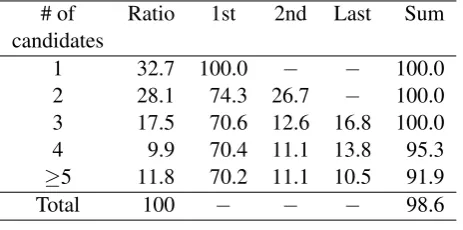
Table 2: Percentages of the position of the correct modified PU among the candidate PUs selected by the initial grammar rules. The column ‘Sum’ shows the coverage of the 1st, 2nd and last (the far-thest) PUs in the distance from the modifier PUs. The EDR Japanese corpus was used in this analy-sis.
detailed condition with specific functional words and exceptional content words are covered in the
rules. Even with these simplified rules, 98.5%of
the modifications between PUs are covered. The role of the grammar rules is to maximize the coverage, and the rules are simply describing high-level syntactic dependencies so that the rules can be created easily without worrying about pre-cision or contradictory rules. The statistical infor-mation is later used to select the rules necessary for a given sentence to produce an accurate pars-ing result.
Furthermore, an analysis of the EDR corpus
shows that 98.6%of the correct dependencies are
either the nearest PU, the second nearest PU, or the farthest PU from the modifier (more details in
Table 2) among the modifiable PUs enumerated
by the grammar rules. Therefore, the model can be simplified by restricting the candidates to these
two or three candidates and by ignoring the other
PUs with a small sacrifice (1.4%) of parsing
ac-curacy. Retaining the farthest modifiable PU from the modifier, the long distance dependencies are captured.
2.3 Calculation of modification probabilities
Letube a modifier PU in question,cuntheu’sn
-th modification candidate PU,ΦuandΨcunthe
re-spective attributes ofuandcun. Then the
probabil-ity ofumodifying itsn-th candidate is calculated
by the triplet equation (1) whenuhas two
candi-dates or the quadruplet equation (2) when u has
three candidates.3These two equations are known
as the Triplet and Quadruplet Model.
P(u←cun) =P(n|Φu,Ψcu1,Ψcu2) (1)
P(u←cun) =P(n|Φu,Ψcu1,Ψcu2,Ψcu3)(2)
Assuming the independence of those modifica-tions, the probability of the dependency tree for
an entire sentenceP(T)is calculated as the
prod-uct of the probabilities of all of the dependencies in the sentence using beam search from the
right-most PU to the left, to maximizeP(T)under the
constraints of the projected structure.
P(T)≃∏
u
P(u←cun) (3)
Equations (1) and (2) have two major
advan-tages. First, all the attributes of the modifier and its candidates can be handled simultaneously – the model expresses the context through the combi-nation of those attributes. Second, the probabil-ity of each modification is calculated based on the
3It is trivial to show thatP(u←cu
社長 を 、
Shacho wo , ‘president’-ACC
Modifier
買収し た
baishu-shi ta ‘acquired’-ADN
Candidate 1
紹介 、
shokai , ‘introduced’-ADV
Candidate 2
開始し た 。
kaishi-shi ta ‘launch’-PAST
Candidate 3
6 6 6
●●●● ‘president’
●●● noun
●●●●
wo
●●● part+comma
●● (0,1,1)
●●●● ‘acquire’
●●● verb
●●●●
ta
●●● aux
●● (0,1,3)
●●●● ‘introduce’
●●● verb+‘,‘
●●●● ‘introduce’
●●● verb+‘,‘
●● (0,2,7)
●●●● ‘launch’
●●● verb
●●●● ‘.’
●●● period
hidden layer●●●●●●●●●●●●●●●●●●●●●●6 ●●●6
softmax
[image:4.595.78.542.63.205.2]●
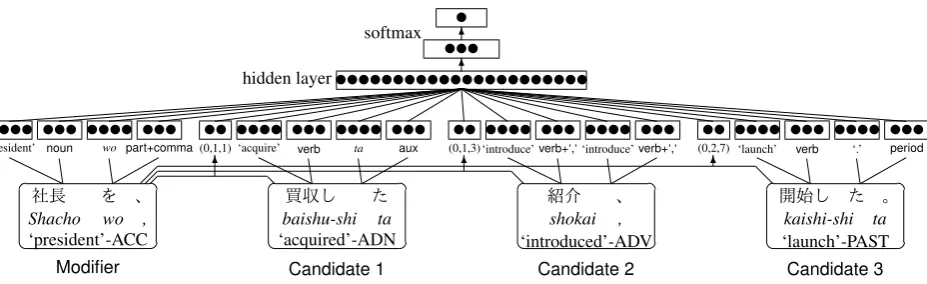
Figure 3: The neural net for the quadruplet model to select the head of the PU “社長を”
(‘president’-ACC) from three modification candidates in an example sentence “… 以前の社長を、0買収した1企業
に紹介、2… 事業を開始した。3” (‘... introduced2the previous president0to the acquired1company, and
launched3 a ... business’). The attributes of the modifier PU and three modification candidates, and the
features between the modifier and each candidate are input as distributed vectors.
relative positions of the candidates, instead of the distance from the modifier PU in the surface sen-tence, making the model more robust.
3 NN parsing model
In the past implementation of the parser by
the Triplet/Quadruplet model (Kanayama et al.,
2000), the equations (1) and (2) were
calcu-lated with logistic regression (maximum entropy method) in which many binary features represent the attributes of each PU. We designed the NN model using distributed representation of words
and parts-of-speech as Chen and Manning (2014)
did.
Figure 3 shows the neural net model that
di-rectly selects the head PU and an example
sen-tence. Here, the head of “社長を”
(‘president-ACC’) is predicted among three modification can-didates selected by the method described in
Sec-tion 2.2. The second candidate PU “紹介、”
(‘introduced-ADV’) is the correct head.
To make the prediction, the attributes for each PU are extracted, and we focus on two words in a PU: the head word – the rightmost content word in the PU – and the form word – the rightmost func-tional word in the PU except for a punctuation. First, the surface form and the PoS of the head word and the form word are converted into vector representations. That is, two vectors are used for 6 PUs in the triplet model and 8 PUs are used in the quadruplet model. Furthermore, the following attributes between two PUs are added.
• the number of a postpositional “はha”4
be-tween two PUs (0, 1, 2, 3, 4, or 5+)
• the number of commas between two PUs (0,
1, 2, 3, 4, or 5+)
• the distance between two PUs (1, 2, 3, ..., 9,
or 10+)
These features expressed as vectors are concate-nated to form a single layer, and the final output is given as the softmax of two or three values (1, 2, or 3).
The above calculation computes the probabili-ties of the modification to candidate PUs, but it does so independently for each modifier PU; there-fore, there may be crossing of modification in a whole sentence. Since the Japanese dependency structures are fully projective, the optimal tree for the sentence is constructed using a beam search to
maximize the Equation (3) in Section2.3,
exclud-ing modification pairs that violate the projective constraint in each step of the beam search. More specifically, combinations of dependencies which
violate projective constraints (e.g.5←7 and 6←
8) are excluded from the beam, then the projective tree structure is guaranteed.
4 Experiments
4.1 Experimental settings
We used EDR Japanese Corpus (EDR, 1996) for
the initial training and evaluation. After
remov-4Typical used as a topic marker, which suggests a
Training method Training size Accuracy
nearest baseline none 62.03% (13581/21894)
logistic regression 190k 88.92% (19468/21894)
NN 40k 88.15% (19300/21894)
NN 80k 88.49% (19373/21894)
NN 120k 89.17% (19522/21894)
[image:5.595.159.438.61.162.2]NN 160k 89.31% (19554/21894)
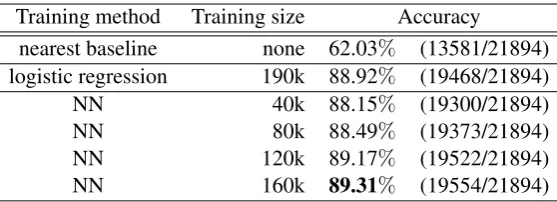
Table 3: The accuracy of PU dependencies tested on EDR corpus. The ‘nearest baseline’ denotes the ratio of the case where the head is the right next PU.
ing inconsistent PUs due to tokenization mis-match between the corpus and the runtime pro-cess, the evaluation was conducted on 2,941 test sentences. 160,080 sentences were used for train-ing and 8,829 sentences were kept for validation.
The models were implemented with
Tensor-Flow (Abadi et al., 2015). The loss function
was calculated by cross entropy. The L2
nor-malization factor multiplied by 10−8 was added,
and output was optimized with AdamOptimizer (Kingma and Ba,2014).
Words are expressed by two vectors. One was 100 dimensional embeddings of the surface form – the other was 50 dimensional embeddings of 148 types of values of the combination of 74 types of fine-grained PoS and a binary feature to find the existence of a comma in the PU. The three features between PUs were converted into 10 dimensional vectors. All of these vectors were randomly ini-tialized and updated during the training. The input layer formed 990 in the triplet model and 1,320 di-mensions in the quadruplet model. The dimension of the hidden layer was set to 200 and conducted a beam search with the size 5.
4.2 Experimental results
Table3shows the accuracies of dependency
pars-ing by the conventional model trained with logis-tic regression and our proposed neural net model. Both models used the very similar grammar rules
and the features are used. While the logistic
regression method required manual selection of combination of features to get optimal accuracy, the neural net model outperformed the others when the training corpus was more than 120k sen-tences, by 0.4 points when the training corpus was
160k sentences. The maximum number of the
training data in neural net model (160k) is less than that used in the logistic regression method (190k) because the development set needed to be
Content words Commas Accuracy
Yes Yes 89.31%
No Yes 88.95%
Yes No 87.40%
[image:5.595.324.511.219.290.2]No No 87.24%
Table 4: Ablation studies to remove content word vocabularies and commas.
kept for the neural model, and some sentences
were dropped as described in Section4.1.
Only words in the modifier PU and the candi-date PUs were used in these methods, and other surrounding context and other dependencies were not considered. By capturing appropriate contexts of candidate PUs selected by the grammar rules and heuristics, our method successfully predicted the dependencies with relatively small pieces of information compared to the initial
transition-based neural parser (Chen and Manning, 2014)
that used a maximum of 18 words in the buffer, stack and modifiers.
There was a huge difference in the training speed. The logistic regression method took 4 to 20 hours on a CPU, but the neural net model con-verged in 5 to 15 seconds on a GPU.
We conducted an ablation study to see the
con-tribution of attributes. We focused on the
vo-cabulary of content words that can be better cap-tured using distributed representation rather than the conventional method, and commas that played an important role in suggesting long-distance
at-tachments. According to the results in Table 4,
word-based (UD)
彼
‘he’
?
が
-NOM
?
3 ‘3’
?
km ‘km’
?
走っ
‘run’
た
-PAST
?
。
.
?
彼
‘he’
が
-NOM 3 ‘3’
km ‘km’
走っ
‘run’
た
-PAST
。
.
6 6
[image:6.595.70.291.59.173.2]PU-based
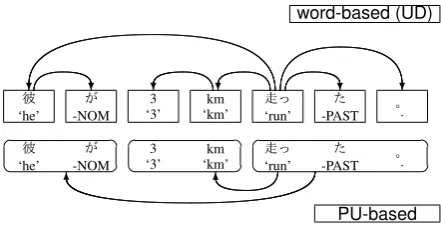
Figure 4: Conversion between PU-based and
word-based dependencies.
accuracy by nearly 2 points, which suggests that commas are important in parsing.
The example dependency in Figure 3
(‘presi-dent’←‘introduced’) was correctly solved by our
neural model. Though many PUs followed the modifier PU in question, the model selected the head word from only three candidates restricted by the grammar rules, and the known dependency re-lationship between two PUs is guaranteed to be as-sociated with the parsing result. The conventional model without neural net wrongly selected the first candidate (‘acquired’) as the head. The ablation of the content words also made the prediction wrong, that clarified that it was because the conventional model did not capture the content words and the attributes in the distance were stronger. On the other hand, the neural model with the content word embeddings appropriately captured the relation-ship between the functional word in the modifier PU (accusative case) and the content word of the correct candidate PU (‘introduced’).
4.3 Comparison on Japanese UD
To compare the performance of our parser with
the results in the 2017 Shared Task (Zeman et al.,
2017), we apply the trained model to UD
Japanese-GSD5 test data. As shown in Figure4,
the word-based dependency in UD Japanese and PU-based dependencies are interchangeable with a strict rule to detect PU boundaries and the head word in a PU. In UD Japanese-GSD data, the at-tachment direction between head words in PUs is always the same after converting to the PU-based structure. Also the non-head words in a PU always depends on the head word of the PU.
The first section of Table5shows comparisons
with the shared task results. Here we evaluate
5It was formerly known as UD Japanese until 2017.
them by UAS (unlabeled attachment score) rather than by LAS (labeled attachment score) because most of the Japanese labels can be deterministi-cally assigned with the combination of the head and the dependent, and assignment with the rules can reproduce the labels in UD Japanese-GSD corpus, thus it is not fair to compare LAS with other machine learning methods. The scores are associated with tokenization accuracies because they highly affect Japanese parsing accuracies in the shared task to handle raw text inputs. Our model performed better than any other results in the shared task, though the comparison is not com-pletely fair since we rely on the segmentation and functional word attachment based on the consis-tent rules with the UD data creation.
In the 2017 Shared Task, the raw text was used as the input, thus the performance of sentence splitting and tokenization highly affected the
pars-ing result.6 To make more direct comparisons in
parsing, our results were mapped with the
base-line tokenzation by UDPipe (Straka et al., 2016)
which many task participants have used. That is, the parsing score was intentionally downgraded, but it outperformed any other results which used UDPipe tokenization as it was, as shown in the
second section of Table5.
Also we compared our parser when the gold tokens are given, with UDPipe UDv2.0 model (Straka and Strakov´a, 2017), and RBG Parser (Lei et al., 2014) which was trained with UD
Japanese-GSD training set. Our model had 9%
and 20%less errors than UDPipe and RBG Parser,
respectively.
5 Application to other languages
Our approach relies on the head-final feature of the languages. In addition to Japanese, Korean and Tamil are categorized as rigid head-final
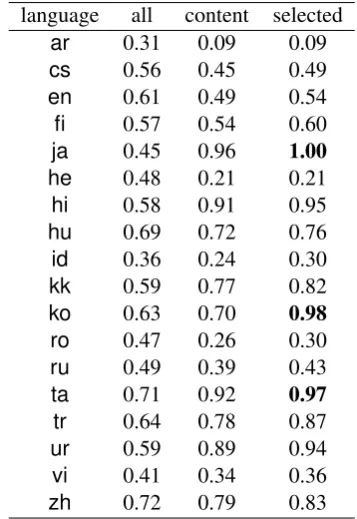
lan-guages (Polinsky, 2012). Table 6 shows the
ra-tio of head-final dependencies by languages in the Universal Dependencies version 2.0 development data. Though the word-level dependencies in UD
do not reflect the head finalness as only 45% of
Japanese dependencies have the head in the right side, but when it comes to content words (the list of functional PoSs are shown in the caption of
Ta-ble6) without functional labels and exceptional
la-bels such as conjunction (see the caption again),
6The mismatched tokens are always regarded as parsing
Models Tokens UAS
Our model 98.61 94.03
Own tokenizers TRL (Kanayama et al.,2017) 98.59 91.14
HIT-SCIR (Che et al.,2017) 92.95 81.94
Our model - UDPipe aligned 89.41 75.88
UDPipe default tokenization C2L2 (Shi et al.,2017) 89.68 75.46
Stanford (Dozat et al.,2017) 89.68 75.42
Our model - with gold tokenization 100.0 95.97
Gold tokenization UDPipe UDv2.0 model (Straka and Strakov´a,2017) 100.0 95.48
[image:7.595.73.533.63.202.2]RBG Parser (Lei et al.,2014) 100.0 94.94
Table 5: F1 scores of tokenization and UAS on the UD Japanese-GSD test set. The top section shows the systems which used their own tokenizers. The second section is a comparison with the systems relying on the default settings of UDPipe, and the bottom section is the situation to ru parsers using the gold PoS as input.
language all content selected
ar 0.31 0.09 0.09
cs 0.56 0.45 0.49
en 0.61 0.49 0.54
fi 0.57 0.54 0.60
ja 0.45 0.96 1.00
he 0.48 0.21 0.21
hi 0.58 0.91 0.95
hu 0.69 0.72 0.76
id 0.36 0.24 0.30
kk 0.59 0.77 0.82
ko 0.63 0.70 0.98
ro 0.47 0.26 0.30
ru 0.49 0.39 0.43
ta 0.71 0.92 0.97
tr 0.64 0.78 0.87
ur 0.59 0.89 0.94
vi 0.41 0.34 0.36
zh 0.72 0.79 0.83
Table 6: The ratio of head-final dependencies by languages. “All” denotes the ratio of all nodes ex-cept for the root. “Content” is the head-final
ra-tio for content words, i.e.functional PoSs (ADP,
AUX,CCONJ,DET,SCONJ,SYM,PART, and
PUNCT) are excluded. “selected” means the
more selective ones, excluding the labels conj,
fixed,flat,auxandmark.
Japanese has the complete head-final structures, and Korean and Tamil have high ratios supporting the linguistic theory.
However, the UD Korean corpus has so many coordination structures under the UD’s general constraint that the left coordinate should be the head, because many subordinating structures are represented as coordination while corresponding Japanese ones are not, that it is difficult to con-vert the corpus to the strictly head-final structure. That is the reason why we could not evaluate our method on Korean, but the Triplet/Quadruplet Model has been applied to Korean with sim-ilar grammatical rules and it has been shown that the transfer learning from Japanese worked (Kanayama et al.,2014), thus our neural classifier approach to Korean parsing is expected to work well.
Also UD Tamil data has exceptional cases in proper nouns and other phenomena, and the rela-tively small corpus made the further investigation difficult. We are leaving it to future work.
6 Related work
The parsing approach to select heads of
depen-dents has been proposed by Zhang et al. (2017).
They applied bidirectional RNN to select the prob-ability that each word chooses another word or the ROOT node as its head. They reported compa-rable results for four languages. Their method re-quired a maximum spanning tree algorithm to gen-erate valid trees. On the other hand, our approach straightforwardly outputs the projective tree by ex-ploiting the head-final feature in Japanese.
[image:7.595.90.269.335.595.2]motivation with ours. They tackled multilingual parsing by using a small set of attachment rules determined with Universal POS, and achieved 55
UAS value with predicted PoS as input. Our
method applied a neural model on top of the gram-matical restriction to achieve higher accuracy for a specific language.
Garc´ıa et al. (2017) tackled the multilingual
shared task with the rule-based approach. The
rules are simplified with the almost delexicalized PoS-level constraints and created with a small ef-fort by an expert. Though the performance was limited compared to other supervised approaches, it is meaningful for the comparison of linguistic features, and the combination with machine learn-ing methods can be useful as we are aimlearn-ing at.
7 Conclusion
In this paper we implemented a neural net pars-ing model as the direct classifier to predict the attachment of phrasal units in a intuitive manner by exploiting grammatical knowledge and heuris-tics, and confirmed that the neural net model outperformed the conventional machine learning method, and our method worked better than the
shared task results. Unlike the most of neural
parsing methods in which interpretation of the model output and control of the model without data supervision are difficult, our method is simple enough to understand the behavior of the model, and the grammatical knowledge can be reflected in the restriction of modification candidates. More-over, the neural net with distributed vector repre-sentations enabled us to handle more vocabularies than the logistic regression with distinct word fea-tures in which only the limited number of content words and their combination with other features could be distinguished in the parsing model.
Our experiments showed that a limited number of words are seen as able to predict attachments. For further improvement, we can integrate the LSTM model, which handles more contextual
in-formation with simplification (Cross and Huang,
2016). We did not handle coordination
relation-ships explicitly in this work, but we will intend to address coordination with more lexical knowledge and a broader context.
References
Mart´ın Abadi, Ashish Agarwal, Paul Barham, Eugene Brevdo, Zhifeng Chen, Craig Citro, Greg S.
Cor-rado, Andy Davis, Jeffrey Dean, Matthieu Devin, Sanjay Ghemawat, Ian Goodfellow, Andrew Harp, Geoffrey Irving, Michael Isard, Yangqing Jia, Rafal Jozefowicz, Lukasz Kaiser, Manjunath Kudlur, Josh Levenberg, Dan Man´e, Rajat Monga, Sherry Moore, Derek Murray, Chris Olah, Mike Schuster, Jonathon Shlens, Benoit Steiner, Ilya Sutskever, Kunal Tal-war, Paul Tucker, Vincent Vanhoucke, Vijay Vasude-van, Fernanda Vi´egas, Oriol Vinyals, Pete Warden, Martin Wattenberg, Martin Wicke, Yuan Yu, and Xi-aoqiang Zheng. 2015. TensorFlow: Large-scale ma-chine learning on heterogeneous systems. Software available from tensorflow.org.
Masayuki Asahara, Hiroshi Kanayama, Takaaki Tanaka, Yusuke Miyao, Sumire Uematsu, Shinsuke Mori, Yuji Matsumoto, Mai Omura, and Yugo Mu-rawaki. 2018. Universal Dependencies version 2 for Japanese. InProceedings of LREC 2018.
Wanxiang Che, Jiang Guo, Yuxuan Wang, Bo Zheng, Huaipeng Zhao, Yang Liu, Dechuan Teng, and Ting Liu. 2017. The hit-scir system for end-to-end pars-ing of universal dependencies. Proceedings of the CoNLL 2017 Shared Task: Multilingual Parsing from Raw Text to Universal Dependenciespages 52– 62.
Danqi Chen and Christopher Manning. 2014. A fast and accurate dependency parser using neural net-works. In Proceedings of the 2014 conference on empirical methods in natural language processing (EMNLP). pages 740–750.
James Cross and Liang Huang. 2016. Incremental parsing with minimal features using bi-directional lstm. In The 54th Annual Meeting of the Associa-tion for ComputaAssocia-tional Linguistics. page 32.
Timothy Dozat, Peng Qi, and Christopher D Manning. 2017. Stanford’s graph-based neural dependency parser at the conll 2017 shared task. Proceedings of the CoNLL 2017 Shared Task: Multilingual Pars-ing from Raw Text to Universal Dependenciespages 20–30.
EDR. 1996. EDR (Japan Electronic Dictionary Re-search Institute, Ltd.) electronic dictionary version 1.5 technical guide.
Marcos Garc´ıa and Pablo Gamallo. 2017. A rule-based system for cross-lingual parsing of romance languages with universal dependencies. InCoNLL Shared Task.
Hiroshi Kanayama, Masayasu Muraoka, and Kat-sumasa Yoshikawa. 2017. A semi-universal pipelined approach to the conll 2017 ud shared task. Proceedings of the CoNLL 2017 Shared Task: Mul-tilingual Parsing from Raw Text to Universal Depen-denciespages 265–273.
Hiroshi Kanayama, Youngja Park, Yuta Tsuboi, and Dongmook Yi. 2014. Learning from a neigh-bor: Adapting a japanese parser for korean through feature transfer learning. In Proceedings of the EMNLP’2014 Workshop on Language Technology for Closely Related Languages and Language Vari-ants. pages 2–12.
Hiroshi Kanayama, Kentaro Torisawa, Yutaka Mitsu-ishi, and Jun’ichi Tsujii. 2000. A hybrid Japanese parser with hand-crafted grammar and statistics. In Proceedings of the 18th International Conference on Computational Linguistics. pages 411–417.
Daisuke Kawahara, Sadao Kurohashi, and Kˆoiti Hasida. 2002. Construction of a japanese relevance-tagged corpus. InLREC.
Diederik Kingma and Jimmy Ba. 2014. Adam: A method for stochastic optimization. arXiv preprint arXiv:1412.6980.
Tao Lei, Yuan Zhang, Regina Barzilay, and Tommi Jaakkola. 2014. Low-rank tensors for scoring de-pendency structures. Association for Computational Linguistics.
H´ector Mart´ınez Alonso, ˇZeljko Agi´c, Barbara Plank, and Anders Søgaard. 2017. Parsing universal depen-dencies without training. InProceedings of the 15th Conference of the European Chapter of the Associa-tion for ComputaAssocia-tional Linguistics. Valencia, Spain, pages 230–240.
Ryan McDonald, Fernando Pereira, Kiril Ribarov, and Jan Hajiˇc. 2005. Non-projective dependency pars-ing uspars-ing spannpars-ing tree algorithms. InProceedings of the conference on Human Language Technology and Empirical Methods in Natural Language Pro-cessing. Association for Computational Linguistics, pages 523–530.
Tetsuya Nasukawa and Tohru Nagano. 2001. Text anal-ysis and knowledge mining system. IBM systems journal40(4):967–984.
Joakim Nivre, Cristina Bosco, Jinho Choi, Marie-Catherine de Marneffe, Timothy Dozat, Richard Farkas, Jennifer Foster, Filip Ginter, Yoav Gold-berg, Jan Haji, Jenna Kanerva, Veronika Laippala, Alessandro Lenci, Teresa Lynn, Christopher Man-ning, Ryan McDonald, Anna Missila, Simonetta Montemagni, Slav Petrov, Sampo Pyysalo, Natalia Silveira, Maria Simi, Aaron Smith, Reut Tsarfaty, Veronika Vincze, and Daniel Zeman. 2015. Univer-sal dependencies 1.0.
Joakim Nivre, Johan Hall, Jens Nilsson, Atanas Chanev, G¨uls¸en Eryigit, Sandra K¨ubler, Svetoslav Marinov, and Erwin Marsi. 2007. Maltparser: A language-independent system for data-driven de-pendency parsing. Natural Language Engineering 13(2):95–135.
Joakim Nivre and Ryan McDonald. 2008. Integrat-ing graph-based and transition-based dependency parsers. Proceedings of ACL-08pages 950–958.
Maria Polinsky. 2012. Headness, again. UCLA Work-ing Papers in LWork-inguistics, Theories of EverythWork-ing 17:348–359.
Tianze Shi, Felix G Wu, Xilun Chen, and Yao Cheng. 2017. Combining global models for parsing univer-sal dependencies. Proceedings of the CoNLL 2017 Shared Task: Multilingual Parsing from Raw Text to Universal Dependenciespages 31–39.
Milan Straka, Jan Hajic, and Jana Strakov´a. 2016. Udpipe: Trainable pipeline for processing conll-u files performing tokenization, morphological analy-sis, pos tagging and parsing. InLREC.
Milan Straka and Jana Strakov´a. 2017. Tokenizing, pos tagging, lemmatizing and parsing ud 2.0 with udpipe. InProceedings of the CoNLL 2017 Shared Task: Multilingual Parsing from Raw Text to Univer-sal Dependencies. Association for Computational Linguistics, pages 88–99.
Takaaki Tanaka, Yusuke Miyao, Masayuki Asahara, Sumire Uematsu, Hiroshi Kanayama, Shinsuke Mori, and Yuji Matsumoto. 2016. Universal depen-dencies for japanese. InProceedings of LREC 2016.
Daniel Zeman, Martin Popel, Milan Straka, Jan Hajiˇc, Joakim Nivre, Filip Ginter, Juhani Luotolahti, Sampo Pyysalo, Slav Petrov, Martin Potthast, Fran-cis Tyers, Elena Badmaeva, Memduh G¨okırmak, Anna Nedoluzhko, Silvie Cinkov´a, Jan Hajiˇc jr., Jaroslava Hlav´aˇcov´a, V´aclava Kettnerov´a, Zdeˇnka Ureˇsov´a, Jenna Kanerva, Stina Ojala, Anna Mis-sil¨a, Christopher Manning, Sebastian Schuster, Siva Reddy, Dima Taji, Nizar Habash, Herman Leung, Marie-Catherine de Marneffe, Manuela Sanguinetti, Maria Simi, Hiroshi Kanayama, Valeria de Paiva, Kira Droganova, Hˇector Mart´ınez Alonso, Hans Uszkoreit, Vivien Macketanz, Aljoscha Burchardt, Kim Harris, Katrin Marheinecke, Georg Rehm, Tolga Kayadelen, Mohammed Attia, Ali Elkahky, Zhuoran Yu, Emily Pitler, Saran Lertpradit, Michael Mandl, Jesse Kirchner, Hector Fernandez Alcalde, Jana Strnadova, Esha Banerjee, Ruli Manurung, An-tonio Stella, Atsuko Shimada, Sookyoung Kwak, Gustavo Mendonc¸a, Tatiana Lando, Rattima Nitis-aroj, and Josie Li. 2017. CoNLL 2017 Shared Task: Multilingual Parsing from Raw Text to Universal Dependencies. InProceedings of the CoNLL 2017 Shared Task: Multilingual Parsing from Raw Text to Universal Dependencies. Association for Computa-tional Linguistics.