Proceedings of the 57th Annual Meeting of the Association for Computational Linguistics: Student Research Workshop, pages 10–16 10
Robust-to-Noise Models in Natural Language Processing Tasks
Valentin Malykh
Neural Systems and Deep Learning Laboratory, Moscow Institute of Physics and Technology, Samsung-PDMI Joint AI Center, Steklov Mathematical Institute at St. Petersburg
Abstract
There are a lot of noisy texts surrounding a person in modern life. A traditional approach is to use spelling correction, yet the existing solutions are far from perfect. We propose a robust to noise word embeddings model which outperforms existing commonly used models like fasttext and word2vec in different tasks. In addition, we investigate the noise robustness of current models in different natural language processing tasks. We propose extensions for modern models in three downstream tasks, i.e. text classification, named entity recognition and aspect extraction, these extensions show improvement in noise robustness over existing solutions.
1 Introduction
The rapid growth of the usage of mobile elec-tronic devices has increased the number of user input text issues such as typos. This happens be-cause typing on a small screen and in transport (or while walking) is difficult, and people acci-dentally hit wrong keys more often than when us-ing a standard keyboard. Spell-checkus-ing systems widely used in web services can handle this issue, but they can also make mistakes. These typos are considered to be noise in original text. Such noise is a widely known issue and to mitigate its pres-ence there were developed spelling correcting sys-tems, e.g. (Cucerzan and Brill,2004). Although spelling correction systems have been developed for decades up to this day, their quality is still far from perfect, e.g. for the Russian language it is 85% (Sorokin, 2017). So we propose a new way to handle noise i.e. to make models themselves robust to noise.
This work is considering the main area of noise robustness in natural language processing and, in particular, in four related subareas which are de-scribed in corresponding sections. All the
subar-eas share the same research questions applied to a particular downstream task:
RQ1. Are the existing state of the art models robust to noise?
RQ2. How to make these models more robust to noise?
In order to answer these RQs, we describe the commonly used approaches in a subarea of interest and specify their features which could improve or deteriorate the performance of these models. Then we define a methodology for testing existing mod-els and proposed extensions. The methodology in-cludes the experiment setup with quality measure and datasets on which the experiments should be run.
This work is organized as follows: in Section 2 the research on word embeddings is motivated and proposed, in further sections, i.e. 3, 4, 5, there are propositions to conduct research in the area of text classification, named entity recogni-tion and aspect extracrecogni-tion respectively. In Secrecogni-tion 6we present preliminary conclusions and propose further research directions in the mentioned areas and other NLP areas.
2 Word Embeddings
algorithms for word vector modelling robust to noise.
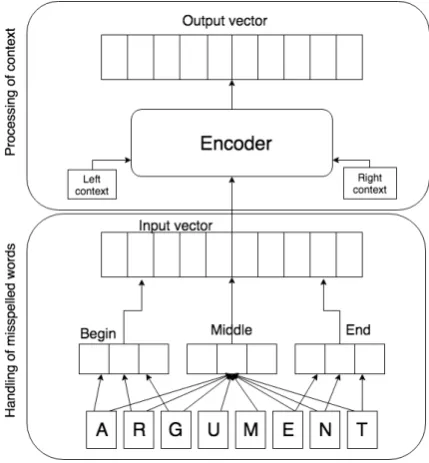
Figure 1: RoVe model architecture.
We suggest a new architecture RoVe (Robust Vectors).1 It is presented on Fig. 1. The main feature of this model is open vocabulary. It codes words as sequences of symbols. This en-ables the model to produce embeddings for out-of-vocabulary (OOV) words. The idea as such is not new, many other models use character-level embeddings (Ling et al., 2015) or encode the most common ngrams to assemble unknown words from them (Bojanowski et al.,2016). How-ever, unlike analogous models, RoVe is specifi-cally targeted at typos — it is invariant to swaps of symbols in a word. This property is ensured by the fact that each word is encoded as a bag of charac-ters. At the same time, word prefixes and suffixes are encoded separately, which enables RoVe to produce meaningful embeddings for unseen word forms in morphologically rich languages. Notably, this is done without explicit morphological analy-sis. This mechanism is depicted on Fig.2.
Another feature of RoVe is context dependency — in order to generate an embedding for a word one should encode its context (the top part of Fig. 1). The motivation for such architecture is the following. Our intuition is that when process-ing an OOV word our model should produce an embedding similar to that of some similar word
1An open-source implementation is available here:
https://gitlab.com/madrugado/robust-w2v
from the training data. This behaviour is suit-able for typos as well as unseen forms of known words. In the latter case we want a word to get an embedding similar to the embedding of its initial form. This process reminds lemmatisation (reduc-tion of a word to its initial form). Lemmatisa(reduc-tion is context-dependent since it often needs to resolve homonymy based on word’s context. By making RoVe model context-dependent we enable it to do such implicit lemmatisation.
At the same time, it has been shown that em-beddings which are generated considering word’s context in a particular sentence are more infor-mative and accurate, because a word’s immediate context informs a model of the word’s grammat-ical features (Peters et al., 2018). On the other hand, use of context-dependent representations al-lowed us to eliminate character-level embeddings. As a result, we do not need to train a model that converts a sequence of character-level embeddings to an embedding for a word, as it was done in (Ling et al.,2015).
2.1 Methodology
We suppose to compare RoVe with common word vector tools: word2vec (Mikolov et al.,2013) and fasttext (Bojanowski et al.,2016).
We score the performance of word vectors gen-erated with RoVe and baseline models on three tasks: paraphrase detection, sentiment analysis, identification of text entailment. We consider these tasks to be binary classification ones, so we use ROC AUC measure for model quality evalua-tion.
For all tasks we suppose to train simple baseline models. This is done deliberately to make sure that the performance is largely defined by the quality of vectors that we use. For all the tasks we will com-pare word vectors generated by different modifica-tions of RoVe with vectors produced by word2vec and fasttext models.
We presume to conduct the experiments on datasets for three languages: English (analytical language), Russian (synthetic fusional), and Turk-ish (synthetic agglutinative). Affixes have differ-ent structures and purposes in these types of lan-guages, and in our experiments we show that our character-based representation is effective for all of them.
Figure 2: Generation of input embedding for the wordprevious. Left: generation of character-level one-hot vectors, right: generation of BME representation.
English Russian
noise (%) 0 10 20 0 10 20
BASELINES
word2vec 0.649 0.611 0.554 0.649 0.576 0.524 fasttext 0.662 0.615 0.524 0.703 0.625 0.524
RoVe
[image:3.595.170.428.246.339.2]stackedLSTM 0.621 0.593 0.586 0.690 0.632 0.584 SRU 0.627 0.590 0.568 0.712 0.680 0.598 biSRU 0.656 0.621 0.598 0.721 0.699 0.621
Table 1: Results of the sentiment analysis task in terms of ROC AUC.
(Pronoza et al., 2016) for the Russian language paraphrase identification task, Microsoft Research Paraphrase Corpus (Dolan et al., 2004) for the English language paraphrase identification task, Turkish Paraphrase Corpus (Demir et al., 2012) for the Turkish language paraphrase identifica-tion task; Russian Twitter Sentiment Corpus (Rubtsova,2014) for the Russian language senti-ment analysis task, Stanford Sentisenti-ment Treebank (Socher et al.,2013) for the English language sen-timent analysis task; and Stanford Natural Lan-guage Inference (Bowman et al.,2015) for the En-glish language natural language inference task.
2.2 Results
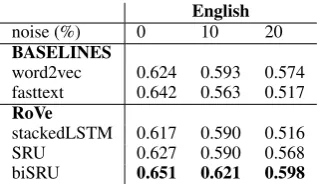
Due to lack of space we provide the results only for sentiment analysis task for the Russian and En-glish languages and for natural language inference task for the English language.
There are three variants of the proposed RoVe model listed in Tables1and2, these are ones us-ing different recurrent neural networks for context encoding. The whole results are published in (hid-den).
For both mentioned tables the robust word em-bedding model Rove shows better results for all noise level and both tasks, with the exception of zero noise for English language sentiment
analy-English
noise (%) 0 10 20
BASELINES
word2vec 0.624 0.593 0.574 fasttext 0.642 0.563 0.517
RoVe
stackedLSTM 0.617 0.590 0.516 SRU 0.627 0.590 0.568 biSRU 0.651 0.621 0.598
Table 2: Results of the task on identification of textual entailment.
sis task for which the fasttext word embeddings are showing better results. The latter could be ex-plained as fasttext has been explicitly trained for this zero noise level, which is unnatural for human generated text.
3 Text Classification
A lot of text classification applications like senti-ment analysis or intent recognition are performed on user-generated data, where no correct spelling or grammar may be guaranteed.
[image:3.595.337.497.378.470.2]and Ruder,2018), not all models behave well with real-world data like comments or tweets.
3.1 Methodology
We do experiments on two corpora: Airline Twit-ter Sentiment 2 and Movie Review (Maas et al., 2011), which are marked up for sentiment analy-sis task.
We conduct three types of experiments: (a) the train- and testsets are spell-checked and artificial noise in inserted; (b) the train- and testsets are not changed (with the above mentioned exception for Russian corpus) and no artificial noise is added; and (c) the trainset is spell-checked and noised, the testset is unchanged.
These experimental setups are meant to demon-strate the robustness of tested architectures to arti-ficial and natural noise.
As baselines we use architectures based on fast-text word embedding model (Bojanowski et al., 2016) and an architecture which follows (Kim et al., 2016). Another baseline, which is purely character-level, will be adopted from the work (Kim,2014).
3.2 Results
Fig.3contains results for 4 models:
• FastText, which is recurrent neural network using fasttext word embeddings,
• CharCNN, which is a character-based convo-lutional neural network, based on work (Kim, 2014),
• CharCNN-WordRNN - a character-based convolutional neural network for word em-beddings with recurrent neural network for entire text processing; it follows (Kim et al., 2016),
• and RoVe, which is a recurrent neural net-work using robust to noise word embeddings.
One could see in the figure that the model which uses robust word embeddings is more robust to noise itself starting from 0.075 (7.5%) noise level.
4 Named Entity Recognition
The field of named entity recognition (NER) re-ceived a lot of attention in past years. This task
2Publicly available here: https://www.kaggle.
com/crowdflower/twitter-airline-sentimen
is an important part of dialog systems (B´echet, 2011). Nowadays dialog systems become more and more popular. Due to that the number of dia-log system users is increased and also many users communicate with such systems in inconvenient environments, like being in transport. This makes a user to be less concentrated during a conversa-tion and thus causes typos and grammatical errors. Considering this we need to pay more attention to NER models robustness to this type of noise.
4.1 Methodology
We conduct three types of experiments: (a) the trainset and testset are not changed and no artifi-cial noise is induced; (b) the artifiartifi-cial noise is in-serted into trainset and testset simultaneously; and (c) the trainset is being noised, the testset is un-changed.
These experimental setups are meant to demon-strate the robustness of tested architectures to arti-ficial and natural noise (i.e. typos).
The proposed corpora to use are: English and Russian news corpora, CoNLL’03 (Tjong Kim Sang and De Meulder, 2003) and Persons-1000 (Mozharova and Loukachevitch, 2016) re-spectively, and French social media corpus CAp’2017 (Lopez et al.,2017).
We investigate variations of the state of the art architecture for Russian (Anh et al.,2017) and En-glish (Lample et al., 2016) languages and apply the same architecture to the French language cor-pus.
5 Aspect Extraction
Aspect extraction task could provide information to make dialogue systems more engaging for user (Liu et al.,2010).
Therefore, we have decided to study the Attention-Based Aspect Extraction (ABAE) model (He et al., 2017) robustness using ar-tificially generated noise. We propose three extensions for an ABAE model, which are supposedly more noise robust. There are:
• CharEmb - a convolutional neural network over characters in addition to word as a whole embeddings; these two embeddings are con-catenated and used in ABAE model;
0.000 0.025 0.050 0.075 0.100 0.125 0.150 0.175 0.200 0.68
0.70 0.72 0.74 0.76 0.78 0.80
Noise level
F1
score
FastText RoVe
[image:5.595.119.480.60.271.2]CharCNN-WordRNN CharCNN
Figure 3: Airline Twitter Sentiment Dataset. Trained on spell-checked and noised data, tested on spell-checked and noised with the same noise level as the training set.
• RoVe - an ABAE model using robust word embeddings.
5.1 Methodology
As the noise model, we took simple character swapping with some probability, i.e. for any given string we go through it character by character and randomly decide if we need to replace this particu-lar letter of the input with some random character. As a quality measure we takeF1 (weighted by class representativity) score following (He et al., 2017). The authors of the original paper used data from the Citysearch corpus with user reviews on restaurants in New York city originally described in (Ganu et al.,2009). The reviews were labeled by human annotators with a set of categories, like “Food” or “Stuff”. The authors used only reviews with exactly one labeled category. So in the end a model predicts a label for a review in the unsuper-vised way. The label is considered to be the most probable aspect label.
5.2 Results
In Fig.4we show both the baseline ABAE model and its extended version proposed in this work. The original model has shown lower results for all lower noise levels, while all extensions show improvement over the original model. The RoVe extensions shows improvement for all noise levels over the original model and the other extensions. The full results for aspect extraction task are pub-lished in (Malykh and Khakhulin,2018).
Figure 4: F1 measure for ABAE model and proposed
extensions.
6 Preliminary Results and Future Research Directions
In this work the research in four related subareas is proposed, these are word embeddings, text clas-sification and named entity recognition and aspect extraction.
Preliminary experiments for the robust to noise word embeddings showed that explicit noise han-dling is better than implicit like in fasttext model. The preliminary results for the word embeddings had been published in (Malykh, 2017). The pos-sible further research in that direction could be an investigation of embeddings for infix morphology languages, like Arabic and Hebrew.
[image:5.595.312.521.329.470.2]preliminary results are published in (Malykh and Lyalin, 2018), and for aspect extraction task the results are published in (Malykh and Khakhulin, 2018). The further research could be done in three directions. Firstly, all of the tasks could be ap-plied to more languages. Secondly, for classifi-cation task corpora with more marked up classes could be used. This task is harder in general case, and there are some available corpora with dozens of classes. And last but not least, thirdly, the sug-gested methodology could be applied to the other subareas of natural language processing, like Au-tomatic Speech Recognition and Optical Character Recognition, and achieve results in noise robust-ness improvement there.
References
Thanh L Anh, Mikhail Y Arkhipov, and Mikhail S Burtsev. 2017. Application of a hybrid bi-lstm-crf model to the task of russian named entity recogni-tion. In Conference on Artificial Intelligence and Natural Language, pages 91–103. Springer.
Sanjeev Arora, Yuanzhi Li, Yingyu Liang, Tengyu Ma, and Andrej Risteski. 2016. Linear algebraic struc-ture of word senses, with applications to polysemy.
Fr´ed´eric B´echet. 2011. Named entity recognition. Spoken Language Understanding: systems for ex-tracting semantic information from speech, pages 257–290.
Piotr Bojanowski, Edouard Grave, Armand Joulin, and Tomas Mikolov. 2016. Enriching word vectors with subword information.
Samuel R. Bowman, Gabor Angeli, Christopher Potts, and Christoper Manning. 2015. A large annotated corpus for learning natural language inference.
Silviu Cucerzan and Eric Brill. 2004. Spelling correc-tion as an iterative process that exploits the collec-tive knowledge of web users. InProceedings of the 2004 Conference on Empirical Methods in Natural Language Processing.
Seniz Demir, Ilknur Durgar El-Kahlout, Erdem Unal, and Hamza Kaya. 2012. Turkish paraphrase cor-pus. In Proceedings of the Eight International Conference on Language Resources and Evaluation (LREC’12), Istanbul, Turkey. European Language Resources Association (ELRA).
Bill Dolan, Chris Quirk, and Chris Brockett. 2004. Un-supervised construction of large paraphrase corpora: Exploiting massively parallel news sources.
Gayatree Ganu, Noemie Elhadad, and Am´elie Marian. 2009. Beyond the stars: improving rating predic-tions using review text content. In WebDB, vol-ume 9, pages 1–6. Citeseer.
Ruidan He, Wee Sun Lee, Hwee Tou Ng, and Daniel Dahlmeier. 2017. An unsupervised neural attention model for aspect extraction. InProceedings of the 55th Annual Meeting of the Association for Compu-tational Linguistics (Volume 1: Long Papers), vol-ume 1, pages 388–397.
Jeremy Howard and Sebastian Ruder. 2018. Fine-tuned language models for text classification. arXiv preprint arXiv:1801.06146.
Yoon Kim. 2014. Convolutional neural networks for sentence classification. pages 1746–1751.
Yoon Kim, Yacine Jernite, David Sontag, and Alexan-der M Rush. 2016. Character-aware neural language models.
Guillaume Lample, Miguel Ballesteros, Sandeep Sub-ramanian, Kazuya Kawakami, and Chris Dyer. 2016. Neural architectures for named entity recognition. InProceedings of NAACL-HLT, pages 260–270.
Quanzhi Li, Sameena Shah, Xiaomo Liu, and Armineh Nourbakhsh. 2017. Data sets: Word embeddings learned from tweets and general data.
Wang Ling, Tiago Lu´ıs, Lu´ıs Marujo, Ram´on Fern´andez Astudillo, Silvio Amir, Chris Dyer, Alan W. Black, and Isabel Trancoso. 2015. Finding function in form: Compositional character models for open vocabulary word representation. CoRR, abs/1508.02096.
Jingjing Liu, Stephanie Seneff, and Victor Zue. 2010. Dialogue-oriented review summary generation for spoken dialogue recommendation systems. In Hu-man Language Technologies: The 2010 Annual Conference of the North American Chapter of the Association for Computational Linguistics, pages 64–72. Association for Computational Linguistics.
C´edric Lopez, Ioannis Partalas, Georgios Balikas, Na-dia Derbas, Am´elie Martin, Coralie Reutenauer, Fr´ed´erique Segond, and Massih-Reza Amini. 2017. Cap 2017 challenge: Twitter named entity recogni-tion. arXiv preprint arXiv:1707.07568.
Andrew L Maas, Raymond E Daly, Peter T Pham, Dan Huang, Andrew Y Ng, and Christopher Potts. 2011. Learning word vectors for sentiment analysis. In Proceedings of the 49th annual meeting of the as-sociation for computational linguistics: Human lan-guage technologies-volume 1, pages 142–150. Asso-ciation for Computational Linguistics.
V. Malykh. 2017. Generalizable architecture for robust word vectors tested by noisy paraphrases. In Supple-mentary Proceedings of the Sixth International Con-ference on Analysis of Images, Social Networks and Texts (AIST 2017), pages 111–121.
Valentin Malykh and Vladislav Lyalin. 2018. Named entity recognition in noisy domains. In The Pro-ceedings of the 2018 International Conference on Artificial Intelligence: Applications and Innova-tions.
Tomas Mikolov, Ilya Sutskever, Kai Chen, G.s Cor-rado, and Jeffrey Dean. 2013. Distributed represen-tations of words and phrases and their composition-ality. 26.
Valerie Mozharova and Natalia Loukachevitch. 2016. Two-stage approach in russian named entity recog-nition. In Intelligence, Social Media and Web (ISMW FRUCT), 2016 International FRUCT Con-ference on, pages 1–6. IEEE.
Matthew E. Peters, Mark Neumann, Mohit Iyyer, Matt Gardner, Christopher Clark, Kenton Lee, and Luke Zettlemoyer. 2018. Deep contextualized word rep-resentations.CoRR, abs/1802.05365.
Ekaterina Pronoza, Elena Yagunova, and Anton Pronoza. 2016. Construction of a russian para-phrase corpus: Unsupervised parapara-phrase extraction. 573:146–157.
Yuliya Rubtsova. 2014. Automatic term extraction for sentiment classification of dynamically updated text collections into three classes. InInternational Con-ference on Knowledge Engineering and the Seman-tic Web, pages 140–149. Springer.
R Socher, A Perelygin, J.Y. Wu, J Chuang, C.D. Man-ning, A.Y. Ng, and C Potts. 2013. Recursive deep models for semantic compositionality over a senti-ment treebank. 1631:1631–1642.
Alexey Sorokin. 2017. Spelling correction for mor-phologically rich language: a case study of russian. InProceedings of the 6th Workshop on Balto-Slavic Natural Language Processing, pages 45–53.