87
Sigmorphon 2019 Task 2 system description paper:
Morphological analysis in context for many languages,
with supervision from only a few
Jared Kelly*Brad Aiken**Alexis Palmer*
Suleyman Olcay Polat**Taraka Rama*Rodney Nielsen**
*Department of Linguistics, University of North Texas
{jared.kelly,alexis.palmer}@unt.edu, [email protected]
**Department of Computer Science and Engineering, University of North Texas
{bradfordaiken,suleymanolcaypolat}@my.unt.edu, [email protected]
Abstract
This paper presents the UNT HiLT+Ling sys-tem for the Sigmorphon 2019 shared Task 2: Morphological Analysis and Lemmatiza-tion in Context. Our core approach focuses on the morphological tagging task; part-of-speech tagging and lemmatization are treated as secondary tasks. Given the highly multi-lingual nature of the task, we propose an ap-proach which makes minimal use of the sup-plied training data, in order to be extensible to languages without labeled training data for the morphological analysis task. Specifically, we use a parallel Bible corpus to align contex-tual embeddings at the verse level. The aligned verses are used to build cross-language trans-lation matrices, which in turn are used to map between embedding spaces for the various lan-guages. Finally, we use sets of inflected forms, primarily from a high-resource language, to induce vector representations for individual UniMorph tags. Morphological tagging is per-formed by matching vector representations to embeddings for individual tokens. While our system results are dramatically below the aver-age system submitted for the shared task eval-uation campaign, our method is (we suspect) unique in its minimal reliance on labeled train-ing data.
1 Introduction
This paper describes the UNT HiLT+Ling sys-tem submission for the Sigmorphon shared task on morphological analysis and lemmatization in con-text (McCarthy et al., 2019). We focus primarily on the morphological tagging task, treating part-of-speech tagging and lemmatization as secondary tasks. We approach morphological analysis from the perspective of low-resource languages, aim-ing to develop an approach which exploits exist-ing language resources in order to make morpho-logical analysis in context feasible for languages
without annotated training data. We propose a model to perform morphosyntactic annotation for any language with a translation of the Bible. Ac-cording to Wycliffe1, there are currently 683 lan-guages in the world which contain a translation of the entire Bible, and an additional 1534 languages for which the entire New Testament, and some-times other sections, are available.
We train contextual word representations using ELMo (Peters et al., 2018) and align embedding spaces for language pairs using Bible verse num-bers as an alignment signal. We then compute vec-tor representations for UniMorph tags in English and project those representations into the target language. The projected morpheme tag embed-dings are used to identify morphological features and label tokens in context with UniMorph tags.
We give a system overview in Section 2, with more detailed model descriptions in Section 5. The system’s performance is currently poor; we outline known limitations and make some sugges-tions for improvement.
2 System Overview
The system we developed for Sigmorphon 2019 Task 2 can be divided into two parts: the core model and two additional non-core components. The core model is responsible for the morpholog-ical tagging task, our main focus. The two non-core components are part-of-speech tagging and lemmatization.
Core model: Minimally-supervised morpho-logical analysis in context. Following task specifications, we aim to predict UniMorph tags for words in context. Our approach is designed to work on new languages with minimal super-vision. Specifically, the base model uses the fol-lowing forms of supervision: a) multilingual bible
data, verse-aligned; and b) roughly twenty words per from the training data per UniMorph tag. Once this model has been developed, it can be applied for a new language with no annotated training data for the task; the only data needed is a Bible in that language.
The steps in the process (explained in detail in Section5.1) are as follows:
1. Learn sentence-level ELMO embeddings (Peters et al.,2018) for each language. 2. Use verse-aligned data to learn a vector
translation matrix (followingMikolov et al., 2013a) between each language and English. 3. Compute a vector representation for each
UniMorph tag.
4. For UniMorph tags found in English, map tag vectors into the other languages which use the tag, by way of the relevant translation matrix. For tags not found in English, com-pute vector representations for each tag in the language-specific space.
5. Identify all UniMorph tags represented in the embedding for a given word, treating mor-phological analysis in the style of analogy tasks (Mikolov et al.,2013b).
POS tagging and lemmatization. POS tagging and lemmatization are treated as non-core compo-nents of the model. In other words, we incorpo-rate these tasks into our model in order to meet the requirements of the competition. For these two tasks, greater supervision is allowed, and mod-els are learned from the training data provided. The POS tagger in our system is a straightforward HMM model, and lemmatization is done with a seq2seq neural architecture. See Section 5.2 for more detailed descriptions of the models.
3 Related Work
The core idea of using the Bible as parallel data in low-resource settings is largely inspired by pre-vious work. The Bible has been used as a means of alignment for cross-lingual projection, both for POS tagging (Agic et al., 2015) and for depen-dency parsing (Agic et al., 2016), as well as for base noun-phrase bracketing, named-entity tag-ging, and morphological analysis (Yarowsky et al., 2001) with promising results.
Peters et al. (2018) introduce ELMo embed-dings, contextual word embeddings which incor-porate character-level information using a CNN.
Both of these properties - sensitivity to context and the ability to capture subword information -make contextual embeddings suitable for the task at hand.
In order to make embeddings useful across lan-guages, we need a method for aligning embedding spaces across languages. Ruder et al.(2017) pro-vide an excellent survey of methods for aligning embedding spaces. Mikolov et al. (2013a) intro-duce a translation matrix for aligning embeddings spaces in different languages and show how this is useful for machine translation purposes. We adopt this approach to do alignment at the verse level. Alignment with contextual embeddings is more complicated, since the embeddings are dy-namic by their very nature (different across differ-ent contexts). In order to align these dynamic em-beddings,Schuster et al.(2019) introduce a num-ber of methods, however they all require either a supervised dictionary for each language, or access to the MUSE framework for alignment, neither of which we assume in our work.
The UniMorph 2.0 data-set (Kirov et al.,2018) provides resources for morphosyntactic analysis across 111 different languages. The work de-scribed here uses the tag set from UniMorph.
4 Data
This section describes the data resources used for training and evaluating the system.
4.1 Bible data
The main data used for building our core model is a multilingual Bible corpus. For as many of the shared task languages as possible (41), we use the corpus from Christodouloupoulos and Steed-man(2015). Bibles for an additional 19 languages were sourced elsewhere. Of the remaining 11 lan-guages, we use proxy languages (Section4.2) for 9. For two languages (Akkadian and Sanskrit), we were unable to locate a suitable Bible in time. Where there are multiple data sets for a given lan-guage, we use the same Bible for all data sets.
For some languages we have access to the en-tire Bible, and for others only the New Testament (NT). This introduces discrepancies in the amount of data used to train embeddings from language to language, as the Old Testament is much longer than the New Testament.
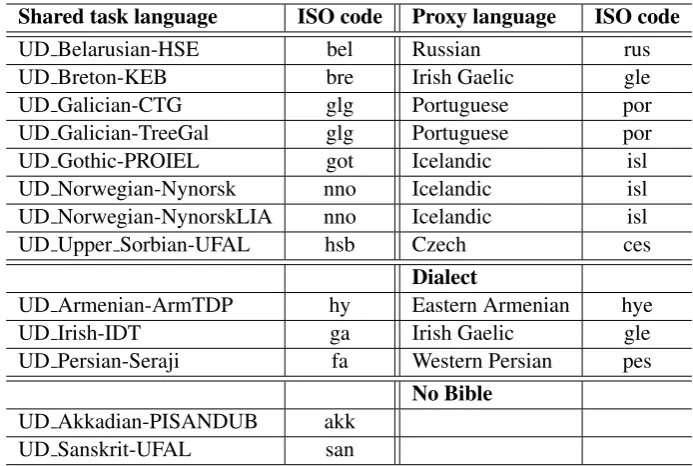
Shared task language ISO code Proxy language ISO code
UD Belarusian-HSE bel Russian rus
UD Breton-KEB bre Irish Gaelic gle
UD Galician-CTG glg Portuguese por
UD Galician-TreeGal glg Portuguese por
UD Gothic-PROIEL got Icelandic isl
UD Norwegian-Nynorsk nno Icelandic isl
UD Norwegian-NynorskLIA nno Icelandic isl
UD Upper Sorbian-UFAL hsb Czech ces
Dialect
UD Armenian-ArmTDP hy Eastern Armenian hye
UD Irish-IDT ga Irish Gaelic gle
UD Persian-Seraji fa Western Persian pes
No Bible
UD Akkadian-PISANDUB akk
[image:3.595.124.471.61.294.2]UD Sanskrit-UFAL san
Table 1: Shared task languages for which a proxy language or close dialect was used, and languages for which no Bible was used.
over one thousand languages, including many low-resource languages. One advantage of using the Bible, beyond its wide availability in translation for free, is that its verses are fairly well-aligned in meaning across languages (unlike words or even sentences). One drawback to using Bible data is the archaic nature of the language. For example, even if we use a modern translation, the English Bible contains fewer than 15,000 different word types, and no occurrences of modern words (e.g. Republican,computer, orNASA).
The limited domain of the text offers both ad-vantages and disadad-vantages. On the one hand, much of the vocabulary found in the shared task evaluation data does not occur in the Bible. Us-ing embeddUs-ings trained on the Bible, then, results in an extremely large number of out-of-vocabulary tokens at test time. On the other, the semantic territory covered by the embedding spaces varies remarkably little from language to language, in-creasing the feasibility of aligning embedding spaces across multiple languages.
4.2 Proxy languages
In order to do morphological analysis for a given language, our method requires access to a digitally-available version of at least portions of the Bible for that language. At the time the model was developed, we did not have access to Bibles for all shared task languages. For each missing
language, we select a proxy language (Table 1). For example, we don’t have a Bible for Galician, so at every stage in the process where the Galician Bible would be used, we substitute the Portuguese Bible, treating Portuguese as pseudo-Galician. We identify two different cases of proxy language sub-stitution. In some cases, we are able to select a closely-related dialect for the target language. In others, the proxy language is selected based on a combination of morphological similarity (typolog-ically speaking) and language relatedness.2
4.3 Sigmorphon data
We use the provided training data (McCarthy et al.,2018) primarily to train a part-of-speech tag-ger and lemmatizer for each shared task data set, and the provided test data is used to evaluate the system. We use portions of the training data for three other purposes: a) to build contrasting sets of words for each UniMorph tag (Section 5.1.3); b) to build lists of UniMorph tags relevant for each language; and c) to create a simple baseline for the two languages for which we have no Bible, proxy language or otherwise.
2
In an early experiment, we investigated the effectiveness of similarity measures over language vectors (Malaviya et al.,
5 Models
The model description consists of two parts: the core model, for morphological analysis, and two non-core components, for part-of-speech tagging and lemmatization.
5.1 Core model: morphological analysis
Our core system addresses the task of morpho-logical analysis with minimal supervision from la-beled training data. The approach exploits parallel data in the form of a multilingual Bible corpus.
5.1.1 Contextual embeddings for every Bible
Prior research has shown embedded word vector representations are capable of capturing contex-tual nuances in meaning beyond one sense per word (Arora et al.,2018, for example). Because context variance is an important factor affecting morphological analysis, we use ELMo embed-dings (Peters et al.,2018) as our base representa-tion. As a first step, we train separate ELMo mod-els on each of the Bible translations in our cor-pus. For each language, we hold out four books (Mark, Ephesians, 2 Timothy, and Hebrews) for model evaluation and train on all remaining books. Models are trained at the sentence level, using de-fault parameter settings and following recommen-dations from the AllenNLPbilm-tfrepository.3
5.1.2 Verse alignment for embedding projection
The next step is to use the natural verse align-ment of the Bible to learn projections from one embedding space to another, treating English as the source language and learning projections into the embedding spaces for each of our non-English Bible languages in turn.
Mikolov et al.(2013a) show that type-level em-bedding spaces (e.g. word2vec) can be projected across languages by calculating a translation ma-trix from a set of type-level translation word pairs. The translation matrix is a vector of dimension-wise factors by which word representations from a source language can be multiplied to transform them into parallel word representations in the tar-get language embedding space.
Aligning contextual representations such as ELMo is more complicated, as there is no good way of aligning words between two language em-bedding spaces without a dictionary and without
3https://github.com/allenai/bilm-tf
losing the encoded information about contextual polysemy, for which ELMo is particularly useful.
Schuster et al. (2019) propose using context-free anchors to align contextually-dependent em-bedding spaces (such as ELMo). We propose in-stead to calculate translation matrices at the verse level, computing the representation for each verse as the unweighted average of its constituent con-textual word embeddings.
First, we compute ELMo embeddings for each token in a small subset of the Bible: Psalms (OT) and Romans (NT). For a given language pair, we compute a verse embedding for each verse that ap-pears in both Bibles (some verses are missing in some languages, and some languages have extra verses)4 and derive the translation matrix for that language pair using the standard method, as intro-duced byMikolov et al.(2013a).
Given pairs of verse vectors in a source and tar-get language{xi, zi}ni=1respectively, we calculate
the translation matrix (W) between the two lan-guages utilizing gradient descent, as follows:
min W
n
X
i=1
kW xi−zi k2
5.1.3 Inducing vectors for UniMorph tags In lieu of using supervised, annotated data for training the model with morphological informa-tion, we work from the hypotheses that each of the 42 UniMorph tags can be isolated in the embed-ding space and that we can derive a vector repre-sentation for each tag, applying a process similar to the well-known analogy tasks ofMikolov et al. (2013b). For this purpose, we build small hand-curated data sets (only in English), with contrast-ing sets of words for each tag. In other words, for each UniMorph tag found in English, we col-lect from the training data one set of words with the tag and a parallel set without it. The word sets do not necessarily contain minimal pairs, but rather groups of words that are matched for part-of-speech. For example, for the plural tag PL, we build a list of 10 plural tokens (e.g. [women,cats, dogs,deer, ...]) and another list of 10 singular to-kens (e.g. [man,car,dog,apple, ...]). The (vectors for) the set of words with the tag are subtracted
4
from (vectors for) the set of words without the tag. More precisely, we take the weighted average of both sets of words, in which those with the tag are weighted 1, and those without it are weighted -1.
Having derived a vector representation for each UniMorph tag, these vectors can now be projected from English into the target language using the re-spective translation matrix. Rather than projecting every tag into every language, we project only the tags that are seen in a given language’s training data.
Of course, only a subset of all UniMorph tags are found in English. For those which do not ap-pear in the English data (e.g. Ergative), an addi-tional method was developed using the Sigmor-phon training data in other languages. When tag-ging a language that has the tag ERGin the train-ing data, we build new word list pairs specific to that language and calculate the UniMorph tag rep-resentation as described above.
5.1.4 Morphological analysis
To assign UniMorph tags to words at test time, a sequence of tokens in context (one sentence at a time) is fed into ELMo using the target language ELMo model, generating contextual embeddings for each word in the sequence. Next, for each to-ken, we iteratively subtract each of the target lan-guage’s possible UniMorph vectors and search for another word in the target language whose embed-ding is within 0.1 cosine distance of the resulting vector. For example, when tagging the German wordKinder(children), subtracting the vector rep-resentation for the Plural tag should result in a vec-tor that is close to that forKind(child). This sub-traction process is applied to every word, for every UniMorph tag found in the language. Whenever a word is found within the threshold of the derived embedding, the tag that resulted in the successful transformation is assigned to that token. In the ex-ample above,Kindergets tagged with PL.
Intuitively, this method is plausible because words, their inflected forms, synonyms, and closely related terms tend to occur in tight clus-ters in embedding spaces. Therefore, subtracting the embedding for the PL tag from the embedding for the should not produce a close match in En-glish, since the plural tag is never associated with the. This would not be a grammatically meaning-ful transformation.
5.1.5 Baselines
We use two different baselines for the morpholog-ical analysis task.
No-embedding baseline. This method is used to tag the two languages for which we have no Bible, not even for a proxy language, and thus have no Bible-trained word embeddings for the language. Under this approach, each word is simply labeled with all tags it has been seen with in the training data.
Embedding baseline. This method makes use of the verse embeddings described above and was deployed to do tagging where time constraints pro-hibited implementation of the full model for a given language.
The contextualized word representations built to support the embedding projection process are collected into a set of dictionaries (one for each language) of seen tokens and their associated vec-tors. In this setting, instead of re-training the ELMo model on test data in context, we retrieve stored vectors for tokens to be tagged. This method has clear shortcomings, both with respect to coverage of the model and regarding the han-dling of polysemous tokens.
5.2 Non-core components: POS tagging and lemma generation
For part-of-speech tagging, we implement a Hid-den Markov Model Viterbi algorithm trained on the Sigmorphon training and development datasets. Given our interest in methods which re-duce the need for large labeled corpora and super-vised learning, we additionally implemented some simple heuristics based on previously-generated morpheme tags.
For example, a word is given a higher proba-bility of being tagged as a verb if it has a modal, tense, or other conjugative tag already assigned to it (e.g., V.PTCP or PRS). These heuristics were designed to be entirely language-neutral, general-izing to the full set of test languages.
Lemma Accuracy Lemma Levenshtein Morph Accuracy Morph F1
Mean 83.143 0.5511 15.689 51.870
[image:6.595.96.501.63.106.2]Median 90.66 0.16 13.98 55.18
Table 2: Shared task results for our models, across all languages.
Morph Accuracy Morph F1
Full Bible (n=77) 16.08 52.64
NT only (n=17) 13.12 48.68
Bible from close dialect (n=3; 2 NT, 1 full) 20.55 57.06
Bible from proxy language, (n=8; all full Bible) 12.88 51.57
No Bible 26.6 42.23
Table 3: Morphological analysis results. Macro-average for subgroups of data sets, categorized according to resources available for embedding training, alignment, and projection.
recovered with the tagger. To counter exposure bias, all training is done with Jackknifing.
5.3 Limitations - there are many
The models as described above are subject to many limitations, and we have many ideas for im-proving the system.
First, the model is computationally intensive and time intensive, to an extent that meant we only applied the full model to a fraction of the data.
Because producing ELMo embeddings on-the-fly is so time consuming, we took some short-cuts in order to get results in time for submission. Word types already tagged were stored together with their tags after the first encounter, and the tags retrieved for later occurrences. Also, only a subset of the test sentences were in fact tagged with the ELMo approach at all. These two things together resulted in many false positives and redundant tags (e.g. the same noun tagged as both nominative and accusative). We feel confident that a full run of the system, however long it takes, will result in much better performance.
Second, our method for tagging words with UniMorph tags does nothing to constrain the set of possible tags, allowing multiple conflicting tags to be simultaneously assigned. Application of out-put constraints could go a long way toward solving this issue.
Third, we would like to rework our method for collecting pairs of word lists for derivation of vec-tor representations for UniMorph tags. A problem with the current method is that it assumes the exis-tence of inflected/non-inflected word pairs for all tags, and in all languages. In fact, many morpho-logical paradigms do not consist of contrasts
be-tween inflected and un-inflected forms (these are perhaps more common in English than in most languages), but rather of sets of inflectional op-tions, one of which is likely to occur. Our model does not currently account well for this aspect of morphology.
For example, when tagging the German article dem(definite, masculine, dative), subtracting the vector representation for the Dative tag under our current model results in an ill-defined form; there is no article that is definite and masculine and with undefined case. Instead, we would like for the pro-cess to yield a set of vectors, close to those for the articlesder(definite, masculine,nominative);den (definite, masculine, accusative); and des (defi-nite, masculine,genitive).
Fourth, the system is very bad at handling mor-phological analysis for out-of-vocabulary tokens, and there are many out-of-vocabulary tokens.
6 Results
future.
For lemmatization, we come closer to average performance, coming in at roughly 12 percent less accurate on average (across languages) than the top-performing submitted system.
Table3looks at results compared to the amount and type of Bible data used to train embeddings for each language. Performance suffers when train-ing on only the New Testament, compared to the full Bible. Surprisingly, proxy language training shows only a slightly lower average performance compared to training and testing on the same lan-guage. Of course, all results need to be inter-preted with respect to the limitations previously discussed.
7 Discussion
In addition to the model and implementation lim-itations discussed in Section5.3, there are a num-ber of extensions which could be considered for improving the model.
Our current model allows a mismatch between granularity for training of the embedding spaces (sentences) and granularity for alignment of the embedding spaces (verses). We’d like to experi-ment with verse-trained models as well.
We would also like to train on all of our Bible data, without holding out any data for evaluation of the embedding space (i.e. the four books men-tioned in Section4). For languages for which we don’t have a Bible, we will investigate new meth-ods for identifying transfer languages (Lin et al., 2019).
Even though our models as implemented prior to submission failed to attain reasonable accuracy on the morphological analysis task, we believe that performance can be improved and that the gen-eral architecture deserves further exploration. Ide-ally, our model could extend to any of the 800 (or more) languages that has a translation of the entire bible, opening new frontiers for minimally-supervised morphological analysis.
Acknowledgments
Thanks to the reviewers for helpful feedback. Computational resources were provided by UNT office of High-Performance Computing.
References
Zeljko Agic, Dirk Hovy, and Anders Sgaard. 2015. If all you have is a bit of the Bible: Learning POS tag-gers for truly low-resource languages. In Proceed-ings of the 53rd Annual Meeting of the Association for Computational Linguistics and the 7th Interna-tional Joint Conference on Natural Language Pro-cessing, pages 268–272.
Zeljko Agic, Anders Johannsen, Barbara Plank, Hc-tor Martnez Alonso, Natalie Schluter, and Anders Sgaard. 2016. Multilingual Projection for Pars-ing Truly Low-Resource Languages. Transactions of the Association for Computational Linguistics, 4:301–312.
Sanjeev Arora, Yuanzhi Li, Yingyu Liang, Tengyu Ma, and Andrej Risteski. 2018. Linear algebraic struc-ture of word senses, with applications to polysemy. Transactions of the Association of Computational Linguistics, 6:483–495.
Christos Christodouloupoulos and Mark Steedman. 2015. A massively parallel corpus: the Bible in 100 languages. Language Resources and Evalua-tion, 49(2):375–395.
Christo Kirov, Ryan Cotterell, John Sylak-Glassman, G´eraldine Walther, Ekaterina Vylomova, Patrick Xia, Manaal Faruqui, Sebastian J. Mielke, Arya D. McCarthy, Sandra K¨ubler, David Yarowsky, Jason Eisner, and Mans Hulden. 2018. UniMorph 2.0: Universal Morphology.CoRR, abs/1810.11101.
Yu-Hsiang Lin, Chian-Yu Chen, Jean Lee, Zirui Li, Yuyan Zhang, Mengzhou Xia, Shruti Rijhwani, Junxian He, Zhisong Zhang, Xuezhe Ma, Antonios Anastasopoulos, Patrick Littell, and Graham Neu-big. 2019. Choosing transfer languages for cross-lingual learning. InProceedings of ACL 2019.
Patrick Littell, David R Mortensen, Ke Lin, Katherine Kairis, Carlisle Turner, and Lori Levin. 2017. Uriel and lang2vec: Representing languages as typologi-cal, geographitypologi-cal, and phylogenetic vectors. In Pro-ceedings of the 15th Conference of the European Chapter of the Association for Computational Lin-guistics: Volume 2, Short Papers, volume 2, pages 8–14.
Chaitanya Malaviya, Graham Neubig, and Patrick Littell. 2017. Learning language representations for typology prediction. In Conference on Em-pirical Methods in Natural Language Processing (EMNLP), Copenhagen, Denmark.
Chaitanya Malaviya, Shijie Wu, and Ryan Cotterell. 2019. A simple joint model for improved contex-tual neural lemmatization.CoRR, abs/1904.02306.
on Universal Dependencies (UDW 2018), pages 91– 101, Brussels, Belgium. Association for Computa-tional Linguistics.
Arya D. McCarthy, Ekaterina Vylomova, Shijie Wu, Chaitanya Malaviya, Lawrence Wolf-Sonkin, Gar-rett Nicolai, Christo Kirov, Miikka Silfverberg, Se-bastian Mielke, Jeffrey Heinz, Ryan Cotterell, and Mans Hulden. 2019. The SIGMORPHON 2019 shared task: Crosslinguality and context in morphol-ogy. In Proceedings of the 16th SIGMORPHON Workshop on Computational Research in Phonetics, Phonology, and Morphology, Florence, Italy. Asso-ciation for Computational Linguistics.
Tomas Mikolov, Quoc V. Le, and Ilya Sutskever. 2013a. Exploiting Similarities among Languages for Ma-chine Translation.CoRR, abs/1309.4168.
Tomas Mikolov, Wen-tau Yih, and Geoffrey Zweig. 2013b. Linguistic regularities in continuous space word representations. In Proceedings of the 2013 Conference of the North American Chapter of the Association for Computational Linguistics: Human Language Technologies, pages 746–751.
Matthew E. Peters, Mark Neumann, Mohit Iyyer, Matt Gardner, Christopher Clark, Kenton Lee, and Luke Zettlemoyer. 2018. Deep contextualized word rep-resentations.CoRR, abs/1802.05365.
Sebastian Ruder, Ivan Vuli´c, and Anders Søgaard. 2017.A survey of cross-lingual embedding models. CoRR, abs/1706.04902.
Tal Schuster, Ori Ram, Regina Barzilay, and Amir Globerson. 2019. Cross-Lingual Alignment of Contextual Word Embeddings, with Applica-tions to Zero-shot Dependency Parsing. CoRR, abs/1902.09492.