56
Triangular Architecture for Rare Language Translation
Shuo Ren1,2∗, Wenhu Chen3, Shujie Liu4, Mu Li4, Ming Zhou4 and Shuai Ma1,2 1SKLSDE Lab, Beihang University, Beijing, China
2Beijing Advanced Innovation Center for Big Data and Brain Computing, Beijing, China 3University of California, Santa Barbara, CA, USA
4Microsoft Research in Asia, Beijing, China
Abstract
Neural Machine Translation (NMT) per-forms poor on the low-resource language pair (X, Z), especially when Z is a rare language. By introducing another rich language Y, we propose a novel trian-gular training architecture (TA-NMT) to leverage bilingual data (Y, Z) (may be small) and (X, Y) (can be rich) to im-prove the translation performance of low-resource pairs. In this triangular archi-tecture,Z is taken as the intermediate la-tent variable, and translation models ofZ are jointly optimized with a unified bidi-rectional EM algorithm under the goal of maximizing the translation likelihood of (X, Y). Empirical results demonstrate that our method significantly improves the translation quality of rare languages on MultiUN and IWSLT2012 datasets, and achieves even better performance combin-ing back-translation methods.
1 Introduction
In recent years, Neural Machine Translation (NMT) (Kalchbrenner and Blunsom, 2013; Sutskever et al., 2014; Bahdanau et al., 2014) has achieved remarkable performance on many translation tasks (Jean et al., 2015; Sennrich et al., 2016; Wu et al., 2016; Sennrich et al., 2017). Being an end-to-end architecture, an NMT system first encodes the input sentence into a sequence of real vectors, based on which the decoder generates the target sequence word by word with the attention mechanism (Bahdanau et al., 2014; Luong et al., 2015). During training, NMT systems are optimized to maximize the translation probability of a given language pair
∗
Contribution during internship at MSRA.
with the Maximum Likelihood Estimation (MLE) method, which requires large bilingual data to fit the large parameter space. Without adequate data, which is common especially when it comes to a rare language, NMT usually falls short on low-resource language pairs (Zoph et al., 2016).
In order to deal with the data sparsity problem for NMT, exploiting monolingual data (Sennrich et al., 2015; Zhang and Zong, 2016; Cheng et al., 2016; Zhang et al., 2018; He et al., 2016) is the most common method. With monolingual data, the back-translation method (Sennrich et al., 2015) generates pseudo bilingual sentences with a target-to-source translation model to train the to-target one. By extending back-translation, source-to-target and target-to-source translation models can be jointly trained and boost each other (Cheng et al., 2016; Zhang et al., 2018). Similar to joint training (Cheng et al., 2016; Zhang et al., 2018), dual learning (He et al., 2016) designs a reinforce-ment learning framework to better capitalize on monolingual data and jointly train two models.
of the rich-resource pair English-French.
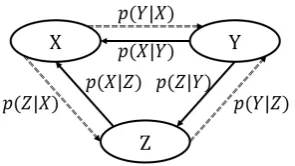
Figure 1: Triangular architecture for rare language translation. The solid lines mean rich-resource and the dash lines mean low-resource.X,Y andZare three different languages.
With the introduced rich language Y, in this paper, we propose a novel triangular architec-ture (TA-NMT) to exploit the additional bilingual data of(Y, Z) and(X, Y), in order to get better translation performance on the low-resource pair (X, Z), as shown in Figure 1. In this architec-ture,(Y, Z)is used for training another translation model to score the translation model of (X, Z), while (X, Y) is used to provide large bilingual data with favorable alignment information.
Under the motivation to exploit the rich-resource pair(X, Y), instead of modeling X ⇒ Z directly, our method starts from modeling the translation task X ⇒ Y while taking Z as a la-tent variable. Then, we decompose X ⇒ Y into two phases for training two translation mod-els of low-resource pairs ((X, Z) and(Y, Z)) re-spectively. The first translation model generates a sequence in the hidden space ofZfromX, based on which the second one generates the translation inY. These two models can be optimized jointly with an Expectation Maximization (EM) frame-work with the goal of maximizing the translation probability p(y|x). In this framework, the two models can boost each other by generating pseudo bilingual data for model training with the weights scored from the other. By reversing the transla-tion directransla-tion of X ⇒ Y, our method can be used to train another two translation modelsp(z|y) andp(x|z). Therefore, the four translation mod-els (p(z|x),p(x|z),p(z|y)andp(y|z)) of the rare languageZcan be optimized jointly with our pro-posed unified bidirectional EM algorithm.
Experimental results on the MultiUN and IWSLT2012 datasets demonstrate that our method can achieve significant improvements for rare languages translation. By incorporating back-translation (a method leveraging more monolin-gual data) into our method, TA-NMT can achieve even further improvements.
Our contributions are listed as follows:
• We propose a novel triangular training archi-tecture (TA-NMT) to effectively tackle the data sparsity problem for rare languages in NMT with an EM framework.
• Our method can exploit two additional bilin-gual datasets at both the model and data lev-els by introducing another rich language.
• Our method is a unified bidirectional EM al-gorithm, in which four translation models on two low-resource pairs are trained jointly and boost each other.
2 Method
As shown in Figure 1, our method tries to lever-age(X, Y)(a rich-resource pair) and(Y, Z)to im-prove the translation performance of low-resource pair (X, Z), during which translation models of (X, Z)and(Y, Z)can be improved jointly.
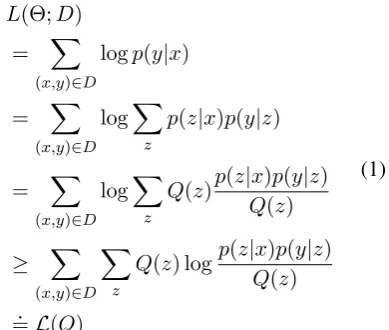
Instead of directly modeling the translation probabilities of low-resource pairs, we model the rich-resource pair translation X ⇒ Y, with the language Z acting as a bridge to connectX and Y. We decompose X ⇒ Y into two phases for training two translation models. The first model p(z|x) generates the latent translation inZ from the input sentence inX, based on which the sec-ond onep(y|z)generate the final translation in lan-guage Y. Following the standard EM procedure (Borman, 2004) and Jensen’s inequality, we derive the lower bound ofp(y|x)over the whole training dataDas follows:
L(Θ;D)
= X
(x,y)∈D
logp(y|x)
= X
(x,y)∈D
logX
z
p(z|x)p(y|z)
= X
(x,y)∈D
logX
z
Q(z)p(z|x)p(y|z) Q(z)
≥ X
(x,y)∈D
X
z
Q(z) logp(z|x)p(y|z) Q(z)
. =L(Q)
(1)
but one line asL(Q). Note that we use an approxi-mation thatp(y|x, z)≈p(y|z)due to the semantic equivalence of parallel sentencesxandy.
In the following subsections, we will first pro-pose our EM method in subsection 2.1 based on the lower-bound derived above. Next, we will extend our method to two directions and give our unified bidirectional EM training in subsec-tion 2.2. Then, in subsecsubsec-tion 2.3, we will discuss more training details of our method and present our algorithm in the form of pseudo codes.
2.1 EM Training
To maximizeL(Θ;D), the EM algorithm can be leveraged to maximize its lower boundL(Q). In the E-step, we calculate the expectation of the variable z using current estimate for the model, namely find the posterior distribution Q(z). In the M-step, with the expectationQ(z), we max-imize the lower bound L(Q). Note that condi-tioned on the observed data and current model, the calculation of Q(z) is intractable, so we choose Q(z) =p(z|x)approximately.
M-step: In the M-step, we maximize the lower bound L(Q) w.r.t model parameters givenQ(z). By substitutingQ(z) =p(z|x)intoL(Q), we can get the M-step as follows:
Θy|z= arg max
Θy|z
L(Q)
= arg max Θy|z
X
(x,y)∈D
X
z
p(z|x) logp(y|z)
= arg max Θy|z
X
(x,y)∈D
Ez∼p(z|x)logp(y|z)
(2)
E-step:The approximate choice ofQ(z)brings in a gap between L(Q)andL(Θ;D), which can be minimized in the E-step with Generalized EM method (McLachlan and Krishnan, 2007). Ac-cording to Bishop (2006), we can write this gap explicitly as follows:
L(Θ;D)− L(Q) =X z
Q(z) log Q(z) p(z|y)
=KL(Q(z)||p(z|y))
=KL(p(z|x)||p(z|y)) (3)
where KL(·) is the KullbackLeibler divergence, and the approximation thatp(z|x, y) ≈ p(z|y)is also used above.
In the E-step, we minimize the gap between L(Q)andL(Θ;D)as follows:
Θz|x= arg min
Θz|x
KL(p(z|x)||p(z|y)) (4)
To sum it up, the E-step optimizes the model p(z|x)by minimizing the gap betweenL(Q)and L(Θ;D) to get a better lower boundL(Q). This lower bound is then maximized in the M-step to optimize the modelp(y|z). Given the new model p(y|z), the E-step tries to optimize p(z|x) again to find a new lower bound, with which the M-step is re-performed. This iteration process continues until the models converge, which is guaranteed by the convergence of the EM algorithm.
2.2 Unified Bidirectional Training
The modelp(z|y) is used as an approximation of p(z|x, y)in the E-step optimization (Equation 3). Due to the low resource property of the language pair (Y, Z), p(z|y) cannot be well trained. To solve this problem, we can jointly optimizep(x|z) and p(z|y) similarly by maximizing the reverse translation probabilityp(x|y).
We now give our unified bidirectional general-ized EM procedures as follows:
• Direction ofX ⇒Y
E: OptimizeΘz|x.
arg min Θz|x
KL(p(z|x)||p(z|y)) (5)
M: OptimizeΘy|z.
arg max Θy|z
X
(x,y)∈D
Ez∼p(z|x)logp(y|z) (6)
• Direction ofY ⇒X
E: OptimizeΘz|y.
arg min Θz|y
KL(p(z|y)||p(z|x)) (7)
M: OptimizeΘx|z.
arg max Θx|z
X
(x,y)∈D
Ez∼p(z|y)logp(x|z) (8)
Figure 2: Triangular Learning Architecture for Low-Resource NMT
2.3 Training Details
A major difficulty in our unified bidirectional training is the exponential search space of the translation candidates, which could be addressed by either sampling (Shen et al., 2015; Cheng et al., 2016) or mode approximation (Kim and Rush, 2016). In our experiments, we leverage the sam-pling method and simply generate the top target sentence for approximation.
In order to perform gradient descend training, the parameter gradients for Equations 5 and 7 are formulated as follows:
∇Θz|xKL(p(z|x)||p(z|y))
=Ez∼p(z|x)log
p(z|x)
p(z|y)∇Θz|xlogp(z|x) ∇Θz|yKL(p(z|y)||p(z|x))
=Ez∼p(z|y)log
p(z|y)
p(z|x)∇Θz|ylogp(z|y) (9)
Similar to reinforcement learning, models p(z|x)andp(z|y)are trained using samples gen-erated by the models themselves. According to our observation, some samples are noisy and detri-mental to the training process. One way to tackle this is to filter out the bad ones using some addi-tional metrics (BLEU, etc.). Nevertheless, in our settings, BLEU scores cannot be calculated dur-ing traindur-ing due to the absence of the golden tar-gets (zis generated based onxoryfrom the rich-resource pair(x, y)). Therefore we choose IBM model1 scores to weight the generated translation candidates, with the word translation probabilities calculated based on the given bilingual data (the low-resource pair(x, z)or(y, z)). Additionally, to stabilize the training process, the pseudo samples generated by model p(z|x) or p(z|y) are mixed with true bilingual samples in the same mini-batch with the ratio of 1-1. The whole training procedure is described in the following Algorithm 1, where the 5th and 9th steps are generating pseudo data.
Algorithm 1 Training low-resource translation models with the triangular architecture
Input: Rich-resource bilingual data (x, y); low-resource bilingual data(x, z)and(y, z)
Output: ParametersΘz|x,Θy|z,Θz|yandΘx|z 1: Pre-trainp(z|x),p(z|y),p(x|z),p(y|z)
2: whilenot convergencedo
3: Sample(x, y),(x∗, z∗),(y∗, z∗)∈D 4: . X ⇒Y: OptimizeΘz|xandΘy|z
5: Generate z0 from p(z0|x) and build the training batchesB1 = (x, z0)∪(x∗, z∗),B2 = (y, z0)∪(y∗, z∗)
6: E-step: updateΘz|xwithB1(Equation 5) 7: M-step: updateΘy|zwithB2(Equation 6) 8: . Y ⇒X: OptimizeΘz|y andΘx|z 9: Generate z0 from p(z0|y) and build the training batchesB3 = (y, z0)∪(y∗, z∗),B4 = (x, z0)∪(x∗, z∗)
10: E-step: updateΘz|y withB3(Equation 7) 11: M-step: updateΘx|zwithB4(Equation 8) 12: end while
13: returnΘz|x,Θy|z,Θz|y andΘx|z
3 Experiments
3.1 Datasets
In order to verify our method, we conduct exper-iments on two multilingual datasets. The one is MultiUN (Eisele and Chen, 2010), which is a col-lection of translated documents from the United Nations, and the other is IWSLT2012 (Cettolo et al., 2012), which is a set of multilingual tran-scriptions of TED talks. As is mentioned in sec-tion 1, our method is compatible with methods ex-ploiting monolingual data. So we also find some extra monolingual data of rare languages in both datasets and conduct experiments incorporating back-translation into our method.
MultiUN: English-French (EN-FR) bilingual data are used as the rich-resource pair (X, Y). Arabic (AR) and Spanish (ES) are used as two simulated rare languagesZ. We randomly choose subsets of bilingual data of(X, Z) and(Y, Z) in the original dataset to simulate low-resource sit-uations, and make sure there is no overlap in Z between chosen data of(X, Z)and(Y, Z).
IWSLT20121: English-French is used as the rich-resource pair(X, Y), and two rare languages Z are Hebrew (HE) and Romanian (RO) in our
Pair MultiUN IWSLT2012
Lang Size Lang Size
(X, Y) EN-FR 9.9 M EN-FR3 7.9 M
(X, Z) EN-AR 116 K EN-HE 112.6 K
(Y, Z) FR-AR 116 K FR-HE 116.3 K
monoZ AR 3 M HE 512.5 K
(X, Z) EN-ES 116 K EN-RO4 467.3 K
(Y, Z) FR-ES 116 K FR-RO 111.6 K
[image:5.595.75.288.62.176.2]monoZ ES 3 M RO 885.0 K
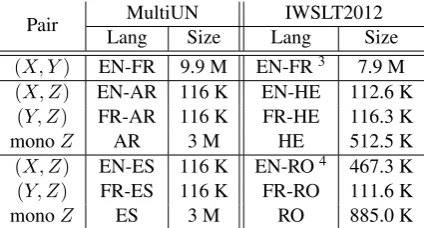
Table 1: training data size of each language pair.
choice. Note that in this dataset, low-resource pairs (X, Z) and (Y, Z) are severely overlapped in Z. In addition, English-French bilingual data from WMT2014 dataset are also used to enrich the rich-resource pair. We also use additional English-Romanian bilingual data from Europarlv7 dataset (Koehn, 2005). The monolingual data of Z (HE and RO) are taken from the web2.
In both datasets, all sentences are filtered within the length of 5 to 50 after tokenization. Both the validation and the test sets are 2,000 parallel sen-tences sampled from the bilingual data, with the left as training data. The size of training data of all language pairs are shown in Table 1.
3.2 Baselines
We compare our method with four baseline sys-tems. The first baseline is the RNNSearchmodel (Bahdanau et al., 2014), which is a sequence-to-sequence model with attention mechanism trained with given small-scale bilingual data. The trained translation models are also used as pre-trained models for our subsequent training processes.
The second baseline is PBSMT(Koehn et al., 2003), which is a phrase-based statistical machine translation system. PBSMT is known to perform well on low-resource language pairs, so we want to compare it with our proposed method. And we use the public available implementation of Moses5 for training and test in our experiments.
The third baseline is a teacher-student alike method (Chen et al., 2017). For the sake of brevity, we will denote it as T-S. The process is illus-trated in Figure 3. We treat this method as a sec-ond baseline because it can also be regarded as a method exploiting(Y, Z) and(X, Y)to improve
2 https://github.com/ajinkyakulkarni14/TED-Multilingual-Parallel-Corpus
3
together with WMT2014 4
together with Europarlv7 5http://www.statmt.org/moses/
Method Resources PBSMT (X, Z),(Y, Z)
RNNSearch (X, Z),(Y, Z)
T-S (X, Z),(Y, Z),(X, Y)
BackTrans (X, Z),(Y, Z),(X, Y), monoZ
TA-NMT (X, Z),(Y, Z),(X, Y)
TA-NMT(GI) (X, Z),(Y, Z),(X, Y), monoZ
Table 2: Resources that different methods use
the translation of (X, Z) if we regard(X, Z) as the zero-resource pair and p(x|y) as the teacher model when trainingp(z|x)andp(x|z).
[image:5.595.306.524.64.157.2]The fourth baseline is back-translation (Sen-nrich et al., 2015). We will denote it as Back-Trans. More concretely, to train the modelp(z|x), we use extra monolingualZdescribed in Table 1 to do back-translation; to train the modelp(x|z), we use monolingualX taken from (X, Y). Pro-cedures for training p(z|y) and p(y|z) are simi-lar. This method use extra monolingual data ofZ compared with our TA-NMT method. But we can incorporate it into our method.
Figure 3: A teacher-student alike method for low-resource translation. For trainingp(z|x) and p(x|z), we mix the true pair(y∗, z∗)∈Dwith the pseudo pair (x0, z∗) generated by teacher model p(x0|y∗)in the same mini-batch. The training pro-cedure ofp(z|y)andp(y|z)is similar.
3.3 Overall Results
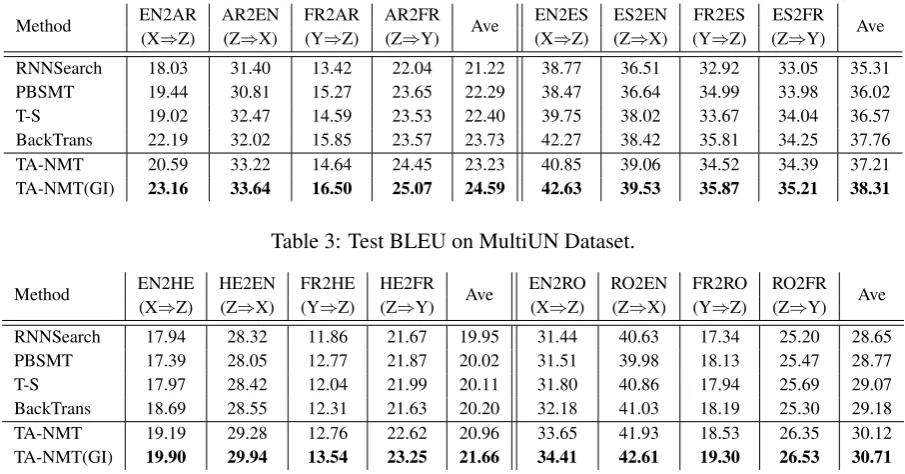
Experimental results on both datasets are shown in Table 3 and 4 respectively, in whichRNNSearch,
PBSMT, T-S and BackTrans are four base-lines. TA-NMT is our proposed method, and
TA-NMT(GI)is our method incorporating back-translation as good initialization. For the purpose of clarity and a fair comparison, we list the re-sources that different methods exploit in Table 2.
[image:5.595.310.525.382.446.2]Method EN2AR AR2EN FR2AR AR2FR Ave EN2ES ES2EN FR2ES ES2FR Ave (X⇒Z) (Z⇒X) (Y⇒Z) (Z⇒Y) (X⇒Z) (Z⇒X) (Y⇒Z) (Z⇒Y)
RNNSearch 18.03 31.40 13.42 22.04 21.22 38.77 36.51 32.92 33.05 35.31
PBSMT 19.44 30.81 15.27 23.65 22.29 38.47 36.64 34.99 33.98 36.02
T-S 19.02 32.47 14.59 23.53 22.40 39.75 38.02 33.67 34.04 36.57
BackTrans 22.19 32.02 15.85 23.57 23.73 42.27 38.42 35.81 34.25 37.76
TA-NMT 20.59 33.22 14.64 24.45 23.23 40.85 39.06 34.52 34.39 37.21
[image:6.595.72.525.61.298.2]TA-NMT(GI) 23.16 33.64 16.50 25.07 24.59 42.63 39.53 35.87 35.21 38.31
Table 3: Test BLEU on MultiUN Dataset.
Method EN2HE HE2EN FR2HE HE2FR Ave EN2RO RO2EN FR2RO RO2FR Ave
(X⇒Z) (Z⇒X) (Y⇒Z) (Z⇒Y) (X⇒Z) (Z⇒X) (Y⇒Z) (Z⇒Y)
RNNSearch 17.94 28.32 11.86 21.67 19.95 31.44 40.63 17.34 25.20 28.65
PBSMT 17.39 28.05 12.77 21.87 20.02 31.51 39.98 18.13 25.47 28.77
T-S 17.97 28.42 12.04 21.99 20.11 31.80 40.86 17.94 25.69 29.07
BackTrans 18.69 28.55 12.31 21.63 20.20 32.18 41.03 18.19 25.30 29.18
TA-NMT 19.19 29.28 12.76 22.62 20.96 33.65 41.93 18.53 26.35 30.12
TA-NMT(GI) 19.90 29.94 13.54 23.25 21.66 34.41 42.61 19.30 26.53 30.71
Table 4: Test BLEU on IWSLT Dataset.
for both(X, Z)and(Y, Z) by generating pseudo data from each other, leads up to 1.1 BLEU points improvement on average over RNNSearch. Com-pared with T-S, our method gains a further im-provement of about 0.9 BLEU on average, because our method can better leverage the rich-resource pair (X, Y). With extra large monolingual Z in-troduced, BackTrans can improve the performance ofp(z|x) andp(z|y)significantly compared with all the methods without monolingual Z. How-ever TA-NMT is comparable with or even bet-ter than BackTrans forp(x|z)andp(y|z)because both of the methods leverage resources from rich-resource pair(X, Y), but BackTrans does not use the alignment information it provides. Moreover, with back-translation as good initialization, fur-ther improvement is achieved by TA-NMT(GI) of about 0.7 BLEU on average over BackTrans.
In Table 4, we can draw the similar conclu-sion. However, different from MultiUN, in the EN-FR-HE group of IWSLT, (X, Z) and (Y, Z) are severely overlapped in Z. Therefore, T-S cannot improve the performance obviously (only about 0.2 BLEU) on RNNSearch because it fails to essentially double training data via the teacher model. As for EN-FR-RO, with the additionally introduced EN-RO data from Europarlv7, which has no overlap in RO with FR-RO, T-S can im-prove the average performance more than the EN-FR-HE group. TA-NMT outperforms T-S by 0.93 BLEU on average. Note that even though
Back-Trans uses extra monolingual Z, the improve-ments are not so obvious as the former dataset, the reason for which we will delve into in the next subsection. Again, with back-translation as good initialization, TA-NMT(GI) can get the best result. Note that BLEU scores of TA-NMT are lower than BackTrans in the directions of X⇒Z and Y⇒Z. The reason is that the resources used by these two methods are different, as shown in Table 2. To do back translation in two directions (e.g., X⇒Z and Z⇒X), we need monolingual data from both sides (e.g., X and Z), however, in TA-NMT, the monolingual data of Z is not necessary. There-fore, in the translation of X⇒Z or Y⇒Z, Back-Trans uses additional monolingual data of Z while TA-NMT does not, that is why BackTrans outper-forms TA-NMT in these directions. Our method can leverage back translation as a good initializa-tion, aka TA-NMT(GI) , and outperforms Back-Trans on all translation directions.
The average test BLEU scores of different methods in each data group (AR, EN-FR-ES, EN-FR-HE, and EN-FR-RO) are listed in the columnAveof the tables for clear comparison.
3.4 The Effect of Extra Monolingual Data
the experiments on IWSLT as shown in Table 1. So we conduct the following experiment to verify the conjecture by changing the scale of monolin-gual Arabic data in the MultiUN dataset, of which the data utilization rates are set to 0%, 10%, 30%, 60% and 100% respectively. Then we compare the performance of BackTrans and TA-NMT(GI) in the EN-FR-AR group. As Figure 4 shows, the amount of monolingualZactually has a big effect on the results, which can also verify our conjec-ture above upon the less significant improvement of BackTrans and TA-NMT(GI) on IWSLT. In ad-dition, even with poor ”good-initialization”, TA-NMT(GI) still get the best results.
Figure 4: Test BLEU of the EN-FR-AR group per-formed by BackTrans and TA-NMT(GI) with dif-ferent amount of monolingual Arabic data.
3.5 EM Training Curves
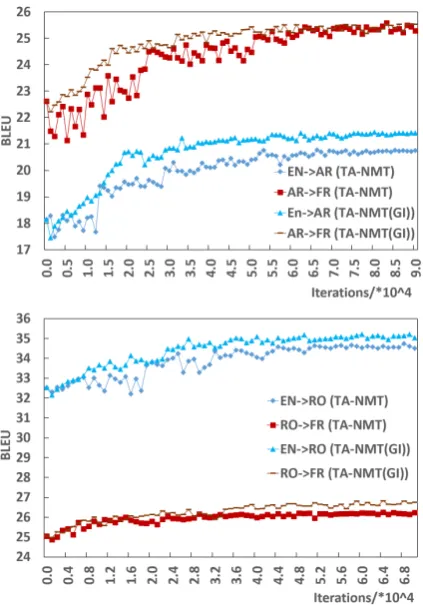
To better illustrate the behavior of our method, we print the training curves in both the M-steps and E-steps of TA-NMT and TA-NMT(GI) in Figure 5 above. The chosen models printed in this figure are EN2AR and AR2FR on MultiUN, and EN2RO and RO2FR on IWLST.
From Figure 5, we can see that the two low-resource translation models are improved nearly simultaneously along with the training process, which verifies our point that two weak models could boost each other in our EM framework. No-tice that at the early stage, the performance of all models stagnates for several iterations, especially of TA-NMT. The reason could be that the pseudo bilingual data and the true training data are hetero-geneous, and it may take some time for the els to adapt to a new distribution which both mod-els agree. Compared with TA-NMT, TA-NMT(GI) are more stable, because the models may have
Figure 5: BLEU curves on validation sets dur-ing the traindur-ing processes of NMT and TA-NMT(GI). (Top: EN2AR (the E-step) and AR2FR (the M-step); Bottom: EN2RO (the E-step) and RO2FR (the M-step))
adapted to a mixed distribution of heterogeneous data in the preceding back-translation phase.
3.6 Reinforcement Learning Mechanism in Our Method
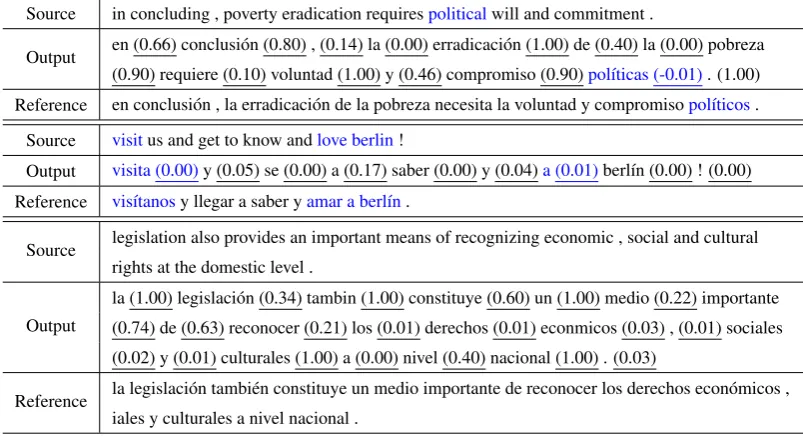
As shown in Equation 9, the E-step actually works as a reinforcement learning (RL) mecha-nism. Modelsp(z|x)andp(z|y)generate samples by themselves and receive rewards to update their parameters. Note that the reward here is described by the log terms in Equation 9, which is derived from our EM algorithm rather than defined arti-ficially. In Table 5, we do a case study of the EN2ES translation sampled by p(z|x) as well as its time-step rewards during the E-step.
[image:7.595.87.278.269.399.2]sec-Source in concluding , poverty eradication requirespoliticalwill and commitment .
Output en (0.66) conclusi´on (0.80) , (0.14) la (0.00) erradicaci´on (1.00) de (0.40) la (0.00) pobreza (0.90) requiere (0.10) voluntad (1.00) y (0.46) compromiso (0.90)pol´ıticas (-0.01). (1.00)
Reference en conclusi´on , la erradicaci´on de la pobreza necesita la voluntad y compromisopol´ıticos.
Source visitus and get to know andlove berlin!
Output visita (0.00)y (0.05) se (0.00) a (0.17) saber (0.00) y (0.04)a (0.01)berl´ın (0.00) ! (0.00)
Reference vis´ıtanosy llegar a saber yamar a berl´ın.
Source legislation also provides an important means of recognizing economic , social and cultural rights at the domestic level .
Output
la (1.00) legislaci´on (0.34) tambin (1.00) constituye (0.60) un (1.00) medio (0.22) importante
(0.74) de (0.63) reconocer (0.21) los (0.01) derechos (0.01) econmicos (0.03) , (0.01) sociales
(0.02) y (0.01) culturales (1.00) a (0.00) nivel (0.40) nacional (1.00) . (0.03)
[image:8.595.97.499.64.282.2]Reference la legislaci´on tambi´en constituye un medio importante de reconocer los derechos econ´omicos , iales y culturales a nivel nacional .
Table 5: English to Spanish translation sampled in the E-step as well as its time-step rewards.
ond case, the output misses important words and is not fluent. Rewards received by the modelp(z|x) are zero for nearly all tokens in the output, leading to an invalid updating. In the last case, the output sentence is identical to the human reference. The rewards received are nearly all positive and mean-ingful, thus the RL rule will update the parameters to encourage this translation candidate.
4 Related Work
NMT systems, relying heavily on the availabil-ity of large bilingual data, result in poor transla-tion quality for low-resource pairs (Zoph et al., 2016). This low-resource phenomenon has been observed in much preceding work. A very com-mon approach is exploiting com-monolingual data of both source and target languages (Sennrich et al., 2015; Zhang and Zong, 2016; Cheng et al., 2016; Zhang et al., 2018; He et al., 2016).
As a kind of data augmentation technique, ex-ploiting monolingual data can enrich the training data for low-resource pairs. Sennrich et al. (2015) propose back-translation, exploits the monolin-gual data of the target side, which is then used to generate pseudo bilingual data via an additional target-to-source translation model. Different from back-translation, Zhang and Zong (2016) propose two approaches to use source-side monolingual data, of which the first is employing a self-learning algorithm to generate pseudo data, while the sec-ond is using two NMT models to predict the trans-lation and to reorder the source-side monolingual
sentences. As an extension to these two meth-ods, Cheng et al. (2016) and Zhang et al. (2018) combine two translation directions and propose a training framework to jointly optimize the source-to-target and target-to-source translation models. Similar to joint training, He et al. (2016) propose a dual learning framework with a reinforcement learning mechanism to better leverage monolin-gual data and make two translation models pro-mote each other. All of these methods are concen-trated on exploiting either the monolingual data of the source and target language or both of them.
Our method takes a different angle but is com-patible with existing approaches, we propose a novel triangular architecture to leverage two ad-ditional language pairs by introducing a third rich language. By combining our method with existing approaches such as back-translation, we can make a further improvement.
Another approach for tackling the low-resource translation problem is multilingual neural machine translation (Firat et al., 2016), where different encoders and decoders for all languages with a shared attention mechanism are trained. This method tends to exploit the network architecture to relate low-resource pairs. Our method is differ-ent from it, which is more like a training method rather than network modification.
5 Conclusion
of low-resource pairs translation with a unified bidirectional EM framework. By introducing an-other rich language, our method can better ex-ploit the additional language pairs to enrich the original low-resource pair. Compared with the RNNSearch (Bahdanau et al., 2014), a teacher-student alike method (Chen et al., 2017) and the back-translation (Sennrich et al., 2015) on the same data level, our method achieves significant improvement on the MutiUN and IWSLT2012 datasets. Note that our method can be com-bined with methods exploiting monolingual data for NMT low-resource problem such as back-translation and make further improvements.
In the future, we may extend our architecture to other scenarios, such as totally unsupervised train-ing with no biltrain-ingual data for the rare language.
Acknowledgments
We thank Zhirui Zhang and Shuangzhi Wu for use-ful discussions. This work is supported in part by NSFC U1636210, 973 Program 2014CB340300, and NSFC61421003.
References
Dzmitry Bahdanau, Kyunghyun Cho, and Yoshua Ben-gio. 2014. Neural machine translation by jointly learning to align and translate. arXiv preprint arXiv:1409.0473.
Christopher M Bishop. 2006. Pattern recognition and machine learning. springer.
Sean Borman. 2004. The expectation maximization algorithm-a short tutorial. Submitted for publica-tion, pages 1–9.
Mauro Cettolo, Christian Girardi, and Marcello Fed-erico. 2012. Wit3: Web inventory of transcribed and translated talks. In Proceedings of the 16th Con-ference of the European Association for Machine Translation (EAMT), volume 261, page 268.
Yun Chen, Yang Liu, Yong Cheng, and Victor OK Li. 2017. A teacher-student framework for zero-resource neural machine translation. arXiv preprint arXiv:1705.00753.
Yong Cheng, Wei Xu, Zhongjun He, Wei He, Hua Wu, Maosong Sun, and Yang Liu. 2016. Semi-supervised learning for neural machine translation.
arXiv preprint arXiv:1606.04596.
Andreas Eisele and Yu Chen. 2010. Multiun: A mul-tilingual corpus from united nation documents. In
Proceedings of the Seventh conference on Interna-tional Language Resources and Evaluation, pages
2868–2872. European Language Resources Associ-ation (ELRA).
Orhan Firat, Kyunghyun Cho, and Yoshua Ben-gio. 2016. Multi-way, multilingual neural ma-chine translation with a shared attention mechanism.
arXiv preprint arXiv:1601.01073.
Di He, Yingce Xia, Tao Qin, Liwei Wang, Nenghai Yu, Tieyan Liu, and Wei-Ying Ma. 2016. Dual learn-ing for machine translation. InAdvances in Neural Information Processing Systems, pages 820–828.
S´ebastien Jean, Orhan Firat, Kyunghyun Cho, Roland Memisevic, and Yoshua Bengio. 2015. Montreal neural machine translation systems for wmt’15. In
WMT@ EMNLP, pages 134–140.
Nal Kalchbrenner and Phil Blunsom. 2013. Recur-rent continuous translation models. InEMNLP, vol-ume 3, page 413.
Yoon Kim and Alexander M Rush. 2016. Sequence-level knowledge distillation. arXiv preprint arXiv:1606.07947.
Philipp Koehn. 2005. Europarl: A parallel corpus for statistical machine translation. InMT summit, vol-ume 5, pages 79–86.
Philipp Koehn, Franz Josef Och, and Daniel Marcu. 2003. Statistical phrase-based translation. In
Proceedings of the 2003 Conference of the North American Chapter of the Association for Computa-tional Linguistics on Human Language Technology-Volume 1, pages 48–54. Association for Computa-tional Linguistics.
Minh-Thang Luong, Hieu Pham, and Christopher D Manning. 2015. Effective approaches to attention-based neural machine translation. arXiv preprint arXiv:1508.04025.
Geoffrey McLachlan and Thriyambakam Krishnan. 2007. The EM algorithm and extensions, volume 382. John Wiley & Sons.
Rico Sennrich, Alexandra Birch, Anna Currey, Ulrich Germann, Barry Haddow, Kenneth Heafield, An-tonio Valerio Miceli Barone, and Philip Williams. 2017. The university of edinburgh’s neural mt sys-tems for wmt17. arXiv preprint arXiv:1708.00726.
Rico Sennrich, Barry Haddow, and Alexandra Birch. 2015. Improving neural machine translation models with monolingual data. arXiv preprint arXiv:1511.06709.
Rico Sennrich, Barry Haddow, and Alexandra Birch. 2016. Edinburgh neural machine translation sys-tems for wmt 16. arXiv preprint arXiv:1606.02891.
Ilya Sutskever, Oriol Vinyals, and Quoc V Le. 2014. Sequence to sequence learning with neural net-works. InAdvances in neural information process-ing systems, pages 3104–3112.
Yonghui Wu, Mike Schuster, Zhifeng Chen, Quoc V Le, Mohammad Norouzi, Wolfgang Macherey, Maxim Krikun, Yuan Cao, Qin Gao, Klaus Macherey, et al. 2016. Google’s neural ma-chine translation system: Bridging the gap between human and machine translation. arXiv preprint arXiv:1609.08144.
Jiajun Zhang and Chengqing Zong. 2016. Exploit-ing source-side monolExploit-ingual data in neural machine translation. InEMNLP, pages 1535–1545.
Zhirui Zhang, Shujie Liu, Mu Li, Ming Zhou, and En-hong Chen. 2018. Joint training for neural machine translation models with monolingual data. InAAAI.