Munich Personal RePEc Archive
A Correlation between Workplace Stress
and Organizational Commitment:
Doctors response from Public and
Private Hospitals in Karachi, Pakistan
Zehra, Syeda Zufiesha and Ather, Marium and Zehra,
Beenish
House Officer DIKIOHS DUHS, Pakistan, House Officer KMDC
Karachi University, Pakistan, House Officer DIKIOHS DUHS,
Pakistan
1 April 2017
Online at
https://mpra.ub.uni-muenchen.de/79073/
A Correlation between Workplace Stress and Organizational Commitment: Doctors
response from Public and Private Hospitals in Karachi, Pakistan
Syeda Zufiesha Zehra
House Officer DIKIOHS DUHS, Pakistan
Email: [email protected]
Marium Ather
House Officer KMDC Karachi University, Pakistan
Email: [email protected]
Beenish Zehra
House Officer DIKIOHS DUHS, Pakistan
Email: [email protected]
Abstract
The study inspects the correlation between occupational stress and organizational commitment
among doctors working in public and private sectors of Karachi. The self-constructive survey
questionnaire is circulated through convenience sampling techniques and gathered 1039
responses (public hospital=549 and private hospitals=490). A five-point likert scale measured
response ranges from strongly agree (1) to strongly disagree (5) while 10-item scale was used to
evaluate occupational stress. Additionally, dimensions of organizational commitment; affective,
normative and continuance commitment were evaluated on a scale containing 6-items. The data
was analyzed through SPSS 23. As interpreted from results, there is a weak positive linear
relationship between AC and personal factor and organizational factor. Likewise, NC shares a
weak positive linear relationship with personal resources and organizational factor. Similarly,
CC has a weak positive linear relationship with personal factor and personal resources. However,
AC has a strong negative relationship with personal resources while NC also has a strong
negative relationship with personal factor. In a similar manner, CC has a weak negative linear
relationship with organizational factor. Moreover, level of stress and commitment among doctors
are under more stress. However, AC and NC are relatively high in females while CC is more in
males.
Key Words: Occupational Stress, Organizational Commitment, Public and Private Hospitals, Doctors, Personal Factors, Personal Resources, Organizational Factors
Introduction
In each facet of a work life of all individual, there exists a stress factor (Smith, 2000; Chang &
Lu, 2007). To enhance the understanding regarding the impact stress creates on the workers-
work related attitude, organizational researcher investigates the stress. The department of human
resources, in an alliance represents its foundation. The stress level of a person depends upon the
individual’s devotion and experience gained during the route of development, which can receive
clear attention of the researcher to get this topic highlighted. In this present era, job stress
remains the rampant source of stress for a person. Stress happens to be the main rationale of
misleading behavior of an employee working in an organization. Cost associated with stress
influence both the employee and the organization. In particular, stress appears to be the staircase
for the motivation and activity of an organization.
As stated by many researchers, stress and stress related problems have been a prevalent
discussion for studies. In Pakistan, scarce numbers of researches have been conducted and
visualizing the need of giving this topic a thought, we came across the demand of an empirical
study to be conducted.
Objective
• To establish gender discrimination in an alliance and career related stress in public and private hospitals.
• How organizational commitment and occupational stress does affects the working
efficient of MALE and FEMALE doctors?
• To determine the relationship between organizational tenure of employees,
Hypotheses
• H1: There is no significant relationship between occupational stress and organizational commitment of doctors in private and public sectors.
• H2: There is no difference between male and female doctor's the occupational stress
and organizational commitment in public and private hospitals.
• H3: There is no significant difference between public and private hospital doctors'
occupational stress and organizational commitment depending on their tenure.
Literature review
Occupational stress
Selye define stress as a physical and psychological relation to undesirable circumstances or
influences in the alliance surrounding or vicinity (cited from Haque & Aston, 2016). In the same
way, Nwadini (2006) state stress as a destruction of the emotional steadiness of the entity that
bring about a state of incompetence in personality and behavior. In terms of work, the feeling of
stress is distinguished from emotional imbalance or disrupting environment, which shatters one’s
confidence. Stress can also be related to different conditions through which an individual has
been through, be it professional stress or personal stress. The combination of role strain; which
encompass role disagreement, uncertainty and burden. As reviewed from previous literature
occupation stress have an effect on emotional reaction and has a cognitive role.
Stress can relate to pessimistic emotional imbalance such as depression, rage, strain, fear,
stubborn and frustrated behaviors which can differ in strength (Kumasey et al., 2014). The
consequences of stress can be abrupt or long lasting (Haque, Aston, Kozlvoski, 2016; Zehra et
al., 2017). According to Dianna and Griffin (1999), some employees endure stress that can cause
an instant response to a situation while other shows concealed reaction. They also presumed that
occupational stress can be a risk to the excellence of work quality of an employee. Stress can
also be the chief cause of mismanagement and poor work efficiency of an employee (Haque et
al., 2016). Stress appears as a destructive emotional disparity which can render job
discontentment and deprived organizational commitment, as suggested by former studies (Zehra
et al., 2017). On the counter part, the foremost part of occupational stress might be loss of
The renowned consequences of stress presents as low job satisfaction, faulty quality of products
and services, deprived and inadequate internal communication, conflicts and disagreement
amongst employees , excessive sick leave, low motivation and morale, lack of capacity etc
(Cicie, 2012). the overall organization efficiency and efficacy along with the proceeding
problems are directly or indirectly associated with stress (Haque & Aston, 2016).
Organizational Commitment
The affiliation between research variables demands a brief distinguishing background of
theoretical perception of organizational commitment (Haque & Yamoah, 2014). The ample
number of researchers and scholars defines occupational commitment under the context of
behavioral sciences. It is accompanied by goals set by an organization to be satisfied by an
employee at his workplace (Haque & Yamoah, 2014). Whereas Mowday et al., (1979) argued
that, organizational commitment is a psychological contract among organization and personnel.
Bateman and Strasser (1984) argued it is a commitment that an employee signed with his
organization and stays associated and affiliated throughout, by being loyal and devoted to the
agreement. The willingness of an employee, helping efforts and approval of the norms affiliated
with an organization is regarded as organizational commitment. In count to that, Mowday et al.,
(1979) along with portal et al, added further justification of organizational commitment by
giving terms to these three dimensions; affective commitment (AC), normative commitment
(NC), and continuance commitment (CC) respectively (cited from Haque & Yamoah, 2014).
Affective, Normative, & Continuance Commitment
Employee contract, acknowledgement, and zealous participation are component of
organizational commitment. As mentioned above, the actual three component of organizational
commitment as sufficient empirical studies have acknowledged it as "affective commitment -
actual involvement, normative commitment - recognition, and continuance commitment -
attachment of employees" (Allen & Meyer, 1996; Bartlett & Kang, 2004; Haque & Yamoah,
2014).
Affective commitment defines as when organizational commitment manifest in employees when
they consider organizational objectives, as their own goals. Furthermore, normative commitment
organization .Moreover, Continuance commitment explains employee’s dedicated performance to serve the same organization. After an organization there is a well defined plethora working
around and to be very honest it seems so reckless. Now that, all the types of organizational
commitment has been explained, It is easy to make a clear understanding regarding the
relationship between organizational commitment with occupational stress. Organizational
commitment is the emotional attachment of employees towards their current organization.
Organizational commitment is a strong conviction in, and absorption of organization objectives
and principal, and enthusiasm to exert significant effort in favor of the organization, they serve
and their clear will to sustain organization citizenship. Organizational commitment has been an
umbrella which shadows affective, normative and continuance commitment. And these evaluate
organizational commitment as a variable. Affective commitment points at emotional tie and
reorganization of the employees with the alliance. The favors gained being part of the
organization is referred as continuance commitment whereas, normative commitment shows an
urge of upholding employment.
Empirical literature
On occupational stress, absolute numbers of researches have been carried out. As evaluated,
western countries such as Australia, United State played a fundamental role in the study in
contrast to Asians. Organizational stresses among two genders differ as stated by a study
executed in Australia. It is elucidated that males have propensity to work for extensive time span
than females while the center of attention for female is intrinsic rewards rather than wages and
promotions.
Gmelch & Burns (1994) of United States instituted that; stress is more customary in women’s in
terms of assignment based and professional distinctiveness. Parallel conclusions were made by
Singaporean researchers so as to female endures more stress than male as they can tackle
organizational politics elegantly. Analogous verdict was also formulated by
Fotinatos-Ventouratos & Cooper (2005) of UK, that women’s undergo raised mean score in virtue of
“association with other people; which signifies job strain. De Smet et al., (2005) illustrated that,
adjusting for age, education and occupational group, men predispose less psychological job
hassles, even though it seems to be insignificant. Males are more liable to manage their
women in reputable organization leads to their approach for less qualified job. In males job strain
is not persistent, devoid of evident regional heterogeneity (de Smet et al., 2005). Age seems to
have curvilinear relationship, with older employee being more contended than younger ones.
Work stress among younger personnel is more prevalent than older ones, as stated by Dua (1994)
of Australia. This contributed to the idea that with growing age people turns out to be more
skillful and mature. Again, according to study in Malaysia by Manshor (2003), in correlation
with workload, age has an association with the stress. When an individual attain a certain age it
becomes unbearable for him to stand workload. Balay (2007) emphasized that commitment
experienced at the teacher’s age is frequently based on internalization of organizational
principles and recognition with those principles. Balay (2007) further found that male teachers
were more likely to experience stress based on compliance and avoidance of conflict than were
female teachers.. On the other hand, Rozenblatt (2001) argued that there is no connection
between increasing age, nationality, education and organization workload and stress. Whereas,
these aspects are influenced by employee’s ability and skill flexibility. Hispanic females are
more prone to job stress than males as enquired by Rodriguez-Calcagno and Brewer (2005).
Brewer and Mcmahon (2003) investigated that though there was a huge sum of discrepancy level
of job stress among industrial education teacher educators , this discrepancy was not clarified by
demographic features.
In contrast, to the two different age groups, older faces less stressful life and role stress as
compare to younger counterpart, as revealed by Barkat and Asma (1999). The more the
experience gained during work years of service, the more life and role stress prevails. An inverse
relation is found between stress and income, i.e, the more he earning the lesser is the stress. Virk,
Chhabra & Kumar (2001) suggested that with the promotion of an employee, the stress level also
elevates. Further studies; have concluded duration of service, offered by an employee has both
negative and positive association with stress. Hence, more studies showed that participant with
lesser experience; reveal more stressful reaction, as compared to participant with more
experience. Four factors have been acknowledged by Kumasey et al., (2014): personal
characteristics (i.e. age, gender, education level), role characteristics (i.e. tenure, rank/position,
role conflict, promotion opportunities), structural characteristics (i.e. organization size, span of
recognition, support from peers).In particularly, it can be identified that role characteristics and
structural characteristics plays the role as capable stressors, which can affect commitment level
or work efficiency of an employee.
As identified, organizational commitment can affect the attitude of an employee. According to a
study, there is a correlation between organizational commitment and improved job performance
and attitudes such as openness to innovation (Wycoff & Skogan, 1994), worker productivity
(Clegg & Dunkerley, 1980; Haque & Yamoah, 2014), job satisfaction (Meyer et al., 1993; Ford
et al., 2003; Becker & Billings, 1993; Haque & Yamoah, 2014; Haque et al., 2015), and positive
social responsibility (Witt, 1990), organizational citizenship behavior (Shore et al., 1995;
Coyle-Shapiro et al., 2006), low turnover intention (Mowday et al., 1982; Allen and Meyer, 1996;
Faizan & Zehra, 2016; Haque & Aston, 2016).These merits of organizational commitment
influence not only the organization but the individuals as well by trial and error- learning
method. On the other hand, the negative aspects of low level of organizational commitment is
related to pessimistic work related approach and attitude such as turnover intentions (Bashaw &
Grand, 1994; Morrow, 1993), occupational deviance (Haarr, 1997), absenteeism (Farrell &
Stamm, 1988; Morrow, 1993) and reduced employee effort, theft, job dissatisfaction, and
unwillingness (Morrow, 1993). However, the above empirical evidences do not confirm that in
developed context the relationship between variables has been explored thus this research is
essential in this regard.
Methodology
We compared the variables of interest in different hospital setups through a self-constructive
survey questionnaire to know the relationship among variables through quantitative approach.
This cross sectional study design provided sufficient data regarding gender discrimination,
commitment and stress level in distinct public and private sector. This study covered a period of
time from Nov 2016 to December 2016 (along with pilot sampling). Data for the study was
derived from 1039 number of participants working in various hospital setups in Karachi,
Pakistan. . Hospitals and participants in the study were sorted out by non-probability sampling
system. Initially, we elected the hospitals that showed interest. Consequently, consent document
numbers were answered which became part of the data analysis. Thus 72.4% of response rate
was attained in the study. The sample used for the study showed variation.
The data was collected by self reported questioner. A five-point likert scale measured response
ranges from strongly agree (1) to strongly disagree (5). A 10-item scale was used to evaluate
occupational stress. The three types of occupational commitment; affective, normative and
continuance were evaluated on a scale containing 6-items. The researchers took consent from the
participating organizations. The concerned organizations in the study were previewed to the
nature of the study and kind of data, we were interested in. Cover letters for the organizations
were accompanied with the copies of research instrument and objective of the study. In fact,
confidentiality of the information was also assured to the participants. An envelope enclosing
research instruments were sent to each participant, and were guided to fill complete questioner
and seal it. This ensured that the data is approached only by the researcher.
In context of Pakistan, we inspected the individual disparity in stress and occupational
commitment. Consequently, we examined gender disparity in stress and organizational
commitment, along with disparity in stress and occupational stress amongst doctors in public and
private hospitals. By means of standardized measure of occupational stress and occupational
commitment data was complied. The data was screened, coded and analysized on statistical
software. To facilitate the analysis Statistical Product and Services Solution (SPSS) version 23.0
for IBM was used.
[image:9.612.70.596.542.639.2]Results
Table 1: Tests of Normality
Type_of_hospit
al
Kolmogorov-Smirnova Shapiro-Wilk
Statistic Df Sig. Statistic Df Sig.
Organisational_Factor
s
Public Hospital .130 549 .000 .962 549 .000
Private Hospital .125 490 .000 .963 490 .000
One thousand and nine hundred respondents contributed in the study. To ensure whether data
was normally distributed or not we applied normality test. As specified in aforementioned table
1, Shapiro-Wilk was calculated to be 0.000 which shows that data is not normally distributed.
Similarly, to test the internal consistency/reliability of the variables we applied CRONBASH
ALPHA test. The cronbach's alpha value was 0.56 which shows intermediate level of internal
[image:10.612.76.548.234.706.2]consistency for our scale with this sample size.
Table 2: Descriptive Statistics
DEMOGRAPHIC VARIABLES OVERALL PUBLIC PRIVATE MALE FEMALE
Gender Male 30.9% 24% 38.7% - -
Female 69.% 75.9% 61.2% - -
Marital
Status
Single 70% 77.5% 61.6% 47.1%% 78.1%
Married 27.4% 20.5% 35.1% 24.2% 19.5%
Divorced 0.4% 0.18% 0.8% 15.2% 0.2%
Single mother
0.4% 0.3% 0.6% 0% 0.6%
Single father 0.1% 0% 0.4% 11.4% 0%
Prefer not to disclose
1.3% 1.2% 1.4% 2.4% 1.3%
Type
of hospital
Public 52.8% - - 40.9% 58.1%
Private 47.1% - - 59% 41.8%
Monthly income Less than 10,000
18.7% 12.3% 25.9% 11.1% 22.1%
10,000-20,000
13.8% 16.5% 10.8% 5.6% 16.1%
20,001-30,000
12.8% 18.2% 6.% 8% 14.9%
30,001-40,000
40,001-50,000
9.2% 9.2% 9.1% 14.5% 6.8%
Greater than 50,000
14.7% 4.4% 22.2% 28.8% 8.3%
Prefer not to disclose
25.2% 30.4% 19.3% 22.6% 26.3%
Age 22-25 years 61.3% 66.8% 54.8% 33.5% 73.6%
26-30 years 18.2% 21.4% 14.4% 24.2% 15.4%
31-40 years 8% 7.4% 8.7% 15.2% 4.8%
41-50 years 6% 2.3% 10.2% 13% 2.9%
51-60 years 5.1% 1.4% 9.5% 11.8% 2.3%
Greater than
60
1% 0.1% 2% 2.4% 0.41%
total number of experience in Hospitality
Less than 1 year
38.85% 43.1% 34% 21.4% 46.7%
1-2 years 24.4% 28.2% 20.2% 20.1% 26.3%
3-5 years 15.5% 18.3% 12.4% 14.9% 15.8%
6-8 years 5.2% 3.6% 7.1% 10.8% 2.7%
9-12 years 4.3% 2.1% 6.7% 8.3% 2.5%
13 – 15 years 2.6% 1% 4.4% 4.6% 1.8%
Greater than 16
8.7% 3.2% 14.8% 19.5% 3.9%
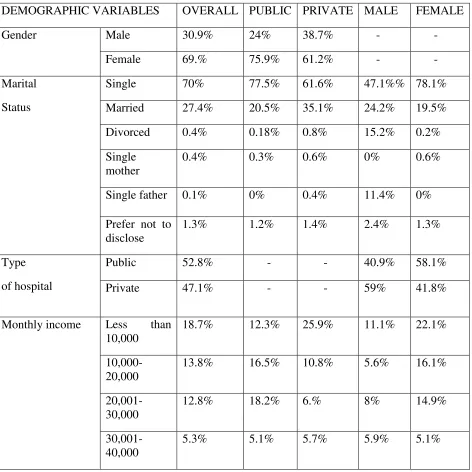
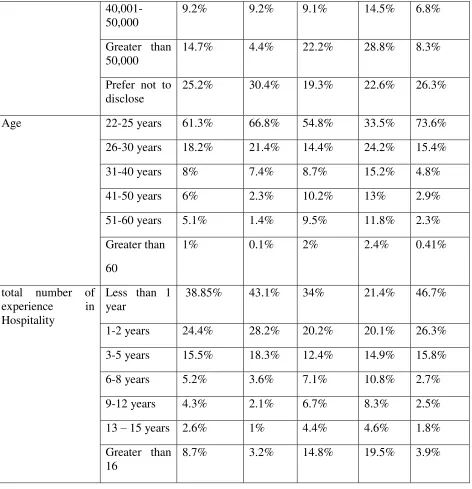
As above table reveals that the majority of the respondents are female (69.0%), single (70%)
aging between 22-25 (61.3%), working in public sector (52.8%) having experience of less than 1
[image:11.612.76.548.71.560.2]year (38.5%) with monthly income of less than 10,000(18.7%).
Table 3: test statistic a
Mann-Whitney U
109944.000 115214.000 111350.500 112761.000 106299.500 110981.000
Wilcoxon
W 161947.000 372617.000 163353.500 164764.000 158302.500 162984.000 Z -1.241 -.050 -.923 -.604 -2.068 -1.020 Asymp.
Sig. (2-tailed)
.215 .960 .356 .546 .039 .308
a. Grouping Variable: Gender
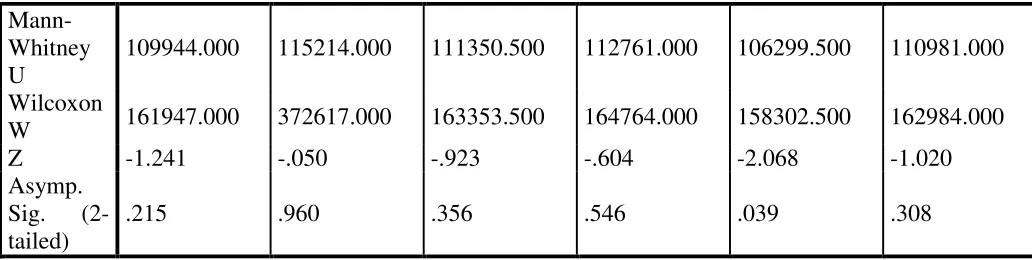
The level of stress and commitment among male and female was evaluated by using Mann
Whitney test. Since, the probability value is less than 0.05 which indicates that data is significant
among male and female genders which show that male and females are not equally affected by
stress. Males are under more stress in contrast to females. Since the ‘p’ value of AC, NC, and CC
is less than the alpha value that indicates that data is statically significant, showing that AC and
[image:12.612.72.588.71.201.2]NC is higher among females whereas CC is higher among males.
The probability value (p) is less than 0.05, which indicates that result is significant. Thus, there is
statistically significant difference between public and private sector indicating that organizational
Table 5: Spearsmens Correlation
Speramens rho Organisational_Factors
Personal_ Factors Personal_R esources Affective_Co mmitment Normative_Co mmitment Continuance_C ommitment Organisational_ Factors Correl ation Coeffi cient
1.000 .146** .265** .176** .147** -.010
Sig. (2-tailed)
. .000 .000 .000 .000 .739
N 1039 1039 1039 1039 1039 1039
Personal_Facto rs Correl ation Coeffi cient
.146** 1.000 -.015 .225** -.014 -.126**
Sig. (2-tailed)
.000 . .624 .000 .655 .000
N 1039 1039 1039 1039 1039 1039
Personal_Reso urces Correl ation Coeffi cient
.265** -.015 1.000 .081** .260** .149**
Sig. (2-tailed)
.000 .624 . .009 .000 .000
N 1039 1039 1039 1039 1039 1039
Affective_Com mitment Correl ation Coeffi cient
.176** .225** .081** 1.000 .135** -.024
Sig. (2-tailed)
.000 .000 .009 . .000 .430
N 1039 1039 1039 1039 1039 1039
Normative_Co mmitment Correl ation Coeffi cient
.147** -.014 .260** .135** 1.000 .358**
Sig. (2-tailed)
.000 .655 .000 .000 . .000
N 1039 1039 1039 1039 1039 1039
Continuance_C ommitment Correl ation Coeffi cient
-.010 -.126** .149** -.024 .358** 1.000
Sig. (2-tailed)
.739 .000 .000 .430 .000 .
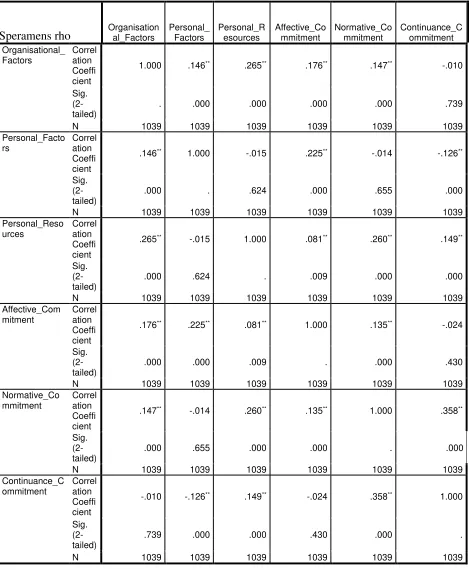
The relationship between organizational stress and commitment was investigated by using
spearmen correlation. Preliminary analysis was performed to assure no volition of assumption of
normality, since ‘p’ value is 0.000 which is less than alpha value than we reject null hypothesis
which proves a significant correlation between affective commitment and organizational factor
justifying a strong evidence against null hypothesis and showing a weak positive relationship
between affective commitment and organizational factor (r=0.176, n=1039, p=0.000). Moreover,
there is a weak positive linear relationship between AC and personal factor. Likewise, NC shares
a weak positive linear relationship with personal resources and organizational factor. Similarly,
CC has a weak positive linear relationship with personal factor and personal resources. However,
AC has a strong negative relationship with personal resources while NC also has a strong
negative relationship with personal factor. In a similar manner, CC has a weak negative linear
relationship with organizational factor.
Findings and Discussions
The elements of organizational commitment that is affective commitment, continuance
commitment and normative commitment differ among male and females as evident from
statistical test. According to a study of Haque and Yamaoh (2014) male shows high level of
affective commitment that highly oppose our findings. Similarly, study conducted by Haque and
Yamoah (2014) studied that normative commitment is more prevalent in women which supports
our findings. Additionally, continuance commitment is more in female’s gender as supported by
their study but our study oppose this. Moreover, males are more affected by stress as evaluated
by our study but according to Kumasey et al., (2014) females are under more stress in
comparison to males. On the other hand, Haque & Aston (2016) and Haque et al., (2016) argued
females are less vulnerable to stress at workplace. Adding more to the discussion, organizational
commitment and stress level appears to be high in private sector. Our findings support the work
of above-mentioned research findings as private sector has higher stress in contrast to public
sectors.
The relationship between organizational commitment and stress has been evaluated, supporting
strong negative relationship between affective commitment and personal resources, normative
commitment and personal factor and weak negative relationship between continuance
(2016) and Cicei (2012). While there is a weak positive relationship between affective
commitment and organizational factor, affective commitment and personal factor, normative
commitment and organizational factor, normative commitment and personal resources,
continuance commitment and personal factor , continuance commitment and personal resources
as supported by the study of Kumasey et al., (2014) and Cicei (2012).
Conclusion and Recommendations
In hospital sectors of Pakistan both the public and private sector, male are more affected by
stress in comparison to their counterparts. It is due to their personal stressors. However, affective
commitment and normative commitment is more prevalent among females whereas continuance
commitment is more in males. It is due to the workplace environment as female receiving more
support in contrast to their counterpart. In addition, organizational commitment and occupational
stress are more in private hospitals because of the fast-paced environment. Moreover, there is
strong negative relationship between AC, NC, and CC and personal resources. Additionally, CC
has weak positive relationship with personal factors, organizational factors, Similarly, AC and
NC also has positive weak relationship with organizational and personal factors.
Doctors are an integral part of health care system globally. The study has identified a need to
induce policies for doctors in Pakistan, because doctors working in public and private sectors are
in stress. Simple and affordable statistics measures should be taken to improve the retention of
doctors. There should be induction of professional occupational therapists for the counseling of
stressed employees. Rotations in shifts shall be more flexible so that workload is balanced. This
will increase the organizational commitment of doctors further. A more relaxed and convenient
polices should be incorporated in the vicinity they are serving. The amendments will show more
commitment level and low stress level among doctors. The policies shall be introduced to ensure
References
Allen N. J, and Meyer, J. P. (1996). Affective, Continuance, and Normative Commitment to the
Organization: An Examination of Construct Validity. Journal of Vocational Behaviour. 49, 3, 250-278.
Balay, R. (2007). “Predicting conflict management based on organizational commitment and
selected demographic variables”, Asia Pacific Education Review, 8 (2), 321-36.
Barkat S.A. & Asma P. (1999). Gender and age as determinants of organizational role stress, J.Com. Gui Res.
Bartlett, K. R., & Kang, D. S. (2004). Training in organizational commitment in response to
industry and organizational change in New Zealand and the United States. Human Resource Development International, 7, 4, 423-440.
Bashaw, R. &Grand, E. (1994), “Exploring the distinctive nature of work commitments: the
relationship with personal characteristics, job performance, and propensity to leave”, Journal of
Personal Selling & Sales Management, 14 (2), 41-56.
Bateman, T. & Strasser, S. (1984). “A longitudinal analysis of the antecedents of organizational
commitment”. Academy of Management Journal, 21, 95-96.
Becker, T.E. & Billings, R.S. (1993), “Profiles of commitment: an empirical test”, Journal of
Organizational Behavior, 14(2), 177-190.
Brewer, E.W. & McMahon, J. (2003). “Job stress and burnout among industrial education and
technical teachers educators”, Journal of Vocational Education, 28(2), 125-140.
Clegg, S. & Dunkerley, D. (1980), Organization, Class, and Control, Routledge and Kegan Paul, London.
Coyle-Shapiro, J.A-M., Morrow, C.P. & Kessler, I. (2006), “Serving two organizations:
exploring the employment relationship of contracted employees”, Human Resource
Management, 45(4) 561-583.
Danna, K., & Griffin, R.W. (1999). Health and well-being in the workplace: A review and
synthesis of the literature. Journal of Management, 25, 357–384.
de Smet, P., Sans, S., & Dramaix, M. (2005). Gender and regional differences in perceived job
stress across Europe. European Journal of Public Health, 15, 536-545.
Dua, J. K. (1994). Job stressors and their effects on physical health, emotional health and job
Farrell, D. & Stamm, C.L. (1988), “Meta-analysis of the correlates of employee absence”,
Human Relations, 41 (3), 211-227.
Faizan, R. & Zehra, N. (2016). Quality Work-Life as predictor to Organisational Commitment
under contrasting Leadership Styles: I.T Responses from Pakistan's private software houses.
Global Journal of Management and Administration, Vol. 16(6) 9-23.
Ford, J.K., Weissbein, D.A. & Plamondon, K.E. (2003), “Distinguishing organizational from
strategy commitment: linking officers’ commitment to community policing to job behaviors and
satisfaction”, Justice Quarterly, 20, 159-185.
Fotinatos-Ventouratos, R., & Cooper, C. (2005). The role of gender and social class in work
stress. Journal of Managerial Psychology, 20, 14-23.
Gmelch, W. H., & Burns, J. S. (1994). Sources of stress for academic department chairpersons.
Journal of Educational Administration, 32, 79-94.
Haque, A. U., & Aston, J. (2016). A Relationship between Occupational Stress and
Organizational Commitment of I.T Sector's Employees in Contrasting Economies. Polish Journal of Management Studies. Vol. 14 (1), 95-105.
Haque, A. U., Aston, J., & Kozlovski, E. (2016). Do causes and consequences of stress affect
genders differently at operational level? Comparison of the IT sectors in the UK and Pakistan.
International Journal of Applied Business. Vol. 1 (1), 1-7.
Haque, A. U., Faizan, R., Zehra, N., Baloch, A., Nadda, V., & Riaz, F. (2015). Leading
Leadership Style to Motivate Cultural-Oriented Female Employees in the Developing Country:
I.T Responses from Pakistan. International Journal of Academic Research in Business and Social Sciences. Vol. 5 (9), 280-302.
Haque, A.U., & Yamoah, F. (2014). "Gender Employment Longevity: I.T Staff Response to
Organizational Support in Pakistan," International Journal of Academic Research in Business and Social Sciences, 4 (12), 324-347.
Haarr, R. (1997), “They’re making a bad name for the department: exploring the link between organizational commitment and police occupational deviance in a police patrol bureau”,
Policing: An International Journal of Police Strategies & Management, 20 (4), 786-802.
Meyer, J., Allen, N. and Smith, C. (1993), “Commitment to organizations and occupations: an extension and test of the three-component conceptualization”, Journal of Applied Psychology, 78, 538-551.
Morrow, P.C. (1993), The Theory and Measurement of Work Commitment, JAI Press, Greenwich, CT.
Mowday, R., Porter, L. & Steers, R. (1982), Employee-organization Linkages: The Psychology of Commitment, Absenteeism, and Turnover, Academic Press, New York, NY.
Mowday, R. T., Steers, R. M. and Porter, L. W. (1979), “The measurement of organizational
commitment”, Journal of Vocational Behavior, 14, 224-247.
Nwadiani, M. (2006). Level of perceived stress among lectures in Nigerian universities. Journal of Instructional Psychology. Available at: http://www.thefreelibrary.com/
Rodriguez-Calcagno, M. & Brewer, E.W. (2005). “Job stress among Hispanic professionals”,
Hispanic Journal of Behavioral Sciences, 27(4), 504-516.
Rozenblatt, Z. (2001). “Teachers’ multiple roles and skill flexibility: effects on work attitudes”,
Educational Administration Quarterly, 37(5), 684-708.
Shore, L.M., Barksdale, K. & Shore, T.H. (1995), “Managerial perceptions of employee
commitment to the organization”, Academy of Management Journal, 38(6) 1593-1615.
Virk, J., Chhabra, J. & Kumar, R. (2001). Occupational stress and work motivation in relation to age, job level and type A behaviour.
Witt, L. (1990), “Person-situation effects and sex differences in the prediction of social
responsibility”, Journal of Social Psychology, 130, 543-553.
Wycoff, M. & Skogan, W. (1994), “The effect of a community policing management style on
officers’ attitudes”, Crime & Delinquency, 40, 371-383.
Zehra, S. Z., Zehra, B., Nisa, F.U., Ali, S. Z., Zehra, S. H., & Ather, M. (2017). Measuring
Organizational Commitment and Occupational Stress of Pakistani Doctors: Comparing Lahore