Http://www.ijetmr.com©International Journal of Engineering Technologies and Management Research [1]
AN OVERVIEW OF THE OPTIONS WITHIN AN ISLAMIC CONTEXT
Hamidouche M’hamed *1*1 University of Djilali Bounâama Khemis Miliana, Algeria
Abstract:
The investors search the financial instruments which contain least cost and reduced risk. As a recap, the financial instrument is negotiable contracts and they are two sorts, at the:
• First, the traditional assets financials with that are negotiated in market of the stock exchange (shares, bonds, and the part in organism for collective investment in securities value …) or other cash instruments such as loans and deposits commercialize in the market;
• Second, the derived financial product: there are two types of contracts, for the one a close position like (forwards, futures, swaps) and for the other one, the optional position likes options or warrants.
So, all Islamic country observes that the option hasn’t legitimate in stock exchange and it has for originate most of the doctrine of Islam prohibit the transaction with all kinds of options,this implies a complete absence of options in the financial markets of Muslim countries and this context a random yield with in the money (ITM) of option equal zero.
Keywords: Option; Islamic Finance; Finance Governance; Call; Put.
Cite This Article: HAMIDOUCHE M’hamed. (2018). “An overview of the options within an
Islamic context” International Journal of Engineering Technologies and Management Research, 5(12), 1-27 DOI: https://doi.org/10.29121/ijetmr.v5.i12.2018.325.
1. Introduction
1.1.The History of Options
In financial markets, the term "derivatives" is used to refer to a group of instruments that derive their value from some underlying commodity or market. Forwards, futures, swaps and options are all types of derivative instruments and are widely used for hedging or speculative purposes. So, the modern options contracts were introduced when the Chicago Board of Options Exchange (CBOE) was formed, but the basic concept of options contracts is believed to have been established in Ancient Greece (possibly as long ago as the mid fourth century BC). Since that time, the options have been around in one form or another in various market places, right up until the formation of the CBOE in 1973, when they were properly standardized for the first time and options trading gained some credibility. Historically, the options have evolved in the following context:
Http://www.ijetmr.com©International Journal of Engineering Technologies and Management Research [2] have many financial resources at hand. But he used what he had to place a deposit on the local olive presses. As nobody knew for certain whether the harvest would be good or bad, Thales secured the rights to the presses at a relatively low rate. When the harvest proved to be bountiful, and so demand for the presses was high, Thales charged a high price for their use and reaped a considerable profit. A critical attribute of Thales's arrangement was the fact that its merit did not depend on his forecast for a good harvest being accurate. The deposit gave him the right but not the obligation to hire the presses. If the harvest had failed, his losses were limited to the initial deposit he paid. Thales had purchased an option.
• Tulip Bulb Mania: another relevant occurrence in the history of options was an event in 17th century Holland which is widely referred to as Tulip bulb mania. At the time, tulips were popular in the region and which considered being status symbols among the Holland aristocracy. Their popularity spread into Europe and throughout the world, and this led to a demand for tulip bulbs increased at a dramatic rate. By this point in history, calls and puts were being used in many different markets, primarily for hedging purposes. So, the tulip growers would buy puts to protect their profits just in case the price of tulip bulbs goes down. Tulip wholesalers would buy calls to protect against the risk of the price of tulip bulbs going up. It's worth noting that these contracts were relatively informal and completely unregulated. During the 1630s, the demand for tulip bulbs continued to increase and because of this, the price also went up in value. The value of tulip bulb options contracts increased as a result, and a secondary market for these contracts emerged which enabled anyone to speculate on the market for tulip bulbs. The price of tulip continued to rise, but it could only continue for so long and the bubble busted. Prices had risen to them were unsustainable, and the buyers started to disappear as the prices began to plummet. Many of those that had risked everything on the price of tulip bulbs were completely wiped out. Lot of people had lost all their money and Holland economy went into a recession. Because the options market was unregulated, there was no way to force investors to fulfill their obligations of the options contracts, and this ultimately led to options gaining a bad reputation throughout the world.
• Bans on options trading: Despite the bad name that options contracts had, they still held appeal for many investors. This was largely down to the fact that they offered great leverage power, which is one of the reasons why they are so popular. So, trading of these contracts continued to take place, but they were unable to shake their bad reputation. There was an increased opposition to their use. The options have been banned numerous times in many countries: largely in Europe, Japan, and England and even in some states in America. Despite the development of an organized market for calls and puts during the late 1600s, opposition to them wasn't overcome and eventually options were made illegal in the early eighteenth century. This ban lasted over 100 years and wasn't lifted until later in the nineteenth century.
• Russell Sage and Put & Call Brokers: A development in the history of options trading involved an American financier by the name of Russell Sage. In the late 19th century, Sage
Http://www.ijetmr.com©International Journal of Engineering Technologies and Management Research [3] by him buying stock and a related put from a customer. This enabled him to effectively loan money to the customer at an interest rate that he could set by fixing the price of the contracts and the relevant strike prices accordingly. Sage eventually stopped trading in his way because of significant losses, but he was certainly instrumental in the continued evolution of options trading. During the late 1800s, brokers and dealers started to place adverts to attract buyers and sellers of options contracts with a view to brokering deals. The idea was that an interested party would contact the broker and express their interest in buying either calls or puts on a specific stock exchange. The broker would then try to find someone for the transaction. This was a process, and the terms of each contract were essentially determined by the two relevant parties. The Put and Call brokers and the dealers’ association was formed with a view to establishing networks that could help match buyers and sellers of contracts more effectively, but there was still no standard for pricing them and there was a distinct lack of liquidity in the market. The trading of options was certainly increasing, although the lack of any regulation meant that investors were still wary.
• The Listed Options Market: the market for options continued to essentially be controlled by put and call brokers with contracts being traded over the counter. There was some standardization in the market, and more people became aware of these contracts and their potential uses. The market remained relatively illiquid with limited activity at this time. The brokers were making their profits from the spread between what the buyers were willing to pay and what the sellers were willing to accept, but there was no real correct pricing structure and the brokers could set the spread as wide as they wanted. Even though the Securities and Exchange Commission (SEC) in the United States had done some regulation into the over the counter options market, by the late 1960s the trading of them wasn't really progressing at an interesting rhythm. There were too many complexities involved and inconsistent prices made it very difficult for any investor to seriously consider options as a viable tradable instrument. In 1968, the Chicago Board of Trade saw a significant decline in the trading of commodity futures on its exchange, and it's the beginning to look for new ways to grow their business. The aim was to diversify and create additional opportunities for members of the exchange to trade. After considering a lot of alternatives, the decision was made to create a formal exchange for the trading of options contracts. It had to deal with a many hurdle, but in April 1973, in the Chicago Board of Options Exchange (CBOE) a subsidiary of the Chicago Board of Trade (CBT), could offer call or put options on 16 shares. For the first time, options contracts were properly standardized ant at the first day, few contracts were exchanged (911 in total). At the same time, the Options Clearing Corporation (OCC) was established for centralized clearing and ensuring the proper fulfillment of contracts. Thus, removing many of the concerns investors still held about contracts not being honored. Over 2,000 years after Thales had created the first call, the trading of options was finally legitimate.
Http://www.ijetmr.com©International Journal of Engineering Technologies and Management Research [4] market and to regulate all forward transactions made in the United States. In the same year, the average daily volume of contracts exchanged on the CBOE was over 20.000. After then, in 1975 the options were negotiated at American Stock Exchange of New York. In 1977, from 16 companies initially, they grew to nearly 500 companies whose shares support options contracts. In the following years, more options exchanges were established around the world and the range of contracts that could be traded continued to grow. In Europe, the first market was born in Amsterdam (Hollande) and begins his activity in 1978. After bitter conflicts between the Securities and Exchange Commission (SEC) and the CFTC, it was decided in 1981 that the CFTC would regulate the forward contracts of interest rate and forward option contracts (the futures and the future options), while the SEC would control the options on the instruments underlying the forward contracts (on-cash options). In this year, The CME engages in the trading of futures and options on interest rates, currencies, foreign exchange rates and stock exchange index. It was in 1982, that CME launched the trading of futures and options on the S&P 500 (index of the New York Stock Exchange) and a series of contracts on the Dollar LIBORof 3 months constituting one of the most active trading compartments of the CME. We note that Chicago Mercantile Exchange’s was inaugurated in December 1919 preceded by the ancestor Chicago produce exchange opened in 1874 and established to Earth up and Egg Board based in 1898. In 2007 merged the CBOT and the CME to form a single group with name “the CME group”.
Towards the end of the 20th century, online trading began to gain popularity, which made the trading of many different financial instruments vastly more accessible for members of the public all over the world. The amount and quality of the online brokers available on the web increased and online options trading became popular with a huge number of traders. In the modern options market there are thousands of contracts listed on the exchanges and many million contracts traded in every day. The options trading continues to grow in popularity and show no signs of slowing down.
2. The Dynamic of Markets
In the 19th century, several stock exchanges of derivatives products were born in Europe and in the United States of America. The competition also the complementary of stock exchanges caused a consolidation of them since the end of the 20th century. Now, the market is dominated by some big actors who try to gather most of the derivatives products to become forward, the unique actor of these markets. Now, two groups stand out as the world leaders of derivatives products and localized in the United States, the Chicago Mercantile Exchange (CME) and Intercontinental Exchange (ICE).
Http://www.ijetmr.com©International Journal of Engineering Technologies and Management Research [5] exchange established in 1872 by a group of traders in dairy products, to try to standardize the exchanges on this market. Ten years later, while other products of agricultural origin are exchanged, the stock exchange is renamed New York Mercantile Exchange, abbreviated in NYMEX. The NYMEX refocuses its activities on industrial products such as the energy and the metals (gold, silver, platinum ….). In 1994, it takes the control of the stock exchange of precious metals Commodity Exchange (Comex) localized in New York and refocused its activities on industrial products such as the energy (oil, natural gas, electricity) and metals (gold, silver, platinum …). In 2008, the NYMEX was acquired by Chicago Mercantile Exchange (CME). And in 2012, the CME also acquired Kansas City Board of Trade (KCBT).
• As for the group Intercontinental Exchange (ICE) is not a stock exchange, but a company managing an electronic platform of transactions which was created in 2000 by big international banks implied in the oil derived markets and several leading oil companies. The group moreover acquired at the beginning of year 2000, international Petroleum Exchange (IEP), London market created in 1981. International Petroleum Exchange (IEP) establishes the second market derived of the world for the forward contracts and the options concerning the energy raw materials. The ICE strengthened its activities by acquiring in 2007 the NYBOT and Winnipeg Commodity Exchange then European Climate Exchange (ECX) in 2010 and European NYSE Euronext in 2013. In finally, thedynamic markets namely are:
➢ The New York Board of Trade (NYBOT) is a market which activates in futures and which results from it of the fusion in 2004 between New York Cotton Exchange (NYCE) and Coffee Sugar and Cocoa Exchange (CSCE). The market of New York Cotton Exchange was established in 1870 and had developed after, the contracts on currencies, then on indexes and the raw materials from 1995. However, the Coffee Sugar and Cocoa Exchange (CSCE) was created in 1882, it’s a market dedicated to the transactions of coffee, then developed the assets of the brown sugar from 1916 and cocoa in 1979;
➢ The Winnipeg Commodity Exchange (WCE) is the former name of a derivatives market based in Winnipeg, Manitoba, Canada. The WCE began its existence as the Winnipeg Grain & Produce Exchange in 1887. In 1904, it introduced its first futures contracts. It was, and remains, Canada's only commodity futures exchanges. It also formerly operated the Canadian Financial Futures Market. Now it’s known as ICE Futures Canada. The futures and options contracts are electronically traded in barley and canola; ➢ The European Climate Exchange (ECX) manages the product development and marketing
for ECX Carbon Financial Instruments (ECX CFIs) relating to carbon emissions trading. They are futures and options contracts based on the underlying EU Allowances (EUA) and Certified Emissions Allowances (CER) and spot contracts. ECX contracts are standardized exchange-traded products and all trades are cleared by ICE Clear Europe. It is no longer a subsidiary of the CCE (Chicago Climate Exchange) but rather a twin company;
Http://www.ijetmr.com©International Journal of Engineering Technologies and Management Research [6] Especially as there are others stock markets, in the United States such Minneapolis Grain Exchange as well as others on the American continent (Bolsa De Mercadorias & Futures, Canada Derivatives Exchange…etc.). And in Europe, outside England market, there are two big groups:
• So, in England, the creation of derivatives markets for managing financial risks in Europe began with the creation in London the LIFFE (London International Financial Futures and options Exchanges) in 1982. It offered initially to the participants of market the management tools of risk for the foreign exchange and the interest rate. In 1992, the LIFFE merged with the market of negotiable options of London "London Traded Options Market (LTOM)", adding thus the options on shares to its range of products. In 1996, LIFFE merged with the stock exchange of derivatives of raw materials (London Commodity Exchange “LCE") widening his range of financial services for derivatives of raw materials (Coffee, cocoa, fodder wheat and white sugar). The LIFFE was acquired in 2001 by Euronext and become Euronext Liffe and in 2014, Euronext Liffe was acquired by “ICE”.
• In France, the massive increase of the national debt at the beginning of the 80s urged the government to look for solutions to improve the circuits of treatment the national debt. The French financial futures market (French International Financial Futures Market “MATIF”) was so opened on February 1986 and offer instruments to cover against the risk of rate and that in 1988, the MATIF widens the range of financial instruments to the forward contracts on goods (wheat miller, the seeds of rapes and corn). Taking advantage of the success of this market, the company of stock-brokers created the MONEP (Paris Market of Negotiable Options) in September 1987. The company of stock-brokers became the society of the French stock exchanges (then Euronext). The financial instruments admitted in the MONEP are contracts of options and forward contracts on shares and on of Paris Stock exchange index (the CAC 40);
• In 1989, Deutsche Termin-Börse (DTB) is created in Frankfurt by Deustsche Boerse. It’s the German futures market specializing in the negotiation of financial derivative on shares or index. It was created with the aim of countering the success of the forward contracts wording in German currency (Mark) proposed by the LIFFE. In September of 1997, DTB signs an agreement with Swiss Options and Financial Futures Exchange (SOFFEX) of Zurich to create the EUREX market. This agreement allows the DTB to dominate more and more the European market of contracts for the long-term rates. At the beginning of 1999, EUREX became the leader in Europe in front the CBOT and imposed on the contracts of the rates upon 2, 5, 10 and 30 years, established in euros.
• Relegated to the second row, the LIFFE and the stock exchange of France would compete especially the short-term contracts, the actions and the indexes. The Liffe dominates the market of the short-term interest rates. The interest rate Euribor is the dominant product of Liffe (41 European banks and 8 international banks lend themselves and borrow Euros for 3 months). Eurex and Liffe also compete on contracts on shares and indexes, but not on raw materials, because Liffe covers agricultural materials whereas Eurex covers precious metals and energy.
Http://www.ijetmr.com©International Journal of Engineering Technologies and Management Research [7] kind of market, as they are the options (forward instruments) negotiated [1]. The market will be considered as an:
• Organized Market: This market performs three conditions:
➢ The existence of a clearing room which organizes the liquidity of the market and which assures the good end of the operations It involves that as soon as an operation is concluded between two operators of the market, it’s going to be recorded by the clearing room. From this moment, this room is going to substitute itself for both contracting parties and to be for each of them their only interlocutor; this condition must allow to assure the security and the transparency of the market;
➢ The necessity for the operators to pay a deposit of guaranties to cover any possible failure, a deposit which is straightened when it’s the positions with conditional sellers This guarantee deposit as soon as a transaction is concluded, is paid by every counterpart with species, bonds of treasure or other forms.
➢ The closed positions maintained by the operators are daily straightened by the payment of the differences, what involves every day, if the variation of the price is superior to a limit fixed in advance (the maximal limit of variation), the clearing room suspend the session and proceed to a margin call. It means that the position of every intervener on the market is going to be liquidated and if he gets a loss, the intervener is going to compensate this difference with a cash payment paid immediately. These last two conditions have for object to assure the security. That it is strengthened by the existence of an authority of market which regulates and assures the supervision of the market. But this need for security explains why access to these markets is booked for members who will have been approved by the authority of market after having presented severe guarantees, as the same time their solvency and their experience.
• Assimilated Market: It’s a market where the liquidity is considered as assured particularly by the presence of credit institutions or firms which assure permanent quotations of bid and ask of the underlying instrument that’s the ranges corresponding. The practices of the market. In this market, liquidity, security and transparency are considered as good, but the absence of an official list of these markets can introduce uncertainties as for qualification of some of them.
• Over the Counter Market: includes all the operations untreated on an organized or assimilated market. That is all the operations concluded directly with counterparty (bilateral transactions) and without passing by a clearing room. In this market, the costs of transaction are lower because there is no deposit the guarantee: the risk of counterparty isn’t thus covered. It’s characterized by important risk of liquidity, a low security and transparency which is variable. On these markets, the contracts are non-standardized, unlike contracts established on the organized markets.
3. The Characteristics of the Options
Http://www.ijetmr.com©International Journal of Engineering Technologies and Management Research [8] The holder thus has a right and the salesman has an obligation towards the buyer. The practices drove to the standardization of the terms of the contracts of options (in over periods: one, two, three, six or until nine months). So, a contract of option has several characteristics:
• The maturity: the time price which the right is given up. After the maturity the date it’s called a date of exercise, the option stops existing.
• The price of exercise (strike): the price to which the underlying can be bought or sold (definite price in advance).
• The support: the number of unity for which the right is given up.
• The premium: sum paid by the buyer of the option to the salesman. This premium constitutes the value of the right.
When an option expires, it doesn’t have value and doesn’t exist anymore.
CALL OPTION PUT OPTION
SALER
Perceive the premium
Receives the right to buy the underlying with a predetermined price until a fixed date.
Position forward buyer
Receives the right to sell the underlying to a predetermined price until a fixed date
Position forward salesman
BUYER
Pay the premium
agrees to sell the same underlying the predetermined price on request of the buyer (up) on the date fixed
Position forward salesman
agrees to by the same underlying the predetermined price on request of the buyer up the date fixed
Position forward buyer
We deduct at first, that for the buyer, the risk is thus limited to the cost of the premium and the unlimited potential earnings, at second, for the salesman, that the maximum earnings correspond to the premium, but the loss is in theory unlimited.
4. The Value of an Option
The main valuable determiners an option Put or Call are: the difference between the exercise price and the current price (price courses) of the asset, the deadlines staying before the expiration of the option and the volatility of the option course. The volatility is the rate of variation considered of the prices of an underlying asset regarding the market trend. The volatility is a statistical measure of the movement of the prices (defined as standard deviation). More the volatility is important, and the option is more expensive (as well for a call or put). The models according method to evaluate the option are model Black-Scholes for the European option and binomial Model for the American option. So, the factors which influence in the price of option are described in the below board:
Board n° 1: Factors determining the value of an option
The determining factors Effect of the increase on the price of the
PUT CALL
The price of the support The volatility
Dividends
The short-term interest rate The cycle of the option
Http://www.ijetmr.com©International Journal of Engineering Technologies and Management Research [9] The interpretation of positive or negative influence for factors to determining the value of an option is giving in the following board:
Board n° 2: Interpretation of the board of factors determining the value of an option.
Value of CALL Value of PUT
The support Increase of the price strike (PS)
⇒The call decrease
Increase of the Price strike (PS)
⇒ The put increase
Volatility Increase of the dispersal of the price of the asset
Falls with the call and of was able to because the probability to be able to exercise the option increases.
Distributed income
Distribution of the dividend for a share Increase of thePS & Decrease of call
Distribution of the dividend for ashare Decrease of call & Increase of thePS
Interest rate Increase interest rate
Increase of the call. The purchase of a call analyzes as a purchase of the asset postponed in the date of exercise. In the meantime, the buyer can place the amount updated by the price of exercise and benefited from the interests.
Increase of the interest rates
Decline of was able to. The purchase of was able to analyzes as a sale of the asset postponed in the date of exercise. In the meantime, the buyer has to borrow the amount updated by the price of exercise and pay interests.
Cycle of the option
Reduction of the life expectancy of the option
Falls with the call and put because the probability to be able to exercise the option decreases.
Price Strike (PS)
if PS2> PS1
Value of call 2 < Value call 1
if PS2< PS1
Value put 2 > put 1
5. Evaluation of Option
The evaluation of an option (call or was able to) consist to estimate the premium to be paid for acquire it. This premium is constituted at the same by the intrinsic value and by the residual value (or value time). The intrinsic value of option is the difference between the price of exercise and the forward price. When the intrinsic value is positive, the put option is profitable, and, in the case or it’s negative, the call option is profitable. When this value is invalid, the option isn’t profitable. The residual value (value time) is the premium and the risk perceived in the case or the option is exercised before the term. This situation generates three possible cases which are:
• In the money option (ITM) or ITM call options, the underlying price is higher than the strike price for ITM put options the underlying price is lower than the strike price.
• At the money option (ATM), on where the strike price and underlying price are identical.
Http://www.ijetmr.com©International Journal of Engineering Technologies and Management Research [10] The vocabulary DITM (Deep in the money) means considerably in the price and DOTM (Deep out of the money) means widely except the price. This vocabulary is used in the trading to more express the senses of ITM and OTM.
Board n° 3: Miscellaneous positions and results of an option
Call Put Position Immediate exercise Price
PS > PU PS < PU OTM Lost Raised
PS = PU PS = PU ATM Lost Averagely raised
PS < PU PS > PU ITM Benefit Little raised PS: Price Strike. PU: Price of the support or price of underlying.
The evaluation of the most famous premium is the said formula Black and Scholes and bases on a some number of hypotheses such as the random price, the volatility constant, option at the European, etc. In case these hypotheses are not respected, other models exist as for example the binomial model of Cox-Ross and Rubinstein.So, the premium of an option decomposes of two values: an intrinsic value and a value time mentioned with this formula:
Premium = intrinsic Value + time value
The intrinsic value:which determines by the difference between the strike and the price.
Intrinsic value = Price of the asset – strike
The intrinsic value represents the earnings which will be obtained if the option was exercised at once (the difference between the price of the support and the strike.
Call ITM = PS – Strike
Intrinsic value (VI) =Put ITM = Strike – PS OTM = 0
The buyer of the call will decide to practice if the price of the underlying is upper to the strike. The buyer of put decides to practice if the price of under adjacent is lower than the strike.
Http://www.ijetmr.com©International Journal of Engineering Technologies and Management Research [11] Time Value = price of option - intrinsic value
The value time is generally given in the form of percentage. In every case, the various types of options suppose an anticipation of the evolution of the price of the underlying product. The buyer of call and the salesman of were able to thus have the same hope: an increase of the underlying. Conversely, the buyer of was able to and the salesman of call bank on a decline of the underlying.
Call ITM = Prime + strike – PS
The time value (VT) =Put ITM = Prime + strike + PS OTM = Prime
6. Evaluation Models
The model at continuous time of Black-Scholes BS (1973), and the binomial model of Cox, Ross and Rubinstein (1979) are based on the same hypotheses, so for the:
• The formula of Black and Sholes: the formula Black and Scholes was the first model used usually for the evaluation of option. This formula calculates a theoretical value for an option by using share prices, planned dividends, price of exercise, the planned interest rates, the time staying in the expiration and the planned volatility. The formula Black and Scholes doesn’t describe perfectly the real markets of options. This model is more often used in the evaluation of the options for the trading. The model of Fisher Black and Myron Scholes was in June 1973. According to this model:
1) The value C of an option to buy (call) is given by the equation: Pa..N(d1) e .N(d2)
t
.
r
e
p
− =
C
2) The value P of the option was able to is then calculated by the difference between these 2
parts so:P=P
e
−
rt
.
N(−d2)−Pa
.N(−d1)With: 𝒅𝟏=𝐼𝑛( 𝑝𝑎 𝑃𝑒)+(𝑟+
𝜎2 2).𝑡
𝜎√𝑡 𝑎𝑛𝑑 𝒅𝟐 =
𝐼𝑛(𝑝𝑎𝑃𝑒)+(𝑟−𝜎22).𝑡
𝜎√𝑡
Pa= Price of the share (underlying),Pe= Strike, r= Annual interest rate for the investment without
risk,t= cycle of the option, expressed in years, until the term,
= Standard deviation of the variations of under adjacent,N(b) = accumulated normal function, In = Napierian logarithm (e = 2,71828).The first part of the formula [Pa. N (d1)] corresponds to the profit expected from the purchase of
an asset: it depends on the variation of the premium of the call entailed by the variation of the price of underlying [N (d1)]. The second part represents the current value of the payment to the price of exercise when due.
• The model of Cox, Ross and Rubinstein: Let be the following used notations:
S: The price of the active support.
C: The European price of an option of purchase.
C: The price of an American option of purchase.
Http://www.ijetmr.com©International Journal of Engineering Technologies and Management Research [12] P: The price of an American option of sale.
K: The price of exercise of the European or American option.
R: The interest rate without risk.
Σ: The volatility of the share support.
T: The maturity date of the option.
N: the function of distribution of the normal law.
The proposed binomial approach was introduced by Cox, Ross and Rubinstein for calculate the price of the option supposing that the price of the active support can be approached by a binomial process, that is on every interval of time, he moves in the increase of (u) or in the decline of (d).The crucial point of this approach constitutes a portfolio of arbitration without risk by buying the active support and by selling the option.
This portfolio is without risk because at the end of period its price is certain. The creation of portfolio of cover requires the purchase of a unity of the support, and the sale of a number H of option: (S-HC). It is possible also to create this portfolio by buying an option and by selling 1/H
asset. The ratio of cover H is given by the following expression:
Cd Cu d u s H − − = ( ) .
At the end of period, the value of the portfolio of cover becomes R(S-HC); she must be equal to the final value (uS - HCu). If these two values are not equal, it is possible to implement portfolios of arbitration allowing making a profit without risk by buying the cheaper portfolio and in value the other one. So, both portfolios present the same value is:
HR H u R S
C = ( − )+ cu
Replace the ratio of cover H by its value, the value of the option becomes:
R d u R u C d u d R Cu
C d /
) ( ) ( − − + − −
This expression corresponds exactly to the formula of evaluation of an European option of purchase in the binomial model in a period. The price of the option in this model is given by its hoped value updated in the interest rate without risk under the neutral probability at the risk. For the passage of a binomial model in a period towards a binomial model in N periods (intervals) and
suppose that u 1
d= . During every interval of time the active support, increases by an amount to
take the value Known with the probability p, and decline of d, to the value Sd with the probability (1-p). The parameters u, d and p are given by the average and the distance-type of S onto the interval ∆T.
Http://www.ijetmr.com©International Journal of Engineering Technologies and Management Research [13] It’s equal also to the probability of increase which multiplies the price of the support in the state correspond, p Known increased by the probability of the decline which multiplies the price of the support in the state in question, or (1-p) Sd, calculating the value hoped by the title and its variance,
by using the fact that
d u= 1 .
d u
d m p t r m
t d
t u
− − = =
− =
=exp( , exp( ), exp( ),
With these values, it’s possible to generate a binomial tree in which the value of the support in every knot spells: [Sujdn-j] for j which varying from 0 to i.
i: corresponds to the period and the indication j position. The evaluation of an European or American option in any question (i, j), noted F(i, j) is made by a recurrent procedure, by beginning from the maturity date T and by crossing the tree until the present moment. In the maturity date T, the value of an European option of purchase is:
Sujdn j k
j
FN1 =max0, − −
This condition approaches the value of the option in the maturity date: max or [Sujdn-j]
corresponds to the value of the support after j movements in the increase a
0
,
St
−
k
nd (N-j) movements in the decline. In the same date, the value of one European call of sale is:
j N j
d Su K
FNj=max0, − −
This condition gives an estimate of the value of the option to sell to the maturity date: movement in the increase and (N - J) movement in the decline corresponds to the value of the support after j. The value of the option in any knot is obtained from following both knots by updating the value found in the interest rate without risk, is:
)( 1, 1(1 ) 1, )
exp
,j r t P i j P Fi j
Fi = − Ft + + − + for 0iM −1 et 0 ji
This function gives the price of the option according to both updated likely values. If the option is American, an additional condition is imperative, translating the fact that the price of the option must be equal at least to its intrinsic value, is for put option:
,exp( )( 1, 1(1 ) 1, )
,j MaxSu d K r t P i j P Fi j
Fi = j i−j − − F + + − +
The following condition gives the value of the American option of sale [2]:
,exp( )( 1, 1(1 ) 1, )
,j MaxK Sujd t r t pFi j p Fi j
Http://www.ijetmr.com©International Journal of Engineering Technologies and Management Research [14]
7. Analysis Options through the Greek Letters
The analysis of the price of an option is the degree of exhibition (exposure) at a risk of market is given by the following coefficients called Greek letters. These letters represent the instruments for the management of the options. We quote:
• Delta (Δ): The Delta of an option measures the effect of the variation of the premium price of the option regarding the variation of the underlying. The delta is an indicator of sensibility which helps to measure the influence of the price of the underlying on the price of the option and all other variables of evaluation of the options staying constant.
Delta of option = Variation of the premium
Variation of the price of under adjacent
It is the by-product of the premium regarding the price of the underlying, diagrammatically; it is represented by the slope of the tangent to the representative curves of the evolution of the premiums according to the price of the asset.
δ =
δPδS
δCall = N(d1), The premium of call it’s between 0 et 1,
δPut = δCall − 1 = N(d1) – 1, The premium of put it’s between -1 et 0
The value absolved from the delta goes away from 0,5 when we get closer to the term. In practice, the knowledge of the delta is fundamental for the implementation of the strategies of cover (blanket).
Board n° 4:Position of the price of the option according to delta
Value of ∆ Designations
Call Put
Value of 0<∆<+ 1
-1<∆< 0
Positive or negative relation between the option and the underlying
Position ITM ∆→+1 ∆→-1 The option moves as the underlying in absolute value OTM ∆→0 ∆→0 Any movement of the underlying known price has an
unimportant impact on the premium of the option. ATM ½ -½ Global position independent from the evolution of the
underlying. Neutral delta
Http://www.ijetmr.com©International Journal of Engineering Technologies and Management Research [15] Vega: Vega measures the implicit sensibility, which is the sensibility of the premium of the options in a change of the volatility of the underlying or the measure of the variation of the price of an option for a 1 % variation in the implicit volatility.
𝐕𝐞𝐠𝐚 𝐨𝐟 𝐨𝐩𝐭𝐢𝐨𝐧 = 𝐕𝐚𝐫𝐢𝐚𝐭𝐢𝐨𝐧 𝐨𝐟 𝐭𝐡𝐞 𝐩𝐫𝐞𝐦𝐢𝐮𝐦
𝐕𝐚𝐫𝐢𝐚𝐭𝐢𝐨𝐧 𝐨𝐟 𝐭𝐡𝐞 𝐯𝐨𝐥𝐚𝐭𝐢𝐥𝐢𝐭𝐲
𝛝 =𝛅𝐏
𝛅𝛝ϑcall = ϑput = δP
δσ= S√TN
′(d 1)
Theta: The passage of time influences the value of an option. The term of the option, its residual cycle, an increase of this last one believes the value of the premiums. The reason is evident there: the more the term is taken away, the more is big the probability of fluctuations in the prices and thus in the exercise or in the resale of the option with earnings. Logically, when the term approaches, the value time of the option decreases A negative theta means that this position depreciates when the term approaches. The time has a negative effect on a position buyer of option and a positive effect on one positions saleswoman of options. The theta measures the change in the price of an option in the fur is as time goes by.
𝐓𝐡𝐞𝐭𝐚 𝐨𝐟 𝐨𝐩𝐭𝐢𝐨𝐧 =𝐕𝐚𝐫𝐢𝐚𝐭𝐢𝐨𝐧 𝐨𝐟 𝐭𝐡𝐞 𝐩𝐫𝐞𝐦𝐢𝐮𝐦
𝐕𝐚𝐫𝐢𝐚𝐭𝐢𝐨𝐧 𝐨𝐟 𝐭𝐡𝐞 𝐭𝐞𝐫𝐦 𝜽 =
𝜹𝑷 𝜹𝑻
Theta is a negative value for the buyer and a value is positive for the salesman of the option. For an European call on a share not paying dividends.
𝜽𝒄𝒂𝒍𝒍= −𝑺𝑵 ′(𝒅
𝟏)𝝈
𝟐√𝑻 − 𝒓𝑲𝒆
−𝒓𝑻𝑵(𝒅 𝟐)
And for one was able to European on an share not paying dividends
𝜽𝒑𝒖𝒕= −𝑺𝑵
′(𝒅 𝟏)𝝈
𝟐√𝑻 + 𝒓𝑲𝒆
−𝒓𝑻𝑵(𝒅 𝟐)
Rho (ρ): Measure the change in the price of an option for 1 % of change in the interest rate without risk. In theory, an increase of the interest rates pulls a depreciation of calls and a valuation of Puts.
𝝆 =
𝜹𝑷𝜹𝑹ρcall = K.Te – r.t.N(d2) and ρput = − K.Te – r.t.N(− d2)
It is the least important indicators of sensibility because the effect of the change of the interest rate on the value of the options is very low. His influence depends however on the nature of the options.
Http://www.ijetmr.com©International Journal of Engineering Technologies and Management Research [16] believes the value of the premium of the call. The reasoning is good on symmetric for one was able to whose acquisition is comparable to a sale on credit, this time an increase of rate reduces the current value of the future cash flow and thus reduces the value of the premium.
In the case of the options of exchanges, the influence of the interest rates is complicated, by the set of the parity of the interest rates: we indeed know that, if the domestic interest rate increases with regard to the rate practiced on the dollar for example, the adjournment on him converses believes indicating an early stronger increase of this currency; the probability so that a holder of a call dollar (of one was able to Euro) exercises its greater option, what contributes in increase the value of the premium: conversely a decline of the rate domesticates, with regard to the practical rate on the currency, reduces the premium of the call converse (was able to national currency).
Le Gamma (Γ): Measure the variation of the delta for a variation of a unit in the price of the underlying (by a variation of the title support).
𝐆𝐚𝐦𝐦𝐚 𝐨𝐟 𝐨𝐩𝐭𝐢𝐨𝐧 = 𝐕𝐚𝐫𝐢𝐚𝐭𝐢𝐨𝐧 𝐨𝐟 𝐭𝐡𝐞 𝐝𝐞𝐥𝐭𝐚 𝐨𝐟 𝐨𝐩𝐭𝐢𝐨𝐧
𝐕𝐚𝐫𝐢𝐚𝐭𝐢𝐨𝐧 𝐨𝐟 𝐭𝐡𝐞 𝐩𝐫𝐢𝐜𝐞 𝐨𝐟 𝐮𝐧𝐝𝐞𝐫 − 𝐚𝐝𝐣𝐚𝐜𝐞𝐧𝐭
𝜸 = 𝜹
𝟐𝑷
𝜹𝑺𝟐
It seems evident that the gamma is raised more as the term of the option is approached and the gamma is maximum for the options "in parity".
Boardn° 5: The position of the option according to the value of gamma
Value Call Put
γ > 0
ITM γ →0 A low gamma indicates that the variations noticed on the underlying have not enough effect on the delta of the option
OTM γ → 0
ATM MA X γ A strong gamma indicates that the variations of the underlying act strongly on the delta.
8. The Kinds of Option
There are the options classic said "Vanilla", that is standard and the "exotic" or second-generation options and which are more elaborated. We find:
• The Options with Barrier: the options barriers are two types: knock in", the option comes into effect only if the underlying reaches a given level; or "Knock out", the option is lost if the underlying reaches a given level. They are accompanied by a threshold of release from which the option is activated or deactivated.
Http://www.ijetmr.com©International Journal of Engineering Technologies and Management Research [17] • The Digital Options: called also binary options " all now nothing ", if the option is "in the
money" when due finale, the carrier cashes a fixed x amount subsidize the premium.
• The Options Lookback: this option allows its carrier to buy call or to sell put in the most favorable price during the cycle of the option. The strike of exercise is thus known only at the end of period.
• The Asian Options: two kinds exist: "fixed strike" when the price of exercise is fixed, the underlying being the average of the courses "market" of period and the "floating strike" when the price of exercise is the average of the courses "market" of period.
• Options Spread: in these options, the underlying is a distance between two financial assets generally from interest rates, but also the difference of performance between two assets (indications…);
• The Options of Correlation: these options give the right to buy or to sell the minimal, maximal performance or the averages of several assets (indications…);
• The Options Start Forward: it’s an option which comes into effect in part of later date; either the price of exercise is fixed, or it is a function of the evolution of the underlying;
• The Options Compound: it is about options an option of which underlying;
• The Options of Bermudan: these options are at the middle European, at the middle-Americans in the sense that it are apply in several dates predetermined between the date of operation and the final maturity date of the option (an option that can be exercised on several different dates in the future).
• The Options of Exchangeof an Asset against the Other One: this option allows exchanging a financial asset for the other one.
The kind of operation determines the period during which the right of the buyer of the option can practice in the American option that can be exercised at any time until the expiry date, but for the European or Asian option, that can only be exercised on the expiry date (the majority of over the counter interest rate options are of this nature (more exactly before two days “D-2”.
9. Strategy of Option
The dilemma purchase and sale oblige the operators to arm it with strategies based on anticipations of the evolution of the underlying, on relation between the cash market and the market of the options and on the volatility of the price of the underlying.
A) The strategies based on the early evolution of the price of the asset (volatility). This strategy contains:
• The basic strategies consist:
1) Straddle: purchase of a call and one was able to at the same price of exercise and on the same term on the same underlying. The maximal loss amounts to the sum of the paid premiums. The earnings will be obtained as soon as the value of underlying superior to the price of exercise increased by the loss, or lower than the price of exercise decreased by the loss;
Http://www.ijetmr.com©International Journal of Engineering Technologies and Management Research [18] b) Pair of shorts straddle: which consist to sell simultaneously a call and one was able to on the same underlying and banks on price stability. The salesman of a straddle runs a risk of being assigned on both esteemed in case of sudden decline of the price of the underlying. 1) Strangle: also corresponds to the simultaneous purchase of a call at different prices of
exercise was also able to: the purchase of was able to is made "outside", and that of the call "inside": it results from it of low premiums. Term on the same underlying having different prices of exercise. Strategy used in case of forecast of a valuable movement, but we ignore the management. The buyer of strangle anticipates a market very volatility, and conversely the salesman of strangle sort a decline of the volatility allowing to stay in the range of earnings.
• Length strangle: the purchase of strangle consists in buying simultaneously a call and one was able to on the same underlying having different prices of exercise and the same term. The buyer of strangle expects that the future fluctuation in the share price is bigger than the price paid for the option.
• Pair of shorts strangle: the sale strangle consists in selling simultaneously a call and one Was able to on the same underlying having prices of different exercises and the same term. In the case of a sharp rise in the volatility, the maximal loss can then exceed the taken premiums. The salesman of a strangle risks to be assigned on both sides. In case of sudden decline of the underlying.
2) Butterfly: it is a question of selling 2 calls at a price of average exercise and to buy the other one from a lower price; and the last one at an upper price. The butterfly corresponds to the purchase strangle and to the sale simultaneous of a straddle of the same term and the even nominal. The buyer of butterfly hopes for a certain price stability while the salesman believes in important movements.
3) The condor: correspond to the purchase strangle and to the simultaneous sale of another strangle of the same term and the even nominal but with prices of different exercises. The buyer of the condor expects certain price stability.
• Pair of shorts condor: profitable transaction in long as the price of the underlying fluctuates inside these two thresholds or break-even points. The risk of loss of this strategy is known in advance and limited. This strategy reaches its maximum when the price stays inside the established thresholds. When the prices of underlying pass outside of the ranges of break-even points, the paid premiums are lost.
• Pair of shorts condor: contrary to the position long condor, the transaction is profitable in long as the price of the underlying fluctuates the inside of these two break-even points. The risk of loss of this strategy is known in advance and limited. If the prices of underlying pass outside of the range of thresholds, the paid premiums will be lost. This strategy achieves on maximum when the prices of underlying rest inside both break-even points. 4) The seagull: this strategy corresponds to the purchase of a call and the simultaneous sale
of one was able to the same term and the same price of exercise. Usually, or arranges so that the received premium compensates for the paid premium (zero premium). The seagull can be used for example to take advantage of a rise in prices of the underlying without having to pay of premium.
Http://www.ijetmr.com©International Journal of Engineering Technologies and Management Research [19] B) The Strategies of Vertical Distances: The distances are positions from which the operator removes earnings in the hypothesis or the anticipations show them justified, while limiting the loss in the case or they turn out false. It is a question, in a general way, of buying and of selling options of the same nature; of the same term but at different prices. He is common to set the bullish strategies against bearish strategies.
• Vertical Distance: purchase and simultaneous sale of the other one at price of higher exercise or lower; sale of one was able to and simultaneous purchase of the other one at price of lower exercise or more raised We find:
a) The distance vertical to the increase is constituted by the purchase of a call at a price of exercise (PS) and by the sale of a call at a price of exercise higher (PS'). The engendered maximal loss is the difference enters the premium p' won during the sale of the second call and call p paid to acquire the first one. As the options have the same term; he is certain that p' < p, the difference between both premiums increase when the difference between the prices of exercise increases. The opportunity of earnings increases when the distance between the prices of exercise decrease.
b) When due, the price of the asset is lower than the price of exercise, no option is exercised, and the operator undergoes an equal loss unlike the premiums. So that the operation generates earnings, the bought option must be, when due "inside", the maximum earnings being equal unlike the prices of exercise net of the cost of the options.
c) The distance vertical to the decline or the symmetric strategy consisting in buying one was able to at a price of exercise and to sell one was able to the same term at a price of exercise low pus. This time, the loss is limited to the difference between the premium of the first one was able to and that of the second. The earnings are maximum when the price of the underlying is equal to the price of exercise of the sold option.
Horizontal Distance: sale of a call in short term; and purchase of a call at the same price of exercise but at the distant term.
C) The Strategies of Arbitration: they aim at taking advantage of differences of the price of the same property on markets different prices of the various options. There is from then on opportunity of arbitration as soon as the previous relation reveals a distance between both quoted.
D) The Speculative Strategies: they consist in looking for profits by anticipating the evolution of the prices but without possessing the underlying.
E) Strategy of Covers: it is about operations allowing to protect itself against the decline or the rise in prices (put and call) when the investor intends to acquire underlying in a near future. It follows from this operation:
Http://www.ijetmr.com©International Journal of Engineering Technologies and Management Research [20] Covered Option to sell: considered as conservative strategy; it implies to utter puts while possessing a position saleswoman said openly by a number about underlying equivalents. The inconvenience of this strategy it is because the potential of earnings is limited in case or the price of underlying fall abruptly. The main objective is to increase the income of an investor of the position saleswoman of their shares [3].
10.Accounting Aspect
The legal and statutory measures relative to the currency and to the monetary system at the national level group together (include) generally: the financial products and of savings, the banking and financial services, markets and the service providers of investment. The crisis of subprime urged the group of G7 to press International accounting standard board (I.A.S.B) to this one straightens or reforms the standards of I.F.R.S 7 (International Financial Reporting Standards about statement of cash flows) and I.A.S 39 (international accounting standard for financial instruments of accounting and evaluating which has been replaced by the IFRS 9.
These amendments aim disjunctives at two, the first one being to allow the financial institutions to limit the impacts connected to the crisis on their accounts and the second concerns the harmonization of the European and American accounting rules. The necessity at the European level for the adoption of the reforms comes from the situation of markets, because companies quoted on the American market better crossed the crisis than those esteemed in Europe because of a clearer and more precise writing of US GAAP (U.S. Generally Accepted Accounting Principles).For comparison to the standards IAS/ IFRS Better still, authorized US GAAP the reclassifying of assets of the portfolio of negotiation towards the portfolio of debts kept in terms (banking portfolio) in the weakened of cost, then the IAS 39 (before amendment) forbade this type of transfer. The trading portfolio is estimated at the just value.
Http://www.ijetmr.com©International Journal of Engineering Technologies and Management Research [21] to limit the impact of fluctuation of these assets on the market and to reduce the uncertainty on the book value of banks and partners of insurances.
At the end to integrate these new rules, companies are going to have to analyze what can be allocated reserves and improve the information to be supplied. It takes their place to note that IFRS 9 (financial instruments published by the IASB on November 12th, 2009 concerning the classification and the valuation of financial assets aims at replacing IAS 39 before 2013). The objective of IAS 39 is to establish the principles of posting and valuation of financial assets, financial liabilities (passive) and certain contracts or sale of not financial elements. A financial instrument presents the following characteristics:
• His value which varies according to a variation of a specified interest rate,
• His price, the price of the goods, the exchange rate, the valuable indication or the rate of a notation of credit or an indication of credit or another variable;
• Adjusted later.
In the following, we expose standard accounting for giving information and evaluation:
a) International accounting standards 39 (IAS 39) for posting and evaluation:The objective of the IAS 39 is to establish the principles of posting and valuation of financial assets, financial liabilities and certain contracts of purchase or sale of not financial elements. Measures relative to the presentation of the financial instruments are defined in IAS 32 financial instruments: presentation.
The present standard applies in contracts of purchase or sale of a not financial element which can be the object of a clear payment in finance or in another financial instrument, or by the exchange of financial instruments, as if contracts were financial instruments, with the exception of contract concluded and maintained with the aim of the reception or of the delivery of a not financial element according to the constraints which expects the entity in purchase, in sale or in use. The manners proceed to the net payment of a contract of purchase or sale of a not financial element in finance, in other financial instrument or by the exchange of financial instruments. A sold of purchase or sale option for not financial element with clear amount which can be settled in finance or in other financial instrument or buying the exchange of financial instruments enters the scope of the present standard. Such a contract cannot be concluded for the reception or the delivery of the not financial element according to the constraints which expect the entity in purchase, in sale or in use. b) International Financial Reporting Standards (IFRS 7) information to given:The objective
Http://www.ijetmr.com©International Journal of Engineering Technologies and Management Research [22] must supply sufficient information to allow a link with the posts presented in the balance sheet. The book value of each of the following categories, such as defined in IAS 39, must be indicated either to the balance sheet, or in the secondary notes in financial status. If the entity indicated a financial liability as being for its just value by means of the income statement correspondingly, she must indicate the amount of the change of the just value of this financial liabilities, during period and accumulated, which is attributable in the changes of the credit risk. An entity must supply the information relative to the methods used to conform to the expressed requirements.
In the case or an entity reclassified a financial asset as being estimated either at the cost or at the weakened cost, and either at the just value, or at the just value, and either at the cost or at the weakened cost, the entity must indicate the amount so reclassified in and except every category and the motives for reclassifying. If an entity reclassified a financial asset outside the category of the just value by means of the income statement, or outside the category of assets available on the sale, she has to indicate at once the amount reclassified in and outside every category and the effective interest rate as well as amounts estimated by cash flow which the entity expects to recover in the date of reclassifying of the financial asset. The entity indicates for every category of financial assets is:
• The nature of assets;
• The nature of the risks and the advantages attached to the property of these assets in which the entity remains explained;
• If the entity continues to count the completeness of these assets, the book values of these and associated liabilities;
• If the entity continues to count assets considered as far as its continuous implication book values total of the original assets, the amount of the assets which the entity continues to count and book value of the associated liabilities;
• The instruments of guarantees, that is:
1) For the given guarantees: the book value of financial assets given in guarantee of the asset or the liabilities and the terms and the conditions of this stake in guarantee,
2) For the detained guarantees: the just value of the detained guarantee, the just value of quite guarantees and the terms and the conditions associated to it use.
• In term of cover, the information separated for every type of cover.
An entity must supply the following information allowing determining the just value:
• The methods and, when a technique of valuation is used, the hypotheses were applied in the determination of the just value of every category of financial assets or financial liabilities.
• If the just values are determined, in all or in part, by direct reference to prices published on a market active or estimated according to a technique of valuation;
• If the just values are counted or supplied in financial status are not supported by the taken of transaction current observable on the market for the same instrument and, not on the data of observable markets.
Http://www.ijetmr.com©International Journal of Engineering Technologies and Management Research [23] and the procedures of management of the risk, as well as the methods used to measure this one.
• For every type of risks ensue from financial instruments, an entity must indicate:
• Quantitative information on exposure at the risk in the closing date, under a shortened form. This information must be established on the supplied, in-house information, to the main leaders of the entity (the information of risk of liquidity by bringing and an analysis of the terms of the making financial liabilities appear the residual contractual terms);
• A description of the way about manages the inherent risk of liquidity;
• Information of the risk of market through:
1) The analysis of sensibility for every type(chap) of risk of market in which the entity is explained to the closing date, taking up how the appropriate result and the capital would have been influenced by the changes of the relevant variables of risk reasonably possible for this date;
2) The methods and the hypotheses used in the elaboration of the analysis of sensibility; 3) The changes of the methods and the hypotheses used the period, as well as the reasons
motivating these changes;
If an entity prepares an analysis of sensibility, the entity also must supply:
1) An explanation of the method employee in the preparation of this analysis of sensibility, as well as main underlying parameters and hypotheses in the supplied data;
2) An explanation of the objective of the used method and of the limits which can have the effect that the information does not reflect entirely the just value of assets and concerned liabilities
3) When the supplied analyses of sensibility are not representative of a risk inherent to a financial instrument and do not reflect the exposure during exercise, the entity indicates therefore, reason for which she judges that the analyses of sensibility are not representative.
11.Religions Aspects
The Muslim’s relationship with the God (Allah) is one of love and obedience, complete trust and thoughtfulness, peace and appreciation, steadfastness and active service. Muslims believe that Allah is always watching the actions of his servants. Therefore, Islamic business or every Muslims is no exception to the obligation to pursue the guidance and law of Islamic Mu`amalah [4]. So, any Muslims adopt fully Islamic principles in their daily operations and the conduct of their business Sharia.
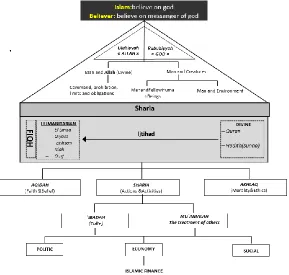
Http://www.ijetmr.com©International Journal of Engineering Technologies and Management Research [24] understanding, the interpretation and the application of the Koran and the Sunna. It’s the third source of legislation being situated after the Koran and the Sunna.The Fiqh is also the right Muslim such as it was built by the legal advisers (Ijtihad) who use various processes (the exercise of the reason and the personal judgment by the savants of the Islam), the analogy (Qiyas), the legal preference (Istihsan), the general interest (Islah) and the customs or the traditions (Ourf). When the specialists in Fiqh recognize the validity of one of the opinions released with these processes, this one takes strength of law.
So, the Islamic finance leans essentially on the sharia. So, the Sharia can be classified into three main components; namely, Aqidah, Sharia and Akhlaq. Sharia consists of two main elements, which are `Ibadah and Mu`amalah. `Ibadah relates to the practices devoted to Allah, whereas, Mu`amalah involves the relationship among human beings for their benefit. Mu`amalah generally covers three main elements, which are politic, social and economic. Therefore, the relationship between Tawhid and Sharia under which the concept of Mu’amalah stems from is depicted in figure 1
Figure 1: The Framework of Islamic Finance