Bilingually-Guided Monolingual Dependency Grammar Induction
Kai Liu†§, Yajuan L ¨u†, Wenbin Jiang†, Qun Liu‡†
†Key Laboratory of Intelligent Information Processing Institute of Computing Technology, Chinese Academy of Sciences
P.O. Box 2704, Beijing 100190, China
{liukai,lvyajuan,jiangwenbin,liuqun}@ict.ac.cn
‡Centre for Next Generation Localisation
Faculty of Engineering and Computing, Dublin City University [email protected]
§University of Chinese Academy of Sciences
Abstract
This paper describes a novel strategy for automatic induction of a monolingual de-pendency grammar under the guidance of bilingually-projected dependency. By moderately leveraging the dependency in-formation projected from the parsed coun-terpart language, and simultaneously min-ing the underlymin-ing syntactic structure of the language considered, it effectively in-tegrates the advantages of bilingual pro-jection and unsupervised induction, so as to induce a monolingual grammar much better than previous models only using bilingual projection or unsupervised in-duction. We induced dependency gram-mar for five different languages under the guidance of dependency information pro-jected from the parsed English translation, experiments show that the bilingually-guided method achieves a significant improvement of28.5%over the unsuper-vised baseline and3.0%over the best pro-jection baseline on average.
1 Introduction
In past decades supervised methods achieved the state-of-the-art in constituency parsing (Collins, 2003; Charniak and Johnson, 2005; Petrov et al., 2006) and dependency parsing (McDonald et al., 2005a; McDonald et al., 2006; Nivre et al., 2006; Nivre et al., 2007; Koo and Collins, 2010). For supervised models, the human-annotated corpora on which models are trained, however, are expen-sive and difficult to build. As alternative strate-gies, methods which utilize raw texts have been in-vestigated recently, including unsupervised
meth-ods which use only raw texts (Klein and Man-ning, 2004; Smith and Eisner, 2005; William et al., 2009), and semi-supervised methods (Koo et al., 2008) which use both raw texts and annotat-ed corpus. And there are a lot of efforts have also been devoted to bilingual projection (Chen et al., 2010), which resorts to bilingual text with one lan-guage parsed, and projects the syntactic informa-tion from the parsed language to the unparsed one (Hwa et al., 2005; Ganchev et al., 2009).
In dependency grammar induction, unsuper-vised methods achieve continuous improvements in recent years (Klein and Manning, 2004; Smith and Eisner, 2005; Bod, 2006; William et al., 2009; Spitkovsky et al., 2010). Relying on a predefined distributional assumption and iteratively maximiz-ing an approximate indicator (entropy, likelihood, etc.), an unsupervised model usually suffers from two drawbacks, i.e., lower performance and high-er computational cost. On the contrary, bilin-gual projection (Hwa et al., 2005; Smith and Eis-ner, 2009; Jiang and Liu, 2010) seems a promis-ing substitute for languages with a large amount of bilingual sentences and an exist-ing parser of the counterpart language. By project-ing syntactic structures directly (Hwa et al., 2005; Smith and Eisner, 2009; Jiang and Liu, 2010) across bilingual texts or indirectly across multi-lingual texts (Snyder et al., 2009; McDonald et al., 2011; Naseem et al., 2012), a better depen-dency grammar can be easily induced, if syntactic isomorphism is largely maintained between target and source languages.
Unsupervised induction and bilingual projec-tion run according to totally different principles, the former mines the underlying structure of the monolingual language, while the latter leverages the syntactic knowledge of the parsed
Bilingual corpus Joint Optimization
Bilingually-guided Parsing model Unsupervised
objective
Projection objective Random
Treebank
Evolved treebank Target
sentences
Source
[image:2.595.158.440.67.171.2]sentences projection
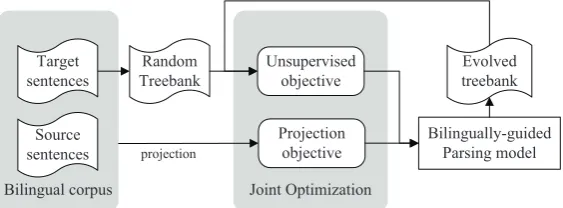
Figure 1: Training the bilingually-guided parsing model by iteration.
part language. Considering this, we propose a novel strategy for automatically inducing a mono-lingual dependency grammar under the guidance of bilingually-projected dependency information, which integrates the advantage of bilingual pro-jection into the unsupervised framework. A randomly-initialized monolingual treebank evolves in a self-training iterative procedure, and the grammar parameters are tuned to simultane-ously maximize both the monolingual likelihood and bilingually-projected likelihood of the evolv-ing treebank. The monolevolv-ingual likelihood is sim-ilar to the optimization objectives of convention-al unsupervised models, while the bilinguconvention-ally- bilingually-projected likelihood is the product of the bilingually-projected probabilities of dependency trees. By moderately leveraging the dependency information projected from the parsed counterpart language, and simul-taneously mining the underlying syntactic struc-ture of the language considered, we can automat-ically induce a monolingual dependency grammar which is much better than previous models only using bilingual projection or unsupervised induc-tion. In addition, since both likelihoods are fun-damentally factorized into dependency edges (of the hypothesis tree), the computational complexi-ty approaches to unsupervised models, while with much faster convergence. We evaluate the final automatically-induced dependency parsing mod-el on 5 languages. Experimental results show that our method significantly outperforms previ-ous work based on unsupervised method or indi-rect/direct dependency projection, where we see an average improvement of 28.5% over unsuper-vised baseline on all languages, and the improve-ments are 3.9%/3.0% over indirect/direct base-lines. And our model achieves the most signif-icant gains on Chinese, where the improvements are 12.0%, 4.5% over indirect and direct projec-tion baselines respectively.
In the rest of the paper, we first describe the un-supervised dependency grammar induction frame-work in section 2 (where the unsupervised op-timization objective is given), and introduce the bilingual projection method for dependency pars-ing in section 3 (where the projected optimiza-tion objective is given); Then in secoptimiza-tion 4 we present the bilingually-guided induction strategy for dependency grammar (where the two objec-tives above are jointly optimized, as shown in Fig-ure 1). After giving a brief introduction of previ-ous work in section 5, we finally give the experi-mental results in section 6 and conclude our work in section 7.
2 Unsupervised Dependency Grammar Induction
In this section, we introduce the unsupervised ob-jective and the unsupervised training algorithm which is used as the framework of our bilingually-guided method. Unlike previous unsupervised work (Klein and Manning, 2004; Smith and Eis-ner, 2005; Bod, 2006), we select a self-training approach (similar to hard EM method) to train the unsupervised model. And the framework of our unsupervised model builds a random treebank on the monolingual corpus firstly for initialization and trains a discriminative parsing model on it. Then we use the parser to build an evolved tree-bank with the 1-best result for the next iteration run. In this way, the parser and treebank evolve in an iterative way until convergence. Let’s introduce the parsing objective firstly:
Defineei as the ith word in monolingual
sen-tenceE;deijdenotes the word pair dependency
re-lationship (ei →ej). Based on the features around
deij, we can calculate the probability P r(y|deij)
as:
P r(y|deij) =
1
Z(deij)
exp(X
n
λn·fn(deij, y)) (1)
whereyis the category of the relationship ofdeij:
y = +means it is the probability that the word pair deij can form a dependency arc and y = −
means the contrary. λndenotes the weight for
fea-ture functionfn(deij, y), and the features we used
are presented in Table 1 (Section 6). Z(deij)is a
normalizing constant:
Z(deij) = X
y
exp(X
n
λn·fn(deij, y)) (2)
Given a sentenceE, parsing a dependency tree is to find a dependency tree DE with maximum
probabilityPE:
PE = arg max DE
Y
deij∈DE
P r(+|deij) (3)
2.1 Unsupervised Objective
We select a simple classifier objective function as the unsupervised objective function which is in-stinctively in accordance with the parsing objec-tive:
θ(λ) = Y
de∈DE
P r(+|de) Y
de∈DeE
P r(−|de) (4)
where E is the monolingual corpus andE ∈ E,
DEis the treebank that contains allDEin the
cor-pus, andDeE denotes all other possible dependen-cy arcs which do not exist in the treebank.
Maximizing the Formula (4) is equivalent to maximizing the following formula:
θ1(λ) =
X
de∈DE
logP r(+|de)
+ X
de∈DeE
logP r(−|de)
(5)
Since the size of edges between DE and DeE is disproportionate, we use an empirical value to re-duce the impact of the huge number of negative instances:
θ2(λ) =
X
de∈DE
logP r(+|de)
+|DE|
|DeE|
X
de∈DeE
logP r(−|de)
(6)
where|x|is the size ofx.
Algorithm 1 Training unsupervised model
1: build random DE 2: λ←train(DE,DeE)
3: repeat
4: for eachE∈Edo ⊲E step 5: DE←parse(E, λ)
6: λ←train(DE,DeE) ⊲M step 7: until convergence
Bush held a talk with Sharon bushi yu shalong juxing le huitan
Ă Ă
[image:3.595.306.530.73.232.2]ᏗҔ Ϣ ≭啭 В㸠 њ Ӯ䇜
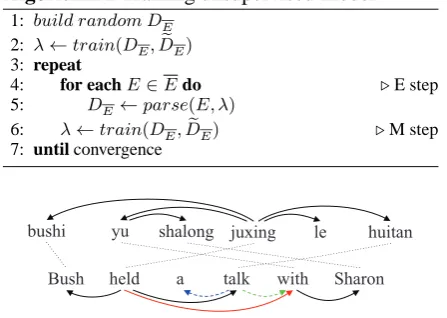
Figure 2: Projecting a Chinese dependency tree to English side according to DPA. Solid arrows are projected dependency arcs; dashed arrows are missing dependency arcs.
2.2 Unsupervised Training Algorithm
Algorithm 1 outlines the unsupervised training in its entirety, where the treebank DE and unsuper-vised parsing model withλare updated iteratively. In line 1 we build a random treebank DE on the monolingual corpus, and then train the parsing model with it (line 2) through a training procedure
train(·,·)which needsDE andDeE as classifica-tion instances. From line 3-7, we train the unsu-pervised model in self training iterative procedure, where line 4-5 are similar to the E-step in EM al-gorithm where calculates objective instead of ex-pectation of 1-best tree (line 5) which is parsed according to the parsing objective (Formula 3) by parsing process parse(·,·), and update the tree bank with the tree. Similar to M-step in EM, the algorithm maximizes the whole treebank’s unsu-pervised objective (Formula 6) through the train-ing procedure (line 6).
3 Bilingual Projection of Dependency Grammar
In this section, we introduce our projection objec-tive and training algorithm which trains the model with arc instances.
Algorithm 2 Training projection model
1: DP, DN←proj(F , DF, A, E)
2: repeat ⊲ train(DP, DN)
3: ∇φ←grad(DP, DN, φ(λ))
4: λ←climb(φ,∇φ, λ)
5: until maximization
language to the target language. Therefore, we can hardly obtain a treebank with complete trees through direct projection. So we extract projected discrete dependency arc instances instead of tree-bank as training set for the projected grammar in-duction model.
3.1 Projection Objective
Correspondingly, we select an objective which has the same form with the unsupervised one:
φ(λ) = X
de∈DP
logP r(+|de)
+ X
de∈DN
logP r(−|de)
(7)
whereDP is the positive dependency arc instance
set, which is obtained by direct projection methods (Hwa et al., 2005; Jiang and Liu, 2010) andDN is
the negative one.
3.2 Projection Algorithm
Basically, the training procedure in line 2,7 of Al-gorithm 1 can be divided into smaller iterative steps, and Algorithm 2 outlines the training step of projection model with instances. F in Algo-rithm 2 is source sentences in bilingual corpus, and A is the alignments. Function grad(·,·,·) gives the gradient (∇φ) and the objective is op-timized with a generic optimization step (such as an LBFGS iteration (Zhu et al., 1997)) in the sub-routineclimb(·,·,·).
4 Bilingually-Guided Dependency Grammar Induction
This section presents our bilingually-guided gram-mar induction model, which incorporates unsuper-vised framework and bilingual projection model through a joint approach.
According to following observation: unsuper-vised induction model mines underlying syntactic structure of the monolingual language, however, it is hard to find good grammar induction in the ex-ponential parsing space; bilingual projection ob-tains relatively reliable syntactic knowledge of the
parsed counterpart, but it possibly contains a lot of noises (e.g. Figure 2). We believe that unsu-pervised model and projection model can comple-ment each other and a joint model which takes bet-ter use of both unsupervised parse trees and pro-jected dependency arcs can give us a better parser. Based on the idea, we propose a nov-el strategy for training monolingual grammar in-duction model with the guidance of unsuper-vised and bilingually-projected dependency infor-mation. Figure 1 outlines our bilingual-guided grammar induction process in its entirety. In our method, we select compatible objectives for unsu-pervised and projection models, in order to they can share the same grammar parameters. Then we incorporate projection model into our iterative unsupervised framework, and jointly optimize un-supervised and projection objectives with evolv-ing treebank and constant projection information respectively. In this way, our bilingually-guided model’s parameters are tuned to simultaneous-ly maximizing both monolingual likelihood and bilingually-projected likelihood by 4 steps:
1. Randomly build treebank on target sentences for initialization, and get the projected arc in-stances through projection from bitext.
2. Train the bilingually-guided grammar induc-tion model by multi-objective optimizainduc-tion method with unsupervised objective and pro-jection objective on treebank and projected arc instances respectively.
3. Use the parsing model to build new treebank on target language for next iteration.
4. Repeat steps 1, 2 and 3 until convergence.
The unsupervised objective is optimized by the loop—”tree bank→optimized model→new tree bank”. The treebank is evolved for runs. The unsupervised model gets projection constraint im-plicitly from those parse trees which contain in-formation from projection part. The projection ob-jective is optimized by the circulation—”projected instances→optimized model”, these projected in-stances will not change once we get them.
4.1 Joint Objective
For multi-objective optimization method, we em-ploy the classical weighted-sum approach which just calculates the weighted linear sum of the ob-jectives:
OBJ =X
m
weightmobjm (8)
We combine the unsupervised objective (For-mula (6)) and projection objective (For(For-mula (7)) together through the weighted-sum approach in Formula (8):
ℓ(λ) =αθ2(λ) + (1−α)φ(λ) (9)
where ℓ(λ) is our weight-sum objective. And α
is a mixing coefficient which reflects the relative confidence between the unsupervised and projec-tion objectives. Equally,αand(1−α)can be seen as the weights in Formula (8). In that case, we can use a single parameter α to control both weights for different objective functions. Whenα = 1it is the unsupervised objective function in Formula (6). Contrary, ifα = 0, it is the projection objec-tive function (Formula (7)) for projected instances. With this approach, we can optimize the mixed parsing model by maximizing the objective in For-mula (9). Though the function (ForFor-mula (9)) is an interpolation function, we use it for training instead of parsing. In the parsing procedure, our method calculates the probability of a dependency arc according to the Formula (2), while the inter-polating method calculates it by:
P r(y|deij) =αP r1(y|deij)
+ (1−α)P r2(y|deij)
(10)
whereP r1(y|deij)andP r2(y|deij)are the
proba-bilities provided by different models.
4.2 Training Algorithm
We optimize the objective (Formula (9)) via a gradient-based search algorithm. And the gradi-ent with respect toλktakes the form:
∇ℓ(λk) =α
∂θ2(λ) ∂λk
+ (1−α)∂φ(λ)
∂λk
(11)
Algorithm 3 outlines our joint training proce-dure, which tunes the grammar parameterλ simul-taneously maximize both unsupervised objective
Algorithm 3 Training joint model
1: DP, DN←proj(F , DF, A, E)
2: build random DE 3: λ←train(DP, DN)
4: repeat
5: for eachE∈Edo ⊲E step 6: DE←parse(E, λ)
7: ∇ℓ(λ)←grad(DE,DeE, DP, DN, ℓ(λ))
8: λ←climb(ℓ(λ),∇ℓ(λ), λ) ⊲M step 9: until convergence
and projection objective. And it incorporates un-supervised framework and projection model algo-rithm together. It is grounded on the work which uses features in the unsupervised model (Berg-Kirkpatrick et al., 2010).
In line 1, 2 we get projected dependency in-stances from source side according to projec-tion methods and build a random treebank (step 1). Then we train an initial model with projection instances in line 3. From line 4-9, the objective is optimized with a generic optimization step in the subroutineclimb(·,·,·,·,·). For each sentence we parse its dependency tree, and update the tree into the treebank (step 3). Then we calculate the gra-dient and optimize the joint objective according to the evolved treebank and projected instances (step 2). Lines 5-6 are equivalent to the E-step of the EM algorithm, and lines 7-8 are equivalent to the M-step.
5 Related work
The DMV (Klein and Manning, 2004) is a single-state head automata model (Alshawi, 1996) which is based on POS tags. And DMV learns the gram-mar via inside-outside re-estimation (Baker, 1979) without any smoothing, while Spitkovsky et al. (2010) utilizes smoothing and learning strategy during grammar learning and William et al. (2009) improves DMV with richer context.
Type Feature Template
Unigram wordi posi wordi◦posi
wordj posj wordj◦posj
Bigram wordi◦posj wordj◦posi posi◦posj
wordi◦wordj wordi◦posi◦wordj wordi◦wordj◦posj wordi◦posi◦posj posi◦wordj◦posj
wordi◦posi◦wordj◦posj
Surrounding posi−1◦posi◦posj posi◦posi+1◦posj posi◦posj−1◦posj posi◦posj◦posj+1 posi−1◦posi◦posj−1 posi◦posi+1◦posj+1 posi−1◦posj−1◦posj posi+1◦posj◦posj+1 posi−1◦posi◦posj+1 posi◦posi+1◦posj−1 posi−1◦posj◦posj+1 posi+1◦posj−1◦posj posi−1◦posi◦posj−1◦posj posi◦posi+1◦posj◦posj+1
[image:6.595.91.507.63.188.2]posi◦posi+1◦posj−1◦posj posi−1◦posi◦posj◦posj+1
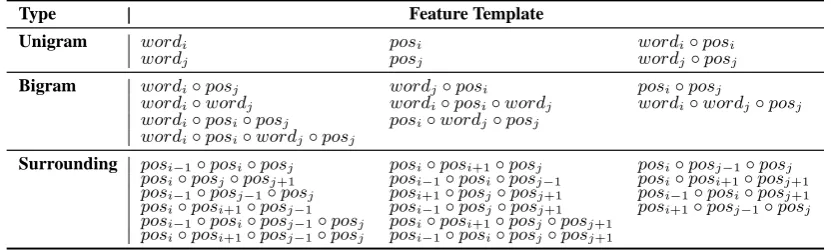
Table 1: Feature templates for dependency parsing. For edgedeij:wordi is the parent word andwordj
is the child word, similar to ”pos”. ”+1” denotes the preceding token of the sentence, similar to ”-1”.
for dependency projection and annotation, which requires a small set of dependency annotated cor-pus of target language.
Similarly, using indirect information from mul-tilingual (Cohen et al., 2011; T¨ackstr¨om et al., 2012) is an effective way to improve unsupervised parsing. (Zeman and Resnik, 2008; McDonald et al., 2011; Søgaard, 2011) employ non-lexicalized parser trained on other languages to process a target language. McDonald et al. (2011) adapts their multi-source parser according to DCA, while Naseem et al. (2012) selects a selective sharing model to make better use of grammar information in multi-sources.
Due to similar reasons, many works are devoted to POS projection (Yarowsky et al., 2001; Shen et al., 2007; Naseem et al., 2009), and they also suf-fer from similar problems. Some seek for unsu-pervised methods, e.g. Naseem et al. (2009), and some further improve the projection by a graph-based projection (Das and Petrov, 2011).
Our model differs from the approaches above in its emphasis on utilizing information from both sides of bilingual corpus in an unsupervised train-ing framework, while most of the work above only utilize the information from a single side.
6 Experiments
In this section, we evaluate the performance of the MST dependency parser (McDonald et al., 2005b) which is trained by our bilingually-guided model on 5 languages. And the features used in our ex-periments are summarized in Table 1.
6.1 Experiment Setup
Datasets and Evaluation Our experiments are
run on five different languages: Chinese(ch), Danish(da), Dutch(nl), Portuguese(pt) and
Swedish(sv) (da, nl, pt and sv are free data sets distributed for the 2006 CoNLL Shared Tasks (Buchholz and Marsi, 2006)). For all languages, we only use English-target parallel data: we take the FBIS English-Chinese bitext as bilingual cor-pus for English-Chinese dependency projection which contains 239K sentence pairs with about 8.9M/6.9M words in English/Chinese, and for other languages we use the readily available data in the Europarl corpus. Then we run tests on the Penn Chinese Treebank (CTB) and CoNLL-X test sets.
English sentences are tagged by the implemen-tations of the POS tagger of Collins (2002), which is trained on WSJ. The source sentences are then parsed by an implementation of 2nd-ordered MST model of McDonald and Pereira (2006), which is trained on dependency trees extracted from Penn Treebank.
As the evaluation metric, we use parsing accu-racy which is the percentage of the words which have found their correct parents. We evaluate on sentences with all length for our method.
Training Regime In experiments, we use the
projection method proposed by Jiang and Liu (2010) to provide the projection instances. And we train the projection partα= 0first for initial-ization, on which the whole model will be trained. Availing of the initialization method, the model can converge very fast (about 3 iterations is suffi-cient) and the results are more stable than the ones trained on random initialization.
Baselines We compare our method against
(M-60.0 61.5
ch
50.3 51.2
da
59.5 60.5
accuracy% nl
70.5 74.5
pt
61.5 65.0
0.1 0.2 0.3 0.4 0.5 0.6 0.7 0.8 0.9 1
alpha
[image:7.595.307.529.62.170.2]sv
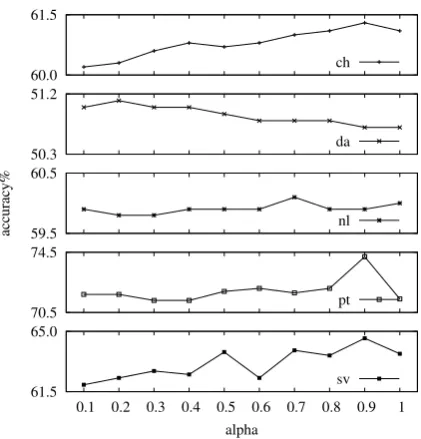
Figure 3: The performance of our model with re-spect to a series of ratioα
cDonald et al., 2011; Naseem et al., 2012).
6.2 Results
We test our method on CTB and CoNLL-X free test data sets respectively, and the performance is summarized in Table 2. Figure 3 presents the per-formance with differentαon different languages.
Compare against Unsupervised Baseline
Ex-perimental results show that our unsupervised framework’s performance approaches to the DMV method. And the bilingually-guided model can promote the unsupervised method consisten-cy over all languages. On the best results’ aver-age of four comparable languaver-ages (da, nl, pt, sv), the promotion gained by our model is 28.5% over the baseline method (DMV) (Klein and Manning, 2004).
Compare against Projection Baselines For all languages, the model consistent-ly outperforms on direct projection baseline. On the average of each language’s best result, our model outperforms all kinds of baselines, yielding 3.0% gain over the single-source direct-projection method (Jiang and Liu, 2010) and 3.9% gain over the multi-source indirect-projection method (Mc-Donald et al., 2011). On the average of all results with different parameters, our method also gain-s more than 2.0% improvementgain-s on all bagain-selinegain-s. Particularly, our model achieves the most signif-icant gains on Chinese, where the improvements are 4.5%/12.0% on direct/indirect projection
base-Accuracy%
Model ch da nl pt sv avg
DMV 42.5∗ 33.4 38.5 20.1 44.0 —.–
DPA 53.9 —.– —.– —.– —.– —.–
WPC 56.8 50.1 58.4 70.5 60.8 59.3
Transfer 49.3 49.5 53.9 75.8 63.6 58.4 Selective 51.2 —.– 55.9 73.5 61.5 —.– unsuper 22.6 41.6 15.2 45.7 42.4 33.5
avg 61.0 50.7 59.9 72.0 63.1 61.3
max 61.3 51.1 60.1 74.2 64.6 62.3
Table 2: The directed dependency accuracy with different parameter of our model and the base-lines. The first section of the table (row 3-7) shows the results of the baselines: a unsupervised method baseline (Klein and Manning, 2004)(D-MV); a single-source projection method baseline (Hwa et al., 2005) (DPA) and its improve-ment (Jiang and Liu, 2010)(WPC); two multi-source baselines (McDonald et al., 2011)(Trans-fer) and (Naseem et al., 2012)(Selective). The second section of the table (row 8) presents the result of our unsupervised framework (unsuper). The third section gives the mean value (avg) and maximum value (max) of our model with different
αin Figure 3.
*: The result is based on sentences with 10 words or less after the removal of punctuation, it is an incomparable result.
lines.
The results in Figure 3 prove that our unsuper-vised frameworkα= 1can promote the grammar induction if it has a good start (well initialization), and it will be better once we incorporate the infor-mation from the projection side (α = 0.9). And the maximum points are not inα = 1, which im-plies that projection information is still available for the unsupervised framework even if we employ the projection model as the initialization. So we suggest that a greater parameter is a better choice for our model. And there are some random factors in our model which make performance curves with more fluctuation. And there is just a little improve-ment shown inda, in which the same situation is observed by (McDonald et al., 2011).
6.3 Effects of the Size of Training Corpus
To investigate how the size of the training corpus influences the result, we train the model on ex-tracted bilingual corpus with varying sizes: 10K, 50K, 100K, 150K and 200K sentences pairs.
[image:7.595.76.287.64.284.2]53 54 55 56 57 58 59 60 61 62 63
10K 50K 100K 150K 200K
accuracy%
size of training set our model
[image:8.595.84.273.64.199.2]baseline
Figure 4: Performance on varying sizes (average of 5 languages,α= 0.9)
51 52 53 54 55 56 57 58 59 60 61 62 63
0 0.05 0.1 0.15 0.2 0.25 0.3 0.35
accuracy%
noise rate our model
baseline
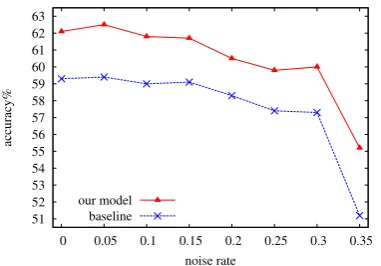
Figure 5: Performance on different projection quality (average of 5 languages, α = 0.9). The noise rate is the percentage of the projected in-stances being messed up.
ously outperforms the baseline with the increasing size of training corpus. It is especially noteworthy that the more training data is utilized the more su-periority our model enjoys. That is, because our method not only utilizes the projection informa-tion but also avails itself of the monolingual cor-pus.
6.4 Effect of Projection Quality
The projection quality can be influenced by the quality of the source parsing, alignments, projec-tion methods, corpus quality and many other fac-tors. In order to detect the effects of varying pro-jection qualities on our approach, we simulate the complex projection procedure by messing up the projected instances randomly with different noise rates. The curves in Figure 5 show the perfor-mance of WPC baseline and our bilingual-guided method. For different noise rates, our model’s re-sults consistently outperform the baselines. When the noise rate is greater than 0.2, our improvement
49.5 ... 54.6 ... 58.2 58.6 59.0 59.4 59.8 60.2
0 0.02 0.04 0.06 0.08 0.1 ... 0.2 ... 0.3
accuracy%
[image:8.595.318.506.65.200.2]alpha our model baseline(58.5)
Figure 6: The performance curve of our model (random initialization) on Chinese, with respect to a series of ratio α. The baseline is the result of WPC model.
increases with the growth of the noise rate. The re-sult suggests that our method can solve some prob-lems which are caused by projection noise.
6.5 Performance on Random Initialization
We test our model with random initialization on different α. The curve in Figure 6 shows the per-formance of our model on Chinese.
The results seem supporting our unsupervised optimization method when α is in the range of (0,0.1). It implies that the unsupervised structure information is useful, but it seems creating a nega-tive effect on the model whenαis greater than 0.1. Because the unsupervised part can gain constraints from the projection part. But with the increase of
α, the strength of constraint dwindles, and the unsupervised part will gradually lose control. And bad unsupervised part pulls the full model down.
7 Conclusion and Future Work
[image:8.595.84.275.258.391.2]resource-rich languages is easy to obtain, such a hybrid method seems to be a better choice for au-tomatic grammar induction. It also indicates that the combination of bilingual constraint and unsu-pervised methodology has a promising prospect for grammar induction. In the future work we will investigate such kind of strategies, such as bilin-gually unsupervised induction.
Acknowledgments
The authors were supported by National Natural Science Foundation of China, Con-tracts 61202216, 863 State Key Project (No. 2011AA01A207), and National Key Technology R&D Program (No. 2012BAH39B03), Key Project of Knowledge Innovation Program of Chi-nese Academy of Sciences (No. KGZD-EW-501). Qun Liu’s work is partially supported by Science Foundation Ireland (Grant No.07/CE/I1142) as part of the CNGL at Dublin City University. We would like to thank the anonymous reviewers for their insightful comments and those who helped to modify the paper.
References
H. Alshawi. 1996. Head automata for speech transla-tion. In Proc. of ICSLP.
James K Baker. 1979. Trainable grammars for speech recognition. The Journal of the Acoustical Society of America, 65:S132.
T. Berg-Kirkpatrick, A. Bouchard-Cˆot´e, J. DeNero, and D. Klein. 2010. Painless unsupervised learn-ing with features. In HLT: NAACL, pages 582–590.
Rens Bod. 2006. An all-subtrees approach to unsu-pervised parsing. In Proc. of the 21st ICCL and the 44th ACL, pages 865–872.
S. Buchholz and E. Marsi. 2006. Conll-x shared task on multilingual dependency parsing. In Proc. of the 2002 Conference on EMNLP. Proc. CoNLL.
Eugene Charniak and Mark Johnson. 2005. Coarse-to-fine n-best parsing and maxent discriminative r-eranking. In Proc. of the 43rd ACL, pages 173–180, Ann Arbor, Michigan, June.
W. Chen, J. Kazama, and K. Torisawa. 2010. Bi-text dependency parsing with bilingual subtree con-straints. In Proc. of ACL, pages 21–29.
S.B. Cohen, D. Das, and N.A. Smith. 2011. Unsu-pervised structure prediction with non-parallel mul-tilingual guidance. In Proc. of the Conference on EMNLP, pages 50–61.
Michael Collins. 2002. Discriminative training meth-ods for hidden markov models: Theory and exper-iments with perceptron algorithms. In Proc. of the 2002 Conference on EMNLP, pages 1–8, July.
Michael Collins. 2003. Head-driven statistical mod-els for natural language parsing. In Computational Linguistics.
D. Das and S. Petrov. 2011. Unsupervised part-of-speech tagging with bilingual graph-based projec-tions. In Proc. of ACL.
K. Ganchev, J. Gillenwater, and B. Taskar. 2009. De-pendency grammar induction via bitext projection constraints. In Proc. of IJCNLP of the AFNLP: Vol-ume 1-VolVol-ume 1, pages 369–377.
R. Hwa, P. Resnik, A. Weinberg, and O. Kolak. 2002. Evaluating translational correspondence using anno-tation projection. In Proc. of ACL, pages 392–399.
R. Hwa, M. Osborne, A. Sarkar, and M. Steedman. 2003. Corrected co-training for statistical parsers. In ICML-03 Workshop on the Continuum from La-beled to UnlaLa-beled Data in Machine Learning and Data Mining, Washington DC.
R. Hwa, P. Resnik, A. Weinberg, C. Cabezas, and O. Kolak. 2005. Bootstrapping parsers via syntactic projection across parallel texts. Natural language engineering, 11(3):311–325.
W. Jiang and Q. Liu. 2010. Dependency parsing and projection based on word-pair classification. In Proc. of ACL, pages 12–20.
D. Klein and C.D. Manning. 2004. Corpus-based in-duction of syntactic structure: Models of dependen-cy and constituendependen-cy. In Proc. of ACL, page 478.
Terry Koo and Michael Collins. 2010. Efficient third-order dependency parsers. In Proc. of the 48th ACL, pages 1–11, July.
T. Koo, X. Carreras, and M. Collins. 2008. Simple semi-supervised dependency parsing. pages 595– 603.
R. McDonald and F. Pereira. 2006. Online learning of approximate dependency parsing algorithms. In Proc. of the 11th Conf. of EACL.
R. McDonald, K. Crammer, and F. Pereira. 2005a. On-line large-margin training of dependency parsers. In Proc. of ACL, pages 91–98.
R. McDonald, F. Pereira, K. Ribarov, and J. Hajiˇc. 2005b. Non-projective dependency parsing using s-panning tree algorithms. In Proc. of EMNLP, pages 523–530.
R. McDonald, S. Petrov, and K. Hall. 2011. Multi-source transfer of delexicalized dependency parsers. In Proc. of EMNLP, pages 62–72. ACL.
T. Naseem, B. Snyder, J. Eisenstein, and R. Barzilay. 2009. Multilingual part-of-speech tagging: Two un-supervised approaches. Journal of Artificial Intelli-gence Research, 36(1):341–385.
Tahira Naseem, Regina Barzilay, and Amir Globerson. 2012. Selective sharing for multilingual dependency parsing. In Proc. of the 50th ACL, pages 629–637, July.
J. Nivre, J. Hall, J. Nilsson, G. Eryi˜git, and S. Mari-nov. 2006. Labeled pseudo-projective dependency parsing with support vector machines. In Proc. of CoNLL, pages 221–225.
J. Nivre, J. Hall, J. Nilsson, A. Chanev, G. Eryigit, S. K¨ubler, S. Marinov, and E. Marsi. 2007. Malt-parser: A language-independent system for data-driven dependency parsing. Natural Language En-gineering, 13(02):95–135.
Slav Petrov, Leon Barrett, Romain Thibaux, and Dan Klein. 2006. Learning accurate, compact, and inter-pretable tree annotation. In Proc. of the 21st ICCL & 44th ACL, pages 433–440, July.
A. Sarkar. 2001. Applying co-training methods to sta-tistical parsing. In Proc. of NAACL, pages 1–8.
L. Shen, G. Satta, and A. Joshi. 2007. Guided learning for bidirectional sequence classification. In Annual Meeting-, volume 45, page 760.
N.A. Smith and J. Eisner. 2005. Contrastive estima-tion: Training log-linear models on unlabeled data. In Proc. of ACL, pages 354–362.
D.A. Smith and J. Eisner. 2009. Parser adapta-tion and projecadapta-tion with quasi-synchronous gram-mar features. In Proc. of EMNLP: Volume 2-Volume 2, pages 822–831.
B. Snyder, T. Naseem, and R. Barzilay. 2009. Unsu-pervised multilingual grammar induction. In Proc. of IJCNLP of the AFNLP: Volume 1-Volume 1, pages 73–81.
Anders Søgaard. 2011. Data point selection for cross-language adaptation of dependency parsers. In Proc. of the 49th ACL: HLT, pages 682–686.
Valentin I. Spitkovsky, Hiyan Alshawi, and Daniel Ju-rafsky. 2010. From baby steps to leapfrog: How “less is more” in unsupervised dependency parsing. In HLT: NAACL, pages 751–759, June.
O. T¨ackstr¨om, R. McDonald, and J. Uszkoreit. 2012. Cross-lingual word clusters for direct transfer of lin-guistic structure.
William, M. Johnson, and D. McClosky. 2009. Im-proving unsupervised dependency parsing with rich-er contexts and smoothing. In Proc. of NAACL, pages 101–109.
D. Yarowsky, G. Ngai, and R. Wicentowski. 2001. Inducing multilingual text analysis tools via robust projection across aligned corpora. In Proc. of HLT, pages 1–8.
Daniel Zeman and Philip Resnik. 2008. Cross-language parser adaptation between related lan-guages. In Proc. of the IJCNLP-08. Proc. CoNLL.