Phase Transformations Induced by Severe Plastic Deformation
Andrey Mazilkin
1,3, Boris Straumal
1,2,3,4,+, Askar Kilmametov
2,3, Petr Straumal
4and Brigitte Baretzky
31Institute of Solid State Physics, Russian Academy of Sciences, 142432 Chernogolovka, Russia
2Chernogolovka Scientific Center of Russian Academy of Sciences, 142432 Chernogolovka, Russia
3Karlsruhe Institute of Technology (KIT), Institute of Nanotechnology, 76344 Eggenstein-Leopoldshafen, Germany 4National University of Science and Technology (MISIS), 119049 Moscow, Russia
Severe plastic deformation (SPD) can induce various phase transformations. After a certain strain, the dynamic equilibrium establishes between defects production by an external force and their relaxation (annihilation). The grain size, hardness, phase composition etc. in this steady-state does not depend on the initial state of a material and is, therefore, equifinal. In this review we discuss the competition between precipitation and dissolution of precipitates, amorphization and (nano)crystallization, SPD-induced accelerated mass-transfer, allotropic and martensitic transitions and formation of grain boundary phases. [doi:10.2320/matertrans.MF201938]
(Received March 1, 2019; Accepted May 15, 2019; Published June 28, 2019)
Keywords: severe plastic deformation, phase transformations, thermodynamics, kinetics
1. Introduction
Severe plastic deformation (SPD) is a novel class of mechanical treatment which permits to apply a very high strain to the material without its failure, which is not possible with traditional methods. SPD always leads to strong grain refinement or even to amorphization of a material. At the same time, SPD can drive the phase transformations.16) In
other words the phases in a material before and after SPD can be different. Frequently, after SPD a material contains such phases as if it was annealed at elevated temperature and then quickly quenched.3)Thus, SPD opens completely new
ways for tailoring microstructure and properties of materials. The understanding of SPD-driven phase transformations is the topic of this review.
2. Steady-State during SPD
The important feature of SPD is that the sample cannot break during straining, and its shape remains more or less unchanged. It is especially well pronounced in case of high pressure torsion (HPT). The small disk between two anvils conserves its shape independently on number of anvil rotations. The torsion can continue until the anvils (typically made of WC-Co alloy) break. For example, in case of HPT of NdFeB alloys the anvils withstand only about 20 rotations7,8) but in case of soft aluminium-, magnesium- or
copper-based alloys HPT can continue up to hundreds or even thousands anvil rotations.913)When the straining starts,
the amount of lattice defects (like vacancies, dislocations, grain boundaries) expectedly increases. However, it would be strange to anticipate that the number of defects would increase infinitely during endless anvil rotations. Even when the HPT proceeds at room temperature when the coefficients of bulk diffusion are below 10¹3010¹40m2/s, the relaxation starts. Its rate increases with increasing concentration of defects until the dynamic equilibrium establishes. In other words, the rate of defects production becomes equal to the rate of their annihilation (relaxation). Here it is appropriate to
mention that usually HPT (and generally SPD) takes place at room temperature and the samples are almost not heated during HPT.14,15)After HPT treatment they are usually just a little bit warm. The direct temperature measurements between anvils witness that the temperature during SPD does not exceed about 40°C.16,17)
Thus, after a certain number of anvil rotations, the rate of defects production becomes equal to the rate of their annihilation (relaxation) and the steady-state is reached.5,18)
The easiest way to observe it is to measure the torsion torque during HPT. It increases during the transient stage, but quickly saturates after 11.5 rotations in case of Al-, Cu-, Mg- or even Ti-based alloys.1,5,13,16,19) In case of harder
alloys like NdFeB the torsion torque saturates after 22.5 anvil rotations.5,7,8) Not only torsion torque, but also the
values of the properties or structural parameters saturate in the steady state. For example, the most prominent feature of SPD is the grain refinement.13,2025)If one starts to deform the material with grain size of several millimetres, it quickly decreases down to few hundreds of nanometers. Then, the grain size reach the steady-state value, stabilises and does not decrease anymore.17,2629) In the same material, the steady-state grain size depends first of all on the SPD mode. For example, the smallest grain size in copper and copper-based alloys of about 15 nm is reached by the ball milling (Fig. 1).30)The second strongest grain refiner is HPT.1,3136)
This is followed by planar twist channel angular extrusion (PTCAE),37) equal channel angular pressing (ECAP),34,38)
equal channel angular pressing with the subsequent HPT (ECAP+HPT),34) equal channel angular pressing with
following cold rolling (ECAP+CR),39) simple shear extrusion (SSE),40,41) and constrained groove pressing (CGP).42)Same tendency is true also for aluminium and its alloys.43) The steady-state grain size is also the function of HPT pressure, strain rate and temperature.5,18) It decreases with increasing melting temperature, atomic bond energy, specific heat capacity and activation energy for self-diffusion.18,44) One has to underline that the grain size in
the dynamic equilibrium is a real steady-state value. It means that it is reached not only“from the top”but also“from the bottom”. In other words, if one starts HPT of steel from the +Corresponding author, E-mail: straumal@issp.ac.ru
Special Issue on Severe Plastic Deformation for Nanomaterials with Advanced Functionality
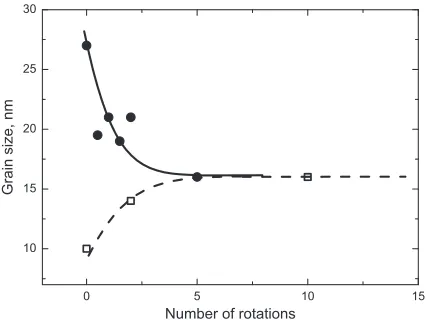
coarse-grained sample, one quickly reaches the grain size of 1520 nm28,4551) (Fig. 2). However, if one starts to deform the nanocrystalline steel sample with grain size of 10 nm produced by mechanical alloying, the grains do not become smaller. To the contrary, they grow during SPD up to the same steady-state value of 1520 nm (Fig. 2).9) Similar
phenomenon was observed also in nickel52,53)and copper.54)
Together with observation of grain refinement, a huge amount of experimental data is collected on the Vickers microhardness during and after SPD of copper, aluminium, titanium, magnesium alloys, steels etc.10,17,29,5567) Usually microhardness increases during SPD.10,17,29,5567)It correlates also with tensile strength.13,24,25,57,60,6870)It is true not only for rotation angle for HPT but also for number of passes during equal channel angular pressing (ECAP).62)The main mechanism here is the Hall-Petch hardening due to the grain refinement.71) Few exclusions only support this fact. For
[image:2.595.63.280.60.230.2]example, in AlZn alloys the Hall-Petch hardening competes with softening driven by the decomposition of (Al) solid solution, and after HPT the alloy is softer than before HPT (Fig. 3).31,56,72,73) Similar to the grain size, the hardness
value is also a function of material and SPD mode. So, if to increase the purity of aluminium, one observes the transition from hardening to softening during HPT.74)Thus, when the initial hardness of an alloy is higher than the steady-state one, then softening rather than hardening is observed during SPD.72)
The decrease of grain size and increase of Vickers microhardness after HPT, ECAP and alternating roll bonding (ARB) correlates with increase of electrical resistivity of copper.62)It is important to underline that different properties
(grain size, hardness, torsion torque, lattice parameter, resistivity etc.) reach steady state not at the same time.
3. Competition between Dissolution of Precipitates and Decomposition of Supersaturated Solid Solution
It has been long time generally believed that SPD always leads to the grain refinement23,75) and to the dissolution of precipitates and formation of supersaturated solid solution. However, we demonstrated above that the grain size decreased during SPD only in the case if the grains in the initial sample before SPD are larger than those in the steady-state. If the grains before SPD are smaller than in the steady state, they will grow during the deformation and reach the same steady-state grain size“from below”(see Fig. 2). This is true also for the SPD-induced hardening/softening (see Fig. 3). Similar is the situation with dissolution/precipitation process. In the steady-state during SPD a certain concen-tration in the solid solution css establishes. Its value is
controlled by the dynamic equilibrium between competing dissolution and precipitation. If the initial concentration in a solid solution cinitis below css, it increases during SPD and
precipitates dissolve. Otherwise, if cinit>css, the
concen-tration of second component in a solid solution decreases and new precipitates appear (so-called dynamic ageing). For the
first time such dynamic ageing has been observed in AlZn alloys.73)Now it is an established topic for investigations and
the instrument for the tailoring the properties of materials.76)
Below, the decomposition of the solid solution in all discussed cases leads to the formation of small particles of the second phase (i.e. to precipitation). Therefore, for this
1 2 3 4 5 6 7 8
10 100 1000 10000
CGP
SSE
ECAP+CR
ECAP ECAP+HPT
PTCAE
HPT
Grain size, nm
SPD mode, a.u.
BM
Fig. 1 Steady-state grain size in copper subjected to the different SPD modes: 1Ball milling (BM),30)2High pressure torsion (HPT),1,3136) 3Planar twist channel angular extrusion (PTCAE),37)4Equal channel angular pressing (ECAP),34,38)5 ECAP+HPT,34)6 Equal channel angular pressing with following cold rolling (ECAP+CR),39)7Simple shear extrusion (SSE),40,41)8Constrained groove pressing (CGP).42)
0 5 10 15
10 15 20 25 30
Grain size, nm
Number of rotations
Fig. 2 Grain size plotted vs. number of torsions for pure coarse-grained steel sample (filled circles)46) and nanocrystalline steel produced by mechanical alloying (open squares).9)
0 1 2 3 4 5
0.5 1.0 1.5 2.0 2.5
Microhardness, GPa
Number of torsions
[image:2.595.317.535.67.227.2] [image:2.595.63.276.318.478.2]discussion we use the terms “decomposition” and “precip-itation”as synonyms.
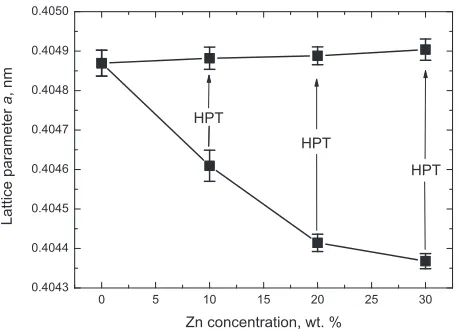
The as-cast AlZn alloys were subjected to HPT at 5 turns, 5 GPa and 1 rpm.73)The coarse-grained supersaturated solid solution (Al) in the as-cast Al30 wt.% Zn alloy contained about 15 wt.%Zn. Zn concentration in the solid solution for Al20 wt.%Zn and Al10 wt.%Zn alloys (measured locally by the electron-probe microanalysis) was 7 and 3 wt.% Zn, correspondingly. In Fig. 4 the respective values for the lattice parameter in (Al) are given, they are well below the lattice parameter in pure aluminium. The HPT at room temperature produced nanograined pure Al and pure Zn particles.20,73)
The supersaturated solid solution also completely decom-posed, and the lattice parameter in all three alloys became non-distinguishable from that of pure aluminium (Fig. 4). The composition of the solid solutions in Al30 wt.% Zn before and after the HPT is shown by black and grey circles in Fig. 5 correspondingly. The decomposition during SPD proceeds extremely quickly. Already after about 0.5 rotations of anvils the lattice spacing becomes equal to that of Al and microhardness reaches its steady-state value.73)
The competition between dissolution of precipitates and decomposition of supersaturated solid solution has been studied in details for the binary copper alloys.6)Physically,
it is the steady-state concentration in the solid solution css
which establishes during SPD. However, in order to compare different binary alloys with different maximal solubilities of a second component, an idea of a so-called effective temper-ature Teff is very useful. Thus, after SPD the concentration cssof a second component in the matrix solid solution is as
high as if the sample has been annealed at a certain (elevated) temperature Teff. In other words,cssis equal to the solubility
of a second component atTeff. The solubility is defined by the
solvus line in the equilibrium binary phase diagram. Consider the example of competition between dissolution and precipitation in CuCo system.32,77,78) The as cast Cu 4.9 wt.% Co alloy contained grains of Cu-based solid solution (with grain size 1020 µm), Co particles with size about 2 µm and fine dispersed Co precipitates with a size about 1020 nm.32,77,78) Cobalt fully dissolved in copper
matrix after annealing at 1060°C for 10 h (sample 2). The grain size after this annealing was about 50 µm. During
annealing at 570°C for 840 h (sample 1), the Cu-based solid solution almost fully decomposed: less than 0.5 wt.% Co remained dissolved in Cu (based on XRD measurements and phase diagram29)).
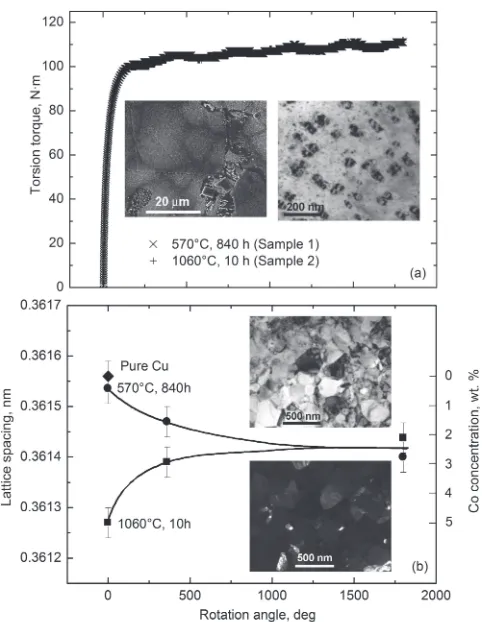
After HPT of both samples the Cu grain size drastically decreased to about 200 nm, and that of Co-precipitates to only 1020 nm (insets in Fig. 6). The lattice parameter of Sample 1 before deformation is very close to that of pure copper (diamond in Fig. 6). With an increasing number of rotations, the lattice parameter of Sample 1 decreased and that of Sample 2 increased. After 5 anvil rotations (1800 deg.) the lattice parameter in both samples becomes almost undistinguishable and corresponds to the solid solution of Co in Cu with nearly 2.5 wt.%. In other words, the composition of the solid solution in the Cu4.9 wt.%Co alloy after HPT does not depend on the initial state prior to HPT. This is a so-calledequifinal composition ceqµ2.5 wt.%
Co. Thus, the steady-state with respect to the grain size, size of Co precipitates, torsion torque and concentration of Co in a solid solution during HPT is indeed equifinal. The composition of Cu-rich matrix in both alloys before and after HPT is shown in the CuCo phase diagram (Fig. 7). The solid solution in samples 1 and 2 after HPT contains as much Coceqµ2.5 wt.%Co, as if they would be annealed atTeff1=
920«30°C and Teff2=870«30°C, respectively.
Here the analogy appears between thermodynamic equi-libriumwhen the composition of phases does not depend on the starting state and equifinality when the composition of phases in a steady-state during SPD also does not depend on the phases in a starting state. The values like equivalent (effective) temperature Teff and steady-state (equifinal)
composition of solid solution ceq are frequently called
attractors in the thermodynamics of non-equilibrium (or open) systems.79)
In Ref. 6) the values of Teff were compared for several
Cu-based alloys CuNi,80) CuCo,32,77,78) CuSn,8183) Cu
In,84,85) CuCr,86) CuAg,8789) CuAlNi90,91) CuHf6)
(Fig. 8). TheTefflinearly increases with increase of activation
0 5 10 15 20 25 30
0.4043 0.4044 0.4045 0.4046 0.4047 0.4048 0.4049 0.4050
HPT
HPT
Lattice parameter
a
, nm
Zn concentration, wt. % HPT
Fig. 4 Dependence of the lattice parameter in aluminium matrix on the total zinc concentration in the AlZn alloys before and after HPT.73)
600
500
400
0 6
0 20 40 80 100
300
200 (Al)
Al
(Zn)
Zn At. % Zn
Wt. % Zn L
T
e
m
per
ature
, °
C
100 700
0 8
0 10 20 30 40 60 100
Teff
= 30-50°C
[image:3.595.56.285.69.234.2] [image:3.595.314.537.72.241.2]enthalpy of bulk tracer diffusionHD. The correlation between
activation enthalpy of bulk tracer diffusion HDand melting
temperature Tm of diffusing alloying component also has
been found. As a result, Tefflinearly increases with increase
of melting temperatureTmof diffusing alloying component as
well. The observed correlations allow one to predict the behaviour and phase transitions in the Cu-based alloys under high pressure torsion.
4. Amorphization and Nanocrystalisation
SPD produces high amount of defects, thus the material is very far from equilibrium during SPD. Nevertheless, one can
use the equilibrium phase diagramsas an instrument for the
Fig. 6 (a) Dependence of torsion torque on the rotation angle. Insets: SEM (left) and bright-field TEM (right) micrographs of Cu4.9 wt.%Co alloy after annealing at 570°C for 840 h. (b) Dependence of lattice spacing on the rotation angle. Circles mark the lattice spacing in Sample 1 annealed at 570°C for 840 h. Squares correspond to the Sample 2 annealed at 1060°C for 10 h. Diamond shows the lattice spacing for pure copper. The respective Co concentration is shown on the right vertical axis, ceqµ 2.5 wt.% Co. Insets: Bright-field (top) and dark-field (bottom) TEM micrographs of Cu4.9 wt.%Co alloy after annealing at 570°C for 840 h and HPT (6 GPa, 5 rot, 1 rpm).32)
700 800 900 1000 1100 1200 1300 1400
In In
Sn Sn Al
Ag
Co Co
Hf Cr
Effective temperature, K
Activation enthalphy of bulk diffusion, kJ/mol
160 180 200 220 240 6000 500 1000 1500 2000 2500 3000
800 1000 1200 1400
Al
Hf Cr
Co
Ag
Sn
Effective temperature, K
Melting temperature, K In
(a) (b)
Fig. 8 (a) Dependence between effective temperature of HPT treatmentTeffof copper-based solid solutions and activation enthalpy of bulk tracer diffusionHDof alloying element.6)(b) Correlation between effective temperatureTeffand melting temperatureTmof alloying element in various Cu-based alloys.
870±30°C 920±30°C
422°C 1084.9°C 1112°C
(Cu)
(αCo)+(Cu)
(εCo)+(Cu)
Cu, wt.% Cu, at.%
80 90 100
80 90 100
400 600 800 1000 1200 1400
L
Temperature, °C
[image:4.595.49.290.66.377.2] [image:4.595.326.527.72.377.2] [image:4.595.81.517.583.750.2]description of phase transformations in the non-equilibrium conditions. This idea goes back to the work of Georges Martin who developed it for the description of phase transformations under strong irradiation.92) His main idea
was that the forced mixing induced by irradiation emulates the increase of entropy and changes the thermodynamic potentials in the alloy. The equilibrium configuration of the solid under irradiationflux¤at temperatureTis identical to the configuration at¤=0 and a certain effective temperature
Teff:
Teff¼Tð1þÞ: ð1Þ
If the irradiation-driven movements of atoms are similar in amplitude to conventional diffusion jumps, they can be described by the “ballistic” diffusion coefficient Dball and
¦=Dball/Db, where Db is conventional bulk diffusion
coefficient, possibly increased due to the non-equilibrium defect concentration.92) It means that one can use the
equilibrium phase diagram for the description of the system under irradiation, but atTeffinstead of the actual temperature T. For example, if the liquid phase is present in the phase diagram at Teff, the amorphous phase would appear under
irradiation.92)Thus, G. Martin proposed tofind a temperature
Teff (usually called effective temperature) in an equilibrium
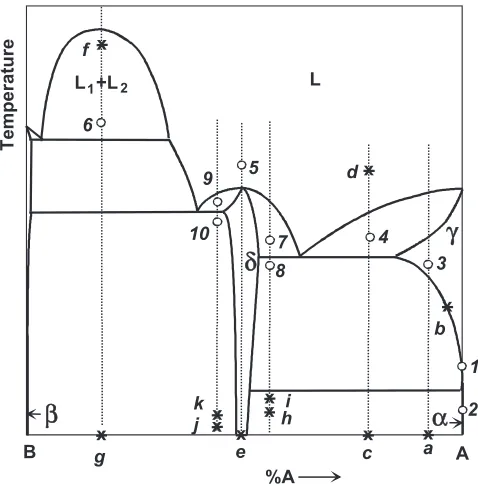
phase diagram where the given phase appears under irradiation. The composition of phases after SPD allows to localize those phases in the respective equilibrium phase diagram and to estimate the effective temperatureTeff. Such a
schematic diagram is shown in Fig. 9. We already used this idea for description of the SPD influence (see Section 3). In our case we use the value of DHPTfor the diffusion-like
mass-transfer induced by HPT instead ofDball.
The obvious example for the Teff approach is the
amorphization. Let us consider first the HPT of NbNiY alloys.93,94) The coarse-grained as-cast Ni20 wt.% Nb30 wt.% Y and Ni18 wt.% Nb22 wt.% Y alloys contained before high pressure torsion (HPT) the NiY, NbNi3, Ni2Y,
Ni7Y2 and Ni3Y phases (pointg, Fig. 9) (Fig. 10(a)).95,96)
After HPT these alloys transformed into a mixture of two nanocrystalline NiY and Nb15Ni2 phases and two different
amorphous phases (one was Y-rich and another Nb-rich) (point 6, Fig. 9). The NiNbY phase diagram contains two immiscible melts above 1440°C (Fig. 10(a)).96) Therefore, the effective temperature is slightly above Te=1440°C and
L
αα
γ
δ
β
1
2 3 4 5
6 L +L1 2
A B
%A
Temperature
a b
c d
e f
g
hi j
k
7 8 9
10
Fig. 9 The schematic binary phase diagram showing the points of HPT deformation or other thermal treatments (stars) and respective confi g-uration points at the (increased) effective temperatures. The dashed vertical lines denote compositions of various alloys. Figurative points corresponding to the effective temperature of the alloys are indicated by an open circle and numbered. Each star point with a letter indicates the composition and temperature of an alloy’s treatment (normal cooling, SPD or rapid quenching).
0.25
0.25 0.25
0.75
0.50
0.50 0.00 1.00
0.00
0.00 1.00
1.00 0.75
0.75
0.50
Ni
Nb
Y Liquid 1 + Liquid 2
(a)
0.25
Nb6Ni7+liquid NbNi3+Nb6Ni7+liquid
liquid+liquid
Ni2Y+Nb6Ni7+liquid
Nb6Ni7+Ni2Y+NiY NbNi3+Nb6Ni7+Ni2Y
liquid
0.15 0.20 0.10
0.05 0.30 0.35
0 0.40
x in Ni0.6Nb0.4-xYx
1200 1400 1600 1800 2000 2200
T, K
(b)
[image:5.595.308.547.69.312.2]Teff = 1450°C
[image:5.595.83.516.539.738.2]can be estimated as Teff=1450°C (Fig. 10(a)). It is
remarkable that the rapid solidification of these alloys from the liquid state (pointf, Fig. 9) also allows obtaining the mixture of two amorphous phases.
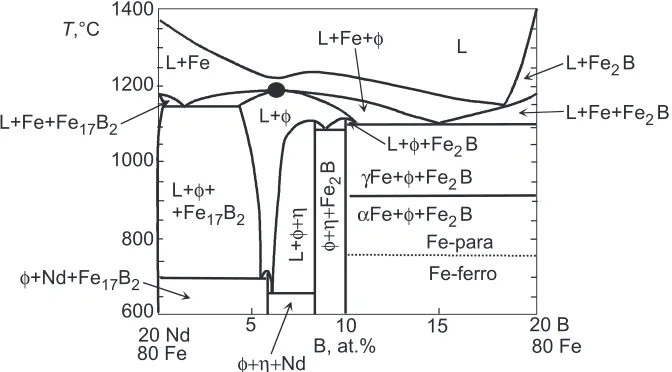
In Refs. 7, 8) the HPT has been used for the treatment of liquid-phase sintered hard magnetic NdFeB-based alloy (5 GPa, 1 rpm, 5 rot, ambient temperature). The amorphiza-tion of the crystalline alloy took place under the acamorphiza-tion of HPT. This permitted to obtain for the first time the mixture of two different amorphous phases with embedded grains of the ferromagnetic Nd2Fe14B phase. The SPD-treatment at
ambient temperature TSPD=300 K is frequently equivalent
to the heat treatment at a certain elevated temperature
Teff>300 K. The composition of phases in the studied
NdFeB-based alloy after HPT corresponds to the state at
Teff³1170°C (Fig. 11).
Especially valuable data on the effective temperature at SPD can be extracted from the results on HPT treatment of Ti48.5 at.% Ni, Ti50.0 at.% Ni and Ti50.7 at.% Ni alloys.97) The HPT of equiatomic Ti50.0 at.% Ni alloy at room temperature (pointe, Fig. 9) resulted in the fully amorphous state (point 5, Fig. 9, Teff=1350°C,
respec-tively). The HPT of the non-equiatomic Ti48.5 at.% Ni alloy at 270°C (pointh) produced the mixture of amorphous and nanocrystalline phases (point 7, Teff=1050°C). When
the HPT temperature of the Ti48.5 at.% Ni alloy increased up to 350°C (point h), only the mixture of nanocrystaline phases formed, without amorphous phase. It means that the corresponding point moved from the position 7 in the ¤+L region into position 8 in the two-phase ¤+£ region and the effective temperature decreased to Teff=950°C. The HPT
of another non-equiatomic Ti50.7 at.% Ni alloy at 200°C (pointj) produced the mixture of amorphous and nano-crystalline phases (point 9, Teff=1250°C). When the HPT
temperature of the Ti50.7 at.% Ni alloy increased up to 250°C (point k), only the mixture of nanocrystaline phases formed, without amorphous phase. It means that the corresponding point moved from the position 9 in the ¤+L region into position 10 in the two-phase¤+¢region and the effective temperature decreased toTeff=1100°C. Therefore,
it can be clearly seen from the data obtained by Prokoshkin
et al.97) that the increase of the HPT treatment temperature leads to the decrease of Teff. It is in full accordance with
the eq. (1) because the increase ofTleads to increase ofDb,
and at the same time the amount of deformation-driven atomic movements characterized by DHPT remains
un-changed. Other examples of amorhization under the action of SPD can be found in Refs. 98103). Nanocrystallization is a process which is opposite to the amorphization. If one applies SPD to the initially amorphous sample, one can observe that the small nanocrystals start to appear.104112)
Obviously, the nanocrystallization and amorphization are also coupled and competing processes like precipitation/ dissolution (see Section 3 above).
5. SPD-Driven Accelerated Mass-Transfer
The discussed SPD-driven phase transformations are connected with redistribution of components and, therefore, with mass transfer. This SPD-driven mass transfer is diffusion-like, in other words by the SPD-driven jump of an atom from one lattice position to another this atom has to overcome the same energetic barrier as during the conventional diffusion.
In Refs. 80, 87) we developed a mass-transfer model for the description of dynamic equilibrium in competitive precipitation and dissolution by the HPT in copper-silver system. This model assumes that HPTfixes the composition at interfaces between copper matrix and silver precipitate. It has been shown that the observed steady-state composition in the matrix and precipitate size are controlled by the HPT-enhanced diffusion-like mass-transfer. We succeeded to calculate the steady-state concentration css using only the
value of bulk diffusion coefficientD. Afterwards we found the Teff value supposing that css is equal to the silver
solubility in copper atTeff. As in the cases discussed above in
Sections 3 and 4, Teff in CuAg alloys was higher than the
HPT temperature THPT. The fact that usually Teff>THPT
means simply that the steady-state concentration of vacancies during HPT is higher than the equilibrium one at THPT. It
could be close to the equilibrium vacancy concentration at
Teff.113,114)
L
L+Fe2B
L+Fe+Fe2B L+Fe+Fe17B2
L+φ+ +Fe17B2
L+φ L+Fe
L+Fe+φ
L+φ+Fe2B
γFe+φ+Fe2B
Fe-ferro Fe-para
φ+η+
Fe
2
B
L+
φ+η
φ+η+Nd
φ+Nd+Fe17B2 T,°C 1400
1200
1000
800
600
80 Fe 20 B 20 Nd
80 Fe
15 10
5
B, at.%
[image:6.595.131.467.72.258.2]αFe+φ+Fe2B
If one substitutes cobalt or silver in the copper-based solid solution, the bulk diffusion coefficientDof an impurity also changes. According to the eq. (1), the higherDwould lead to the lower Teff and lower D requires higher Teff. Figure 8(a)
contains the plot showing nearly linear correlation between activation enthalpy of bulk diffusionHDandTeff. Physically,
such correlation is easy to understand because the high HD
means also high energy barrier for the jumps of alloying atoms between lattice positions in copper. Increased energy barrier for atomic jumps decreases the diffusivity and relaxation rate in the dynamic equilibrium between precipitation and dissolution during HPT. In turn, slow relaxation, increases the steady-state concentration of non-equilibrium lattice defects (vacancies). As a result,Teffwould
increase as well.
The SPD-driven mass transfer proceeds extremely quickly and in ambient conditions without substantial increase of sample temperature.115,116) Usually, the time for
establish-ment of steady-state by HPT is about 25 minutes. It varies by change of pressure, strain rate and HPT temperature, but not more than one order of magnitude. One can estimate the observed SPD-driven mass-transfer using the effective diffusion coefficient and compare it with “conventional” diffusion coefficient at temperature of HPT-treatment and at
Teff.
The SPD-driven phase transformations can also be analyzed when assuming1)that thesteady-stateconcentration
of lattice defects during SPD is higher than that in the equilibrium at the temperature of SPD-treatment, TSPD, and
pressure of the SPD-treatment, PSPD. It has been indeed
observed in the direct measurements of vacancy concen-tration during HPT.115,117)This concentration would be equal
to theequilibriumconcentration of lattice defects at a certain effective temperature Teff.1) In case of CuCo system Teff
amounts to Teff=900°C (Fig. 7). Figure 7 shows the
composition of Cu-rich matrix in both alloys before and after HPT in the CuCo phase diagram. The Cu-rich solid solution in both alloys after HPT contains as much Co
ceqµ2.5 wt.% Co, as if they would be annealed at Teff=
900°C.
The extrapolation of bulk diffusion coefficients toTeffgives D=5©10¹14m2/s for diffusion of Co in Cu118) and D=
10¹13m2/s for self-diffusion in Cu.119)Indeed, the
deforma-tion driven mechanisms can ensure the mass-transfer rate which is comparable to the bulk diffusion fluxes at Teff=
900°C. The bulk diffusion fluxes at 900°C could ensure the decomposition/precipitation rates even if the effect of pressure is taken into account.120,121)
6. Allotropic and Martensitic Transformations
Many elements exist in different allotropic modifications at different temperature and pressure. The most prominent examples are iron, cobalt, titanium. For example, the CoCu alloys before HPT contain the (metastable at room temper-ature) fcc¡-Co phase, but after HPT the¾-Co phase appears in the samples.1,59,60,122)Even more interesting is the situation
in Ti, Zr and Hf where the high-pressure½-phase exists.123)
The Ti, Zr and Hf possess also two different allotropic modifications at ambient pressure, namely the
low-temper-ature hcp¡-phase and high-temperature ¢-phase. HPT leads to the transitions of ¡- and ¢-phases to the ½-phase which remain in the samples after pressure release.123126) The
alloying of titanium with ¢-stabilizers (like Fe, Co or Nb) strongly modifies the ¡-¢-½-transformations.126130) For example, the ¢-to-½-transformation in Ti-alloys is marten-sitic.126128) There are special orientation relationships between ¢ and ½ lattices which ensure the diffusionless martensitic transformations where long-range mass transfer is not needed and the atoms conserve more or less their neighbors before and after transition.131)It has been observed, for example, that iron addition changes the lattice parameters in ¢ and ½ phases in such a way that in the Ti4 wt.% Fe alloy the orientation relationship fulfils optimally. At this concentration the amount of½ phases transformed from the ¢ one reaches almost 100% and decreases by lower and higher Fe concentration.126,127) The metastable ½-phase
disappears by heating around 150°C in pure titanium. However, the alloying can stabilize it up to 500°C.131,132)
HPT of silicon and germanium also leads to the formation of metastable high pressure phases.133,134) In Ref. 135) the single crystalline Si(100) was subjected to HPT at 24 GPa at room temperature. The HPT-processed samples contained lattice defects such as dislocations and nanotwins in diamond-cubic Si-I, and metastable phases such as body-centered-cubic Si-III and hexagonal-diamond Si-IV. In Ref. 134) crystalline Ge disks were subjected to HPT under the nominal pressure of 24 GPa. The samples processed at room temperature consisted of diamond-cubic Ge-I and simple tetragonal Ge-III nanograins in addition to amorphous regions. The samples processed at 77 K consisted of Ge-I as well as residual Ge-III nanograins and some amorphous phase. No other metastable phases such as body-centered-cubic Ge-IV or hexagonal-diamond Ge-V were observed in the cryogenic HPT-processed sample.
Similar to the semiconductors Si and Ge, plastic deformation of oxides is generally very difficult due to their hard and brittle nature resulting from their covalent or ionic bonding. However, the HPT technique allows one to keep the silicon, germanium or oxide samples in the confined space, the samples cannot break of“escape”from the volume between the HPT anvils. This unique feature allows one to reach the high strains in the oxides. Moreover, one can start from powder samples. HPT first compacts the powder and then ensures the deformation. Thus, the opportunity to strain oxides and/or metal/oxide composites is very general.136)
However, here we discuss only the cases where oxides possess different crystal lattices and respective phase transitions can take place.
Crystalline VO2 transformed from the coarse-grained
monoclinic phase to a nanograined triclinic phase with insulating electrical properties by plastic strain effect.137)The anatase-to-rutile phase transformation in TiO2usually occurs
at 1173 K. During HPT of titania ceramic nanopowder the anatase-to-rutile transformation took place at 473573 K.138) The formation of rutile phase was accompanied with dynamic recrystallization and an unusual grain growth. A high-pressure TiO2-II phase (columbite) with the orthorhombic
and remained stable at ambient pressure. TiO2-II was
stabilized in grains with sizes less than ³15 nm because of high energy barrier for reverse phase transformation, while larger grains had the anatase structure.139)
Barium titanate, BaTiO3belongs to the group of perovskite
oxides with the general ABO3 formula. BaTiO3 transforms
under ambient pressure from a rhombohedral structure to an orthorhombic phase at¹90°C, to a ferroelectric tetragonal phase at 5°C, and to a paraelectric cubic phase at 120°C.140143) At ambient temperature, it exhibits a tetrago-nal-to-cubic phase transformation at 2 GPa140143) and it disorders at 5 GPa.144) HPT of tetragonal BaTiO
3 powders
leads to the formation of cubic phase and to strong grain refinement.145)
ZrO2 has a monoclinic phase at room temperature under
ambient pressure, and transforms to a tetragonal phase at 1373 K, a cubic phase at 2673 K, a liquid phase at 2963 K and an orthorhombic phase under pressures above 10 GPa.146)
However, addition of specific elements such as Y to ZrO2
stabilizes the tetragonal phase at room temperature.147) This partially stabilized ZrO2exhibits a phase transformation from
tetragonal to monoclinic.148) During HPT the transformation with a coherent interface occurs from the metastable tetragonal phase to the monoclinic phase.149)
7. Grain Boundary Phase Transitions
Severe plastic deformation drives not only phase trans-formations between 3-dimensional or bulk phases discussed above. SPD can also lead to the various grain boundary (GB) phase transitions. The most prominent GB phase trans-formations like wetting-dewetting ones take place in the two-phase (or multiphase) regions of the bulk phase diagrams.150) In case of complete wetting, the second phase
(liquid or even solid one) forms the continous layer between two grains in the matrix.13,24,151)In this case the contact angle between GB and second phase is zero.152) In case of incomplete (or partial) wetting, the second phase (liquid or solid) forms the chain of individual particles along GB with a certain non-zero contact angle.153,154) If the amount of wetting phase is small, the continous layer between two grains can become very thin, it contains few monolayers of a second component and is just a couple of nanometers thick.155157) If the amount of a second component in GB is
below one monolayer, one speaks about conventional GB adsorption.157,158) If the GB contact angle is high, but the
GB between individual particles of a second phase contains few monolayers of a second component, one speaks about pseudopartial (or psedoincomplete, or constrained complete) GB wetting.159161) The transitions between these different GB states (phases) are called GB transitions, and they also can be driven by SPD, similar to the bulk (or volume) ones. The grain size after SPD is very small. In other words, the specific area of grain boundaries in a volume unit increases. Therefore, the “conventional” grain boundary phase tran-sitions become more pronounced then in the coarse-grained materials. For example, the usage of the ultrafine-grained polycrystals made it possible to observe and measure the thermal effect of the GB premelting phase transforma-tions.162165)In other words, the liquid-like GB layers form
well below the bulk solidus line. As a result, the melting in GBs begins during heating 1015°C earlier than in the bulk.162165) Between bulk and GB solidus the (generally
solid) polycrystal contains thin liquid GBs. Such a materials possesses extremely high plasticity.166171)The high specific density of GBs in the SPD-treated alloys allowed one also to observe the thermal effect of phase transition from incomplete to complete GB wetting.163165) It takes place between bull solidus and liquidus lines.
Even in case of one-layer GB adsorption (i.e. when the concentration of a second component per GB unit area is below one monolayer), the specific area of GBs in SPD-treated polycrystals is so high that a big amount of a second component is needed to fill all GB adsorption layers. These adsorbed GB atoms are taken away from the bulk second phase. As a result, the amount of bulk second phase decreases, it can disappear completely (like, for example, disappears cementite in steels). In such a way, the GB adsorption can apparently shift the lines in the bulk phase diagrams for the ultra-fine grained materials in comparison with their coarse-grained counterparts.170174)
The HPT of the AlZn, AlMg and AlZnMg alloys leads to the formation of 25 nm thin GB layers of Zn-rich phase.75,175183)The contact angle between Zn particles and GB is high, the GB between individual particles of a second phase contains few monolayers of a second component. In other words, here one can speaks about pseudopartial GB wetting.159161) The presence of “soft” Zn-rich GB layers
between grains of“hard”phase leads to a kind of lubricating during GB sliding. As a result, the ultrafine-grained Al-based alloys become superductile.176178,180183)The opposite effect
can also take place. Thus, the second solid phase can form before HPT the continous layers in GBs of a matrix (so-called complete GB wetting). If this phase is hard (like for example in case of CuSn or Mg-based alloys), the soft matrix deform during HPT and its grains are refined, but the hard skeleton of intermetallics in the initial GBs remain more or less intact and ensure the high hardness of an alloy.13,24,76,79)All these SPD-driven GB phenomena are now under intensive investigations.
8. Conclusions
It is frequently observed that the phases in the materials after severe plastic deformation differ from those in the initial state. During SPD established a steady-state, and structure and properties of a material in this steady state do not depend on the initial state and are, therefore, equifinal. The SPD-induced phase transformations proceed very quickly, they include precipitation and dissolution of precipitates, amorph-ization and (nano) crystallamorph-ization, allotropic and martensitic transitions and formation of grain boundary phases.
Acknowledgements
performed in National University of Science and Technology MISiS. It was also partially supported by the state task of ISSP and CSC RAS (A. Mazilkin, B. Straumal, A. Kilmametov, discussion of Cu, Al and Ti alloys).
REFERENCES
1) B.B. Straumal, A.A. Mazilkin, B. Baretzky, E. Rabkin and R.Z. Valiev:Mater. Trans.53(2012) 6371.
2) X. Sauvage, A. Chbihi and X. Quelennec:J. Phys.: Conf. Ser.240
(2010) 012003.
3) B. Straumal, A. Korneva and P. Zięba: Arch. Civ. Mech. Eng.14
(2014) 242249.
4) E.I. Teitel’, L.S. Metlov, D.V. Gunderov and A.V. Korznikov:Phys. Met. Metallogr.113(2012) 11621168.
5) B.B. Straumal, A.R. Kilmametov, Yu. Ivanisenko, A.A. Mazilkin, O.A. Kogtenkova, L. Kurmanaeva, A. Korneva, P. Zięba and B. Baretzky:Int. J. Mater. Res.106(2015) 657664.
6) B.B. Straumal, A.R. Kilmametov, A. Korneva, A.A. Mazilkin, P.B. Straumal, P. Zięba and B. Baretzky:J. Alloys Compd.707(2017) 20 26.
7) B.B. Straumal, A.R. Kilmametov, A.A. Mazilkin, S.G. Protasova, K.I. Kolesnikova, P.B. Straumal and B. Baretzky:Mater. Lett.145(2015) 6366.
8) B.B. Straumal, A.A. Mazilkin, S.G. Protasova, D.V. Gunderov, G.A. López and B. Baretzky:Mater. Lett.161(2015) 735739.
9) C. Borchers, C. Garve, M. Tiegel, M. Deutges, A. Herz, K. Edalati, R. Pippan, Z. Horita and R. Kirchheim:Acta Mater.97(2015) 207215.
10) S. Lee and Z. Horita:Mater. Trans.53(2012) 3845.
11) K. Edalati, S. Toh, M. Watanabe and Z. Horita:Scr. Mater.66(2012) 386389.
12) J.M. Cubero-Sesin and Z. Horita:Mater. Trans.53(2012) 4655.
13) K. Bryła, J. Morgiel, M. Faryna, K. Edalati and Z. Horita:Mater. Lett.
212(2018) 323326.
14) A.A. Mazilkin, B.B. Straumal, S.G. Protasova, O.A. Kogtenkova and R.Z. Valiev:Phys. Solid State49(2007) 868873.
15) B.B. Straumal, O.A. Kogtenkova, S.G. Protasova, P. Zięba, T. Czeppe, B. Baretzky and R.Z. Valiev:J. Mater. Sci.46(2011) 4243 4247.
16) K. Edalati, D.J. Lee, T. Nagaoka, M. Arita, H.S. Kim, Z. Horita and R. Pippan:Mater. Trans.57(2016) 533538.
17) K. Edalati, Y. Hashiguchi, P.H.R. Pereirac, Z. Horita and T.G. Langdon:Mater. Sci. Eng. A714(2018) 167171.
18) K. Edalati and Z. Horita:Acta Mater.59(2011) 68316836.
19) K. Edalati, Z. Horita, T. Furuta and S. Kuramoto:Mater. Sci. Eng. A
559(2013) 506509.
20) A.A. Mazilkin, O.A. Kogtenkova, B.B. Straumal, R.Z. Valiev and B. Baretzky:Def. Diff. Forum237240(2005) 739744.
21) A.A. Mazilkin, B. Baretzky, S. Enders, O.A. Kogtenkova, B.B. Straumal, E.I. Rabkin and R.Z. Valiev:Def. Diff. Forum249(2006) 155160.
22) R. Kulagin, Y. Beygelzimer, Yu. Ivanisenko, A. Mazilkin, B. Straumal and H. Hahn:Mater. Lett.222(2018) 172175.
23) R.Z. Valiev, R.K. Islamgaliev and I.V. Alexandrov:Prog. Mater. Sci.
45(2000) 103189.
24) K. Bryła, M. Krystian, J. Horky, B. Mingler, K. Mroczka, P. Kurtyka and L. Lityńska-Dobrzyńska:Mater. Sci. Eng. A737(2018) 318327.
25) E.A. Lukyanova, N.S. Martynenko, V.N. Serebryany, A.N. Belyakov, L.L. Rokhlin, S.V. Dobatkin and Y.Z. Estrin: Russ. Metall. 2017
(2017) 912921.
26) P. Kral, J. Dvorak, V. Sklenicka, T. Masuda, Z. Horita, K. Kucharova, M. Kvapilova and M. Svobodova:Mater. Sci. Eng. A 723(2018) 287295.
27) S. Sabbaghianrad, S.A. Torbati-Sarraf and T.G. Langdon:Mater. Sci. Eng. A712(2018) 373379.
28) K. Tirsatine, H. Azzeddine, Y. Huang, T. Baudin, A.-L. Helbert, F. Brisset, D. Bradai and T.G. Langdon:J. Alloys Compd.753(2018) 4653.
29) M.Y. Alawadhi, S. Sabbaghianrad, Y. Huanga and T.G. Langdon:
J. Mater. Rest. Technol.6(2017) 369377.
30) M. Azabou, T. Makhlouf, J. Saurin, L. Escoda, J.J. Suñol and M. Khitouni:Int. J. Adv. Manuf. Technol.87(2016) 981987.
31) A.A. Mazilkin, B.B. Straumal, E. Rabkin, B. Baretzky, S. Enders, S.G. Protasova, O.A. Kogtenkova and R.Z. Valiev:Acta Mater.54
(2006) 39333939.
32) B. Straumal, A.R. Kilmametov, Yu.O. Kucheev, L. Kurmanaeva, Yu. Ivanisenko, B. Baretzky, A. Korneva, P. Zięba and D.A. Molodov:
Mater. Lett.118(2014) 111114.
33) Y. Huang, S. Sabbaghianrad, A.I. Almazrouee, K.J. Al-Fadhalah, S.N. Alhajeri and T.G. Langdon:Mater. Sci. Eng. A656(2016) 5566.
34) N. Lugo, N. Llorca, J.M. Cabrera and Z. Horita:Mater. Sci. Eng. A
477(2008) 366371.
35) J.Čížek, M. Janeček, O. Srba, R. Kužel, Z. Barnovská, I. Procházka and S. Dobatkin:Acta Mater.59(2011) 23222329.
36) X.Z. Liao, Y.H. Zhao, Y.T. Zhu, R.Z. Valiev and D.V. Gunderov:
J. Appl. Phys.96(2004) 636640.
37) M. Shamsborhan and M. Ebrahimi: J. Alloys Compd. 682(2016) 552556.
38) C.L. Tang, H. Li and S.Y. Li: Trans. Nonferr. Met. Soc. China26
(2016) 17361744.
39) Z.N. Mao, R.C. Gu, F. Liu, Y. Liu, X.Z. Liao and J.T. Wang:Mater. Sci. Eng. A674(2016) 186192.
40) E. Bagherpour, F. Qods, R. Ebrahimi and H. Miyamoto:Mater. Sci. Eng. A674(2016) 221231.
41) E. Bagherpour, F. Qods, R. Ebrahimi and H. Miyamoto:Mater. Sci. Eng. A666(2016) 324338.
42) P.C. Yadav, A. Sinhal, S. Sahu, A. Roy and S. Shekhar:J. Mater. Eng. Perform.25(2016) 26042614.
43) C. Xu, Z. Horita and T.G. Langdon:Mater. Sci. Eng. A528(2011) 60596065.
44) K. Edalati and Z. Horita:Mater. Sci. Eng. A528(2011) 75147523.
45) A.V. Korznikov, Y.V. Ivanisenko, D.V. Laptionok, I.M. Safarov, V.P. Pilyugin and R.Z. Valiev:Nanostruct. Mater.4(1994) 159167.
46) Y. Ivanisenko, W. Lojkowski, R.Z. Valiev and H.-J. Fecht: Acta Mater.51(2003) 55555570.
47) Y. Ivanisenko, R.K. Wunderlich, R.Z. Valiev and H.-J. Fecht: Scr. Mater.49(2003) 947952.
48) J. Zrnik, R. Pippan, S. Scheriau, L. Kraus and M. Fujda:J. Mater. Sci.
45(2010) 48224826.
49) S. Bayramoglu, C.H. Gür, I.V. Alexandrov and M.M. Abramova:
Mater. Sci. Eng. A527(2010) 927933.
50) J. Ning, E. Courtois-Manara, L. Kurmanaeva, A.V. Ganeev, R.Z. Valiev, C. Kübel and Y. Ivanisenko:Mater. Sci. Eng. A581(2013) 8 15.
51) Y. Todaka, Y. Miki, M. Umemoto, C. Wang and K. Tsuchiya:Mater. Sci. Forum584586(2008) 597602.
52) X.Z. Liao, A.R. Kilmametov, R.Z. Valiev, H. Gao, X. Li, A.K. Mukherjee, J.F. Bingert and Y.T. Zhu:Appl. Phys. Lett.88(2006) 021909.
53) R. Pippan, S. Scheriau, A. Taylor, M. Hafok, A. Hohenwarter and A. Bachmaier:Annu. Rev. Mater. Res.40(2010) 319343.
54) H. Wen, R.K. Islamgaliev, K.M. Nesterov, R.Z. Valiev and E.J. Lavernia:Philos. Mag. Lett.93(2013) 481489.
55) K. Edalati, D. Akama, A. Nishio, S. Lee, Y. Yonenaga, J.M. Cubero-Sesin and Z. Horita:Acta Mater.69(2014) 6877.
56) R. Tejedor, K. Edalati, J.A. Benito, Z. Horita and J.M. Cabrera:Mater. Sci. Eng. A743(2019) 597605.
57) I.F. Mohamed, T. Masuda, S. Lee, K. Edalati, Z. Horita, S. Hirosawa, K. Matsuda, D. Terada and M.Z. Omar:Mater. Sci. Eng. A704(2017) 112118.
58) K. Edalati, H. Shao, H. Emami, H. Iwaoka, E. Akiba and Z. Horita:
Int. J. Hydr. Ener.41(2016) 89178924.
59) M. Isik, M. Niinomi, K. Cho, M. Nakai, H. Liu, H. Yilmazer, Z. Horita, S. Sato and T. Narushima:J. Mech. Behav. Biomed. Mater.59
(2016) 226235.
60) M. Isik, M. Niinomi, H. Liu, K. Cho, M. Nakai, Z. Horita, S. Sato, T. Narushima, H. Yilmazer and M. Nagasako:Mater. Trans.57(2016) 11091118.
61) T. Hongo, K. Edalati, H. Iwaoka, M. Arita, J. Matsuda, E. Akiba and Z. Horita:Mater. Sci. Eng. A618(2014) 18.
123127.
63) A. Hanna, H. Azzeddine, R. Lachha, T. Baudin, A.-L. Helbert, F. Brisset, Y. Huang, D. Bradai and T.G. Langdon:J. Alloys Compd.778
(2019) 6171.
64) Y.I. Bourezg, H. Azzeddine, T. Baudin, A.-L. Helbert, Y. Huang, D. Bradai and T.G. Langdon:Mater. Sci. Eng. A724(2018) 477485.
65) P. Bazarnik, Y. Huang, M. Lewandowska and T.G. Langdon:Mater. Sci. Eng. A712(2018) 513520.
66) D.M.M. Cardona, J. Wongsa-Ngam, H. Jimenez and T.G. Langdon:
J. Mater. Rest. Technol.6(2017) 355360.
67) S.A. Torbati-Sarraf, S. Sabbaghianrad, R.B. Figueiredo and T.G. Langdon:J. Alloys Compd.712(2017) 185193.
68) M. Diez, H.-E. Kim, V. Serebryany, S. Dobatkin and Y. Estrin:Mater. Sci. Eng. A612(2014) 287292.
69) E.A. Lukyanova, N.S. Martynenko, I. Shakhova, A.N. Belyakov, L.L. Rokhlin, S.V. Dobatkin and Y.Z. Estrin:Mater. Lett.170(2016) 59.
70) N.S. Martynenko, E.A. Luk’yanova, M.M. Morozov, V.S. Yusupov, S.V. Dobatkin and Y.Z. Estrin:Met. Sci. Heat Treat.60(2018) 253 258.
71) C.C. Koch, T.G. Langdon and E.J. Lavernia:Metall. Mater. Trans. A
48(2017) 51815199.
72) A.A. Mazilkin, B.B. Straumal, M.V. Borodachenkova, R.Z. Valiev, O.A. Kogtenkova and B. Baretzky:Mater. Lett.84(2012) 6365.
73) B.B. Straumal, B. Baretzky, A.A. Mazilkin, F. Phillipp, O.A. Kogtenkova, M.N. Volkov and R.Z. Valiev:Acta Mater.52(2004) 44694478.
74) Y. Ito, K. Edalati and Z. Horita:Mater. Sci. Eng. A679(2017) 428 434.
75) X. Sauvage, M.Yu. Murashkin, B.B. Straumal, E. Bobruk and R.Z. Valiev:Adv. Eng. Mater.17(2015) 18211827.
76) V.D. Sitdikov, P.S. Chizhov, M.Yu. Murashkin and R.Z. Valiev: Rev. Adv. Mater. Sci.47(2016) 5965.
77) A. Korneva, O. Kogtenkova, S. Protasova, B. Straumal, A. Mazilkin, L. Kurmanaeva and P. Zięba: Inżyn. Materiał.34(4126) (2013) 306 309.
78) B.B. Straumal, S.G. Protasova, A.A. Mazilkin, O.A. Kogtenkova, L. Kurmanaeva, B. Baretzky, G. Schütz, A. Korneva and P. Zięba:Mater. Lett.98(2013) 217221.
79) L. von Bertalanffy:Science111(1950) 2329.
80) B.B. Straumal, S.G. Protasova, A.A. Mazilkin, E. Rabkin, D. Goll, G. Schütz, B. Baretzky and R. Valiev:J. Mater. Sci.47(2012) 360367.
81) B.B. Straumal, A.R. Kilmametov, Yu.O. Kucheev, K.I. Kolesnikova, A. Korneva, P. Zięba and B. Baretzky:JETP Lett.100(2014) 376 379.
82) A. Korneva, B. Straumal, R. Chulist, A. Kilmametov, P. Bała, G. Cios, N. Schell and P. Zięba:Mater. Lett.179(2016) 1215.
83) A. Korneva, B. Straumal, A. Kilmametov, G. Cios, P. Bała and P. Zięba:Mater. Charact.118(2016) 411416.
84) A. Korneva, B. Straumal, O. Kogtenkova, Yu. Ivanisenko, A. Wierzbicka-Miernik, A. Kilmametov and P. Zięba: IOP Conf. Ser.: Mater. Sci. Eng.63(2014) 012093.
85) B.B. Straumal, A.R. Kilmametov, A.A. Mazilkin, L. Kurmanaeva, Y. Ivanisenko, A. Korneva, P. Zięba and B. Baretzky:Mater. Lett.138
(2015) 255258.
86) A. Korneva, B. Straumal, A. Kilmametov, R. Chulist, P. Straumal and P. Zięba:Mater. Charact.114(2016) 151156.
87) B.B. Straumal, V. Pontikis, A.R. Kilmametov, A.A. Mazilkin, S.V. Dobatkin and B. Baretzky:Acta Mater.122(2017) 6071.
88) A. Korneva, B. Straumal, A. Kilmametov, R. Chulist, G. Cios, B. Baretzky and P. Zięba:Materials12(2019) 447.
89) B.B. Straumal, A.R. Kilmametov, O.A. Kogtenkova, A.A. Mazilkin, B. Baretzky, A. Korneva and P. Zięba: Int. J. Mater. Res.110(2019), in press.
90) G.A. López, I. López-Ferreño, A.R. Kilmametov, T. Breczewski, B.B. Straumal, B. Baretzky, M.L. Nó and J. San Juan: Mater. Today: Procs.
2S(2015) S747S750.
91) B.B. Straumal, A.R. Kilmametov, G.A. López, I. López-Ferreño, M.L. Nó, J. San Juan, H. Hahn and B. Baretzky:Acta Mater.125(2017) 274285.
92) G. Martin:Phys. Rev. B30(1984) 14241436.
93) B.B. Straumal, A.A. Mazilkin, S.G. Protasova, D. Goll, B. Baretzky,
A.S. Bakai and S.V. Dobatkin: Kovove Materialy-Metallic Materials
49(2011) 1722.
94) A.A. Mazilkin, G.E. Abrosimova, S.G. Protasova, B.B. Straumal, G. Schütz, S.V. Dobatkin and A.S. Bakai:J. Mater. Sci.46(2011) 4336 4342.
95) U.R. Kattner:JOM49(1997) 1419.
96) N. Mattern, U. Kühn, A. Gebert, A. Schoeps, T. Gemminga and L. Schultz:Mater. Sci. Eng. A449451(2007) 207210.
97) S.D. Prokoshkin, I.Yu. Khmelevskaya, S.V. Dobatkin, I.B. Trubitsyna, E.V. Tatyanin, V.V. Stolyarov and E.A. Prokofiev: Acta Mater. 53
(2005) 27032714.
98) A.V. Sergueeva, C. Song, R.Z. Valiev and A.K. Mukherjee:Mater. Sci. Eng. A339(2003) 159165.
99) X. Sauvage, L. Renaud, B. Deconihout, D. Blavette, D.H. Ping and K. Hono:Acta Mater.49(2001) 389394.
100) T. Miyazaki, D. Terada, Y. Miyajima, C. Suryanarayana, R. Murao, Y. Yokoyama, K. Sugiyama, M. Umemoto, T. Todaka and N. Tsuji:
J. Mater. Sci.46(2011) 42964301.
101) V.V. Stolyarov, D.V. Gunderov, A.G. Popov, V.S. Gaviko and A.S. Ermolenko:J. Alloys Compd.281(1998) 6971.
102) Y. Matsuura, S. Hirosawa, H. Yamamoto, S. Fujimira, M. Sagawa and K. Osamura:Jpn. J. Appl. Phys.24(1985) L635L637.
103) Á. Révész, S. Hóbor, J.L. Lábár, A.P. Zhilyaev and Zs. Kovácz:
J. Appl. Phys.100(2006) 103522.
104) A.M. Glezer, M.R. Plotnikova, A.V. Shalimova and S.V. Dobatkin:
Bull. Russ. Acad. Sci., Physics73(2009) 1233.
105) S. Hóbor, Á. Révész, A.P. Zhilyaev and Zs. Kovácz: Rev. Adv. Mater. Sci.18(2008) 590592.
106) Zs. Kovács, P. Henits, A.P. Zhilyaev and Á. Révész:Scr. Mater.54
(2006) 17331737.
107) G.E. Abrosimova, A.S. Aronin, S.V. Dobatkin, S.D. Kaloshkin, D.V. Matveev, O.G. Rybchenko, E.V. Tatyanin and I.I. Zverkova: J. Metastab. Nanocryst. Mater.24(2005) 6972.
108) Á. Révész, E. Schafler and Zs. Kovács:Appl. Phys. Lett.92(2008) 011910.
109) S. Hóbor, Zs. Kovács, A.P. Zhilyaev, L.K. Varga, P.J. Szabó and Á. Révész:J. Phys.: Conf. Ser.240(2010) 012153.
110) S. Hóbor, Á. Révész, P.J. Szabó, A.P. Zhilyaev, V. Kovács Kis, J.L. Lábár and Zs. Kovács:J. Appl. Phys.104(2008) 033525.
111) P. Henits, Á. Révész, A.P. Zhilyaev and Zs. Kovács:J. Alloys Compd.
461(2008) 195199.
112) Zs. Kovács, P. Henits, A.P. Zhilyaev, N.Q. Chinh and Á. Révész:
Mater. Sci. Forum519521(2006) 13291334.
113) B. Oberdorfer, E.-M. Steyskal, W. Sprengel, W. Puff, M. Zehetbauer, R. Pippan and R. Wuerschum:Phys. Rev. Lett.105(2010) 146101.
114) J. Čížek, O. Melikhova, Z. Barnovská, I. Procházka and R.K. Islamgaliev:J. Phys. Conf. Ser.443(2013) 012008.
115) B.B. Straumal, O.A. Kogtenkova, R.Z. Valiev, P. Zięba and B. Baretzky:Diff. Found.5(2015) 95108.
116) T. Ungár, E. Schafler, P. Hanak, S. Bernstorffand M. Zehetbauer:
Mater. Sci. Eng. A462(2007) 398401.
117) T. Ungár, E. Schafler, P. Hanák, S. Bernstorffand M. Zehetbauer:
Z. Metallk.96(2005) 578583.
118) C.A. Mackliet:Phys. Rev.109(1958) 19641970.
119) S. Fujikawa and K.I. Hirano: Proc. of Yamada Vth Conf. on Point Defects, Defect Interactions in Metals, ed. by J.I. Takamura, M. Doyama and M. Kiritani, (Univ. of Tokyo Press, 1982) pp. 554558. 120) D.A. Molodov, B.B. Straumal and L.S. Shvindlerman:Scr. Metall.18
(1984) 207211.
121) B.B. Straumal, L.M. Klinger and L.S. Shvindlerman:Scr. Metall.17
(1983) 275279.
122) B.B. Straumal, S.G. Protasova, A.A. Mazilkin, B. Baretzky, D. Goll, D.V. Gunderov and R.Z. Valiev:Philos. Mag. Lett.89(2009) 649 654.
123) B.B. Straumal, A.S. Gornakova, A.A. Mazilkin, O.B. Fabrichnaya, M.J. Kriegel, B. Baretzky, J.-Z. Jiang and S.V. Dobatkin:Mater. Lett.
81(2012) 225228.
124) B.B. Straumal, A.S. Gornakova, O.B. Fabrichnaya, M.J. Kriegel, A.A. Mazilkin, B. Baretzky, A.M. Gusak and S.V. Dobatkin:High Temp. Mater. Proc.31(2012) 339350.
Gornakova, M.J. Kriegel, O.B. Fabrichnaya, D. Rafaja and H. Hahn:
Scr. Mater.136(2017) 4649.
126) A. Kilmametov, Yu. Ivanisenko, A.A. Mazilkin, B.B. Straumal, A.S. Gornakova, O.B. Fabrichnaya, M.J. Kriegel, D. Rafaja and H. Hahn:
Acta Mater.144(2018) 337351.
127) B.B. Straumal, A.R. Kilmametov, Yu. Ivanisenko, A.A. Mazilkin, R.Z. Valiev, N.S. Afonikova, A.S. Gornakova and H. Hahn:J. Alloys Compd.735(2018) 22812286.
128) A.R. Kilmametov, Yu. Ivanisenko, B.B. Straumal, A.S. Gornakova, A.A. Mazilkin and H. Hahn:Metals8(2018) 112.
129) A.S. Gornakova, A.B. Straumal, I.I. Khodos, I.B. Gnesin, A.A. Mazilkin, N.S. Afonikova and B.B. Straumal: J. Appl. Phys. 125
(2019) 082522.
130) B.B. Straumal, A. Korneva, A.R. Kilmametov, L. Lityń ska-Dobrzyńska, A.S. Gornakova, R. Chulist, M.I. Karpov and P. Zięba:
Materials12(2019) 426.
131) B.B. Straumal, A.R. Kilmametov, Yu. Ivanisenko, A.S. Gornakova, A.A. Mazilkin, M.J. Kriegel, O.B. Fabrichnaya, B. Baretzky and H. Hahn:Adv. Eng. Mater.17(2015) 18351841.
132) M.J. Kriegel, A. Kilmametov, M. Rudolph, B.B. Straumal, A.S. Gornakova, H. Stöcker, Y. Ivanisenko, O. Fabrichnaya, H. Hahn and D. Rafaja:Adv. Eng. Mater.20(2018) 1700933.
133) B. Chon, Y. Ikoma, M. Kohno, J. Shiomi, M.R. McCartney, D.J. Smith and Z. Horita:Scr. Mater.157(2018) 120123.
134) Y. Ikoma, K. Kumano, K. Edalati, M.R. McCartney, D.J. Smith and Z. Horita:Mater. Charact.132(2017) 132138.
135) Y. Fukushima, Y. Ikoma, K. Edalati, B. Chon, D.J. Smith and Z. Horita:Mater. Charact.129(2017) 163168.
136) Y. Qi, A. Kosinova, A.R. Kilmametov, B.B. Straumal and E. Rabkin:
Mater. Charact.145(2018) 389401.
137) K. Edalati, I. Fujita, X. Sauvage, M. Arita and Z. Horita:J. Alloys Compd.779(2019) 394398.
138) K. Edalati, Q. Wang, H. Razavi-Khosroshahi, H. Emami, M. Fuji and Z. Horita:Scr. Mater.162(2019) 341344.
139) H. Razavi-Khosroshahi, K. Edalati, M. Arita, Z. Horita and M. Fuji:
Scr. Mater.124(2016) 5962.
140) W. Zhong, D. Venderbilt and K.M. Rabe:Phys. Rev. Lett.73(1994) 18611864.
141) T. Ishidate, S. Abe, H. Takahashi and N. Mori:Phys. Rev. Lett.78
(1997) 23972400.
142) S.A. Hayward and E.K.H. Salje:J. Phys.: Condens. Matter14(2002) L599L604.
143) J.J. Wang, P.P. Wu, X.Q. Ma and L.Q. Chen: J. Appl. Phys.108
(2010) 114105.
144) U.D. Venkateswaran, V.M. Naik and R. Naik:Phys. Rev. B58(1998) 1425614260.
145) K. Edalati, M. Arimura, Y. Ikoma, T. Daio, M. Miyata, D.J. Smith and Z. Horita:Mater. Res. Lett.3(2015) 216221.
146) R.C. Garvie, R.H.J. Hannink and R.T. Pascoe: Nature 258(1975) 703704.
147) R.H.J. Hannink, P.M. Kelly and B.C. Muddle:J. Am. Ceram. Soc.83
(2000) 461487.
148) J.M. Leger, P.E. Tomaszewski, A. Atouf and A.S. Pereira:Phys. Rev. B47(1993) 1407514083.
149) K. Edalati, S. Toh, Y. Ikoma and Z. Horita:Scr. Mater.65(2011) 974 977.
150) E.I. Rabkin, L.S. Shvindlerman and B.B. Straumal:Int. J. Mod. Phys. B5(1991) 29893028.
151) B.B. Straumal, O.I. Noskovich, V.N. Semenov, L.S. Shvindlerman, W. Gust and B. Predel:Acta Metall. Mater.40(1992) 795801.
152) B.B. Straumal, W. Gust and T. Watanabe:Mater. Sci. Forum294296
(1999) 411414.
153) B.B. Straumal, A.A. Mazilkin, S.G. Protasova, A.M. Gusak, M.F. Bulatov, A.B. Straumal and B. Baretzky: Rev. Adv. Mater. Sci.38
(2014) 1728.
154) A.B. Straumal, K.V. Tsoi, I.A. Mazilkin, A.N. Nekrasov and K. Bryła: Arch. Metall. Mater.64(2019), in press.
155) L.-S. Chang, B.B. Straumal, E. Rabkin, W. Gust and F. Sommer:
J. Phase Equil.18(1997) 128135.
156) L.-S. Chang, E. Rabkin, B. Straumal, P. Lejcek, S. Hofmann and W. Gust:Scr. Mater.37(1997) 729735.
157) L.-S. Chang, E. Rabkin, B.B. Straumal, S. Hoffmann, B. Baretzky and W. Gust:Defect Diff. Forum156(1998) 135146.
158) B.B. Straumal, P. Zięba and W. Gust:Int. J. Inorg. Mater.3(2001) 11131115.
159) B.B. Straumal, A.O. Rodin, A.E. Shotanov, A.B. Straumal, O.A. Kogtenkova and B. Baretzky:Def. Diff. Forum333(2013) 175192.
160) B.B. Straumal, A.A. Mazilkin, S.G. Protasova, G. Schütz, A.B. Straumal and B. Baretzky:J. Mater. Eng. Perform.25(2016) 3303 3309.
161) B.B. Straumal, A.A. Mazilkin and B. Baretzky: Curr. Opin. Solid State Mater. Sci.20(2016) 247256.
162) B. Straumal, R. Valiev, O. Kogtenkova, P. Zieba, T. Czeppe, E. Bielanska and M. Faryna:Acta Mater.56(2008) 61236131.
163) O.A. Kogtenkova, S.G. Protasova, A.A. Mazilkin, B.B. Straumal, P. Zięba, T. Czeppe and B. Baretzky:J. Mater. Sci.47(2012) 8367 8371.
164) O.A. Kogtenkova, B.B. Straumal, S.G. Protasova, A.S. Gornakova, P. Zięba and T. Czeppe:JETP Lett.96(2012) 380384.
165) O.A. Kogtenkova, P. Zieba, T. Czeppe, L. Lityn’ska-Dobrzynska, B.B. Straumal and A.N. Nekrasov:Bull. Russ. Acad. Sci., Physics77
(2013) 13861390.
166) K. Higashi, T.G. Nieh, M. Mabuchi and J. Wadsworth:Scr. Metall. Mater.32(1995) 10791084.
167) Y. Takayama, T. Tozawa and H. Kato:Acta Mater.47(1999) 1263 1270.
168) H. Iwasaki, T. Mori, M. Mabuchi and K. Higashi: Acta Mater.46
(1998) 63516360.
169) B. Baudelet, M.C. Dang and F. Bordeaux: Scr. Metall. Mater.26
(1992) 573578.
170) M. Mabuchi, K. Higashi, T. Imai and K. Kubo:Scr. Metall.25(1991) 16751680.
171) B.B. Straumal, A.A. Mazilkin, S.G. Protasova, S.V. Dobatkin, A.O. Rodin, B. Baretzky, D. Goll and G. Schütz:Mater. Sci. Eng. A503
(2009) 185189.
172) B.B. Straumal, A.O. Rodin, A.L. Petelin, B. Baretzky, S.G. Protasova, S.V. Dobatkin, J. Dutta Majumdar and I. Manna:Def. Diff. Forum
309310(2011) 5162.
173) B.B. Straumal, S.V. Dobatkin, A.O. Rodin, S.G. Protasova, A.A. Mazilkin, D. Goll and B. Baretzky:Adv. Eng. Mater.13(2011) 463 469.
174) Yu. Ivanisenko, X. Sauvage, A. Mazilkin, A. Kilmametov, J.A. Beach and B.B. Straumal:Adv. Eng. Mater.20(2018) 1800443.
175) B. Straumal, R. Valiev, O. Kogtenkova, P. Zieba, T. Czeppe, E. Bielanska and M. Faryna:Acta Mater.56(2008) 61236131.
176) R.Z. Valiev, M.Yu. Murashkin and B.B. Straumal:Mater. Sci. Forum
633634(2009) 321332.
177) R.Z. Valiev, M.Y. Murashkin, A. Kilmametov, B.B. Straumal, N.Q. Chinh and T.G. Langdon:J. Mater. Sci.45(2010) 47184724.
178) N.Q. Chinh, T. Csanádi, J. Gubicza, R.Z. Valiev, B.B. Straumal and T.G. Langdon:Mater. Sci. Forum667669(2011) 677682.
179) O.A. Kogtenkova, A.A. Mazilkin, B.B. Straumal, G.E. Abrosimova, P. Zięba, T. Czeppe, B. Baretzky and R.Z. Valiev:J. Mater. Sci.48
(2013) 47584765.
180) B.B. Straumal, X. Sauvage, B. Baretzky, A.A. Mazilkin and R.Z. Valiev:Scr. Mater.70(2014) 5962.
181) N.Q. Chinh, R.Z. Valiev, X. Sauvage, G. Varga, K. Havancsák, M. Kawasaki, B.B. Straumal and T.G. Langdon: Adv. Eng. Mater.16
(2014) 10001009.
182) B.B. Straumal, A.A. Mazilkin, X. Sauvage, R.Z. Valiev, A.B. Straumal and A.M. Gusak:Russ. J. Non-Ferr. Metals56(2015) 44 51.