Do Not Sit This One Out:
a Mixed-Methods Study on Sitting
in Office Environments
Femke van de Lagemaat
Master’s Thesis Health Psychology and Technology
Faculty of Behavioural, Management and Social Sciences
University of Twente
Abstract
Prolonged sitting (in office environments) is associated with health risks such as all-cause (premature) mortality, cardiovascular diseases, type 2 diabetes and metabolic syndrome. This mixed-methods study investigated sitting behaviour in (semi-) office environments. The objective of the first quantitative study was to identify office workers’ sitting durations of an average workday through the newly developed online brief questionnaire on occupational sitting (BQOS). Participants (N=310) sat for exactly 11 hours of which over six and a half hours was occupational. Statistical analysis showed no significant differences between groups based on age, educational levels and working hours. Although facilities as alternatives to traditional sitting were present, most of the sample (almost) never used them. In the
subsequent qualitative study, the objectives were to investigate knowledge and awareness of the health risks associated with prolonged sitting of highly sedentary office workers.
Furthermore, if and how knowledge and awareness were related to sedentary behaviour, to complement the modifiable individual determinants of the ecological model explaining occupational sitting. Participants (n=10) from the first quantitative study were interviewed. Knowledge of the health risks was relatively low but most participants were aware that they were at risk considering their occupational sitting times. No clear relationship was found between knowledge, awareness and sitting behaviour. Additional findings related to intentions and barriers. Some additional individual determinants were proposed to be included in the ecological model. This sequential explanatory mixed-methods study contributed to literature
on prevalence of office workers’ occupational sitting times followed by analysing the roles of knowledge and awareness as determinants of prolonged occupational sitting. How the
concepts of knowledge and awareness determine occupational sedentarism remained unclear. However, awareness seemed to be more predictive than knowledge, but their interaction is unclear. Future research should assess (the interaction between) these concepts including the proposed additional determinants in other target groups and validate the BQOS.
Introduction
Technological innovations and shifting economic demands have changed our levels of physical activity and sedentary behaviour (Hadgraft et al., 2016). Demands for physical activity have lowered which led to increased levels of sedentary behaviour (Owen, Healy, Matthews & Dunstan, 2010). Sedentary behaviour is characterised by activities that do not increase energy use above resting (e.g. sleeping) (Cole, Tully & Cupples, 2015), meaning an
energy expenditure of ≤1.5 metabolic equivalents (METs) while sitting or in a reclining posture (Barnes et al., 2012). Such activities are tv viewing, transportation, game-console use and working at a desk. Prolonged sitting is associated with health risks. Among adults, high(er) levels of sedentary behaviour are strongly related to all-cause (premature) mortality, cardiovascular diseases, type 2 diabetes and metabolic syndrome (de Rezende, 2014; Owen et al., 2010). When sitting, the work performed by the large skeletal muscles in the legs, back and trunk required for upright movement stops, affecting the cellular processes (e.g. cholesterol) in those skeletal muscles (Bey & Hamilton, 2003). This may, among others, increase the risk of becoming overweight and other health risks (Owen, Leslie, Salmon & Fotheringham, 2000). Breaking up sedentary time seems to have benefits (Owen et al., 2010). Sedentary behaviour is a distinct concept to “lack of exercise” (Cole et al., 2015). This means that highly sedentary adults who also meet physical activity guidelines will still be subject to a compromised metabolic health (Owen et al., 2010). Therefore, sedentary behaviour comes with health risks, independent of moderate or vigorous activity (Barnes et al., 2012). Though, Owen et al. (2010) state that this distinction needs more research to confirm with high certainty that these adverse health consequences are only due to too much sitting, or that what has been observed is maybe caused by not enough light, moderate and/or high intensity physical activity.
Most sedentary behaviour research focused on total sitting times, leisure-time sedentary behaviour and children/youth. Less attention has been given to other domains including the workplace, in which sedentary behaviour is particularly present (Lubans et al., 2011). Sitting times differ per kind of workplace, Jans, Proper & Hildebrant (2007) found significant (p<0.01) differences among sectors and occupational groups regarding sedentary behaviour. Highest levels were found in computerisation, government and judicial
difference between the highest and lowest sitting times within these sectors was 218 minutes per day. Studies also found that those spending a large part of their working time sitting, did
not compensate by sitting less outside work (during leisure) (Clemes, O’Connell &
Edwardson, 2014; Jans et al., 2007).
Considering that many workers spend most of their waking time at work, the workplace seems to be one of the primary settings where the health effects of sedentary behaviour must be targeted. Epidemiological studies have shown that office employees are able to spend at minimum two-thirds of their workday sitting (Parry & Straker, 2013; Ryan, Dall, Granat & Grant, 2011). Besides, these high levels of sedentary behaviour in offices are often accompanied by only little physical activity (Hadgraft et al., 2016). Therefore, this study addressed sedentary behaviour in office environments considering that it is most present in these environments, thus possibly largely affecting public health and quality of life.
Current State of Research on Sedentary Behaviour: Behavioural Epidemiology
Salmon, Tremblay, Marshall & Hume (2011) argued that the application of a
“behavioural epidemiology” (developed by Sallis, Owen & Fotheringham, 2000) is required
for sedentary behaviour research (on children and youth), which involves five phases. The phases are: (1) the health outcomes associated with of sedentary behaviour; (2) measuring sedentary behaviour; (3) identifying prevalence and variations of sedentary behaviour in populations; (4) identifying determinants of sedentary behaviour; (5) developing and testing interventions to decrease levels sedentary behaviour. For adults, the first three phases have been addressed in various studies (Bauman et al., 2011; Healy et al., 2011; Thorp, Owen, Neuhaus & Dunstan, 2011;), but evidence for phase four and five seems less-developed (Owen et al., 2011). Therefore, this study attempted to contribute to phase four, to complement the behavioural epidemiology framework of adults’ sedentary behaviour. With regards to current research in the Netherlands, The Dutch Ministry of Public Health, Welfare and Sports recently (in 2014) set up a cooperation called the Life style monitor, consisting of various Dutch major health institutes. The Life style monitor aims at monitoring lifestyles of Dutch citizens, including sedentary behaviour. Their findings are meant to inform policies regarding public health and currently mostly relate to prevalence and non-modifiable determinants (such as age and educational level) and they have not addressed guidelines for sedentary behaviour (yet) (National Institute for Public Health and the
government and citizens to decrease their daily sitting time. However, their report also did not contain specific guidelines. This emphasises the need for research on this topic (such as determinants and guidelines), considering the Dutch public health and the high levels of sedentarism that are found in the Netherlands, compared to other countries (Jans et al., 2007).
Explaining Sedentary Behaviour: The Ecological Approach
Sedentary behaviour is a health behaviour that is undertaken by individuals.
Nonetheless, it has become apparent that sedentary behaviour is a complex and multifaceted phenomenon with several levels of influencing factors (Hadgraft, Dunstan & Owen, 2018). Thus, analysing individual sedentary behaviour is not complete without taking the broader social and environmental influences into account (Hadgraft et al., 2018). Researchers have therefore recently encouraged the use of an ecological model to address sedentary behaviour (Owen et al., 2011). Ecological models assess the multiple levels of influence on sedentary behaviour: the individual, interpersonal, organisational, environmental and policy levels. Such framework allows to understand the context in which sedentary behaviour occurs and assists in explaining and predicting sedentary behaviour (Owen et al., 2011). A commonly used ecological model in health education is the social ecological model (SEM) for health
promotion, from McLeroy, Bibeau, Steckler, & Glanz, 1988. McLeroy et al. (1988) adapted
the model from Bronfenbrenner’s (1979) ecological systems theory. The fact that ecological approaches have been applied to health behaviours before and that their use is encouraged in the field of sedentary behaviour, led to the decision of choosing the ecological approach as the framework for the present study.
As the social ecological approach has only recently been applied in sedentary
behaviour research, not much evidence has been gathered yet on the individual, interpersonal, organisational, environmental and policy level determinants of occupational sitting.
Regarding individual determinants, studies identifying intrapersonal determinants mostly concerned non-modifiable factors (Smith et al., 2016). For example, older age (Mummery, Schofield, Steele, Eakin, & Brown, 2005), higher education, higher income (De Cocker et al., 2014), and lower tenure at work (Hadgraft et al., 2016) were found to be positively associated with occupational sitting times. More research is therefore required on modifiable
ecological model), acknowledging that individual determinants alone do not sufficiently explain occupational sitting.
Modifiable Individual Determinants of Sedentary Behaviour
Concerning psychosocial factors, perceived level of tiredness and perceived level of stress have shown to be positively related to occupational sitting time (Ding, Gebel,
Phongsavan, Bauman, & Merom, 2014; Uijtdewilligen et al., 2014). The perceived benefit of less sitting was also found to be associated with sitting at work (De Cocker et al., 2014; Saidj et al., 2015). The theory of planned behaviour (TPB) (Ajzen, 1985) has been applied to occupational sitting (Prapavessis, Gaston & DeJesus, 2015). According to TPB, the main determinant of an individual to engage in sedentary behaviour is intention. Proximal determinants are attitude (evaluation of perceived benefits and costs), subjective norms (perceived expectations of significant others) and perceived behavioural control (perceived amount of control over sedentarism). Prapavessis et al. (2015) found that for occupational sitting, the strongest predictors were subjective norm and intention (Prapavessis et al., 2015). It seems that so far, the TPB has been the only theory applied to occupational sitting.
Theories applied to other domains of sedentary behaviour are the TPB and the dual-process theory (Biddle, 2018). A study that applied TPB to the domains of TV viewing, socialising, music/reading and computer use concluded that sedentary behaviour might be planned and intentional (Rhodes & Dean, 2009). The study also found that attitudes, and not perceived behavioural control (as is the case in many other health behaviours), seemed to be most strongly associated with intentions and behaviour (Rhodes & Dean, 2009). Another study (Kremers & Brug, 2008) found that intentions did not influence sedentary behaviour in adolescents with strong habits, and that interventions to reduce sitting time should not solely provide information to increase motivation but should also consider disrupting environmental factors that cue habitual behaviours. The dual-process theory has been applied to sedentary behaviour of students (non-occupational) (Conroy, Maher, Elavsky, Hyde & Doerksen, 2013). According to dual-process theories, behaviours are regulated through automatic
(nonconscious, fast, effortless and unintended) and controlled (conscious, slow, effortful and volitional) processes (Bargh & Chartrand, 1999).Conroy et al. (2013) found that intentions to reduce sitting time (concerning controlled processes) consistently predicted sedentary
The application of the aforementioned theories to sedentary behaviour have led to enhancement of understanding sedentary behaviour, but regarding office environments, more research is certainly required. It is unclear if outcomes from studies on other domains of sedentary behaviour are also applicable to occupational sedentary behaviour.
Theories of Existing Interventions to Reduce Occupational Sitting
A complete explaining theory for occupational sitting seems to be lacking (Biddle, 2018). Without being able to fully explain occupational sitting it could be argued that attempts to change occupational sitting may be insufficiently supported by literature (Biddle, 2018). However, there are many examples of interventions trying to reduce occupational sitting times (which is part of the next and fifth phase from the behavioural epidemiology). Therefore, it is not surprising that existing interventions aiming at sedentary behaviour reduction rarely contain or mention explicit theory use as found by Gardner, Smith, Lorencatto, Hamer & Biddle (2016). Gardner et al. (2016) identified 15 studies conducted among employees or office workers. By analysing the used behavioural change techniques, Gardner et al. (2016) were able to reveal the assumptions that underlay the possibly implicitly used theories. The most frequently used techniques were setting behavioural goals, providing social support and changing the environment (e.g. implementing sit-stand desks). This implies that intervention developers mostly considered sedentary behaviour to be determined by external environment or by self-regulatory problems. Meaning that workers would become motivated to reduce sitting time if their environment was modified or if they were assisted in developing self-regulatory skills to sit less. Other studies found that these assumptions are well founded, for example reported by Alkhajah et al. (2012), who found that provision of sit-stand desks often reduced sitting time.
Gardner et al. (2016) argued that surprisingly few interventions aimed at motivating participants through providing information or education about the health risks of sedentary behaviour. Gardner et al. (2016) state that these health risks may be unknown among
individuals as the risks were only (relatively) recently recognised as health concern within the scientific community (Barnes et al., 2012). Promising interventions mostly applied the
based on theory, they do provide valuable information, as their findings fit into the social ecological model, acknowledging the different roles and influences of various contexts.
Proposed Addition to Modifiable Individual Determinants of Sedentary Behaviour
In order to complement existing literature on psychosocial determinants of occupational sitting, this study proposed an addition of concepts to explain sedentary behaviour on the individual level. The concepts were knowledge and awareness associated with the health risks of prolonged sitting at work (see in italics in Figure 1). The concepts were investigated separately, but their possible relationship was analysed in research question four. The concepts were chosen due to not having been assessed before in this form and being methodologically relatively accessible to assess for a master’s thesis.
As the topic of prolonged sitting at work is a relatively new topic, a lack of knowledge regarding the health risks may play an important role in determining prolonged sitting. This was also shown in a study by de Cocker et al. (2015), who found that workers and employers from Belgium had limited knowledge about the cardio-metabolic health risks associated with sedentary behaviour. When participants were asked for their knowledge about health risks related to prolonged sitting, they showed more concerns about musculoskeletal related health risks than cardio-metabolic health risks, while the latter are more important. However, it is known that knowledge itself is unlikely to change behaviour. Individuals often know about the consequences on unhealthy behaviour but do not change their behaviour. However, awareness can be a determinant of behaviour (change) (Snyder, 2007).
Awareness differs from knowledge in a way that awareness is more personal: it
reflects an individuals’ perspective or evaluation on his or her own sitting behaviour (Straker,
Figure 1. Proposed addition of knowledge and awareness (in italics) to modifiable individual determinants as part of the ecological approach.
Insight into the relationship between office workers’ knowledge, awareness and sitting
behaviour may contribute to explaining sedentary behaviour at work at the individual level of the ecological approach. The nature of this study required an explanatory sequential mixed-methods design, as highly sedentary office workers first needed to be identified after which the concepts of knowledge and awareness could be assessed. This design provided
quantitative data on broad sitting patterns, followed by a richer understanding of knowledge and awareness. Sedentary behaviour can be measured using objective (e.g. activity trackers) and subjective measures. Both have their advantages and disadvantages. Objective measures usually require more resources, whereas subjective measures are more accessible and provide insight into self-reported behaviour which is not provided in objective measures (Lubans et al., 2011). This led to the choice of using subjective measures.
questionnaire was developed for the study, the brief questionnaire for occupational sitting (BQOS). This study aimed at answering the following research questions:
1. Quantitative and qualitative—What kind of sitting behaviour in office environments is reported by (semi-)governmental office workers?
2. Qualitative—What do highly sedentary (semi-)governmental office workers know about the general health risks associated with prolonged sitting in office environments? 3. Qualitative—To what extent are highly sedentary (semi-)governmental office workers aware of their personal health risks associated with prolonged sitting in office environments?
4. Qualitative—What is the relationship between highly sedentary
(semi-)governmental office workers’ knowledge, awareness and behaviour regarding
prolonged sitting in office environments?
Method (Quantitative Study) Participants
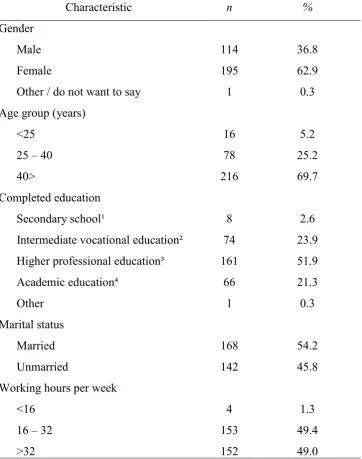
The study was conducted from end-2017 to mid-2018. Participants were recruited via purposive sampling (Cohen, Manion & Morrison, 2002) of two companies located in eastern Netherlands, with most (>90%) employees using a flexplace traditional chair and sitting desk but where facilities as alternatives for sitting were available (sit-stand desks, balance ball chairs and kneeling chairs). Participants received an invite for participation in an e-mail or screen notification on their work computer. Inclusion criteria were that participants a) were 18 years and older, b) worked in an office, c) spoke Dutch or English at a professional level. 398 employees gave online informed consent for participation (see Appendix A). The study was approved by the Ethics Committee of the University of Twente (also supervising the study) (application number 17684). After adjusting and leaving out invalid (unfinished and
chronologically invalid) cases, the sample consisted of 310 valid cases with 62 from one company and 248 from the other. The sample included 195 women (mean age 45.1,
Table 1
Participant Characteristics Quantitative Study
Note. Educational levels in Dutch: ¹: middelbaar onderwijs,²: middelbaar beroepsonderwijs, ³:hoger beroepsonderwijs, ⁴: wetenschappelijk onderwijs. Materials and Procedure
Data about sitting at work and during leisure was gathered using the BQOS, a Dutch online questionnaire that was developed for this study (see Appendix A) and pilot tested on 11 persons. The questionnaire was distributed using Qualtrics, an online questionnaire tool (see Qualtrics.com) for which the University of Twente has a license. Demographics were asked
and to get a full picture of an average participants’ working day, the following points in time were asked: waking up, going to work, leaving work, going to sleep. Participants were asked
Characteristic n %
Gender
Male 114 36.8
Female 195 62.9
Other / do not want to say 1 0.3
Age group (years)
<25 16 5.2
25 – 40 78 25.2
40> 216 69.7
Completed education
Secondary school¹ 8 2.6
Intermediate vocational education² 74 23.9 Higher professional education³ 161 51.9
Academic education⁴ 66 21.3
Other 1 0.3
Marital status
Married 168 54.2
Unmarried 142 45.8
Working hours per week
<16 4 1.3
16 – 32 153 49.4
to report all sitting durations within these points in time (e.g. the time spent sitting between leaving work and going to sleep). The same was asked for a free day except the work-related times. The next question asked for the use of facilities that serve as alternatives for traditional sitting (on a daily, weekly, monthly, yearly basis, never or other). Participants interested in participating in an additional face-to-face interview were able to give contact information in the last question of the questionnaire, otherwise remaining anonymous.
Analysis
Data from both companies were merged into one set of data but remained identifiable. Cases were adjusted where it was clear that a mistake was made, for example when someone reported to be leaving the house at 8.30, arriving at work at 9.00, and reported 30 hours sitting time while traveling (which was then changed to 30 minutes). In case of (even the slightest) doubts cases were immediately excluded so that the data remained as authentic as possible. All calculations and statistical tests were performed with SPSS 23. Next to demographics, use of facilities as alternative to sitting was calculated. After that, the following measures (in minutes) for a working day were calculated: total wake time, total sitting time, percentage of sitting time on total day, total work time, total sitting time at work, sit-work ratio (percentage of sitting time during work time), percentage of work-related sitting time of total daily sitting time. Furthermore, wake time minus work time (leisure) and not work-related sitting time were calculated. Independent samples t-tests were used to analyse any differences between gender on sitting times at work, daily working hours and sit-work ratios. Also, sit-work ratios were compared for those working ≤32 hours per week and those working more than 32 hours using an independent samples t-test. A Pearson correlation was calculated between sitting time at work and sitting time outside work. Means of sit-work ratios were compared of age groups (<39, 40-55, >56) and levels of education.
Results (Quantitative Study)
Research Question 1—What Kind of Sitting Behaviour in Office Environments Is Reported by (Semi-)Governmental Office Workers?
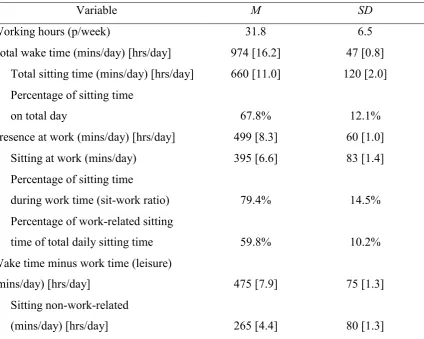
(over three and a half hours) (SD = 75) were spent sitting, meaning 56.8% of that time. A large part of the sample (74.2%) reported never (or a couple of times per year) to use facilities as alternatives to sitting (sit-stand desk, balance ball chairs, kneeling chairs, desk bikes). Table 2
Wake, Work and Sitting Times and Percentages
Variable M SD
Working hours (p/week) 31.8 6.5
Total wake time (mins/day) [hrs/day] 974 [16.2] 47 [0.8] Total sitting time (mins/day) [hrs/day] 660 [11.0] 120 [2.0] Percentage of sitting time
on total day 67.8% 12.1%
Presence at work (mins/day) [hrs/day] 499 [8.3] 60 [1.0] Sitting at work (mins/day) 395 [6.6] 83 [1.4] Percentage of sitting time
during work time (sit-work ratio) 79.4% 14.5% Percentage of work-related sitting
time of total daily sitting time 59.8% 10.2% Wake time minus work time (leisure)
(mins/day) [hrs/day] 475 [7.9] 75 [1.3]
Sitting non-work-related
(mins/day) [hrs/day] 265 [4.4] 80 [1.3]
Note. Times were rounded off upwards, hours to one decimal and minutes to zero decimals. .
For sitting times at work (minutes), no significant differences were found through an independent samples t-test between men and women; t(307) = 1.97, p = 0.05, with men 407 minutes (SD =89) and women 389 minutes (SD = 77). However, daily work hours (in
hours per week (M = 79.7%, SD = 13.5%), with t(308) = -.302, p > 0.05.
A one-way ANOVA on sit-work ratios across age groups (aged ≤39 (n=84); between 40 and 55 (n=141); aged >56 (n=85)) did not reveal a significant difference between one or more age groups [F(2, 307) = 0.22, p > 0.05]. A comparison across levels of education regarding sit-work ratios (secondary school (M = 81.66%, SD = 17.02%); intermediate vocational education (M = 77.2%, SD = 18.2%); higher professional education (M = 78.7%,
SD = 13.7%); academic education (M = 83.2%, SD = 10.2%) also did not reveal any
significant differences between one or more educational levels [F(4, 305) = 1.79, p > 0.05]. A Pearson correlation was run to determine the relationship between the time spent sitting at work and non-work-related sitting time. The correlation was extremely weak and statistically insignificant (r = .075, N=310; p > 0.05).
Summary (Quantitative Study)
For a regular working day, the sample reported to be awake for over 16 hours, of which 11 hours was spent sitting, with most part at work (six and a half hours), and an average sit-work ratio of nearly 80%. During the evening (between coming home from work and going to sleep), participants sat for over three and a half hours on average. Almost three-quarters of the sample never used (or only a couple of times a year) facilities as alternatives to sitting at work. It can be concluded that the sample was quite homogenous, with regards to no observed differences on sitting times and sit-work ratios compared between men and women, age groups, educational levels and number of weekly working hours.
In the next (qualitative) study, the aim was to find out what highly sedentary
participants from the quantitative study knew about the general health risks associated with prolonged sitting at work, how personally aware they were of these risks and what their sitting behaviour looked like. Finally, the aim was to investigate the relationship between these three concepts (knowledge, awareness and sitting behaviour). Highly sedentary participants were chosen as such sample was expected to provide insights into what explains high levels of sedentarism.
Method (Qualitative Study) Participants
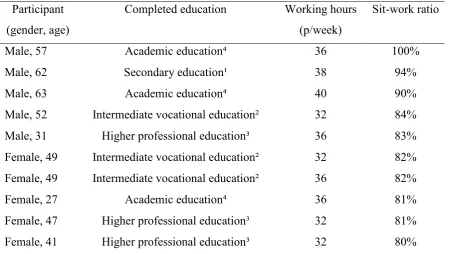
c) never using facilities as alternatives to traditional sitting. Those forced to be sitting for most part of the day due to medical implications were excluded. 28 participants were found to be eligible. Arrangements were made by telephone and written informed consent (in duplicate) was given before the interview took place. None of the interviewees had met with the interviewer before the interviews, and none had spoken with other interviewees about the interview. 10 interviews took place in February 2018 which all lasted between 12 and 30 minutes. The sample consisted of five men and five women with a mean age of 47.8 (SD = 12.0), six married and four unmarried. All interviewees used flexplaces (no own desk and chair in their office). The sit-work ratios (percentages) of sitting time during daily working hours ranged from 80.0% to 100.0% (M= 85.8%, SD = 6.7). See all interview sample characteristics in Table 3.
Materials and Procedure
A semi-structured interview scheme was developed for this study and two pilot tests took place to improve the scheme. The used interview scheme can be found in Appendix B
and discussed the concepts of knowledge, awareness and the interviewees’ sitting behaviour
at work. Knowledge was defined as the level of being informed on health risks of prolonged
sitting, with a question such as “What do you know about the health risks associated with
prolonged sitting at work?”. Awareness was assessed as to how much a participant was aware of these risks, in terms of applying it to their self: “To what extent do you think that these health risks apply to your situation?”. A question such as “Do you undertake actions to reduce your sitting time or to sit differently?” was asked (amongst others) to assess sitting behaviour
at work.
There were no drop-outs and all interviews were conducted by a female researcher with intermediate interviewing skills, trained by discussing the interview scheme and through feedback of the first interviews. Participants were interviewed separately after informed consent was given in duplicate (see Appendix C), no notes were taken during the interviews to have full attention for the conversation. Every interview meeting took place at the
Table 3
Interview Sample Characteristics
Participant (gender, age)
Completed education Working hours (p/week)
Sit-work ratio
Male, 57 Academic education⁴ 36 100%
Male, 62 Secondary education¹ 38 94%
Male, 63 Academic education⁴ 40 90%
Male, 52 Intermediate vocational education² 32 84%
Male, 31 Higher professional education³ 36 83%
Female, 49 Intermediate vocational education² 32 82% Female, 49 Intermediate vocational education² 36 82%
Female, 27 Academic education⁴ 36 81%
Female, 47 Higher professional education³ 32 81%
Female, 41 Higher professional education³ 32 80%
Note. Educational levels in Dutch: ¹: middelbaar onderwijs, ²: middelbaar beroepsonderwijs, ³: hoger beroepsonderwijs, ⁴: wetenschappelijk onderwijs.
.
Interviews were concluded by asking the participants not to discuss the details of the interview with (yet to be interviewed) colleagues to prevent bias, until all interviews had taken place. Immediately after the interview, participants received a document containing information about the study and contact information of the researchers (see Appendix D). Transcripts were sent to participants within one week after the interview, for corrections and comments to be submitted within seven workdays. Once all interviews were finished,
participants received additional information (if interested) about the health risks of prolonged sitting at work and how to reduce those (see Appendix E), based on information of Dutch research institutes. This was consciously sent after all interviews took place to eliminate the risk of interference of this information. Interviews took place until saturation was reached with regards to the research questions. Interview data were anonymised after the interviews and loaded into ATLAS.ti (version 7.5.18) for analysis.
Analysis
concepts of behaviour, knowledge and awareness (research questions one, two and three), through identification of themes arising from the data. Some themes were combined or changed as the process went on. Codes where created to categorise data and linked to quotes from interviews. Quotes out of different interviews but of the same code where compared in a table to identify differences and similarities, and to define codes as clear and unilateral as possible. Once codes were final, quotes selected for reporting were translated to English and translations were checked by the supervisors of the study. Contexts of quotes were always
taken into account by incorporating the interviewers’ questions and responses in the quote.
For the last research question (the relationship between knowledge, awareness and sitting behaviour), participants were categorised on their levels of knowledge, awareness and actions to reduce sitting time to discover potential patterns.
Results (Qualitative Study)
Research Question 1—What Kind of Sitting Behaviour in Office Environments Is Reported by (Semi-)Governmental Office Workers?
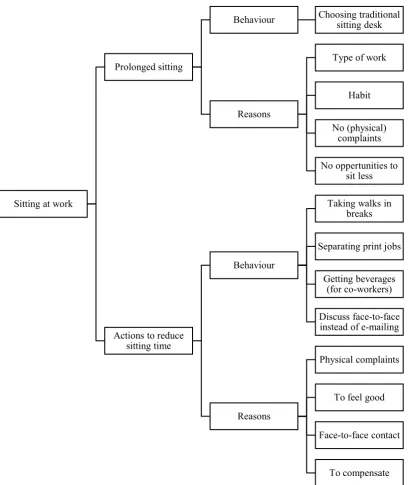
Themes arising from the interviews related to “Prolonged sitting: behaviour”, “Prolonged sitting: reasons”, “Actions to reduce sitting time: behaviour” and “Actions to
reduce sitting time: reasons”. The corresponding codes can be found in the coding tree (see
Figure 2) and are all described in this results section.
Prolonged Sitting: Behaviour
All interviewees said that they did not have their own desk at the office environment and had to choose a desk that was free every day. They all used traditional sitting desks, and some had adjusted chairs for themselves, that they moved around depending on where a free desk was. When asked for their sitting behaviour at work, all participants roughly described the same pattern: sitting at their flexplace desk for most part of the day, except for getting something to drink, going to meetings or during the break(s). The following participants briefly described their sitting pattern and losing track of time (resulting in several hours without standing up) as follows:
“… I go to the toilet a couple of times, you go for a coffee, but overall I spent most time sitting and when I have a meeting I move around a bit, but then I also sit down.”
Male, age 50-60, participant one.
three hours without … getting up from your chair.”
Female, age 40-50, participant six.
Prolonged Sitting: Reasons
The main reason given for the time spent sitting while being at work was because of the type of work next to it being a habit. All participants told that most of their work activities and tasks needed to be done on a computer, as the following participant described:
“The reason is that we have to a lot of computer work, since we work with all kinds of programs, in which we (describes work activities) … so the work that we do, is very much dependent of a computer with all kinds of programs.” Female, age 40-50, participant six.
Next to the type of work, habits were frequently mentioned as one of the main reasons for prolonged sitting at work, often in combination with not experiencing a need to sit less (no physical complaints). The answer of the following participant showed how strong habits can be, as he often sat next to a sit-stand desk, but did not use it and instead kept using a
traditional low desk:
“Interviewer: Is there something that keeps you from using that sit-stand desk? Participant: Well, really the habit I guess … nothing stops me actually,
but yeah, you just do what you are used to do, what makes you feel good.”
Male, age 50-60, participant nine.
It became clear that not all facilities that served as alternatives for sitting (e.g. sit-stand desks) were available for all employees. One interviewee said this was the main reason for his prolonged sitting:
“We used to have a sit-stand desk for people with physical problems, but that was only a test … It would be nice to work while standing sometimes, but
that is not possible anymore, so I have to sit down.”
Male, age 60-70, participant three.
Actions to Reduce Sitting Time: Behaviour
co-workers instead of sending them an e-mail, discussing an issue face-to-face. Some tried to take extra walks, as described by the following participant:
“You go on an extra walk, or you grab something extra to drink, to keep moving a little bit.”
Male, age 30-40, participant eight.
[image:19.595.75.485.174.660.2]
Figure 2. Coding tree for occupational sitting in office environments.
Actions to Reduce Sitting Time: Reasons
Physical complaints were mentioned by almost all participants as reason to sit less. Some experienced eye complaints from looking at a screen all day or specific complaints
Sitting at work
Prolonged sitting
Behaviour Choosing traditional sitting desk
Reasons
Type of work
Habit
No (physical) complaints
No oppertunities to sit less
Actions to reduce sitting time
Behaviour
Taking walks in breaks
Separating print jobs
Getting beverages (for co-workers)
Discuss face-to-face instead of e-mailing
Reasons
Physical complaints
To feel good
Face-to-face contact
regarding diseases or conditions. However, sitting-related complaints were described by half of the interviewees, as the following interviewee said:
“… I sometimes get lower back pain from all the sitting, so I want to sit less … and I also get pain in my buttocks because of all the sitting.”
Female, age 20-30, participant four.
When asked for the reason why certain participants walked to their co-workers instead of sending an email, one replied with:
“Well, it is actually twofold, I just think that the personal contact is more
satisfying … and you get some exercise.” Female, age 40-50, participant 10.
Actions to reduce sitting time were not always motivated by (physical) health issues, but also by other reasons. One participant said:
“Participant: I feel guilty in the evening when I sit down on the couch and again, do not get any physical exercise … Actually, I should get some exercise a couple of evenings per week. That would give me a good feeling, that I am doing something good, instead of sitting down and watching television again.
Interviewer: But would that be from a health perspective, or mainly to feel good about yourself?
Participant: Mainly to get a good feeling yes ….”
Male, age 60-70, participant three.
Some participants said they performed the actions to sit less to compensate for all the sitting at work. For example by practicing sports after working hours or by parking the car farther away from work:
“… I often go to work by car, and then I park it (mentions location in city), I could park it much closer to the office but now I still get to walk a bit.” Female, age 40-50, participant seven.
Research Question 2—What Do Highly Sedentary (Semi-)Governmental Office Workers Know About the General Health Risks Associated with Prolonged Sitting in Office Environments?
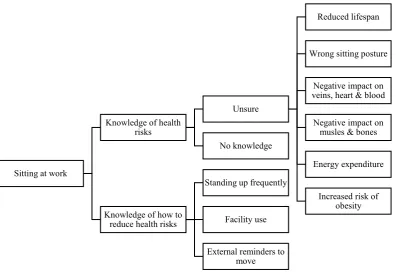
The main themes regarding knowledge of the health risks in general were:
Knowledge of Health Risks
Most participants were able to mention health risks associated with prolonged sitting. However, participants telling about what they knew about the health risks associated with prolonged sitting at work all said that they were not sure if the risks that they mentioned were correct. One participant said she thought that prolonged sitting led to an earlier death (reduced lifespan), and others said the harm was in a wrong posture. The negative impact on veins, heart & blood was described by the following participant, including the uncertainty about her answer:
“Well maybe the blood circulation– when you sit a lot, that you might constrict that [the blood circulation] I do not–, no, I would not know.”
Female, age 40-50, participant seven.
Another participant differentiated between short-term and long-term risks, as follows: “I think it affects the functions of the body on the short-term, right, how
your body functions, your heart, your blood circulation, and for the long- term I think it affects your muscle tissue, muscle mass and your bones.”
Female, age 40-50, participant six.
A lack of energy expenditure as a result of prolonged sitting was also mentioned by few participants. Next to this, an increased risk for obesity was mentioned as a risk of prolonged sitting at work, again showing the uncertainty:
“Maybe that you might become overweight, from the less physical exercise [when you sit].”
Female, age 40-50, participant five.
Whereas nine out of 10 participants were able to mention risks or at least some presumptions, one participant said to know nothing about the health risks:
“I mean, life in itself is a health risk, so this [sitting] will also be associated with health risks in some way, but, I never got into that to be honest.” Male, age 60-70, participant two.
Knowledge of How to Reduce Health Risks
“I think standing up more often, and that when you stand up, that it is not just two minutes, coffee machine and back, but at least a little bit longer, going up and down the stairs, so to speak, to get some more physical exercise.”
[image:22.595.73.470.151.424.2]Female, age 20-30, participant four.
Figure 3. Coding tree for knowledge about health risks associated with prolonged sitting at work.
Few participants talked about facility use (that serve as alternative to traditional sitting) as ways to reduce risks:
“Well, I read about it … that it might be best to work at a stand desk, that it would be much better … that you can switch positions, sometimes sitting, sometimes standing, after all, you have to work with your computer, but in that way I could just continue working, but then in another posture than sitting.”
Female, age 40-50, participant five.
“A kneeling chair, yes, it seems you need to keep your balance and your body will
automatically find the correct posture, so you have to keep working in order to keep your balance.”
Female, age 40-50, participant six. Sitting at work
Knowledge of health risks
Unsure
Reduced lifespan
Wrong sitting posture
Negative impact on veins, heart & blood
Negative impact on musles & bones
Energy expenditure
Increased risk of obesity No knowledge
Knowledge of how to reduce health risks
Standing up frequently
Facility use
Lastly, external reminders to move were discussed by some participants. One talked about thinking to install software that automatically freezes the computer (e.g. after every two hours of uninterrupted working), so she would be forced to do something else than work on her computer. Another actually made use of reminders and discussed how this worked for him: “My watch vibrates when I do not move for one hour, I do not have that very
often though … But when you look at an entire day, I set my profile to moderate activity, I really have to– well you really need to put some effort in it to get to 70%, so yeah, I do not think that is enough.”
Male, age 30-40, participant eight.
Research Question 3—To What Extent Are Highly Sedentary (Semi-)Governmental Office Workers Aware of Their Personal Health Risks Associated with Prolonged Sitting in Office Environments?
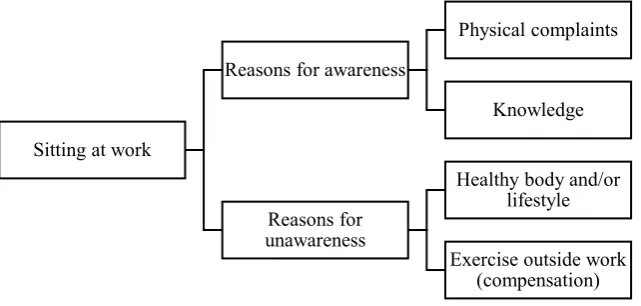
Participants were either aware (n=8) or unaware (n=2) of the fact that the health risks also applied to themselves, but not both or in-between aware or unaware. Regarding
awareness, the interview findings could be divided into: “Reasons for awareness” and “Reasons for unawareness”, see Figure 4.
Reasons for Awareness
Physical complaints were mostly mentioned as what led participants to their
awareness. The following participant described in what way she was aware of the health risks of prolonged sitting:
“Interviewer: Do you think that those risks also apply to you?
Participant: Yes I think so, I think that when I come home, my body holds more water, since I always sit in the same way, or I have muscle complaints.”
Female, age 40-50, participant five.
“Just the sitting … that the body is inactive, and an hour is not that bad, but after half a day sitting for a couple of hours, something already happened, (negative effects) and I was surprised by that, since that also applies to me, you know, because I have this sitting job, so I was shocked by that.”
[image:24.595.74.395.171.324.2]Female, age 40-50, participant six.
Figure 4. Coding tree of awareness of personal risks.
Reasons for Unawareness
Some participants did not think that the health risks applied to them, for two main reasons. A (perceived) healthy body or lifestyle was often said to be the reason that participants did not think they were at risk:
“Interviewer: But you do not exactly know what it does to your body when you sit a lot?
Participant: No, not what it means for me, personally. Look, I can imagine that when you are obese, and you live an unhealthy life, and next to that, you drink (alcohol) and you smoke, eat fatty foods, well then you would have to compensate. But I am– I live relatively healthy, eating behaviour and those kinds of things. So, I, yeah, do not see the problem”.
Male, age 50-60, participant one.
Next to a healthy body or lifestyle, physical exercise outside work, to compensate for the sitting at work, was often mentioned as a reason why participants did not think that their sitting behaviour was bad for their health.
“I am not aware of the health risks that it might cause, the sitting, well, of course I know that it causes less physical exercise, but I try to
Sitting at work
Reasons for awareness
Physical complaints
Knowledge
Reasons for unawareness
Healthy body and/or lifestyle
compensate that in my free time … at home, in the evening.” Male, age 50-60, participant nine.
Research Question 4—What Is the Relationship Between Highly Sedentary (Semi-)Governmental Office Workers’ Knowledge, Awareness and Behaviour
Regarding Prolonged Sitting in Office Environments?
Knowledge, awareness and behaviour could all be divided into categories. Knowledge was divided into 1) (almost) no knowledge (less than three risks) and b) moderate or higher knowledge (knowing three or more risks). Awareness was divided into 1) aware and 2) unaware. Sitting behaviour ranged from 1) no actions to reduce sitting time and 2) undertaking actions to reduce sitting time. Four small patterns were discovered, in which small groups of participants showed similar levels of knowledge, action taking and awareness. However, no clear pattern was observed that showed some sort of strong link between
concepts (e.g. level of knowledge and behaviour). The only (small) straightforward links were that participants with moderate or high knowledge all undertook actions, whereas this differed for the ones with (almost) no knowledge (see also Table 4). Besides, six out of the eight aware participants undertook actions, regardless of levels of knowledge.
The first pattern included participants seven, eight and 10. They all had (almost) no knowledge about the health risks but were all aware that their own sitting pattern was not healthy, and therefore undertook actions to reduce sitting time. This was clearly described as follows by one of them:
“Oh I would not know (what the risks are), I know it is not healthy, but I have no idea about the consequences … (About actions:) I get coffee for my colleagues, take the stairs … I try to exercise as much
as possible … I think I may be sitting too much on a working day …
I think there is room for improvement when it comes to that, less sitting.”
Female, age 40-50, participant seven.
Participants three and nine both had (almost) no knowledge, were aware of the risks but did not undertake actions to reduce sitting time. Participant nine did not think that his own sitting
behaviour was part of a healthy lifestyle, but did not change his behaviour, due to “the habit”
“Interviewer: Can you tell me what you know about the risks associated with prolonged sitting at work?
Participant: I do not know anything about that, but I do experience it …
my legs sometimes seem to be constricted … I have the feeling that
it has to do with the long sitting … We only go on a walk in the break …
my colleagues push me to do so … but other than that, I do not get
much exercise on a day … But well, it might not be so good to be sitting for
four hours times two, before and after the break, on a day.”
[image:26.595.75.482.306.542.2]Male, age 60-70, participant three.
Table 4
Participant’s Levels of Knowledge, Reducing Sitting Time and Awareness
Participant Level of knowledge Reducing sitting time Awareness
7 (almost) no Undertaking actions Aware
8 (almost) no Undertaking actions Aware
10 (almost) no Undertaking actions Aware
3 (almost) no No actions Aware
9 (almost) no No actions Aware
1 (almost) no No actions Unaware
2 (almost) no No actions Unaware
4 Moderate or higher Undertaking actions Aware
5 Moderate or higher Undertaking actions Aware
6 Moderate or higher Undertaking actions Aware
Third, there were two participants (numbers one and two) with (almost) no knowledge, who did not experience any risks and did not take any actions to reduce their sitting time. They were the only ones who were unaware. When discussing actions to reduce sitting time, participant two said the following as explanation for not taking such actions:
“Well, I know it somewhat unhealthy, but, I feel healthy, and I am
not disturbed by it (sitting)… Furthermore, I do not know
is not really there … There is no stimulus for me to do something about it.”
Male, age 50-60, participant one.
Moderate or higher knowledge was shown by three participants (number four, five and six), who were able to mention five or more risks associated with prolonged sitting at work. They were aware that the risks also applied to them, and undertook actions to reduce their sitting time, as described by one of them:
“I was shocked by the television program (that showed the risks), … that made me aware, so much that I did something about it …
I get up more often, if I am sitting for too long behind my desk …
I am the one who initiates to get coffee, I walk to the printer more often.”
Female, age 40-50, participant six.
Additional Findings
Two other additional but major themes came up naturally during the interviews that seemed to be interwoven in the research topic, but that were not directly investigated through the research questions. Those themes related to “Intention” (to sit less) and “Barriers” that participants experienced to sit less. Nine of 10 participants said that they wanted to sit less (intention) but could not because of various reasons (barriers). Some said that less sitting would impact their efficiency:
“It is hard to fit it (less sitting) into my work activities … I read
a lot, I write a lot, and fitting exercise into that is very hard to organise …
It does not match with my activities, I would have to reorganise my activities, do another type of work.”
Male, age 50-60, participant one.
Others experienced what could be described as normative issues as barriers to sit less: “Standing in a meeting where everybody is sitting, would also be a little
bit awkward, so I do not know, I think that I also just go along with how things go.”
Female, age 20-30, participant four.
“When I look at my immediate co-workers, and I would place a desk bike here and start cycling behind my desk, that would get everyone laughing.”
Summary (Qualitative Study)
Prolonged sitting was mostly determined by amongst others, the type of work and habits. Actions to reduce sitting time such as taking walks in breaks were mostly motivated by physical complaints, to feel good or to compensate for all the sitting at work. Regarding knowledge, participants knew more about how to reduce health risks, than about the health risks themselves. Participants knew either nothing about the risks or were unsure about what they knew. The most mentioned action to reduce health risks was to stand up more frequently and get more physical exercise. Most participants did not think that their own sitting pattern was part of a healthy lifestyle, which led them to being aware of the health risks associated with prolonged sitting at work. Physical complaints or knowledge about the risks led most respondents to this awareness. Those unaware of the health risks argued that this unawareness was because of a healthy body or lifestyle, or because they compensated for the sitting, outside work.
There was no clear relationship between levels of knowledge, action taking (to reduce sitting time) and awareness. However, direct links were found for those with moderate or high knowledge, who all undertook actions (to reduce sitting time), as opposed to those with (almost) no knowledge, of which some undertook actions, and some did not. Second, six out of the eight aware participants undertook actions, regardless of levels of knowledge.
Additional findings related to intention and barriers, themes that seemed to be inextricably linked to the study topic.
Discussion
The purpose of the present study was to identify the kind of sitting behaviour (prevalence) in office environments of employees of (semi-)governmental companies. Followed by investigating the concepts of knowledge and awareness and how these concepts possibly influenced sedentary behaviour. This study was the first to assess these concepts, next to existing identified determinants. Data collected in this study provide information regarding determinants of occupational sitting on the individual level, as part of the SEM framework. Additionally, the findings contribute to occupational sedentary behaviour literature, with regards to prevalence of sedentary behaviour in office environments.
Research Question 1—What Kind of Sitting Behaviour in Office Environments Is Reported by (Semi-)Governmental Office Workers?
employees, reported to be spending most of their total sitting time of an entire day (11 hours), at work (six and a half hours). This is higher than other Dutch research has found before. A study conducted by the (Dutch) National Institute for Public Health and the Environment (2016) showed that the higher educated (higher professional education and higher) sat (on average) 10.1 hours and the lower educated for 7.7 hours on a weekday. In the present study, no similar differences were found between completed levels of education, possibly due to a small and incomplete sample of lower educated participants. This could also be explained by the type of work or by environmental factors such as all using same kind of offices. It was concluded that the sample was homogenous in terms of no differences for age groups and groups based on working hours. However, the homogeneity of the sample allowed for
understanding and describing this particular sample ((semi-)governmental employees working in office environments) in depth. Similar research but with other samples (from different work sectors) may reveal insights into correlates (determinants) of sedentary behaviour, as none were found in this quantitative data. Given the sample size and the homogeneity of the sample, it must be noted that the sample was not large enough for generalisability of the results.
There was no correlation between sitting time at work and sitting time outside work, in contrast with other research. Other studies (though some measured differently and some similarly) found positive correlations between the amount of time spent sitting at work and outside work (Clemes et al., 2014; Jans et al., 2007). However, consistent with other research (e.g. Jans et al., 2007), evenings were mainly spent sitting. Almost three-quarters of the sample never used (or only a couple of times a year) facilities as alternatives to sitting (sit-stand desks, balance ball chairs, etc.) whereas these facilities were available for almost all participants. It could be cautiously concluded that availability or presence of such facilities did not cause direct behaviour change (use of such facilities), as was also discovered in the qualitative study. It could be argued that the environment had a limited impact and did not nudge participants. These findings are in contrast with other studies, such as from Alkhajah et al. (2012), who found that provision of sit-stand desks often reduced sitting time. The
not measured in the domain-specific sitting questionnaire of Marshall et al. (2010). The subjectively measured number of hours spent sitting may have been under- or overestimated by participants, as shown by a systematic review analysing studies that compared subjective measures to objective measures (Lubans et al., 2011). However, other questionnaires (e.g. Marshall et al., (2010), contain larger timeslots in which sitting times need to be reported, thus being more prone to under- or overestimating sitting times. The BQOS had to be filled in from waking up to going to sleep, naturally following daily processes in chronological order. This possibly simplified the answering process and eliminated guessing as much as possible.
A limitation of the BQOS related to the fact that the questionnaire only measured sitting times without assessing frequencies and durations of standing up or exercising, which is a key issue in determining the health risks (Owen et al., 2010). However, such information was gathered during the interviews, which supported the quantitative data. Furthermore, almost one quarter of the data needed to be excluded (nearly 400 participated and 310 cases remained) due to the used software. The questionnaire software could not detect mistakes, such as reported sitting of 30 minutes in a period of 20 minutes or chronological
inconsistencies. The use of other software could have corrected participants while
participating and would not have resulted in manually excluding this number of cases. This should be considered in future research.
Despite the use of subjective measures, a part of the sample might be at serious risk, also given the fact that the majority (almost) never used facilities and that the sample mostly consisted of (almost) full-time working individuals. Given these points, the BQOS remains to be validated, for instance by comparing the BQOS to objective measures (e.g. activity
trackers) or other questionnaires. Since the BQOS was based on a chronological principle (following the natural process of a day), validity could (amongst others) be assessed by applying the think aloud method (van Someren, Barnard & Sandberg, 1994). This method allows the researcher to listen to participants thinking aloud while fulfilling a task (Someren et al., 1994). The method provides insight into how participants respond to the chronological principle and to which extend participants are assisted or not by this principle.
Research Question 2—What Do Highly Sedentary (Semi-)Governmental Office Workers Know About the General Health Risks Associated with Prolonged Sitting in Office Environments?
regarding the health risks was relatively low. This is subject to interpretation but the mentioned (and unsure) risks were rarely the most important ones, as those reported in literature by Bey & Hamilton (2003); de Rezende et al. (2014); Owen et al. (2000); Owen et al. (2010). The findings were partly in line with those from a study by de Cocker et al. (2015), in which participants showed more concerns about musculoskeletal related health risks than the cardio-metabolic health risks, the latter being more important. Another recent qualitative study (Flint, Crank, Tew & Till, 2017) also found that although office workers thought it was more beneficial to take more frequent breaks instead of one, most of them did not understand the health implications of prolonged sitting, similar to the present study. In the present study, the majority thought that too much sitting could be compensated (e.g. after work, practicing sports), whereas the risks of prolonged sitting seem to be independent of (vigorous) physical activity (Barnes et al., 2012), although this distinction requires more research (Owen et al., 2010). The sample of the quantitative study was chosen due to expected high levels of sitting (considering the type of work).In turn, the interview participants were deliberately selected on high sit-work ratios and not using facilities as alternatives to sitting, which may explain the low level of knowledge.
The current findings clearly indicate a knowledge gap on the health risks of prolonged sitting. Participants showed more knowledge about reducing the health risks than about the risks themselves. An explanation for this finding could be the presence of facilities that serve as alternative to traditional sitting. For example, participant X does not know about the health risks associated with prolonged sitting but sees sit-stand desks being implemented around him, which informs him that those probably serve to reduce risks. Gardner et al. (2016) state that these health risks may not yet be understood knowing that the risks were only (relatively) recently recognised as health concern within the scientific community (Barnes et al., 2012). It might be inappropriate to expect high levels of knowledge of such a relatively new health topic.
Research Question 3—To What Extent Are (Semi-)Governmental Office Workers Aware of the Health Risks Associated with Prolonged Sitting in Office Environments?
healthy lifestyle. Awareness was mostly caused by physical complaints or knowledge about the health risks. As six out of the eight aware participants undertook actions to reduce sitting time, awareness could be seen as a predictor of action taking to reduce sitting time, and unawareness as a predictor of prolonged sitting (will be further discussed under research question four).
Research Question 4—What Is the Relationship Between Highly Sedentary (Semi-)Governmental Office Workers’ Knowledge, Awareness and Behaviour
Regarding Prolonged Sitting in Office Environments?
This research question investigated the relationship between knowledge, awareness and sedentary behaviour. It aimed at contributing to insights on determinants of sedentary behaviour on the individual level of the ecological framework. Regarding behaviour, results revealed that prolonged sitting in office environments was mostly determined by the type of work, which needed to be done on a computer, consistent with findings of Cole et al. (2015), who found the nature of the job to be a barrier for physical exercise. In the present study, no clear relationship was found in the proposed model investigating the relationship between knowledge, awareness and sitting behaviour. The model did not explain prolonged sitting at work or actions to reduce sitting times.
However, the findings contribute to existing literature and may guide future research as described below. In contrast with findings by Gardner et al. (2016), the current study did not observe behaviour change due to environmental modifications (e.g. presence of sit-stand desks). This might be the result of lacking knowledge, as shown by Shrestha et al. (2016) who stated that the combination of the two (education and environmental changes) might be most promising. As successful interventions (Gardner et al., 2016) aimed at both the individual and environmental levels, it would be interesting to know if higher levels of knowledge would make a difference in behaviour and would lead to an increased facility use (e.g. sit-stand desks) in office workers.
not exactly knowing what exactly is harming one’s health. A higher level of awareness could possibly have had more influence on sedentary behaviour.
This study showed that awareness can be present in combination with low knowledge of the health risks. It therefore raises questions about the interaction between knowledge and awareness. It is unclear if the combination of high knowledge and high awareness together is a stronger predictor than the separate concepts (knowledge or awareness alone). That being said and considering that information provision (about the health risks) is likely to reduce sedentary behaviour (Gardner et al., 2016), it would be interesting to know how an increased level of knowledge would influence both awareness and action taking (to reduce sitting times). However, it could be argued that awareness may be independent of knowledge and is possibly caused by other things (e.g. physical complaints). Furthermore, this study included highly sedentary office workers. To evaluate the proposed model completely, future research should include office workers with lower sitting times, to investigate how levels of knowledge and awareness play a role in low sedentarism.
Explaining Occupational Sedentary Behaviour
Looking at the proposed model that explains occupational sedentary behaviour on the individual level, there was no clear relationship between knowledge, awareness and
behaviour. Nonetheless, this study found that there are more determinants that play a role in explaining occupational sitting. Most participants did not consider or mention preventive
measures, but instead they showed more like a “wait-and-see” attitude, which may be
explained by the low level of knowledge or the absence of physical complaints for example. Furthermore, actions to reduce sitting times were mostly motivated by physical complaints. This suggests that another determinant could be added to the model (see Figure 5), namely
“perceived physical complaints”. It could be argued that the presence of (severe) physical complaints (e.g. due to prolonged sitting) would make a difference in sedentarism. Given the fact that additional findings related to barriers, it might be beneficial to include this
An important reason for prolonged sitting mentioned by the participants were habits. In some cases, habits were so strong that they withheld participants from using available (and nearby) facilities such as sit-stand desks, even for those with intentions to sit less. In this case, these habits were stronger than environmental influences and intentions. However, also those who did not mention habits as reasons for prolonged sitting did not use facilities as
alternatives to traditional sitting. This confirms the ecological approach and complexity of sedentary behaviour. As habits have been investigated in other domains of sedentary behaviour (Conroy et al., 2013; Kremers & Brug, 2008), it also seems to be applicable to occupational sitting, however requiring more evidence.
[image:34.595.70.534.398.649.2]The intention to sit less was assessed in the interviews, however only briefly. Nine of 10 participants said they wanted to sit less, but seemingly these intentions were not strong enough to change behaviour, as for instance habits seemed to overrule intentions. As intentions are considered to be strong behavioural determinants in occupational sitting (Conroy et al., 2013) (however requiring more evidence), this study should have assessed intentions more thoroughly. It cannot be concluded that intentions do not play a role, as it was not correctly measured, and more evidence would be needed.
Figure 5. Proposed addition of determinants (in italics) to existing (in bold) individual modifiable determinants as part of the ecological approach.
possible determinants that play a role in occupational sitting. Therefore, to complete and validate the model, future research should investigate if there are still other determinants that explain occupational sitting.
For the qualitative study, strengths were that saturation was reached and all interviews had the same structure (well prepared) and there were no drop-outs. These strengths allowed conclusions to be drawn (cautiously) about the independent concepts of knowledge,
awareness and sitting behaviour. However, to confirm relationships between the concepts, larger sample sizes are required, also to compare patterns as no major patterns were found with regards to the relationships in this study. Limitations of the qualitative study related to the coding process, which was mostly carried out by one researcher (although supervised by two other researchers), coding is a delicate process in which interpretation should always be discussed. Another researcher being present during the interviews and coding process would have been desirable, for example to notice inconsistencies.
To the best of my knowledge, the quantitative data accompanied by in-depth
information about sitting behaviour, knowledge and awareness has not been gathered before. The sequential explanatory mixed-methods design enabled analysing prevalence of sedentary behaviour of office workers. Subsequently, it allowed selecting a particular sample
purposively and carefully based on its sedentary behaviour, thus giving insights in
determinants and subsequent levels of sedentarism. It is a design I would highly recommend for future research attempting to assess and identify determinants of occupational sitting if enough time and resources are available.
This study added information to a model that explains occupational sitting on the individual level of the SEM. Future research should focus on further establishing this model taking the findings of this study into account. For example, by applying quantitative
techniques on determinants, with questionnaire items that allow to explain variance of determinants. A complete model could be used to inform interventions that try to reduce occupational sitting times, which is the next step in the behavioural epidemiology framework. Such information would also inform guidelines that are currently lacking which should be composed and disseminated. Together with a model explaining sedentary behaviour,