92
Multi-Source Neural Machine Translation with Missing Data
Yuta Nishimura1 , Katsuhito Sudoh1 , Graham Neubig2,1, Satoshi Nakamura1
1Nara Institute of Science and Technology, 8916-5 Takayama-cho, Ikoma, Nara 630-0192, Japan 2Carnegie Mellon University, 5000 Forbes Avenue, Pittsburgh, PA 15213, USA
{nishimura.yuta.nn9, sudoh, s-nakamura}@is.naist.jp [email protected]
Abstract
Multi-source translation is an approach to exploit multiple inputs (e.g. in two dif-ferent languages) to increase translation accuracy. In this paper, we examine ap-proaches for multi-source neural machine translation (NMT) using an incomplete multilingual corpus in which some transla-tions are missing. In practice, many mul-tilingual corpora are not complete due to the difficulty to provide translations inall of the relevant languages (for example, in TED talks, most English talks only have subtitles for a small portion of the lan-guages that TED supports). Existing stud-ies on multi-source translation did not ex-plicitly handle such situations. This study focuses on the use of incomplete multilin-gual corpora in multi-encoder NMT and mixture of NMT experts and examines a very simple implementation where miss-ing source translations are replaced by a special symbol<NULL>. These methods allow us to use incomplete corpora both at training time and test time. In exper-iments with real incomplete multilingual corpora of TED Talks, the multi-source NMT with the<NULL>tokens achieved higher translation accuracies measured by BLEU than those by any one-to-one NMT systems.
1 Introduction
In general, machine translation systems translate from one source language to a target language. For example, we may translate a document or speech that was written in English to a new language such as French. However, in many real translation sce-narios, there are cases where there are multiple
Spanish
Hola ×
English
Hello Thank you
French
Bonjour Je vous remercie
× (a) A standard bilingual corpus
Spanish Hola Gracias English
Hello Thank you
French Bonjour Je vous remercie
×
(b) A complete multi-source corpus
Spanish
Hola
×
English
Hello
Thank you French Bonjour Je vous remercie
×
[image:1.595.309.522.219.535.2](c) An incomplete multi-source corpus with missing data
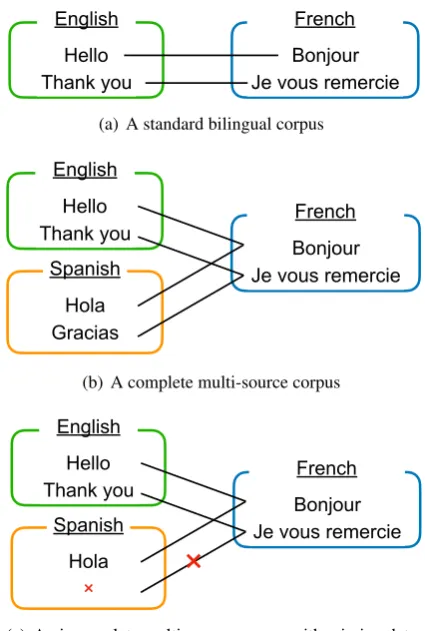
Figure 1: Example of type of corpora.
languages involved in the translation process. For example, we may have an original document in English, that we want to translate into several lan-guages such as French, Spanish, and Portuguese. Some examples of these scenarios are the cre-ation of video captions for talks (Cettolo et al.,
cu-rated translations in a number of languages, and we’d like to generate translations in the remaining languages for which we do not yet have transla-tions.
In this work, we focus on this sort of mul-tilingual scenario using multi-source translation (Och and Ney,2001;Zoph and Knight,2016; Gar-mash and Monz, 2016). Multi-source translation takes in multiple inputs, and references all of them when deciding which sentence to output. Specifi-cally, in the context of neural machine translation (NMT), there are several methods proposed to do so. For example,Zoph and Knight(2016) propose a method where multiple sentences are each en-coded separately, then all referenced during the decoding process (the “multi-encoder” method). In addition,Garmash and Monz(2016) propose a method where NMT systems over multiple inputs are ensembled together to make a final prediction (the “mixture-of-NMT-experts” method).
However, this paradigm assumes that we have data inallof the languages that go into our multi-source system. For example, if we decide that En-glish and Spanish are our input languages and that we would like to translate into French, we are lim-ited to training and testing only on data that con-tains all of the source languages. However, it is unusual that translations in all of these languages are provided– there will be many sentences where we have only one of the sources. In this work, we consider methods for multi-source NMT with missing data, such situations using anincomplete multilingual corpus in which some translations are missing, as shown in Figure 1. This incomplete multilingual scenario is useful in practice, such as when creating translations for incomplete multi-lingual corpora such as subtitles for TED Talks.
In this paper, we examine a simple implemen-tation of multi-source NMT using such an incom-plete multilingual corpus that uses a special sym-bol<NULL>to represent the missing sentences. This can be used with any existing multi-source NMT implementations without no special modi-fications. Experimental results with real incom-plete multilingual corpora of TED Talks show that it is effective in allowing for multi-source NMT in situations where full multilingual corpora are not available, resulting in BLEU score gains of up to 2 points compared to standard bi-lingual NMT.
Encoder
Encoder Decoder
Encoder Es
Ar
[image:2.595.310.522.65.135.2]Fr En
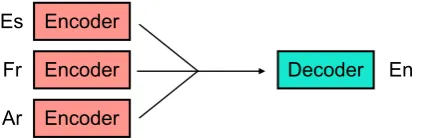
Figure 2: Multi-encoder NMT
2 Multi-Source NMT
At the present, there are two major approaches to multi-source NMT: multi-encoder NMT (Zoph and Knight, 2016) and mixture of NMT experts (Garmash and Monz,2016). We first review them in this section.
2.1 Multi-Encoder NMT
Multi-encoder NMT (Zoph and Knight, 2016) is similar to the standard attentional NMT frame-work (Bahdanau et al.,2015) but uses multiple en-coders corresponding to the source languages and a single decoder, as shown in Figure2.
Suppose we have two LSTM-based encoders and their hidden states and cell states at the end of the inputs areh1,h2 andc1,c2, respectively. The multi-encoder NMT method initializes its decoder hidden stateshand cell statecas follows:
h= tanh(Wc[h1;h2]) (1)
c=c1+c2 (2)
Attention is then defined over each encoder at each time step tand resulting context vectors c1t andc2t, which are concatenated together with the corresponding decoder hidden statehtto calculate
the final context vectorh˜t.
˜
ht= tanh(Wc[ht;c1t;c2t]) (3)
Encoder
Encoder Decoder
Encoder Es
Ar
Fr En
Decoder
Decoder Gating Network
pre-train
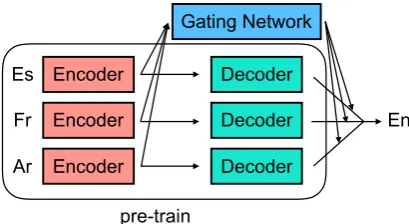
Figure 3: Mixture of NMT Experts
2.2 Mixture of NMT Experts
Garmash and Monz(2016) proposed another ap-proach to multi-source NMT called mixture of NMT experts. This method ensembles together independently-trained encoder-decoder networks. Each NMT model is trained using a bilingual cor-pus with one source language and the target lan-guage, and the outputs from the one-to-one models are summed together, weighted according to a gat-ing network to control contributions of the proba-bilities from each model, as shown in Figure3.
The mixture of NMT experts determines an out-put symbol at each time steptfrom the final output vectorpt, which is the weighted sum of the prob-ability vectors from one-to-one models denoted as follows:
pt= m
X
j=1
gtjpjt (4)
where pjt and gjt are the probability vector from j-th model and the corresponding weight at time step t, respectively. m is the number of one-to-one models.gtis calculated by the gating network
as follows:
gt= softmax(Wgatetanh(Whid[ft1(x);...f m
t (x)])) (5)
whereftj(x) is the input vector to the decoder of thej-th model, typically the embedding vector for the output symbol at the previous time stept-1.
3 Multi-Source NMT with Missing Data
In this work, we examine methods to use incom-plete multilingual corpora to improve NMT in a specific language pair. This allows multi-source techniques to be applied, reaping the benefits of other additional languages even if some transla-tions in these additional languages are missing.
Eso es verdad
C'est vrai That is true
<NULL> Es
Ar
[image:3.595.76.281.66.178.2]Fr En
Figure 4: Multi-encoder NMT with a missing in-put sentence
Specifically, we attempt to extend the methods in the previous section to use an incomplete multilin-gual corpus in this work.
3.1 Multi-encoder NMT
In multi-encoder NMT, each encoder must be pro-vide with an input sentence, so incomplete multi-lingual corpora cannot be used as-is.
In this work, we employ a very simple mod-ification that helps resolve this issue: replacing each missing input sentence with a special symbol <NULL>. The special symbol<NULL>can be expected to be basically ignored in multi-encoder NMT, with the decoder choosing word hypotheses using other input sentences. Note that this method can be applied easily to any existing implementa-tion of the multi-encoder NMT with no modifica-tion of the codes.
Figure4 illustrates the modified multi-encoder NMT method. Here the source languages are Spanish, French, and Arabic and the target lan-guage is English, and the Arabic input sentence is missing. Here, the Spanish and French input sen-tences are passed into the corresponding encoders and<NULL>is input to the Arabic encoder.
3.2 Mixture of NMT Experts
In the mixture of NMT experts method, each one-to-one NMT model can be trained independently using incomplete multilingual corpora. However, we still need a complete multilingual corpus to train the gating network.
[image:3.595.308.518.68.135.2]4 Experiments
We conducted two experiments with different in-complete multilingual corpora. One is an experi-ment with a pseudo-incomplete multilingual cor-pus, the other is an experiment with an actual in-complete multilingual corpus.
4.1 NMT settings
We describe the settings of common parts for all NMT models: multi-encoder NMT, mixture of NMT experts, and one-to-one NMT. We used global attention and attention feeding (Luong et al.,2015) for the NMT models and used a bidi-rectional encoder (Bahdanau et al.,2015) in their encoders. The number of units was 512 for the hidden and embedding layers. Vocabulary size was the most frequent 30,000 words in the train-ing data for each source and target languages. The parameter optimization algorithm was Adam (Kingma and Ba,2015) and gradient clipping was set to 5. The number of hidden state units in the gating network for the mixture of NMT experts experiments was 256. We used BLEU (Papineni et al., 2002) as the evaluation metric. We per-formed early stopping, saving parameter values that had the smallest log perplexities on the valida-tion data and used them when decoding test data.
4.2 Pseudo-incomplete multilingual corpus (UN6WAY)
First, we conducted experiments using acomplete multilingual corpus and apseudo-incomplete cor-pus derived by excluding some sentences from the complete corpus, to compare the performance in complete and incomplete situations.
4.2.1 Data
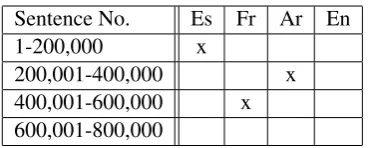
We used UN6WAY (Ziemski et al., 2016) as the complete multilingual corpus. We chose Spanish (Es), French (Fr), and Arabic (Ar) as source lan-guages and English (En) as a target language The training data in the experiments were the one mil-lion sentences from the UN6WAY corpus whose sentence lengths were less than or equal to 40 words. We excluded 200,000 sentences for each language for the pseudo-incomplete multilingual corpus as shown in Table1. “Sentence number” in Table 1 represents the line number in the corpus, and thex means the part removed for the incom-plete multilingual corpus. We also chose 1,000 and 4,000 sentences for validation and test from
Sentence No. Es Fr Ar En
1-200,000 x
200,001-400,000 x
400,001-600,000 x
[image:4.595.325.512.60.134.2]600,001-800,000
Table 1: Settings of the pseudo-incomplete UN multilingual corpus (x means that this part was deleted)
the UN6WAY corpus, apart from the training data. Note that the validation and test data here had no missing translations.
4.2.2 Setup
We compared multi-encoder NMT and the mixture of NMT experts in the complete and incomplete situations. The three one-to-one NMT systems, Es-En, Fr-En, and Ar-En, which were used as sub-models in the mixture of NMT experts, were also compared for reference.
First, we conducted experiments using all of the one million sentences in the complete multilingual corpus, Complete (0.8M). In case of the mixture of NMT experts, the gating network was trained using the one million sentences.
Then, we tested in the incomplete data situ-ation. Here there were just 200,000 complete multilingual sentences (sentence No. 600,001-800,000), Complete (0.2M). Here, a standard multi-encoder NMT and mixture of NMT experts could be trained using this complete data. On the other hand, the multi-source NMT with<NULL> could be trained using 800,000 sentences (sen-tence No. 1-800,000),Pseudo-incomplete (0.8M). Each one-to-one NMT could be trained using these 800,000 sentences, but the missing sentences replaced with the<NULL>tokens were excluded so resulting 600,000 sentences were actually used.
4.2.3 Results
cor-Condition One-to-one Multi-encoder Mix. NMT Experts
Es-En Fr-En Ar-En
Complete (0.8M) 31.87 25.78 23.08 37.55 (+5.68)∗ 33.28 (+1.41)
Complete (0.2M) 27.62 22.01 17.88 31.24 (+3.62) 32.16 (+4.54)
[image:5.595.88.513.66.137.2]Pseudo-incomplete(0.8M) 30.98 25.62 22.02 36.43(+5.45)∗ 32.44 (+1.47)
Table 2: Results in BLEU for one-to-one and multi-source ({Es, Fr, Ar}-to-En) translation on UN6WAY data (parentheses are BLEU gains against the best one-to-one results). ∗ indicates the difference from mixture of NMT experts is statistically significant (p <0.01).
Source Training Valid. Test
{En, Fr, Pt (br)}-to-Es
English 189,062 4,076 5,451
French 170,607 3,719 4,686
Portuguese (br) 166,205 3,623 4,647 {En, Es, Pt (br)}-to-Fr
English 185,405 4,164 4,753
Spanish 170,607 3,719 4,686
Portuguese (br) 164,630 3,668 4,289 {En, Es, Fr}-to-Pt (br)
English 177,895 3,880 4,742
Spanish 166,205 3,623 4,647
[image:5.595.76.285.205.395.2]French 164,630 3,668 4,289
Table 3: Data statistics in the tasks on TED data (in the number of sentences). Note that the number of target sentences is equal to that of English for each task.
Target Training Valid. Test
Spanish 83.4 85.0 78.2
French 85.0 83.2 89.7
Portuguese (br) 88.6 89.3 90.0
Table 4: The percentage of data without missing sentences on TED data.
pus, even if just through the simple modification of replacing missing sentences with<NULL>.
With respect to the difference between the multi-encoder NMT and mixture of NMT experts, the multi-encoder achieved much higher BLEU in Pseudo-incomplete (0.8M) and Complete (1M), but this was not the case in Complete (0.2M). One possible reason here is the model complex-ity; the multi-encoder NMT uses a large single model while one-to-one sub-models in the mixture of NMT experts can be trained independently.
4.3 An actual incomplete multilingual corpus (TED Talks)
4.3.1 Data
We used a collection of transcriptions of TED Talks and their multilingual translations. Because these translations are created by volunteers, and the number of translations for each language is dependent on the number of volunteers who cre-ated them, this collection is an actual incomplete multilingual corpus. The great majority of the talks are basically in English, so we chose English as a source language. We used three translations in other languages for our multi-source scenario: Spanish, French, Brazilian Portuguese. We pre-pared three tasks choosing one of each of these three languages as the target language and the oth-ers as the additional source languages. Table3
shows the number of available sentences in these tasks, chosen so that their lengths are less than or equal to 40 words.
4.3.2 Setup
We compared multi-encoder NMT, mixture of NMT experts and one-to-one NMT with English as the source language. The validation and test data for these experiments were also incomplete. This is in contrast to the experiments on UN6WAY where the test and validation data were complete, and thus this setting is arguable of more practical use.
4.3.3 Results
because the baseline performance was relatively low compared with the previous experiments and the size of available resources was also smaller.
In comparison between the multi-source NMT and the mixture of NMT experts, results were mixed; the mixture of NMT experts was better in the task to French.
4.3.4 Discussion
We analyzed the results using the TED data in de-tail to investigate the mixed results above. Figure5
(in the last page) shows the breakdown of BLEU in the test data, separating the results for com-plete and incomcom-plete multilingual inputs. When all source sentences are present in the test data, multi-encoder NMT has better performance than mixture of NMT experts except for {En, Es, Pt (br)}-to-Fr. However, when the input is incom-plete, mixture of NMT experts achieves perfor-mance better than or equal to multi-encoder NMT. From this result, we can assume that mixture of NMT experts, with its explicit gating network, is better at ignoring the irrelevant missing sentences. It’s possible that if we designed a better attention strategy for multi-encoder NMT we may be able to resolve this problem. These analyses would sup-port the results using the pseudo incomplete data shown in Table 2, where the validation and test data were complete.
4.3.5 Translation examples
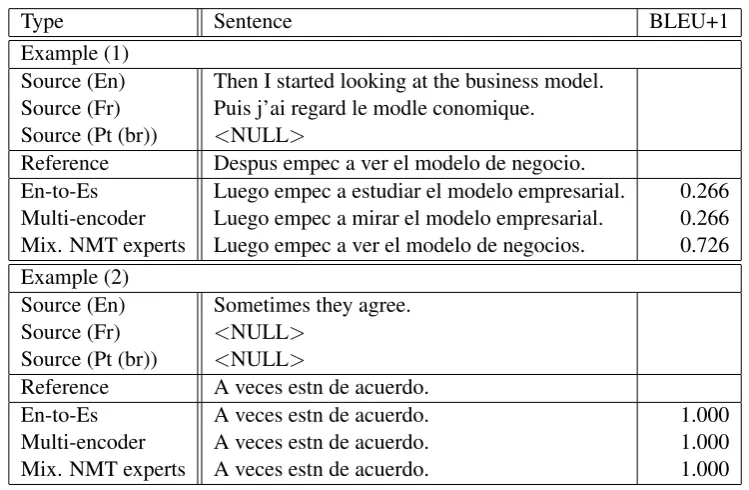
Table 6 shows a couple of translation examples in the{English, French, Brazilian Portuguese} -to-Spanish experiment. In Example(1), BLEU+1 of mixture of NMT Experts is larger than one-to-one (English-to-Spanish) because of the French sen-tence, although the source sentence of Brazilian Portuguese is missing. BLEU+1 of multi-encoder is same as one-to-one, but the generation word is different. The word of ”minar” is generated from multi-encoder, and ”estudiar” is generated from one-to-one. ”minar” means ”look” in English, and ”estudiar” means ”study”, so the meaning of sen-tence which was generated from multi-encoder is close to the reference one than that from one-to-one. Besides the word of ”ver” which is gener-ated from mixture of NMT experts meas ”see” in English, so the sentence of multi-encoder is more appropriate than the reference sentence.
In Example(2), there is only the English sen-tence in the source sensen-tences. We can see that sentences which are generated from all models are
27.51
21.03 26.33
22.70
18 19 20 21 22 23 24 25 26 27 28
Complete (4267) Incomplete (1184)
BL
EU
the type of test translations
(a) TED:{En,Fr,Pt (br)}-to-Es
26.28
19.31 26.77
20.71
18 19 20 21 22 23 24 25 26 27 28
Complete (4267) Incomplete (486)
BL
EU
the type of test translations
(b) TED:{En,Es,Pt (br)}-to-Fr
27.62
24.65 26.48
24.65
18 19 20 21 22 23 24 25 26 27 28
Complete (4267) Incomplete (475)
BL
EU
the type of test translations
Multi-encoder NMT Mixture of NMT experts
[image:6.595.316.534.46.536.2](c) TED:{En,Es,Fr}-to-Pt (br)
Figure 5: Detailed comparison of BLEU in TED test data. Completemeans the part of test data, in which there is no missing translation, and incom-plete means that, in which there are some miss-ing translation. The number in a parenthesis is the number of translations.
Task One-to-one Multi-encoder Mix. NMT Experts (En-to-target)
[image:7.595.120.480.61.135.2]{En, Fr, Pt (br)}-to-Es 24.32 26.01(+1.69) 25.51 (+1.19) {En, Es, Pt (br)}-to-Fr 24.54 25.62 (+1.08) 26.23(+1.69) {En, Es, Fr}-to-Pt (br) 25.14 27.36(+2.22) 26.39 (+1.25)
Table 5: Results in BLEU (and BLEU gains) by one-to-one and multi-source NMT on TED data. Note that the target language in each row differs so the results in different rows cannot be compared directly. All the differences are statistically significant (p <0.01).
Type Sentence BLEU+1
Example (1)
Source (En) Then I started looking at the business model. Source (Fr) Puis j’ai regard le modle conomique.
Source (Pt (br)) <NULL>
Reference Despus empec a ver el modelo de negocio.
En-to-Es Luego empec a estudiar el modelo empresarial. 0.266
Multi-encoder Luego empec a mirar el modelo empresarial. 0.266 Mix. NMT experts Luego empec a ver el modelo de negocios. 0.726 Example (2)
Source (En) Sometimes they agree.
Source (Fr) <NULL> Source (Pt (br)) <NULL>
Reference A veces estn de acuerdo.
En-to-Es A veces estn de acuerdo. 1.000
Multi-encoder A veces estn de acuerdo. 1.000
Mix. NMT experts A veces estn de acuerdo. 1.000
Table 6: Translation examples in{English, French, Brazilian Portuguese}-to-Spanish translation.
5 Related Work
In this paper, we examined strategies for multi-source NMT. On the other hand, there are there are other strategies for multilingual NMT that do not use multiple source sentences as their input.
Dong et al. (2015) proposed a method for multi-target NMT. Their method is using one sharing en-coder and deen-coders corresponding to the number of target languages. Firat et al. (2016) proposed a method for multi-source multi-target NMT us-ing multiple encoders and decoders with a shared attention mechanism. Johonson et al.(2017) and
Ha et al.(2016) proposed source and multi-target NMT using one encoder and one decoder, and sharing all parameters with all languages. No-tably, these methods use multilingual data to better train one-to-one NMT systems. However, our mo-tivation of this study is to improve NMT further by the help of other translations that are available on the source side at test time, and thus their ap-proaches are different from ours.
6 Conclusion
In this paper, we examined approaches for multi-source NMT usingincompletemultilingual corpus in which each missing input sentences is replaced by a special symbol<NULL>. The experimen-tal results with simulated and actual incomplete multilingual corpora show that this simple mod-ification allows us to effectively use all available translations at both training and test time.
The performance of multi-source NMT depends on source and target languages, and the size of missing data. As future work, we will investigate the relation of the languages included in the mul-tiple sources and the number of missing inputs to the translation accuracy in multi-source scenarios.
7 Acknowledgement
[image:7.595.111.486.188.433.2]References
Dzmitry Bahdanau, Kyunghyun Cho, and Yoshua Ben-gio. 2015. Neural Machine Translation by Jointly Learning to Align and Translate. InProceedings of the 3rd International Conference on Learning Rep-resentations.
Mauro Cettolo, Christian Girardi, and Marcello Fed-erico. 2012. WIT3: Web Inventory of Transcribed
and Translated Talks. In Proceedings of the 16th
EAMT Conference, pages 261–268.
Daxiang Dong, Hua Wu, Wei He, Dianhai Yu, and Haifeng Wang. 2015. Multi-Task Learning for
Mul-tiple Language Translation. In Proceedings of the
53rd Annual Meeting of the Association for Com-putational Linguistics, pages 1723–1732, Beijing, China. Association for Computational Linguistics.
Orhan Firat, Kyunghyun Cho, and Yoshua Bengio. 2016. Multi-Way, Multilingual Neural Machine
Translation with a Shared Attention Mechanism. In
Proceedings of the 2016 Conference of the North American Chapter of the Association for Computa-tional Linguistics: Human Language Technologies, pages 866–875, San Diego, California. Association for Computational Linguistics.
Ekaterina Garmash and Christof Monz. 2016. En-semble Learning for Multi-Source Neural Machine
Translation. InProceedings of COLING 2016, the
26th International Conference on Computational Linguistics: Technical Papers, pages 1409–1418, Osaka, Japan. The COLING 2016 Organizing Com-mittee.
Thanh-Le Ha, Jan Niehues, and Alexander Waibel. 2016. Toward Multilingual Neural Machine Trans-lation with Universal Encoder and Decoder. In Pro-ceedings of the 13th International Workshop on Spo-ken Language Translation, Seattle, Washington.
Melvin Johonson, Mike Schuster, Quoc V. Le, Maxim Krikun, Yonghui Wu, Zhifeng Chen, Nikhil Thorat, Fernanda Vigas, Martin Wattenberg, Greg Corrado, Macduff Hughes, and Jeffrey Dean. 2017. Google’s Multilingual Neural Machine Translation System: Enabling Zero-Shot Translation.Transactions of the Association for Computational Linguistics, vol. 5, pages 339–351.
Diederik P. Kingma Kingma and Jimmy Ba. 2015.
Adam: A Method for Stochastic Optimization. In
Proceedings of the 3rd International Conference on Learning Representations.
Philipp Koehn. 2004. Statistical Significance Tests for Machine Translation Evaluation. InProceedings of EMNLP 2004, pages 388–395, Barcelona, Spain. Association for Computational Linguistics.
Philipp Koehn. 2005. Europarl: A Parallel Corpus for Statistical Machine Translation. InConference Pro-ceedings: the tenth Machine Translation Summit, pages 79–86, Phuket, Thailand. AAMT, AAMT.
Thang Luong, Hieu Pham, and Christopher D. Man-ning. 2015. Effective Approaches to
Attention-based Neural Machine Translation. In
Proceed-ings of the 2015 Conference on Empirical Meth-ods in Natural Language Processing, pages 1412– 1421, Lisbon, Portugal. Association for Computa-tional Linguistics.
Franz Josef Och and Hermann Ney. 2001. Statisti-cal Multi-Source Translation. In Proceedings of the eighth Machine Translation Summit (MT Summit VIII), pages 253–258.
Kishore Papineni, Salim Roukos, Todd Ward, and Wei-Jing Zhu. 2002. BLEU: a Method for Automatic Evaluation of Machine Translation. InProceedings of the 40th Annual Meeting of the Association for Computational Linguistics (ACL), pages 311–318, Philadelphia.
J¨org Tiedemann. 2009. News from OPUS - A Col-lection of Multilingual Parallel Corpora with Tools and Interfaces. In N. Nicolov, K. Bontcheva, G. Angelova, and R. Mitkov, editors, Recent Advances in Natural Language Processing, vol-ume V, pages 237–248. John Benjamins, Amster-dam/Philadelphia, Borovets, Bulgaria.
Micha Ziemski, Marcin Junczys-Dowmunt, and Bruno Pouliquen. 2016. The United Nations Parallel Cor-pus v1.0. InProceedings of the Tenth International Conference on Language Resources and Evaluation (LREC 2016), Paris, France. European Language Resources Association (ELRA).