Encoding World Knowledge in the Evaluation of Local Coherence
Muyu Zhang1∗, Vanessa Wei Feng2, Bing Qin1, Graeme Hirst2, Ting Liu1and Jingwen Huang1 1Research Center for Social Computing and Information Retrieval
Harbin Institute of Technology, Harbin, China
2Department of Computer Science, University of Toronto, Toronto, ON, Canada
{myzhang,qinb,tliu,jwhuang}@ir.hit.edu.cn
{weifeng,gh}@cs.toronto.edu
Abstract
Previous work on text coherence was primar-ily based on matching multiple mentions of the same entity in different parts of the text; therefore, it misses the contribution from se-mantically related but not necessarily coref-erential entities (e.g., Gates and Microsoft). In this paper, we capture such semantic relat-edness by leveraging world knowledge (e.g., Gatesis the person who created Microsoft), and use two existing evaluation frameworks. First, in the unsupervised framework, we in-troduce semantic relatedness as an enrichment to the original graph-based model of Guin-audeau and Strube (2013). In addition, we incorporate semantic relatedness as additional features into the popular entity-based model of Barzilay and Lapata (2008). Across both frameworks, our enriched model with seman-tic relatedness outperforms the original meth-ods, especially on short documents.
1 Introduction
In a well-written document, sentences are organized and presented in a logical and coherent form, which makes the text fluent and easily understood. There-fore, coherence is a fundamental aspect of high text quality, and the evaluation of coherence is a crucial component of many NLP applications, such as essay scoring (Miltsakaki and Kukich, 2004), story gener-ation (McIntyre and Lapata, 2010), and document summarization (Barzilay et al., 2002).
∗This work was partly done while the first author was
vis-iting University of Toronto.
A particularly popular model for evaluating text coherence is the entity-based local coherence model of Barzilay and Lapata (2008) (B&L), which ex-tracts mentions of entities in adjacent sentences, and captures local coherence in terms of the transitions in the grammatical role of each mention. Follow-ing this direction, a number of extensions have been proposed (Elsner and Charniak, 2008; Elsner and Charniak, 2011; Lin et al., 2011; Feng et al., 2014), the majority of which focus on enriching the origi-nal entity features. An exception is the unsupervised model of Guinaudeau and Strube (2013) (G&S), which converts the document into a graph of sen-tences, and evaluates the text coherence by comput-ing the average out-degree over the entire graph.
However, despite the apparent success of these methods, they rely merely on matching mentions of the same entity, but neglect the contribution from semantically related but not necessarily coreferen-tial entities. For example, the text in Figure 1a1has
no common entity ins2and s3. However, the
tran-sition between them is perfectly coherent, because there exists close semantic relatedness between two distinct entities, Gates in s2 and Microsoft in s3,
which can be captured by the world knowledge that
Gates is the person who created Microsoft
(repre-sented byGates-create-Microsoft). In fact, the is-sue of absence of common entities between adjacent sentences is quite prevalent. Analyzing the CoNLL 2012 dataset (Pradhan et al., 2012), we found that 42.34% of the time, adjacent sentences do not share common entities. As a result, methods which rely on strict entity matching would fail on these cases.
1Based on a news item: http://www.cnbc.com/id/101576926
s1: In 1980, [Gates]S licensed [ 86-DOS ]O from [ Tim Paterson ]X for $50,000, which marketed it as [ PC-DOS ]X.
s2: [Gates' smartest move ]S was retaining [ ownership of the source code ]O of what he and [ Allen ]X would develop as [ MS-DOS ]X. s3: [Microsoft ]S got a [ licensing fee ]O every time [ IBM ]S sold a [ PC ]O.
s1: In 1980, [Gates]S licensed [ 86-DOS ]O from [ Tim Paterson ]X for $50,000, which marketed it as [ PC-DOS ]X.
s2: [Gates' smartest move ]S was retaining [ ownership of the source code ]O of what he and [ Allen ]X would develop as [ MS-DOS ]X. s3: [Microsoft ]S got a [ licensing fee ]O every time [ IBM ]S sold a [ PC ]O.
(a) A fragment of news text
s1
S - - - S O O O O - - - - - s2 s3 M o ve O w n er sh ip So u rc e C o d e M S-D O S Fe e Ti m e IB M P C
- - - - - - - S O X S O
M ic ro so ft G at es 8 6 -D O S P at er so n P C -D O S
S O X X - - - - - - - - - - s1
S - - - S O O O O - - - - - s2 s3 M o ve O w n er sh ip So u rc e C o d e M S-D O S Fe e Ti m e IB M P C
- - - - - - - S O X S O
M ic ro so ft G at es 8 6 -D O S P at er so n P C -D O S
S O X X - - - - - - - - - -
[image:2.612.81.538.59.150.2](b) The corresponding entity grid
Figure 1: A news text fragment with its corresponding entity grid constructed following B&L (2008). Al-thoughs2ands3share no entity, their transition is still coherent, becauseGatesandMicrosoftare semanti-cally related by the knowledgeGates-create-Microsoft.
We wish to incorporate semantic relatedness be-tween different entities into existing models to tackle the problem described above. In particular, we pro-pose to capture such semantic relatedness between different entities with world knowledge represented as triples, e.g., Gates-create-Microsoft. Given a text to be evaluated, we first retrieve relevant world knowledge from multiple sources. For the unsuper-vised framework of G&S, we integrate knowledge into the original graph-based document representa-tion, in which sentences are the nodes and edges are formed by shared entities and our world knowledge. Then, we adopt a dynamic programming algorithm to produce a coherence score for the text. For the supervised framework of B&L, we incorporate the world knowledge as a novel set of features into the original entity-based model, and train a model to dis-criminate different degrees of text coherence.
To evaluate the impact of incorporating seman-tic relatedness, we conduct experiments on two datasets, each of which resembles a real sub-task in the text coherence modeling: sentence ordering
and summary coherence rating. On both tasks, across two frameworks, supervised and unsuper-vised, we perform a direct comparison between our enhanced model and the original one. On both tasks, our models are shown to be more powerful than the models relying on entity matching only. Moreover, for sentence ordering, world knowledge is shown to be especially useful on short documents.
2 Background
2.1 Entity-based local coherence modeling
The initial entity-based model was developed by B&L. It is based on the intuition that there exists
a canonical order of how entities occur in the text. Therefore, we can model text coherence by measur-ing how mentions of various entities are distributed within the text. Specifically, for a given documentd, an entity grid is constructed in which the rows rep-resent the sentences and the columns reprep-resent enti-ties. Each grid cellri j corresponds to the syntactic
role of entityej in sentence si: subject (S), object
(O), other (X), or nothing (−). For example, Figure 1b shows the entity grid of the text shown in Figure 1a. If an entity serves multiple syntactic roles in a sentence, its grammatical role is resolved according to the priority order:S OX −.
Based on the entity grid representation, a lo-cal coherence transition is defined as a sequence
{S,O,X,−}n, representing the grammatical roles or absence of a particular entity acrossnadjacent sen-tences. Then, the document is encoded as a feature vectorΦ(d)=(p1(d),p2(d), . . . ,pm(d)), wherept(d)
is the normalized frequency of the transitiontin the entity grid, andmis the number of predefined tran-sitions. pt(d) is computed as the number of
occur-rences of transitiontamong all entities in the entity grid, divided by the total number of transitions of the same length. Using this feature encoding, the model is then trained as a preference ranking problem be-tween documents of different degrees of coherence.
2.2 Graph-based local coherence modeling
G&S, which transforms the entity grid into a sen-tence graph and measures text coherence by comput-ing the average out-degree of the graph. For a docu-mentd, its entity grid is constructed first, following the method described in Section 2.1. Then, a bipar-tite graphG = (Vs,Ve,L,W) is constructed, where
Vsis the set of nodes representing sentences in the
text; Ve is the set of nodes representing entities; L
is the set of edges associated with a weightw ∈W. An edge exists between a sentence sx and an entity
e, if and only ifeoccurs insx. Each edge is further
associated with a weightw(e,sx), determined by the
grammatical role of the entityein sentencesx: 3 for
subject (S), 2 for object (O), 1 for other (X), and 0 for nothing (−). Note that graphGconsists of both sentence nodes and entity nodes.
Then, G is converted to another graph P, which consists of sentence nodes only, where an edge con-nects two sentence nodes if and only if at least one entity is shared between these two sentences. InP, the weight of each edge is computed by aggregating the edge weights in the original bipartite graphG:
w(P)(s
x,sy)=
X
e∈Exyw (G)(e,s
x)∗w(G)(e,sy), (1)
where Exy is the set of entities shared by two
sen-tencessxandsy, andw(G)(e,sx) is the weight of edge
between entity e and sentence sx as illustrated
be-fore. The coherence of the document is thus mea-sured by the average out-degree of graphP.
Although this method is purely unsupervised, it achieves a performance comparable with its super-vised counterparts, e.g., B&L. However, since this method still relies on matching multiple mentions of the same entity, it misses the important contribution from those semantically related yet distinct entities,
e.g.GatesandMicrosoftin Figure 1a.
3 Finding relevant world knowledge
To supplement existing models with information de-rived from semantic relatedness, given a document
dto be evaluated, we first retrieve all world knowl-edge related tod. There are two major issues for this process: (1)knowledge sources: where can we ob-tain this knowledge?, and (2)knowledge selection: how do we pinpoint the most relevant ones?
Knowledge sources There are two main kinds of knowledge sources: (1) manually edited knowledge
bases, such as YAGO (Hoffart et al., 2013), which consists of about 4 million human-edited instances from on-line encyclopedias such as WikiPedia (De-noyer and Gallinari, 2007) and FreeBase (Bol-lacker et al., 2008), and (2) automatically con-structed knowledge bases, such as Reverb (Fader et al., 2011), which covers about 20 million in-stances extracted from raw texts. Generally speak-ing, manually edited knowledge bases have better accuracy but lower coverage, while automatically extracted knowledge bases are the opposite. To seek a good balance, we use both YAGO and Re-verb as our knowledge sources. In addition, the automatically constructed knowledge bases can be extracted from raw texts of any domain, which makes our method adaptable. Both sources are pre-sented in triples, argument1-predicate-argument2,
(e.g.,Gates-create-Microsoft), where the two argu-ments are usually entities and the predicate is the relation between them (Zhang et al., 2014).
Knowledge selection For each document d, we then select the subset of relevant knowledge in-stances, in the sense that they represent relations be-tween the entities ind. In particular, we extract all entities ind, and query the knowledge bases to ob-tain all the knowledge instances in which both of the two arguments, argument1 and argument2, match some of the entities ind.
One issue in knowledge selection is whether to retrieve knowledge instances using exact or partial matching. For a given pair of entities in the text, the chance is rather low to find instances in the knowl-edge bases where the two arguments perfectly match the pair of entities, because entities in the source document might appear in aliases or abbreviations. In contrast, partial matching between arguments and entities usually increases coverage but at risk of in-troducing more noise. In our work, to balance ac-curacy and coverage, when retrieving world knowl-edge, we use partial matching and form queries only for those entities realized as noun phrases in the text.
4 World knowledge encoding
4.1 Unsupervised graph-based framework
S1 S2 S3
e1 e2 e3 e4 e5 e6 e1 e2 e3 e4 e5 e1 e2 e3 e4
Gates MS-DOS Microsoft PC Product
S1 S2 S2
S1 S2 S2
S1 S2 S2
(a) Entity graph with background knowledge
b-1. Without BK
b-2. With BK between adjacent sentence
(b) Sentence graph
b-3. With BK between non-adjacent sentence
S1
S2
S3
Source target
e1 e2 e1 e3 e4 e5
e1 e2 e1 e3 e4 e5 (a)-1
(a)-2
S1 S2 S3
S1 S2 S3
S1 S2 S3
e1 e2 e1 e3 e4 e5
(a)-3
S1 S2 S3
S1 S2 S3
S1 S2 S3
(b)-1
(b)-2
(b)-3
(a) Entity graph (b) Sentence graph
S1
S2
S3
Source target
e1 e2 e1 e3 e4 e5
(a)-1
S1 S2 S3 S1 S2 S3
e1 e2 e1 e3 e4 e5
(a)-2
S1 S2 S3 S1 S2 S3
(b)-1 (b)-2 S1 S2 S3 Source target
e1 e2 e1 e3 e4 e5
(a)-1
S1 S2 S3 S1 S2 S3
e1 e2 e1 e3 e4 e5
(a)-2
S1 S2 S3 S1 S2 S3
(b)-1
(b)-2
e1 e2 e1 e3 e4 e5
S1 S2 S3 S1 S2 S3
e1 e2 e1 e3 e4 e5
S1 S2 S3 S1 S2 S3
S1 S2 S3 S1 S2 S3
e1 e2 e1 e3 e4 e5
S1 S2 S3 S1 S2 S3
e1 e2 e1 e3 e4 e5
S1 S2 S3 S1 S2 S3
e1 e2 e1 e3 e4 e5
S1 S2 S3 S1 S2 S3
e1 e2 e1 e3 e4 e5
S1 S2 S3 S1 S2 S3
(a) Traditional entity graph relying on entity matching
S1 S2 S3
e1 e2 e3 e4 e5 e6 e1 e2 e3 e4 e5 e1 e2 e3 e4
Gates MS-DOS Microsoft PC Product
S1 S2 S2
S1 S2 S2
S1 S2 S2
(a) Entity graph with background knowledge
b-1. Without BK
b-2. With BK between adjacent sentence
(b) Sentence graph
b-3. With BK between non-adjacent sentence
S1
S2
S3
Source target
e1 e2 e1 e3 e4 e5
e1 e2 e1 e3 e4 e5 (a)-1
(a)-2
S1 S2 S3
S1 S2 S3
S1 S2 S3
e1 e2 e1 e3 e4 e5
(a)-3
S1 S2 S3
S1 S2 S3
S1 S2 S3
(b)-1
(b)-2
(b)-3
(a) Entity graph (b) Sentence graph
S1
S2
S3
Source target
e1 e2 e1 e3 e4 e5
(a)-1
S1 S2 S3 S1 S2 S3
e1 e2 e1 e3 e4 e5
(a)-2
S1 S2 S3 S1 S2 S3
(b)-1 (b)-2 S1 S2 S3 Source target
e1 e2 e1 e3 e4 e5
(a)-1
S1 S2 S3 S1 S2 S3
e1 e2 e1 e3 e4 e5
(a)-2
S1 S2 S3 S1 S2 S3
(b)-1
(b)-2
e1 e2 e1 e3 e4 e5
S1 S2 S3 S1 S2 S3
e1 e2 e1 e3 e4 e5
S1 S2 S3 S1 S2 S3
S1 S2 S3 S1 S2 S3
e1 e2 e1 e3 e4 e5
S1 S2 S3 S1 S2 S3
e1 e2 e1 e3 e4 e5
S1 S2 S3 S1 S2 S3
e1 e2 e1 e3 e4 e5
S1 S2 S3 S1 S2 S3
e1 e2 e1 e3 e4 e5
S1 S2 S3
S1 S2 S3
S1 S2 S3
(b) Traditional sentence graph converted from (a)
S1 S2 S3
e1 e2 e3 e4 e5 e6 e1 e2 e3 e4 e5 e1 e2 e3 e4
Gates MS-DOS Microsoft PC Product
S1 S2 S2
S1 S2 S2
S1 S2 S2
(a) Entity graph with background knowledge
b-1. Without BK
b-2. With BK between adjacent sentence
(b) Sentence graph
b-3. With BK between non-adjacent sentence
S1
S2
S3
Source target
e1 e2 e1 e3 e4 e5
e1 e2 e1 e3 e4 e5 (a)-1
(a)-2
S1 S2 S3
S1 S2 S3
S1 S2 S3
e1 e2 e1 e3 e4 e5
(a)-3
S1 S2 S3
S1 S2 S3
S1 S2 S3
(b)-1
(b)-2
(b)-3
(a) Entity graph (b) Sentence graph
S1
S2
S3
Source target
e1 e2 e1 e3 e4 e5
(a)-1
S1 S2 S3 S1 S2 S3
e1 e2 e1 e3 e4 e5
(a)-2
S1 S2 S3 S1 S2 S3
(b)-1 (b)-2 S1 S2 S3 Source target
e1 e2 e1 e3 e4 e5
(a)-1
S1 S2 S3 S1 S2 S3
e1 e2 e1 e3 e4 e5
(a)-2
S1 S2 S3 S1 S2 S3
(b)-1
(b)-2
e1 e2 e1 e3 e4 e5
S1 S2 S3 S1 S2 S3
e1 e2 e1 e3 e4 e5
S1 S2 S3 S1 S2 S3
S1 S2 S3 S1 S2 S3
e1 e2 e1 e3 e4 e5
S1 S2 S3 S1 S2 S3
e1 e2 e1 e3 e4 e5
S1 S2 S3 S1 S2 S3
e1 e2 e1 e3 e4 e5
S1 S2 S3 S1 S2 S3
e1 e2 e1 e3 e4 e5
S1 S2 S3 S1 S2 S3
(c) Our entity graph encoding relatedness between entities
S1 S2 S3
e1 e2 e3 e4 e5 e6 e1 e2 e3 e4 e5 e1 e2 e3 e4
Gates MS-DOS Microsoft PC Product
S1 S2 S2
S1 S2 S2
S1 S2 S2
(a) Entity graph with background knowledge
b-1. Without BK
b-2. With BK between adjacent sentence
(b) Sentence graph
b-3. With BK between non-adjacent sentence
S1
S2
S3
Source target
e1 e2 e1 e3 e4 e5
e1 e2 e1 e3 e4 e5 (a)-1
(a)-2
S1 S2 S3
S1 S2 S3
S1 S2 S3
e1 e2 e1 e3 e4 e5
(a)-3
S1 S2 S3
S1 S2 S3
S1 S2 S3
(b)-1
(b)-2
(b)-3
(a) Entity graph (b) Sentence graph
S1
S2
S3
Source target
e1 e2 e1 e3 e4 e5
(a)-1
S1 S2 S3 S1 S2 S3
e1 e2 e1 e3 e4 e5
(a)-2
S1 S2 S3 S1 S2 S3
(b)-1 (b)-2 S1 S2 S3 Source target
e1 e2 e1 e3 e4 e5
(a)-1
S1 S2 S3 S1 S2 S3
e1 e2 e1 e3 e4 e5
(a)-2
S1 S2 S3 S1 S2 S3
(b)-1
(b)-2
e1 e2 e1 e3 e4 e5
S1 S2 S3 S1 S2 S3
e1 e2 e1 e3 e4 e5
S1 S2 S3 S1 S2 S3
S1 S2 S3 S1 S2 S3
e1 e2 e1 e3 e4 e5
S1 S2 S3 S1 S2 S3
e1 e2 e1 e3 e4 e5
S1 S2 S3 S1 S2 S3
e1 e2 e1 e3 e4 e5
S1 S2 S3 S1 S2 S3
e1 e2 e1 e3 e4 e5
S1 S2 S3
S1 S2 S3
S1 S2 S3
(d) Our sentence graph converted from (c)
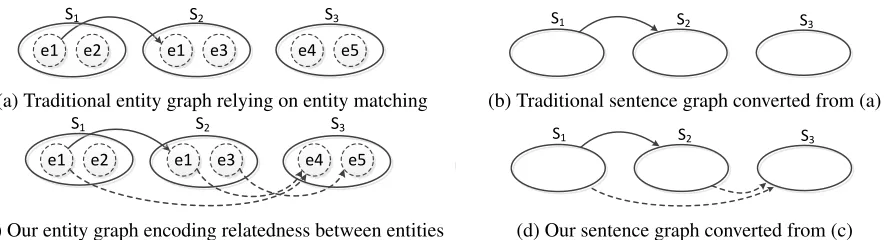
Figure 2: (a) and (b) show the traditional entity and sentence graph based on matching multiple mentions of the same entity; while (c) and (d) represent our entity and sentence graph encoding semantic relatedness between those semantically related but not necessarily coreferential entities (e.g.,GatesandMicrosoft) by addingworld-knowledge edges(dashed lines) accroding to world knowledge (e.g.,Gates-create-Microsoft).
how we capture semantic relatedness by encoding world knowledge to the graph-based model. The outline of our method is as follows. Given a docu-mentd, we first retrieve relevant world knowledge from multiple sources (see Section 3). Then, we construct anentity graph with world knowledge to capture both the distribution information and seman-tic relatedness between entities (see Section 4.1.1). After that, we convert the entity graph into a sen-tence graph(see Section 4.1.2), in which two stences are connected not only through common en-tities but also through world knowledge. Finally, we apply our novelreachability score computationover the sentence graph to produce a coherence score for the text to be evaluated (see Section 4.1.3).
4.1.1 Entity graph
As shown in Figure 2c, there are two kinds of edges in ourentity graph: (1)common-entity edges
(solid lines), which connect different mentions of the same entity, such asGatesins1andGatesins2; (2)
world-knowledge edges (dashed lines), which con-nect different entities through certain world knowl-edge, such as Gates in s2 and Microsoft in s3 re-lated by Gates-create-Microsoft. This representa-tion captures not only the distriburepresenta-tion informarepresenta-tion of individual entities but also the semantic related-ness between different entities. In contrast, the orig-inal graph-based model by G&S (Figures 2a and 2b) includes common-entity edges only and misses the semantic relatedness information. Formally, for a document d, we define its entity graph as G =
(V,Lm,Lk,Wm,Wk), where V denotes the nodes of
entities;Lmdenotes the set of common-entity edges
and Lk denotes the set of world-knowledge edges;
andWm andWk are the two sets of weights
associ-ated withLmandLkrespectively.
Following G&S, for each common-entity edge
lm ∈ Lm, which connects two mentions of the same
entity e appearing in different sentences sx and sy,
we compute its weight asw(e,sx)×w(e,sy), where
the value of w(e,sx) is based on the grammatical
role of the entity e in the sentence sx as follows:
3 for subject (S), 2 for object (O), 1 for other (X), and 0 for nothing(−). When multiple mentions of the same entity appear with different grammatical roles in the same sentence, the role with the high-est weight is chosen to represent the entity. For each world-knowledge edgelk ∈Lk, which connects two
different entitieseixandejyappearing in sentencesx
andsyrespectively, we consider three factors when assigning the weight to the edge: (1) semantic relat-edness betweeneixandejy: higher relatedness leads
to a higher weight; (2) the grammatical roles ofeix
andejyinsxandsy: different roles correspond to
dif-ferent weights; and (3) textual distance betweeneix
andejy: longer distance results in a lower weight.
Therefore we compute the weight oflk betweeneix
andejyas below:
wk(eix,ejy)= r(ei,ej)×dw(e(ix,eixe,sx)×w(ejy,sy)
jy)×2 , (2)
wherew(eix,sx) is associated to the grammatical role
ofeixinsxas illustrated before;d(eix,ejy) is the
dis-tance betweeneixandejy; andr(ei,ej) is the
[image:4.612.83.525.57.177.2]For-mula 3 below. Note that the value ofr(ei,ej) is
in-dependent of the sentence in whicheiandejappear,
so we denote it asr(ei,ej) instead ofr(eix,ejy).
r(ei,ej)=
logn(ei,ej)
max
lmn∈Lklogn(em,en)
ifn(ei,ej)>2,
0 otherwise.
(3) wheren(ei,ej) corresponds to the number of world
[image:5.612.311.544.67.269.2]knowledge instances relatingeiandej. For instance,
Figure 1a contains an edge between Gates (e1 in s1) and Microsoft (e2 in s3), in which w(e11,s1) andw(e23,s3) are 3, and d(e11,e23) is 2. Note that
we consider the grammatical roles in both com-mon edges and background knowledge edges be-cause we treat them independently from each other. The grammatical information is important to both of these two kinds of edges.
4.1.2 Sentence graph
Figure 2d shows the sentence graph converted
from the entity graph in Figure 2c. In our
work, in order to incorporate world knowledge, we adopt an enriched representation of sentence graph,
G0 = (V0,L0
m,L0k,Wm0,Wk0), whereV0 is the sentence
nodes; L0
mdenotes the set of common-entity edges
(solid lines);L0
k denotes the set of world-knowledge
edges (dashed lines), andW0
mandWk0correspond to
the weights associated with the edges inL0
mandL0k.
Intuitively, the semantic relatedness between two sentences can be measured as the total relatedness of each entity pair in the two sentences. There-fore, in our enhanced sentence graph representa-tion, for a pair of sentences sx and sy, the weight
of their common-entity edge, w0
m(sx,sy), is
com-puted asw0
m(sx,sy) = Pei∈Vxywm(eix,eiy), whereVxy
is the set of entities shared by two sentences sx
and sy, and wm(eix,eiy) is the weight of the
corre-sponding common-entity edge in the entity graph (see Section 4.1.1). Similarly, the weight of their world-knowledge edge, w0
k(sx,sy), is computed as w0
k(sx,sy) = Pei∈Vx,ej∈Vywk(eix,ejy), whereVx and Vydenote the set of entities insxandsyrespectively,
and wk(eix,ejy) is the weight of the corresponding
world-knowledge edge in the entity graph.
Algorithm 1:Reachability score computation.
Input:G0=(V0,L0
m,L0k,Wm0,Wk0). Output: The final reachability scoreS.
1 n← |V0|
2 for j=1→ndo 3 score(v0j)←0 4 for j=1→ndo 5 fori=0→ j−1do 6 ifl0m(i, j)∈L0mthen
7 score(v0j)←score(v0i)+w0m(i,j) 8 ifl0k(i, j)∈L0kthen
9 score(v0j)←score(v0i)+w0k(i,j)
10 returnS =
P
v0
j∈V0∧out(v0j)=0score(v
0
j) |{v0
j :v0j ∈V0∧out(v0j)=0}|
4.1.3 Reachability score computation
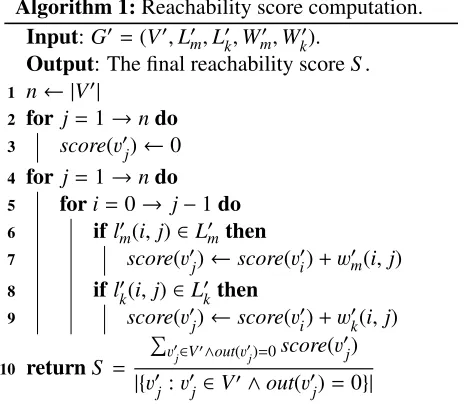
Based on our sentence graph representation, we compute a reachability score for each sentence node. To produce a final coherence score for the text, we compute theaverage reachability scoreamong those nodes whose out-degree is equal to 0 in the graph, rather than among all nodes, because of the intuition that, if a sentence node has no subsequent nodes, their reachability score therefore reflects the tightness between this sentence and the preceding part of the text. For a certain sentence node v0
j,
its reachability score is defined as the sum of edge weights on all paths from the starting node (i.e., the first sentence) tov0
j, and the contribution of each path
to the final reachability score depends on the total weight of that path as shown in Equation 4.
score(v0j)=
X
v0
i∈V0,v0i,v0j
(score(v0i)+w0m(i,j)+w0k(i, j)) (4)
where score(v0
i) denotes the reachability score of v0
i, and w0m(i,j) and w0k(i,j) are the weights of the
common-entity edge and the world-knowledge edge between v0
i and v0j; if there is no such edge in the
graph, the corresponding weight is set to 0.
S1 S2 S2
(a) Entity graph (b) Sentence graph
S1 S2 S2
S1 S2 S2
S1 S2 S2
S1 S2 S2
S1 S2 S2
S1 S2 S2
S1 S2 S2
S1 S2 S2 S1 S2 S2
S1 S2 S2 S1 S2 S2
S1 S2 S2 S1 S2 S2
[image:6.612.80.288.59.143.2]S1 S2 S2 S1 S2 S2
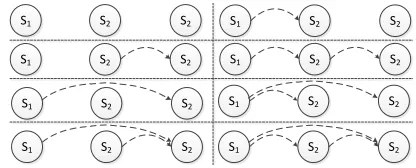
Figure 3: Eight patterns of how world knowledge is distributed among three adjacent sentences.
4.2 Supervised entity-based framework
As mentioned previously, numerous extensions have been proposed to the original entity-based model of B&L. However, those extensions mostly rely on en-tity matching and thus fail to incorporate the infor-mation from semantically related yet distinct enti-ties. We propose a novel extension by introducing world knowledge to capture entity-wise relatedness. Inspired by the original entity-based model, in which local coherence is reflected by the patterns of how entities act grammatically from one sentence to the next, we believe that local coherence can also be characterized by the patterns of how world knowl-edge relates a pair of sentences. Specifically, given a set of sentences, there are different patterns of how knowledge instances are distributed among them. We consider modeling those patterns within a win-dow of 3 sentences, in which there are 23 =8 diff
er-ent distribution patterns, as shown in Figure 3. We then use the frequencies of these distribution pat-terns over the entire document as additional features into the entity-based model. In particular, for each particular distribution pattern bk, its corresponding
frequencyp(bk)= |V|0b| −k| 2, where|bk|is the number
of occurrences ofbkin the sentence graph.
In addition top(bk), we also compute another
fea-ture, p(E), which is the frequency that two nodes are connected by certain world knowledge over the sentence graph, reflecting the overall semantic re-latedness within the graph. p(E) is computed as
p(E) = ||LV0k0||. With these world knowledge features incorporated into the original entity-based model, we obtain an enhanced model with an emphasis on semantic relatedness between different entities.
5 Experiments
To evaluate the impact of incorporating semantic re-latedness, we conduct experiments on two datasets, each of which resembles a real sub-task in modeling
text coherence: sentence ordering and summary
coherence rating. Since text coherence is a rela-tive concept rather than a binary distinction, in both tasks, we formulate the problem as pairwise prefer-ence ranking. Specifically, given a set of texts with different degrees of coherence, we train a ranker to prefer the more coherent text over the less coherent one. Performance is therefore measured as the frac-tion of correct pairwise rankings as recognized by the ranker. We use SVMlight (Joachims, 2002) with
the ranking configuration to train and evaluate our models, with all parameters set to default values.
On both tasks, across two frameworks, supervised and unsupervised, we directly compare our modified model against the original one, i.e., B&L in the su-pervised framework and G&S in the unsusu-pervised framework. In our experiments, we use the Stan-ford parser (Marneffe et al., 2006) to automatically extract the grammatical role for each entity mention.
5.1 Sentence ordering
The task of sentence ordering attempts to simu-late the situation where, given a predefined set of information-bearing items, we need to determine the best order to arrange those items.
In this paper, we follow G&S and introduce CoNLL 20122(Pradhan et al., 2012) as our dataset,
which is composed of documents from multiple news sources. For each text, we randomly shuffle its sentences to generate 20 permutations with incorrect sentence order. For a fair comparison, we also evalu-ate our model on a filtered subset of documents with an average length of 31.8 sentences. Therefore, our dataset contains 72 documents and 72×20 = 1440 permutations, among which the shortest one con-tains 25 sentences. For our enhanced graph-based model (introduced in Section 4.1), which is purely unsupervised, we evaluate our model over the entire dataset. For our enhanced entity-based model (in-troduced in Section 4.2), which is purely supervised, we use half of the complete CoNLL dataset for train-ing (237 documents plus permutations) and use half
of the filtered subset (36 documents plus permuta-tions). The training and test sets do not overlap.
In this task, each training and test instance is com-posed of a pair of a source document and one of its permutations, and the source document is always considered more coherent than its permutation.
5.2 Summary coherence rating
The second task is summary coherence rating, in which, given a pair of summaries about the same set of source documents, we determine the rank-ing of these two summaries based on their de-grees of coherence. The performance of the model is assessed by comparing model-induced rankings against the rankings given by human judges. We use the same dataset (DUC 2003) as B&L and G&S did, which consists of summaries generated either by human writers or by automatic summarization sys-tems. Each summary was given a coherence score by averaging among seven judges. Often, machine-generated summaries receive low coherence scores because they contain sentences taken out of context and thus display problems with respect to coherence. This dataset consists of 16 input document clus-ters, each of which is associated with five machine-generated summaries along with a human-written summary. In total, we have 96 summaries (for more details, see B&L). We form pairwise rankings by taking any two summaries originating from the same document cluster, given that the two summaries re-ceive different coherence scores: 144 of the resulting rankings are used for training and 80 are for testing.
5.3 Experiment results
In this section, we demonstrate the performance of our models with world knowledge encoded in one of the two ways: paths in a sentence graph or features in an entity grid. We compare our models against the original graph-based model (G&S) and entity-based model (B&L). The evaluation is conducted on the two tasks, sentence ordering and summary co-herence rating, and the accuracy is the fraction of correct pairwise rankings.
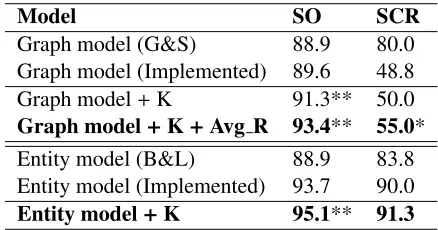
Table 1 shows the performance of various models on both tasks. The first section shows the results of G&S’s graph-based local coherence model, includ-ing the performance reported in their original paper and that achieved by our re-implementation,
repre-Model SO SCR
Graph model (G&S) 88.9 80.0
Graph model (Implemented) 89.6 48.8
Graph model+K 91.3** 50.0
Graph model+K+Avg R 93.4** 55.0*
Entity model (B&L) 88.9 83.8
Entity model (Implemented) 93.7 90.0
Entity model+K 95.1** 91.3
Table 1: Accuracies (%) of various models on the two tasks, sentence ordering (SO) and sum-mary coherence rating (SCR). Models that per-form significantly better than their corresponding re-implemented basic models are denoted by ** (p < .01) or * (p< .05), verified using pairedt-test.
senting the effect with no world knowledge encoded. The second section shows the performance of our two graph-based models with world knowledge en-coded. Graph model + K is the basic model with world knowledge encoded, but coherence is simply measured as the average out-degree as in G&S’s
ap-proach. Graph model + K + Avg R replaces the
out-degree measurement by ouraverage reachabil-ity score (described in Section 4.1.3), which mea-sures coherence in a more sophisticated way. The third section shows the results of B&L’s entity-based local coherence model, including the originally ported performance and that obtained by our re-implementation, in which no world knowledge fea-tures are included. The last section,Entity model+
K, shows the result of entity-based model with our world knowledge features encoded. Note that the random baseline of both tasks is 50%.
Firstly, for graph-based models, ourGraph model
+ K outperforms the original models, suggesting that world knowledge is truly helpful for capturing more coherence information3. Moreover, by
[image:7.612.316.535.59.174.2]Figure 4: Graph-based models, with and without world knowledge (labeled asWith KandWithout K), tested on sets with different numbers of sentences.
ducing the scoring scheme of average reachability score, ourGraph model+ K+ Avg R achieves the best performance among all graph-based models.
Secondly, for entity-based models, our en-hanced model with knowledge features encoded also achieves superior performance than our re-implemented model, again confirming the useful-ness of world knowledge. Interestingly, we observe that our re-implementation obtains higher accuracy compared to the performance reported by B&L. This is partly due to the fact that the documents in our dataset have an average length of 31.5 sentences, which are longer than those used in B&L’s experi-ments. We will further discuss this problem in Sec-tion 5.4 and show that document length is an impor-tant factor to the overall performance.
However, on the task of summary coherence rat-ing, the difference between our extended models and the original ones is generally not significant, primar-ily due to the fact that the sample size for this task is too small, i.e., 80 pairwise rankings.
5.4 Effect of document length
5.4.1 Effect of document length on the overall performance
We further analyze the impact of document length on the task of sentence ordering. We partition our original dataset, which consists of 214 documents and their permutations, into 8 non-overlapping sub-sets, according to the length of documents: 1-5, 6-10,. . . , and 36-40 sentences. To illustrate the cor-relation between the performance and the length
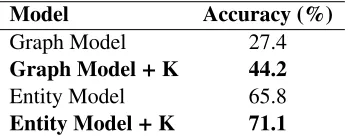
Model Accuracy (%)
Graph Model 27.4
Graph Model+K 44.2
Entity Model 65.8
[image:8.612.81.288.58.200.2]Entity Model+K 71.1
Table 2: Performance of various models with and without world knowledge in the sentence ordering task, tested on short documents with 1–5 sentences.
[image:8.612.341.515.60.128.2]of document, we test our models with and with-out world knowledge encoded on each subset sepa-rately. Since the size of the available training data in each subset is relatively small, the supervised entity-based model suffers from sparsity. Therefore, we fo-cus on the unsupervised graph-based models only.
Figure 4 shows the performance on different sub-sets. We can see that the performance of both models generally improves as the number of sen-tences increases. This observation is quite intuitive, because the longer a document is, the higher the chance is that, after being shuffled, adjacent sen-tences in the resulting permutation would be com-pletely irrelevant to each other. Therefore, for longer documents, it is much easier for the model to distin-guish a permutation from its source document.
5.4.2 Effect of document length on the model with world knowledge
6 Conclusions and future work
In this paper, for the evaluation of text coherence, we go beyond strict entity matching and model the se-mantic relatedness between distinct entities through the use of world knowledge. Specifically, we in-corporate world knowledge into two existing frame-works: (1) the unsupervised graph-based model (G&S), and (2) the supervised entity-grid model (B&L). Across the two frameworks, on both of our evaluation tasks, sentence ordering and summary coherence rating, our enhanced models with world knowledge encoded are shown to be stronger than the corresponding basic models, confirming that se-mantic relatedness is truly important for coherence modeling and such relatedness can be effectively captured by world knowledge. Moreover, we ob-serve that world knowledge is particularly useful for short documents in sentence ordering, as it provides additional clues to relate sub-topics in the text.
In our future work, we wish to explore the ef-fect of our world knowledge in conjunction with dis-course relations. Specifically, we plan to incorporate world knowledge into the framework of discourse role matrix (Lin et al., 2011; Feng et al., 2014). In addition, we also plan to develop a more sophis-ticated feature encoding by distinguishing different types of predicates in world knowledge triples.
Acknowledgments
We would like to thank Mao Zheng and Yanyan Zhao for their great help. This work was partly supported by National Natural Science Founda-tion of China via grant 61133012, the NaFounda-tional 863 Leading Technology Research Project via grant 2012AA011102 and the National Natural Science Foundation of China Surface Project via grant 61273321.
References
Regina Barzilay and Mirella Lapata. 2008. Modeling local coherence: An entity-based approach. Computa-tional Linguistics, 34(1):1–34.
Regina Barzilay, Noemie Elhadad, and Kathleen R. McKeown. 2002. Inferring strategies for sentence or-dering in multidocument news summarization. Jour-nal of Artificial Intelligence Research, 17(1):35–55.
Kurt Bollacker, Colin Evans, Praveen Paritosh, Tim Sturge, and Jamie Taylor. 2008. Freebase: a col-laboratively created graph database for structuring hu-man knowledge. In Proceedings of the 2008 ACM SIGMOD international conference on Management of data, pages 1247–1250. ACM.
Ludovic Denoyer and Patrick Gallinari. 2007. The Wikipedia XML corpus. InComparative Evaluation of XML Information Retrieval Systems, pages 12–19. Springer.
Micha Elsner and Eugene Charniak. 2008. Coreference-inspired coherence modeling. In Proceedings of the 46th Annual Meeting of the Association for Computa-tional Linguistics on Human Language Technologies: Short Papers, pages 41–44. Association for Computa-tional Linguistics.
Micha Elsner and Eugene Charniak. 2011. Extending the entity grid with entity-specific features. In Pro-ceedings of the 49th Annual Meeting of the Associa-tion for ComputaAssocia-tional Linguistics: Human Language Technologies: short papers-Volume 2, pages 125–129. Association for Computational Linguistics.
Anthony Fader, Stephen Soderland, and Oren Etzioni. 2011. Identifying relations for open information ex-traction. InProceedings of the Conference on Empiri-cal Methods in Natural Language Processing, pages 1535–1545. Association for Computational Linguis-tics.
Vanessa Wei Feng, Ziheng Lin, and Graeme Hirst. 2014. The impact of deep hierarchical discourse structures in the evaluation of text coherence. InProceedings of the 25th International Conference on Computational Linguistics, pages 940–949.
Katja Filippova and Michael Strube. 2007. Extend-ing the entity-grid coherence model to semantically related entities. InProceedings of the Eleventh Eu-ropean Workshop on Natural Language Generation, pages 139–142. Association for Computational Lin-guistics.
Camille Guinaudeau and Michael Strube. 2013. Graph-based local coherence modeling. InProceedings of the 51st Annual Meeting of the Association for Computa-tional Linguistics, pages 93–103.
Johannes Hoffart, Fabian M Suchanek, Klaus Berberich, and Gerhard Weikum. 2013. Yago2: a spatially and temporally enhanced knowledge base from Wikipedia.
Artificial Intelligence, 194:28–61.
Thorsten Joachims. 2002. Optimizing search engines us-ing clickthrough data. In Proceedings of the Eighth ACM SIGKDD International Conference on Knowl-edge Discovery and Data Mining, pages 133–142. ACM.
relations. In Proceedings of the 49th Annual Meet-ing of the Association for Computational LMeet-inguistics: Human Language Technologies-Volume 1, pages 997– 1006. Association for Computational Linguistics. M. Marneffe, B. Maccartney, and C. Manning. 2006.
Generating typed dependency parses from phrase structure parses. In Proceedings of the 5th Interna-tional Conference on Language Resources and Evalu-ation, volume 6, pages 449–454. European Language Resources Association (ELRA).
Neil McIntyre and Mirella Lapata. 2010. Plot induction and evolutionary search for story generation. In Pro-ceedings of the 48th Annual Meeting of the Associa-tion for ComputaAssocia-tional Linguistics, pages 1562–1572. Association for Computational Linguistics.
Eleni Miltsakaki and Karen Kukich. 2004. Evaluation of text coherence for electronic essay scoring systems.
Natural Language Engineering, 10(1):25–55.
Sameer Pradhan, Alessandro Moschitti, Nianwen Xue, Olga Uryupina, and Yuchen Zhang. 2012. CoNLL-2012 shared task: Modeling multilingual unrestricted coreference in ontonotes. In Joint Conference on EMNLP and CoNLL-Shared Task, pages 1–40. Asso-ciation for Computational Linguistics.