Poly[1,4-bis(ammoniomethyl)cyclo-hexane [di-
l
-bromido-dibromido-plumbate(II)]]
Matthew Kyle Rayner and David Gordon Billing*
Molecular Sciences Institute, School of Chemistry, University of the Witwatersrand, Private Bag 3, PO Wits 2050, South Africa
Correspondence e-mail: [email protected] Received 27 April 2010; accepted 7 May 2010
Key indicators: single-crystal X-ray study;T= 173 K; mean(C–C) = 0.005 A˚;
Rfactor = 0.021;wRfactor = 0.047; data-to-parameter ratio = 28.1.
The title compound, {(C8H20N2)[PbBr4]}n, crystallizes as an
inorganic–organic hybrid with alternating layers of diammo-nium cations and two-dimensional corner-sharing PbBr6
octahedra extending parallel to the bc plane, which are eclipsed relative to one another. Both PbBr6 octahedra and
the organic cation exhibit 1 symmetry. The cations interactvia N—H Br hydrogen bonding in the right-angled halogen sub-type of the terminal halide hydrogen-bonding motif.
Related literature
For hydrogen-bonding nomenclature for inorganic–organic hybrids, see: Mitzi (1999). Hybrid structures containing diammonium cations have been synthesized by Dobrzycki & Woz´niak (2008) and Zhu et al. (2003). The semiconducting properties of similar hybrids were demonstrated by Mitzi (2004). For the related chloridoplumbate(II), see: Rayner & Billing (2010a) and for the isotypic iodidoplumbate(II), see: Rayner & Billing (2010b).
T= 173 K
Data collection
Bruker APEXII CCD area-detector diffractometer
Absorption correction: integration (XPREP; Bruker, 2005)
Tmin= 0.091,Tmax= 0.656
10495 measured reflections 1966 independent reflections 1742 reflections withI> 2(I)
Rint= 0.063
Refinement
R[F2> 2(F2)] = 0.021
wR(F2) = 0.047
S= 0.81 1966 reflections
70 parameters
H-atom parameters constrained
max= 0.78 e A˚3
min=2.31 e A˚3
Table 1
Selected bond lengths (A˚ ).
Pb1—Br2i 2.9821 (3) Pb1—Br2ii
2.9886 (3)
Pb1—Br1i 3.0054 (4)
[image:1.610.314.566.342.398.2]Symmetry codes: (i)xþ1;y;z; (ii)x;yþ1 2;zþ12.
Table 2
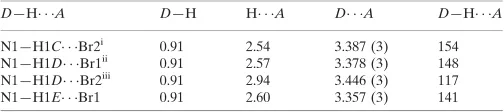
Hydrogen-bond geometry (A˚ ,).
D—H A D—H H A D A D—H A
N1—H1C Br2i
0.91 2.54 3.387 (3) 154 N1—H1D Br1ii
0.91 2.57 3.378 (3) 148 N1—H1D Br2iii
0.91 2.94 3.446 (3) 117 N1—H1E Br1 0.91 2.60 3.357 (3) 141 Symmetry codes: (i)xþ1;y;z; (ii)x;yþ1
2;zþ 1
2; (iii)x;y;zþ1.
Data collection:APEX2(Bruker, 2005); cell refinement:SAINT (Bruker, 2005); data reduction:SAINT; program(s) used to solve structure:SHELXS97(Sheldrick, 2008); program(s) used to refine structure: SHELXL97 (Sheldrick, 2008); molecular graphics: ORTEP-3 for Windows (Farrugia, 1997) and DIAMOND (Bran-denburg, 1999); software used to prepare material for publication: WinGX(Farrugia, 1999) andPLATON(Spek, 2009).
The University of the Witwatersrand and the National Research Fund (GUN: 2069064) are acknowledged for the funding and infrastructure required to perform the experi-ment.
Supplementary data and figures for this paper are available from the IUCr electronic archives (Reference: WM2338).
Structure Reports
Online
supporting information
supporting information
Acta Cryst. (2010). E66, m658 [https://doi.org/10.1107/S1600536810016806]
Poly[1,4-bis(ammoniomethyl)cyclohexane [di-
µ
-bromido-dibromidoplumbate(II)]]
Matthew Kyle Rayner and David Gordon Billing
S1. Comment
Inorganic-organic hybrid materials are of interest due to their electronic and fluorescent properties (Mitzi, 2004). The title
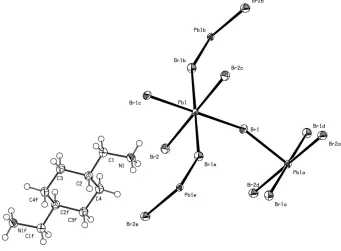
structure (Fig. 1) is one of three 2-dimensional hybrid structures that we have synthesized encorporating this
di-ammonium cation. The structures differ in terms of their halogen ligands, which include bromide (presented here),
chloride (Rayner & Billing, 2010a) and iodide (Rayner & Billing, 2010b). The bromide and iodide hybrids crystallize in
the monoclinic crystal system in space group P21/c while the chloride compound crystallizes in the orthorhombic Pnma
system.
In the title structure the lead atoms in the PbBr6 octahedra occupy inversion centers, giving the octahedra 1 symmetry.
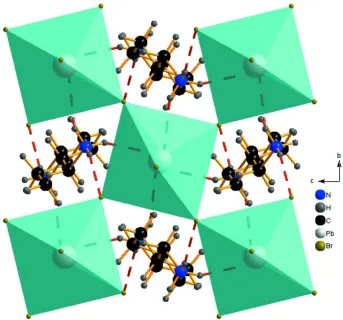
The PbBr6 octahedra share corners to form layers extending parallel to the bc plane. Octahedra from alternate layers are
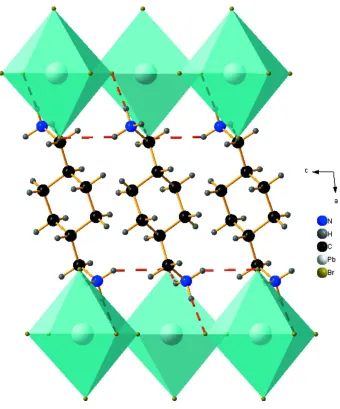
eclipsed relative to one another (Fig. 2). In all three structures only the trans form of the cation has been observed giving
the cation 1 symmetry (Fig. 3). Very few inorganic-organic hybrid structures encorporating diammonium cations have
been reported (Dobrzycki & Woźniak, 2008; Zhu et al., 2003). The ammonium cations interact with the inorganic layer
via N—H···X (X = Br, I and Cl) hydrogen bonding in the right-angled halogen subtype of the terminal halide hydrogen
bonding motif (Mitzi, 1999).
S2. Experimental
A mixture of 0.050 g (0.14 mmol) PbBr2 and 0.021 g (0.15 mmol) 1,4-bis-(aminomethyl)-cyclohexane (mixture of
isomers) was dissolved in 5 ml HBr at 383 K and slowly cooled at a rate of 0.069 K/min to yield colourless, plate-shaped
single crystals suitable for X-ray analysis.
S3. Refinement
The H atoms on the diammonium cation were refined using a riding-model, with C—H = 0.99 Å, N—H = 0.91 Å and
Figure 1
The asymmetric unit of the title compound with atom labels. Displacement ellipsoids were drawn at the 50% probability
supporting information
Figure 2
Figure 3
Packing diagram viewed along the b axis. Hydrogen bonds are drawn as dashed red lines.
Poly[1,4-bis(ammoniomethyl)cyclohexane [di-µ-bromido-dibromidoplumbate(II)]]
Crystal data
(C8H20N2)[PbBr4]
Mr = 671.09
F(000) = 608
supporting information
Data collection
Bruker APEXII CCD area-detector diffractometer
Radiation source: fine-focus sealed tube Graphite monochromator
φ and ω scans
Absorption correction: integration (XPREP; Bruker, 2005)
Tmin = 0.091, Tmax = 0.656
10495 measured reflections 1966 independent reflections 1742 reflections with I > 2σ(I)
Rint = 0.063
θmax = 28.0°, θmin = 1.7°
h = −15→15
k = −10→10
l = −10→10
Refinement
Refinement on F2
Least-squares matrix: full
R[F2 > 2σ(F2)] = 0.021
wR(F2) = 0.047
S = 0.81 1966 reflections 70 parameters 0 restraints
Primary atom site location: structure-invariant direct methods
Secondary atom site location: difference Fourier map
Hydrogen site location: inferred from neighbouring sites
H-atom parameters constrained
w = 1/[σ2(F
o2) + (0.0349P)2 + 0.0549P]
where P = (Fo2 + 2Fc2)/3
(Δ/σ)max = 0.011
Δρmax = 0.78 e Å−3
Δρmin = −2.31 e Å−3
Special details
Experimental. Numerical intergration absorption corrections based on indexed crystal faces were applied using the XPREP routine (Bruker, 2005)
Geometry. All esds (except the esd in the dihedral angle between two l.s. planes) are estimated using the full covariance matrix. The cell esds are taken into account individually in the estimation of esds in distances, angles and torsion angles; correlations between esds in cell parameters are only used when they are defined by crystal symmetry. An approximate (isotropic) treatment of cell esds is used for estimating esds involving l.s. planes.
Refinement. Refinement of F2 against ALL reflections. The weighted R-factor wR and goodness of fit S are based on F2,
conventional R-factors R are based on F, with F set to zero for negative F2. The threshold expression of F2 > σ(F2) is used
only for calculating R-factors(gt) etc. and is not relevant to the choice of reflections for refinement. R-factors based on F2
are statistically about twice as large as those based on F, and R- factors based on ALL data will be even larger.
Fractional atomic coordinates and isotropic or equivalent isotropic displacement parameters (Å2)
x y z Uiso*/Ueq
C1 0.2360 (3) −0.0472 (4) 0.4803 (5) 0.0262 (8)
H1A 0.2798 −0.0711 0.5858 0.031*
H1B 0.2282 −0.1498 0.4166 0.031*
C2 0.1224 (3) 0.0131 (4) 0.5124 (4) 0.0216 (8)
H2 0.1325 0.1095 0.5871 0.026*
C3 0.0636 (3) −0.1206 (4) 0.6011 (4) 0.0257 (8)
H3A 0.0558 −0.2192 0.5312 0.031*
H3B 0.1093 −0.1499 0.7035 0.031*
C4 0.0501 (3) 0.0661 (5) 0.3589 (4) 0.0247 (7)
H4A 0.0869 0.1569 0.3058 0.030*
H4B 0.0419 −0.0261 0.2807 0.030*
Br1 0.25157 (3) 0.02969 (4) −0.01928 (4) 0.02426 (9) Br2 0.50023 (3) 0.18890 (4) −0.31018 (4) 0.02370 (9)
Pb1 0.5000 0.0000 0.0000 0.01590 (6)
Atomic displacement parameters (Å2)
U11 U22 U33 U12 U13 U23
C1 0.024 (2) 0.0232 (17) 0.0322 (19) 0.0000 (15) 0.0076 (16) 0.0042 (14) C2 0.024 (2) 0.0206 (17) 0.0210 (17) −0.0015 (13) 0.0039 (15) −0.0010 (12) C3 0.0206 (19) 0.0285 (18) 0.0277 (18) 0.0035 (15) 0.0011 (15) 0.0101 (14) C4 0.0213 (19) 0.0285 (18) 0.0246 (17) −0.0011 (15) 0.0040 (14) 0.0042 (14) N1 0.0203 (16) 0.0229 (15) 0.0267 (15) −0.0014 (12) 0.0065 (12) −0.0019 (12) Br1 0.0241 (2) 0.02380 (17) 0.02478 (17) −0.00282 (13) 0.00175 (14) −0.00035 (12) Br2 0.0311 (2) 0.02090 (17) 0.01975 (16) 0.00481 (13) 0.00579 (13) 0.00695 (12) Pb1 0.02093 (10) 0.01395 (9) 0.01320 (9) 0.00121 (6) 0.00358 (6) 0.00007 (5)
Geometric parameters (Å, º)
C1—N1 1.497 (4) C4—H4B 0.9900
C1—C2 1.509 (5) N1—H1C 0.9100
C1—H1A 0.9900 N1—H1D 0.9100
C1—H1B 0.9900 N1—H1E 0.9100
C2—C3 1.531 (4) Br1—Pb1 3.0054 (4)
C2—C4 1.526 (5) Br2—Pb1 2.9821 (3)
C2—H2 1.0000 Br2—Pb1ii 2.9886 (3)
C3—C4i 1.514 (5) Pb1—Br2iii 2.9821 (3)
C3—H3A 0.9900 Pb1—Br2iv 2.9886 (3)
C3—H3B 0.9900 Pb1—Br2v 2.9886 (3)
C4—C3i 1.514 (5) Pb1—Br1iii 3.0054 (4)
C4—H4A 0.9900
N1—C1—C2 111.7 (3) H4A—C4—H4B 108.0
N1—C1—H1A 109.3 C1—N1—H1C 109.5
C2—C1—H1A 109.3 C1—N1—H1D 109.5
N1—C1—H1B 109.3 H1C—N1—H1D 109.5
C2—C1—H1B 109.3 C1—N1—H1E 109.5
H1A—C1—H1B 108.0 H1C—N1—H1E 109.5
supporting information
C2—C3—H3B 109.3 Br2iv—Pb1—Br1 84.697 (10)
H3A—C3—H3B 108.0 Br2v—Pb1—Br1 95.303 (10)
C3i—C4—C2 111.3 (3) Br2iii—Pb1—Br1iii 89.925 (10)
C3i—C4—H4A 109.4 Br2—Pb1—Br1iii 90.075 (10)
C2—C4—H4A 109.4 Br2iv—Pb1—Br1iii 95.303 (10)
C3i—C4—H4B 109.4 Br2v—Pb1—Br1iii 84.697 (10)
C2—C4—H4B 109.4 Br1—Pb1—Br1iii 180.000 (13)
N1—C1—C2—C3 177.9 (3) C3—C2—C4—C3i 55.8 (4)
N1—C1—C2—C4 54.7 (4) Pb1ii—Br2—Pb1—Br2iv −0.28 (4)
C1—C2—C3—C4i 178.5 (3) Pb1ii—Br2—Pb1—Br2v 179.72 (4)
C4—C2—C3—C4i −56.0 (4) Pb1ii—Br2—Pb1—Br1 84.42 (3)
C1—C2—C4—C3i 178.4 (3) Pb1ii—Br2—Pb1—Br1iii −95.58 (3)
Symmetry codes: (i) −x, −y, −z+1; (ii) −x+1, y+1/2, −z−1/2; (iii) −x+1, −y, −z; (iv) x, −y+1/2, z+1/2; (v) −x+1, y−1/2, −z−1/2.
Hydrogen-bond geometry (Å, º)
D—H···A D—H H···A D···A D—H···A
N1—H1C···Br2iii 0.91 2.54 3.387 (3) 154
N1—H1D···Br1iv 0.91 2.57 3.378 (3) 148
N1—H1D···Br2vi 0.91 2.94 3.446 (3) 117
N1—H1E···Br1 0.91 2.60 3.357 (3) 141