Original citation:
Broadberry, Stephen, Ghosal, Sayantan and Proto, Eugenio. (2016) Anonymity, efficiency wages and technological progress. Journal of Development Economics.
Permanent WRAP URL:
http://wrap.warwick.ac.uk/80595
Copyright and reuse:
The Warwick Research Archive Portal (WRAP) makes this work by researchers of the University of Warwick available open access under the following conditions. Copyright © and all moral rights to the version of the paper presented here belong to the individual author(s) and/or other copyright owners. To the extent reasonable and practicable the material made available in WRAP has been checked for eligibility before being made available.
Copies of full items can be used for personal research or study, educational, or not-for-profit purposes without prior permission or charge. Provided that the authors, title and full bibliographic details are credited, a hyperlink and/or URL is given for the original metadata page and the content is not changed in any way.
Publisher’s statement:
© 2016, Elsevier. Licensed under the Creative Commons Attribution-NonCommercial-NoDerivatives 4.0 International http://creativecommons.org/licenses/by-nc-nd/4.0/
A note on versions:
The version presented here may differ from the published version or, version of record, if you wish to cite this item you are advised to consult the publisher’s version. Please see the ‘permanent WRAP URL’ above for details on accessing the published version and note that access may require a subscription.
Anonymity, E¢ ciency Wages and
Technological Progress
Stephen Broadberry
y, Sayantan Ghosal
zand Eugenio Proto
xMay, 2016
Abstract
Although the Industrial Revolution is often characterized as the culmination of
a process of commercialisation, the precise nature of such a link remains unclear.
This paper provides an analysis of one such link: the role of commercialisation in
raising wages as impersonal labour market transactions replace personalized
custom-ary relations. In the presence of an aggregate capital externality, we show that the
resulting shift in relative factor prices will, under certain conditions, lead to higher
capital-intensity in the production technology and hence, a faster rate of technological
progress. We provide historical evidence using European data to show that England
was among the most urbanized and the highest wage countries at the onset of the
In-dustrial Revolution. The model highlights the e¤ects of changes in the availability of
information, typical of a modernizing country, on e¢ ciency wages and technological
progress.
JEL classi…cation: N13, O14, O43
Keywords: Commercialisation, Industrial Revolution, Anonymity, E¢ ciency Wages, Learning by Doing.
We are grateful to Sascha Becker, Nick Crafts, Frank Lewis, Sharun Mukand, Jon Temple, Fabian Waldinger, Nico Voigtländer, Joachim Voth, Fabrizio Zilibotti and seminar/conference participants at Warwick; Queen’s University, Canada; Krakow; Copenhagen and She¢ eld for helpful comments and sug-gestions.
yNu¢ eld College, Oxford University and CAGE, stephen.broadberry@nu¢ eld.ox.ac.uk zAdam Smith Business School, University of Glasgow - [email protected]
1
Introduction
In his seminal paper, Greif (1994) links the degree of anonymity in labour markets to
the probability with which past choices of individual workers are revealed to a potential
employer in current spot markets. Taking as his starting point the very di¤erent strategies
deployed by Genoese and Maghribi traders, Greif (1994) makes the point that the degree
of anonymity is linked to di¤erent “rules of the game” due to institutional or cultural
practices. For Greif, a collectivist culture (as embodied in the hiring practices of Maghribi
traders) is linked to a low degree of anonymity while an individualist culture (as embodied
in the hiring practices of Genoese traders) is linked to a high degree of anonymity. In a
related but di¤erent vein, Banerjee and Newman (1998), make the point that development
is characterized by a change in the informational structure among economic agents leading
to the bulk of GDP being produced in urban areas where markets are likely to have a
greater degree of anonymity.
In this paper we wish to examine how the degree of anonymity impacts on the capital
intensity of production and hence, on capital accumulation and technological change. The
commercial and industrial revolutions provide the most natural backdrop for examining
these issues. In particular, we focus on the growing reliance on anonymous, impersonal
re-lations, as against personalized customary relations in labor markets following the
commer-cial revolution which preceded the shift towards urbanization. With growing urbanization
the degree of anonymity increased. Hence, for our purposes, commercialization means more
than simply an increase in the proportion of output passing through the market (Britnell
and Campbell, 1995: 1).
A number of recent studies have pointed to the emergence of northwest Europe as a
high wage economy during the early modern period, between the sixteenth and eighteenth
centuries, with Britain overtaking the Netherlands to become the highest wage economy
in Europe (van Zanden, 1999; Allen, 2001; Broadberry and Gupta, 2006). At the same
time Britain was among the most urbanized countries in the world in the …rst half of the
eighteenth century, at the onset of the Industrial Revolution (de Vries, 1984; Malanima
2009). Since one of the key features of the Industrial Revolution was the development of
labor saving technology in Britain, it is natural to link the Industrial Revolution to these
prior developments in factor prices and the global commercial environment in which they
Indeed, a long tradition in economic history links the transition to modern economic
growth to the widespread commercialisation of Britain and other parts of northwest Europe
between the late medieval period and the Industrial Revolution (Toynbee, 1890; Polanyi,
1944; Britnell and Campbell, 1995). However, the precise nature of the links between the
Commercial Revolution and the Industrial Revolution has remained unclear. Furthermore,
it must be emphasized that an older view that saw wages rising only in response to higher
productivity resulting from technological progress, which was prevalent amongst a
previ-ous generation of economic historians, can no longer be sustained in the presence of the
overwhelming evidence that Britain was already a high wage economy before the Industrial
Revolution (Crafts, 2011; Allen, 2009; Mokyr, 2009).
The approach taken here draws on ideas which have been used in the literature on the
importance of high wages in stimulating the innovations of the Second Industrial
Revolu-tion in late nineteenth century America (Rothbarth, 1946; Habakkuk, 1962; David, 1975;
Broadberry, 1997).1 Until recently, there has been a reluctance to cast Britain in the role
of a high wage producer at the time of the Industrial Revolution, since the vast literature
on the standard of living debate emphasized the slowness of real wages to rise.
How-ever, recent work has emphasized international comparisons of the level of real wages and
other factor prices, pointing clearly to Britain’s unusual combination of factor prices with
expensive labor and cheap coal (Allen, 2001; 2009; Broadberry and Gupta, 2006; 2009).
This is important not only in explaining the adoption of modern technology, but also its
non-adoption in other countries with di¤erent factor prices, a point emphasized in the
the-oretical literature by Zeira (1998) and in the historical literature by Broadberry and Gupta
(2009), Allen, (2009) and Fremdling (2000).
In this paper, we examine how an increase in the degree of anonymity impacts on capital
accumulation through a higher degree of capital intensity in production.2 Our results are
as follows. First, we deploy an e¢ ciency wage argument (Shapiro and Stiglitz, 1984) to
show that a greater degree of anonymity will lead to higher wages. Note that the e¢ ciency
wage argument developed here avoids the objection sometimes levelled at the literature on
induced innovation that high wages do not necessarily re‡ect high labor costs because the
1See Acemoglu (2009) for a formal treatment of the link between labor scarcity and the rate of
techno-logical progress.
labor is also highly productive. In our model, higher wages in anonymous labour markets
are required to induce the same e¤ort as achieved with lower wages in more personalized
customary relationships backed up by greater information sharing between …rms about
shirking workers. Second, in the presence of an aggregate capital externality, we derive
the conditions under which the resulting rise in the wage/cost of capital ratio leads to the
adoption of a more capital-intensive technology for each individual …rm: the key condition
here is that when labour and capital are imperfect substitutes, the elasticity of substitution
between labour and capital has to be greater than one. Third, the model shows how a
higher degree of capital intensity in the production technology leads to a faster rate of
technological progress via greater learning by doing (Hicks (1932) and Arrow (1962)), in
a small open economy where interest rates are …xed by world markets.3 Fourth, holding
the degree of anonymity in the labour market …xed, the model shows an increase in the
scale of the domestic economy also results in a shift to a more capital intensive production
and higher wages and via technological progress, a higher stock of the steady state capital
and real wages. Fifth, the model shows that the scale of the domestic economy and the
degree of anonymity are mutual complements i.e. the impact of an increase in the degree
of anonymity on the long run capital stock and technology is larger when the scale of the
domestic economy is higher.
While it has already been emphasised that changes in the information structure of a
modernising economy have important consequences for access to credit (e.g. Banerjee and
Newman (1998)) we are, to the best of our knowledge, the …rst to point out the e¤ects of
changes in the availability of information on e¢ ciency wages and technological progress. As
a result, our paper highlights the role of the informal sector, via its e¤ect on the prevailing
level of anonymity, as a driver of capital accumulation and technological progress and has
implications for policies that impact on it. Our model shows that the e¢ ciency wage and
the level of anonymity are positively linked to the demand for capital and technological
progress. A policy of unemployment subsidies, cash transfers or public job creation, usually
blamed for increasing employment in the informal sector, can in fact increase e¢ ciency
wages and have a positive e¤ect on capital accumulation and technological progress; the
3The perspective that techological progress should be understood as endogenous to economic forces has
opposite can be true if migration to urban areas is restricted.
The link we make between a greater degree of anonymity and technological progress …nds
empirical support in Gorodnichenko and Roland (2010), who …nd that less collectivistic
societies are characterized by a higher degree of innovation.
The paper proceeds as follows. In section 2, we present a literature review. Section 3
present the theoretical model to derive the conditions under which anonymity and
tech-nological progress are linked. Section 4 then provides a historical narrative. Section 5
concludes. The proof of our main proposition is in the Appendix.
2
Related literature
The present paper is related to Legros, Newman and Proto (2013), who analyze how the
incomplete information a¤ects the level of labour division through the e¤ect on wages.
LNP consider a fully anonymous environment where wage levels change the level of labour
division to improve the monitoring of workers’e¤ort and the production of innovations. In
our paper, the capacity of monitoring is given, but the level of anonymity, hence the capacity
of punishment of shirking workers changes. Both paper emphasizes how the information
on e¤ort provision is crucial in shaping the …rms’decisions and in determining externality
that ultimately a¤ects technological progress.
The current paper suggests a link between the two main strands of the macro-development
literature: the institutional approach (e.g. North, 1990; Greif, 2004; 2006; Acemoglu and
Robinson, 2006) and uni…ed growth theory (e.g. Galor and Weil, 1999; 2000; Galor and
Moav, 2000; Hansen and Prescott 2002; Doepke, 2004; Galor, 2005; Cervellati and Sunde,
2005, Madsen, Ang and Banerjee, 2010). The institutional approach emphasizes the
im-portance of trade and commercial development, which are supported by an appropriate
institutional framework, while uni…ed growth theory links technological progress to wages
via an emphasis on human capital, with families choosing to have fewer but more highly
educated children as technology becomes more complex. Our approach sees the two
the-oretical frameworks as complementary. Establishing the right institutional framework to
encourage the development of trade leads to a higher wage, which then has the e¤ects on
technology traced out in uni…ed growth models.
com-mercial development and economic growth that is complementary to the links suggested
by Acemoglu et al. (2005) and by Galor and Mountford (2006). Acemoglu et al. focus on
the impact of Atlantic trade on institutions, with growing trade strengthening the position
of merchants in northwest Europe and enabling them to impose e¤ective constraints on
the executive, hence contributing to the development of less extractive institutions.
Ga-lor and Mountford (2006) show that trade might have generated a demographic boom in
non-industrial countries, specialized in the production of unskilled-labor-intensive goods,
hence fostering the process of divergence. Our approach focuses on an alternative link
between trade and growth, with increasing commercialisation a¤ecting factor prices, choice
of technology and the rate of technological progress.
Our setting is complementary to other model of endogenous growth, based on the idea
that capital was an important engine of growth in the process of economic development
(Galor and Moav 2004), since we emphasize the e¤ect of high wages on the capital
inten-sity of production and the subsequent rate of technological progress. Along similar lines
Voigtländer and Voth (2006) emphasize the e¤ects of growing capital inputs on TFP growth
for the …rst phase of industrialization.
3
The model
In this section, building on Shapiro and Stiglitz’s (1984) original model of e¢ ciency wages,
we introduce our concept of anonymity and endogenous technological progress via learning
by doing. We show that a higher degree of anonymity, arguably generated by the
com-mercial revolution, made more di¢ cult monitoring workers and led to an increase in wages
and subsequently to more capital intensive production. This process eventually led to a
technological increase in labour e¢ ciency that we characterize as the industrial revolution.
3.1
Workers
Time periods are indexed by t, t = 0;1;2; :::. There is a mass N of identical risk averse
workers. There is a probabilitydthat at each timet, the worker dies or permanently retires
from working. Since the number of workers is …xed at each period, there aredN new workers
in the economy so that the labor supply is always constant. Workers have an inter temporal
next period, (1 d); and de…ne the resulting product as <1:
At any period t, each worker can be either employed or unemployed and is endowed
with a …xed amount of e¤ort that can be costlessly provided. If she is unemployed she
uses her e¤ort in a backyard informal activity, which yields At; where At is a
technolog-ical parameter, linked to the general economic environment at any time t; which we will
characterize later; if she is employed she earns a wage wt:
Since e¤ort cannot be observed, employed workers can either shirk or work (i.e. choose
an e¤ort level e 2 f0;1g). An employed shirking worker uses her e¤ort for the backyard
activity earning At in addition to the wage o¤ered by the employer. She can be detected
with probability 1 p and …red.4 In this case, a shirking worker can look for a job in the
next period by "hiding" among the pool of new workersdN and her probability of …nding a
new job isq , whereq(which is endogenous and will be determined later) is the probability,
common to all individuals in the unemployment pool, of being hired and 2 (0;1) is a
parameter, the probability of being detected by a new employer as having shirked in the
last job, accounting for the level of anonymity in the economy. We can think of as the
probability that the bad reputation of the shirking workers reached the new employer. The
parameter can be reasonably considered close to 1 in a small village market and close to
0 in a large urban environment.
A non-shirking worker will work in the …rm until termination (which happens with
probability d at each t). We note that p+ (1 p) q is the probability that a shirking
worker at timet; will still be employed at timet+ 1. We de…neVE
t (e)as the intertemporal
utility of an employed worker that exercises e¤ort e 2 f0;1g at timet:
We will now write down the conditions required to ensure that at the prevailing wages
at time period t, choosing high e¤ort e = 1 is optimal for each employed worker. To this
end, by the one-shot deviation principle (Blackwell (1965)), it is su¢ cient to show that no
employed worker can gain by deviating and choosing low e¤ort e= 0 for one period at any
t.
Fix a sequence of market wages fwt :t 0g.
4As it has been already emphasized by Shapiro and Stiglitz (1980) …ring a shirking worker is also the
The intertemporal utility for an employed non shirking worker is
VtE(1) =wt+ VtE+1(1); (1)
and we have the following expected discounted utilities for an employed worker who shirks
once but does not shirk again in the future:
VtE(0) =wt+ At+ ((p+ (1 p) q)VtE+1(1) + (1 (p+ (1 p) q))V
U S
t+1); (2)
where VtU S is the intertemporal utility of an unemployed worker who has shirked at least
once in the past but does not shirk again if employed in the future i.e.
VtU S = At+ (q Vt+1E (1) + (1 q )VtU S+1): (3)
Therefore, given the sequence of market wages, the no shirking constraint is met
when-ever:
VtE(1) VtE(0): (4)
We assume that at eacht, each worker correctly anticipates future levels ofVE
t (e); e2 f0;1g
and VtU S.
3.2
Production and …rms
There is a …xed massm >0 of identical …rms, indexed byi, where m is a scale parameter
in the model: a higher value of m will be associated with a larger domestic economy.
We will assume that each …rmi has a production function with Harrod-neutral (or labour
augmenting) technological progressF~(fi; ki; Atli)wherefiis a …rm-speci…c input (which we
interpret as entrepreneurship),ki is the capital used by …rmiand li is the labour employed
by …rmi. We will assume thatfi is in …xed supply for each …rmiand we setfi = 1for each
…rmi. Let F(ki; Atli) = ~F(1; ki; Atli). Although we assume that F~(fi; ki; Atli) is a strictly
increasing production function that satis…es constant returns to scale in the three factors of
production (fi; ki; li), for a …xed quantity offi, we will assume thatF(ki; Atli)is a strictly
the two factors of production (ki; li).5 Our theory hinges on the …rms’choices in terms of the
capital labor ratio; therefore, for sake of simplicity, we assume that the production function ~
F(fi; ki; Atli)is a multi-factor constant elasticity of substitution production function. There
are di¤erent partial elasticities of substitution between capital and labour on the one hand
and capital and entrepreneurship (and labour and entrepreneurship) on the other (as a
factor of production, we do not treat entrepreneurship symmetrically with capital and
labour). Uzawa (1962) shows (Theorems 1 and 2) that such a production must necessarily
have the functional form:
~
F(fi; ki; Atli) = (fi)1 ( k + (1 ) (Atl) ) (5)
where 0< <1 and <1 so that the elasticity of substitution between capital labour is
1
1 and the elasticity of substitution between capital (respectively, labour) and
entrepre-neurship is one.6 Setting fi = 1, we obtain
F(k; Atl) = ( k + (1 ) (Atl) ) ;0< <1; <1.
We assume that At evolves over time according to
At=a(
Kt 1
m ): (6)
where Kt 1 is the aggregate stock of capital inherited from the preceding time period:
the interpretation is that the prevailing technology in any period t is determined by an
aggregate capital externality i.e. it is a function of the new knowledge created in the
preceding period which is itself an increasing function of the per …rm aggregate capital
stock in that period.7 This assumption can be interpreted as productivity growth through
5We need to assume that the production function displays decreasing returns to scale in capital and
labour in order to ensure that the …rst order conditions characterizing pro…t-maximization can be inverted to yield a demand function for capital and labour as a function of relative factor prices.
6The CES production function is increasingly prominent in macroeconomics and growth economics, see
e.g. Klump et al. (2011) for a survey.
7An alternative speci…cation would be to haveA
t=a(Kt 1)i.e. the prevailing technology in any period
tis a function of the new knowledge created in the preceding period which is itself an increasing function of
theaggregate capital stock in that period. We point that out the results obtained below would continue to
learning by doing (e.g. Arrow (1962) and Romer (1986)), speci…cally the stock of knowledge
increases with the amount of aggregate capital used i.e. a(0) = 0anda0(:)>0. We assume
that each …rm is negligible in the aggregate and does not take into account the impact of
its own capital use on the aggregate capital stock (hence, on per …rm aggregate capital
stock) and on innovation. An increase in per …rm aggregate capital impacts positively on
innovation and productivity. The above speci…cation can also be interpreted as a simple
way of modelling, in a reduced form representation, the commecialisation in innovation (via
a patenting system) on productivity (e.g. the patenting system is cheaper to run the larger
the aggregate capital stock and ‡ow of productivity enhancing innovation.
Firms borrow capital from an external capital market at an exogenously given interest
rate r; the capital supply is perfectly elastic and, in equilibrium, make non-zero pro…ts,
given the assumption <1, which implies decreasing return to scale on capital and labor
factors. Therefore, pro…ts of the …rm can be interpreted as a return to a …xed factor of
production, namely entrepreneurship.
All …rms are price-takers. At each t, each …rm i takes the sequence of future market
wageswt, the interest rater and the technological parameterAt as given. Although …rms’
choices at time t 1 in‡uence the technology at timet; we make the standard assumption
that the contribution of each …rm is negligible and it is not internalized when the decision
takes place: in e¤ect, maximizing the sum of pro…ts over time is equivalent to maximizing
current period pro…ts within each time period. Therefore, at each t, each …rm maximizes
current period pro…ts only i.e.
max
ki;t;li;tF(k; Atl) wi;tli;t rki;t (7)
3.3
Market equilibria and steady state
We de…ne a market equilibrium for a …xed as follows:
A market equilibrium is a sequence of (Kt; Lt; wt; At :t 1)such that at each t = 0;1: : ::
1. Given r, wt and At, for each …rms li;t =Lt; ki;t =Kt maximizes pro…ts,
2. Given wt, no employed worker shirks i.e. wt satis…es the no shirking constraint (4),
3. At =a(Kt 1 m ).
At a steady state Kt = Kt+1 = K , Lt = Lt+1 = L and At = At+1 = A for all t.
From (6), it follows that A =a Km . Therefore, the steady state (long-run) values of the
variables at a market equilibrium are denoted by K ; L ; w ; A =a(Km ).
Next, we characterize the market equilibrium in our model.
3.4
Characterization of Market equilibrium
At each t, the …rst order conditions characterizing pro…t maximizing input choices are:
Fk(kt; Atlt) = r (8)
AtFl(kt; Atlt) = wt: (9)
Assume that at each t, wt = !tAt i.e. the market wage is linear in At. We interpret
!t = Atwt as wages measured in e¢ ciency units of labour. In our model, as At will evolve
over time, real wages wt will change over time.
We can decompose the value functions (1), (2) and (3) for each worker as follows:
VtE(1) = AtvEt (1) (10)
VtE(0) = AtvEt (0) (11)
VtU S = AtvU St : (12)
where vE
t (e) and vtU S depend on !t. Furthermore, we note that in equilibrium the no
shirking constraint (4) must bind, therefore
vEt (1) =vtE(0): (13)
Recalling that in equilibrium all …rms are equal, so that Kt =mki;t and Lt =mli;t for
all …rms iat each t, and solving recursively the system given by expressions (12), (11) and
(10) for the steady state values of vE
equations describing the steady state (where we have used (6)) as follows:
Fk(
K m ; a
K m
L
m) = r (14)
Fl(
K m ; a
K m
L
m) = !t: (15)
with the no shirking constraint (4)
! =!(L ; ) = (1 p(1 q(L ) ))
(1 (p+ (1 p)q(L ) )): (16)
where q(L ) = LN is the probability of …nding a job for any non employed worker in
equilibrium.8 We note that, di¤erently from the classical model with "e¢ ciency wages",
our equilibria are compatible with no unemploymentN =L i.e. it is possible that when
q(L) = 1; w <1 for low values of i.e. when the degree of anonymity in the market isn’t
too high.9
What is the impact of a change in the degree of anonymity on the steady state values
of capital stock, employment and wages?
The following proposition examines the impact of a higher degree of anonymity on the
steady state capital labour ratio and wages:
Proposition 1 Suppose 1. Then, F(k; Atl) is strictly concave in k and l: The
rela-tionship between anonymity and scale of domestic labour and goods market, and the
tech-nological and capital dynamics when capital and labour are imperfect substitutes is given by
the following:
(i) For each ; m >0, there is a unique steady state with positive capital stock K and
employment level L .
(ii) For each m >0,the steady state capital stock K ,capital labour ratio KL , technology
A =a(Km )and real wages w =!(L )a(Km )are all increasing in the degree of anonymity
.
8In equilibrium, nobody shirks, so isq;anddLis number of new jobs in the economy, at the same time
dN is the ‡ow of new employed workers, therefore the equationqdN =dLmust hold andq=q(L) = L N. 9A standard critique of e¢ ciency wage models is that non-employed workers would bid for the jobs by
(iii) For each > 0, the steady state stock capital stock K , capital labour ratio KL ,
technology A =a(Km ) and real wages w =!(L )a(Km ) are all increasing in the scale of
the domestic market m.
(iv) The higher the scale of the domestic economy m, the higher is the impact of an
increase in the degree of anonymity on the steady state capital stock K , capital labour
ratio KL , technology A = a(Km ) and real wages w = !(L )a(Km ) i.e. and m are
mutual complements.
(v) Assume that in the vicinity of the steady state, at each t, agents expect that future
employment and wage levels will be the same as current employment levels. For each
; m > 0, the steady state is locally a saddle. Further, there exists 0 < < 1 such that
whenever < <1 the steady state is locally stable.
Proof: See the appendix.
The above proposition shows that there is a unique positive steady state value of the
capital stock K corresponding to each value of . If the degree of anonymity increases to
0 > , what are the short-run and long-run e¤ects?
Given a …xed scale, starting from the steady state capital stock and employment
corresponding to , with imperfect substitutes in the model, a change in results in a
change in (real) wages in the short-term i.e. in a change in !t (as alwaysAt is …xed at t
and will change from periodt+ 1).
Given that the marginal productivity of capital will decrease, and the marginal
pro-ductivity of labour will increase, as more capital is employed, in response to an increase
in !t, as long as the degree of complementarity between labor with capital isn’t too high,
there will be a partial substitution of labour by capital in the aggregate. Therefore, when
capital and labour are imperfect substitutes in production, both wages in e¢ ciency units
and employment will adjust to clear the labor market.
In the long-run, an increase in the anonymity of the labor market results in a shift to a
more capital intensive production and higher wages in e¢ ciency units and via technological
progress (driven by learning by doing), the steady state capital and real wages associated
with a higher level of anonymity (and hence, technology) is also an increasing function of
.
An important condition is the assumption that , which restrict the degree of
capital are substitutes and the elasticity of substitution between labour and capital in
production is greater than one. Berthold et al. (2002) and Bertolila and Saint-Paul (2003)
…nd empirical support for this condition when the technological progress is assumed
Harrod-neutral like in our case.
The above proposition shows that in the long-run, for a …xed degree of anonymity in the
labor market, an increase in the scale of the domestic economy also results in a shift to a
more capital intensive production and higher wages in e¢ ciency units and via technological
progress (driven by learning by doing). Moreover, the scale of the domestic economy and
the degree of anonymity are mutual complements and echoes results obtained elsewhere on
the e¤ect of scale in endogenous growth models (e.g.Kremer (1993) and Galor and Weil
(2000)). For example, a large commercialised economy will have a higher long run capital
stock, capital labour ratio, technology and real wages than a small commercialised economy.
Another example is that productivity in urban areas depends on the scale of the domestic
economy (Lobo et. al (2011) for suggestive evidence of such an e¤ect). These results
allow us to di¤erentiate how commercialisation (via an invreasing degree of anonymity)
impacts on two economies operating at very di¤erent scales (e.g. the case of England and
Netherlands for which we provide evidence below).
In order to examine the local stability of the steady state, we assume that in the vicinity
of the steady state, at eacht, agents expect that future employment and wage levels will be
the same as current employment levels. Under this assumption, when workers are patient
enough, current wages in e¢ ciency units aren’t too sensitive to small changes in current
labour market conditions. Therefore, small changes in current labour market conditions
do not result in large changes in relative factor prices and therefore, capital stock and
technology. Therefore, when workers are patient enough, the steady state is locally stable.
In the proof of the above proposition, for a …xed scale of the domestic economy, it is
shown that once the level of anonymity is su¢ ciently high, we should observe equilibrium
involuntary unemployment growing with the level of anonymity; hence an increase in the
productivity should go hand in hand with an increase in the unemployment rate. This
pat-tern is perfectly consistent with the models of industrialization based on thedual economy
model (Lewis, 1954; for more recent contributions see e.g. Barenjee and Newman, 1998;
Proto, 2007; Vollrath, 2009a; Vollrath, 2009b). At the beginning of a process of
generated by individuals who are not able to …nd a job in the formal sector. As Harris and
Todaro (1970) point out, the reason of this involuntary unemployment is the downward
rigidity of the wages in the modern sector. In our model this rigidity is due to the e¢ ciency
wages. In the next section, we will present some supportive empirical evidence based on
the British industrialization.10
4
Historical evidence: the transition to modern
eco-nomic growth in Northwest Europe, 1300-1850
We now examine the transition to modern economic growth, combining historical evidence
with the theoretical model presented in the previous section. We argue that the Industrial
Revolution was linked to the Commercial Revolution of the early modern period through
the e¤ects of growing commercialisation on factor prices. An increasing degree of anonymity
due to growing commercialisation led to an increase in the price of labor relative to the
price of capital, which induced a substitution into a more capital intensive technology and
an acceleration of technological progress through learning by doing. We argue further
that the fact that commercialisation went further in Britain than in the rest of Europe
during the early modern period helps to explain why the Industrial Revolution occurred
…rst in Britain. However, this does not mean that commercialisation should be seen as the
sole cause of industrialization, which is a complex process. In particular, the institutional
mechanisms proposed here should be seen as complementary to the factors proposed in
uni…ed growth theory, where higher wages are also linked to demographic factors. This
is a point to which we will return later in this section, but we begin by setting out some
historical evidence on the main steps in the argument linking growing commercialisation
to real economic development.
4.1
Growing commercialisation and anonymity
The growing commercialisation of the European economy can be most easily captured
quantitatively by the share of the population living in urban areas, since towns were the
10However, as is shown in the appendix, a potential mitigating factor is the scale of the domestic economy:
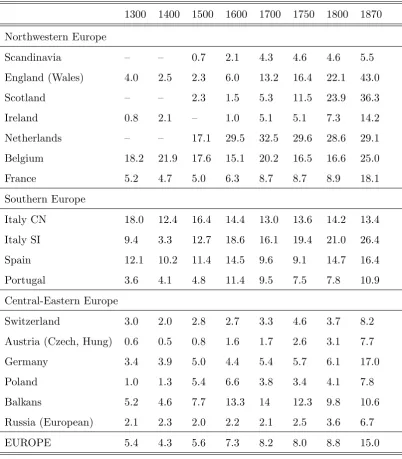
centres of commerce. Table 1 provides data on the share of the population living in towns
of at least 10,000 inhabitants. For Europe as a whole, the trend is unmistakably upwards
from 1400. Looking at regional trends, however, urbanization shows a pattern of divergence
within Europe. In the late medieval period, there were two main urban centres of commerce
in north Italy and in the Low Countries. While urbanization stalled in north Italy after
1500, there was a brief surge in Portugal and to a lesser extent Spain during the sixteenth
century, following the opening up of the new trade routes to Asia and the New World, which
undermined Venice’s key role at the Mediterranean end of the Silk Road. However, the most
dramatic growth of urbanization in the early modern period occurred in the Netherlands
in the sixteenth and seventeenth centuries and in England during the seventeenth and
eighteenth centuries as those countries displaced the Iberian powers in long distance trade
and commercialized their domestic economies to an unprecedented extent. This strong
positive correlation between urbanization and playing a leading role in international trade
is worth emphasizing because some writers have played down the role of international trade
in the process of British economic development, preferring to focus on developments in the
home market (Deane and Cole, 1967; McCloskey, 1981; Oxley and Greasley, 1998). Partly
as a result of taking an international comparative perspective over a long time span, recent
writers such as Acemoglu et al. (2005) and Findlay and O’Rourke (2008) have tended to
emphasize the importance of international trade in the Industrial Revolution.
The extent of commercialisation can also be captured quantitatively in the declining
share of the labour force engaged in agriculture. The link between commercialisation and
the share of the labour force in agriculture is at least implicit in the historical literature on
proto-industrialisation following the work of Mendels (1972), who saw commercialisation
leading to the development of industry in the countryside before the Industrial Revolution.
It is also implicit in the work of Brenner (1982), who emphasized the contrast between
England, where the peasantry was replaced by tenants and labourers who had to compete
in the market, and the continent where peasants were able to cling to the land and preserve
feudal property rights. Table 2 provides data on the share of the labour force in agriculture
for a number of European countries. By 1600, the release of labour from agriculture had
proceeded further in the Netherlands than in the rest of Europe, as the Dutch economy
relied increasingly on imports of basic agricultural products such as grain and paid for them
the share of the labour force engaged in agriculture was even smaller in England, where a
highly commercialized agriculture produced enough grain to feed the population without
recourse to substantial imports until well into the nineteenth century (Deane and Cole,
1962; Crafts, 1985). The share of the labour force in agriculture remained substantially
higher in the rest of Europe.
This growth of commercialisation had implications for the degree of anonymity in
eco-nomic relations, in factor markets as well as in product markets and this, in turn, had
implications for wages. Whilst the association between commercialisation and anonymity
is straightforward in product markets, the association requires more justi…cation in factor
markets, since it is possible in principle to envisage an industrial sector with highly
per-sonalized employment relations selling its output in highly impersonal product markets.
However, in the development of early modern Europe, anonymity tended to increase in
fac-tor markets in parallel with product markets, as a result of economies of agglomeration. As
the commercial sector became more concentrated in towns, it was natural for the industrial
sector also to locate in towns, particularly in an era of high transport costs (Crafts and
Venables, 2003). When workers were employed in small-scale enterprise in isolated rural
locations where they formed part of a close-knit community, the problem of securing e¤ort
from workers could be solved through reliance on customary relations backed up by close
supervision. As markets integrated and people moved to towns where they were unknown
to their neighbors and potential employers, it became necessary for employers to …nd new
ways to elicit e¤ort. In the model above, this is captured by the result that an increase in
the value of , the degree of anonymity in the economy, raises wages to ensure that the
no-shirking constraint equations (4) and (16) are satis…ed.
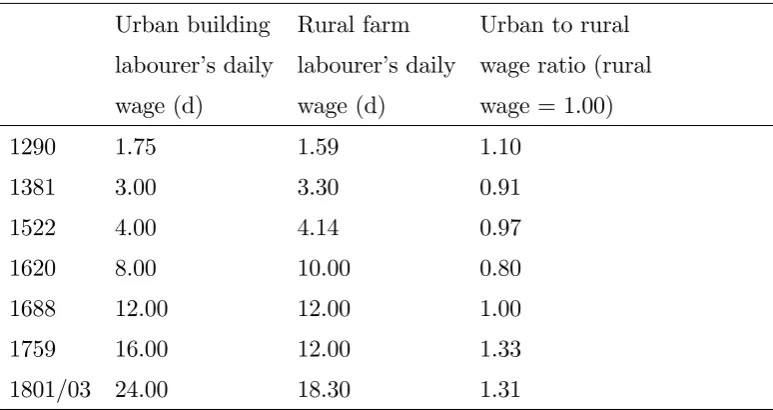
In the historical record, it shows up in the growing di¤erence between urban and rural
wages during the early modern period, shown here in Table 3 for the case of England. It is
well known from the dual economy models that the existence of a wage gap between rural
and urban sectors is justi…ed by the existence of unemployment in the formal section of
the urban sector, as we also explained at the end of section 3.4. This is due to the
down-ward rigidity of the urban wages, in our case caused by informational asymmetries which
prevent the wage from clearing the market. As the urban sector became more anonymous,
information became less and less available. This should have caused the e¢ ciency wage to
sector, where informational asymmetries remained less severe. Therefore, what is
interest-ing in Table 3 is the increase of this wage gap, consistent with our model, where growinterest-ing
urbanization leads to an increase in the level of anonymity and a higher e¢ ciency wage.
Predating the changes of the classic Industrial Revolution period, the early modern
period saw a number of changes which weakened the close monitoring of industrial
produc-tion in medieval Europe, where a master directly oversaw the work of his apprentices. In
light consumer goods industries such as textiles, the putting-out system emerged, with an
entrepreneur taking responsibility for delivering materials to workers in their own homes,
and taking responsibility for marketing the output. This allowed the gains of specialization
and division of labor, but created opportunities for workers both to take leisure when the
entrepreneur desperately needed production and to substitute poor materials for the good
materials supplied by the entrepreneur or to cover up imperfections, if not to outright
em-bezzle.11 Indeed, Marglin (1974) sees the factory system as a solution to these problems,
rather than as a more e¢ cient method of production. This would be similar to the argument
of Skott and Guy (2007) that information and communications technologies have recently
made it easier to monitor the e¤ort of low-skill workers. However, Marglin’s interpretation
is quite contrary to the mainstream view that the factory system was more e¢ cient than
putting-out, and created its own problems of disciplining and monitoring workers, which
needed to be solved before it could be widely adopted.
It should be noted that although the degree of anonymity was clearly increasing,
tradi-tional ways of monitoring did not disappear overnight. Indeed, recent work by Humphries
(2003) and Minns and Wallis (2012) suggests that industrial apprenticeship remained
im-portant during the Industrial Revolution period, even after the repeal of the Statute of
Arti…cers in 1814, which meant that a legal apprenticeship was no longer required to
prac-tise a particular trade. However, apprenticeship did not apply to the bulk of the growing
industrial labor force in the towns, which was relatively unskilled. One approach to dealing
with this increase in the degree of anonymity in market based relationships, which was
11If the entrepreneur was under time pressure to ful…l an order and had provided materials to a shirking
widely adopted in large urban enterprises during the early stages of the Industrial
Revolu-tion, was payment by results or piece rates (Pollard, 1965: 189-191). Of course, piece rates
had also been used in a rural setting during the early modern period as part of the putting
out system, but their “discovery”in the context of urban industry in the eighteenth century
was often greeted as “an innovation of major signi…cance” (Pollard, 1965: 190). However,
as Huberman (1996: 17-32) points out, attempts to manage the wage-e¤ort bargain through
piece rate payments in early nineteenth century Lancashire often met with little success
unless accompanied by the payment of an e¢ ciency wage premium above the spot-market
rate. Rather than risk the prospect of losing a job with a wage above the spot market rate,
a worker employed at the e¢ ciency wage was deterred from shirking (Shapiro and Stiglitz,
1984). Although the Lancashire market for labor in cotton spinning in the early nineteenth
century has often been portrayed as the archetypal spot market, Huberman (1996) cautions
against this interpretation, arguing that it was more myth than reality. It is, moreover, a
myth which is di¢ cult to square with the central …nding that has emerged from the new
focus on comparative levels of real wages in Europe: that Britain was a high wage economy
at the time of the Industrial Revolution (Allen, 2001; Broadberry and Gupta, 2006).
Our theoretical model predicts that once the level of anonymity is su¢ ciently high, we
should observe equilibrium involuntary unemployment, growing with the level of anonymity.
The …rst reliable …gures of urban unemployment, dating from the 1850s, indicate a level
of around 5% (Mitchell, 1988: 122). However, the available data refer to the experience
of relatively well paid and relatively skilled trade union workers. For a broader picture
of unemployment, it is necessary to use data on poor relief. Boyer (2002) reports an
increase in real per capita expenditure on poor relief by a factor of 4 between 1696 and
1800. This growing burden on ratepayers created pressure to reduce the generosity of the
system, leading to the 1834 Poor Law Reform Act, which attempted to restrict Poor Law
payments to indoor relief in workhouses where conditions were harsh (Rose, 1972). Boot
(1990) and MacKinnon (1986) show an increasing trend in male able bodied paupers being
o¤ered indoor relief in London and in other urban areas from 1860 onward. Furthermore,
Pollard (1981: 903) notes that, "Indeed, many migrants did not even come for jobs, but for
the expected opportunity of …nding jobs". Boyer and Hatton (1997) …nd strong empirical
support for rigidity in manufacturing wages, showing how migration reacted to the expected
who using a large dataset related to the period 1850-1881, …nds that unemployment rates
among the stayers in the agricultural sector were lower than among the movers to the urban
sector.
In addition to the growing degree of anonymity associated with the rise of the putting
out system and then the factory system, in the British context Nef (1934) emphasizes the
growth of large-scale industry between 1540 and 1640. He points to the introduction of new
industries into Britain with a high minimum e¢ cient scale, such as paper and gunpowder
mills, cannon foundries, alum and copper factories, sugar re…neries and saltpeter works.
However, of more importance quantitatively was the growing scale of production in older
established industries such as coal and iron ore mining, where new technology was increasing
minimum e¢ cient scale.
To end this section, it is interesting to ask if industrial labour markets in early
mod-ern Britain were more akin to those described by Greif (1994) for Genoese traders or for
Maghribi traders during the medieval period, i.e. individualistic or collectivist? We would
see them as operating closer to the Genoese end of the spectrum, since there is no evidence
of any widespread sharing of information about shirkers between employers. This is in
striking contrast to the abundant evidence of groups of industrialists operating in ways
more akin to the Maghribi traders to deter opportunistic behavior in their …nancial
deal-ings, with Quaker networks being particularly singled out in this regard (Prior and Kirby,
1993).
4.2
Changing factor prices
Table 4 sets out the pattern of silver wages in Europe. The silver wage is the silver content of
the money wage in the local currency, and is useful for comparing wages across countries on
a silver standard. Note …rst that Northwestern Europe saw substantial silver wage growth
in the century after the Black Death of the mid-fourteenth century and again during the
early modern period after 1500, as well as during the Industrial Revolution period from the
mid-eighteenth century, when Britain …nally overtook the Netherlands decisively. Second,
note that although southern Europe shared in the rise in the silver wage following the Black
Death, from the mid …fteenth century the region was characterized more by ‡uctuations
than by trend growth in the silver wage. Third, central and eastern Europe were also
mid-fourteenth century. This is the pattern that would be expected from the conventional
economic history of Europe, with the Mediterranean region playing the leading economic
role during the …rst half of the millennium, but with northwest Europe forging ahead after
1500.
It is worth noting that these changes in the ranking of silver wage levels within Europe
are strongly associated with changes in commercial leadership. The decline of the north
Italian city states as commercial centres with the opening up of the new trade routes to the
East is one of the decisive turning points in European …nancial and commercial history and
was accompanied by a relative decline in silver wages (Kindleberger, 1996). But equally, it
is clear that after a short Iberian boom, commercial leadership shifted to northwest Europe
rather than to Spain or Portugal, and this is again re‡ected in relative wage trends in
Table 4. Furthermore, even within Europe, the link between relative wages and commercial
leadership holds, with the emergence of Britain as the wage leader accompanied by London’s
eclipse of Amsterdam as the …nancial and commercial centre of the North Sea area (Neal,
1990).
We have focused so far on wage di¤erences within Europe, but a complete picture of
the transition to modern economic growth also requires a consideration of wage di¤erences
between Europe and Asia. Broadberry and Gupta (2006) provide some evidence of this
Great Divergence in the form of silver wage di¤erences, shown here in Table 5. Silver wages
in India and the Yangzi delta region of China were already lower than those in England
by the beginning of the seventeenth century, and then fell further behind. Contrary to
the revisionist claims of Pomeranz (2000), Parthasarathi (1998) and Frank (1998) that the
richest parts of Asia remained at the same level of development as the richest parts of
Europe until as late as 1800, they appear closer to the poorer parts of Europe.
We are interested in the incentives to adopt capital intensive technology. Hence we need
also to examine the cost of capital, an important element of which is the rate of interest.
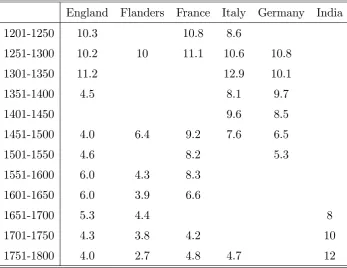
Nominal interest rates for a number of countries are presented in Table 6. Note that since
interest rates changed together across Europe, it is reasonable to assume them exogenous
with respect to each single European economy, so that intra-European di¤erences in the
factor price ratio were driven by wage rate changes, as highlighted in our model. Table
6 suggests a rate of interest in Europe around 10% in the late medieval period, falling to
European rates of interest during the …rst half of the eighteenth century, to around 3-4%.
12 By this point, interest rates were substantially lower in Europe than in other parts of the
world such as India, where rates remained at medieval levels. Growing commercialisation
was thus accompanied by declining interest rates. The downward trend of interest rates in
Europe, combined with the increase in wages, translates into an increase in the wage/cost
of capital ratio, raising the incentives to substitute capital for labor in production. The
greater increase of wage rates in northwest Europe meant that the incentive to adopt capital
intensive production methods was also greater in that region.
4.3
Factor prices and technology
Recent work by Broadberry and Gupta (2006; 2009) and by Allen (2009) emphasize the
important role of factor prices in explaining the key technological choices of the Industrial
Revolution period. Broadberry and Gupta (2009) analyze the shift of competitive
advan-tage in cotton textiles between India and Britain. India was the world’s major producer
and exporter of cotton textiles during the early modern period, but was displaced from this
position by Britain during the Industrial Revolution. Broadberry and Gupta (2009) point
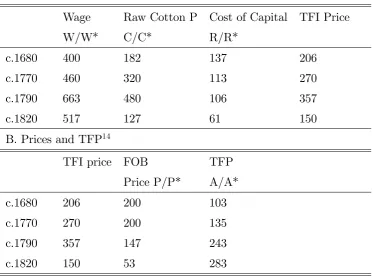
to the much higher wages in Britain than in India already in the late seventeenth century,
when Indian cotton textiles were imported into Britain by the East India Company. This
can be seen in the …rst column of Table 7. Combined with the smaller di¤erences in the cost
of raw cotton and the cost of capital, this presented British producers with a severe total
factor input (TFI) price disadvantage. To get to a point where the free on board (FOB)
price, (i.e. excluding transport costs), was cheaper in Britain, required a shift to more
capital intensive technology and a sustained period of technological progress to increase
total factor productivity (TFP). For much of the eighteenth century, the ‡edgling British
cotton industry required protection, although the point at which the shift in competitive
advantage from India to Britain occurred varied by type of yarn or cloth (as a result of
di¤erent input costs) and by market (as a result of transport costs).
12Falling interest rates in the …rst half of the eighteenth century are usually associated with developments
Once the shift to capital-intensive technology had occurred, technological progress
ac-celerated, as implied by equation (6) in the model. In Table 7, TFP growth shifted in
Britain’s favour at an annual rate of 0.3 per cent before 1770, rising to 1.5 per cent during
the period 1770-1820. This would be quite consistent with the 1.9 per cent per annum TFP
growth rate estimated by Harley (1993: 200) for the British cotton industry between 1780
and 1860, together with slowly rising or stagnating productivity in India. This
accelera-tion of TFP growth following the shift to capital intensive technology can be explained in
part by the greater potential for learning on capital intensive technology. A similar case of
learning by doing on capital intensive technology is identi…ed by David (1973) in the cotton
industry at Lowell, Massachusetts, 1834-1856, drawing on the literature on the "Horndal"
e¤ect, named after the Swedish steel mill where the phenomenon was …rst documented.
However, learning by doing is not the only way in which switching to capital
inten-sive technology could have stimulated TFP growth. Drawing in particular on the work
of Sullivan (1989), Broadberry and Gupta (2009) also emphasize the role of the British
patent system in helping to foster technological progress once high wages had stimulated
the introduction of capital intensive technology. One way of thinking about this
inter-action between factor prices and the patent system is that they are both symptoms of a
highly commercialized economy. Just as we have seen that high wages are associated with
commercialisation, so it is possible to see the patent system as the commercialisation of
invention. It should also be noted that patents protected intellectual property embodied
in machinery, and so reinforced the shift to capital-intensive technology.
4.4
Real economic development
In Table 4, we examined the path of silver wages. However, an analysis of the transition to
modern economic growth would not be complete without considering the path of real
con-sumption wages and GDP per capita. The real concon-sumption wage is obtained by dividing
the silver wage with the silver price of basic consumption goods. Real consumption wages
of European unskilled building laborers for the period 1300-1850 are shown in Table 8,
taking London in the period 1500-49 as the numeraire. The …rst point to note is that real
wages followed a similar pattern across the Black Death in much of Europe. Complete time
series exist for comparatively few cities before 1500, but there is also scattered evidence
real wage across most of the continent of Europe following the Black Death, which struck
in the middle of the fourteenth century, wiping out between a third and a half of the
popu-lation, when successive waves of the plague are cumulated (Herlihy, 1997). This episode of
European economic history is thus broadly consistent with the Malthusian model, with a
strong negative relationship between real wages and population (Postan, 1972: 27-40). It
is worth emphasizing again that our approach is complementary to uni…ed growth theory,
rather than seeking to provide an alternative analytical framework.
In the …rst half of the …fteenth century, the real wage was quite uniform across the
countries for which we have data, at about twice its pre-Black Death level. From the
second half of the …fteenth century, however, Britain and Holland followed a very di¤erent
path from the rest of Europe, maintaining real wages at the post-Black Death level and
avoiding the collapse of real wages which occurred on the rest of the continent as population
growth returned. Considering that in the same period Britain and Holland witnessed an
increase in the level of urbanization, as noted above, we can argue that growing anonymity
is a candidate to explain this emergence of high wages in northwest Europe.
Table 9 presents the results of the latest research on the reconstruction of national
in-come during the late medieval and early modern periods in a number of countries. The
GDP per capita data show northwest Europe pulling ahead of the previously more
devel-oped Mediterranean Europe from the late sixteenth century. The national income data
thus reinforce the conclusion from the silver wage and real consumption wage data and
from urbanization rates that Britain and Holland followed a di¤erent path from Italy and
Spain. The Asian data con…rm the conventional view that the Great Divergence was
al-ready underway during the early modern period, as Europe embarked upon a period of
growing commercialisation which would ultimately end up with the Industrial Revolution
and the transition to modern economic growth.
4.5
Why was the Industrial Revolution British?
As well as documenting the Little Divergence between northwest Europe and the rest of
the continent, Tables 4, 8 and 9 also show the emergence of Britain as the leading economy
within northwest Europe, consistent with the …rst Industrial Revolution and the transition
to modern economic growth occurring there rather than in Holland. This does seem to
the main commercial center in northwest Europe by the early nineteenth century (Neal,
1990). However, it must be recognized that during the sixteenth and seventeenth centuries,
Holland was at least as commercialized as Britain, but did not go on to have the …rst
industrial revolution.
To understand this, it is necessary to recognize a recent change in the understanding of
patterns of economic growth in the past that has been permitted by work extending
histori-cal national accounting back to the medieval period on a high frequency basis (Broadberry,
2013; Fouquet and Broadberry, 2015). Graphs of GDP per capita based on conjectures for a
very few years, such as Maddison (2001), paint a misleading picture of the world stagnating
at bare-bones subsistence for thousands of years before a sudden burst of growth from the
mid-eighteenth century. However, with high frequency data, we now know that before the
eighteenth century, episodes of positive GDP per capita growth (growth booms) alternated
with episodes of negative per capita GDP growth (growth reversals), so that there was no
long run trend improvement of living standards. It turns out that there were a number of
episodes where levels of GDP per capita in certain regions reached similar levels to those
achieved in Britain on the eve of the Industrial Revolution. In these episodes, it is possible
to see elements of the process we are describing in this paper. In Northern Song China, for
example, coke smelting of iron was introduced 700 years before Abraham Darby perfected
the process at Ironbridge (Hartwell, 1962). Indeed, the advanced nature of Chinese
tech-nology at this time and at the time of the famous “Voyages to the Western Oceans”during
the early Ming dynasty has given rise to the famous “Needham Puzzle”, concerning the
failure of China to build on this technological precocity. However, this is no longer such
a puzzle once it is recognized that growth booms have typically been followed by growth
reversals across the whole of the second millennium, while archaeological evidence suggests
that the pattern must also have held for millennia before that (Jongman, 2014). In the face
of a stochastic, institutional and political, environment, the forces that we are modelling
here should be seen as increasing the probability of an industrial revolution rather than
mechanically guaranteeing it.
In the British case, commercialisation of the innovation process via the patent system
can be seen as helping to break the pattern of growth reversals, by encouraging a continuous
stream of inventions, so that Britain was the …rst nation to achieve sustained economic
really became e¤ective during the eighteenth century (MacLeod, 1988; Bottomley, 2014).
It should also be borne in mind that although Holland had a similar factor price structure
to Britain, it had a much smaller population, which acted as a constraining factor in the
era of mercantilism.13 A small population meant a small home market, which provided
less rewards for innovation (Broadberry and Gupta, 2009: 302). Although in principle this
problem could be overcome by accessing overseas markets, this was not straightforward
in a world of mercantilist restrictions. An important limiting factor here was the need
for an e¤ective navy, which implied high per capita defence costs for a country with a
small population because of a large …xed cost element. This had to be paid for with high
taxes. The importance of the size of the economy is captured in the model by the scale
parameter, m. Moreover, as we have shown, the scale of the domestic economy and the
degree of anonymity are mutual complements i.e. the impact of an increase in the degree
of anonymity on the long run capital stock and productivity is higher when the scale of the
domestic economy is larger.
5
Concluding remarks
We have argued that commercialisation played an important role in the transition to modern
economic growth. We see the growing commercialisation of the late medieval and early
modern periods as leading to the acceleration of technological progress during the Industrial
Revolution period via the e¤ects of increasing anonymity on factor prices. The argument
can be summarized as follows: (1) Commercialisation raised wages as a growing reliance
on impersonal labor market relations in place of customary relations with a high degree of
monitoring led to the adoption of e¢ ciency wages. (2) The resulting rise in the wage/cost
of capital ratio led to the adoption of a more capital-intensive production technology (which
requires that the elasticity of substitution between capital and labour is greater than one).
(3) This led to a faster rate of technological progress, via an aggregate capital externality
and learning-by-doing. We present some empirical evidence supporting the pattern implied
by the model. In particular, among other piece of historical evidence, we show that England
13The Dutch also had an ine¤ective patent system during the seventeenth century, but it failed to improve
and northwest Europe was the most urbanized region, and England in particular was the
country with the lowest share of labour force in agriculture at the onset of the industrial
revolution. We show evidence that wages in England were the highest in Europe in the
same period. Furthermore, available data show an increasing wage gap between English
rural and urban sectors that matches the increasing level of urbanization. Extending our
analysis to a multi-sector model to model structural change is a topic of future research.
References
[1] Allen, R.C. (2000), “Economic Structure and Agricultural Productivity in Europe,
1300-1800”, European Review of Economic History, 4, 1-26.
[2] Acemoglu, D. (2009), "When Does Labor Scarcity Encourage Innovation?", NBER
Working Paper No. 14809.
[3] Acemoglu D. and J A. Robinson,(2006), Economic Origins of. Dictatorship and
Democracy, New York: Cambridge University Press.
[4] Acemoglu, D., Johnson, S. and Robinson, J.A. (2005), “The Rise of Europe: Atlantic
Trade, Institutional Change and Economic Growth”,American Economic Review,
95: 546-579.
[5] Allen, R.C. (2001), “The Great Divergence in European Wages and Prices from the
Middle Ages to the First World War”, Explorations in Economic History, 38,
411-447.
[6] Allen, R.C. (2009), The British Industrial Revolution in Global Perspective,
Cam-bridge: Cambridge University Press.
[7] Álvarez-Nogal, C. and Prados de la Escosura, L. (2009), “The Rise and Fall of Spain,
800-1850”, Universidad Carlos III, Madrid.
[8] Álvarez-Nogal, C. and Prados de la Escosura, L. (2013), “The Rise and Fall of Spain
(1270-1850)”, Economic History Review, 66, 1-37.
[9] Arrow, K.J. (1962), “The Economic Implications of Learning by Doing”, Review of
[10] Bairoch, P., Batou, J. and P. Chevre (1988). Population of Eurpean Cities from
800-1860 . Geneva (CH): Geneva University, centre of International Economic
History.
[11] Banerjee A.V., and A.F. Newman (1998). “Information, the Dual Economy, and
Development”, Review of Economic Studies, 64, 631-653.
[12] Bassino, J.-P., Broadberry, S., Fukao, K., Gupta, B. and Takashima, M. (2015).
Japan and the Great Divergence, 725-1874. CEPR Discussion Paper No. 10569,
http://www.cepr.org/active/publications/discussion_papers/dp.php?dpno=10569.
[13] Bentolila, S. and Saint-Paul, G. (2003). Explaining movements in the labor share.
Contributions to Macroeconomics, 3:Article 9.
[14] Berthold, N., Fehn, R., and Thode, E. (2002). Falling labour share and rising
un-employment: Long-run consequences of institutional shocks? German Economic
Review, 3:431–459.
[15] Blackwell, D. (1965), “Discounted Dynamic Programming”,Annals of Mathematical
Statistics, 36, 226–235.
[16] Boot, H.M. (1990), "Unemployment and Poor Law Relief in Manchester, 1845-50",
Social History, 15, 217-228.
[17] Bottomley, S. (2014), The British Patent System During the Industrial Revolution,
1700-1850: From Privilege to Property, Cambridge: Cambridge University Press.
[18] Boyer, G. (1990), An Economic History of the English Poor Law, 1750-1850,
Cam-bridge: Cambridge University Press.
[19] Boyer, G. (2002), "English Poor Laws", in Whapes, R. (ed.), EH .Net Encyclopedia,
http://eh.net/encyclopedia/article/boyer.poor.laws.england.
[20] Boyer, G. and Hatton, T. (1997), "Migration and Labour Market Integration in Late
Nineteenth Century England and Wales",Economic History Review, 50, 697-734.
[21] Britnell, R.H. and Campbell, B.M.S. (eds.), (1995), A Commercialising Economy:
England 1086 to c.1300, Manchester: Manchester University Press.
[22] Brenner, R. (1982), “The Agrarian Roots of European Capitalism”,Past and Present,
[23] Broadberry, S.N. (1997), The Productivity Race: British Manufacturing in
Interna-tional Perspective, 1850-1990, Cambridge: Cambridge University Press.
[24] Broadberry, S. (2013), “Accounting for the Great Divergence”, Economic History
Working Papers, 184/13. London School of Economics and Political Science,
http://eprints.lse.ac.uk/54573/.
[25] Broadberry, S.N., Campbell, B. and B. van Leeuwen, (2011), “British Economic
Growth, 1270-1870: An Output-Based Approach”, mimeo LSE.
[26] Broadberry, S.N., Campbell, B., Klein, A, Overton, M. and B. van Leeuwen, (2013)
"When did Britain industrialize? The sectoral distribution of the labour force and
labour productivity in Britain, 1381–1851" Explorations in Economic History 50
16–27.
[27] Broadberry, S., Campbell, B.M.S., Klein, A., Overton, M. and van Leeuwen, B.
(2015), British Economic Growth, 1270-1870, Cambridge: Cambridge University
Press.
[28] Broadberry, S., Custodis, J. and Gupta, B. (2015), “India and the Great Divergence:
An Anglo-Indian Comparison of GDP per capita, 1600-1871”, Explorations in
Economic History, 56, 58-75.
[29] Broadberry, S., Guan, H. and Li, D.D. (2015c), “China, Europe and the Great
Di-vergence: A Study in Historical National Accounting”, Nu¢ eld College, Oxford.
[30] Broadberry, S.N. and B. Gupta, (2006), “The Early Modern Great Divergence:
Wages, Prices and Economic Development in Europe and Asia, 1500-1800”,
Eco-nomic History Review, 59, 2-31.
[31] Broadberry, S.N. and B. Gupta. (2009), “Lancashire, India and Shifting Competitive
Advantage in Cotton textiles, 1700-1850: The Neglected Role of Factor Prices”,
Economic History Review, 62, 279-305.
[32] Broadberry, S.N. and B. Gupta, (2011), “India and the Great Divergence: An
Anglo-Indian Comparison of GDP per capita, 1600-1871”, London School of Economics
and University of Warwick.
[33] Buyst, E. (2009), "Estimates of Economic Growth in the Southern Low