© 2019, IRJET | Impact Factor value: 7.211 | ISO 9001:2008 Certified Journal | Page 7207
AN EXPERIMENTAL STUDY ON LIGHT TRANSMITTING CONCRETE
Poornima D, Shailaja T, Pooja H P,
Santosh G, Sachidananda B, Rashmi M P
1,2,3,4,5
Dept.of Civil Engineering PESCE, Mandya ,Karnataka, India.
6
Assistant Professor, Dept. of Civil Engineering PESCE, Mandya, Karnataka, India.
---***---Abstract - The present study aims at producing the “Lighttransmitting concrete” specimens by reinforcing optical fibres and comparing it with the conventional concrete. The concrete specimens were subjected to different tests such as compressive strength test, split tensile strength test. The compressive strength results obtained for the translucent concrete specimens were almost same as that of the conventional concrete specimen. The results of the transmission test were satisfactory as the POF retain its efficiency. Thus, it is evident that the transparency of the concrete structures can be introduced with the insertion of optical fibres without compromising the strength, which is a step forward to the aspiration of achieving some new feet in modern architecture.
Key Words: optical fibre, concrete, Conventional concrete(CC) , Silica Fume (SF) ,modern technology.
1. INTRODUCTION
Concrete has been used since Roman times for the development of infrastructure and housing, but its basic components have remained the same. Three ingredients make up the dry mix: coarse aggregate, consisting of larger pieces of material like stones or gravel; fine aggregate, made up of smaller particles such as sand; and cement, a very fine powder material that binds the mix together when water is added. Just a few decades ago concrete was often misunderstood, disliked and captured by its image fixed due to the rapid urbanization of the 1960s. But since that time, concrete has made considerable progress, not only in technical terms, but also in aesthetic terms. It is no longer the heavy, cold and grey material of the past; it has become beautiful and lively. By research and innovation, newly developed concrete has been created which is more resistant, lighter, white or colored, etc. Concrete has learned to adapt to almost all new challenges that appeared. Light transmitting concrete is one of the new, most functional technique and different from normal concrete. This concrete allows more light and less weight compare to normal concrete. Using the sunlight as source of light instead of using electrical energy during day time is the main purpose of translucent concrete, so as to reduce the load on non-renewable sources result it into energy saving. Additionally, a light transmitting concrete is aesthetically pleasing, it gives a very attractive out look to the buildings.
1.1 History
In 2001 by Hungarian architect, Aron Losonczi was first invented the light transmitting concrete and then successfully produced the first transparent concrete block in 2003 by using optical fibers, named as LiTraCon working with scientists at the "TECHNICAL UNIVERSITY OF BUDAPEST", light transmitting concrete is produced by embedding 4% to 5% of optical fibers into the concrete mixture. The transparent concrete mainly focuses on transparency and its objective of application pertains to green technology and artistic finish. It is the “combination of optical fibers and fine concrete”. At present, green structures focus greatly on saving energy with indoor thermal systems. Therefore it is imperative to develop a new functional material to satisfy the structure in terms of safety monitoring (such as damage detection, fire warning), environmental protection and energy saving and artistic modeling. Due to globalization and construction of high rise buildings, the space between buildings is reduced; these causes to increasing he use of non-renewable energy sources, so therefore there is a need of smart construction technique.
During the last three decades, great studies have taken in improving the performance of concrete as a construction material. Particularly Silica fume is indispensable in production of high strength concrete for practical applications. Silica fume is sometimes called as micro silica or silica dust. It is a byproduct of manufacturing Silicon or Ferro silicon alloys. It is an ultrafine powder collected as a by-product of the silicon and ferrosilicon alloy production. It is extremely fine with particles size less than 1 micron and with an average diameter of about 0.1 microns, about 100 times smaller than average cement particles. Its behavior is related to the high content of amorphous silica (> 90%).
© 2019, IRJET | Impact Factor value: 7.211 | ISO 9001:2008 Certified Journal | Page 7208
1.2 Literature surveyThis survey of the literature on light transmitting concrete was for the purpose of evaluating the function of the light transmitting concrete. This study brings together the findings and opinions found in the literature, published principally during the past some years, concerning the strength and aesthetic properties of LiTraCon along with replacement of cement wit silica fume concerning increasing strength. This survey also indicates the changes that have occurred in opinions on the effects under study.
A. Kavya S, Karthik D, Sivaraja M [2016] .
They have carried out an experimental study on light transmitting concrete using optical fibers. The project was carried out by adding 2.5%, 3.5%, 4.5%, and 5% optical fibers and concluded that the strength of concrete is high at 4.5% and gradually decreases at 5.5% respectively. The efficiency of the application of the optical fibers was studied by comparing the strength with normal M30 grade concrete and the test results proved that the efficiency is more in all aspects. Hence the application of optical fiber will make the concrete decorative as well as make the concrete structure efficient.[9]
B. Gurpreet Singh, DhandeUttam, AdurkarAjit, Prof.MRs G A [2016].
They have studied optical fibres casting of concrete involves the preparation of M25 grade concrete by cement, FA, CA, optical fibres. Casting of conventional concrete (0% of plastic optical fibre), casting of 3% of plastic optical fibre content, casting of 4% of plastic optical fibre concrete, compression test, and light transmission test are the steps involved. The % of light transmission through 3% fibre is 10.51% and 4% fiber is 12.55%. It saves electricity cost of a residential building throughout its life time. Compressive strength of 0% fibre, 3% fibre[4]
C. Amarkhail (2015).
He observed Effects of Silica Fume on Properties of High-Strength Concrete. Found that up to 10% cement may be replaced by silica fume without harming the concrete workability. Concrete containing 10% silica fume replacement achieved the highest compressive strength followed by 15% silica fume replacement with a small difference. Concrete with 15% silica fume content achieved the highest flexuralstrength.10% and 15% silica fume content as replacement of cement were found to be the optimum amount for significantly enhancement of compressive strength and flexural strength respectively.[1]
D. Ghutke & Bhandari (2014).
They examine the Influence of silica fume on concrete. Results showed that the silica fume is a good replacement of cement. The rate of strength gain in silica fume concrete is high. Workability of concrete decreases as increase with % of silica fume. The optimum value of compressive strength can be achieved in 10% replacement of silica fume. As strength of 15% replacement of cement by silica fume is more than normal concrete. The optimum silica fume replacement percentage varies from 10 % to 15 % replacement level.[3] 2. OBJECTIVE
The objectives of this project are:
To produce light transmitting concrete by using plastic optical fibres.
Experimental investigation on LiTraCon by conducting compressive strength test.
Experimental study on LiTraCon by conducting tensile strength test.
To study their characteristics and to develop a functioning material which is not only energy saving but gives out artistic finish
To find the effect of partial replacement of Silica fume on the strength characteristics of light transmitting concrete. Two percentage levels of replacement i.e. 10 and 15 percent are considered for partially replacing cement with silica fume. M20 concrete grade is initially designed without replacement and subsequently cement is partially replaced with silica fume.
3. MATERIALS USED
Cement
Cement is a powdery substance made by lime and clay, mixed with water to form mortar or mixed with sand, gravel, and water to make concrete. In the present study ordinary Portland cement of grade 53 has been used.
Fine Aggregate M sand
In present study fine aggregate (M-sand) passing through 2.36mm sieve has been used.
Coarse aggregate
In the present study coarse aggregates of size 12mm down has been used.
Optical fibers
© 2019, IRJET | Impact Factor value: 7.211 | ISO 9001:2008 Certified Journal | Page 7209
Fig-3.1: optical fiberEach optical fiber strands has three components inside:
Core
Cladding
Coating
CORE: -The core is the inner light carrying member with high refractive index. It is a cylindrical rod of dielectric material. Light propagates mainly along the core of the fiber. It is generally made of glass. It is surrounded by a layer of material called the cladding. The larger the core lighter will be transmitted.
CLADDING:-The Cladding is generally made of glass or plastic. Cladding is the middle layer with a lower refractive index when compared to core of high refractive index. The cladding causes light to be confined to core by total internal reflection. Cladding helps to keep the light within the core.
Reduces loss of light from the core into the surrounding air
Reduces scattering loss at the surface of the core
Protects the fiber from absorbing surface contaminates.
Adds mechanical strength.
COATING:-For extra protection, the cladding is enclosed in an additional layer called the coating or buffer. The coating or buffer is a layer of material used to protect an optical fiber from physical damage. The material used for a buffer is a type of plastic. The buffer is elastic in nature and prevents abrasions. The buffer also prevents the optical fiber from scattering losses caused by micro bends.
Silica fume
Silica fume also known as micro silica is an amorphous polymer of silicon dioxide, silica. It is an ultrafine powder collected as a bi-product of silicon and ferro silicon alloy production and consists of spherical particles with an average particle diameter 0f 150 mm. Because of its extreme fineness and very high amorphous silicon dioxide content, it is very reactive pozzolonic cement. The addition of silica fume to concrete improves its durability by reducing permeability and resulting in higher resistance to sulphate attack. With the addition of silica fume the slump loss with
time is directly proportional to increase in silica fume content due to larger surface area in concrete mix.
Silica fume used concrete gives high strength than that of normal cement. In the present study, cement is replaced by 10% and 15% of silica fume.
4. METHODOLOGY
Manufacturing process for obtained mix proportion M20-[1: 2.85: 2.17] concrete.
1) Mould preparation: - In the process of producing light transmitting concrete, the first step involved is preparation of mould. The mould prototype can be made with different materials such as, cast iron or play wood. In the mould preparation, it is very important to fix the basic dimensions of mould. The standard size of the cube and cylinder according to IS 456 2000, is 15cm 15cm15cm and 30cm height with15cm diameter for concrete respectively. Markings are made exactly according to the size of the cube, the holes of 3mm diameter are made on two opposite sides of moulds with spacing of 2cm as shown in below fig.
Fig-4.1: LITRACON moulds
2) Optical fibers: - The optical fibers were cut into pieces of required length with certain portion emerging out of the mould. In the present study optical fiber of 0.75mm diameter has been used, tied up the four strands of optical fibers using tape.
3) Fixing of fibers: - This tied optical fibers are then passed through the 3mm diameter holes in the moulds.
4) Concreting: - In the present work the concrete mix has been prepared with ordinary Portland cement of 53 grade , M sand 2.75mm sieve passing, coarse aggregates of 12mm down size silica fume and tap water. The moulds were cleaned thoroughly and oiled to obtain smooth finishing surface. The prepared mix and the layer of optical fibers were placed alternatively, and subject for vibrator machine for compaction.
5) Demoulding: - After 24hrs of casting demould the concrete specimens.
© 2019, IRJET | Impact Factor value: 7.211 | ISO 9001:2008 Certified Journal | Page 7210
7) Cutting and polishing: - After curing period of concrete [image:4.595.316.550.127.585.2]specimens and before subjecting for tests, the extra portion of optical fibers projecting out of the cubes and cylinders has to be cut and polished for better transmission of light through the optical fibers.
Fig-3: Manufacturing process
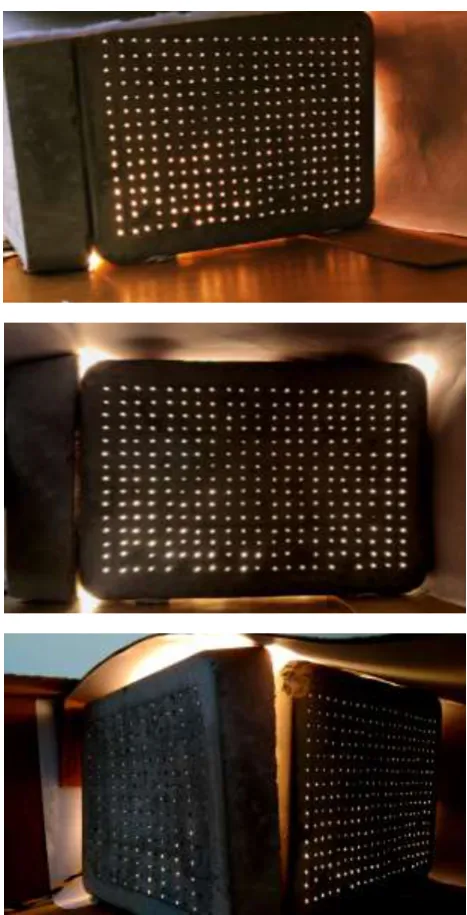
5. Light transmitting panels produced by our present study
Fig -5.1: Sun light passing through the LITRACON BLOCK (Picture: during day time)
[image:4.595.45.286.178.376.2]
Fig-5.2: Light transmitting panel making using optical fibers
Fig-5.3: Light transmission through the concrete panels
[image:4.595.47.277.403.596.2]6. RESULTS
Table: 6.1 Compressive strength results of present experimental work
SL
NO Description
Average compressive strength N/mm2 7 days 28 days 01 Conventional Concrete 10.9 17.16 02 Concrete with SF 10% 15% 18.29 17.3 28.84 27.55
03 LITRACON 10% 12.9 20.10
[image:4.595.37.564.637.792.2]© 2019, IRJET | Impact Factor value: 7.211 | ISO 9001:2008 Certified Journal | Page 7211
Table: 6.2 Split tensile strength results of presentexperimental work
SL
NO Description
Average split tensile strength N/mm2 7 days 28 days 01 Conventional Concrete 1.54 2.49 02 Concrete with SF 10% 1.93 2.57
15% 1.84 2.42
03 LITRACON 10% 15% 1.68 1.87 2.01 2.15
6.1 Comparison of strength parameters obtained in present experimental work.
Fig- 6.1: Graph of 7 and 28 days compressive strength of CC and replacement with SF and LITRACON
Fig-6.2: Graph of 7 and 28 days Split tensile Strength of CC and replacement with SF and LITRACON
7. CONCLUSIONS
It can be concluded that the compressive strength of light transmitting concrete with 10% replacement of cement by silica fume has been increased by 17.13% than that of conventional concrete.
Also it is observed that the compressive strength of light transmitting concrete with 15% replacement of cement by silica fume has been increased by 22.76% than that of conventional concrete.
From the above points it is clear that LITRACON with replacement of silica fume by 15% gives high compressive strength than that of 10%.
It is observed that the split tensile strength of concrete with 10% replacement of cement by silica fume increased by 13.61% compared to CC. And 8.26% for 15% replacement.
Also it is cleared that use of silica fume enhanced the strength parameters of concrete than that of conventional concrete.
Application of optical fiber will make the concrete aesthetic appearance as well as can make the concrete structural efficient by acting as reinforcing material.
By using light transmitting concrete it acquires minimum power consumption. Light transmitting is an emerging trend in concrete technology. It’s considered as a special concrete which ensures future benefits.
REFERENCES
[1] Amarkhail, N. (2015). EFFECTS OF SILICA FUME ON
PROPERTIES OF HIGH-STRENGTH CONCRETE. International Journal of Technical Research and Applications.
[2] Concrete Technology Theory and practice, by M.S.
SHETTY ,S.CHAND
[3] Ghutke, V. S. &Bhandari, P.S. (2014). Influence of silica
fume on concrete. IOSR Journal of Mechanical and Civil Engineering.
[4] Gurpreet Singh, DhandeUttam, AdurkarAjit, Prof.Mrs G. A. Sayyed [2017] ”EXPERIMENTAL INVESTIGATION ON LITRACON BY USING PLASTIC OPTICAL FIBRE”, International Journal of Latest Research in Engineering and Technology(IJLRET).
[5] IS:1199-1959 Code of practice for “Workability of
Concrete by Slump Test”.
[6] IS: 516-1959 Code of practice for “Compressive Strength
Test”.
© 2019, IRJET | Impact Factor value: 7.211 | ISO 9001:2008 Certified Journal | Page 7212
[8] IS: 10262-2009 Code of practice for “Concrete Mix
Design”.
[9] Kavya S, Karthik D, Sivaraja M [2016] “An Experimental Study on light Emitting Concrete” International Journal of Advanced Research in Education and Technology(IJRET)
[10] Shreyas K [2018] “Litracon” Shreyas K / International Journal of New Technologies in Science and Engineering,
BIOGRAPHIES
Poornima D
Final year [8th semester] student Civil Engineering Department, PES College of Engineering, Mandya
Shailaja T
Final year [8th semester ] student Civil Engineering Department, PES College of Engineering, Mandya
Pooja H P
Final year [8th semester] student Civil Engineering Department, PES College of Engineering, Mandya
Santhosh G
Final year [8th semester] student Civil Engineering Department, PES College of Engineering, Mandya
Sachidananda B
Final year [8th semester] student Civil Engineering Department, PES College of Engineering, Mandya
Rashmi M P Assistant Professor