The Simplification, Solution and Estimation of a
Small Open DSGE Model:Evidence from the UK
and Canada
Lancaster University
LI JINYU
November 23, 2019
This dissertation is submitted for the degree of Doctor of
Philosophy
Dedication
This thesis is dedicated to my parents who encouraged me to pursue the goal of
Declaration
This thesis has not been submitted in support of an application for another degree
at this or any other university. It is the result of my own work and includes
noth-ing that is the outcome of work done in collaboration except where specifically
indicated. Many of the ideas in this thesis were the product of discussion with my
supervisor David Peel and Alina Spiru.
The thesis is being submitted in partial fulfillment of the requirements for the
degree of:. . . .PhD. . . .
I give consent for my thesis to be available for photocopying and for inter library
loan, and for the title and summary to be made avalibale to outside organisations.
Signed: LI JINYU
The Simplification, Solution and Estimation of a Small Open DSGE
Model:Evidence from the UK and Canada
Abstract
This thesis makes three main contributions to the literature on Dynamic
Stochas-tic General Equilibrium (DSGE) models. The first contribution is to bridge the
gap between a theoretical small open DSGE model provided by Gali and
Mona-celli and an empirical model developed by Lubik and Schorfheide, as no previous
studies have shown their relationship explicitly. Since all the models suffer from
the misspecification problem to some extent, the second contribution is to
ap-ply two methodologies including DSGE-VAR approach and indirect inference to
study the effect of the possibly misspecified equation of the change rate of terms
of trade. The third contribution is to search for the model with the best data
fit-ting in two stages of model comparisons. The thesis assumes that the parameters
of the simplified DSGE model are constant at the first stage, and based on the
constant parameter models with the best performance on data fitting, it assumes
a subset of the parameters including exogenous shock variances and policy
param-eters follow two independent Markov-switching Markov chains at the second stage.
The empirical results are quite different for the UK and Canada within the sample
period covering 1992: Q4 – 2008: Q4. The UK data supports that the movement
of the nominal exchange rate should not enter into the monetary policy reaction
function. Also, the data supports that it is possible for the UK to experience
the two kinds of structural changes, including the economic environment and the
Acknowledgements
It is necessary to thank many people who help me to finish the thesis. First, my
thanks go to my supervisor David Peel and Alina Spiru. Professor David suggests
me to start my research from Gali and Monacelli’s’ model and motivates me to
carry on the research of model comparisons. Alina is very patient to help me to
clarify my research questions and the relevant research methodologies.
Second, I want to appreciate Giorgio Motta and Efthymios Pavlidis. Giorgio give
me the first DSGE lectures since I joined Lancaster University since 2014, and he
also provides much additional help through my research. Efthymios used to be my
PhD director, and he always can offer me much help when something does not go
well.
I also thank Professor Xu Wenli from ANHUI University and PhD Nan Yi in
Harbin Institute of Technology in China, Professor Hirokuni Iiboshi from Tokyo
Metropolitan University in Japan. Professor Xu recommends me to use the tool
RISE to study the Markov-Switching DSGE models, and Nan Yi provides much
help when I have some coding problems with Matlab. Professor Iiboshi is so kind
that he offers me his code resources to solve a standard Markov-Switching New
Keynesian model numerically.
Lastly, I give my deepest thanks to my parents, who never get bored with me
Contents
General Introduction 1
Previous literature on the development of DSGE models . . . 1
The Solutions to the DSGE Models . . . 4
The Bayesian Estimation of DSGE Models . . . 6
The Structure of the Thesis . . . 10
1 The Simplification and Solution of the Model 11 1.1 Introduction . . . 11
1.2 A Small Open DSGE Model . . . 12
1.2.1 Types of Model Variables . . . 12
1.2.2 Gali and Monacelli’s framework . . . 12
1.2.3 From Gali to Lubik . . . 31
1.3 Solutions to the Model . . . 35
1.3.1 Blanchard and Kahn’s Methodology . . . 38
1.3.2 Schur Decomposition . . . 40
1.3.3 Numerical Solutions . . . 42
1.4 Conclusion . . . 48
2.3 Bayesian Estimation of DSGE model . . . 61
2.3.1 Likelihood function . . . 63
2.3.2 Choice of Priors . . . 64
2.3.3 MCMC Approximation of Bayesian Posteriors . . . 67
2.4 The Analysis of the Estimation Results . . . 70
2.4.1 Estimation Results for the UK . . . 72
2.4.2 Estimation Results for Canada . . . 79
2.5 Check for the Model Specification . . . 86
2.5.1 Model Evaluation by DSGE-VAR . . . 87
2.5.2 Model Evaluation by Indirect Inference . . . 92
2.6 Conclusion . . . 95
3 Model Comparison One: Constant Parameters Estimation 96 3.1 Introduction . . . 96
3.2 Model Comparison of Bayesian Methodology . . . 100
3.3 Bayesian Estimation of the Updated DSGE Models . . . 102
3.3.1 Group One: No Nominal Exchange Depreciation . . . 105
3.3.2 Group Two: No Nominal Exchange Depreciation and Change of Output Deviation . . . 117
3.3.3 Group Three: Nominal Exchange Depreciation and Change of Output Deviation . . . 129
3.3.4 An Overall Remark of the Model Comparison at the First Stage . . . 141
3.4 Conclusion . . . 144
4 Model Comparison Two: Markov-Switching Parameters Estima-tion 146 4.1 Introduction . . . 146
4.2 Markov-Switching DSGE Models . . . 148
4.3 Estimated Markov Switching DSGE Models for the UK . . . 153
4.3.2 UK: the Model Two with the Switching Taylor Rule . . . 166
4.3.3 UK: the Model Three with Switching Variances and
Switch-ing Policy Parameters . . . 177
4.3.4 The Model Comparison and Data Analysis for the UK . . . 195
4.4 Estimated Markov Switching DSGE Models for Canada . . . 202
4.4.1 Canada: the Model One with Switching Variances . . . 204
4.4.2 Canada: the Model Two with the Switching Taylor Rule . . 215
4.4.3 Canada: the Model Three with Switching Variances and
Switching Policy Parameters . . . 226
4.4.4 Model Comparison and Data Analysis for Canada . . . 244
4.5 Conclusion . . . 250
5 General Conclusion 252
5.1 Main Findings . . . 252
5.2 Limitations and Directions of Further Research . . . 255
Bibliography 257
Appendix 266
Structure of the DSGE Model . . . 266
List of Tables
1.1 Calibration . . . 42
1.2 Numerical Solutions for the Calibrated Parameters . . . 46
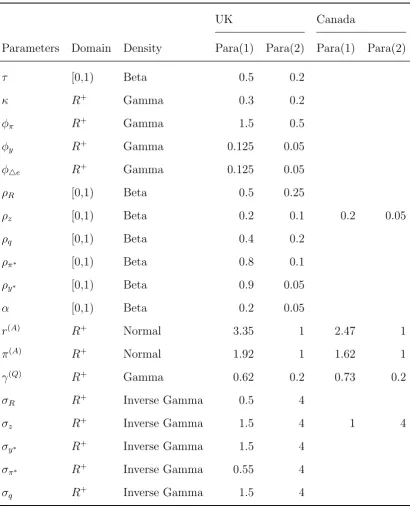
2.1 Prior Distributions for the UK and Canada . . . 66
2.2 Parameter Estimation Results for the UK and Canada . . . 71
2.3 Numerical Solutions for the UK (Benchmark Model) . . . 77
2.4 Numerical Solutions for Canada (Benchmark Model) . . . 84
2.5 The Calibration of DSGE Prior Weights λ . . . 90
2.6 Power of the Wald Test at 5% significance level . . . 94
3.1 Constant Parameter Estimation Results (Control Group) . . . 104
3.2 Constant Parameter Estimation Results (Group One) . . . 106
3.3 Numerical Solutions for the UK in the Group One . . . 110
3.4 Numerical Solutions for Canada in the Group One . . . 115
3.5 Constant Parameter Estimation Results (Group Two) . . . 118
3.6 Numerical Solutions for the UK in the Group Two . . . 122
3.7 Numerical Solutions for Canada in the Group Two . . . 127
3.8 Constant Parameter Estimation Results (Group Three) . . . 130
3.9 Numerical Solutions for the UK in the Group Three . . . 134
3.10 Numerical Solutions for Canada in the Group Three . . . 139
3.11 Numerical Results of the Posterior Odds Ratio . . . 143
3.12 The Rank of the Data Fitting Performance of Each Group . . . 143
4.1 Parameter Estimation Results of the Benchmark Models . . . 152
4.3 Model One with Markov-Switching Variances(UK) . . . 156
4.4 The Numerical Solution to Regime 1 of the Model One for the UK . 160
4.5 The Numerical Solution to Regime 2 of the Model One for the UK . 161
4.6 Variance Decomposition of the Model One for the UK . . . 165
4.7 Model Two with Markov-Switching Policy Parameters(UK) . . . 167
4.8 The Numerical Solution to Regime 1 of the Model Two for the UK 171
4.9 The Numerical Solution to Regime 2 of the Model Two for the UK 172
4.10 Variance decomposition of the Model Two for the UK . . . 176
4.11 Model Three with 2 Markov Chains(UK) . . . 179
4.12 The Numerical Solution to Regime 1 of the Model Three for the UK 186
4.13 The Numerical Solution to Regime 2 of the Model Three for the UK 187
4.14 The Numerical Solution to Regime 3 of the Model Three for the UK 188
4.15 The Numerical Solution to Regime 4 of the Model Three for the UK 189
4.16 Variance Decomposition of the Model Three for the UK . . . 194
4.17 Log Marginal Data Densities and Ranks of the Models for the UK . 198
4.18 Prior Distributions of the Structural Parameters for Canada . . . . 203
4.19 Model One with Markov-Switching Variances(Canada) . . . 205
4.20 The Numerical Solution to Regime 1 of the Model One for Canada 209
4.21 The Numerical Solution to regime 2 of the Model One for Canada . 210
4.22 Variance Decomposition of the Model One for Canada . . . 214
4.23 Model Two with Markov-Switching Policy Parameters(Canada) . . 216
4.24 The Numerical Solution to Regime 1 of the Model Two for Canada 220
4.25 The Numerical Solution to Regime 2 of the Model Two for Canada 221
4.26 Variance Decomposition of the Model Two for Canada . . . 225
List of Figures
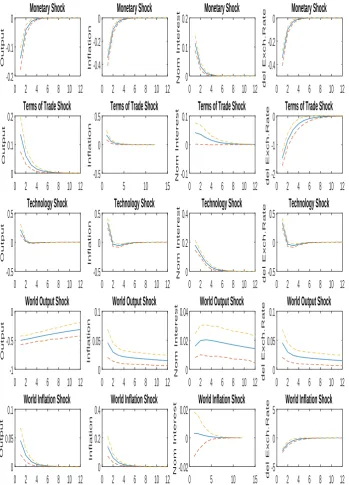
1.1 Impulse response functions for the Calibrated parameters . . . 47
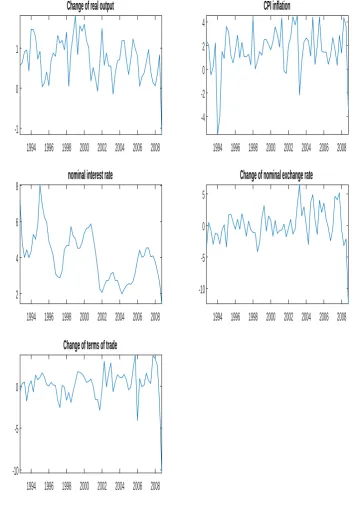
2.1 Data of UK . . . 55
2.2 Data of Canada . . . 58
2.3 Impulse response functions for the benchmark model in the UK . . 78
2.4 Impulse response functions for the benchmark model in Canada . . 85
2.5 Calibrations of DSGE Prior Weights . . . 91
3.1 Impulse response functions for Group One in the UK . . . 111
3.2 Impulse response functions for Group One in Canada . . . 116
3.3 Impulse response functions for Group Two in the UK . . . 123
3.4 Impulse response functions for Group Two in Canada . . . 128
3.5 Impulse response functions for Group Three in the UK . . . 135
3.6 Impulse response functions for Group Three in Canada . . . 140
4.1 Impulse responses,UK(Markov-switching Model One) . . . 162
4.2 Impulse responses,UK(Markov-switching Model Two) . . . 173
4.8 Impulse responses,Canada(Model One) . . . 211
4.9 Impulse responses,Canada(Model Two) . . . 222
4.10 Impulse responses,Canada(Switching Variances of Model Three) . . 239
4.11 Impulse responses,Canada(Switching Taylor Rules of Model Three . 240
4.12 Smoothed probability of high volatility from model one . . . 247
4.13 Smoothed probability of strict inflation from model two . . . 248
General Introduction
The main objective of the thesis is to answer the question that how to improve the
data fitting for a given DSGE model based on different specifications of monetary
policy function and some subsets of parameter space following Markov-Switching
chains. The thesis will prefer the UK and Canada as two sample countries within
the sample period 1992:Q4-2008:Q4. There are mainly three reasons motivating
the preference. First, the DSGE model adopted by the thesis is appropriate for
small open economies, which includes features that the UK and Canada hold to
some extent. Second, the UK and Canada share something in common within the
chosen sample period. They both announce that they adopt inflation targeting
monetary policy after the early 1990s. This thesis does not consider the periods of
the zero lower bound after 2008 when the conventional monetary policy does not
work. Third, the UK and Canadian monetary policy also exhibit some different
features within the chosen sample period. There is a debate about whether the
movement of the nominal exchange rate should enter into the design of the
mon-etary policy. Overall, the thesis will study the two sample countries within the
sample period at the same time and exhibit their similar and different features,
makers about the impact and feedback of their conduct policy in an economy with
assumptions of the real business cycle or New Keynesian nominal rigidity, which
plays an increasingly key role in the modern macroeconomic analysis. Ramsey
(1927[73],1928[74]) initially mature the framework of this approach. Subsequently,
Cass (1965[13]) and Koopmans(1965[54]) carry on developing this methodology.
The Lucas critique (Lucas, 1976[61]) and the urgent need to set up micro-founded
macroeconomic models lead to a revolution in macroeconomics in the 1980s. It is
Kydland and Prescott (1982[55]) who set up the vital work in modern
macroeco-nomic analysis, which is famous for the starting point of the Real Business Cycle
(RBC) theory. In the combination between the developed economic theory and the
major events in the 20st, the size of DSGE model becomes larger and the
struc-ture of it becomes more complicated, because DSGE models gradually
incorpo-rate a large number of New Keynesian features(Rotemberg,1982[76];Blanchard and
Kiyotaki,1987[9]; Rotemberg and Woodford,1997[77]; Woodford,2011[93];Smet and
Wouters, 2003[82],2007[83]). At the meantime, instead of studying the policy and
the economy isolated from the world, Some individuals including Clarida,Gali and
Gertler (2001[20];2002[21]),Gertler, Gilchrist and Natalucci(2007[38])and
Mona-celli (2005[66]) start extending the DSGE framework to the context of an open
economy in the presence of the trade sector and the currency values in their
mod-els. Gali and Monacelli (2005[37]) develop a critical theoretical DSGE model which
describe a small open economy which is allowed to trade with the rest of the world
and hardly impose a significant impact on the global economy. This model with
calibrated parameters can be regarded as the seminal one to guide the policy
mak-ers to design the optimal monetary policies. Unexpectedly, as pointed by Diebold
(1998[27]), the large scale and the complicated structure of the models may
pre-vent us from measuring the estimates of parameters efficiently and consistently.
Some individuals then simplify Gali and Monacelli’s framework, and among them,
Lubik and Schorfheide (2007[60])’s simplification is applied for practical purpose
in terms of constant parameter model (Zheng and Guo,2013[94].) and
literature, including Lubik and Schorfheide, clearly explain the relationship
be-tween the theoretical model and the empirical one in terms of the model variables
and the parameters. To use their model directly may confuse others because there
is not a clear transition from the micro-foundations to the simplified model.
Ac-cordingly, the lack of transparency motivates the thesis to set up a bridge between
the theoretical model and the simplified one. Chapter 1 of the thesis replicates the
derivation process of the empirical model and stands out the meaning of the
vari-ables and parameters in the simplified model, thereby identifying whether there are
The Solutions to the DSGE Models
The solution to a DSGE model is approximately a VAR model with restricted
co-efficients deriving from the structural parameters. Blanchard and Kahn (1980[8])
develop a solution method which provides an important condition for the existence
and uniqueness of the solutions to the system. That is, the number of explosive
eigenvalues should be exactly equal to the number of jump variables with the
ex-pectation operators. Sims (2002[80]) proposes a solution method, which is a bit
different from Blanchard and Kahn’s work. Although they still decouple the
sys-tem of models into explosive and nonexplosive portions, the expected errors instead
of the expectation operators appear in the system. Besides, the technique of QZ or
Schur decomposition is applied in their methodology to overcome the singularity
of the matrix coefficients. Klein (2000[51]) develops a method which is a hybrid
of those of Blanchard and Kahn (1980[8]) and Sims (2001[80]). Like Blanchard
and Kahn’s method, he distinguishes the predetermined and jump variables of the
system. Also, the QZ technique is applied to solve the system in the absence of
expectation errors. Furthermore, Uhlig (1995[89]) develops an undetermined
coef-ficient approach, which is very different from the other methodologies. Rather than
focusing on solving the system with different portions, he tries to uncover the
rela-tionships among the parameters and solve them once for all. Moreover, Svensson
and Williams (2005[85]), Farmer et al(2011[32]), Cho (2014[17]) introduce Markov
switching to the parameters of the system. They solve the Markov-Switching
DSGE model through solving a constant parameters model with the structural
parameters and the transition probabilities. They have proved that their
solu-tions are unique and stable. In a word, Blanchard and Kahn’s approach is the
fundamental one for this thesis to solve the simplified DSGE model, which also
incorporates the techniques of QZ decomposition as does in Sims and Klein’s work.
It is often difficult to solve the model by hand when the number of the
equa-tions and variables are many even for an already simplified system. Thus, it is
packaged in some powerful software such like Matlab(Judd, 1998[46]; Miranda
and Fackler, 2004[65]; Woodford and Philips, 2011[92]; Brandimarte,2013[10])
and a newly invented software Julia (Caraiani,2018[12]). In this thesis, Dynare
(Adjemian,2011[1]) is the primary tool to solve the constant parameter DSGE
models and Rise (Maih,2015[62])) is a very efficient tool to solve the
The Bayesian Estimation of DSGE Models
The thesis will estimate the DSGE models with the Bayesian methodology and
evaluate their performances of data fitting with the posterior likelihood ratio test.
The combination between a prior probability distribution and the maximum
like-lihood function of the data in the Bayesian approach can construct a posterior
probability distribution which provides a full statistical characterisation of the
observed data. Geweke (1999[39]) and Robert and Casella (2013[75]) provide a
numerical approach to calculate the integration of the posterior probability
den-sities in the Bayesian framework. Bauwens et al. (2000[5]) offer an application of
Bayesian methods to study a wide range of dynamic reduced-form models.
More-over, Koop (2003[53]) writes a textbook which incorporates a general overview of
Bayesian statistical methods with further details regarding computational issues.
It is not very common to estimate DSGE models with Bayesian methodology
un-til Smet and Wouters (2003[82], 2007[83]) use this approach to estimate a closed
DSGE model for the US economy with data covering the period 1966: Q1-2004:
Q4. After that, Adolfson et al. (2007[2]) extend and estimate the model
de-veloped by Christiano (2005[18]) for the Eurozone with data covering the period
1970: Q1-2002: Q4. An and Schorfheide (2007[3]) estimate the DSGE model
developed by Woodford (2011[93]) with artificial data and evaluate the model
with posterior odds ratio and DSGE-VAR approach. In addition to the
devel-oped countries, Gabriel et al. (2010[33]) estimate a DSGE model in the
pres-ence of financial frictions with Indian data covering period 1980: Q1-2006: Q4.
Zheng and Guo (2013[94]) estimate the DSGE model developed by Lubik and
Schorfheide(2007[60]) with China data covering the period 1992: Q1-2011: Q4.
There are also some useful textbooks regarding the Bayesian estimation of DSGE
models (Dejong and Dave,2011[23]; Hashimzade and Thornton,2013[41]; Herbst
and Schorfheide, 2015[42]). It is exceedingly beneficial to use such textbooks to
Lubik and Schorfheide (2007[60]) offer the primary motivation for my research.
They estimate a small open DSGE model, which is a simplified version of Gali
and Monacelli’s model, with the data of Canada, Britain, New Zealand and
Aus-tralia covering the period 1983: Q1-2002: Q4. They consider two versions of the
model with different specification of Taylor principle rules and conclude that it
offers the best data fitting for the UK and Canada when it considers the
move-ment of the nominal exchange rate in the policy reaction function. However, the
empirical results for the UK are not approved by the Bank of England in their
release. The sample period they choose includes at least one structural change
when the UK is no longer a member of the Exchange Rate Mechanism (ERM)
since 1992. The thesis will adopt a new sample size of the UK and Canada
cov-ering the period 1992: Q4-2008: Q4, which excludes the period when the UK is
a member of ERM and extends the period until the nominal interest rates
ex-perience zero lower bound in the recent financial crisis. Chapter 2 will estimate
the original Lubik and Schorfheide’s model with the new sample size and reserve
the results as a control group in the next chapter. Moreover, it will borrow two
methodologies developed from Le et al. (2013[56]) and Del Nergo et al. (2007[26])
to identify the misspecification problems of the small open DSGE model
consid-ering whether there is a unit process of the rate change of the terms of trade or not.
Taylor rule policy reaction function (1993[86]) is the equation with different
specifi-cations in the estimation. Taylor originally includes the inflation rate and the
out-put gap in the policy reaction function. Gradually, its structure has been changed
a lot in examining the coefficients of monetary policy reaction functions in
type of monetary policy with the US data covering the period 1982: Q1-2003: Q1.
This type of rule is also applied by Smet and Wouter (2007) in their DSGE model.
Overwhelmingly, the policy reaction function incorporates four kinds of
specifica-tions based on a combination between the existence of the nominal exchange rate
depreciation and the rate change of output. Among them, the original one in Lubik
and Schorfheide’s model is regarded as the control group while others comprise of
the treatment groups. Chapter 3 of the thesis compares the four groups and finds
the model with the best data fitting in using the Bayesian likelihood approach.
The model with the best fitting performance will be the benchmark model for the
next chapter.
Some economies inevitably have experienced structural changes in the past decades.
For instance, Nelson(2003[67]) offers guidance of the regime changes of UK
mon-etary policy covering the period 1972-1997, from the period of floating exchange
rate to the period of independence of the Bank of England. VARs model is
a convenient methodology to study the regime shifts (Catelnuovo and Surico
,2005[14];Benati,2009[6]). Since Davig and Leeper (2006[22]) and Farmer et al.
(2011[32]) can provide a unique solution to the Markov-Switching rational
ex-pectation models, it motivates individuals to identify the regime shifts in
differ-ent countries based on diversified versions of DSGE models. Benati and Surico
(2009[6]) estimate a Markov-Switching New Keynesian model with US data
cov-ering the period of the Great Moderation. Liu and Mumtaz (2011[57]) initially
examine the UK data with a small open Markov-Switching DSGE model developed
from Justiniano and Preston (2010[48]) covering 1970: Q1-2009: Q1. Chen and
MacDonald(2012[16]) estimate a small open DSGE model developed by Lubki and
Schorfheid (2007[60]) covering the period 1975:Q1-2010:Q2. Here is one thing to
mention, the models developed from Justiniano and Preston (2010[48]) and Lubki
and Schorfheid (2007[60]) are both the simplified version of Gali and Monacelli
(2005[37])’s framework. Chapter 4 will introduce two similar kinds of Markov
DSGE model which offer the best data fitting in the previous chapter. Chapter 4
tries to find the Markov-switching DSGE model with the best data fitting, and it
mainly has three aspects different from the previous literature. First, the chosen
sample size is shorter and covers the period 1992: Q4-2008: Q4. The chosen period
excludes the potential impacts of the fixed exchange rate regime and the zero lower
bound on the monetary policy reaction function. Second, chapter 4 borrows the
specification of the monetary policy reaction function offering the best data fitting
for each country from the constant parameter estimation in chapter 3. At last,
chapter 4 only considers two kinds of structural changes, including the variance of
The Structure of the Thesis
There are five chapters in this thesis. Chapter 1 will derive the core parts of
the theoretical small open DSGE model proposed by Gali and Monacelli. It then
uncovers the simplification process from the theoretical model to the empirical one
provided by Lubik and Schorfheide. At the end of chapter one, it will exhibit a
classical method combined with Dynare to solve the model numerically. Chapter
2 will describe the data sample and then introduces the Bayesian methodology
to estimate the model for the UK and Canada separately. Moreover, it provides
two alternative methodologies linking VARs to DSGE models, thereby checking
the model identification regarding the equation of the change rate of the terms of
trade. Chapter 3 will regard the empirical results from chapter 2 as the control
group and have another three treatment groups based on different specifications of
the monetary policy reaction function. It will search for the model with the best
performance of data fitting for each of the two countries. Chapter 4 will regard
the model with the best performance of data fitting in chapter 3 as the benchmark
model and introduce two types of Markov-Switching parameters in the small open
DSGE model. It will carry on searching for the model with the best performance
of data fitting within the same sample period and tries to answer whether there is a
significant improvement of data fitting between the constant parameter model and
the Markov-Switching DSGE model. Chapter 5 summarises the main findings of
the thesis and offers some implications of the current research with further possible
Chapter 1
The Simplification and Solution
of the Model
1.1
Introduction
The thesis will borrow the small open DSGE model from Lubik and Schorfheide
(2007)[60]’s research. This log-linear model is a simplified version of the model
developed by Gali and Monacelli (2005)[37]. There are two economies in this
model. One is the home country, and the other one is the rest of the world. The
DSGE model comprises of a forward-looking IS equation, a forward-looking Philip
curve, an exchange rate equation derived based on the law of one price and a
Taylor type monetary policy rule and four exogenous stationary processes. In the
log-linear model, the log differences of economic variables express the percentage
deviations of such variables concerning their stable states. There are two sections
in this chapter. The first section will show the derivation process of the
1.2
A Small Open DSGE Model
This section will present the main components of a small open DSGE model derived
by Gali and Monacelli(2005 [37]). After that, it will uncover the process of how
Lubik and Schorfheide (2007[60]) simplify the model from the previous work. The
simplified version of the model has been used in the empirical research to study the
behaviour of central banks in different countries(Zheng and Guo (2013[94]), Chen
and Macdonald(2012[16])). However, few of them, even Lubik and Schorfheide
themselves, has explicitly revealed the process to generate the simplified model
from Gali and Monacelli’s work. By uncovering the connections between the two
versions of models, this section is helpful to understand the assumptions and the
limitations of the model better.
1.2.1
Types of Model Variables
It is essential to introduce the types of model variables adopted in the DSGE model
in this section. For instance, ifMt is an arbitrary type of economic variable, then
mt is the log value of the economic variable: mt=logMt. ˜mt is the log difference
of the economic variable: m˜t = mt −m = logMt−logM = MtM−M,where M is
the steady state of the economic variable. Lubik and Schorfheide opt for ˜mt in
their DSGE model and the steady state ˜mis zero, which implies that the economic variablesMt will converge to their stationary statesM in the equilibrium level.
1.2.2
Gali and Monacelli’s framework
Gali and Monacelli’s framework incorporates about eight segments which are
rele-vant to the following simplifying process. The first segment discusses the
intertem-poral optimal condition of the household. The second one brings in the definition
of terms of trade given the steady state of the purchasing power parity. The third
one assumes there is an uncovered interest parity between any two countries in
the bond market. The fourth one shows a retailer firm in the market of perfect
mo-nopolistic competition. The sixth one exhibits the optimal pricing strategy of the
wholesale firms when the price is sticky according to the Calvo rule (1983[11]).
The seventh segment displays the relationship between the consumption and
out-put in the given small open economy. The final one obtains the potential outout-put
and natural rate of the interest rate. The equations and the dependent
parame-ters generated from such eight segments will play critical roles in the simplifying
process.
Households
The representative household optimises the following utility function:
E0
∞
X
t=0
βt
Ct1−σ 1−σ −
Nt1+ϕ 1 +ϕ
, (1.1)
where Nt is hours of labour, Ct is a composite consumption index, β is the
in-tertemporal discount factor, σ is the relative risk aversion coefficient and ϕ is the marginal disutility with respect to labour supply. In addition, The composite
consumption indexCt can be defined as:
Ct=
h
(1−α)1/η(CH,t)(
η−1
η )+α1/η(C
F,t)(
η−1
η )
iη−η1
, (1.2)
where CH,t is an index of consumption of domestic produced goods, CF,t is an
index of imported goods, η measures the elasticity of substitution between such two kinds of goods, andα is an index of openness. The equation defining CH,t is:
CH,t =
Z 1
0
CH,t(j)
ξ ε−1dj
ξ−ξ1
, (1.3)
whereCH,t(j) represents the consumption of home product of goodj at timet, and
in the world. Moreover, Ci,t consists of a continuum of differentiated goods in the
unit interval:
Ci,t =
Z 1
0
Ci,t(j)
ξ ε−1dj
ξ ξ−1
, (1.5)
where Ci,t(j) represents the consumption of product of good j imported from a
foreign countryi at timet.
It assumes that the total consumption from goods market and bond market cannot
exceed the revenue in each period. Thus, the household’s period budget can be
written as
Z 1
0
PH,t(j)CH,t(j)dj+
Z 1
0
Z 1
0
Pi,t(j)Ci,t(j)djdi+Et[Qt,t+1Dt+1]≤Dt+WtNt+Tt,
(1.6)
where PH,t(j) is the price of home product of good j, Pi,t(j) is the price of good
j imported from country i. Qt,t+1 is the stochastic discount factor for the
nomi-nal payoffs Dt+1 in the period t+ 1 of the bond held at the end of period t. Wt
is the nominal wage andTtis the lump sum transfers (positive) or taxes (negative).
The next task is to take i,j,H and F off from the budget constraint. First, max-imise equation (1.3) given the constraint:
Z 1
0
PH,t(j)CH,t(j)dj =PH,tCH,t. (1.7)
The maximisation procedures arrive at the demand function of the domestic good
j.
CH,t(j) =
PH,t(j)
PH,t
−ξ
CH,t. (1.8)
Substitute the above equation in the equation (1.7) yields the domestic price index:
PH,t = (
Z 1
0
PH,t(j)1−ξdj)
1
1−ξ. (1.9) Second, maximise equation (1.5) given the constraint:
Z 1
0
The demand function of the imported good j from a foreign countryi is
Ci,t(j) =
Pi,t(j)
Pi,t
−ξ
Ci,t. (1.11)
Likewise, the price index(expressed in home currency) for imported goods from
countryi can be written in the following way:
Pi,t = (
Z 1
0
Pi,t(j)1−ξdj)
1
1−ξ. (1.12) By far, it is ready to take j away from the period budget constraint (1.6). Third, maximise equation (1.4) given the constraint
Z 1
0
Pi,tCi,tdi=PF,tCF,t. (1.13)
The demand function of the imported good for a given countryi is
Ci,t =
Pi,t
PF,t
−γ
CF,t. (1.14)
The price index (expressed in home currency) for imported goods is
PF,t= (
Z 1
0
Pi,t1−γdi)1−1γ. (1.15) Now it is ready to take i away from the period budget constraint (1.6). Fi-nally,maximise equation (1.2) given the constraint:
PH,tCH,t+PF,tCF,t=PtCt. (1.16)
The demand function of the domestic goodCH,t is given by
CH,t = (1−α)
PH,t
Pt
−η
Ct. (1.17)
The demand function of the imported good CF,t is given by
CF,t=α
PF,t
P −η
Turning back to the maximisation of the representative household’s utility (1.1)
given the above budget constraint leads to the intertemporal optimal condition.
βRtEt
(Ct+1 Ct
)−σ( Pt Pt+1
)
= 1. (1.21)
where Rt = EtQ1t,t+1 is the gross return on a risk free one period discount bond
paying off one unit of home currency at time t + 1.Rewrite the intertemporal condition in the log-linear form:
˜
ct =Etct˜+1−
1
σ(rt−Etπt+1−ρ), (1.22)
wherert=Rt−1 is the net interest rate, πt=log(Pt)−log(Pt−1) is CPI inflation,
and ρ= β1 −1 is the time discount rate.
The derivation process of the household section is the very key component in
the framework of a DSGE model. In addition to Gali and Monacelli (2005[37]),
the famous book written by Gali(2015[35]) and Walsh (2017[91]) offer a very
speci-fied explanation and illustration of the optimal conditions of households in a small
open economy. More specifically,the latter one also includes a two-country model
developed by Obstfeld and Rogoff (1995[68];1996[69]). The two-country model is
useful when someone is interested in examining the impact of national
develop-ment on the international economy. The thesis is consistent with Gali(2015[35])’s
framework, which assumes the domestic economy is tiny and have little impacts
Purchasing Power Parity and Law of One Price
Gali and Monacelli (2005[37]) define the effective terms of tradeStas the following
equation:
St=
PF,t
PH,t
=
Z 1
0
Si,t1−γdi 1−1γ
, (1.23)
whereSi,t =
Pi,t
PH,t is the bilateral terms of trade between the home economy and a foreign country i. In addition, the price of country i’s goods Pi,t is expressed in
the domestic currency. Given the assumptions that the steady state satisfying the
purchasing power parityS = 1 and the elasticity of substitution between different countriesγ = 1, rewrite the formula above in the log-linear from:
˜
st = (pF,t−pF)−(pH,t−pH) = pF,t−pH,t =
Z 1
0
˜
si,tdi. (1.24)
Analogically, under the assumption of purchasing power parity and the elasticity
of substitution between home product and imported goodsη= 1, rewrite the CPI price formula (1.19) in the log-linear expression:
pt= (1−α)pH,t+αpF,t=pH,t+αs˜t. (1.25)
Take one period backward of the above equation and subtract it from the above
equation yield the following relationship between the CPI inflation and domestic
inflation.
πt =πH,t+α4s˜t, (1.26)
where the domestic inflation πH,t = pH,t−pH,t−1 is defined as the rate of change
in the index of domestic goods prices.
rewritten as the following equation:
Pi,t =εi,tPi,ti =εi,t(
Z 1
0
Pi,ti (j)1−ξdj)1−1ξ (1.28) Substitute the above equation in the equation (1.15) and rewrite PF,t in the
fol-lowing equation:
PF,t=
" Z 1
0
εi,t(
Z 1
0
Pi,ti (j)1−ξdj)1−1ξ
1−γ di
#1−1γ
. (1.29)
Rewrite the above equation in the log-linear form under the assumptions γ = 1 yields the equation below:
pF,t=
Z 1
0
(ei,t+pii,t)di =et+p∗t, (1.30)
where et =
R1
0 ei,tdi is the log nominal effective exchange rate, p
i
i,t =
R1 0 p
i
i,t(j)dj
is the log domestic price index for country i expressed in its own currency, and p∗t = R1
0 p
i
i,tdi is the log world price index. Combining this formula with the
equation (1.24), the log difference of terms of trade is rewritten as the following
equation:
˜
st= ˜et+p∗t −pH,t. (1.31)
Take one period backward of the above equation and subtract it from the above
equation generates an important relationship between CPI inflation and the rate
change of nominal exchange rate in the equation below:
πt =πt∗+4e˜t−(1−α)4s˜t. (1.32)
The definition of terms of trade in Gali and Monacelli (2005[37])’s framework
is a bit different from the practical side. Chamberlin and Yueh (2006[15]) define
the terms of trade as the ratio of export to import prices, which is just the
op-posite to the definition of Gali and Monacelli (2005[37]). Generally, an exchange
rate depreciation will increase the import price and weaken the terms of trade.
sector. From the viewpoints of the import sector, the weakened terms of trade
will deteriorate the trade balance if the country does not expand the quantity of
its export. The exchange rate depreciation 4e˜t and the change rate of the terms
of trade 4s˜t should move in the opposite direction, and the simplified model will
Uncover Interest Parity and Terms of Trade
The intertemporal optimal condition for the representative household in any other
country i is written in the following equation:
βEt
(C
i
t+1
Ci t
)−σ( P
i t
Pi
t+1
)
=Qit,t+1. (1.33)
Under the assumption of law of one price and complete security markets, there are
no arbitrage opportunities in the bond market:
Qt,t+1 =Qit,t+1
εit εi
t+1
, (1.34)
where it implies a potential investor is able to buy the domestic bonds and the
foreign bonds at the same discounted current price expressed in the same currency.
The combination between equation (1.33) and (1.34) arrives at an uncovered
in-terest rate parity:
Rt =Rit
εi
t+1
εi t
= 1 εi t
Ritεit+1, (1.35)
where it implies the profit of one unit of the domestic currency invested in the
domestic bond market is same as the profit of one unit of the domestic currency
invested in the foreign bond market. Rit = Qi1
t,t+1 is the foreign gross return of
one period bond and the dimension ofεi
t is
f oreigncurrency
homecurrency . Combining the equation (1.33) with equation (1.21), it yields the equation below:
Ct+1
Ct
= (
Pi
tεit
Pt
Pi
t+1εit+1
Pt+1
)−σC
i
t+1
Ci t
= ( Qi,t Qi,t+1
)−σC
i
t+1
Ci t
, (1.36)
whereQi,t =
Pi
tεit
Pt is defined as the bilateral real exchange rate for the currency in the country i. It is important to extract an important relationship between the domestic and home consumption from the above equation:
Ct=vCtiQ
1
σ
i,t, (1.37)
where v is a arbitrary constant and can be canceled off when log-linearize the
above equation around the steady stateC =Ci =C∗ under the assumption of the purchasing power parity Qi =Si = 1:
˜
ct= ˜c∗t +
1
wherec∗t =R01citdi is the index of world consumption andqt=
R1
0 qi,tdi=
R1
0(ei,t+
pi
t −pt) is the log effective real exchange rate. Combining equation (1.25) and
(1.31),the log difference of the real effective exchange rate is expressed by:
˜
qt = ˜et+p∗t −pt= ˜st+pH,t−pt = (1−α) ˜st. (1.39)
Substitute the real exchange rate in the equation (1.38), it yields a relationship
between the home consumption and the world consumption:
˜
ct = ˜c∗t + (
1−α
σ ) ˜st. (1.40)
In addition, log-linearize the equation (1.35) will yield a relationship between the
home net interest rate and the world net interest rate r∗t:
rt−r∗t =Et4et˜+1. (1.41)
Combining the above equation with the equation (1.32) yields the relationship
between the interest rate and terms of trade:
˜
st= (r∗t −π
∗
t+1) + (rt−EtπH,t+1) + ˜st+1. (1.42)
Uncovered interest rate parity assumes that the bond investors will hold the bond
with the highest expected return. However, the assumption of the uncovered
in-terest rate parity is too strong for two reasons (Blanchard,2013[7]). On the one
hand, it ignores the transaction cost. For instance, entering in and exists from
the UK bond market requires three contracts with different transaction costs. On
Retailers(Final Goods Firm)
The optimisation problems are a bit complicated in the home production sector,
which require the inclusion of two sections: firms called retailers which produce
the final goods in the market of perfect competition and firms called wholesalers
which produce the intermediate goods in the market of monopolistic competition.
The wholesale firms will produce many infinitely differentiate intermediate goods
and sell them to the retailer firms with a flexible or sticky price. The retailer firms
then aggregate the intermediate goods into the same type of final goods and then
sell them with perfect competition.
The objective of the retailer is to maximise the profit in the below equation:
PH,tYt−
Z 1
0
PH,t(j)Yt(j)dj, (1.43)
with the constraint below implying that the elasticity of substitution of the many
infinitely intermediate goods is ξ:
Yt=
Z 1
0
Yt(j)
ξ−1
ξ
ξ ξ−1
. (1.44)
Accordingly, the optimisation procedures arrive at the demand function for the
wholesale good j:
Yt(j) =
PH,t(j)
PH,t
−ξ
Yt. (1.45)
Substitute the above equation and the equation (1.9) in equation (1.43), the
max-imum profit of the retailer firms is zero, which proves that there is perfect
Wholesale Firms with flexible prices strategy
Given the flexible price strategy, the objective of the wholesale firms is to maximize
the profit:
PH,t(j)Yt(j)−(1−τ1)WtNt(j) (1.46)
whereτ1 is the subsidy of employment. The objective is constrained by the
equa-tion (1.45) and the producequa-tion funcequa-tion defined as the below equaequa-tion:
Yt(j) =AtNt(j). (1.47)
The optimal price of wholesale goodj is written in the following equation:
PH,t(j) =
ξ
ξ−1M C
n
t, (1.48)
whereM Ctn= (1−τ1)WAtt is the nominal marginal cost. In addition, the marginal
cost is independent of j and identical for all wholesale firms. Rewrite the real
marginal cost M Ct =
M Cn
t
PH,t in the log-linear form:
mct =log(1−τ1) +wt−pH,t−at. (1.49)
Wholesale Firms with sticky prices strategy
Calvo (1983[11]) assumes the wholesale firms has a θ probability of keeping the price of its good fixed in the following periods and a 1−θ probability of optimally redefining its price. The objective of the wholesale firm to maximize the profit is
defined in the below equation:
∞
X
k=0
θkEt[Qt,t+k(Yt+k(PH,t∗ −M C n
t+k))], (1.50)
subjecting to the constraint obtained from equation (1.45):
Yt+k(j) = (
PH,t∗ PH,t+k
)−εYt+k (1.51)
The discount factor Qt,t+k = βk(
Ct+k
Ct )
−σ( Pt
Pt+k) is derived from the optimal in-tertemporal condition (1.21). Under the assumptions σ = 1,η = 1 and γ = 1, it arrives at the optimal redefining pricePH,t∗ :
PH,t∗ = ξ
ξ−1
X1,t
X2,t
, (1.52)
where X1,t = M Ct + θβEtX1,t+1 and X2,t = PH,t−1 +θβEtX2,t+1. The optimal
resetting price is identical for all the wholesale firms. In addition, the above
equation can be represented by the domestic inflation instead of the domestic
price index:
PH,t∗ PH,t−1
= 1 +πH,t∗ = ξ
ξ−1
1 PH,t−1
X1,t
X2,t
= ξ
ξ−1(1 +πH,t) X1,t
X2∗,t, (1.53) whereX2∗,t= 1+βθ(1+πH,t+1)−1EtX2,t+1. Log-linearize the equation (1.53) around
the zero steady inflation rate yields:
πH,t∗ =πH,t+ ˜x1,t−x˜∗2,t, (1.54)
where ˜x1,t = (1−θβ) ˜mct+θβEtx1˜,t+1 and ˜x∗2,t =−θβEtπH,t+1+θβEtx∗2˜,t+1. Also,
˜
mct = mct−mc is the log difference of the real marginal cost with respect to its
stationary state. Given the price stickness, the domestic price index function (1.9)
can be rewritten as follows:
PH,t1−ξ =
Z θ
0
PH,t1−ξ−1(j)dj+
Z 1
θ
The above equation can be rewritten in terms of the inflation by dividing Pt1−−1ξ from both sides:
(1 +πH,t)1−ξ =θ+ (1−θ)(1 +π∗H,t)
1−ξ (1.56)
Log-linearize the function above yields the relationship between the optimal
infla-tion and the domestic inflainfla-tion:
πH,t = (1−θ)πH,t∗ (1.57)
Substitute the above equation in the equation (1.54) yields the domestic Philips
curve:
πH,t=βEtπH,t+1+κmc˜t, (1.58)
whereκ= (1−θ)(1θ−θβ).
Monopolistic competition and the sticky prices are two central assumptions for
the supply side in the DSGE model considering the features of the New
Keyne-sian. The prices of goods are normally higher than the marginal cost, which
inval-idates the assumption of the perfect competition in the real business cycle model.
For instance, Hall(1998[40]) finds evidence of a higher price than the marginal
cost in the US economy. Dixit and Stiglitz(1997[28]) mathematically approximate
the central idea of the imperfect competition, and after that, most of the DSGE
models borrow their ideas to assume there is a continues of differentiated goods
locating in the interval from zero to one. More specifically, Torres(2015[88]) offers
an excellent and fundamental book to cover the final goods production sector
(re-tailers) in the perfect competition market and the production of the intermediate
goods sector (wholesale firms) in the monopolistic competition market. The price
Consumption and Output
The equilibrium in the goods market for the small open economy requires:
Yt(j) = CH,t(j) +
Z 1
0
CH,ti (j)di, (1.59)
whereCH,ti (j) represents foreign country i’s consumption for the good j produced in the home country. The simplification of the above equation needs several steps.
First, rewrite CH,t(j) in the from of Ct through the equations (1.8) and (1.17):
CH,t(j) = (
PH,t(j)
PH,t
)−ξCH,t = (
PH,t(j)
PH,t
)−ξ(1−α)(PH,t Pt
)−ηCt. (1.60)
Second, rewriteCH,ti (j) in the form of CH,ti through equation(1.8) :
CH,ti (j) = (PH,t(j) PH,t
)−ξCH,ti , (1.61)
where it implies the foreign country i prefers to consume good j from the home economy given the price of it PH,t(j) in relation to the whole price index PH,t.
Next, rewrite Ci
H,t in the form of CF,ti through equation (1.14):
CH,ti = ( PH,t PF,ti εi,t
)−γCF,ti . (1.62)
The home economy export its good to an foreign countryiand the foreign country options to consume the quantity of goods from the home economyCi
H,tamong other
countries in the world given the export price PH,t comparing with the imported
price indexPF,ti for the foreign country in terms of the same currency. Last, rewrite Ci
F,t in the form of Cti through equation (1.18):
CF,ti =α(P
i F,t
Pi t
)−ηCti. (1.63)
The foreign country make a choice on the quantity of imported goods given the
imported price indexPF,ti comparing to its own price indexPti. Gali and Monacelli assume the preferences are symmetric for consumers, implying the ξ,γ and η are identical across different countries. Combing equations from (1.61) to (1.63), it
yields a relationship between the consumption of a certain type of good produced
in the home economyCi
H,t(j) and the foreign consumption index Cti:
CH,ti (j) = (PH,t(j) PH,t
)−ξ( PH,t Pi
F,tεi,t
)−γα(P
i F,t
Pi t
Above all, substituting the equation (1.60) and (1.64) into the equilibrium
condi-tion (1.59) generate the following equacondi-tion:
Yt(j) = (
PH,t(j)
PH,t
)−ξ
"
(1−α)(PH,t Pt
)−ηCt+α
Z 1
0
( PH,t Pi
F,tεi,t
)−γ(P
i F,t
Pi t
)−ηCtidi #
. (1.65)
Plugging the above equation to the aggregate domestic output (1.44) yields:
Yt= (1−α)(
PH,t
Pt
)−ηCt+α
Z 1
0
( PH,t Pi
F,tεi,t
)−γ(P
i F,t
Pi t
)−ηCtidi. (1.66)
Notice (P i F,t
Pi
t )
−η = (PH,t
Pt )
−η(PF,ti εi,t
PH,t )
−η( Pt
εi,tPti)
−η = (PH,t
Pt )
−η(PF,ti εi,t
PH,t )
−η( 1
Qi,t)
−η.
Ac-cordingly, the above equation is simplified as:
Yt = (
PH,t
Pt
)−η
(1−α)Ct+α
Z 1
0
(εi,tP
i F,t
PH,t
)γ−ηQi,tCtidi
. (1.67)
Introducing the definition of terms of trade through equation (1.23), it yields
εi,tPF,ti
PH,t =
Pi
F,t
Pi
H,t
εi,tPH,ti
PH,t =S
i
tSi,t and then substituting the terms of trade and equation
(1.37) into the above equation:
Yt= (
PH,t
Pt
)−ηCt
(1−α) +α Z 1
0
(StiSi,t)γ−ηQ
η−1
σ
i,t di
. (1.68)
Deriving the first order log-linear approximation to the above equation around the
steady state with the assumption of purchasing power parity yields:
˜
yt= ˜ct+αγs˜t+α(η−
1
σ) ˜qt = ˜ct+ αω
σ s˜t, (1.69)
where ω = σγ + (1−α)(ση −1). The equation above will hold for all coun-tries,implying that:
˜ yi
t = ˜cit+
αω σ
˜ si
t. (1.70)
Given the assumption R01si
tdi = 0, it can generate a world equilibrium condition
where σα = 1−ασ+αω. Finally, combing the Euler equation (1.22) with (1.69) and
(1.72) is able to generate the new IS curve in terms of output instead of
consump-tion:
˜
yt=Etyt˜+1−
1 σα
(rt−EtπH,t+1−ρ) +αΘEt4y∗t˜+1, (1.73)
Marginal Cost, Potential Output and Natural Rate of Interest
In this subsection, it will generate a relationship between the marginal cost
inde-pendent of the price stickness and then introduce the natural rate of output and
interest rate.
In addition to the intertemporal optimal Euler condition (1.21), the optimization
household utility also yields that the marginal substitution rate of consumption
and leisure equating to the real wage price:
Ctσ Nt−ϕ =
Wt
Pt
. (1.74)
Rewriting the above formulas in the log form:
σct+ϕnt=wt−pt. (1.75)
Also, Integrating the production function (1.47) over the domain of j ∈ [0,1] combing with the demand equation (1.45):
Z 1
0
Yt(j)dj =
Z 1
0
(Pt(j) Pt
)−ξdjYt=At
Z 1
0
Nt(j)dj =AtNt, (1.76)
where it assumes Nt=
R1
0 Nt(j)dj is the total labor supply for the home economy.
Taking the log form of the both sides yields the equation below:
yt =at+nt, (1.77)
where it assumes the price dispersion (Pt(j)
Pt )
−ξ is a constant number of one in the
first order approximation. Given the equations (1.72),(1.75) and (1.77), rewriting
the marginal cost equation in (1.49) as follows:
where Ω = σν−µ α+ϕ,Γ =
1+ϕ
σα+ϕ and Ψ =−
σαΘ
σα+ϕ. Also, the subtraction of the steady real marginal cost from the equation (1.78)generates the log deviation of real marginal
cost:
˜
mct = (σα+ϕ)(xt), (1.80)
wherext=yt−yt,n is defined as output gap. Noticing thatxt= ˜xt becauseytand
yt,n share the same steady state of log real output, thusxt= (yt−y)−(yt,n−y) =
˜
yt−y˜t,n= ˜xt. Rewriting the domestic Philips curve (1.58) regarding to the output
gap instead of real marginal cost:
πH,t =βEtπH,t+1+καxt=βEtπH,t+1+καx˜t, (1.81)
whereκα =κ(σα+ϕ). The natural rate of interest is the real interest rate equating
the output and natural output. Thus, addingyt+1˜,n−y˜t,n to the both sides of the
IS curve (1.73) generates the equation below:
˜
xt =Etxt˜+1−
1 σα
( ˜rt−EtπH,t+1−r˜t,n), (1.82)
where ˜xt= ˜yt−y˜t,n is the deviation of output gap from its steady state, ˜rt=rt−ρ
is the deviation of nominal interest rate from its zero inflation steady stateρ and ˜
rt,n = rt,n−ρ is the deviation of the natural rate of interest rate from the same
zero inflation steady interest rateρ. The natural rate of interest rate is defined as:
1.2.3
From Gali to Lubik
Lubik and Schorfheide (2007[60]) simplify Gali and Monacelli (2005[37])’s model
in several ways. In addition to the initial assumptions including purchasing power
parity, the law of one price, uncovered interest parity and η =γ = 1, Lubik and Schorfheide (2007[60]) detrend the real economic variables by the non-stationary
technology process At. They set the marginal substitution between labour and
leisure ϕ to zero. The risk aversion σ is no longer assumed to be one in the simplified model. Moreover, the definition of terms of trade q1 in the simplified
model is the reciprocal of that in Gali and Monacelli (2005[37])’s model. Thus the
signs of the terms of trade in the simplified log-linear DSGE model are all opposite
to those in the previous section.
IS curve
Lubik and Schorfheide (2007[60]) detrend the aggregate real output domestically
and abroad in Gali’s model with the a non-stationary technology process At =
At−1+zt following Y Yt = AYtt =Nt,so the natural rate of the detrended output in
the equation (79) is writing in another way withyt=yyt+at and y∗t =yy
∗
t +at:
˜
yyt,n =αΨ ˜yyt∗ =−αΘ ˜yyt∗. (1.84)
where Ψ =− σαΘ
σα+ϕ =−Θ when Lubik assumesϕ= 0. The natural rate of interest rate is still same but it replaceat with zt which is defined as the rate of change in
the technological process:
Etzt+1 =Etat+1−at, (1.85)
where σα = 1−ασ+αω and Θ = ω−1 = σγ+ (1−α)(ση −1)−1. It implies that
˜
yyt = (yt−at)−(y−at) = yt−y = ˜yt and ˜yy∗t = ˜yt∗. It defines τ = σ1 as the
inverse of risk aversion and substitute τ and the assumptions η =γ = 1 into the parameters,which yields
σα=
1
τ +α(1−τ)(2−α) =
1
τ +λ (1.88)
and
Θ = (1−τ)(2−α)
τ =
λ
ατ, (1.89) whereλ =α(1−τ)(2−α). The definition of terms of trade in the simplified model is Given byQ∗t = PH,t
PF,t, which is the reciprocal of that in the theoretical model.PF,t is still the import price while PH,t is regarded as the exported price assuming the
law of one price always hold in the goods market. Thus, the log form of the terms
of trade is defined as qt∗ = −st. Substituting the new parameters and the new
terms of trade into that IS curve yields:
˜
yyt =Etyy˜t+1−(τ+λ)( ˜rt−Etπt+1−Etzt+1)+α(τ+λ)Et4qt∗˜+1+
λ
τEt4yy˜
∗
t+1, (1.90)
where the change of world output is defined as:
4yy˜∗
Philips curve,Exchange rate and Terms of Trade
Lubik and Schorfheide (2007[60]) rewrites the Philips curve (81) in terms of the
CPI inflation rate with the aid of equation (1.26) as follows:
πt=βEtπt+1+αβEt4qt∗˜+1−α4q˜∗t +
κ
τ +λx˜t, (1.92)
whereκα =κ(σα+ϕ) = τ+κλ. The output gap does not change when the aggregate
output is detrendend by the non-stationary technology process due to the fact
xt= yt−yt,n = (yt−at)−(yt,n−at) = yyt−yyt,n and so does the log deviation
of output gap ˜xt = xt. The simplified model directly borrows the exchange rate
equation (1.32) and changes the sign of the terms of trade from negative to positive
as follows:
πt =πt∗+4e˜t+ (1−α)4q˜t∗. (1.93)
The first difference of equation (1.72) can lead to the change rate of the terms of
trade endogenously:
4q˜t∗ =σα(4yy˜∗t − 4yy˜t) =
1
τ+λ(4yy˜
∗
t − 4yy˜t). (1.94)
However, Lubik and Schorfheide (2007[60]) replace the equation above with an
ex-ogenous process which will be mentioned later. They suggest that the replacement
Monetary Policy and Exogenous Shock Process
Lubik and Schorfheide (2007[60]) sets the nominal interest rate in response to
movements in CPI inflation, output, the nominal exchange rate depreciation with
a smoothing term:
˜
rt=ρRrt˜−1+ (1−ρR)[φππt+φyyy˜t+φ4e4e˜t] +ξtR, ξ R
t ∼N ID(0, σ
2
R), (1.95)
whereφπ,φy andφ4eare policy coefficients. ρRis the smoothing term andξRis an
exogenous policy shock.σR is the standard deviation of the monetary policy shock.
Lubic and Schorfheide also introduce four stationary processes for the exogenous
variableszt,4qt,yt∗ and πt∗ in the model:
zt=ρzzt−1+ξtz, ξ z
t ∼N ID(0, σ
2
z), (1.96)
4q˜t∗ =ρq4qt∗˜−1+ξ
q
t, ξ
q
t ∼N ID(0, σq2), (1.97)
˜
yyt∗ =ρy∗yy˜∗
t−1+ξ
yt∗
t , ξ
y∗t
t ∼N ID(0, σy2∗), (1.98)
πt∗ =ρπ∗π∗t−1+ξπ ∗
t
t , ξ
π∗t
t ∼N ID(0, σ
2
π∗), (1.99)
where ρz,ρq,ρy∗ and ρπ∗ are autoregressive coefficients of the AR(1) processes,
respectively. ξtz,ξtq,ξy ∗
t
t andξ
π∗t
t are innovations of the four AR(1) processes. σz,σq,
σy∗ and σπ∗ are the standard deviation of the corresponding shocks, respectively. ztis the change rate of the technology process. 4q˜∗t is the change rate of the terms
of trade following an exogenous process instead of the endogenous process (1.93). ˜
yy∗
t is the log difference of the detrended world output from its steady state. π∗t is
1.3
Solutions to the Model
I can solve the model comprising of the equations above using the method
devel-oped by Blanchard and Kahn (1980[8]),Klein (2000[51]) or Sims (2002[80]). The
Lubik and Schorfheide’s model comprise of 10 equations including the IS curve
(1.90),natural rate of output (1.84),change of world output(1.91), Philips curve
(1.92),law of one price (1.93),monetary policy reaction function (1.95) and 4 AR
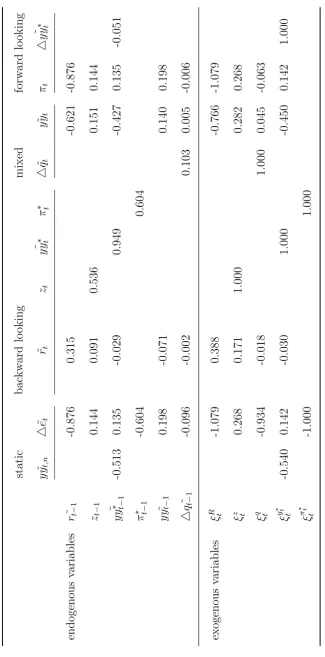
one processes from (96) to (99). The vector of endogenous variables of the system is
xt = [ ˜yyt,n,4e˜t,r˜t, zt,yy˜∗t, πt∗,4q˜t,yy˜t, πt,4yy˜t∗]0. Among the vector,yy˜t,nand4e˜t
are static variables which are just appear at period of timet. ˜rt,zt, ˜yyt∗ and π∗t are
backward looking variables which are appear at period of timet−1 andt. 4q˜tis the
mixed variable which appears at period of timet−1,t andt+ 1. ˜yyt,πt and4yy˜t∗
are forward looking variables which appear at time t and t+ 1. When handling the solution of a dynamic system, it is often replace the static variables with other
endogenous variables so the new vector is Xt = [ ˜rt, zt,yy˜t∗, π∗t,4q˜t,yy˜t, πt,4yy˜t∗]0.
The original system of equations becomes
B[X1,t+1,X2,t+1]0 =A[X1,t,X2,t]0+Gξt+1, (1.100)
where X1,t is the vector of backward looking variables [ ˜rt, zt,yy˜∗t, πt∗]
0 and X
2,t
is the vector of mixed and forward looking variables[4q˜t,yy˜t, πt,4yy˜t∗]
0. In fact,
the mixed variable 4q˜t should both enters into the vector of backward looking
exogenous shocks [ξR
t , ξtz, ξ
q
t, ξ
y∗
t
t , ξ
π∗
t
t ]0. B is a parameter matrix with size 8∗8:
B=
1 0 0 (1−ρR)φ4e (1−ρR)()1−α)φ4e −(1−ρR)φy −(1−ρR)(φπ+φ4e) 0
0 1 0 0 0 0 0 0
0 0 1 0 0 0 0 0
0 0 0 1 0 0 0 0
0 0 0 0 1 0 0 0
0 0 0 0 0 1 τ +λ λτ
0 0 0 0 αβ 0 β 0
0 0 0 0 0 1 0 −1
, (1.101)
and A is a matrix with size 8∗8:
A=
ρR 0 0 0 0 0 0 0
0 ρz 0 0 0 0 0 0
0 0 ρy∗ 0 0 0 0 0
0 0 0 ρπ∗ 0 0 0 0
0 0 0 0 ρq 0 0 0
τ+λ −ρz(τ +λ) 0 0 −α(τ +λ)ρq 1 0 0
0 0 −καΘ
τ+λ 0 α −
κ
τ+λ 1 0
0 0 0 0 0 1 0 0
, (1.102)
and Gis a matrix with size 8∗5:
G=
1 0 0 0 0
0 1 0 0 0
0 0 0 1 0
0 0 0 0 1
0 0 1 0 0
0 0 0 0 0
0 0 0 0 0
0 0 0 0 0
. (1.103)
If the matrixBinvertible, it is appropriate for the Blanchard and Kahn’s
for the methodology of matrix decomposition to solve the system. The goal of the
solution is to find the transition function:
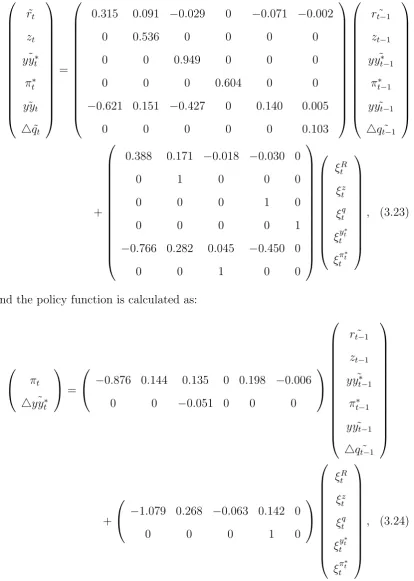
X1,t =PX1,t−1+Qξt, (1.104)
and the policy function:
X2,t=RX1,t−1+Sξt. (1.105)
After that, it can obtain the static variables yy˜t,n and 4e˜t through the equations
1.3.1
Blanchard and Kahn’s Methodology
If the inverse of the matrix B exists,the dynamic system (1.100) becomes
X1,t+1
X2,t+1
=B
−1A
X1,t
X2,t
+B
−1Gξ
t+1. (1.106)
Rewrite B−1A = ΓΛΓ−1.Γ is the eigenvector matrix of the matrix B−1A and Λ
is the eigenvalue matrix. In addition, the eigenvalues follows an increasing order
and the accordingly eigenvectors are also rearranged at the same time. The above
system is rewritten as:
Zt+1 =ΛZt+Γ−1B−1Gξt+1, (1.107)
whereZt =Γ−1Xt. Dividing the eigenvalue matrix in 2 groups based on whether
the absolute value of eigenvalue is smaller or bigger than 1.
Z1,t+1
Z2,t+1
=
Λ1 0
0 Λ2
Z1,t
Z2,t
+Γ
−1B−1Gξ
t+1, (1.108)
where Λ1 is a submatrix with size Q∗Q and the absolute values of eigenvalues in
it are smaller than 1, while Λ2 is a submatrix with size O ∗O and the absolute
values of eigenvalues in it are equal or bigger than 1. If the system is stationary,
Z2,t = 0 otherwise it explode after infinity time due to the matrix Λ2. Z2,t is also
a matrix with the sizeO∗O. To obtain theX back, rewriting the definition ofZt:
Z1,t
Z2,t
= Γ
−1
Xt=
G11 G12
G21 G22
X1,t
X2,t
, (1.109)
where the sizes of the sub-matrices in the Γ−1 is [(Q∗m),(Q∗n); (O∗m),(O∗n)] andmandnare the number of variables in the vector ofX1,t andX2,trespectively.
According to the stationary conditionZ2,t = 0,part of the above system becomes:
Z2,t=G21X1,t+G22X2,t = 0. (1.110)
The above equation determines the policy functions of the dynamic system,
cap-turing the relationship between the jump variables and the the predetermined
solutions to the dynamic system. First, if the number of explosive eigenvalues O is larger than the number of the jump variables n, the system has no solutions. Second, ifO < n,the system has free variables and thus have many infinitely solu-tions. Third, ifO=n, there is one and only one solution for this dynamic system. Overall, if the third condition holds, the unique solution derived from the above
equation is:
X2,t =−G−221G21X1,t. (1.111)
Substitute the unique solution in the rest part of the definition of Zt (1.109),
Z1,t =G11X1,t+G12X2,t, (1.112)
And then substitute it back to the dynamic system (1.108):
G11X1,t+1+G12X2,t+1 = Λ1(G11X1,t+G12X2,t) +Eξt+1, (1.113)
whereE is submatrix of Γ−1B−1Gwith the size m∗6. Substitute the unique solu-tion to the above equasolu-tion and then simplify it to obtain the transisolu-tion funcsolu-tion:
X1,t =RX1,t−1+Sξt, (1.114)
whereR = (−G11G−221G21+G12)
−1
Λ1(−G11G−221G21+G12) and
S = (−G11G−221G21+G12)
−1
E.
Substitute the transition function to the unique solution to finish deriving the
policy function:
X2,t =P X1,t−1+Qξt, (1.115)