COMPARISON STUDY SHOWING RATIONAL USE OF
OPTIMIZATION METHODOLOGY IN PREDICTING THE BEST
POSSIBLE FORMULATIONS OF SUSTAINED RELEASE DOSAGE
FORMS
Masheer Ahmed Khan*
School of Pharmacy, Devi Ahilya Vishwavidyalaya, Takshshila Campus, Khandwa Road,
Indore, 452001, India.
ABSTRACT
A computer optimization technique, based on response-surface
methodology has proven to be a useful approach for selecting
pharmaceutical formulations. The present study examines comparison
showing rational use of optimization methodology in predicting the
best possible formulations of sustained release dosage forms.
Optimization methodology using a factorial design for two factors at
three levels (32) which is equivalent to a central composite design
(CCD) for two factors was selected to optimize varied response
variables viz. release rate exponent (n), k, mean dissolution time MDT
and amount of drug released in 12h (Rel12h) in two different drugs,
diltiazem hydrochloride and metformin hydrochloride. The optimum
formulation was selected using software for both the drugs and the results obtained with the
experimental values were compared with the predicted values. Comparison study for both the
drugs formulations suggests the rational use of optimization methodology and can be
successfully utilized further in other sustained release drug formulations.
KEYWORDS: Optimization, Methodology, Sustained Release.
INTRODUCTION
A computer optimization technique, based on response-surface methodology has proven to be
a useful approach for selecting pharmaceutical formulations. Factorial designs are the most
popular response surface designs.[1-2] A factorial design for two factors at three levels (32)
Volume 6, Issue 17, 838-845. Research Article ISSN 2277–7105
*Corresponding Author
Masheer Ahmed Khan
School of Pharmacy, Devi
Ahilya Vishwavidyalaya,
Takshshila Campus,
Khandwa Road,
Indore-452001, India. Article Received on 24 Oct. 2017,
Revised on 15 Nov. 2017, Accepted on 06 Dec. 2017,
which is equivalent to a central composite design (CCD) for two factors was selected to
optimize varied response variables viz. release rate exponent (n), k, mean dissolution time
MDT and amount of drug released in 12h (Rel12h).[3-5]
Metformin hydrochloride is an oral anti-hyperglycemic agent, acts by decreasing hepatic
glucose output and peripheral insulin resistance in patients with Type 2 diabetes mellitus. It
shows incomplete absorption from the gastrointestinal tract and the absolute bioavailability is
50% – 60 % with relatively short plasma half-life of 1.5 - 4.5 h. A sustained-release
formulation that would maintain plasma levels of the drug for 10 to 16 hours might be
sufficient for once-daily dosing of metformin.[6-8]
Diltiazem hydrochloride which is a calcium channel blocker widely used for its peripheral
and vasodilator properties. It is also used for lowering blood pressure and has some effect on
cardiac induction. It is given as oral dosage form in the treatment of angina pectoris and the
management of hypertension. Its short biological half life (3-5 h), high aqueous solubility,
and frequent administration (usually three to four times a day) make it a potential candidate
for sustained release preparations.[9-11]
In the present work, an attempt has been made to formulate the sustained release matrix
tablets of diltiazem hydrochloride using different grades of HPMC like K4M, and K15M and
sustained release matrix tablets of metformin hydrochloride using hydrophilic matrix material
HPMC K15M in combination with hydrophobic ethyl cellulose release.[12-13]
The raw data obtained from in-vitro dissolution can be analyzed using software. The software
has in built provisions for calculating the values of amount of drug release, percentage of
drug release, log fraction released at various time intervals, log time, mid-point of time
intervals and rate of drug release.[14-19]
MATERIALS UNDER METHODS
Diltiazem hydrochloride was obtained as a gift sample from Promed Labs. Ltd, Indore,
(M.P.) Metformin hydrochloride was obtained as a gift sample from Cipla Pharmaceuticals,
Mumbai, (HPMCK4m, HPMC K15M, and Ethyl cellulose ) were provided by Colorcon
India Ltd., Goa, dicalcium phosphate, microcrystalline cellulose (Avicel PH101), purified
Factorial Design
The 32 factorial designs were selected using two factors (polymers) at three levels and the
factor levels were suitably coded Table (1). Nine formulations were prepared as per the
design and coded F1 to F9 for diltiazem hydrochloride and F1 to F9 for metformin
hydrochloride tablets. Diltiazem hydrochloride matrices were prepared using HPMC K4M
and HPMC K15M polymers and the two polymers HPMC K15M and ethyl cellulose were
selected and their limits were chosen for subsequent detailed studies using the factorial
design. The amount of drug, magnesium stearate, MCC and talc were kept constant while
dicalcium phosphate was taken in sufficient quantity to maintain a constant tablet weight.
Dissolution Studies
The dissolution studies for diltiazem hydrochloride matrix tablets were performed in
triplicate for all the batches in a USP XXIII dissolution rate test apparatus (type II). The
release studies were performed at 75 rpm in 900 ml of phosphate buffer pH 7.4 at 37 ± 0.2οC.
Five milliliters aliquots were withdrawn at predefined intervals, and the volume of the
dissolution medium was maintained by adding the same volume of fresh pre warmed
dissolution medium. The absorbance of the withdrawn samples was measured
spectrophotometrically at 237 nm. Similarly dissolution studies for metformin hydrochloride
were performed using 0.1 N hydrochloric acid for the first 2hrs followed by the medium of
phosphate buffer pH 7.4 at 37 ± 0.2οC for rest of the study time. The absorbance of the
withdrawn samples was measured spectrophotometrically at 233nm.
DATA ANALYSIS
The software calculates the response variables, which were considered for optimization
included, n, mean dissolution time (MDT), k and release at 12th hr (rel12h). Finally, the
prognosis of optimum formulation for both the drugs was conducted in feasible region to
predict the possible solutions. The optimum formulation was selected by the critical
evaluation of the tabulated search values.
Preparation of Predicted optimum Formulation
The tablet formulations for both the drugs were compressed using the chosen optimal
composition and evaluated for physical test, tablet assay and dissolution performance. The
RESULTS
Table. (1): Translation of experimental conditions into physical units
Coded Factor Diltiazem HCL
Level Factor(X1) Factor (X2) Units
HPMC K4M HPMC K15M
-1 0 1 Low Intermediate High 40 60 80 20 30 40 mg mg mg Coded Factor Metformin HCL
Level Factor(X1) Factor (X2) Units
HPMC K15M Ethyl Cellulose
-1 0 1 Low Intermediate High 90 120 150 40 60 80 mg mg mg
Table. (2): Dissolution parameters of Diltiazem hydrochloride matrix tablets during
optimization studies using 32 factorial design.
Formulation
Code n k MDT Rel 12 hr
F1 0.556 0.298 3.148 103.35
F2 0.509 0.289 3.885 93.06
F3 0.505 0.249 5.247 89.67
F4 0.501 0.252 5.219 91.25
F5 0.476 0.250 5.907 88.08
F6 0.469 0.251 6.063 86.23
F7 0.471 0.247 6.248 84.47
F8 0.450 0.229 7.945 75.26
F9 0.428 0.250 7.595 74.39
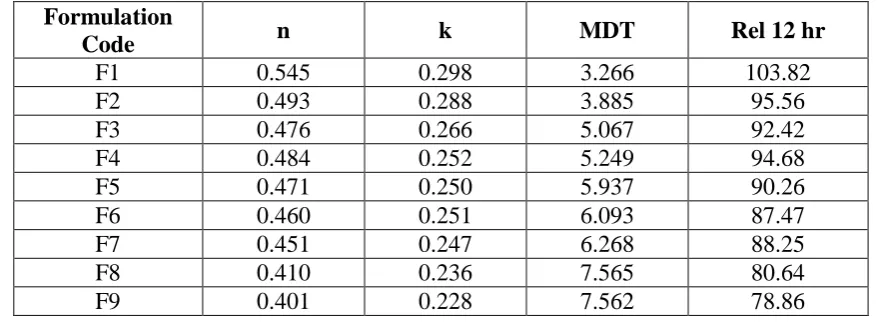
Table. (3): Dissolution parameters of Metformin hydrochloride matrix tablets during
optimization studies using 32 factorial design.
Formulation
Code n k MDT Rel 12 hr
F1 0.545 0.298 3.266 103.82
F2 0.493 0.288 3.885 95.56
F3 0.476 0.266 5.067 92.42
F4 0.484 0.252 5.249 94.68
F5 0.471 0.250 5.937 90.26
F6 0.460 0.251 6.093 87.47
F7 0.451 0.247 6.268 88.25
F8 0.410 0.236 7.565 80.64
[image:4.595.77.518.530.691.2]Table. (4): Predicted values of optimum formulations.
Formulation n k MDT Rel12hr
Diltiazem HCL 0.508 0.288 3.885 93.05 Metformin HCl 0.484 0.252 5.249 94.68
Table. (5): Dissolution parameter of optimum formulations.
Formulation n k MDT Rel12hr
Diltiazem HCL 0.507 0.289 5.187 91.10 Metformin HCl 0.480 0.254 5.07 93.86
Fig. (1): Plot between percent drug release and time for diltiazem Hhdrochloride matrix
tablet formulations as per Factorial design.
Fig. (2): Plot between percent drug release and time for formulations Metformin
[image:5.595.147.455.168.412.2] [image:5.595.146.453.473.646.2]Fig. (3): Plot between percent drug release and time of the diltiazem Hhdrochloride
matrix tablet optimum formulations.
Fig. (4): Plot between percent drug release and time of the Metformin hydrochloride
matrix tablet optimum formulations.
Release Profile Studies: The dissolution parameters of diltiazem hydrochloride formulations
as per design, obtained are shown in the Table (2) and for metformin hydrochloride
formulations as per design are shown in the Table (3).
The release pattern between percent drug release versus time is shown in Fig. (1) for
diltiazem hydrochloride formulations and for metformin hydrochloride formulations are
shown in Fig (2).
Feasible Region
Diltiazem Hydrochloride matrices , n > 0.460; MDT > 3.6; rel 12 hr >90%
[image:6.595.142.454.71.245.2] [image:6.595.144.459.306.468.2]The predicted values for the responses of both the drugs were noted and are shown in Table
(4). Based on the predicted values the levels were decoded and factor values were determined
(refer Table 1). Tablets of optimum formulation was prepared and subjected to dissolution
studies. The dissolution parameters obtained for optimum formulation of both the drugs are
shown in Table (5). The plot between percent drug release and time of the optimized
formulation for both the drugs are shown in Fig. (3) and Fig. (4) respectively.
CONCLUSION
The optimum formulation was selected using software for both the drugs and the results
obtained with the experimental values were compared with the predicted values. Comparison
study for both the drugs formulations suggests the rational use of optimization methodology
and can be successfully utilized further in other sustained release drug formulations.
REFERENCES
1. Swarbric J, and Boylan J.C.; Encyclopedia of Pharmaceutical Technology, Marcell
Dekker, New York, 1995.
2. Bolton S.; Pharmaceutical Statistics: Practical and Clinical Applications. 2nd Ed., Marcel
Dekker Inc, New York, 1990; 308-570.
3. Banker G., Rhodes C.; Modern Pharmaceutics, Marcel Dekker, New York, 1996;
247-289.
4. Lewis GA, Mathieu D. and Phan-Tan-Luu R.; Pharmaceutical Experiment Design (Drugs
and Pharmaceutical Sciences), Marcel Dekker, Inc., New York, 1999.
5. Box G., Connor C., Cousins W., Davies O, Himsworth F and Sillito G.; The Design and
Analysis of Industrial Experiments Davies, O.L., (Ed) 2nd edition, Oliver and Boyd,
London, 1960; 495-565.
6. Ken F., Miranda P., Steven J., Glycemic control in patients with type 2 diabetes mellitus
switched from twice-daily immediate-release metformin to a once-daily extended-release
formulation, Clinical Therapeutics, Volume 25, Issue 2, February, 2003; 515–529.
7. Mandal U, Gowda V, Ghosh A, Selvan S, Solomon S, Pal TK., Formulation and
optimization of sustained release matrix tablet of metformin HCl 500 mg using response
surface methodology, Yakugaku Zasshi, 2007 Aug; 127(8): 1281-90.
8. Wadher KJ, Kakde RB, Umekar MJ, Formulation and evaluation of a sustained-release
9. Saleh M Al-Saidan et al, in vitro and in vivo evaluation of guar gum matrix tablets for
oral controlled release of water soluble diltiazem hydrochloride, AAPS PharmSciTech,
2005; 6(1): E14-21.
10.Mickey.LW and Eugene LP, Models for release of chlorpheneramine and a
noninteracting compound from an inert heterogenous matrix containing an anionic
surfactant, Drug development and Industrial Pharmacy, 1992; 18(3): 265-284.
11.Khan MA , and Chaturvedi SC , Swelling and Drug Release Studies from Hydrophilic
Matrices Containing Combination of Different Grades of Hydroxyl Propyl
Methylcellulose, Asian Journal of Chemistry, 2011; 23(8): 3566-3568.
12.Khan M A, Formulation of sustained release diltiazem hydrochloride matrix tablets
through optimization and their evaluation, Research Journal of Pharmaceutical,
Biological and Chemical Sciences (RJPBCS), 2013; 4(2): 1317-1325.
13.Khan M.A., Formulation of Sustained Release metformin hydrochloride Matrix Tablets
through Optimization and their Evaluation, World Journal of Pharmaceutical Research,
2013; 2(6): 2985-2995.
14.Liu J, Zhang F, McGinity JW. Properties of lipophilic matrix tablets, containing
phenylpropanolamine hydrochloride prepared by hot-melt extrusion. Eur J Pharm
Biopharm. 2001; 52: 181-190.
15.Khan M A, Formulation of sustained release chlorpheniramine maleate tablets through
optimization and their evaluation, Journal of drug delivery and therapeutics, 2012; 2(5):
45-49.
16.Khan MA, and Chaturvedi SC , Swelling and Drug Release Studies from Hydrophilic
Matrices Containing Combination of Different Grades of Hydroxyl Propyl
Methylcellulose, Asian Journal of Chemistry, 2011; 23(8): 3566-3568.
17.Khan M.A., and Chaturvedi S.C., Formulation of Sustained Release Zolpidem tartrate
Matrix Tablets through Optimization and their Evaluation Asiaan Journal of Chemistry,
2010; 22(6): 4749-4762.
18.Singh B and Singh S, A comprehensive computer program for the study of drug release
kinetics from compressed matrices, Ind. J. Pharm. Sci., 1998; 60(6): 358-362.
19.Singh B and Gupta R.K., FACTOP: A Software Aid to Optimize Pharmaceutical
Dosage Forms through Factorial Design in 48th Indian Pharmaceutical Congress, Chennai.