EFFECT OF OVULATION INDUCTION PROGRAMS ON THE
SUCCESSFUL RATE OF GENDER SELECTION TECHNIQUE OF
INFERTILE COUPLES.
Al-Dujaily SS1*, Albarzanchi SA2 and Abbood MS2
1
Biotechnology Research Center, Al-Nahrain University, Baghdad-Iraq.
2
High Institute for Infertility Diagnosis and ART, Al-Nahrain University, Baghdad-Iraq.
ABSTRACT
Back ground: There are many techniques used for sex selection.
Ericsson method is the well- known to isolate Y sperm from X sperm.
Modifications were done in many studies to increase the percentage of
gender successful rate. However, in our knowledge there were cease
studies correlated between gender selection and ovulation induction
programs. Objective: To examine the effect of ovulation induction
programs on gender selection following intra uterine insemination
(IUI) for infertile couples. Patients, Materials and Methods: One
hundred of infertile couples were included in the present study. They
were randomly selected from the patients conducted the High Institute
for Infertility Diagnosis and Assisted Reproductive Technologies. They were divided
into four groups depending on the programs of ovulation induction Protocols were used.
Group one, were orally administration Clomiphene Citrate (CC)only, Group two, were used
Gonadotrophin injection. Group three, were used CC and Gonadotrophin. Group four (the
control) were used free medicine and depending on their natural menstrual cycle .Then IUI
was accomplished and pregnancy test was done after 14 days of insemination to detect the
level of human chorionic gonadotropin. The gender of the fetus was detected by an
ultrasound examination from sixteen weeks gestation on ward. Results: Total pregnancy rate
following (IUI) for gender selection of infertile couples in all four groups were Twenty six
out of one hundred Women who have become pregnant (26.0%). The distribution of Live
birth babies according to gender using the four different programs of induction ovulation was
19 male babies with a percentage of male sex selection (82.6%) while only 4 female babies
Volume 5, Issue 12, 34-44. Research Article ISSN 2277– 7105
*Corresponding Author’
Dr. Al-Dujaily SS
Biotechnology Research
Center, Al-Nahrain
University, Baghdad-Iraq. Article Received on 29 Sept 2016,
Revised on 19 Oct 2016, Accepted on 08 Nov 2016
were delivered with a percentage of (17.4%). Conclusions: The present study concluded that
there was no effect of the programs of ovulation induction on the ratio of gender selection of
infertile couple by IUI.
KEYWORDS: Ovulation induction, IUI, Gender selection.
INTRODUCTION
There were many histories of sex selection by different cultures world wild such as in
Chinese, Egyptian and Greek cultures. The Chinese astrological birth chart, which is at a
standstill used now days, is one of these.[1] However, since thirty five years ago, gender
selection was accomplished in several ways either before implantation (sperm sorting) or
after implantation of an embryo.[2] Assisted reproductive techniques (ART) such as
intrauterine insemination (IUI) solved many male infertility factors which could only be
solved by these techniques. Those spouses undergo IUI with ovulation induction medications
generally have a 25-30% chance of becoming pregnant in any given cycle. Therefore most
couples will be pregnant, but some couples will require more than one cycle.[3,4]
Gender selection technique was patented in the 1970s by Ronald Ericsson. This technique is
based on the idea that Y-bearing (boy-producing) sperm are lighter and swim faster than the
X-bearing (female-producing) sperm. The Ericsson Method sets out to divide the heavier,
slower sperm-producing a girl from the lighter, faster-swimming sperm-producing a boy.[5,6,7]
Many studies were developed this procedure in the sperm manipulation in vitro and increase
the percentage of gender selection such as the studies of Al-Dujaily and Al-Dahan[8] and
Al-Dujaily and Al-Jubori.[9] However the effect of using the programs of ovulation induction on
gender selection following ART not studied yet. Therefore the objective of this study is to
examine the effect of ovulation induction programs on gender selection following IUI for
infertile couples.
PATIENTS, MATERIALS AND METHODS
This study was conducted in the High Institute of Infertility Diagnosis and Assisted
Reproductive Technologies, Al-Nahrain University, since September 2015 till May 2016.
One hundred infertile couples were included in the current work. Couples were carefully
selected through detailed history (in vitro fertilization indicated cases were exclude) viewing
all previous investigations .Men with normozoospermia and mild male factors infertility were
leukocytospermia). The excluded couples were sever male factor infertility and women
polycystic ovary ,endometriosis, tubal occlusion and others.
Ovulation induction
Different induction protocols used for different female patients.
1-Colmid 50 mg tablet (Clomiphene citrate 50 mg, Aventis, France from(50-150) mg/day
for 5 days starting from day 2 of the menstrual cycle.[8]
2-Gonadotrophic were used alone. Such as Follitropin alfa (r-hFSH ,75 IU of Gonal-F) or
Puregon Inj. 50mg that give at day 3 , 5 and 7 depending on the woman ovaries response.[8,9]
3-Gonadotrophins and Clomid: The women of this group have 2-3 repeated doses of 75
IU/day of injectable gonadotropins were added to Clomiphene citrate tab.[9]
4-Natural cycle group: The another women group was considered control group and no
medicine used but depends on natural cycle included in this study. (Ovitrelle 250mg, Merck
Serono S.P.A. Italy) given to trigger ovulation, Insemination done usually 34-36 hours after
hCG injection.[10,11]
2. In vitro activation technique for gender selection
- Male examination and Investigation
The husbands who included in this study were examined by a consultant urologist in the
Institute. Semen sample was obtained via masturbation after an abstinence period of 3-5
days[12], collected directly into a clean, dry and sterile disposable wide mouth container in a
special allocated room for this purpose in the Institute. The sample was transported to the
semen examination laboratory immediately and allowed to liquefy in an incubator at 37ºC.
After complete liquefaction, the semen was analyzed by a macroscopic and microscopic
examination using the standardization of WHO (1999).[13]
a- In vitro sperm activation by swim up )Simple layer).
One ml of warmed Hams-F12 medium was added gently and carefully to overlay liquefied
semen in a sterile test tube then left for 10-30 minutes in CO2 incubator at 37ºC.
b- Discontinuous density gradient centrifugation
Discontinuous density gradient centrifugation technique was prepared using percoll
concentration of (40% - 80%). One ml from the superficial part of the Hams-f12 media of
the prepared test tube was aspirated and added to overlay another prepared warmed 80%
then we put this prepared tub in the centrifuge at 4000 for 20mins as described by
Al-Dujaily and Al-Jubori.[9]
C-Preparation of Albumin
Albumin 17% and 7% were prepared by using human albumin 20% (Biotast, Pharma, GmbH,
Germany was prepared as described by Al-Dujaily and Al-Dahan.[8]
2. Protocols of semen preparation using Ericsson method.
D- Intra- uterine insemination protocol
The female partner was prepared for the insemination process, by asking her to empty her
bladder and to lay down in a lithotomy position on the couch. A warmed and lubricated
Cusco speculum was introduced gently and slightly down word to expose the cervix which
was washed with saline or few drops of Hams-F12 media. The cervical mucus was removed
by a small piece of cotton and the cervix was prepared by using aseptic techniques. The
loaded IUI catheter passed through both the external and internal Os using a marker guide
line for the correct placement. The sperm preparation (0.3-0.5ml sperm suspension) was
gently inserted into the uterine cavity. The speculum gently removed and the patient was
instructed to spin on the side of ovulating ovary for 30 minutes.[9]
E-The follow up of the female partner after insemination.
1. Luteal phase support
Luteal phase supplementation started from the next day after insemination using a
progesterone through either oral route using progesterone tablets (Duphaston®10mg/day,
Solvay, Holland) for 2 weeks or intramuscular route (17- hydroxyl progesterone corporate)
250 IU given twice a week or vaginal route (Crinone 8%) daily for 2 weeks.[14]
2.Follow up for pregnancy and pregnant female
A blood sample was obtained from the female after 2 weeks from the insemination to test for
beta chain of human chorionic gonadotropin (B- HCG) level. If the result of the test was
positive, the patient was undergoing a follow up and careful antenatal care by an obstetrician
with regular visits.
An ultrasonography was done to confirm viability of intra uterine pregnancy, fetal growth
determination[14], while women with a negative pregnancy test, a new cycle of intra uterine
insemination was done.
Statistical analysis.
A statistical analysis was performed using SPSS (statistical package of social science, version
21.0 LED technologies, USA) and Microsoft Excel work 2010 for figures. The results were
expressed as mean + standard error (SE). Students t-test was applied to differentiate between
two groups .Analysis of variance (ANOVA) was used for more than two variables .When p
value reached the significant level, the least significant test (LSD) was performed. Chi square
was done for the non -parametric values. The differences between the values were considered
statistically significant if the P value was lower than 0.05(P<0.05).[15]
RESULTS
1: Programs of ovulation induction of the present study.
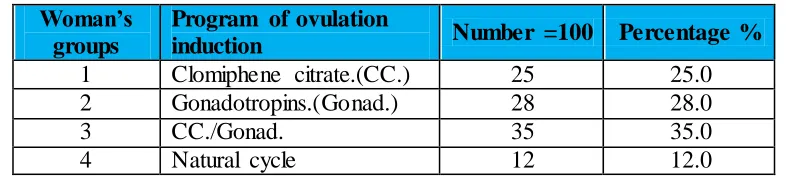
The study involved four ovulation induction programs namely; by using CC, the number of
couples was 25, the second program was by injection of Gonadotropins, the number of
couples was 28 and the third program was by mixing both CC and Gonadotropins, the
number of patients was 35 and the last program was natural cycle, the number of couples was
12 as shown in table (1).
Table (1): Programs of ovulation induction.
Woman’s groups
Program of ovulation
induction Number =100 Percentage %
1 Clomiphene citrate.(CC.) 25 25.0
2 Gonadotropins.(Gonad.) 28 28.0
3 CC./Gonad. 35 35.0
4 Natural cycle 12 12.0
2-Ultra sound finding of follicular size and endometrial thickens prior to Human
chorionic gonadotropin injection of infertile couples involved in gender selection study.
Table( 2) shown, the follicle size and endometrial thickness in women ,whose husband semen
activated in vitro by using density gradient technique and albumin technique for gender
selection. The mean of follicular size in the four groups involved in gender selection
techniques was revealed no significant (P>0.05) different between them. There was no
significant (P>0.05) differences in the mean of endometrium thickness between the four
groups of ovulation induction programs in women underwent gender selection (CC=
[image:5.596.101.494.485.573.2]Table (2): Ultra sound finding of follicular size and endometrial thickness prior to
Human chorionic gonadotropin injection of infertile couples involved in gender
selection study*.
Parameters Ultrasound
CC Gonadotropins CC/Gonad Natural cycle
Mean +SE Mean +SE Mean +SE Mean +SE
Follicular size 20.9+0.327 19.9+0.497 20.7+0.277 20.9+0.353
EM 8.15+0.324 8.82+0.188 8.7+0.116 8.5+0.177
* P>0.05
3-Total pregnancy rate following IUI for gender selection of infertile couples in all four
groups.
The total pregnancy rate in the present study for gender selection was 26 spouses out of 100
(26.0%).The number of women who completed the pregnancy were 23 ( 88.5%) and only 3
aborted(11.5%).The study recorded 19males (82.6%) and 4 females( 17.4) as shown in table
(3).
Table (3): Total pregnancy rate following IUI for gender selection of infertile couples in
all four groups.
4: Pregnancy rate following intra –uterine insemination for gender selection of infertile
couples using four groups of induction ovulation programs.
The pregnancy rate(PR) following IUI for gender selection of infertile couples using
Clomophin Citreat (groupI) was 6 out of 25 (24%) patients while the number of non
pregnant was 19 (76.%0) . Wherease the PR in group II of patients using gonadotrophin
under went IUI for gender selection was 7 (25.0)out of 28(28%). While 21(21.0)were not
pregnant. The PR in groupIII were using CCand gonadotrohpin was 10(26.3) out of 35 (35
%0) couple with 25 (73.3%). The pregnancy rate of the fourth group of anatural cy
was3(25%)out of 12 and the non pregnant were 9 (75 %). There was a significant (P<0.01)
improvement in PR of group III that used CC and gonadotropine compared to the other
three groups as shown in table (4).
No . of patient No. pregnant patient No. non pregnant
100 26 26.0% 74 74%
No. complete pregnancy No. abortion
23 88.5% 3 11.5%
Male Female
[image:6.596.106.483.407.492.2]Table (4): Pregnancy rate following intra –uterine insemination for gender selection of
infertile couples using four groups of ovulation induction.
Programs of ovulation induction No. Percentage %
Group 1(clomiphene-citrate ) Pregnant 6 24.0
Non pregnant 19 76.0
Group 2(Ganado trephine) Pregnant 7 25.0
Non pregnant 21 75.0
Group 3 CC/gonad. Pregnant 10 26.3*
Non pregnant 25 73.7
Group 4/Natural cycle Pregnant 3 25.0
Non pregnant 9 75.0
*P<0.01 High significant compared to other ovulation induction programs.
5: Illustration the successful gender selection following complete pregnancy.
In the group I the number of women who completed the pregnancy was 5(83.3%) out of
25with 4(80%) males and 1(20%) females. The percentage of successful gender selection was
(80%). In group II, the no. of women who completed the pregnancy was 6(85.5) out of 28
with 5(83.5) Male and 1 (16.7%) Female. The percentage of successful gender selection was
(83.3). In group III, the no. of women who complete pregnancy was 9 out of 35 with 7(77.8)
Male and 2(22.2) Female. The percentage of successful gender selection was (77.8 %).In
group four the number of women who couplet the pregnancy was 3(100%) out of 12 all of
them were male (100%) as shown in table (5).
Table (5): Illustration the successful live birth and the gender following IUI program of
infertile couples.
Groups Pregnancies No and% Gender no.%
Total Aborted no. Complete Male Female Group I
(CC) 6/25 1 5 (83.3%) 4(80%) 1(20%)
Group II
(Gonad) 7/28 1 6(85.7%) 5(83.3) 1(16.7%) Group III
(CC+Gonad) 10/35 1 9(90%) 7(77.8%) 2(22.2%) Group IV
(natural) 3/12 0 3(100%) 3(100%) 0(0.0%)
DISCUSSION
Comparison between the four different groups of ovulation induction programs with
[image:7.596.105.492.518.662.2]The results of the four programs of induction ovulation for IUI of gender selection of
infertile couples which have been used in this study found that the mixing of CC with
Gonadotrophin in group three .The highest ratio of pregnancy was in program of third
group which was 10 women get pregnancy out of 35 women with percentage of (26.3 %).
Consequently, the results of pregnancy by IUI were significantly increased in the third
group who they were treated by mixing two types of ovulation induction drugs (CC +
Gonadotrophins) as the percentage of pregnancy was (26.3%) compared to other three
groups of the induction ovulation programs. This observation can be explained by strong
positive effect of the above two drugs on the endometrial thickness and the follicular size
that reached as indicators of good oocyte maturity when used together comparing of each
drug used alone leading to normal implantation and each of these medications have its
properties in ovulation induction result .It has been postulated that CC was a selective
estrogen receptor modulator (SERM) of the triphenlethylene group that has become the most
widely prescribed drug of ovulation induction to reverse an ovulation or oligo ovulation.[16]
Clomiphene is useful in those who are infertile due to an ovulation or oligo ovulation.[17]
Thus , this mean that it increase the number of follicles that entered the stage of recruitment
and selection with increasing the follicular size and endometrial thickness .The current
study could be attributed to the fact that all women were under good ovulation induction
medications and subsequently good mature follicles giving effective endometrial thickness
leading to a successful pregnancy rate.[18]
- Pregnancy following IUI
The data of this study recorded a high pregnancy rate following in vitro activation using
ovulation induction program of CC and Gonadotropin which is (26.3%) compared to other
programs (program 1= 24.0%, program 2= 25.0%and the natural cycle 25.0%). The high
percentage of pregnancy was similar to a previous study done by Al-Dujaily and
Abo-Rhgeef[19], when they recorded a pregnancy rated 37% and increases the successful
fertilization, embryonic development, and implantation and pregnancy rate. The positive
correlation between the high percentage of MNS and fertilization rate, embryonic
development and pregnancy rate by other studies[20,21] have been emphasized. It seems that
the selection of couples with minor male infertility causes (mild asthenoteratozoospermia)
may influence the positive results of assisted reproduction programs.[22,23] Consequently,
optimum male and female fertility potential criteria will lead to a high and successful
- Gender selection outcome illustration the successful gender selection following
complete pregnancy
This high percentage in male selection is attributed to the mixing of different techniques for
sperm preparation.[24] All used in gender selection not to the programs of induction
ovulation.This result matched the results obtained by Dr. Ericsson, method for sex
selection[7], Al-Dujaily and Al-Dahan, result[8] and AL-Dujaily and AL-Jubori.[9] The high
incidence of male gender results can be attributed to the fact that the simple layer,
discontinuous density gradient with albumin techniques result in a clean fraction of
concentrated sperms free from debris, round cells, immotile spermatozoa. Moreover, Y
chromosomes will be aggregated as a pellet at the bottom layer of the test tube as the light Y
sperm can move faster through the layers of albumin concentration in contrast to X sperm
which has a higher molecular weight and hence cannot emerge easily from the high albumin
concentration used following discontinuous density gradient centrifugation.[23] This gives
high yield of male babies delivered to women inseminated using this method.
The present work was noticed that there was no significant relation between the type of
ovulation induction programs and the percentage of pregnancy with male so the medications
of ovulation induction not affect the gender male selection. But these drugs effect the
percentage of pregnancy rate following intra –uterine insemination.
REFERENCES
1. Dawson WR. The Egyptian medical papyri. In broth well. RD, RS, Sandison AT, 4theds.
Diseases in Antiquity. London: Charles C Thomas, 1967; 98-111.
2. Ryju S, Dutt L. Sex selection in: Doing gender, doing geography emerging research in
India, New Delhi, Rout ledge, 2011; P.212.
3. Levesque C. Assisted reproductive technologies. J Biol. Technol., 2004; 2: 6-12.
4. Zavose P M: Male Infertility- Modern diagnostic and treatment modes. Us kidney and
urological disease., 2005; 1-4.
5. Ericsson RJ, Langevin CN, Nishin M. Isolation of fractions rich in human sperm. Natur,
(London)., 1973; 246: 421-424.
6. Al – Dujaily SS and Al – Dhan S. Gender selection by Ericson method following IUI for
7. AL- Dujaily SS and AL-Jubori W. Modified procedures for gender selection by intra-
uterine insemination for infertile couples . World J Pharmaceutical Research., 2015;
4(8): 33-39.
8. American Society for Reproductive Medicine. Treatment: ovulation medication for
inducing ovulation, Guide for patients., 2012; 6-11.
9. Vortman G, van de poat J, Schoemaker RC, et al. Bioequivalence of subcutaneous
injections of recombinant human follicle stimulating hormone. Hum Reprod., 1999; 14:
1698-702.
10.Loumaye E, Felberbaum RE, Dierichk, et al. Ovarian stimulation: from basic science to
clinical application. Reprod Biomed online., 2002; 5(1): 73-86.
11.Mitwally MF, Bilijan MM, Casper RF. Pregnancy outcome after use of aromatase
inhibitor for ovulation. Am J Obstet Gynecol., 2005; 192: 381-386.
12.World Health Organization. Laboratory Manual for the Examination of Human Semen
and Sperm-cervical Mucus Interaction, 4th ed. Cambridge: Camb. Uni. Press., 1999; 128.
13.Glover T and Mitchell K. An Introduction to Biostatistics, 2nd ed. Waveland Press, Inc,
2008; 4.
14.Committee of American Society of Reproductive Medicine. Use of clomiphene citrate in
infertile women: a committee opinion, Fertil. Steril., 2013; 100(2): 341–348.
15.Robert B. McWilliams. Clomiphene Citrate, Clomid. The Center for Reproduction and
Women's Health Care, Houston, Texas., 2014.
16.Ahinko K. Successful intrauterine insemination treatment. Finland University of Temper.,
2009; 5: 24-25.
17.AL- Dujaily S.S, Aborgheef M. Correlation between in vitro preparation technique,
Endometrial thickness, hormonal profile and pregnancy rate with IUI outcome, Iraq. J.
Emb. Inferil. Res., 2012; 2(4): 9-14.
18.Sariozkan S, Turk G, Cantruk F, yay A, Akcy A. The effect of bovine serum albumin and
fetal calf on sperm quality, DNA fragmentation and lipid per oxidation of lipid stored
rabbit semen. PUS National library of Medicine, National Institute of Health., 2013;
67(1): 1-6.
19.Dahl E, Beutel M, Brosig B, et al. Preconception sex selection for non-medical reasons:
a retrospective survey from Germany. Hum Reprod., 2003; 18: 2231-2234.
20.Van Voorhis BJ. Outcomes from assisted reproductive technology. Obstet Gynecol.,
21.Guzick DS, Over steet JW, Faster Litvak P, Brazil CK, Nakajima ST, et al. Sperm
morphology, motility and concentration in fertile and infertile men. N Engl J Med., 2001;
345: 1388-1393.
22.Shaban M, Haj Hassan L, The role of sex selection techniques in an assisted reproductive
technologies program .Textbook of in-vitro Fertilization and Assisted Reproduction.