Original citation:
Feeney, Mistianne , Frigerio, Lorenzo, Kohalmi, Susanne E, Cui, Yuhai and Menassa,
Rima. (2013) Reprogramming cells to study vacuolar development. Frontiers in Plant
Science, Volume 4 . Article number 493.
Permanent WRAP url:
http://wrap.warwick.ac.uk/62308
Copyright and reuse:
The Warwick Research Archive Portal (WRAP) makes this work of researchers of the
University of Warwick available open access under the following conditions.
This article is made available under the Creative Commons Attribution 4.0 International
license (CC BY 4.0) and may be reused according to the conditions of the license. For
more details see: http://creativecommons.org/licenses/by/4.0/
A note on versions:
The version presented in WRAP is the published version, or, version of record, and may
be cited as it appears here.
Reprogramming cells to study vacuolar development
Mistianne Feeney
1,2 ,3*, Lorenzo Frigerio
3, Susanne E. Kohalmi
1, Yuhai Cui
1,2and Rima Menassa
1,21
Department of Biology, University of Western Ontario, London, ON, Canada
2Southern Crop Protection and Food Research Centre, Agriculture and Agri-Food Canada, London, ON, Canada 3School of Life Sciences, University of Warwick, Coventry, UK
Edited by:
Marisa Otegui, University of Wisconsin at Madison, USA
Reviewed by:
Douglas Muench, University of Calgary, Canada
Diane C. Bassham, Iowa State University, USA
Marcela Rojas-Pierce, North Carolina State University, USA
*Correspondence:
Mistianne Feeney, School of Life Sciences, University of Warwick, Coventry CV4 7AL, UK e-mail: [email protected]
During vegetative and embryonic developmental transitions, plant cells are massively
reor-ganized to support the activities that will take place during the subsequent developmental
phase. Studying cellular and subcellular changes that occur during these short transitional
periods can sometimes present challenges, especially when dealing with
Arabidopsis
thaliana
embryo and seed tissues. As a complementary approach, cellular reprogramming
can be used as a tool to study these cellular changes in another, more easily accessible,
tissue type. To reprogram cells, genetic manipulation of particular regulatory factors that
play critical roles in establishing or repressing the seed developmental program can be
used to bring about a change of cell fate. During different developmental phases, vacuoles
assume different functions and morphologies to respond to the changing needs of the cell.
Lytic vacuoles (LVs) and protein storage vacuoles (PSVs) are the two main vacuole types
found in flowering plants such as
Arabidopsis
. Although both are morphologically distinct
and carry out unique functions, they also share some similar activities. As the co-existence
of the two vacuole types is short-lived in plant cells, how they replace each other has
been a long-standing curiosity. To study the LV to PSV transition,
LEAFY COTYLEDON2
,
a key transcriptional regulator of seed development, was overexpressed in vegetative
cells to activate the seed developmental program. At the cellular level,
Arabidopsis
leaf
LVs were observed to convert to PSV-like organelles. This presents the opportunity for
further research to elucidate the mechanism of LV to PSV transitions. Overall, this example
demonstrates the potential usefulness of cellular reprogramming as a method to study
cellular processes that occur during developmental transitions.
Keywords:Arabidopsis thaliana, cellular reprogramming, developmental transition, LEAFY COTYLEDON2, lytic vacuole, protein storage vacuole, vacuole biogenesis
INTRODUCTION
One of the most dramatic cellular changes that occur over
the lifetime of a flowering plant happens during the
transi-tion between vegetative and embryonic developmental phases.
Vegetative cells are massively reorganized to support
embry-onic development and
vice versa
(
Mansfield and Briarty, 1991
,
1992
,
1996
). The array of organelles present within the cells
remains more or less constant, however, vegetative and
embry-onic cells are morphologically distinct (
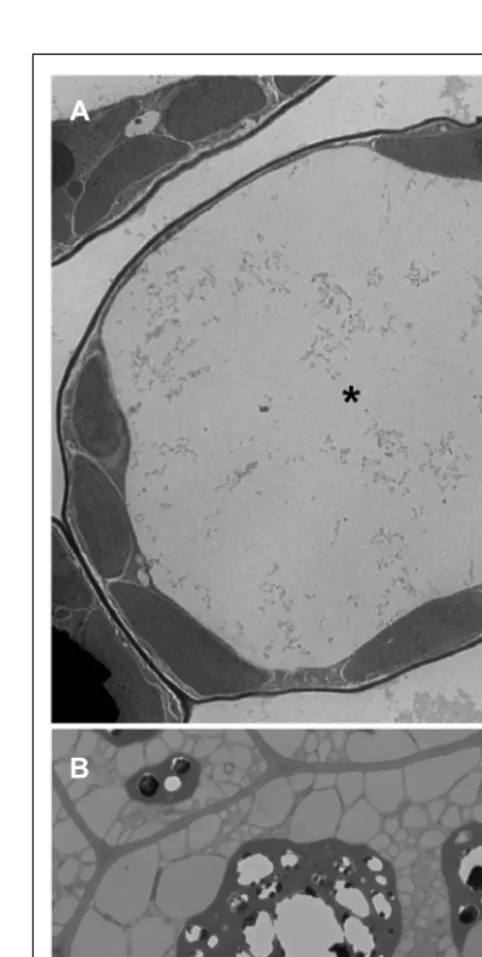
Figures 1A,B
). At the
subcellular level, what happens to the organelles during these
transitions?
Studying the cellular and subcellular changes that occur
dur-ing these developmental transitions is challengdur-ing.
Arabidopsis
thaliana
is the model organism of the plant community and has
been adopted for genetic, physiology, molecular, and
developmen-tal biology research (
Meyerowitz, 2001
;
Somerville and Koornneef,
2002
). Thus, it is beneficial and practical to relate these areas of
study to the cell biology of this plant. In
Arabidopsis
, however, it
is difficult to study the cellular changes that occur during
vege-tative and embryonic developmental programs on account of the
small seed size and technical challenges in isolating embryos from
maternal tissues at early stages of embryogenesis (
Girke et al., 2000
;
Xiang et al., 2011
;
Ibl and Stoger, 2012
).
Feeney et al. Vacuole conversions during developmental transitions
FIGURE 1 | Transmission electron microscope images ofArabidopsis leaf (A) and seed (B) cells. Asterisk shows the LV and arrows point to PSVs. Bars=2μm.
PSVs play an important role in supplying essential nutrients
for our dietary needs. Here we discuss how cellular
reprogram-ming can be used to learn more about LV to PSV transitions in
Arabidopsis
.
LYTIC VACUOLE STRUCTURE AND FUNCTION
The central LV is the largest and most instantly recognizable
organelle in a vegetative plant cell. It can account for up to 90% of
the total cell volume (
Jolliffe et al., 2005
). As such, the LV squeezes
the cytoplasm and other organelles between the tonoplast and
plasma membrane (
Figure 1A
). LVs are present in the cells of
young seedlings shortly after germination and generally exist in
all cells throughout vegetative growth (
Gattolin et al., 2009
;
Zheng
and Staehelin, 2011
).
The LV lumen contains water, numerous hydrolytic enzymes,
and is maintained at a pH of 5.5–6 (
Martinière et al., 2013
). The
tonoplast plays a major role in maintaining this luminal
environ-ment. The tonoplast is a selective membrane that contains a large
number of channel and transport proteins that mediate the
move-ment of organic and ionic substances between the cytoplasm and
vacuole (
Carter et al., 2004
;
Jaquinod et al., 2007
;
Müntz, 2007
).
To maintain an acidic luminal pH, vacuolar ATPase (V-ATPase)
and pyrophosphatase (V-PPase) catalyze ATP-dependent proton
transfer across the tonoplast. Their activity creates a proton
gra-dient and membrane potential which energizes secondary active
transport across the tonoplast (
Yang et al., 2007
;
Krebs et al., 2010
).
The movement of inorganic metabolites is mediated by specific
ion channels (
Voelker et al., 2006
) or transporters (
Brini et al.,
2007
), while organic substances are moved by ATP-binding
cas-sette (ABC) transporters (
Shi et al., 2007
;
Song et al., 2010
). The
movement of water across the tonoplast is facilitated by water
channels called aquaporins (
Maurel et al., 2008
). Within the
vac-uole lumen, numerous hydrolytic enzymes are present such as
proteases, glycosidases, lipases, nucleases, and peroxidases (
Carter
et al., 2004
).
PROTEIN STORAGE VACUOLE STRUCTURE AND FUNCTION
The PSV is a specialized organelle that is unique to flowering plants
(
Wang et al., 2012
). It is found predominantly in seeds and young
meristematic plant cells (
Olbrich et al., 2007
;
Gattolin et al., 2011
).
In shoot and root meristem cells, the existence of PSVs is thought
to be due to the persistence of seed-specific signals in the meristem
(
Olbrich et al., 2007
). Whereas LVs typically occupy most of the
cell space, PSVs are much smaller in size and range from 1.5 to
8
μ
m in diameter (
Gillespie et al., 2005
). PSVs are numerous and
are usually positioned close to the center of the cell (
Shimada et al.,
2008
;
Figure 1B
).
The PSV is a compartmentalized organelle (
Jiang et al., 2001
;
Bolte et al., 2011
;
Regvar et al., 2011
). Comparatively less is known
about the PSV tonoplast than the LV tonoplast (
Isayenkov et al.,
2010
) but they are known to share some similarity in their
com-position of proteins (
Hoh et al., 1995
;
Jiang et al., 2001
;
Isayenkov
et al., 2011
). The pH of the PSV lumen varies between 4.9 and
5.5 (
Otegui et al., 2006
). The defining feature of PSVs is their
ability to accumulate seed storage proteins (SSPs). In fact, the
appearance of PSVs in embryonic cells coincides with storage
reserve accumulation during the maturation phase of
embryogen-esis (
Mansfield and Briarty, 1992
). Lesser recognized roles of PSVs
are the storage of phosphorus and minerals (
Otegui et al., 2002
),
protective compounds such as lectins (
De Hoff et al., 2009
) and
chitinases (
Neuhaus et al., 1991
), and proteolytic enzymes (
Gruis
et al., 2004
). Like their LV counterparts, PSVs are also involved in
autophagy. PSVs of wheat and maize sequester SSPs from
endo-plasmic reticulum (ER)-derived protein bodies (
Levanony et al.,
1992
) or prevacuolar-like compartments (
Reyes et al., 2011
) by
autophagic mechanisms, respectively.
VACUOLE CONVERSION DURING EMBRYONIC AND
VEGETATIVE GROWTH AND DEVELOPMENT
MULTIPLE VACUOLES IN PLANT CELLSAs discussed, seed plants have two principal, functionally distinct
vacuole types, LVs and PSVs (
Becker, 2007
;
Ibl and Stoger, 2012
).
This has raised questions about whether the two vacuoles co-exist
in cells. To address this question, the two vacuole types must be
distinguished. LVs and PSVs can be differentiated by the presence
of tonoplast intrinsic protein (TIP) isoforms (
Jauh et al., 1999
;
Gattolin et al., 2010
). TIPs are aquaporins that are specifically
localized to tonoplasts (
Maurel et al., 2009
).
Arabidopsis
has 10
TIP isoforms and two of these are used to discriminate between
LVs and PSVs, TIP1;1 and TIP3;1, respectively (
Johanson et al.,
2001
;
Gattolin et al., 2010
). In addition, a small number of
sol-uble proteins have been shown to reside exclusively within the
lumen of each vacuole type and thus also serve as markers to
discriminate between both vacuole types. For example, the
cys-teine protease aleurain is targeted to the LV (
Ahmed et al., 2000
),
and phaseolin and 2S albumin, the major SSPs of common bean
and
Arabidopsis
, respectively, are targeted to PSVs (
Frigerio et al.,
1998
;
Miao et al., 2008
). LVs and PSVs were originally proposed to
co-exist in plant cells based on TIP and soluble protein
localiza-tion studies undertaken in the 1990s (
Paris et al., 1996
;
Park et al.,
2004
). This idea was attractive because it provided a convenient
explanation for the diverse sorting signals and routes that proteins
follow to arrive at the two vacuole types (
Vitale and Raikhel, 1999
;
Vitale and Hinz, 2005
;
Frigerio et al., 2008
;
Rojo and Denecke,
2008
). This theory was subsequently challenged as more insight
was gained by studying TIP expression patterns.
TIP3;1
and
TIP1;1
expression were discovered to be tissue- and development-specific
rather than organelle-specific (
Hunter et al., 2007
;
Olbrich et al.,
2007
). Recently, a detailed map of TIP expression patterns in
Arabidopsis
has been produced to better understand the
distribu-tion pattern of these vacuolar markers (
Gattolin et al., 2009
,
2010
,
2011
). However, some differences in TIP expression patterns have
been reported (
Bolte et al., 2011
). The current general view is that
most cells contain one vacuolar type. However, both vacuoles have
been shown to co-exist in some cells but their co-existence is
usu-ally short-lived (
Hoh et al., 1995
;
Frigerio et al., 2008
;
Zheng and
Staehelin, 2011
).
BIOGENESIS OF VACUOLES DURING DEVELOPMENTAL TRANSITIONS
LV to PSV transition
During
Arabidopsis
embryogenesis, a large LV forms in the
fertil-ized zygote. The zygote then divides to produce a vacuolated basal
cell (which will form the suspensor) and a non-vacuolated apical
cell (which will give rise to the embryo;
De Smet et al., 2010
). As
the embryo continues to divide, LVs develop in all cells (
Zouhar
and Rojo, 2009
). During the maturation phase of embryogenesis,
LVs are replaced by PSVs which will accumulate SSPs and mineral
reserves (
Mansfield and Briarty, 1991
).
PSV to LV transition
During germination, storage reserves are mobilized to provide
nutrients and energy for the growing embryo (
Pritchard et al.,
2002
;
Tan-Wilson and Wilson, 2012
). As protein and mineral
reserves are released, PSVs are replaced by LVs. The LV
sub-sequently increases in volume to create turgor and support cell
growth and expansion (
Mansfield and Briarty, 1996
). In
Arabidop-sis
, it takes approximately 3.5 d for the PSV to LV transition to occur
(
Hunter et al., 2007
). PSV to LV transitions are also observed in
root cells. PSVs are present in the radicle as it emerges from the
seed coat. As the root elongates, meristematic regions of the root
tip retain PSVs while PSVs transition to LVs in the distal regions of
elongating roots (
Olbrich et al., 2007
;
Gattolin et al., 2011
;
Zheng
and Staehelin, 2011
).
How do such morphologically distinct vacuoles replace each
other in the cell during vegetative and embryonic transitions? We
envisage two possible scenarios: either a new vacuolar type arises
by remodeling of the pre-existing vacuole, or a new vacuole is
formed
de novo
and very rapidly supersedes the existing one.
Vacuole remodeling
Feeney et al. Vacuole conversions during developmental transitions
of both TIP3;1 and TIP1;1 and storage proteins in the lumen.
The hybrid vacuole then gradually differentiates into a LV with
increasing amounts of TIP1;1 and decreasing amounts of TIP3;1
in the tonoplast. Similarly,
Zheng and Staehelin (2011)
observed
that PSVs in tobacco root tips were transformed into LVs. This
PSV to LV transition involves unique, highly tissue-specific
spa-tial and temporal changes in vacuole architecture. In addition,
within some cell types, the transformation was shown to involve
autophagosome formation and engulfment by the developing LV
(
Zheng and Staehelin, 2011
).
De novo vacuole formation
An alternative hypothesis to explain how different vacuole types
arise involves the independent generation of a vacuole within a
cell that already has a pre-existing vacuole. A key study to support
this theory was conducted by
Hoh et al. (1995)
who investigated
the formation of PSVs in pea cotyledons during seed
develop-ment. The authors observed the development of a tubular PSV
structure which overtook the pre-existing LV. A second example
backing this hypothesis is the demonstration that vacuoles can
be regenerated from evacuolated protoplasts (
Hörtensteiner et al.,
1992
;
Di Sansebastiano et al., 2001
). Using autophagy inhibitors,
an autophagy-like mechanism was demonstrated to be involved
in vacuole biogenesis of evacuolated tobacco protoplasts (
Yano
et al., 2007
). However, the mechanism is distinct from conserved
autophagy pathways (
Bassham, 2007
). Most recently,
Viotti et al.
(2013)
also demonstrated the formation of autophagosome-like
structures which give rise to LVs in
Arabidopsis
root tip cells
but showed that these structures were not formed by the core
autophagy machinery.
If the
de novo
theory holds true, then where does the
membrane for a new vacuole originate? If an autophagy-like
mechanism is involved in biogenesis, perhaps the tonoplast is
generated by a process similar to autophagosome formation (
Li
and Vierstra, 2012
). In autophagosome formation, the first step
is the formation of an isolation membrane which occurs in
the cytoplasm close to the vacuole. This process involves the
recruitment of several autophagy-related (ATG) proteins which
assemble in a coordinated manner to form a cup-shaped
mem-brane structure that elongates and eventually engulfs material to
be transported to the vacuole (
Mizushima, 2007
;
Nakatogawa
et al., 2009
). Mutants defective in vacuole formation have been
identified (
Zouhar and Rojo, 2009
). Most mutations affect factors
involved in membrane fusion. An essential gene involved in
vac-uole biogenesis has been identified as
VACUOLELESS1
(
VCL1
)
through a mutant screen (
Rojo et al., 2001
). Loss-of-function
vcl1
embryos were unable to form vacuoles. Mutants
accumu-lated large numbers of autophagosomes which were unable to
fuse to form the vacuole but instead would fuse with the plasma
membrane and deliver their vacuolar contents to the apoplasm.
Thus,
VCL1
is proposed to be involved in regulating the fusion of
autophagosomes to form a LV (
Zouhar and Rojo, 2009
).
Tono-plasts have also been proposed to originate from the ER or
the Golgi apparatus (
Marty, 1978
;
Robinson and Hinz, 1997
;
Staehelin, 1997
;
Neuhaus and Rogers, 1998
). Using mutants and
pharmacological inhibitors which affect the biosynthetic
secre-tory pathway,
Viotti et al. (2013)
demonstrated that tonoplast
proteins and lipids were derived from the ER and were
deliv-ered directly, via a Golgi-independent route, to form the LV
tonoplast.
REPROGRAMMING CELLS TO STUDY ORGANELLE
DYNAMICS: VACUOLES
As an alternative to studying PSV formation in developing seeds,
we asked if it was possible to induce the formation of PSVs in
vegetative cells. Cues prompting vegetative cells to switch to PSV
formation are not well understood. Despite the fact that SSPs
are the major storage reserves that accumulate in PSVs, their
forced synthesis in vegetative tissues has not been demonstrated to
promote PSV formation. Constitutive expression of phaseolin in
alfalfa vegetative tissues did not result in a significant
accumula-tion of the protein in cells of non-seed organs (
Bagga et al., 1992
).
Further, phaseolin was shown to accumulate and be degraded
in the LV and, in part, secreted upon overexpression in tobacco
(
Frigerio et al., 1998
). In transgenic
Arabidopsis
plants
overexpress-ing a chimeric 2S albumin gene, novel precursor-accumulatoverexpress-ing
(PAC)-like vesicles were induced to form in leaves (
Hayashi et al.,
1999
). Within a plant, PSVs are abundant in seed tissues and are
also observed in meristematic cells in vegetative tissues (
Olbrich
et al., 2007
). Thus it seems that for PSVs to exist, cells must be
programmed to be in an embryonic state.
Genetic research has uncovered a number of genes that
play critical roles in establishing or repressing embryonic cell
fate (
Braybrook and Harada, 2008
;
Zhang and Ogas, 2009
;
Jia et al., 2013b
). Several transcription factors such as
LEAFY
COTYLEDON1
(
LEC1
;
Lotan et al., 1998
),
LEC2
(
Stone et al.,
2001
),
FUSCA3
(
FUS3
;
Gazzarrini et al., 2004
),
BABYBOOM
(
BBM
;
Boutilier et al., 2002
),
WUSCHEL
(
WUS
;
Zuo et al.,
2002
),
EMBRYOMAKER
(
EMK
;
Tsuwamoto et al., 2010
), and
MYB118
(
Wang et al., 2009
) act during embryogenesis to
pro-mote seed developmental programs. In contrast, negative seed
regulators such as
PICKLE
(
PKL
;
Ogas et al., 1999
),
POLYCOMB
REPRESSIVE COMPLEX 2
(
PRC2
;
Bouyer et al., 2011
),
SET
DOMAIN GROUP 8
(
SDG8
;
Tang et al., 2012b
),
BRAHMA
(
BRM
;
Tang et al., 2008
),
VP1/ABSCISIC ACID INSENSITIVE 3-LIKE
(
VAL
) genes (
Suzuki et al., 2007
) and microRNA166 (miR166;
Tang et al., 2012a
) are responsible for suppressing the seed program
in vegetative tissues. Thus, overexpression or downregulation of
these positive and negative seed regulators, respectively, will induce
a seed-specific developmental program causing vegetative tissues
to exhibit embryonic characteristics. This scenario presents an
opportunity to study the cellular and subcellular changes that take
place during this developmental transition.
through the activities of a small number of transcriptional
regu-lators;
LEC1
,
LEC2
,
FUS3,
and
ABSCISIC ACID INSENSITIVE3
(
ABI3
;
Zhang and Ogas, 2009
). Genetic studies showed that
vegeta-tive tissues overexpressing these transcription factors would begin
to exhibit seed traits (
Gazzarrini et al., 2004
;
Kagaya et al., 2005
;
Stone et al., 2008
;
Junker et al., 2012
).
A wealth of genetic knowledge has been gathered on
LEC2
activities (
Stone et al., 2001
,
2008
;
Kroj et al., 2003
;
Santos Mendoza et al., 2005
;
Braybrook et al., 2006
;
To et al., 2006
;
Baud et al., 2007
). To learn more about the cellular changes that
occur during the vegetative to embryonic transition, a
dexametha-sone (DEX)-inducible
LEC2-GR
expression system was exploited
in
Arabidopsis
(
Feeney et al., 2013
). The overexpression of
LEC2
triggers massive cellular reorganization in leaves and causes these
vegetative organs to exhibit embryonic characteristics. Among the
many cellular and subcellular changes, the replacement of LVs with
PSV-like organelles was most notable. In these leaf cells, the large
LV is replaced by smaller and more numerous vacuoles that contain
SSP aggregates. Upon further investigation using immunogold
labeling with tonoplast and luminal markers, it was established
that the small vacuoles had the features of developing PSVs (
Feeney
et al., 2013
). Indeed, the presence of the PSV-specific TIP3;1
pro-tein on the tonoplast (
Gattolin et al., 2011
) and accumulation of
SSPs within the lumen of the small vacuoles indicates that the leaf
vacuoles assumed a storage role (
Jauh et al., 1999
;
Hunter et al.,
2007
;
Olbrich et al., 2007
). Furthermore, confocal analysis revealed
a unique embryo-like vacuolar morphology (
Figures 2B,E
). To
visualize the tonoplast of these developing leaf PSVs,
35S:LEC2-GR
plants co-expressing
TIP3;1-YFP
under its native promoter was
generated. The native
TIP3;1
promoter is developmentally
regu-lated and thus the
TIP3;1-YFP
fusion is specifically expressed in
seed tissues and accumulated on PSV tonoplasts (
Hunter et al.,
2007
). As DEX-induced plants overexpressing
LEC2
began to
acquire embryogenic characteristics (
Feeney et al., 2013
),
TIP3;1-YFP became detectable on the tonoplast of leaf cells, indicating that
vacuoles were PSVs (
Figures 2B,E
). Highly fluorescent
TIP3;1-YFP-labeled tonoplast folds and bulbs appeared (
Saito et al., 2002
,
2011
). These are characteristic vacuolar morphologies of young
cells (
Figure 2A
). However, the tonoplast also retained the
charac-teristic configuration of a large LV lining the periphery of the cell.
To highlight the vacuole lumen, tissues were stained with neutral
red and revealed that the lumen appears to occupy the entire leaf
cell (
Figure 2B
) unlike seed PSVs (
Figure 2C
). In addition,
vacuo-lar lumina began to exhibit autofluorescence (
Figure 2E
), which
was not observed in uninduced leaves (
Figure 2D
).
Autofluores-cent vacuole lumina are usually observed in seed PSVs (
Figure 2F
;
[image:6.842.47.549.365.629.2]Fuji et al., 2007
;
Hunter et al., 2007
;
Bolte et al., 2011
).
There-fore, leaf vacuole tonoplasts were extensively remodeled but their
lumina remained large and filled the entire cell (
Figures 2B,E
).
These results suggest that in response to DEX-inducible
LEC2
FIGURE 2 | Formation of PSV-like organelles in leaves overexpressing LEC2. Leaf epidermal cells from35S:LEC2-GR plants co-expressing TIP3;1:TIP3;1-YFP andTIP1;1:TIP1;1-RFP (LEC2/TIP3-YFP/TIP1-RFP; Feeney et al., 2013) incubated on DEX to induceLEC2 expression (B,E)
are compared toLEC2/TIP3-YFP/TIP1-RFP plants grown without DEX
(D)or leaves of seedlings constitutively expressing 35S:TIP3;1-YFP (A). Leaf cell morphology is compared with cotyledonary cells of
LEC2/TIP3-YFP/TIP1-RFP embryos (C,F). Note thatTIP1;1:TIP1;1-RFP is not expressed in seeds and is not detected on LV tonoplasts in older vegetative tissues (D;Feeney et al., 2013). Green color: TIP3;1-YFP. Vacuolar lumina are highlighted with neutral red (B,C). In bottom images
Feeney et al. Vacuole conversions during developmental transitions
overexpression, leaf LVs are replaced by PSV-like organelles that
bear a resemblance to both LVs and PSVs. Therefore, it appears
that as the
Arabidopsis
leaf LV is replaced by a PSV, the LV tonoplast
remodels before being replaced by smaller-sized PSVs (
Feeney
et al., 2013
). While these observations seem to point toward a
remodeling of existing LVs into PSVs, they do not rule out the
possibility of
de novo
biogenesis of PSVs, which may overlap with
LV remodeling. The next question that will need to be addressed is
therefore how exactly PSVs replace LVs during
LEC2
-induced leaf
cell reprogramming.
A CHALLENGE OF CELLULAR REPROGRAMMING: KNOW
YOUR GENETIC REGULATOR
A number of genetic factors have been revealed to promote cellular
reprogramming and some are highlighted above. To bring about
cellular changes, many of these factors are involved in complex
genetic, biochemical, and physiological interactions (
Gazzarrini
et al., 2004
;
Gutierrez et al., 2007
;
Le et al., 2010
;
Xiang et al., 2011
).
These factors may act in a hierarchical order (
Kagaya et al., 2005
;
To et al., 2006
) and may become active at slightly different
develop-mental times (
Le et al., 2010
;
Willmann et al., 2011
). Thus, while
many of the factors display a redundancy in promoting cellular
reprogramming, they may also display unique activities that affect
distinct cellular processes (
Baud et al., 2007
;
Jia et al., 2013a
). These
aspects should be taken into consideration when choosing a
repro-gramming system to study a particular cellular process. In the case
of vacuoles, several factors may cause vacuolar transitions in
veg-etative tissues. We have demonstrated that
LEC2
overexpression
causes LVs to transition to PSVs and results from overexpression
studies with
LEC1
(
Junker et al., 2012
) and
FUS3
(
Gazzarrini et al.,
2004
) are suggestive that these transcription factors can also bring
about a change in vacuole type.
CONCLUSION
Cellular reprogramming may be a useful means of allowing the
study of cellular processes that take place during the short
transi-tional period between two developmental programs. Several genes
have been discovered that control embryonic cell identity by
estab-lishing or repressing the seed developmental program (
Braybrook
and Harada, 2008
;
Zhang and Ogas, 2009
;
Jia et al., 2013b
). In
the example presented in this review, overexpression of
LEC2
was
used to activate the seed developmental program in
Arabidop-sis
leaves (
Santos Mendoza et al., 2005
;
Stone et al., 2008
). This
system could then be used to study the cellular and subcellular
changes that ensue during the vegetative to embryonic transition
(
Feeney et al., 2013
). The observation that LVs were replaced by
PSV-like organelles in leaves presents an opportunity to elucidate
the mechanism of LV to PSV transitions in
Arabidopsis
. Overall,
we foresee that the major advantage of cellular reprogramming in
vegetative tissues is to provide a convenient and complementary
system in which to study cellular processes that normally occur
during developmental transitions in developing seeds–tissues that
are technically challenging to work with.
ACKNOWLEDGMENTS
We thank J. J. Harada for his ideas and helpful discussions and J.
McNeil for reviewing the manuscript. This work was supported
by the A-base Funding Program of Agriculture and Agri-Food
Canada. Work in the Frigerio lab was funded by a grant from the
Leverhulme Trust (RPG-327).
REFERENCES
Ahmed, S. U., Rojo, E., Kovaleva, V., Venkataraman, S., Dombrowski, J. E., Matsuoka, K., et al. (2000). The plant vacuolar sorting receptor AtELP is involved in trans-port of NH2-terminal propeptide-containing vacuolar proteins inArabidopsis thaliana.J. Cell Biol.149, 1335–1344. doi: 10.1083/jcb.149.7.1335
Bagga, S., Sutton, D., Kemp, J., and Sengupta-Gopalan, C. (1992). Constitutive expression of theβ-phaseolin gene in different tissues of transgenic alfalfa does not ensure phaseolin accumulation in non-seed tissue.Plant Mol. Biol.19, 951–958. doi: 10.1007/BF00040527
Bassham, D. C., Laporte, M., Marty, F., Moriyasu, Y., Ohsumi, Y., Olsen, L. J., et al. (2006). Autophagy in development and stress responses of plants.Autophagy2, 2–11.
Bassham, D. C. (2007). Plant autophagy – more than a starvation response.Curr. Opin. Plant Biol.10, 587–593. doi: 10.1016/j.pbi.2007.06.006
Baud, S., Santos Mendoza, M., To, A., Harscoët, E., Lepiniec, L., and Dubreucq, B. (2007). WRINKLED1 specifies the regulatory action of LEAFY COTYLEDON2 towards fatty acid metabolism during seed maturation inArabidopsis.Plant J.50, 825–838. doi: 10.1111/j.1365-313X.2007.03092.x
Becker, B. (2007). Function and evolution of the vacuolar compartment in green algae and land plants (Viridiplantae). Int. Rev. Cytol.264, 1–24. doi: 10.1016/S0074-7696(07)64001-7
Beebo, A., Thomas, D., Der, C., Sanchez, L., Leborgne-Castel, N., Marty, F., et al. (2009). Life with and without AtTIP1;1, anArabidopsisaquaporin preferentially localized in the apposing tonoplasts of adjacent vacuoles.Plant Mol. Biol.70, 193–209. doi: 10.1007/s11103-009-9465-2
Bethke, P. C., Swanson, S. J., Hillmer, S., and Jones, R. L. (1998). From storage com-partment to lytic organelle: the metamorphosis of the aleurone protein storage vacuole.Ann. Bot.82, 399–412. doi: 10.1006/anbo.1998.0702
Bolte, S., Lanquar, V., Soler, M.-N., Beebo, A., Satiat-Jeunemaître, B., Bouhidel, K., et al. (2011). Distinct lytic vacuolar compartments are embedded inside the protein storage vacuole of dry and germinatingArabidopsis thalianaseeds.Plant Cell Physiol.52, 1142–1152. doi: 10.1093/pcp/pcr065
Boutilier, K., Offringa, R., Sharma, V. K., Kieft, H., Ouellet, T., Zhang, L., et al. (2002). Ectopic expression of BABY BOOM triggers a conversion from vegetative to embryonic growth.Plant Cell14, 1737–1749. doi: 10.1105/tpc.001941 Bouyer, D., Roudier, F., Heese, M., Andersen, E. D., Gey, D., Nowack, M. K., et al.
(2011). Polycomb repressive complex 2 controls the embryo-to-seedling phase transition.PLoS Genet.7:e1002014. doi: 10.1371/journal.pgen.1002014 Braybrook, S. A., and Harada, J. J. (2008). LECs go crazy in embryo development.
Trends Plant Sci.13, 624–630. doi: 10.1016/j.tplants.2008.09.008
Braybrook, S. A., Stone, S. L., Park, S., Bui, A. Q., Le, B. H., Fischer, R. L., et al. (2006). Genes directly regulated by LEAFY COTYLEDON2 provide insight into the control of embryo maturation and somatic embryogenesis.Proc. Natl. Acad. Sci. U.S.A.103, 3468–3473. doi: 10.1073/pnas.0511331103
Brini, F., Hanin, M., Mezghani, I., Berkowitz, G. A., and Masmoudi, K. (2007). Overexpression of wheat Na+/H+antiporter TNHX1 and H+-pyrophosphatase TVP1 improve salt- and drought-stress tolerance inArabidopsis thalianaplants.
J. Exp. Bot.58, 301–308. doi: 10.1093/jxb/erl251
Carter, C., Pan, S., Zouhar, J., Avila, E. L., Girke, T., and Raikhel, N. V. (2004). The vegetative vacuole proteome ofArabidopsis thalianareveals predicted and unexpected proteins.Plant Cell16, 3285–3303. doi: 10.1105/tpc.104.027078 De Hoff, P., Brill, L., and Hirsch, A. (2009). Plant lectins: the ties that bind
in root symbiosis and plant defense. Mol. Genet. Genomics282, 1–15. doi: 10.1007/s00438-009-0460-8
De Smet, I., Lau, S., Mayer, U., and Jürgens, G. (2010). Embryogenesis – the humble beginnings of plant life. Plant J.61, 959–970. doi: 10.1111/j.1365-313X.2010.04143.x
Di Sansebastiano, G. P., Paris, N., Marc-Martin, S., and Neuhaus, J.-M. (2001). Regeneration of a lytic central vacuole and of neutral peripheral vacuoles can be visualized by green fluorescent proteins targeted to either type of vacuoles.Plant Physiol.126, 78–86. doi: 10.1104/pp.126.1.78
Frigerio, L., De Virgilio, M., Prada, A., Faoro, F., and Vitale, A. (1998). Sorting of phaseolin to the vacuole is saturable and requires a short C-terminal peptide.
Plant Cell10, 1031–1042.
Frigerio, L., Hinz, G., and Robinson, D. G. (2008). Multiple vacuoles in plant cells: rule or exception?Traffic9, 1564–1570. doi: 10.1111/j.1600-0854.2008.00776.x Fuji, K., Shimada, T., Takahashi, H., Tamura, K., Koumoto, Y., Utsumi, S., et al.
(2007).Arabidopsisvacuolar sorting mutants (green fluorescent seed) can be identified efficiently by secretion of vacuole-targeted green fluorescent protein in their seeds.Plant Cell19, 597–609. doi: 10.1105/tpc.106.045997
Gattolin, S., Sorieul, M., and Frigerio, L. (2010). Tonoplast intrinsic proteins and vacuolar identity.Biochem. Soc. Trans.38, 769–773. doi: 10.1042/BST0380769 Gattolin, S., Sorieul, M., and Frigerio, L. (2011). Mapping of tonoplast intrinsic
proteins in maturing and germinatingArabidopsisseeds reveals dual localization of embryonic TIPs to the tonoplast and plasma membrane.Mol. Plant4, 180–189. doi: 10.1093/mp/ssq051
Gattolin, S., Sorieul, M., Hunter, P., Khonsari, R., and Frigerio, L. (2009). In vivo imaging of the tonoplast intrinsic protein family inArabidopsisroots.BMC Plant Biol.9:133. doi: 10.1186/1471-2229-9-133
Gazzarrini, S., Tsuchiya, Y., Lumba, S., Okamoto, M., and McCourt, P. (2004). The transcription factor FUSCA3 controls developmental timing inArabidopsis
through the hormones gibberellin and abscisic acid.Dev. Cell7, 373–385. doi: 10.1016/j.devcel.2004.06.017
Gillespie, J., Rogers, S. W., Deery, M., Dupree, P., and Rogers, J. C. (2005). A unique family of proteins associated with internalized membranes in protein storage vacuoles of the Brassicaceae.Plant J.41, 429–441. doi: 10.1111/j.1365-313X.2004.02303.x
Girke, T., Todd, J., Ruuska, S., White, J., Benning, C., and Ohlrogge, J. (2000). Microarray analysis of developingArabidopsisseeds.Plant Physiol.124, 1570– 1581. doi: 10.1104/pp.124.4.1570
Gruis, D., Schulze, J., and Jung, R. (2004). Storage protein accumulation in the absence of the vacuolar processing enzyme family of cysteine proteases.Plant Cell
16, 270–290. doi: 10.1105/tpc.016378
Gutierrez, L., Van Wuytswinkel, O., Castelain, M., and Bellini, C. (2007). Com-bined networks regulating seed maturation.Trends Plant Sci.12, 294–300. doi: 10.1016/j.tplants.2007.06.003
Hara-Nishimura, I., Shimada, T., Hatano, K., Takeuchi, Y., and Nishimura, M. (1998). Transport of storage proteins to protein storage vacuoles is mediated by large precursor-accumulating vesicles. Plant Cell 10, 825–836. doi:10.1105/tpc.10.5.825
Hayashi, M., Toriyama, K., Kondo, M., Hara-Nishimura, I., and Nishimura, M. (1999). Accumulation of a fusion protein containing 2S albumin induces novel vesicles in vegetative cells ofArabidopsis.Plant Cell Physiol.40, 263–272. doi: 10.1093/oxfordjournals.pcp.a029537
Hoh, B., Hinz, G., Jeong, B. K., and Robinson, D. G. (1995). Protein storage vacuoles form de novo during pea cotyledon development.J. Cell Sci.108, 299–310. Hörtensteiner, S., Martinoia, E., and Amrhein, N. (1992). Reappearance of
hydrolytic activities and tonoplast proteins in the regenerated vacuole of evacuolated protoplasts.Planta187, 113–121. doi: 10.1007/BF00201632 Hsieh, K., and Huang, A. H. C. (2004). Endoplasmic reticulum, oleosins,
and oils in seeds and tapetum cells. Plant Physiol. 136, 3427–3434. doi: 10.1104/pp.104.051060
Hunter, P. R., Craddock, C. P., Di Benedetto, S., Roberts, L. M., and Frigerio, L. (2007). Fluorescent reporter proteins for the tonoplast and the vacuolar lumen identify a single vacuolar compartment inArabidopsiscells.Plant Physiol.145, 1371–1382. doi: 10.1104/pp.107.103945
Ibl, V., and Stoger, E. (2012). The formation, function and fate of protein storage compartments in seeds. Protoplasma249, 379–392. doi: 10.1007/s00709-011-0288-z
Irani, N. G., and Russinova, E. (2009). Receptor endocytosis and signaling in plants.
Curr. Opin. Plant Biol.12, 653–659. doi: 10.1016/j.pbi.2009.09.011
Isayenkov, S., Isner, J. C., and Maathuis, F. J. M. (2010). Vacuolar ion chan-nels: roles in plant nutrition and signalling.FEBS Lett. 584, 1982–1988. doi: 10.1016/j.febslet.2010.02.050
Isayenkov, S., Isner, J.-C., and Maathuis, F. J. M. (2011). Rice two-pore K+ chan-nels are expressed in different types of vacuoles.Plant Cell23, 756–768. doi: 10.1105/tpc.110.081463
Jaquinod, M., Villiers, F., Kieffer-Jaquinod, S., Hugouvieux, V., Bruley, C., Garin, J., et al. (2007). A proteomics dissection ofArabidopsis thalianavacuoles isolated
from cell culture.Mol. Cell. Proteomics6, 394–412. doi: 10.1074/mcp.M600250-MCP200
Jauh, G.-Y., Phillips, T. E., and Rogers, J. C. (1999). Tonoplast intrinsic pro-tein isoforms as markers for vacuolar functions.Plant Cell11, 1867–1882. doi: 10.1105/tpc.11.10.1867
Jia, H., McCarty, D. R., and Suzuki, M. (2013a). Distinct roles of LAFL network genes in promoting the embryonic seedling fate in the absence of VAL repression.
Plant Physiol.163, 1293–1305. doi: 10.1104/pp.113.220988
Jia, H., Suzuki, M., and McCarty, D. R. (2013b). Regulation of the seed to seedling developmental phase transition by the LAFL and VAL transcription factor networks.Wiley Interdiscip. Rev. Dev. Biol.doi: 10.1002/wdev.126
Jiang, L., Phillips, T. E., Hamm, C. A., Drozdowicz, Y. M., Rea, P. A., Maeshima, M., et al. (2001). The protein storage vacuole: a unique compound organelle.J. Cell Biol.155, 991–1002. doi: 10.1083/jcb.200107012
Johanson, U., Karlsson, M., Johansson, I., Gustavsson, S., Sjövall, S., Fraysse, L., et al. (2001). The complete set of genes encoding major intrinsic proteins in
Arabidopsisprovides a framework for a new nomenclature for major intrinsic proteins in plants.Plant Physiol.126, 1358–1369. doi: 10.1104/pp.126.4.1358 Jolliffe, N. A., Craddock, C. P., and Frigerio, L. (2005). Pathways for protein
transport to seed storage vacuoles. Biochem. Soc. Trans.33, 1016–1018. doi: 10.1042/BST20051016
Junker, A., Mönke, G., Rutten, T., Keilwagen, J., Seifert, M., Thi, T. M. N., et al. (2012). Elongation-related functions of LEAFY COTYLEDON1 dur-ing the development of Arabidopsis thaliana. Plant J. 71, 427–442. doi: 10.1111/j.1365-313X.2012.04999.x
Kagaya, Y., Toyoshima, R., Okuda, R., Usui, H., Yamamoto, A., and Hattori, T. (2005). LEAFY COTYLEDON1 controls seed storage protein genes through its regulation of FUSCA3 and ABSCISIC ACID INSENSITIVE3.Plant Cell Physiol.
46, 399–406. doi: 10.1093/pcp/pci048
Kawakatsu, T., Hirose, S., Yasuda, H., and Takaiwa, F. (2010). Reducing rice seed storage protein accumulation leads to changes in nutrient quality and storage organelle formation.Plant Physiol.154, 1842–1854. doi: 10.1104/pp.110.164343 Krebs, M., Beyhl, D., Görlich, E., Al-Rasheid, K. A. S., Marten, I., Stierhof, Y.-D.,
et al. (2010).ArabidopsisV-ATPase activity at the tonoplast is required for efficient nutrient storage but not for sodium accumulation.Proc. Natl. Acad. Sci. U.S.A.
107, 3251–3256. doi: 10.1073/pnas.0913035107
Kroj, T., Savino, G., Valon, C., Giraudat, J., and Parcy, F. (2003). Regulation of storage protein gene expression inArabidopsis.Development 130, 6065–6073. doi: 10.1242/dev.00814
Le, B. H., Cheng, C., Bui, A. Q., Wagmaister, J. A., Henry, K. F., Pelletier, J., et al. (2010). Global analysis of gene activity duringArabidopsisseed development and identification of seed-specific transcription factors.Proc. Natl. Acad. Sci. U.S.A.
107, 8063–8070. doi: 10.1073/pnas.1003530107
Levanony, H., Rubin, R., Altschuler, Y., and Galili, G. (1992). Evidence for a novel route of wheat storage proteins to vacuoles.J. Cell Biol.119, 1117–1128. doi: 10.1083/jcb.119.5.1117
Li, F., and Vierstra, R. D. (2012). Autophagy: a multifaceted intracellular sys-tem for bulk and selective recycling. Trends Plant Sci. 17, 526–537. doi: 10.1016/j.tplants.2012.05.006
Liu, Y., Burgos, J. S., Deng, Y., Srivastava, R., Howell, S. H., and Bassham, D. C. (2012). Degradation of the endoplasmic reticulum by autophagy dur-ing endoplasmic reticulum stress inArabidopsis.Plant Cell24, 4635–4651. doi: 10.1105/tpc.112.101535
Lotan, T., Ohto, M.-a., Yee, K. M., West, M. A. L., Lo, R., Kwong, R. W., et al. (1998).
ArabidopsisLEAFY COTYLEDON1 is sufficient to induce embryo development in vegetative cells.Cell93, 1195–1205. doi: 10.1016/S0092-8674(00)81463-4 Mansfield, S. G., and Briarty, L. G. (1991). Early embryogenesis inArabidopsis
thaliana. II. The developing embryo.Can. J. Bot.69, 461–476. doi: 10.1139/b91-063
Mansfield, S. G., and Briarty, L. G. (1992). Cotyledon cell development inArabidopsis thalianaduring reserve deposition.Can. J. Bot.70, 151–164. doi: 10.1139/b92-021 Mansfield, S. G., and Briarty, L. G. (1996). The dynamics of seedling and cotyledon cell development inArabidopsis thalianaduring reserve mobilization.Int. J. Plant Sci.157, 280–295. doi: 10.1086/297347
Martinière, A., Bassil, E., Jublanc, E., Alcon, C., Reguera, M., Sentenac, H., et al. (2013). In vivo intracellular pH measurements in tobacco and Arabidop-sisreveal an unexpected pH gradient in the endomembrane system.Plant Cell
Feeney et al. Vacuole conversions during developmental transitions
Marty, F. (1978). Cytochemical studies on GERL, provacuoles, and vacuoles in root meristematic cells of Euphorbia.Proc. Natl. Acad. Sci. U.S.A.75, 852–856. doi: 10.1073/pnas.75.2.852
Marty, F. (1999). Plant vacuoles.Plant Cell11, 587–599. doi: 10.1105/tpc.11.4.587 Maurel, C., Santoni, V., Luu, D.-T., Wudick, M. M., and Verdoucq, L. (2009). The
cellular dynamics of plant aquaporin expression and functions.Curr. Opin. Plant Biol.12, 690–698. doi: 10.1016/j.pbi.2009.09.002
Maurel, C., Verdoucq, L., Luu, D.-T., and Santoni, V. (2008). Plant aquaporins: membrane channels with multiple integrated functions.Annu. Rev. Plant Biol.
59, 595–624. doi: 10.1146/annurev.arplant.59.032607.092734
Meyerowitz, E. M. (2001). Prehistory and history ofArabidopsisresearch.Plant Physiol.125, 15–19. doi: 10.1104/pp.125.1.15
Miao, Y., Li, K. Y., Li, H.-Y., Yao, X., and Jiang, L. (2008). The vacuolar transport of aleurain-GFP and 2S albumin-GFP fusions is mediated by the same pre-vacuolar compartments in tobacco BY-2 andArabidopsissuspension cultured cells.Plant J.56, 824–839. doi: 10.1111/j.1365-313X.2008.03645.x
Mizushima, N. (2007). Autophagy: process and function.Genes Dev.21, 2861–2873. doi: 10.1101/gad.1599207
Müntz, K. (2007). Protein dynamics and proteolysis in plant vacuoles.J. Exp. Biol.
58, 2391–2407. doi: 10.1093/jxb/erm089
Nakatogawa, H., Suzuki, K., Kamada, Y., and Ohsumi, Y. (2009). Dynamics and diversity in autophagy mechanisms: lessons from yeast.Nat. Rev. Mol. Cell Biol.
10, 458–467. doi: 10.1038/nrm2708
Neuhaus, J.-M., and Rogers, J. C. (1998). Sorting of proteins to vacuoles in plant cells.Plant Mol. Biol.38, 127–144. doi: 10.1023/A:1006032627036
Neuhaus, J.-M., Sticher, L., Meins, F., and Boller, T. (1991). A short C-terminal sequence is necessary and sufficient for the targeting of chitinases to the plant vacuole. Proc. Natl. Acad. Sci. U.S.A.88, 10362–10366. doi: 10.1073/pnas.88.22.10362
Ogas, J., Kaufmann, S., Henderson, J., and Somerville, C. (1999). PICKLE is a CHD3 chromatin-remodeling factor that regulates the transition from embryonic to vegetative development inArabidopsis.Proc. Natl. Acad. Sci. U.S.A.96, 13839– 13844. doi: 10.1073/pnas.96.24.13839
Olbrich, A., Hillmer, S., Hinz, G., Oliviusson, P., and Robinson, D. G. (2007). Newly formed vacuoles in root meristems of barley and pea seedlings have characteristics of both protein storage and lytic vacuoles.Plant Physiol.145, 1383–1394. doi: 10.1104/pp.107.108985
Otegui, M. S., Capp, R., and Staehelin, L. A. (2002). Developing seeds ofArabidopsis
store different minerals in two types of vacuoles and in the endoplasmic reticulum.
Plant Cell14, 1311–1327. doi: 10.1105/tpc.010486
Otegui, M. S., Herder, R., Schulze, J., Jung, R., and Staehelin, L. A. (2006). The proteolytic processing of seed storage proteins inArabidopsisembryo cells starts in the multivesicular bodies.Plant Cell18, 2567–2581. doi: 10.1105/tpc.106.040931 Otegui, M. S., and Spitzer, C. (2008). Endosomal functions in plants.Traffic9,
1589–1598. doi: 10.1111/j.1600-0854.2008.00787.x
Paris, N., Stanley, C. M., Jones, R. L., and Rogers, J. C. (1996). Plant cells con-tain two functionally distinct vacuolar compartments. Cell85, 563–572. doi: 10.1016/S0092-8674(00)81256-8
Park, M., Kim, S. J., Vitale, A., and Hwang, I. (2004). Identification of the protein storage vacuole and protein targeting to the vacuole in leaf cells of three plant species.Plant Physiol.134, 625–639. doi: 10.1104/pp.103.030635
Pritchard, S. L., Charlton, W. L., Baker, A., and Graham, I. A. (2002). Germination and storage reserve mobilization are regulated independently inArabidopsis.Plant J.31, 639–647. doi: 10.1046/j.1365-313X.2002.01376.x
Regvar, M., Eichert, D., Kaulich, B., Gianoncelli, A., Pongrac, P., Vogel-Mikuš, K., et al. (2011). New insights into globoids of protein storage vacuoles in wheat aleurone using synchrotron soft X-ray microscopy.J. Exp. Bot.62, 3929–3939. doi: 10.1093/jxb/err090
Reuveni, M., Evenor, D., Artzi, B., Perl, A., and Erner, Y. (2001). Decrease in vacuolar pH during petunia flower opening is reflected in the activity of tonoplast H+-ATPase.J. Plant Physiol.158, 991–998. doi: 10.1078/0176-1617-00302
Reyes, F. C., Chung, T., Holding, D., Jung, R., Vierstra, R., and Otegui, M. S. (2011). Delivery of prolamins to the protein storage vacuole in maize aleurone cells.Plant Cell23, 769–784. doi: 10.1105/tpc.110.082156
Richter, S., Voß, U., and Jürgens, G. (2009). Post-Golgi traf-fic in plants. Traffic 10, 819–828. doi: 10.1111/j.1600-0854.2009. 00916.x
Riechers, D. E., Kreuz, K., and Zhang, Q. (2010). Detoxification without intoxica-tion: herbicide safeners activate plant defense gene expression.Plant Physiol.153, 3–13. doi: 10.1104/pp.110.153601
Robinson, D. G., and Hinz, G. (1997). Vacuole biogenesis and protein transport to the plant vacuole: a comparison with the yeast vacuole and the mammalian lysosome.Protoplasma197, 1–25. doi: 10.1007/BF01279880
Robinson, D. G., Oliviusson, P., and Hinz, G. (2005). Protein sorting to the storage vacuoles of plants: a critical appraisal.Traffic6, 615–625. doi: 10.1111/j.1600-0854.2005.00303.x
Rojo, E., and Denecke, J. (2008). What is moving in the secretory pathway of plants?
Plant Physiol.147, 1493–1503. doi: 10.1104/pp.108.124552
Rojo, E., Gillmor, C. S., Kovaleva, V., Somerville, C. R., and Raikhel, N. V. (2001). VACUOLELESS1 is an essential gene required for vacuole formation and morpho-genesis inArabidopsis.Dev. Cell1, 303–310. doi: 10.1016/S1534-5807(01)00024-7 Saito, C., Ueda, T., Abe, H., Wada, Y., Kuroiwa, T., Hisada, A., et al. (2002). A complex and mobile structure forms a distinct subregion within the continuous vacuolar membrane in young cotyledons ofArabidopsis.Plant J.29, 245–255. doi: 10.1046/j.0960-7412.2001.01189.x
Saito, C., Uemura, T., Awai, C., Tominaga, M., Ebine, K., Ito, J., et al. (2011). The occurrence of ‘bulbs’, a complex configuration of the vacuolar membrane, is affected by mutations of vacuolar SNARE and phospholipase inArabidopsis.
Plant J.68, 64–73. doi: 10.1111/j.1365-313X.2011.04665.x
Santos-Mendoza, M., Dubreucq, B., Baud, S., Parcy, F., Caboche, M., and Lepiniec, L. (2008). Deciphering gene regulatory networks that control seed development and maturation inArabidopsis. Plant J.54, 608–620. doi: 10.1111/j.1365-313X.2008.03461.x
Santos Mendoza, M., Dubreucq, B., Miquel, M., Caboche, M., and Lepiniec, L. (2005). LEAFY COTYLEDON2 activation is sufficient to trigger the accumulation of oil and seed specific mRNAs inArabidopsisleaves.FEBS Lett.579, 4666–4670. doi: 10.1016/j.febslet.2005.07.037
Scarafoni, A., Carzaniga, R., Harris, N., and Croy, R. D. (2001). Manipulation of the napin primary structure alters its packaging and deposition in trans-genic tobacco (Nicotiana tabacumL.) seeds.Plant Mol. Biol.46, 727–739. doi: 10.1023/A:1011675918805
Shi, J., Wang, H., Schellin, K., Li, B., Faller, M., Stoop, J. M., et al. (2007). Embryo-specific silencing of a transporter reduces phytic acid content of maize and soybean seeds.Nat. Biotechnol.25, 930–937. doi: 10.1038/nbt1322
Shimada, T. L., Shimada, T., Takahashi, H., Fukao, Y., and Hara-Nishimura, I. (2008). A novel role for oleosins in freezing tolerance of oilseeds inArabidopsis thaliana.Plant J.55, 798–809. doi: 10.1111/j.1365-313X.2008.03553.x Somerville, C., and Koornneef, M. (2002). A fortunate choice: the history of
Arabidopsisas a model plant.Nat. Rev. Genet.3, 883–889. doi: 10.1038/nrg927 Song, W.-Y., Park, J., Mendoza-Cózatl, D. G., Suter-Grotemeyer, M., Shim, D.,
Hörtensteiner, S., et al. (2010). Arsenic tolerance inArabidopsisis mediated by two ABCC-type phytochelatin transporters.Proc. Natl. Acad. Sci. U.S.A.107, 21187–21192. doi: 10.1073/pnas.1013964107
Staehelin, L. A. (1997). The plant ER: a dynamic organelle composed of a large number of discrete functional domains. Plant J. 11, 1151–1165. doi: 10.1046/j.1365-313X.1997.11061151.x
Stone, S. L., Braybrook, S. A., Paula, S. L., Kwong, L. W., Meuser, J., Pelletier, J., et al. (2008).ArabidopsisLEAFY COTYLEDON2 induces maturation traits and auxin activity: implications for somatic embryogenesis.Proc. Natl. Acad. Sci. U.S.A.
105, 3151–3156. doi: 10.1073/pnas.0712364105
Stone, S. L., Kwong, L. W., Yee, K. M., Pelletier, J., Lepiniec, L., Fischer, R. L., et al. (2001). LEAFY COTYLEDON2 encodes a B3 domain transcription factor that induces embryo development.Proc. Natl. Acad. Sci. U.S.A.98, 11806–11811. doi: 10.1073/pnas.201413498
Suzuki, M., Wang, H. H. Y., and McCarty, D. R. (2007). Repression of the LEAFY COTYLEDON 1/B3 regulatory network in plant embryo development by VP1/ABSCISIC ACID INSENSITIVE 3-LIKE B3 genes.Plant Physiol.143, 902–911. doi: 10.1104/pp.106.092320
Tang, X., Bian, S., Tang, M., Lu, Q., Li, S., Liu, X., et al. (2012a). MicroRNA–mediated repression of the seed maturation program during vegetative development in
Arabidopsis.PLoS Genet.8:e1003091. doi: 10.1371/journal.pgen.1003091 Tang, X., Lim, M.-H., Pelletier, J., Tang, M., Nguyen, V., Keller, W. A., et al. (2012b).
Tang, X., Hou, A., Babu, M., Nguyen, V., Hurtado, L., Lu, Q., et al. (2008). TheArabidopsisBRAHMA chromatin-remodeling ATPase is involved in repres-sion of seed maturation genes in leaves. Plant Physiol.147, 1143–1157. doi: 10.1104/pp.108.121996
Tan-Wilson, A. L., and Wilson, K. A. (2012). Mobilization of seed protein reserves.
Physiol. Plant.145, 140–153. doi: 10.1111/j.1399-3054.2011.01535.x
To, A., Valon, C., Savino, G., Guilleminot, J., Devic, M., Giraudat, J., et al. (2006). A network of local and redundant gene regulation governsArabidopsis seed maturation.Plant Cell18, 1642–1651. doi: 10.1105/tpc.105.039925
Tsuwamoto, R., Yokoi, S., and Takahata, Y. (2010).ArabidopsisEMBRYOMAKER encoding an AP2 domain transcription factor plays a key role in developmental change from vegetative to embryonic phase.Plant Mol. Biol.73, 481–492. doi: 10.1007/s11103-010-9634-3
Varshney, R. K., Ribaut, J.-M., Buckler, E. S., Tuberosa, R., Rafalski, J. A., and Langridge, P. (2012). Can genomics boost productivity of orphan crops?Nat. Biotechnol.30, 1172–1176. doi: 10.1038/nbt.2440
Viotti, C., Krüger, F., Krebs, M., Neubert, C., Fink, F., Lupanga, U., et al. (2013). The endoplasmic reticulum is the main membrane source for biogenesis of the lytic vacuole inArabidopsis.Plant Cell25, 3434–3449. doi: 10.1105/tpc.113.114827 Vitale, A., and Hinz, G. (2005). Sorting of proteins to storage vacuoles: how many
mechanisms?Trends Plant Sci.10, 316–323. doi: 10.1016/j.tplants.2005.05.001 Vitale, A., and Raikhel, N. V. (1999). What do proteins need to reach different
vacuoles?Trends Plant Sci.4, 149–155. doi: 10.1016/S1360-1385(99)01389-8 Voelker, C., Schmidt, D., Mueller-Roeber, B., and Czempinski, K. (2006). Members
of theArabidopsisAtTPK/KCO family form homomeric vacuolar channels in planta.Plant J.48, 296–306. doi: 10.1111/j.1365-313X.2006.02868.x
Wang, J., Tse, Y. C., Hinz, G., Robinson, D. G., and Jiang, L. (2012). Storage globulins pass through the Golgi apparatus and multivesicular bodies in the absence of dense vesicle formation during early stages of cotyledon development in mung bean.J. Exp. Bot.63, 1367–1380. doi: 10.1093/jxb/err366
Wang, X., Niu, Q.-W., Teng, C., Li, C., Mu, J., Chua, N.-H., et al. (2009). Over-expression of PGA37/MYB118 and MYB115 promotes vegetative-to-embryonic transition inArabidopsis.Cell Res.19, 224–235. doi: 10.1038/cr.2008.276 Wang, Y., Yu, B., Zhao, J., Guo, J., Li, Y., Han, S., et al. (2013). Autophagy contributes
to leaf starch degradation.Plant Cell25, 1383–1399. doi: 10.1105/tpc.112.108993 Willmann, M. R., Mehalick, A. J., Packer, R. L., and Jenik, P. D. (2011). MicroRNAs regulate the timing of embryo maturation inArabidopsis. Plant Physiol.155, 1871–1884. doi: 10.1104/pp.110.171355
Xiang, D., Venglat, P., Tibiche, C., Yang, H., Risseeuw, E., Cao, Y., et al. (2011). Genome-wide analysis reveals gene expression and metabolic network dynamics during embryo development inArabidopsis.Plant Physiol.156, 346–356. doi: 10.1104/pp.110.171702
Yang, H., Knapp, J., Koirala, P., Rajagopal, D., Peer, W. A., Silbart, L. K., et al. (2007). Enhanced phosphorus nutrition in monocots and dicots over-expressing a phosphorus-responsive type I H+-pyrophosphatase.Plant Biotechnol. J.5, 735– 745. doi: 10.1111/j.1467-7652.2007.00281.x
Yano, K., Hattori, M., and Moriyasu, Y. (2007). A novel type of autophagy occurs together with vacuole genesis in miniprotoplasts prepared from tobacco culture cells.Autophagy3, 215–221.
Zhang, H., and Ogas, J. (2009). An epigenetic perspective on developmental regulation of seed genes.Mol. Plant2, 610–627. doi: 10.1093/mp/ssp027 Zhang, H., Wang, L., Deroles, S., Bennett, R., and Davies, K. (2006). New insight
into the structures and formation of anthocyanic vacuolar inclusions in flower petals.BMC Plant Biol.6:29. doi: 10.1186/1471-2229-6-29
Zhao, J., and Dixon, R. A. (2010). The ‘ins’ and ‘outs’ of flavonoid transport.Trends Plant Sci.15, 72–80. doi: 10.1016/j.tplants.2009.11.006
Zheng, H., and Staehelin, L. A. (2011). Protein storage vacuoles are trans-formed into lytic vacuoles in root meristematic cells of germinating seedlings by multiple, cell type-specific mechanisms.Plant Physiol.155, 2023–2035. doi: 10.1104/pp.110.170159
Zouhar, J., and Rojo, E. (2009). Plant vacuoles: where did they come from and where are they heading? Curr. Opin. Plant Biol. 12, 677–684. doi: 10.1016/j.pbi.2009.08.004
Zuo, J., Niu, Q.-W., Frugis, G., and Chua, N.-H. (2002). TheWUSCHELgene promotes vegetative-to-embryonic transition inArabidopsis.Plant J.30, 349–359. doi: 10.1046/j.1365-313X.2002.01289.x
Conflict of Interest Statement:The authors declare that the research was conducted in the absence of any commercial or financial relationships that could be construed as a potential conflict of interest.
Received: 28 September 2013; paper pending published: 21 October 2013; accepted: 15 November 2013; published online: 03 December 2013.
Citation: Feeney M, Frigerio L, Kohalmi SE, Cui Y and Menassa R (2013) Repro-gramming cells to study vacuolar development. Front. Plant Sci. 4:493. doi: 10.3389/fpls.2013.00493
This article was submitted to Plant Cell Biology, a section of the journal Frontiers in Plant Science.